Duolingo taught you words. No one taught you to speak.
PracticeMe: real voice conversations with an AI tutor, 24/7.
How to Become Fluent in English: A Realistic Guide

Wondering how to become fluent in English? You already know more than you think. If you're reading this, you've proven it.
The real question isn't whether you can learn English — it's how to become fluent in English by closing the gap between understanding it and speaking it with confidence. That gap has a name: fluency. And closing it is more achievable than you've been told.
Quick Summary: Fluency isn't perfection — it's communicating naturally and confidently. Most learners reach conversational fluency (CEFR B2) in 6–12 months of daily practice, requiring roughly 500–600 hours. The 8 strategies below — from shadowing native speakers to speaking with AI tutors daily — help you become fluent in English faster than traditional methods.
What Does It Really Mean to Become Fluent in English?
Here's the most liberating thing you'll read today: fluency doesn't mean speaking perfect English.
Being fluent means you can hold a conversation without constantly stopping to search for words. You express your thoughts naturally, understand most of what people say, and handle unexpected questions without freezing. It's a skill you develop through practice — not a talent you're born with.
In language learning terms, this maps to B2 on the CEFR scale — the Common European Framework of Reference for Languages. At B2 level, you can:
- Discuss complex topics and share your opinion clearly
- Follow conversations between native speakers at natural speed
- Handle most work, travel, and social situations confidently
- Speak spontaneously without major pauses
Notice what's not on that list: sounding like a native speaker, having zero accent, or knowing every word. Plenty of native English speakers stumble over grammar and forget vocabulary mid-sentence — nobody questions their fluency.
Your goal isn't perfection. It's confident, natural communication.
How Long Does It Take to Become Fluent in English?
Let's talk real numbers instead of empty promises.
According to Cambridge English, it takes approximately 200 guided learning hours per CEFR level. Going from beginner (A1) to conversational fluency (B2) requires roughly 500–600 hours of focused study and speaking practice.
In real life, the timeline depends entirely on how much time you practice daily:
| Daily Practice | Time to B2 Fluency |
|---|---|
| 30 minutes/day | ~3 years |
| 1 hour/day | ~1.5 years |
| 2 hours/day | ~9 months |
| 3+ hours/day | ~6 months |
Two things stand out. First, anyone who promises you can speak English fluently in 30 days is selling something — that's not how language learning works. Second, consistency matters more than intensity. Thirty minutes every day builds stronger skills than a 5-hour weekend cram session because your brain needs repeated exposure.
If you can read this article, you're likely already between A2 and B1. That cuts your remaining time to fluency significantly.
8 Strategies That Help You Become Fluent in English
These English fluency tips are backed by research and used by learners who've made the leap to confident, natural speaking.
1. Immerse Yourself in English Media
You don't need to move abroad. You can create an English immersion environment from wherever you are.
Start here:
- Switch your phone and social media to English. Every notification forces passive exposure all day.
- Watch shows with English subtitles. English subtitles help connect what you hear with how words are spelled, improving both listening and reading skills.
- Read English articles, books, and news daily. Start with topics you enjoy — it builds vocabulary naturally and keeps you engaged.
- Listen to English podcasts during commutes. Your brain absorbs rhythm, intonation, and new vocabulary even when you're only half-listening.
According to Oxford University Press, extensive reading and listening are among the most effective ways to expand vocabulary. Surround yourself with English consistently and your brain starts treating the language as normal rather than foreign.
2. Speak Every Day — Even 10 Minutes Helps
Understanding English and speaking English use different skills. You can watch English shows all day and still freeze when someone asks you a question — because comprehension and production activate different parts of your brain.
Speaking is physical. Your mouth, tongue, and vocal cords need muscle memory for English sounds — and that only comes through daily practice.
No conversation partner? Talk to yourself. Narrate your actions: "I'm making coffee. I need to leave in 20 minutes." You're building English sentences in real time without the pressure of an audience. Even 10 minutes of speaking practice daily will help you improve faster than a weekly class.
3. Start Thinking in English
If you mentally translate every sentence from your native language before speaking, you'll always sound hesitant. That translation step creates the awkward pauses.
Train yourself to think directly in English:
- Start with simple thoughts: "I'm hungry" — no translation needed
- Describe what you see around you in English throughout the day
- When you learn a new word, picture the thing itself — skip the native language translation
Once this shift clicks, your speaking speed jumps dramatically. You've removed the middleman between thought and speech — a critical step in how to become fluent in English.
4. Use AI Tutors for Unlimited Speaking Practice
The biggest barrier to becoming fluent in English? You need to speak more, but there's nobody to speak with. Human tutors are expensive, scheduling is inflexible, and practicing with friends feels awkward or stressful.
AI-powered speaking practice solves this. With Practice Me, you have real voice conversations with AI tutors 24/7 — no scheduling, no judgment, unlimited time to practice.
What makes this different from a text chatbot:
- You speak out loud in a phone call-like experience, building crucial speaking muscle memory
- Tutors like Sarah, Oliver, and Marcus adapt to your level and help you improve naturally
- American and British accent options train your ear for different native pronunciation styles
- New vocabulary is automatically saved — read back and review everything you've learned
A human tutor gives you 1–2 hours of speaking practice per week. With unlimited AI conversations, you can practice every single day. That difference in volume is what accelerates the journey to English fluency.
Duolingo taught you words. No one taught you to speak.
PracticeMe: real voice conversations with an AI tutor, 24/7.
5. Shadow Native Speakers
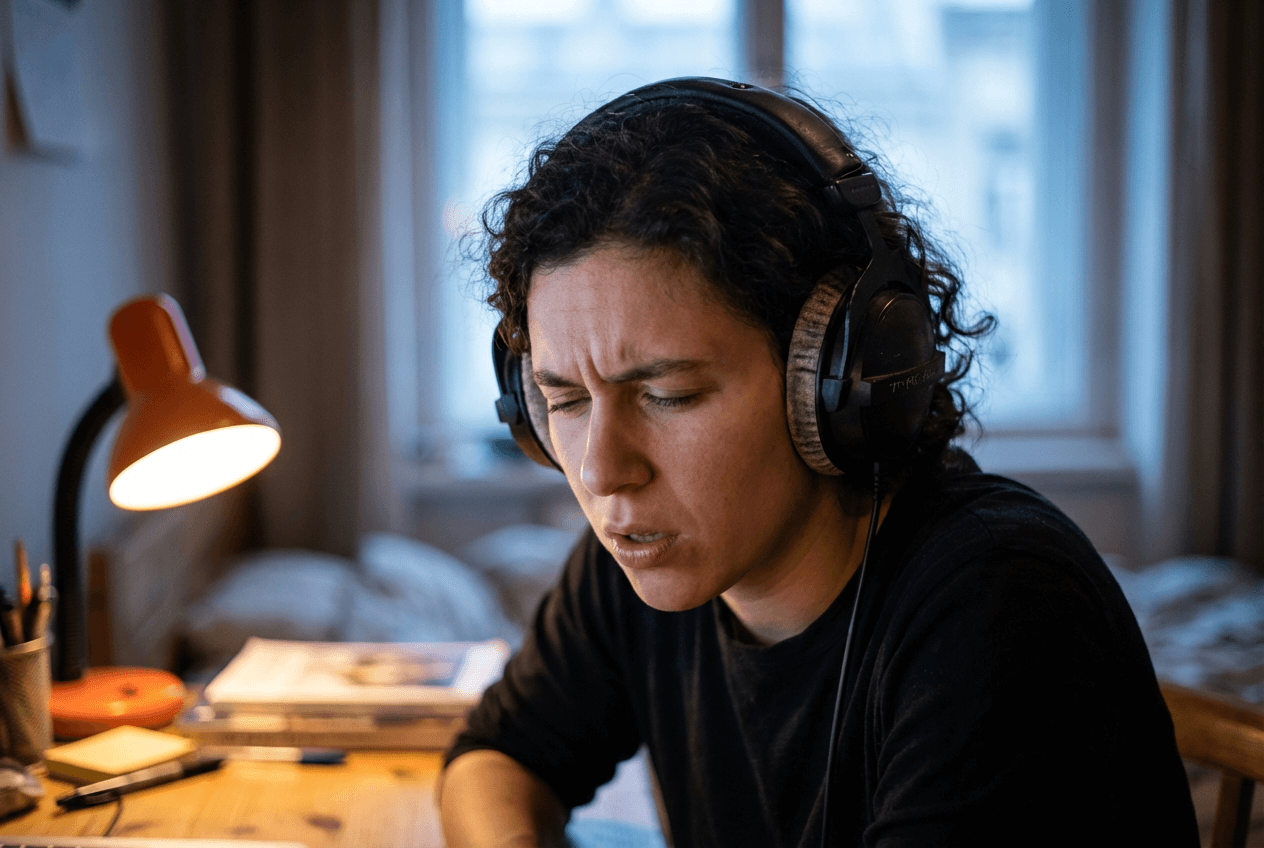
Shadowing is one of the most effective techniques for learning to speak English fluently. You listen to a native speaker and repeat what they say in real time, matching their rhythm, intonation, and pace.
A 2025 systematic review published in Taylor & Francis found that shadowing significantly improves comprehensibility, fluency, and prosody (the musical quality of speech). Originally developed for training interpreters, it's now recognized as a powerful tool for any language learner.
How to start shadowing:
- Pick a short podcast clip or YouTube video (30–60 seconds)
- Listen once to understand the content
- Play it again and speak along simultaneously, mimicking everything you hear
- Repeat 3–5 times until you match the rhythm naturally
Focus on how native speakers say things — the rise and fall of their voice, where they pause, which words they stress. Learning these pronunciation patterns is what makes you sound natural and fluent in English conversations.
6. Learn Phrases, Not Just Words
Your brain can't retrieve individual words and assemble them fast enough for fluent conversation. Fluent English speakers rely on memorized chunks — ready-made phrases they deploy instantly without thinking.
Don't memorize "want," "go," "store" separately. Learn the whole chunk: "I need to run to the store." Instead of studying the word "opinion," memorize: "In my opinion..." or "If you ask me..."
Build your phrase toolkit:
- Opinions: "I think...", "The way I see it..."
- Polite disagreement: "I see your point, but...", "That's fair, although..."
- Buying time: "That's a good question...", "Let me think about that..."
Native speakers use filler phrases constantly — they just sound smooth. Learning these chunks is one of the fastest English fluency tips you can start using today.
7. Track Your Progress
Language learning is a slow process. Day to day, you won't notice improvement — and that kills motivation. The fix? Track concrete metrics so progress becomes visible over time.
Measure at least:
- Speaking time per week — Are you putting in enough practice hours?
- Vocabulary growth — How many new words and phrases have you learned?
Practice Me automatically tracks speaking time, vocabulary from conversations, and improvement trends. Seeing concrete numbers — like 50 new words learned this month or 10 hours of English speaking this week — is what keeps you motivated when progress feels invisible.
8. Embrace Your Mistakes
Fear of making mistakes is the biggest obstacle to English fluency — bigger than grammar, vocabulary, or accent. It's the voice saying "Don't speak — you'll sound stupid."
Every mistake you make and correct strengthens the neural pathway for the correct form. Linguists call this your "interlanguage" — your brain's evolving version of English that improves with every conversation you have.
The best learning environments are judgment-free. AI tutors work especially well because there's nobody to feel embarrassed in front of. You speak more freely, make more mistakes, and learn faster as a result.
Fluency Myths That Hold English Learners Back
"You need to live abroad to become fluent in English." Millions of people have reached fluency without leaving home. The internet gives you access to English media, online communities, and AI conversation partners from anywhere. Daily practice matters more than your location.
"You need to master grammar before you start speaking." Grammar study alone won't make you fluent. Language fluency combines vocabulary, pronunciation, confidence, and cultural understanding — all of which improve faster through real conversation than reading textbooks. The British Council recommends prioritizing communication skills from early stages of learning.
"You can speak English fluently in 30 days." You can make noticeable progress in 30 days, but true fluency takes months of consistent speaking practice. Realistic expectations help you stay motivated instead of quitting from frustration.
"Only children learn languages well." Research from Pearson consistently shows adults have cognitive advantages in structured language learning — better analytical skills, more vocabulary, and stronger study habits. Adults absolutely can become fluent in English at any age.
Frequently Asked Questions
Can I become fluent in English without living abroad?
Yes — millions have done it. Create immersion at home: English media daily, regular speaking practice, thinking in English. Practice Me gives you 24/7 access to real voice conversations with AI tutors, removing the biggest barrier to becoming fluent — having nobody to practice speaking English with.
How many hours a day should I practice to become fluent in English?
Aim for at least 30 minutes of active English practice daily, including speaking time — not just reading or listening. Consistency matters most. Fifteen minutes of daily speaking practice will help you more than a 3-hour weekend study session.
Is it too late to become fluent in English as an adult?
Not at all. Adults learn differently from children, but not worse. Your analytical skills and life experience actually help you understand grammar, vocabulary patterns, and cultural context faster. There's no age limit on language learning.
What's the fastest way to improve English speaking skills?
Speak more — every day if possible. Combine daily speaking practice with AI tutors, shadowing native speakers, and learning phrases instead of individual words. These strategies together target the exact skills that produce English fluency fastest.
How do I know when I'm fluent in English?
When conversations stop feeling like a test. When you understand most of what native speakers say, express your thoughts without long pauses, and handle unexpected questions comfortably — that's fluency. You don't need a perfect accent or every word in the dictionary. For a formal benchmark, aim for CEFR B2.