Duolingo taught you words. No one taught you to speak.
PracticeMe: real voice conversations with an AI tutor, 24/7.
Xenoglossophobia: Overcoming the Fear of Speaking a Foreign Language

You know the words. You've studied the grammar. But the moment someone speaks English to you, your mind goes blank. Your heart pounds. The vocabulary you practiced for hours vanishes, replaced by a single overwhelming feeling: don't mess this up.
If that sounds familiar, there's a word for what you're experiencing — and you're far from alone.
Quick Summary: Xenoglossophobia is the fear of speaking a foreign language. It affects the majority of language learners and has real neurological roots — your brain's threat response literally blocks your ability to recall words under pressure. The good news: it's highly treatable with the right strategies, especially low-pressure practice environments like AI conversation partners.
What Is Xenoglossophobia?
Xenoglossophobia comes from three Greek roots: xeno (foreign), glosso (language or tongue), and phobos (fear). Put together, it means exactly what it sounds like — an intense fear or anxiety around speaking a foreign language.
This isn't just nervousness or a passing feeling of discomfort. Psychologists classify xenoglossophobia as a specific anxiety reaction, meaning it hits people who are otherwise calm and confident. You might give flawless presentations at work in your native language but freeze completely when ordering coffee in English.
The foundational research on foreign language anxiety comes from Horwitz, Horwitz, and Cope, whose 1986 study established the Foreign Language Classroom Anxiety Scale (FLCAS) — still the most widely used tool for measuring language anxiety in classroom and learning settings. Their work identified three core components of this anxiety: communication apprehension, test anxiety, and fear of negative evaluation.
More recently, a 2020 study by Böttger and Költzsch in the Training, Language and Culture journal confirmed that xenoglossophobia manifests with clinical-level intensity in many language learners, going well beyond ordinary shyness.
Symptoms: What Foreign Language Anxiety Feels Like
Foreign language anxiety shows up in your body before you even open your mouth. Böttger and Költzsch documented these physical symptoms in their study of 108 foreign language students:
- Rapid or irregular heartbeat
- Excessive sweating — especially palms and forehead
- Shortness of breath
- Nausea and dry mouth
- Visible shaking or trembling
But the most frustrating symptom is cognitive: your mind goes completely blank. Words you know — words you used correctly yesterday — become unreachable. This feeling of helplessness is what drives many learners to avoid speaking foreign languages altogether.
Here's why that happens. It's neuroscience, not a character flaw. When your brain perceives speaking a foreign language as a threat, the amygdala triggers a stress response. Cortisol floods your system and directly disrupts hippocampal function — the part of your brain responsible for memory retrieval. You literally cannot access vocabulary stored in your long-term memory. Your language skills are still there; your brain just can't reach them under stress.
The behavioral symptoms follow naturally. Learners with language anxiety avoid speaking situations entirely. They let others answer questions in the language classroom. They switch to their native language at the first sign of difficulty. They cancel language learning sessions. Over time, avoidance reinforces the fear, creating a cycle where the anxiety becomes harder to break with each passing week.
Why It Happens: The Causes of Language Learning Anxiety
Understanding why xenoglossophobia develops makes it easier to dismantle. Decades of research on foreign language anxiety point to several consistent triggers:
Fear of negative evaluation is the single biggest driver. The worry that native speakers, classmates, or teachers will judge your pronunciation, grammar, or word choice creates paralyzing pressure. Horwitz's research found that 47% of learners with language anxiety felt self-conscious about speaking in front of others, and 33% reported becoming confused even when they'd prepared thoroughly.
Classroom trauma shapes anxiety more than most people realize. Being corrected harshly in a language classroom, laughed at for pronunciation errors, or forced to speak before you're ready — these experiences leave lasting marks. Many adult learners carry negative associations from school settings where mistakes were punished rather than treated as a natural part of the learning process. The language classroom remains the environment most strongly associated with foreign language anxiety across the research literature, partly because it combines social pressure with performance evaluation in ways that daily life doesn't.
Perfectionism hits adult language learners especially hard. Children acquire languages fearlessly because they haven't yet developed the self-monitoring instincts that come with a fully mature prefrontal cortex. According to Böttger and Költzsch, this brain region finishes developing between ages 20 and 25 — meaning adult learners are neurologically wired to be more self-critical when speaking foreign languages. If you're an adult language learner feeling frustrated that children seem braver than you, it's not a skills gap. It's biology.
Low self-perceived proficiency is another trigger. Interestingly, actual proficiency matters less than how proficient learners believe they are. A 2024 study published in Frontiers in Psychiatry found that self-perception of language skills was a stronger predictor of foreign language anxiety than measured ability — meaning the feeling of inadequacy drives anxiety more than actual inadequacy does.
Cultural distance also plays a role. The more different your native language and culture are from English, the more foreign and threatening speaking it can feel. Language learners from East Asian, Middle Eastern, and South American backgrounds frequently report higher levels of language classroom anxiety when learning English.
7 Strategies to Overcome Xenoglossophobia
Xenoglossophobia isn't permanent. Like any anxiety response, it can be retrained with consistent practice and the right approach. These strategies are drawn from language anxiety research and exposure therapy principles — not wishful thinking.
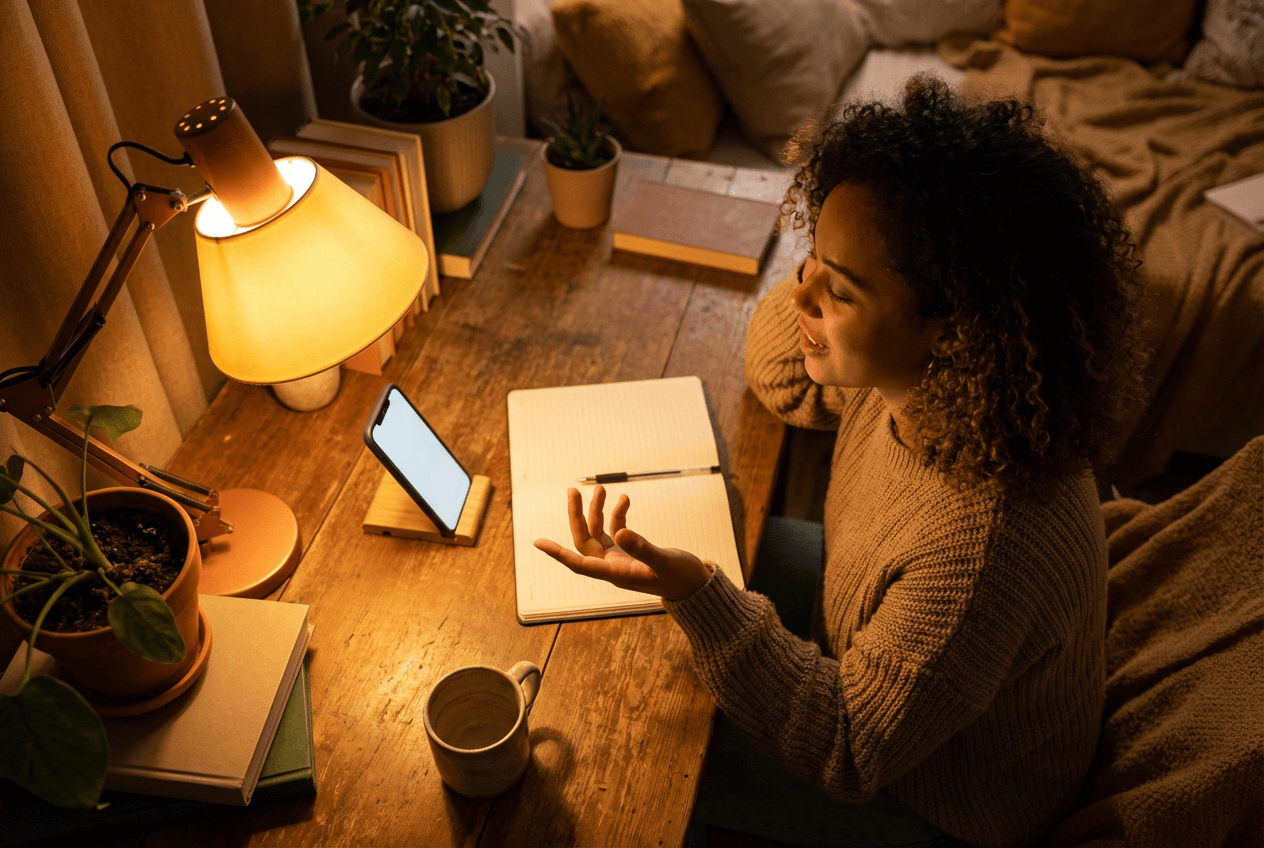
1. Start With Low-Stakes Practice
The single most effective way to reduce speaking anxiety is to remove the audience. Before you practice with anyone — human or AI — practice alone.
Narrate your morning routine in English. Describe objects in your room. Talk to your pet. The goal isn't perfection; it's building the neural pathways for English speech production without any social pressure. Even five minutes a day of solo speaking practice begins rewiring your brain's association between English and threat. Think of it as language learning with the safety net fully extended.
2. Practice With an AI Conversation Partner
Once you're comfortable speaking alone, the next step is conversation — but with zero judgment.
A 2025 study published in Frontiers in Psychology tested this directly. Researchers compared language anxiety levels during human-facilitated and AI-facilitated speaking exercises with 48 EFL learners. The result: anxiety had a strong negative correlation with speaking performance during human interaction (r = -0.500), but essentially no correlation during AI interaction (r = -0.042). The AI environment neutralized language anxiety's effect on performance.
This is exactly why tools like Practice Me exist. Unlike the language classroom or conversation exchange apps where another person is listening and evaluating, an AI conversation partner has no expectations, no impatience, and no judgment. Practice Me's AI tutors — with different personalities and both American and British accents — let you practice real voice conversations 24/7, as naturally as a phone call. You stumble over a word, and nobody flinches.
A 2025 study in Nature Humanities and Social Sciences Communications confirmed what anxious language learners intuitively know: AI conversation bots both improve speaking skills and reduce speaking anxiety simultaneously. For learners with xenoglossophobia, this dual benefit makes AI practice one of the most effective tools currently available.
3. Reframe Mistakes as Learning Data
Every error carries information that a textbook never could. When you say "I have 25 years" instead of "I am 25 years old," you've just discovered an interference pattern between your native language and English. That's valuable learning data — not failure.
Children acquire languages faster partly because they don't attach shame to mistakes. They just keep talking. Adopting that mindset deliberately — treating each mistake as a data point rather than a judgment — gradually defuses the fear of being wrong. In language learning, mistakes aren't the opposite of progress. They are progress.
Duolingo taught you words. No one taught you to speak.
PracticeMe: real voice conversations with an AI tutor, 24/7.
4. Set Micro-Goals, Not Fluency Goals
"Become fluent in English" is not a goal. It's a fantasy that guarantees daily disappointment. Micro-goals work better for anxious learners because they're achievable today, and achieving them releases dopamine — the brain's reward signal.
Try goals like these:
- Order coffee in English today
- Describe your weekend in three sentences
- Have a 2-minute conversation with a Practice Me tutor about the weather
- Use one new vocabulary word in conversation this week
Each small win builds a positive association with speaking English, gradually replacing the fear response with anticipation.
5. Build a Pre-Speaking Routine
Language anxiety is a physiological state, so treat it physiologically. Before any English-speaking situation — a lesson, a meeting, a phone call — do a quick reset:
- Box breathing: Inhale 4 seconds, hold 4, exhale 4, hold 4. Repeat three times. This directly calms the amygdala's threat response.
- Prepare three phrases you're likely to need. Having them ready reduces the "blank mind" effect that makes language anxiety so frustrating.
- Warm up for two minutes — speak English out loud to yourself. Your brain needs a transition period from your native language.
This routine takes under five minutes and measurably reduces the cortisol spike that triggers foreign language anxiety.
6. Track Progress and Celebrate Wins
Language anxiety distorts self-perception. Learners with xenoglossophobia chronically underestimate their own improvement, which reinforces the feeling that they'll never get better. Concrete progress tracking fights this directly.
Practice Me automatically tracks your speaking time, vocabulary growth, and improvement trends — giving you hard evidence that counters the anxious inner voice saying "you're not getting better." When you can see that you spoke for 15 minutes today versus 3 minutes last month, the fear loses some of its power. Positive reinforcement from seeing real progress rewires the fear response over time.
Even without an app, keep a simple log: date, who you spoke with, how long, and one thing that went well. Reviewing it weekly creates the kind of positive learning experience that replaces anxiety with confidence.
7. Gradually Raise the Stakes

Think of overcoming xenoglossophobia like exposure therapy — a well-established approach for treating phobias and anxiety. The key is gradual desensitization:
- Speak alone (zero stakes)
- Speak with an AI partner (low stakes, zero judgment)
- Speak with a supportive friend (low stakes, mild social pressure)
- Speak with a stranger (moderate stakes)
- Speak in a group (higher stakes)
You don't jump from step 1 to step 5. Each level builds on the confidence and language skills earned at the previous one. Most language learners find that by the time they reach step 4, the foreign language anxiety they felt at step 2 has largely disappeared.
You're Not Broken — You're Human
If you experience xenoglossophobia, it doesn't mean you're bad at language learning. It means your brain is doing exactly what it evolved to do: protecting you from perceived social threats.
The difference between learners who overcome foreign language anxiety and those who don't isn't talent or intelligence. It's consistent exposure to low-pressure speaking practice. Every conversation — even a short, imperfect one — teaches your brain that speaking English is safe.
Start where you are. Speak alone. Then speak with an AI. Then speak with people. The fear gets smaller with every conversation you complete.
Ready to take the first step? Practice Me's AI tutors are available 24/7, with no judgment and no pressure — exactly the kind of environment that research shows reduces language anxiety most effectively. See plans and pricing.
Frequently Asked Questions
Is xenoglossophobia a real phobia?
Yes. Xenoglossophobia — also called foreign language anxiety — is recognized in linguistics and psychology research as a specific anxiety reaction. It was formally studied by Horwitz, Horwitz, and Cope in 1986, and their Foreign Language Classroom Anxiety Scale remains the standard measurement tool used in language classroom research worldwide. While it's not listed as a standalone diagnosis in the DSM-5, it fits the criteria for a specific situational phobia with documented physiological symptoms.
How common is foreign language anxiety?
Extremely common. Research consistently shows that foreign language anxiety affects the majority of language learners to some degree. Horwitz's foundational research found that nearly half of learners with language anxiety feel self-conscious speaking in classroom settings, and about a third become confused even when fully prepared. More recent studies confirm it remains one of the most significant emotional barriers in language learning globally.
Can you overcome xenoglossophobia on your own?
Yes, many learners successfully reduce their language anxiety through self-directed strategies — particularly low-stakes practice, gradual exposure, and reframing mistakes as learning opportunities. AI conversation partners like Practice Me are especially helpful because they provide real speaking practice without the social pressure that triggers anxiety. However, if your anxiety is severe enough to interfere with daily life beyond language learning situations, consider speaking with a mental health professional.
Does speaking anxiety get better with practice?
It does — and there's strong research backing this. A 2025 Frontiers in Psychology study found that AI-facilitated speaking practice essentially eliminated the negative effect of language anxiety on performance. The principle is exposure: the more you speak in low-pressure environments, the more your brain learns that speaking a foreign language isn't a threat. Consistency matters more than session length — short, regular practice beats occasional marathon sessions.
What is the fastest way to reduce fear of speaking English?
Start with an AI conversation partner. Research from 2025 shows that AI-facilitated speaking environments reduce language anxiety dramatically compared to human-facilitated ones. Begin with short, 2-3 minute conversations and gradually increase the duration. Combine this with solo practice (narrating your day in English) and pre-speaking breathing exercises. Most language learners notice a significant reduction in their foreign language speaking anxiety within 2-4 weeks of consistent daily practice.