Duolingo taught you words. No one taught you to speak.
PracticeMe: real voice conversations with an AI tutor, 24/7.
How to Get Fluency in English: A Practical Roadmap

"How can I get fluency in English?" If that's your question, you don't need more generic advice — you need a structured plan. How many months will it take? What should you practice each week? How do you know when your English is actually improving?
This English fluency roadmap answers all of it. It breaks the language learning journey from beginner to fluent English speaker into five clear stages based on the CEFR framework (the global standard for measuring language ability), gives you realistic timelines, weekly practice schedules, and concrete milestones to track your speaking progress at every level.
Quick Summary: Getting fluency in English takes roughly 500–600 hours of focused practice to reach B2 (conversational fluency). With 1 hour of daily practice, that's about 18 months. This roadmap breaks the language learning journey into 5 CEFR stages — each with a timeline, weekly schedule, real-world ability markers, and milestones so you always know exactly where you stand.
The English Fluency Roadmap at a Glance
The Common European Framework of Reference for Languages (CEFR) divides language learning ability into six levels. For English fluency, most learners target B2 — the stage where you can hold natural conversations without strain. Here's the full picture of what it takes to learn English to fluency:
| Stage | CEFR Level | Cumulative Hours | Timeline (1 hr/day) | You Can... |
|---|---|---|---|---|
| 1 | A1 (Beginner) | 80–100 hrs | Months 1–2 | Introduce yourself, order food |
| 2 | A2 (Elementary) | 180–200 hrs | Months 3–5 | Make small talk, describe your life |
| 3 | B1 (Intermediate) | 350–400 hrs | Months 6–10 | Express opinions, handle travel |
| 4 | B2 (Fluency) | 500–600 hrs | Months 11–18 | Converse naturally with native speakers |
| 5 | C1 (Advanced) | 700–800 hrs | Months 19–30+ | Speak flexibly in professional settings |
These hour estimates come from Cambridge English research, which suggests 100–200 guided learning hours per CEFR level for motivated adults.
Two important notes. First, if you're reading this article in English, you're likely already at A2 or B1 — which means you're closer to fluency than you think. Second, your timeline depends entirely on daily practice volume. Practicing 2 hours a day cuts the schedule roughly in half.
Let's walk through each stage so you understand exactly what to expect and how to practice effectively.
Stage 1: Beginner (A1) — Building Your Foundation
Timeline: 0–2 months (80–100 hours)
This is where every English learning journey starts. You're building the fundamental blocks — basic grammar structures, essential vocabulary, and getting comfortable with how English sounds actually come out of your mouth.

What A1 Looks Like in Real Life
At A1, you can:
- Introduce yourself: "Hi, I'm Maria. I'm from Brazil. I work in marketing."
- Ask and answer simple questions: "Where do you live?" "What time is it?" "How much does this cost?"
- Understand written signs and short instructions: EXIT, NO PARKING, "Please wait here"
- Order at a restaurant: "I'd like a coffee, please" (even if you can't discuss the full menu)
You cannot yet hold a real English conversation. You're working from memorized phrases, and unexpected questions throw you off. That's completely normal at this early stage of learning.
Milestone before moving on: Can you describe your daily routine in English for 60 seconds without stopping? ("I wake up at 7. I eat breakfast. I go to work by bus...") If yes, you're ready for A2.
A1 Weekly Practice Schedule (5 hours/week)
| Day | Activity | Time |
|---|---|---|
| Mon | English grammar basics (present tense, articles) | 45 min |
| Tue | Vocabulary building (flashcards, themed word lists) | 45 min |
| Wed | Listening practice (beginner English podcasts) | 45 min |
| Thu | Speaking practice — say new English sentences out loud | 45 min |
| Fri | Review + speaking practice with Practice Me | 45 min |
| Sat | Watch a short English video with subtitles | 45 min |
| Sun | Rest (your brain needs downtime to consolidate learning) | — |
At A1, speaking practice means repeating phrases, describing what you see around you in English, and getting comfortable with English pronunciation. Even at this early stage, practicing speaking with an AI tutor helps build the muscle memory your mouth needs. You don't need to understand everything perfectly — the goal is to start speaking the language from day one.
Stage 2: Elementary (A2) — Surviving in English
Timeline: Months 3–5 (180–200 cumulative hours)
A2 is where English starts becoming useful. You move beyond memorized phrases and start building your own simple sentences. The shift feels significant — suddenly you can actually communicate in the language, even if imperfectly.
What A2 Looks Like in Real Life
At A2, you can:
- Make small talk in English: "The weather is nice today. Did you have a good weekend?"
- Navigate airports and hotels: Check in, ask for directions, understand gate announcements (mostly)
- Describe your background: "I studied engineering in Seoul. Now I live in London and work for a tech company."
- Handle basic phone calls: "I'd like to make a reservation for two people, Saturday at 7."
You still pause frequently to search for the right vocabulary, and you can't follow fast conversations between native English speakers. Complex topics like politics or abstract ideas are beyond your current level.
Milestone before moving on: Can you describe a recent vacation or experience for 2 minutes straight in English, including what happened and how you felt? If yes, you're ready for B1.
A2 Weekly Practice Schedule (6 hours/week)
| Day | Activity | Time |
|---|---|---|
| Mon | Grammar practice (past tense, comparatives, question forms) | 45 min |
| Tue | Vocabulary (themed lists: work, travel, food, daily life) | 45 min |
| Wed | Listening (English language podcasts for learners) | 1 hr |
| Thu | Speaking practice with Practice Me — simple English conversations | 1 hr |
| Fri | Reading (English news for learners, graded readers) | 30 min |
| Sat | Shadowing practice + listening to native English speakers | 1 hr |
| Sun | Rest | — |
This is where daily speaking practice becomes non-negotiable for anyone serious about building English fluency. Understanding English and speaking English use different brain systems entirely. You can watch English shows all day and still freeze when someone asks you a question — because comprehension and speech production activate different parts of your brain. The only fix is to speak English out loud, regularly.
Stage 3: Intermediate (B1) — Finding Your Voice
Timeline: Months 6–10 (350–400 cumulative hours)
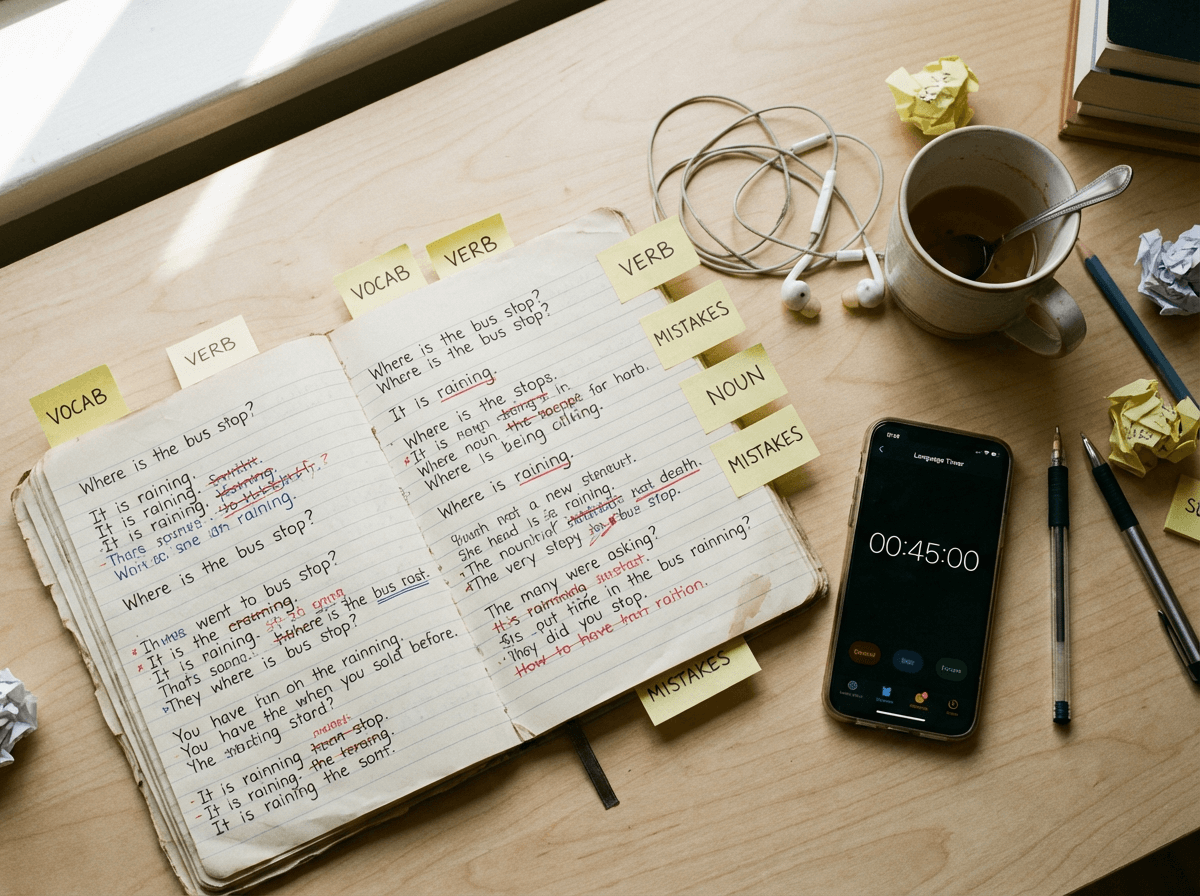
B1 is a major turning point in your English fluency training. You stop feeling like a "language learner" and start feeling like someone who speaks English. You can handle most daily situations without help, and you're beginning to express your personality in the language — not just information.
But B1 also brings the dreaded intermediate plateau. Progress feels slower because the easy wins are behind you. Pushing through this plateau requires more speaking practice, not more grammar study.
What B1 Looks Like in Real Life
At B1, you can:
- Express opinions in English: "I think remote work is better because you save time commuting, but I miss seeing my colleagues."
- Handle most travel situations independently — negotiate with taxi drivers, complain about a hotel room, ask for medical help
- Understand the main points of clear, standard English speech on familiar topics (work, hobbies, current events)
- Participate in work meetings (with some difficulty following fast English discussions)
You're starting to think in English sometimes — a major sign of progress in your language learning. But you still struggle with idioms, humor, and expressing complex or abstract ideas.
Milestone before moving on: Can you explain in English why you liked (or disliked) a movie, book, or trip for 5 minutes, giving specific reasons and examples? If yes, you're approaching B2.
B1 Weekly Practice Schedule (8 hours/week)
| Day | Activity | Time |
|---|---|---|
| Mon | Grammar refinement (conditionals, reported speech) | 45 min |
| Tue | Vocabulary expansion (English idioms, phrasal verbs, collocations) | 45 min |
| Wed | Listening (real English podcasts, YouTube at 0.75x speed) | 1 hr |
| Thu | Speaking — English conversation practice with AI tutors | 1.5 hrs |
| Fri | Reading English articles + writing practice | 1 hr |
| Sat | Speaking — debate topics, describe complex situations in English | 1.5 hrs |
| Sun | Light review or rest | 30 min |
Notice how speaking now takes up the largest portion of your weekly schedule. At B1, the gap between what you understand in English and what you can actually say is the main bottleneck to fluency. Closing that gap requires talking in English — a lot.
This is where tools like Practice Me become essential for learning to speak English fluently. You need high-volume speaking practice without the anxiety of being judged. AI tutors like Sarah, Oliver, and Marcus adapt to your level and let you practice English conversations on any topic — work presentations, travel plans, opinions on current events — for as long as you need. No scheduling, no time limits.
If the fear of speaking a foreign language is what's holding you back at this stage, a judgment-free environment is the fastest way through it.
Duolingo taught you words. No one taught you to speak.
PracticeMe: real voice conversations with an AI tutor, 24/7.
Stage 4: Upper-Intermediate (B2) — Conversational Fluency
Timeline: Months 11–18 (500–600 cumulative hours)
This is the milestone. B2 is what most people mean when they say "I'm fluent in English." You can interact with native English speakers naturally, without either of you feeling strained. You handle complex topics, express nuanced opinions, and understand most of what you hear in the language.

What B2 Looks Like in Real Life
At B2, you can:
- Work in English-speaking environments — attend meetings, write detailed emails, give English presentations
- Watch movies and TV shows in English without subtitles (you'll miss some slang, but follow the plot easily)
- Debate abstract topics: "What are the pros and cons of artificial intelligence in education?"
- Speak English spontaneously — no more long pauses while you mentally translate from your native language
- Catch and correct your own grammar mistakes while speaking
You still make errors. Your vocabulary has gaps. Your accent is clearly non-native. None of that matters — English fluency isn't perfection. It's smooth, confident communication in the language. For a deeper look at what fluency actually means and proven strategies to get there, read our guide on how to become fluent in English.
B2 unlocks real-world doors: It's the minimum English level required for most university programs taught in English. It satisfies employer requirements for "professional English proficiency." And it's the point where living in an English-speaking country stops feeling overwhelming.
Milestone: Can you discuss the pros and cons of a complex topic in English (climate change, remote work, social media's impact) for 10 minutes, giving specific examples and responding to counterarguments? Welcome to English fluency.
B2 Weekly Practice Schedule (10 hours/week)
| Day | Activity | Time |
|---|---|---|
| Mon | Advanced English grammar (subjunctive, nuanced tenses) | 45 min |
| Tue | Vocabulary building (academic, professional, abstract concepts) | 45 min |
| Wed | Listening (English podcasts at native speed, news, lectures) | 1.5 hrs |
| Thu | Speaking practice — English debates, presentations, storytelling | 2 hrs |
| Fri | Reading (English articles, essays, fiction) + writing | 1.5 hrs |
| Sat | Speaking — varied topics and accents with Practice Me | 2 hrs |
| Sun | Light listening or rest | 30 min |
At B2, variety in your speaking practice matters more than raw volume. Practice speaking English on different topics — technology one day, relationships the next, then your career goals. Train with both American and British accents so you can understand English speakers from anywhere in the world.
Stage 5: Advanced (C1) — Professional Mastery
Timeline: Months 19–30+ (700–800 cumulative hours)
Not everyone needs C1 English. If your goal is confident, natural communication, B2 gets you there. C1 is for people who need the English language at a high professional or academic level — think university lecturers, international lawyers, or executives presenting to global boards.

At C1, you can:
- Use the English language flexibly and effectively for social, academic, and professional purposes
- Understand implied meaning — sarcasm, understatement, cultural references
- Produce clear, well-structured English text on complex subjects with sophisticated vocabulary
- Speak English fluently without searching for words — your speech flows naturally even on unfamiliar topics
The jump from B2 to C1 typically requires 200+ additional hours of learning, much of it through deep immersion: reading extensively in English, consuming complex media, and having sustained challenging conversations. At this stage, Practice Me helps you maintain and sharpen your English speaking skills through varied, challenging conversations with different tutor personalities.
Your Weekly English Fluency Practice Template (Any Level)
Whatever stage you're at on this roadmap, effective English fluency training follows the same formula. Adjust the total hours to your level and goals, but keep these proportions roughly the same:
| Activity | % of Time | Why It Matters |
|---|---|---|
| Speaking practice | 40% | The #1 skill for English fluency. Nothing replaces it. |
| Listening | 25% | Trains your ear for natural English rhythm and pronunciation |
| Vocabulary + Grammar | 20% | Builds the toolkit you need for speaking and understanding English |
| Reading + Writing | 15% | Reinforces everything and expands your range in the language |
The golden rule of English fluency: Never let a day pass without speaking English out loud. Even 10 minutes of talking to yourself — "I need to buy groceries. Let me think about what I want for dinner..." — keeps your speaking muscles active and your brain in English mode.

5 Milestones That Prove You're Getting Fluency in English
Test scores measure English knowledge. These milestones measure real fluency — and they're more meaningful than any language exam:
-
You start thinking in English without trying. You catch yourself planning your day or reacting to situations in English before your native language kicks in. This usually happens around B1.
-
You understand English jokes and wordplay. Humor requires fast processing speed and cultural knowledge. If you're laughing at English puns, your comprehension is further along than you realize.
-
You switch topics mid-conversation without freezing. English fluency means flexibility. If someone suddenly changes the subject, you keep up without needing to mentally reset.
-
You catch your own grammar mistakes while speaking English. You say "I goed" and immediately self-correct to "I went" — without anyone pointing it out. This self-monitoring is a clear B2-level sign.
-
You dream in English. It sounds strange, but it's a real phenomenon. When you start dreaming in the English language, it has integrated deeply into your thinking and processing patterns.

Track these milestones alongside concrete metrics. Practice Me automatically tracks your English speaking time, vocabulary growth from conversations, and improvement trends — so you can see your progress even on days when fluency feels far away.
How to Speed Up Your English Fluency Timeline
Want to compress this roadmap and get fluency in English faster? These strategies have the biggest impact on how quickly you learn the language:
Speak English every single day. Not "study" every day — speak. Ten minutes of active speaking practice beats an hour of passive listening for building English fluency. Use Practice Me's AI tutors to make daily English conversations effortless — no scheduling, no judgment, available 24/7 on your iPhone or iPad.
Immerse through your daily environment. Switch your phone language to English. Watch shows in English with English subtitles (not your native language). Follow English-language social media accounts. The more your brain encounters English as "normal," the faster it adapts.
Learn English phrases, not isolated words. Don't memorize "opinion" — memorize "In my opinion..." and "If you ask me..." Your brain retrieves ready-made language chunks faster than it can assemble individual vocabulary words into sentences on the fly.
Track your learning progress every week. Language learning is gradual. Without tracking concrete metrics, you won't notice improvement and you'll lose motivation. Review your speaking hours, vocabulary count, and milestone progress every Sunday.
Prioritize speaking over passive activities. Reading English and listening to English feel productive, but they don't directly build English speaking fluency. If you only have 20 minutes today, spend those minutes talking out loud — not scrolling through grammar exercises.
For a comprehensive list of proven fluency strategies beyond this roadmap, see our detailed guide on how to become fluent in English.
Frequently Asked Questions
How long does it take to get fluency in English?
With consistent daily practice of 1 hour per day, most learners reach conversational English fluency (CEFR B2) in 12–18 months. This requires roughly 500–600 total hours of focused English learning and speaking practice. Practicing 2 hours daily can compress this to 8–10 months. Your timeline varies based on your native language (Spanish speakers typically learn English faster than Mandarin speakers), prior exposure to the language, and how much time you dedicate to active speaking practice.
Can I become fluent in English without living abroad?
Absolutely. Millions of English learners have reached B2 fluency without leaving their home country. The internet gives you access to English media, online communities, and AI-powered speaking practice from anywhere. What matters most is daily exposure to the language and consistent speaking practice — and tools like Practice Me make unlimited English voice conversations available 24/7, wherever you are.
How many hours a day should I practice English?
A minimum of 30 minutes of focused English practice daily produces measurable progress toward fluency. One hour per day is the sweet spot for most language learners — enough to improve steadily without burnout. If you can manage 2 hours, you'll progress roughly twice as fast. The key is consistency: 30 minutes of English every day beats 3.5 hours once a week because your brain needs repeated exposure to retain what you learn.
What's the fastest way to improve English speaking fluency?
Speaking. Specifically, having real English conversations (not just repeating textbook phrases) as frequently as possible. Shadowing native English speakers, thinking in English throughout your day, and learning common phrases instead of isolated vocabulary words also accelerate progress significantly. The biggest mistake English learners make is substituting passive activities like watching shows for active speaking practice.
Is B2 considered fluent in English?
Yes. B2 (Upper-Intermediate) on the CEFR scale is widely recognized as conversational English fluency. At B2, you can interact with native English speakers without strain, discuss complex topics, and function professionally in the language. It's the minimum level most universities require for English-taught programs and what employers generally mean by "professional English proficiency." You won't sound like a native speaker at B2, but you'll communicate confidently and naturally.
Start Your English Fluency Roadmap Today
How can I get fluency in English? Not by finding a magic method or buying an expensive language course. By showing up every day, speaking English out loud, and following a structured path from where you are to where you want to be.
You now have that path — five clear stages, realistic timelines, weekly schedules, and milestones to track your English learning progress. The only variable left is your daily commitment.
Pick your current CEFR level from the roadmap above. Follow the weekly practice schedule for your stage. Track your milestones. And when you're ready to start speaking, Practice Me is ready to listen — 24/7, judgment-free, with AI tutors who adapt to exactly where you are on your English fluency journey.
Your timeline starts today.