Duolingo taught you words. No one taught you to speak.
PracticeMe: real voice conversations with an AI tutor, 24/7.
How to Practice English Speaking Alone at Home

Wondering how to practice English speaking alone? You don't need a language partner, a classroom, or anyone else in the room. You just need the right methods — and the willingness to talk to yourself (which is far less weird than it sounds).
The "I have nobody to practice with" frustration has held back English learners for years. But the truth is: some of the most effective ways to improve English speaking by yourself happen right at home. No judgment. No pressure. No waiting for someone else's schedule.
Quick Summary: You can improve your English speaking skills by yourself using 10 proven methods — from AI conversation partners that talk back in real time, to shadowing native speakers, voice memo diaries, and narrating your daily life. Each method includes a specific 5-minute exercise you can try today.
This guide covers how to practice English speaking alone at home with 10 practical techniques. Each one explains what it is, how it helps you learn new words and improve fluency, and includes a timed exercise you can start right now.
Why Learning to Speak English Alone Actually Works
Most people assume improving your spoken English requires a conversation partner. It doesn't — and language learning research supports this.
Speaking English aloud activates different brain pathways than reading or listening. When you speak, you engage your motor cortex (mouth movements), auditory processing (hearing yourself), and language production centers all at once. This neurological workout happens whether you're talking to another person or speaking to yourself at home.
Here are the key reasons why practicing English speaking at home by yourself can help you improve faster:
- Zero judgment. You can stumble and restart freely. For learners dealing with a fear of speaking a foreign language, this helps build confidence quickly.
- Full control over your learning. You choose the topics, pace, and skills you want to work on — vocabulary, grammar, pronunciation, or fluency.
- Unlimited repetition. Practice the same words, phrases, or sentences 20 times without boring a partner.
The one real limitation used to be the lack of conversation — nobody to respond or help you correct mistakes. AI technology has solved that problem entirely.
1. Talk to an AI Conversation Partner
This method has fundamentally changed how to practice English speaking alone.
Traditional solo techniques like reading aloud or talking to yourself are useful, but they're one-directional — you speak, and nothing responds. There's no real conversation, no unpredictable questions, no need to listen and react on the spot. That's not how English communication works in the real world.
AI conversation apps fix this completely. Practice Me lets you have real voice conversations with AI tutors — in real time, on any topic, for as long as you want. It feels like calling a patient, encouraging friend who speaks native English and is available 24/7 to help you improve your speaking skills.
Here's why AI speaking practice is so effective:
- Real conversation flow — you listen, process, and respond spontaneously, building the kind of fluency you need in everyday life.
- Authentic native accents — Practice Me offers both American and British accents, helping you learn natural pronunciation and rhythm from the start.
- Adaptive difficulty — the tutors simplify for beginners and challenge advanced learners with complex vocabulary, idioms, and deeper topics.
- Completely judgment-free — stumble over words, take long pauses, or ask questions without anyone getting impatient.
The app includes three AI tutor personalities — Sarah, Oliver, and Marcus — each with a distinct conversational style. Some learners prefer structured speaking practice; others want casual chat. This variety keeps your daily routine engaging.
Your 5-minute exercise: Open the app, pick a tutor, and say: "Let's talk about what I did today." Speak naturally for 5 minutes. The tutor will ask follow-up questions, creating genuine back-and-forth dialogue — the exact skill you need for real-world English conversations.

2. Use the Shadowing Technique
Shadowing is one of the most research-backed methods to improve your English pronunciation and fluency by yourself.
What it is: You listen to a native English speaker and speak at the same time — not after them, but simultaneously. You "shadow" their voice, matching rhythm, word stress, and intonation in real time.
Why it works: A 2025 systematic review of 44 studies on shadowing found it consistently improves pronunciation and fluency among second-language learners. Research from the National Institutes of Health shows shadowing activates key speech-processing brain regions and increases working memory — helping you hold longer, more complex sentences during English conversation.
Unlike simple listen-and-repeat exercises, shadowing forces you to process and produce the language simultaneously, building the same rapid neural pathways native speakers use.
How to shadow step by step:
- Find a video or podcast with clear English. TED Talks work well for intermediate learners.
- Listen to a 30-second segment once to understand the content.
- Play it again, speaking along in real time — match the speaker's pace, tone, and rhythm.
- Repeat the same segment 3-4 times. You'll hear yourself improving with each pass.
Your 5-minute exercise: Pick a TED Talk on a topic you enjoy. Choose a 30-second clip from the opening. Shadow it four times. On the fifth pass, record yourself without the audio and compare your pronunciation to the original.

3. Read Aloud Every Day
Reading aloud bridges the gap between knowing English vocabulary and being able to say words fluently in conversation.
Many language learners have a large passive vocabulary (words you recognize when reading) but a much smaller active one (words you can produce smoothly in speech). Reading aloud forces your mouth to physically form words and sentences you'd otherwise only process silently — turning passive knowledge into active speaking ability.
What to read for the best practice:
- News articles from BBC News or Reuters for formal English
- Fiction dialogue for natural, conversational English
- Song lyrics for learning rhythm and connected speech patterns
Choose material slightly below your reading level so you can focus on pronunciation, intonation, and rhythm — not just understanding words.
Your 5-minute exercise: Find an English news article. Read three paragraphs aloud slowly. Read them again faster. On the third pass, read with natural expression — like a news anchor presenting to a live audience. Notice how your delivery improves each time.
4. Narrate Your Daily Life in English
This is the lowest-effort, highest-consistency way to practice speaking English alone at home — and you need zero preparation.
As you go about your day, describe what you're doing in English, out loud. Like a documentary narrator following your own life.
"I'm making coffee. I'm pouring water into the kettle. Now I'm waiting for it to boil. The kitchen smells like toast."
This builds spontaneous production — generating original English sentences in real time, which is exactly what real conversations demand. It also helps you discover vocabulary gaps. You'll quickly realize you don't know the English words for everyday objects and actions, and that awareness accelerates your learning.
Your 5-minute exercise: Tomorrow morning, narrate your entire routine — from waking up to leaving the house. Describe every action, every object, every observation. When you don't know a word, describe it: "the thing that heats the water" works perfectly until you learn "kettle."

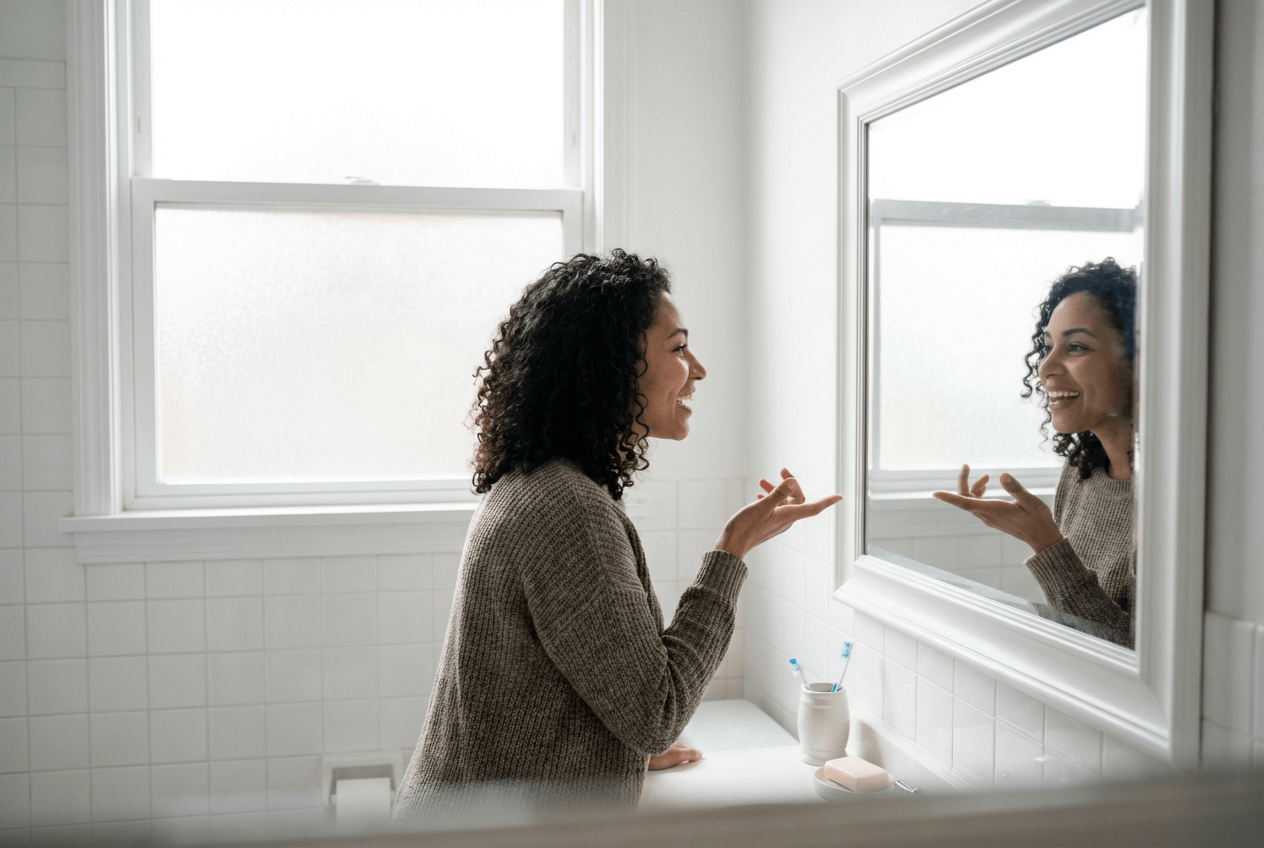
5. Practice Speaking in Front of a Mirror
Mirror practice gives you something no other solo technique offers: the experience of speaking English to a face.
Your brain processes the visual feedback of seeing a "conversation partner." You can watch your mouth form different sounds, observe your facial expressions, and work on the confident body language that goes with speaking English well.
This especially helps learners whose anxiety is about performing rather than vocabulary. It teaches you to stay comfortable speaking while someone (your reflection) watches — a skill that transfers directly to real-world conversations and presentations.
Your 5-minute exercise: Stand before a mirror and answer aloud: "Tell me about yourself — what do you do, and what are you interested in?" Give a 2-minute answer. Repeat, trying to sound more natural and relaxed. Watch how your confidence and posture visibly improve.
6. Record Yourself and Listen Back
Your smartphone's voice recorder is an underused but powerful tool for improving your English pronunciation and speaking skills at home.
You can't accurately hear your own mistakes while you're speaking — your brain auto-corrects in real time. But when you listen to a recording, pronunciation errors, filler words ("um," "uh," "like"), and unnatural pauses suddenly become obvious and fixable.
How to use self-recording effectively:
- Pick a question: "What's your favorite movie and why?"
- Record a 60-second answer without stopping.
- Listen back. Identify one specific thing to improve.
- Re-record with that correction.
Aim for one improvement per session. Small fixes compound fast over weeks of consistent practice.
Your 5-minute exercise: Record yourself describing your hometown. Listen back. Pick one issue — too many filler words, or a pronunciation mistake. Re-record with that single fix.
Duolingo taught you words. No one taught you to speak.
PracticeMe: real voice conversations with an AI tutor, 24/7.
7. Think in English (Then Say It Out Loud)
Still translating from your native language before you speak? This technique helps you break that habit and build real fluency.
Thinking in English cuts out the mental middleman. Instead of: thought in first language → translate → speak English — you train yourself to think directly in English. This eliminates the processing delay that makes your speech sound slow and hesitant.
Start small — practice thinking in English during low-pressure moments:
- Brushing your teeth in the morning
- Walking to work or school
- Waiting in line
The upgrade: say those English thoughts out loud when you're alone. Your internal monologue becomes free, effortless speaking practice that helps build fluency by yourself.
Your 5-minute exercise: Next time you cook, narrate every step aloud. "I need to chop the onion. Where's the knife? This pan isn't hot enough." Just let your English thoughts flow naturally.

8. Sing Along to English Songs
Singing teaches you things about English pronunciation that grammar textbooks can't: connected speech, rhythm, natural stress patterns, and how words blend together in fluent conversation.
Native speakers don't pronounce each word separately when talking. "Want to" becomes "wanna." "Going to" becomes "gonna." Songs exaggerate these natural patterns, making them easier to notice, practice, and absorb into your own English.
Choosing songs that help you learn:
- Clear vocals: Ed Sheeran, Adele, The Beatles — popular with English learners worldwide
- Avoid heavy slang until more advanced
- Follow along with lyrics on Genius
Your 5-minute exercise: Pick an English song you enjoy. Look up the lyrics. Sing along to the chorus five times. On the fifth try, sing without looking at the words. You'll surprise yourself with how much you've absorbed.
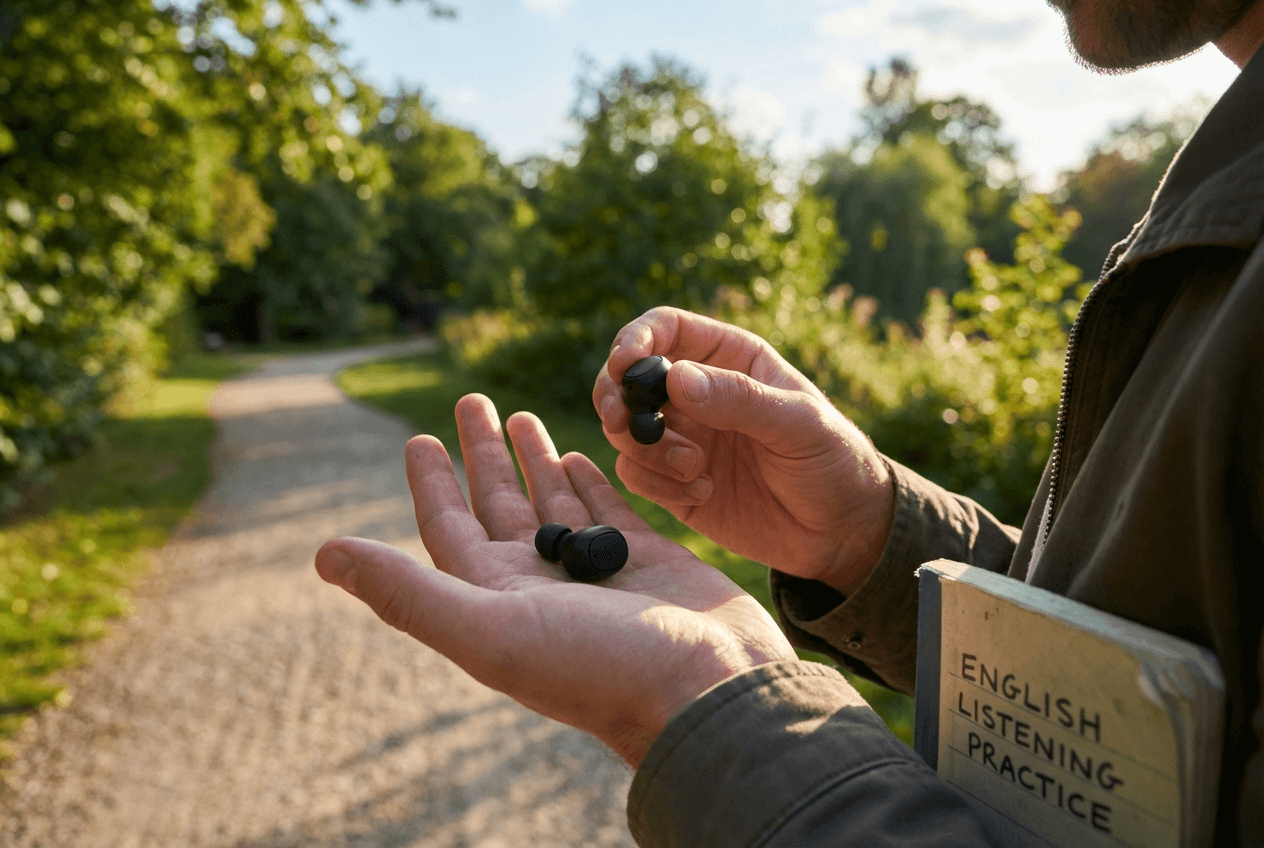
9. Repeat Dialogue from Movies and TV Shows
Imitating movie dialogue teaches something shadowing and reading aloud can't: emotional expression in English.
Actors don't just pronounce words correctly — they convey frustration, excitement, sarcasm, and warmth through tone and delivery. "That's great" means five different things depending on how you say it. Learning to copy these emotional patterns helps you sound natural and expressive in your own English conversations — a skill that makes a real difference.
How to practice this yourself:
- Pick a 30-second scene you love from any English show or movie.
- Watch with subtitles to learn every word.
- Watch again, focusing on how characters speak — speed, pauses, emphasis, and tone.
- Repeat each line, mimicking the actors' emotion and delivery.
- Perform the whole scene without pausing.
Your 5-minute exercise: Find a short dialogue in your favorite English show. Replay it three times, repeating each line aloud. Then perform from memory, matching the actors' energy. This is one of the most enjoyable ways to practice English speaking alone.
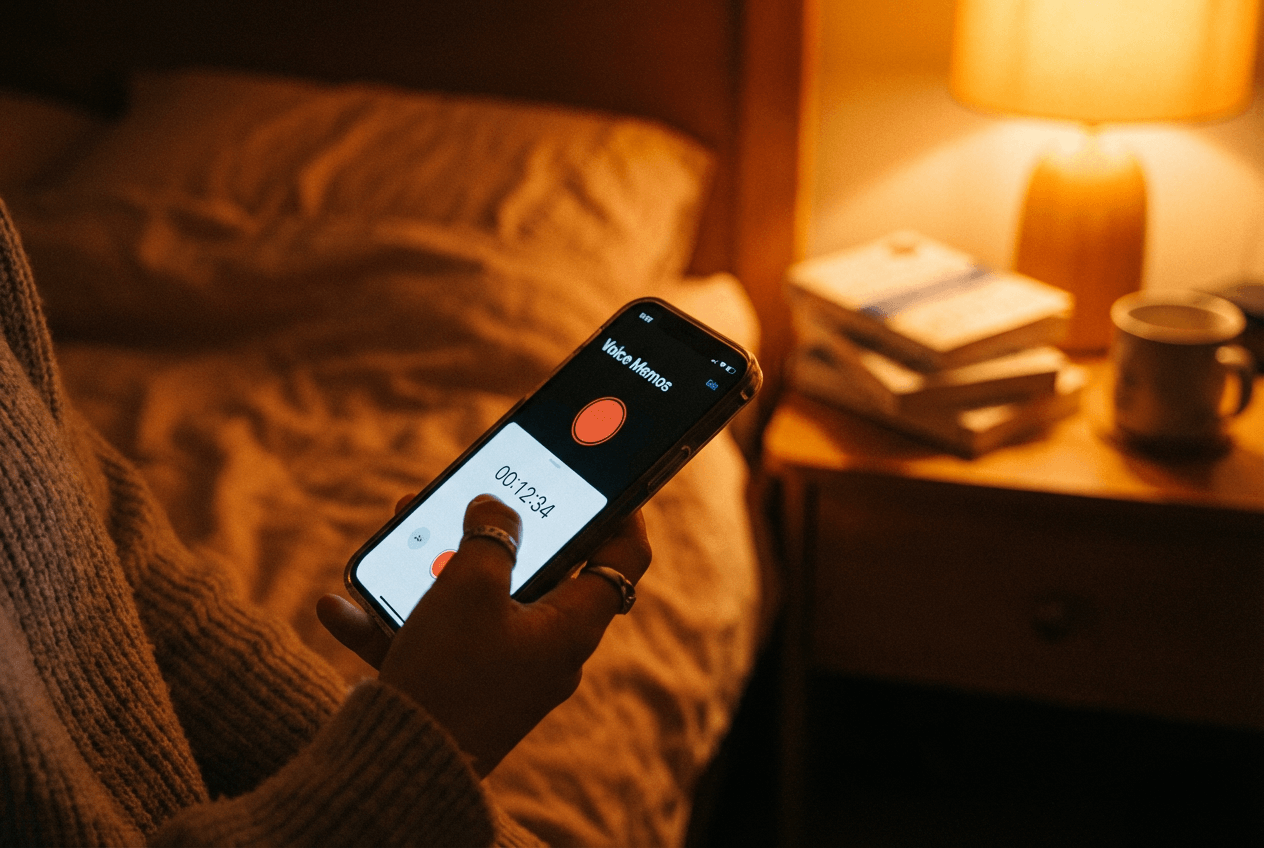
10. Keep a Voice Memo Diary
A daily voice diary is the simplest speaking habit you can build — and one of the most powerful for tracking your learning progress.
Each day, open your phone's voice recorder and talk about your life for 2-3 minutes in English. No structure. No grammar rules to obsess over. Just speak freely.
"Today was okay. I went to work early. The meeting was long but I learned something new. After work I tried a new exercise at the gym."
The real value appears when you compare recordings over time. Listen to an entry from three months ago, then today's. The improvement in your fluency, vocabulary, and confidence will be unmistakable — and deeply motivating.
Your 5-minute exercise: Record a 2-minute diary entry right now. Talk about today, tomorrow's plans, and one opinion about anything. Listen back once. That's a complete practice session.
How to Practice English Speaking Alone: Your Daily Routine
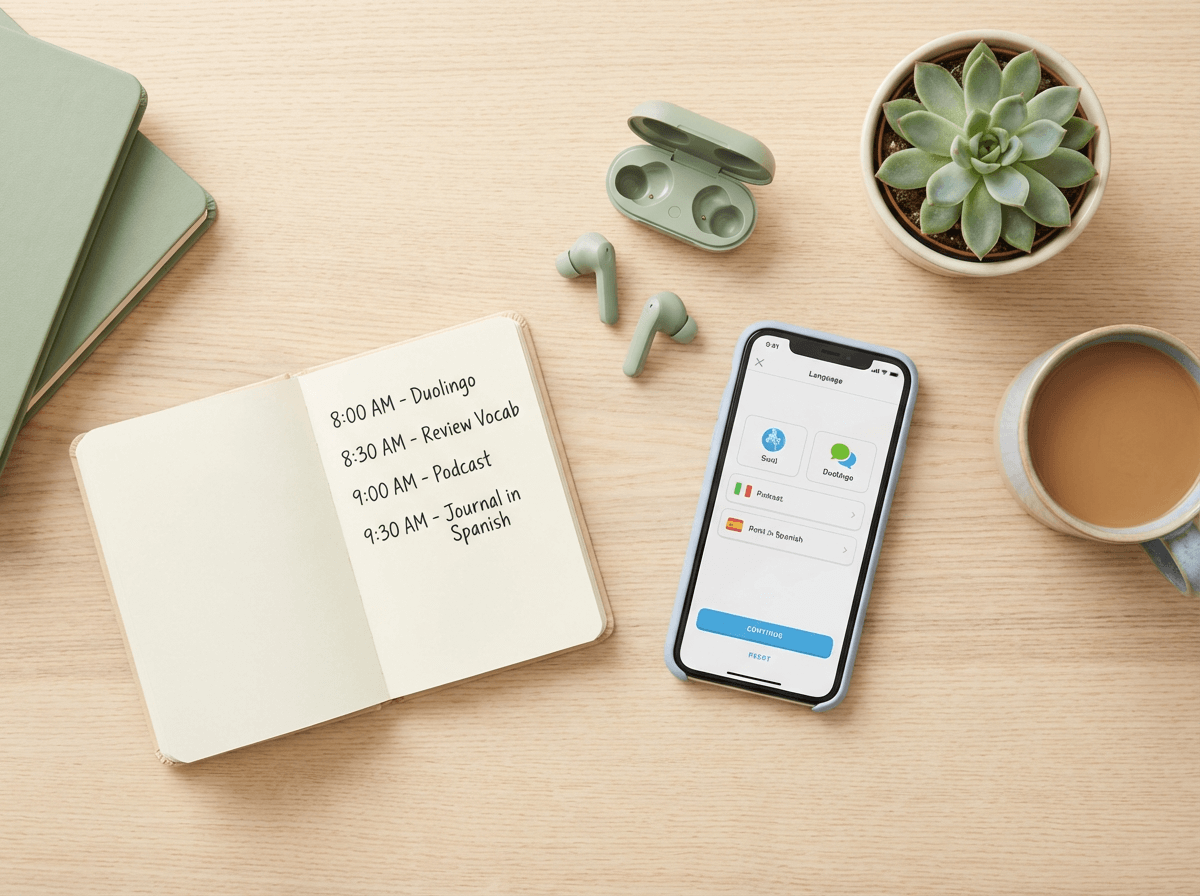
You don't need all 10 methods. Here's how to combine a few techniques into a daily speaking practice routine:
Beginners (15 min/day):
- 5 min — Narrate your morning routine in English (Method 4)
- 5 min — Read one paragraph aloud (Method 3)
- 5 min — Record a voice diary entry (Method 10)
Intermediate learners (20 min/day):
- 5 min — AI conversation with Practice Me (Method 1)
- 5 min — Shadow a TED Talk clip (Method 2)
- 5 min — Sing along to an English song (Method 8)
- 5 min — Voice diary (Method 10)
Advanced speakers (15 min/day):
- 10 min — Extended AI conversation on a complex topic (Method 1)
- 5 min — Movie scene with full emotional delivery (Method 9)
The golden rule: consistency beats intensity. Ten minutes of speaking practice daily improves your English faster than an hour once a week. Your brain builds language pathways through repetition, and those pathways weaken when you skip days.
If you choose just one method, make it Method 1. An interactive AI conversation exercises all speaking skills at once — listening, processing, producing, and self-correcting. It's the closest thing to English immersion you can create from home. Practice Me offers an affordable subscription for unlimited conversations, making consistent daily practice accessible for any learner.
On the path to becoming fluent in English, consistent speaking practice is what separates learners who improve from those who stay stuck at the same level for years. Start with 5 minutes today. Don't stop.
Frequently Asked Questions
How long does it take to improve English speaking alone?
Most learners notice improved confidence within 2-3 weeks of daily practice. Measurable fluency improvements — faster speech, fewer pauses, broader vocabulary use — typically appear after 8-12 weeks of consistent effort (15+ minutes/day). The key factor is consistency. Practicing your English speaking alone every day, even briefly, produces far better results than occasional long sessions.
Can I really improve my speaking skills without talking to another person?
Yes, with an important caveat. Shadowing, reading aloud, and narrating your life effectively build pronunciation, fluency, and confidence by yourself. What they can't fully replicate is real conversational unpredictability — unexpected questions and spontaneous responses. That's exactly why AI conversation partners help so much. They give you real interactive dialogue practice that helps you learn to think on your feet — without needing another human.
What's the best way for beginners to practice English speaking alone?
Start with narrating your daily life (Method 4) and reading aloud (Method 3) — no technology or preparation needed, and they work at any skill level. Once you're comfortable producing basic English sentences, add an AI conversation partner (Method 1) for interactive speaking practice. The natural progression from monologue to conversation builds confidence gradually.
How many minutes a day should I practice speaking English?
Quality matters more than quantity in language learning. Fifteen to twenty minutes of focused, active English speaking practice daily helps more than two hours of passive listening. If 15 minutes feels like too much, start with 5. One short session where you're actually speaking words out loud always helps more than a long session of only thinking about practicing.
Is talking to AI as effective as talking to a real person?
For building fluency, improving pronunciation, and developing conversational confidence — yes, remarkably so. AI tutors like those in Practice Me respond naturally, adapt to your level, and create a judgment-free space for making mistakes and learning from them. Human conversations still have an edge in cultural nuance, humor, and emotional depth. The best approach combines both: use AI for daily speaking practice to build your skills, and have real conversations whenever you can.