Duolingo taught you words. No one taught you to speak.
PracticeMe: real voice conversations with an AI tutor, 24/7.
15 Expert Tips to Improve English Speaking Skills

You've heard the generic tips to improve English speaking skills before. "Practice more." "Watch English movies." "Don't be afraid of mistakes." It all sounds helpful — but none of it tells you what to actually do when you sit down to practice.
How can you improve your English speaking skills in a way that produces real results? With specific, repeatable exercises grounded in language acquisition research. Each of the 15 tips below tells you exactly what to do, why it works (backed by real studies), gives you a 5-minute exercise to start today, and sets a realistic timeline so you know when to expect improvement.
No vague advice. No fluff. Just proven ways to improve English speaking that you can act on immediately.
Quick Summary: Learning how to improve your English speaking skills comes down to three pillars: pronunciation (how clearly your words sound), fluency (how smoothly you speak), and confidence (whether you actually open your mouth). The 15 tips below cover all three, each with a daily exercise you can finish in 5 minutes or less. Most people see noticeable improvement within 2-4 weeks of consistent daily practice.
Pronunciation Tips to Improve English Speaking Skills
Pronunciation isn't about sounding "perfect" — it's about being clearly understood by the people you speak with. If you want to learn how to improve English speaking, start here. These five tips help you sound more natural by targeting the physical and auditory skills behind clear speech.
1. Shadow Native Speakers (The Mimic Method)
What it is: Listen to a native English speaker and repeat what they say in real time — not after they finish, but while they're still talking. You become their vocal shadow.
Why it works: A 2025 systematic review of 44 studies published in the Journal of Second Language Pronunciation found that shadowing consistently improves pronunciation accuracy, fluency, and prosody. A separate study in Brain Imaging and Behavior shows the technique strengthens your phonological loop — the part of working memory responsible for processing speech sounds — helping you hear and reproduce natural English patterns more easily.
Your 5-minute exercise: Find a 2-minute podcast clip or YouTube video (TED Talks work well). Play it and repeat everything the speaker says simultaneously, matching their speed, rhythm, and intonation. Run through it twice — once focusing on individual sounds, once on overall rhythm.
Timeline: Daily practice for 2-4 weeks typically produces noticeable pronunciation improvement. You'll start catching your own errors automatically.
Want to practice shadowing with a live conversation partner? Practice Me's AI tutors speak with native American and British accents — available 24/7 for real-time voice practice whenever you need help.
2. Train Your Ear with Minimal Pairs
What it is: Minimal pairs are two words that differ by just one sound: ship/sheep, bit/beat, fan/van, rice/lice. Practicing them trains your ear to hear — and your mouth to produce — sounds that might not exist in your native language.
Why it works: Many pronunciation errors happen because your brain can't distinguish certain English sounds yet. Spanish speakers often struggle with b/v. Japanese speakers mix up r/l. Arabic speakers confuse p/b. Minimal pair training rewires your auditory processing, helping you improve both listening and speaking skills at the same time.
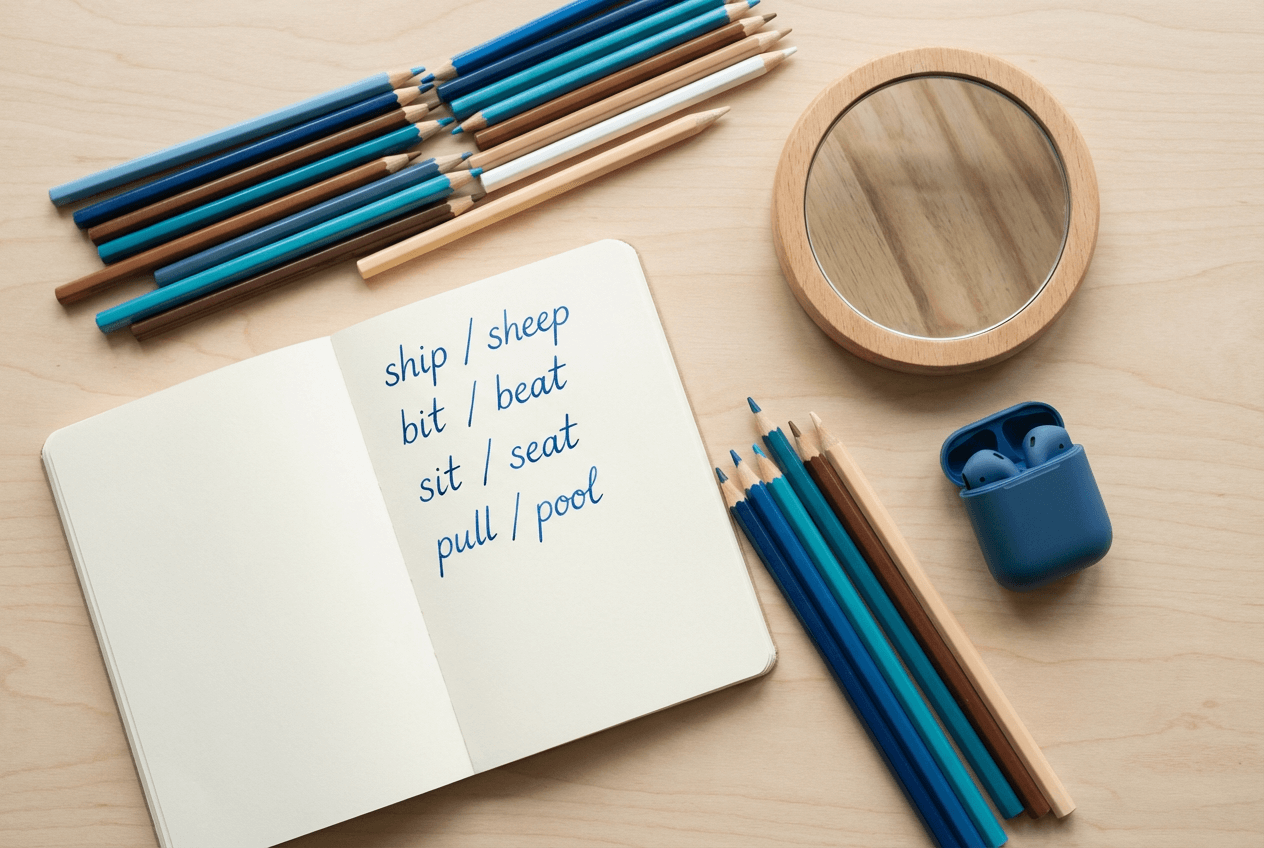
Your 5-minute exercise: Choose 5 minimal pairs targeting sounds you find difficult. Say each word 10 times, alternating: "ship, sheep, ship, sheep..." Record yourself and listen back — can you clearly hear the difference?
Timeline: Most learners notice improved sound distinction within 1-2 weeks. Full production accuracy takes 4-6 weeks of regular practice.
3. Master Mouth Mechanics (Tongue and Lip Positioning)
What it is: English has 44 distinct phonemes — more than most world languages. Sounds like th (as in "think") or the American r require tongue and lip positions that feel completely foreign to many students. Learning the physical mechanics makes these sounds dramatically easier.
Why it works: Pronunciation is a physical skill. Your tongue, lips, and jaw need to learn new positions. Once you know where to place your tongue for "th" (between your teeth, air flowing over it), the sound becomes reproducible on demand rather than an unpredictable gamble.
Your 5-minute exercise: Stand in front of a mirror. Practice these words slowly, watching your tongue: think, this, that, three, through, weather, brother. Exaggerate the tongue placement at first. Repeat each word 5 times.
Timeline: Individual sound mastery takes 1-2 weeks of daily practice. Results are immediate — you'll hear the difference in your very first session.
4. Choose Your Accent and Commit
What it is: Pick either American English or British English as your target accent, then practice consistently within that system.
Why it works: Mixing accents creates inconsistent patterns that confuse listeners. American English pronounces the r in "car" — British English often drops it. American says "schedule" with "sk" — British uses "sh." Committing to one system lets you build consistent muscle memory and helps your English speaking sound more natural.
Your 5-minute exercise: Listen to 2 minutes of your chosen accent (a news anchor or online teacher works well). Write down 3 specific pronunciation differences from how you currently speak. Practice those 3 for the remaining minutes.
Timeline: Accent consistency improves within 4-6 weeks of focused daily practice.
With Practice Me, you can select between American and British accent tutors — so every conversation reinforces the system you've chosen.
5. Warm Up with Tongue Twisters
What it is: Tongue twisters challenge your articulation muscles. They're the vocal equivalent of stretching before a workout.
Why it works: Repetitive practice of difficult sound combinations strengthens the motor speech patterns your mouth needs for clear communication. Your articulators learn to transition between sounds faster — the same principle athletes use when drilling specific movements.
Your 5-minute exercise: Pick 3 tongue twisters and say each 5 times, increasing speed:
- "She sells seashells by the seashore" (s/sh distinction)
- "Red lorry, yellow lorry" (r/l and vowel transitions)
- "Unique New York, unique New York" (nasal sounds)
Timeline: Smoother articulation within 1-2 weeks. Best used as an ongoing warm-up habit.
Fluency Tips: Think Less, Speak More
Fluency doesn't mean perfect grammar — it means speaking smoothly with natural rhythm and minimal hesitation. These tips help you improve English speaking fluency by shrinking the gap between thinking and talking.

6. Learn Phrase Chunks, Not Individual Words
What it is: Instead of memorizing single vocabulary words and assembling sentences in real-time, learn common phrases as complete units: "as a matter of fact," "to be honest," "the thing is," "I was wondering if..."
Why it works: Native speakers rely heavily on prefabricated chunks rather than building sentences word by word (Pawley & Syder). A study in Frontiers in Psychology confirmed that learners taught lexical chunks scored significantly higher on oral proficiency tests than those who learned individual words. Your brain stores chunks as single units, freeing cognitive resources for meaning and natural conversation flow.
Your 5-minute exercise: Learn 3 new phrase chunks today. Write them down, say each aloud 5 times, then use each in an original sentence. Tomorrow, review yesterday's and add 3 more.
Timeline: Noticeably smoother speech within 3-4 weeks. By week 6, you'll use chunks automatically.
Practice Me's vocabulary tracking automatically saves new words and phrases from your conversations with AI tutors — building your personal phrase library as you speak.
7. Replace Filler Words with Strategic Pauses
What it is: Identify your filler words — um, uh, like, you know, basically — and consciously replace them with brief silence.
Why it works: Fillers signal that you're struggling to find the right words. A deliberate pause sounds confident instead. Professional speakers use pauses constantly. The silence gives your brain time to formulate your next thought without broadcasting hesitation.
Your 5-minute exercise: Record yourself speaking for 2 minutes on any topic. Play it back and count every filler word. Re-record, aiming to cut fillers by half. The goal is awareness, not perfection.
Timeline: 50% filler reduction within 2-3 weeks of conscious effort.
8. Speed-Read Aloud Daily
What it is: Read English text aloud at a pace slightly faster than comfortable. Keep going without stopping to self-correct.

Why it works: This forces your brain to process English faster, building automaticity — the ability to produce language without conscious deliberation. It's the same principle musicians use when practicing scales above performance speed.
Your 5-minute exercise: Open any English news article. Read it aloud while timing yourself. Read it again, trying to beat your time by 10-15 seconds while maintaining clarity.
Timeline: Improved reading speed and speaking pace within 2-3 weeks of daily practice.
9. Think in English (Stop Translating)
What it is: Narrate your daily activities and observations directly in English. When you see a red car, think "red car" — not in your mother tongue first.
Why it works: Translation creates a bottleneck. Every time you think in your native language then convert to English, you add a processing step that creates hesitation. Thinking directly in English eliminates this delay. Research on situated learning confirms that contextual language use accelerates speaking development better than classroom exercises alone.
Your 5-minute exercise: Look around you right now. Describe everything you see in English for 5 minutes without stopping. Don't worry about grammar — just keep the words flowing. "White wall. Laptop on desk. Coffee cup almost empty..."
Timeline: Reduced mental translation within 3-4 weeks. This compounds — the longer you do it, the more automatic English thinking becomes.
Duolingo taught you words. No one taught you to speak.
PracticeMe: real voice conversations with an AI tutor, 24/7.
10. Try the 4-3-2 Repetition Technique
What it is: Pick a topic. Talk about it for 4 minutes, then 3, then 2. Each retelling forces you to speak more efficiently.
Why it works: Developed by language researcher Paul Nation, each repetition compresses the same content into less time. Your brain eliminates filler, reorganizes information, and automatizes the language. By the third telling, words flow because content is already in working memory — you're just refining delivery.
Your 5-minute exercise: Talk about your weekend plans for 4 minutes, then 3, then 2. Notice how each version gets smoother. A shorter 3-2-1 format works too.
Timeline: Improved speech rate within 2 weeks. One of the fastest fluency-building techniques available.
Confidence Tips: How to Improve English Speaking by Beating Anxiety
Here's what most teachers won't tell you: confidence is the biggest barrier for most English learners. Not grammar. Not vocabulary size. Not pronunciation.
Research in Frontiers in Psychology confirms that foreign language speaking anxiety directly impairs your ability to access words and grammar you already know. You have the knowledge — anxiety blocks it. These tips help you overcome that barrier.

11. Start with an AI Conversation Partner
What it is: Before high-pressure conversations with native speakers, practice speaking with an AI partner. Lower stakes, zero judgment, available anytime.
Why it works: A 2025 study in Nature Humanities and Social Sciences Communications found AI conversation bots both improved speaking skills and reduced anxiety simultaneously. Without fear of judgment, learners speak more freely, experiment with new vocabulary, and learn faster.
Your 5-minute exercise: Have a 5-minute voice conversation about your day with an AI tutor. Don't prepare — just talk naturally. The goal is getting English words flowing without performance pressure.
Timeline: Reduced speaking anxiety within 1-2 weeks. Many learners feel "unblocked" after just a few sessions.
Practice Me was designed for this. Real-time voice conversations with AI tutors like Sarah, Oliver, or Marcus — each with their own personality and native accent. It feels like a phone call, not a class. Tutors adapt to your level, so you're never overwhelmed. You can try it free for 3 days, then keep going on an affordable yearly plan.
12. Record Yourself and Actually Listen Back
What it is: Record 2 minutes of yourself speaking English daily, then listen back. Most people skip the playback, which is where all the learning happens.
Why it works: Self-monitoring helps you notice patterns invisible in real-time: repeated errors, unnatural intonation, mispronounced words — and things you do well. It's like watching game film as an athlete.
Your 5-minute exercise: Record 2 minutes of speaking. Listen back. Write down one strength and one thing to work on. Focus on that improvement area tomorrow.
Timeline: Self-awareness and natural self-correction within 1-2 weeks. Practice Me's progress tracking complements this by showing your speaking time and vocabulary growth in concrete numbers.
13. Create Positive Self-Talk Scripts
What it is: Replace vague negative thoughts ("My English is terrible") with specific positive facts ("I learned 5 new phrases this week and used 3 in conversation").
Why it works: Psychologist Albert Bandura's self-efficacy research shows beliefs about your ability directly affect performance. Learners who believe they're improving take more risks — leading to faster improvement. Negative self-talk creates avoidance.
Your 5-minute exercise: Write 3 specific, true statements about your English progress. Read them aloud each morning:
- "I understood yesterday's podcast episode."
- "I ordered coffee in English last Tuesday."
- "I can introduce myself confidently in English."
Timeline: Mindset shift within 2-3 weeks. Awkward at first — that's normal and means it's working.
If you struggle with the fear of speaking a foreign language, positive self-talk is among the first tools language psychologists recommend.
14. Keep a "Small Wins" Speaking Journal
What it is: Each evening, write 1-2 speaking wins from your day. Anything counts: new word used, conversation held, native speaker understood, self-correction made.

Why it works: Progress tracking activates reward pathways and builds momentum. When improvement feels invisible (common in language learning), your journal provides evidence you're moving forward. It shifts focus from "how far I need to go" to "how far I've come."
Your 5-minute exercise: Before bed, write down today's speaking wins. Be specific: "Used 'nevertheless' correctly" beats "practiced English." Even on tough days, find something.
Timeline: Increased motivation and confidence within 1-2 weeks. The journal becomes addictive once you build a streak.
15. Use Progressive Exposure (The Comfort Zone Ladder)
What it is: Build a ladder from easiest to hardest speaking situations and climb one rung at a time:

- Talk to yourself in English (mirror practice)
- Talk to an AI tutor (judgment-free)
- Talk to a patient friend in English
- Talk to a stranger (ordering food, asking directions)
- Talk in a group in English
Why it works: This follows the psychological principle of systematic desensitization — gradually increasing exposure to anxiety-provoking situations reduces the anxiety over time. Each successful step builds confidence for the next. Skipping to step 5 often backfires.
Your 5-minute exercise: Identify your current comfort level. Plan one step up this week. At rung 1? Try a 5-minute AI conversation with Practice Me — the easiest bridge from self-talk to real conversation.
Timeline: Significant confidence improvement across 4-6 weeks. Consistency beats speed.
Your 30-Day Plan to Improve English Speaking
Don't attempt all 15 tips simultaneously. Here's a practical approach:
Week 1-2: Pronunciation Focus Pick 2 pronunciation tips (start with shadowing). Practice 10-15 minutes daily. Begin your speaking journal from day one.
Week 2-3: Add Fluency Keep pronunciation practice. Add phrase chunks + thinking in English. Start daily AI conversation practice for real speaking experience.
Week 3-4: Layer in Confidence Maintain routines. Add progressive exposure — climb one ladder rung per week. Celebrate your progress.
The path to becoming fluent in English isn't about memorizing grammar rules — it's about speaking more often, in more situations, with less hesitation each time. Even 15-20 minutes of focused daily practice using these tips to improve English speaking skills produces real, measurable results. Start with one tip today.
Frequently Asked Questions
How long does it take to improve English speaking skills?
With 15-20 minutes of consistent daily practice, most learners notice pronunciation and fluency improvements within 2-4 weeks. Confidence gains typically take 4-6 weeks. Improvement is ongoing — daily consistency matters far more than marathon sessions.
Can I improve my English speaking skills without a conversation partner?
Yes — shadowing, minimal pairs, tongue twisters, speed reading aloud, thinking in English, and self-recording all work solo. However, practicing with a partner (even an AI tutor) accelerates progress because conversation forces spontaneous responses that solo practice can't fully replicate.
What's the fastest way to improve English pronunciation?
Shadowing combined with minimal pairs targeting your specific problem sounds. Add mirror practice for mouth mechanics. Expect noticeable changes in 2-4 weeks with daily 10-minute sessions.
How many hours a day should I practice speaking English?
Quality beats quantity. The 70-30 rule suggests 70% active production (speaking, writing) and 30% passive input (listening, reading). For most learners, 15-30 minutes of focused daily speaking practice produces better results than 2 hours of unfocused effort.
Is it better to practice English speaking with a native speaker or AI?
Both have strengths. Native speakers offer cultural context and authentic interaction. AI partners provide zero judgment, 24/7 availability, and infinite patience. Research shows AI practice reduces speaking anxiety significantly — making it an ideal starting point before progressing to human conversation partners.