Duolingo taught you words. No one taught you to speak.
PracticeMe: real voice conversations with an AI tutor, 24/7.
English Speaking Practice for Beginners: Start Here
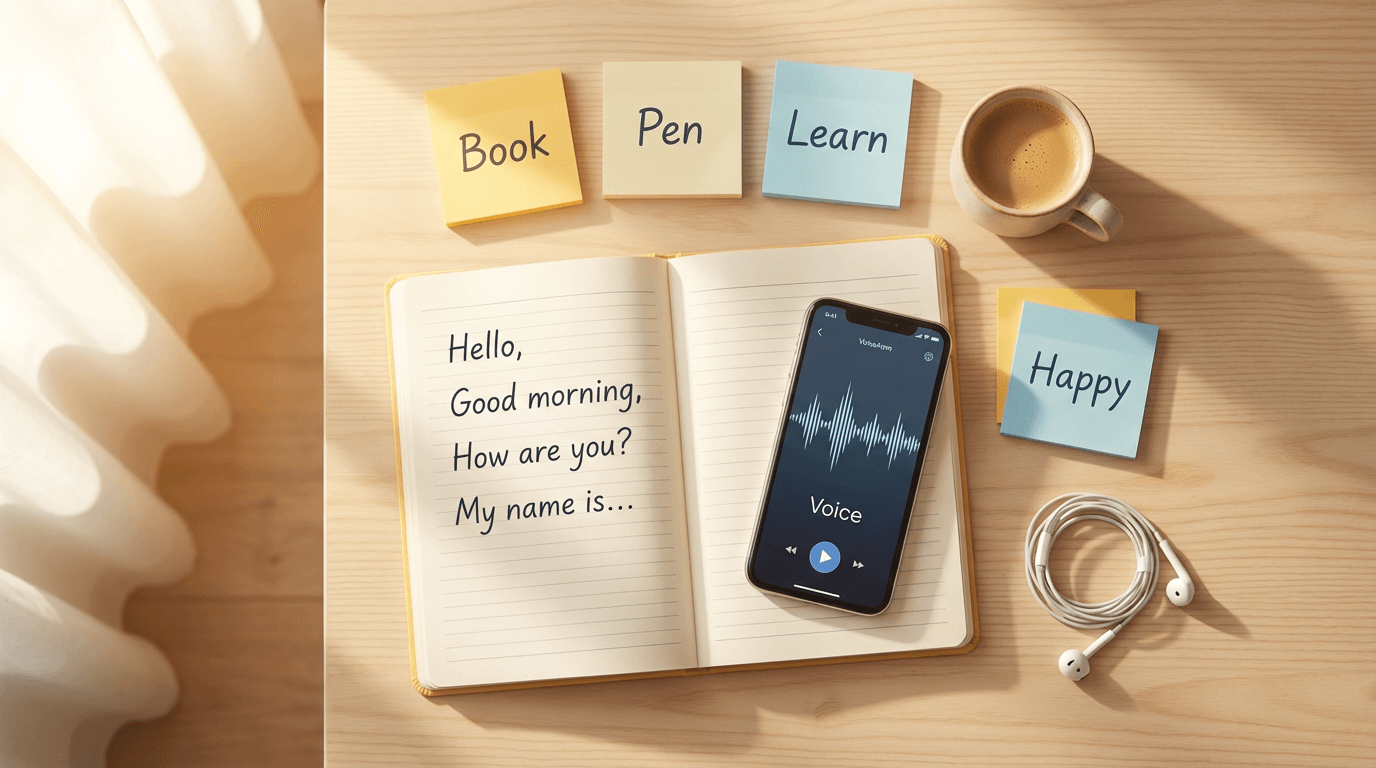
English speaking practice for beginners starts with one truth: you already know more English than you think. If you're reading this page right now, you've proven that.
Learning to speak English feels overwhelming at first. Your mind goes blank. Words disappear the moment you try to say them out loud. You worry about sounding foolish. Every fluent speaker you meet makes it look effortless — and that makes you feel even further behind.
Here's the truth: every single one of those fluent speakers started exactly where you are now. They stumbled over "hello." They forgot simple words. They felt embarrassed.
The difference? They started speaking anyway. And this guide will show you exactly how to do the same — starting today, with free tips, practical activities, and a simple plan you can follow right now. No expensive courses or online classes required.
Quick Summary: English speaking practice for beginners doesn't require a large vocabulary or perfect grammar. Focus on 3 foundational skills (greetings, numbers, everyday objects), follow a simple 7-day speaking plan, and practice in a judgment-free environment. Consistency beats perfection — even 15 minutes of daily conversation practice builds real confidence within weeks.
Why English Speaking Practice for Beginners Feels So Hard
Let's talk about the fears that are probably running through your head right now. Research from the BBC and the British Council shows these three questions come up again and again among students learning English:
"What if I make a mistake?" This is the #1 fear among English learners — and not just beginners. Even advanced speakers worry about this. But mistakes are how your brain builds new language pathways. Every error you make is literally rewiring your brain to improve faster next time. Good teachers and tutors know this.
"What if people judge me?" Here's something most beginners don't realize: native English speakers almost never judge someone for trying to learn their language. They're far more likely to appreciate the effort. The judgment you fear is usually coming from inside your own head.
"What if my mind goes blank?" This one has a scientific explanation. When you feel anxious about speaking, your amygdala — the brain's fear center — activates and actually reduces your brain's ability to process language. The words are in there. Anxiety is blocking them.
The solution isn't more grammar lessons or memorizing longer vocabulary lists. It's reducing the anxiety around speaking through consistent, low-stakes practice where mistakes don't matter. That's the most effective method to build spoken English fluency.
That's exactly what this guide is designed to give you. If the fear of speaking a foreign language has been holding you back, know that it's a normal human response — not a sign that you can't learn English.

3 Foundational English Speaking Skills to Build First
Don't try to learn everything at once. You don't need an online course, expensive classes, or a textbook to get started with English speaking practice for beginners. You need three building blocks that cover the majority of basic English conversations. Master these foundational speaking skills, and you'll have enough vocabulary and confidence to start real conversation practice — which is where improvement truly happens.
Greetings and Simple Introductions
These phrases will carry you through every first English conversation:
- Hello / Hi / Good morning / Good afternoon / Good evening
- My name is ___. What's your name?
- Nice to meet you.
- How are you? I'm fine / good / great, thank you.
- Where are you from? I'm from ___.
- What do you do? I'm a student / I work as a ___.
That's roughly 10-15 phrases, and they cover the first 2-3 minutes of nearly every conversation in English. You don't need hundreds of words to begin. You need these practiced until they roll off your tongue automatically.
Free practice tip: Say these phrases out loud 5 times each. Not in your head — out loud. Speaking English uses different muscles and brain pathways than reading or listening. This simple pronunciation exercise makes a bigger difference than any grammar lesson because it builds the muscle memory you need for real communication.
Numbers, Time, and Everyday Questions
These are your survival phrases — the ones that help you navigate real-world situations from day one of your English learning journey:
- Numbers 1-100 (start with 1-20, then learn by tens: 30, 40, 50...)
- What time is it? It's 3 o'clock / half past 5.
- How much does this cost?
- Where is the ___? (bathroom, bus stop, hotel)
- Can you help me, please?
- I don't understand. Can you say that again?
That last one is a superpower phrase. Saying "I don't understand" isn't a weakness — it's a smart communication strategy that keeps conversations going instead of letting them stall in awkward silence. Learn this phrase early and use it without shame.
Common Objects and Simple Descriptions
Learn the nouns you'll encounter daily — food (water, coffee, bread, chicken, rice), places (hotel, airport, restaurant, hospital), and transportation (bus, taxi, train). Then pair them with simple adjectives:
- Big / small
- Hot / cold
- Good / bad
- Expensive / cheap
- Open / closed
Now combine them: "The coffee is hot." "The restaurant is good." "The hotel is expensive." Congratulations — you're forming real English sentences. No grammar course or paid online lessons required. Just pure speaking practice activities that build fluency from day one.

Your 7-Day English Speaking Practice Plan for Beginners
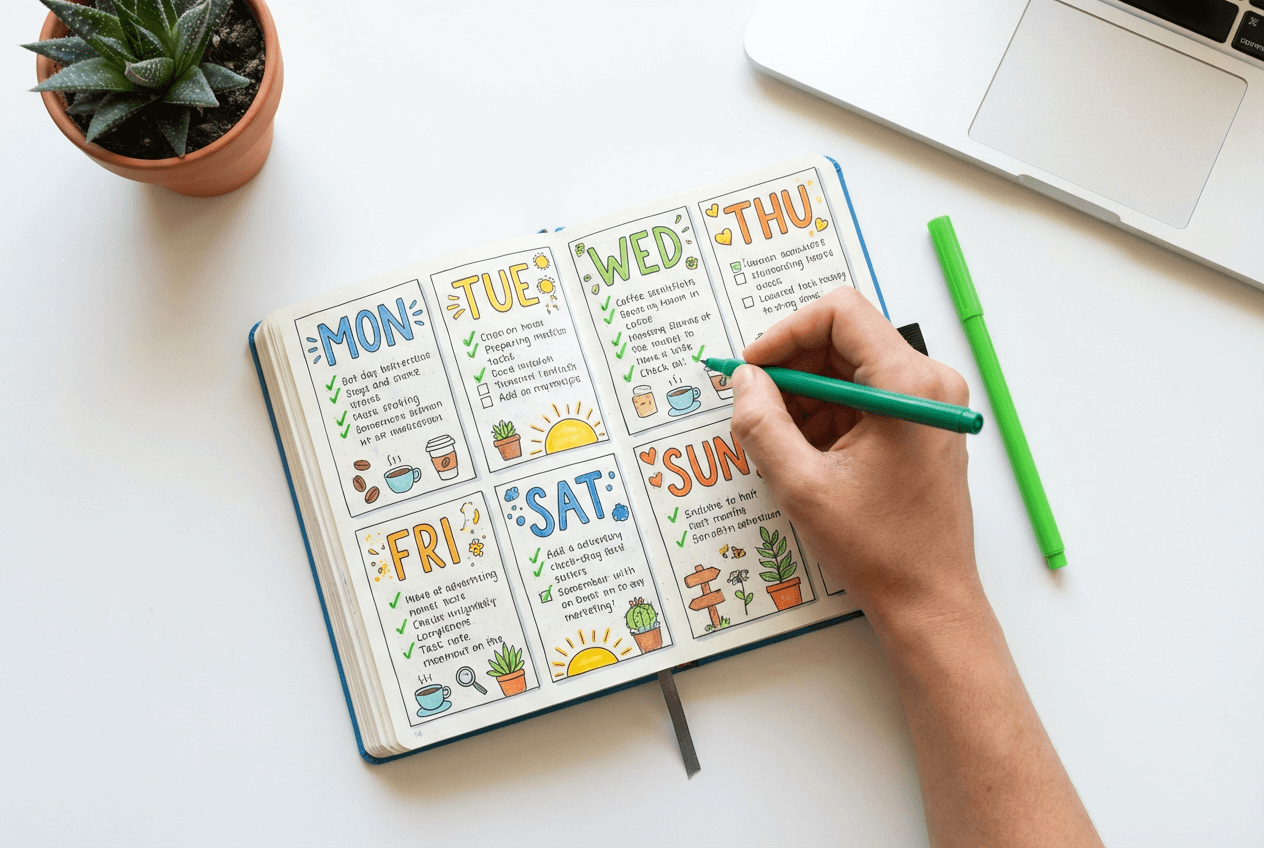
Here's a free plan that takes 15-20 minutes per day. Each day focuses on one practical English conversation topic — no grammar drills, no written exercises, no memorization. The goal isn't perfection. It's getting your mouth used to forming English words and your brain used to thinking in English.
You can practice these speaking lessons on your own, with a friend, or with an AI English tutor that adapts to your beginner level and gives you real-time feedback on your spoken English.
Day 1: Introduce Yourself
Your mission: Say 5 sentences about yourself out loud, without stopping.
Practice these: "Hi, my name is ___. I'm from ___. I'm ___ years old. I work as a ___ (or: I'm a student). I'm learning English because ___."
Say them to a mirror, to your phone, or to an AI tutor. Repeat until you can say all 5 smoothly. This is your English foundation — the conversation you'll have hundreds of times as you improve your fluency.
Day 2: Order Food and Drinks
Your mission: Complete a full ordering conversation from greeting to goodbye.
Practice this flow: "Hello. Can I have a coffee, please? And a sandwich. How much is it? Thank you. Goodbye."
This is one of the most common real-world situations where you'll speak English. Restaurants, cafés, food delivery — once you can do this, you've already improved a practical speaking skill that builds real confidence.
Day 3: Describe Your Daily Routine
Your mission: Describe your typical day in 8-10 sentences.
Use the present simple tense (the first and easiest grammar pattern for beginners): "I wake up at 7. I eat breakfast. I go to work. I have lunch at 12. I come home at 6. I eat dinner. I watch TV. I go to sleep at 11."
Simple? Yes. But stringing 8-10 sentences together without pausing is a real speaking achievement for someone just learning English conversation skills.
Duolingo taught you words. No one taught you to speak.
PracticeMe: real voice conversations with an AI tutor, 24/7.
Day 4: Describe Your Family or Friends
Your mission: Describe 3 people you know in simple sentences.
"My mother is a teacher. She is kind. She likes cooking." "My friend Ahmed is tall. He is funny. He likes football."
You're practicing descriptions, pronouns (he/she), and basic adjectives. These are topics you'll discuss often in English — people love talking about the people they know.
Day 5: Ask for Directions and Help
Your mission: Practice asking 5 different "where" or "how" questions out loud.
"Where is the train station?" "How do I get to the airport?" "Is there a pharmacy near here?" "Can you show me on the map?" "How far is it?"
Asking questions is a skill many beginners avoid because it means the other person will answer — and you might not understand them. That's okay. You can always say: "Can you speak slowly, please?" or "Can you say that again?" These listening and communication phrases are just as important to learn as the questions themselves.
Day 6: Talk About Things You Like
Your mission: Have a 2-minute English conversation about your hobbies and interests.
"I like playing football. I also like watching movies. My favorite movie is ___. I don't like cooking very much. On weekends, I like to go to the park."
This is where learning English gets fun. You're no longer just surviving — you're expressing your personality. Talking about topics you enjoy makes conversations feel natural and helps you remember new vocabulary better (your brain holds onto words connected to emotions).
Day 7: Put It All Together
Your mission: Have a 5-minute conversation that flows through multiple topics.
Combine everything from your week of speaking practice: introduce yourself, describe what you did today, talk about your family, ask questions, order something, share what you like. This is your "graduation conversation" — proof that in just one week of English speaking practice for beginners, you've built a real foundation for fluency.
After finishing Day 7, you're no longer someone who "can't speak English." You're someone who speaks English at a beginner level — and that's a massive difference. From here, you can keep improving by expanding into new conversation topics each week. For a longer-term roadmap, check out our guide on how to become fluent in English.
How AI Tutors Help Beginners Learn and Improve English Speaking
The biggest barrier to English speaking practice for beginners isn't a lack of study material, free online resources, or grammar courses. It's a lack of a safe, patient conversation partner who gives helpful feedback.
Finding someone to practice spoken English with is hard. Scheduling lessons with a human teacher costs money and requires coordination. Speaking with native speakers feels terrifying when you're just starting to learn. And language exchange partners often get frustrated with slow conversations.
This is where AI tutors change everything for students and self-learners.
Practice Me's AI tutors — Sarah, Oliver, and Marcus — detect your speaking level and automatically adjust. When they sense you're a beginner, they:
- Speak slower and use simpler vocabulary so you can follow along and improve your listening skills
- Wait patiently while you search for the right word — no rushing, no awkward silence pressure
- Gently correct pronunciation and grammar without making you feel embarrassed, providing real-time feedback
- Offer encouragement when you complete sentences or try new phrases
- Let you choose your accent — American or British English, depending on your learning goal
The best part? You can repeat the same conversation 50 times and they'll never get bored, impatient, or judgmental. Try asking a human teacher to do that.
With Practice Me, you can work through every day of the 7-day plan above by having real voice conversations on your iPhone or iPad — like a phone call with a patient, supportive teacher who's available whenever you are. 24 hours a day, 7 days a week. It's the most effective way to get English speaking practice for beginners without the stress of real-world judgment.

From "I Can't Speak English" to "I Just Had a Conversation"
What does beginner progress actually look like? Here are three realistic scenarios showing how consistent English speaking practice leads to real improvement:
Maria, Brazil — Week 1 to Week 3: Maria was too nervous to order coffee in English on vacation. She started with the Day 1 introduction activity, practicing 15 minutes daily with an AI tutor. By week 2, she completed full café ordering conversations without freezing up. By week 3, she described her daily routine fluently enough to surprise herself. Her grammar still isn't perfect — but she no longer panics when speaking English. Her confidence grew with every conversation.
Kenji, Japan — Week 1 to Week 4: Kenji needed English for work meetings but always let colleagues speak for him. He started by practicing self-introductions and slowly added work-related vocabulary to his daily speaking exercises. After 4 weeks of daily practice, he introduced himself at a meeting in English for the first time. It wasn't perfect — he forgot two words and paused twice — but his team understood him. He said it felt like "finally unlocking a door."
Fatima, Egypt — Week 1 to Week 6: Fatima was preparing for university in an English-speaking country. She could read English well but had barely spoken it. She started with basic conversation practice and gradually increased difficulty with her AI tutor. By week 6, she was discussing academic topics in 10-minute English conversations. She still practices daily — not because she has to, but because she genuinely enjoys improving her fluency.
None of these stories involve overnight transformations. They all started with someone who thought "I can't do this" — and proved themselves wrong through consistent, low-pressure English speaking practice.

Ready to start your own story? Download Practice Me and have your first English conversation today. You can also review the pricing plans for unlimited access to all three AI tutors.
Frequently Asked Questions
How long does it take a beginner to speak English?
With 15-20 minutes of daily English speaking practice, most beginners can hold basic conversations within 4-8 weeks. You won't be fluent — becoming fluent in English typically takes 6-12+ months of consistent practice — but you'll be able to introduce yourself, order food, describe your day, and handle common situations with confidence. Speaking skills improve much faster than perfect grammar.
Can I practice English speaking if I only know a few words?
Absolutely. You don't need a large vocabulary to start spoken English practice. Research suggests that the 100 most common English words make up about 50% of everyday conversation. Start with greetings, numbers, and basic questions — the foundational skills covered above — and build from there. Practice Me's AI tutors adapt to your exact level, even if you're a true beginner with just a handful of English words.
What if I'm too embarrassed to speak English?
This is the single most common reason people delay English speaking practice — and it's exactly why practicing with an AI tutor helps. There's no human listening, no one to judge your pronunciation, and no social consequences for making mistakes. You can stumble, pause, and try again as many times as you need. Many learners find that after building confidence with AI conversation practice, speaking with native speakers feels much less intimidating. Read more about overcoming language speaking anxiety.
Is 15 minutes a day enough to improve my English speaking?
Yes — and it's more effective than you might think. Short, consistent daily practice beats long, occasional study sessions every time. Fifteen minutes of actual speaking practice — where you're saying words out loud, not just reading online lessons or doing grammar exercises — builds muscle memory, pronunciation skills, and conversational reflexes. The key word is daily. Five days of 15-minute English speaking practice sessions will improve your fluency faster than one 75-minute cramming session on the weekend.
What's the best way to start English speaking practice as a complete beginner?
Start with the 3 foundational skills above (greetings, numbers, common objects), then follow the free 7-day plan. The most important thing is to speak out loud from day one — even if it's just to yourself. Don't wait until you feel "ready" or until you've finished a grammar course. Students who start speaking immediately, even with limited vocabulary, learn and improve faster than those who study for months before attempting their first conversation. An AI tutor like Practice Me makes this easier by giving you a patient, judgment-free conversation partner available 24/7 to help you practice English speaking as a beginner.