Duolingo taught you words. No one taught you to speak.
PracticeMe: real voice conversations with an AI tutor, 24/7.
IELTS Speaking Practice Test: Questions & Band Scores
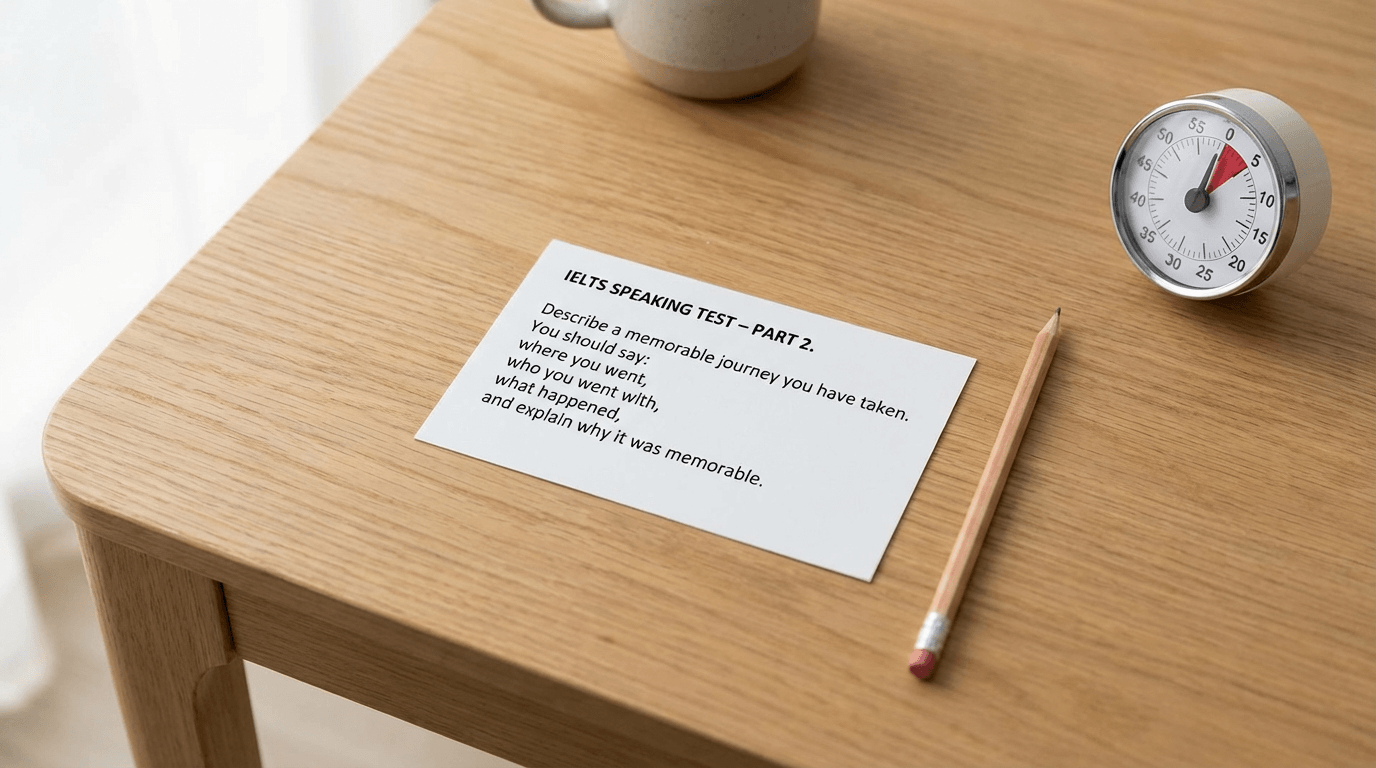
Looking for a complete IELTS speaking practice test with real sample questions and model answers? You're in the right place. This guide walks you through all three parts of the IELTS speaking exam practice — with 50+ sample questions, model answers analyzed at Band 6, 7, and 8 levels, and a full breakdown of how examiners actually score your speaking.
Quick Summary: The IELTS speaking practice test covers 3 parts: Part 1 (personal questions, 4–5 min), Part 2 (cue card task, 3–4 min), and Part 3 (abstract discussion, 4–5 min). You're scored on Fluency & Coherence, Lexical Resource, Grammatical Range & Accuracy, and Pronunciation — each worth 25%. Use the sample questions below as your own IELTS speaking practice test at home, then study the model answers and scoring criteria to understand what separates each band score.
How the IELTS Speaking Practice Test Is Structured
Unlike the listening, reading, and writing sections of IELTS — which use written answers — the speaking test is a face-to-face conversation with a certified examiner, lasting 11–14 minutes total. It's recorded for quality assurance, and the format is identical whether you're sitting IELTS Academic or General Training.
Here's the full test structure:
| Part | Name | Duration | Speaking Task |
|---|---|---|---|
| 1 | Introduction & Interview | 4–5 min | Personal questions on familiar topics (8–10 sample questions) |
| 2 | Individual Long Turn | 3–4 min | 1-min prep + 2-min monologue from a task card |
| 3 | Two-way Discussion | 4–5 min | Abstract questions related to Part 2 task topic |
The examiner assesses your speaking on four equally weighted criteria (25% each):
- Fluency and Coherence — Can you keep speaking without awkward pauses? Do your ideas connect logically?
- Lexical Resource — Do you use precise, varied vocabulary? Can you paraphrase when needed?
- Grammatical Range and Accuracy — Do you use a mix of simple and complex structures correctly?
- Pronunciation — Are you clearly understood? Do you use natural stress and intonation?
Your scores in each criterion are averaged and rounded to produce your final Speaking band score (whole or half bands like 6.0, 6.5, 7.0). According to IELTS scoring guidelines, if your average calculates to 6.25, it rounds up to 6.5 — if it's 6.1, it rounds down to 6.0.
IELTS Speaking Practice Questions: Part 1 (Introduction & Interview)
Part 1 is your warm-up. The examiner introduces themselves, checks your ID, then asks 8–10 questions on 2–3 familiar topics. These are about your life — your job, hometown, hobbies, daily routine.
Key strategy: Give answers that are 2–4 sentences long. One-word answers limit the sample of language the examiner can assess. But don't deliver a 2-minute monologue either — that's the task for Part 2.
Part 1 Sample Questions by Topic
Use these IELTS speaking practice questions to run your own mock test. Set a timer for 5 minutes and answer each question aloud — don't just read them silently.
Work & Studies
- Do you work or are you a student?
- What do you enjoy most about your job/studies?
- Would you like to change your job in the future?
- What subject do you find most difficult?
- Do you think your job will change much in the next few years?
Hometown & Living 6. Where is your hometown? 7. Has your hometown changed much in recent years? 8. What do you like about the area where you live? 9. Would you prefer to live in a city or the countryside?
Daily Life & Routines 10. What do you usually do on weekdays? 11. Do you prefer mornings or evenings? 12. How do you usually get to work or school? 13. What do you do to relax after a busy day?
Hobbies & Interests 14. What do you enjoy doing in your free time? 15. Have you taken up any new hobbies recently? 16. Do you prefer indoor or outdoor activities?
Technology & Media 17. How often do you use social media? 18. Do you prefer reading news online or in a newspaper? 19. What kind of apps do you use most often?
Part 1 Model Answer: Band 6 vs Band 7
Sample question: Do you prefer cooking at home or eating out?
Band 6 sample answer:
"I prefer cooking at home because it is cheaper. I cook simple food like rice and vegetables. Sometimes I eat out with my friends, but not very often because restaurants are expensive."
Band 7 sample answer:
"Honestly, I'd say I prefer cooking at home most of the time. I find it quite therapeutic — especially when I try new recipes from YouTube. That said, I do enjoy eating out occasionally, particularly when it's somewhere with a great atmosphere, like a small Italian place near my office that does incredible pasta."
What separates these two sample answers?
| Criteria | Band 6 | Band 7 |
|---|---|---|
| Vocabulary | Basic ("cheaper," "simple food") | Precise and varied ("therapeutic," "incredible," "great atmosphere") |
| Fluency | Direct but flat, no personality | Natural flow with discourse markers ("Honestly," "That said") |
| Grammar | Simple structures only | Mix of simple and complex ("I find it quite therapeutic — especially when...") |
| Detail | Generic and vague | Specific examples (YouTube recipes, Italian restaurant, pasta) |
The Band 7 answer isn't longer because of filler — it's longer because it includes specific details and natural language. This is exactly the kind of spontaneous detail you develop through regular English speaking practice.
IELTS Speaking Practice Questions: Part 2 (Cue Card Task)
Part 2 is where many test-takers panic. You receive a task card (also called a cue card) with a topic and 3–4 bullet points. You get 1 minute to prepare (with a pencil and paper) and then must speak for 1–2 minutes without stopping — similar to certain task types in the listening section where sustained attention is tested, but here you are the one producing language.
The examiner will not interrupt you during your monologue. They'll tell you when to stop, then may ask 1–2 brief follow-up questions about your task topic.
Key strategy: During your 1-minute prep, jot down a keyword for each bullet point — don't write full sentences. Think of one specific story or example you can build your speaking task around.
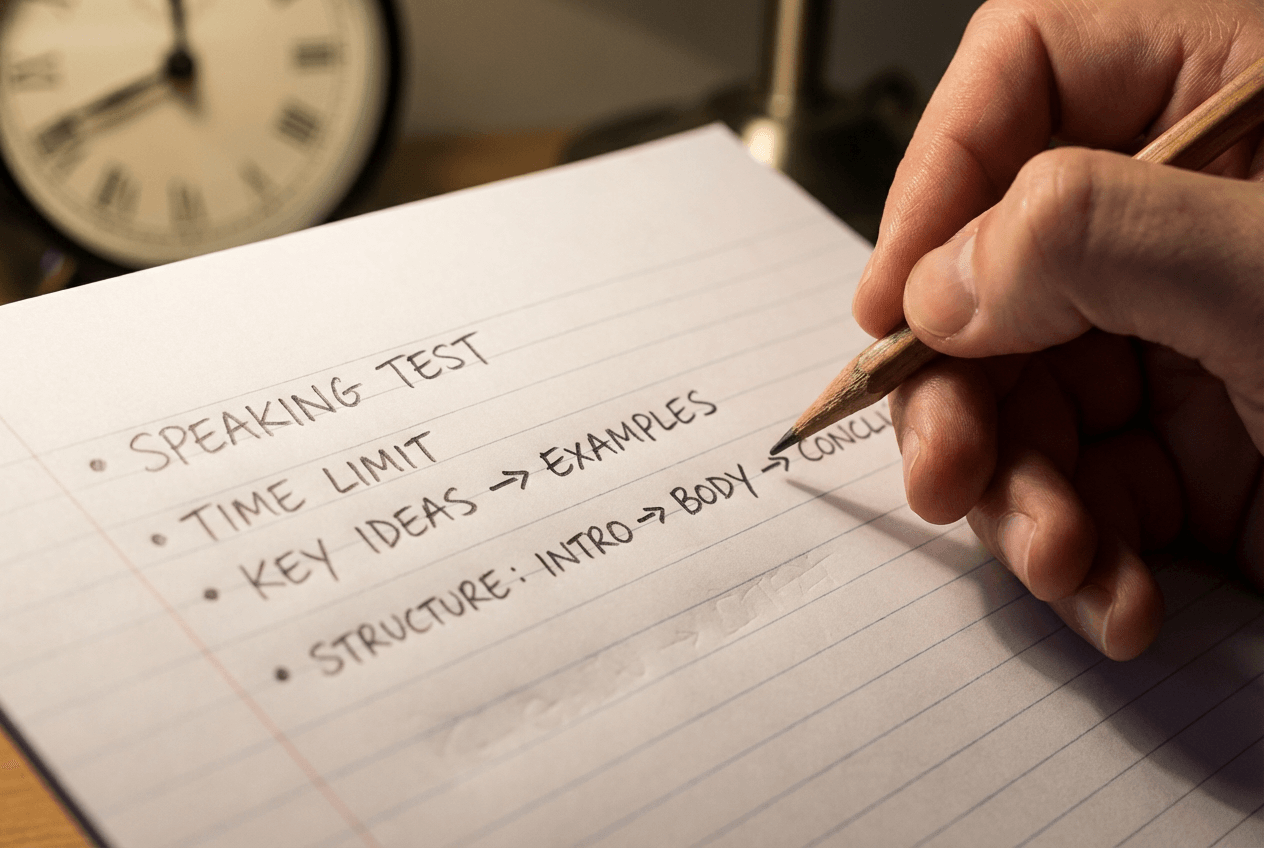
Part 2 Sample Cue Card Tasks
Here are 15 IELTS speaking practice test cue cards based on task topics from recent exams. For each sample task, give yourself 1 minute of prep and then speak for the full 2 minutes.
1. Describe a skill you recently learned. You should say: what the skill is / how you learned it / why you decided to learn it — and explain how you felt about learning it.
2. Describe a place you visited that left a strong impression on you. You should say: where the place is / when you visited it / what you did there — and explain why it made a strong impression.
3. Describe a time you helped someone. You should say: who you helped / what you helped them with / how you helped them — and explain how you felt afterward.
4. Describe something you own that is important to you. You should say: what it is / how you got it / how long you have had it — and explain why it is important to you.
5. Describe an occasion when you had to wait a long time. You should say: when it was / where you were / why you had to wait — and explain how you felt about waiting.
6. Describe a person who has influenced your life. You should say: who the person is / how you know them / what they have done — and explain how they influenced you.
7. Describe an outdoor activity you enjoy. You should say: what the activity is / where you do it / who you do it with — and explain why you enjoy it.
8. Describe a film or TV show that made you think. You should say: what the film/show was about / when you watched it / what happened in it — and explain why it made you think.
9. Describe a change you'd like to make in your life. You should say: what the change is / why you want to make it / how you would make it — and explain how it would improve your life.
10. Describe a conversation that was important to you. You should say: who you spoke with / what you talked about / where the conversation happened — and explain why it was important.
11. Describe an app or website you use regularly. You should say: what it is / what you use it for / how often you use it — and explain why you find it useful.
12. Describe a time you felt proud of yourself. You should say: when it happened / what you did / who was with you — and explain why you felt proud.
13. Describe an interesting older person you know. You should say: who the person is / how you know them / what makes them interesting — and explain what you have learned from them.
14. Describe a mistake you made and learned from. You should say: what the mistake was / when it happened / what you did about it — and explain what you learned.
15. Describe a city you would like to visit in the future. You should say: which city it is / why you want to visit it / what you would do there — and explain what interests you most about it.
Part 2 Model Answer: Band 8 Analysis
Sample task card: Describe a skill you recently learned.
"A few months ago, I decided to learn basic video editing, something I'd been putting off for ages. I'd always been intimidated by the software — you know, programs like DaVinci Resolve — but I started with some beginner tutorials on YouTube and just forced myself to experiment.
The reason I wanted to learn was actually quite practical. I'd been helping a friend document his small bakery business, and we realized that raw phone footage just wasn't cutting it. We needed proper edits — transitions, colour grading, background music — to make the content look professional enough for social media.
What surprised me was how quickly I picked up the basics. Within a couple of weeks, I could put together a decent two-minute video. The more advanced techniques — like motion tracking and audio mixing — those still frustrate me, honestly. But I've found the whole process incredibly satisfying. There's something about taking chaotic raw footage and turning it into a polished story that feels really creative.
Looking back, I think the biggest takeaway wasn't even the technical skill itself — it was realizing that most things seem harder from the outside than they actually are once you start."
Why this sample answer scores Band 8:
| Criteria | What the examiner hears |
|---|---|
| Fluency & Coherence | Speaks for the full 2 minutes without unnatural pauses. Ideas flow logically: motivation → process → result → reflection. Cohesive devices feel natural ("The reason was," "What surprised me," "Looking back"). |
| Lexical Resource | Precise vocabulary ("intimidated by the software," "colour grading," "motion tracking," "chaotic raw footage," "polished story"). Idiomatic language ("putting off for ages," "wasn't cutting it") feels authentic, not forced. |
| Grammar | Effortlessly switches between tenses (past simple, past perfect, present simple). Complex structures feel natural ("There's something about taking X and turning it into Y that feels..."). Only occasional minor lapses. |
| Pronunciation | Natural stress patterns and intonation make the response engaging. Clear word stress on multi-syllable words throughout. |
IELTS Speaking Practice Questions: Part 3 (Discussion)
Part 3 is where the examiner pushes you beyond personal experience into abstract thinking. The questions connect to your Part 2 task topic but require you to analyze, compare, evaluate, and speculate about broader issues.
This is the part that separates Band 6 from Band 7+ on the IELTS speaking exam practice. You can't rely on memorized phrases here — you need to think on your feet and respond spontaneously, much like the way writing Task 2 tests your ability to develop an argument, but spoken in real time.

Duolingo taught you words. No one taught you to speak.
PracticeMe: real voice conversations with an AI tutor, 24/7.
Part 3 Sample Questions by Category
Following a "skill" cue card task:
Opinion Questions
- Why do you think some people are better at learning new skills than others?
- Do you think schools should focus more on practical skills?
- Is it more important to specialize in one skill or learn many?
Comparison Questions 4. How is the way people learn skills today different from the past? 5. Do you think men and women tend to learn skills differently? 6. What's the difference between skills learned at school and skills learned from experience?
Hypothetical Questions 7. If technology keeps advancing, which skills might become unnecessary? 8. How would society be different if everyone had the same skills?
Following a "hometown/city" cue card task:
Opinion Questions 9. What makes a city a good place to live? 10. Do you think people are happier in big cities or small towns?
Comparison Questions 11. How are cities in your country different from cities in other countries? 12. Have the problems facing cities changed over the last 50 years?
Cause & Effect Questions 13. Why are more people moving to cities in developing countries? 14. What problems does rapid urbanization create? 15. How does public transport affect the quality of life in a city?
Future-focused Questions 16. How do you think cities will change in the next 20 years? 17. Will remote work reduce the importance of living in major cities?
Part 3 Model Answer: Band 7 Analysis
Sample question: Why do you think some people find it difficult to learn new skills?
"I think there are a few reasons, actually. Probably the biggest one is fear of failure — a lot of people are afraid of looking foolish when they're beginners, especially adults. Children don't have that problem as much because they're used to being bad at things and learning gradually.
Another factor is time. Most working adults feel they barely have enough hours in the day for their existing responsibilities, let alone picking up something new like a language or an instrument.
And I suppose there's also the issue of motivation. If someone doesn't have a clear reason to learn a skill — like a career goal or a personal project — they tend to give up quite quickly when it gets difficult."
Why this sample scores Band 7 (not 8):
| Strength (Band 7) | Gap to Band 8 |
|---|---|
| Ideas are clearly organized with topic sentences | Could explore one point more deeply instead of listing three |
| Good discourse markers ("Probably the biggest one," "Another factor," "I suppose") | Could use more sophisticated hedging ("It could be argued that...") |
| Accurate grammar with some complex structures | Could show more variety — conditionals, passive voice, relative clauses |
| Relevant vocabulary ("fear of failure," "existing responsibilities") | A few more precise/uncommon collocations would push the lexical resource score higher |
IELTS Speaking Scoring Criteria: What Examiners Actually Assess
Understanding the IELTS speaking scoring criteria isn't just academic knowledge — it tells you exactly what to practice. The official band descriptors published by IELTS define what each band level looks like across four categories. These descriptors apply identically to both the Academic and General Training speaking test.

Fluency and Coherence (25%)
This isn't about speaking fast. Examiners listen for whether your ideas flow logically and whether you can keep talking without long, uncomfortable silences.
What helps your score:
- Using connective phrases naturally: "Having said that," "On the other hand," "The thing is"
- Self-correcting smoothly instead of freezing
- Developing ideas fully rather than giving list-style answers
What hurts your score:
- Long pauses while searching for words
- Starting sentences and abandoning them
- Repeating the same phrases as a crutch ("you know, you know, you know")
Lexical Resource (25%)
This measures the range and precision of your vocabulary. Examiners aren't looking for obscure words — they want to hear appropriate word choices that show you can express nuance.
What helps your score:
- Using topic-specific vocabulary ("commute" instead of "go to work")
- Paraphrasing effectively when you can't find the exact word
- Collocations that sound natural ("heavy traffic," not "big traffic")
What hurts your score:
- Repeating the same words over and over
- Using memorized "impressive" words incorrectly
- Overusing vague language ("thing," "stuff," "nice," "good")
Grammatical Range and Accuracy (25%)
You need both range (variety of structures) and accuracy (getting them right). A mix of simple and complex sentences is ideal — similar to the range expected in writing Task 2 essays, but produced spontaneously.
What helps your score:
- Conditionals: "If I had more time, I'd probably travel more"
- Relative clauses: "My friend, who's lived there for years, recommended it"
- Passive voice where natural: "The park was renovated recently"
What hurts your score:
- Only using simple subject-verb-object sentences
- Making the same error repeatedly (like always dropping third-person "s")
- Attempting complex grammar and getting it wrong consistently
Pronunciation (25%)
This is not about your accent. You can score Band 9 with an Indian, Chinese, Spanish, or any other accent. Examiners assess whether you're easily understood and whether you use pronunciation features effectively. Building comfort with different accents — like American and British English pronunciation — gives you flexibility and confidence.
What helps your score:
- Correct word stress ("phoTOgraphy" vs "photoGRAPHY")
- Natural sentence intonation (voice rising for questions, falling for statements)
- Clear individual sounds, especially vowel distinctions
What hurts your score:
- Flat, monotone delivery with no intonation variety
- Mispronouncing common words that cause listener confusion
- Stress patterns that obscure your meaning
Band 6 vs Band 7 vs Band 8: Side-by-Side Comparison
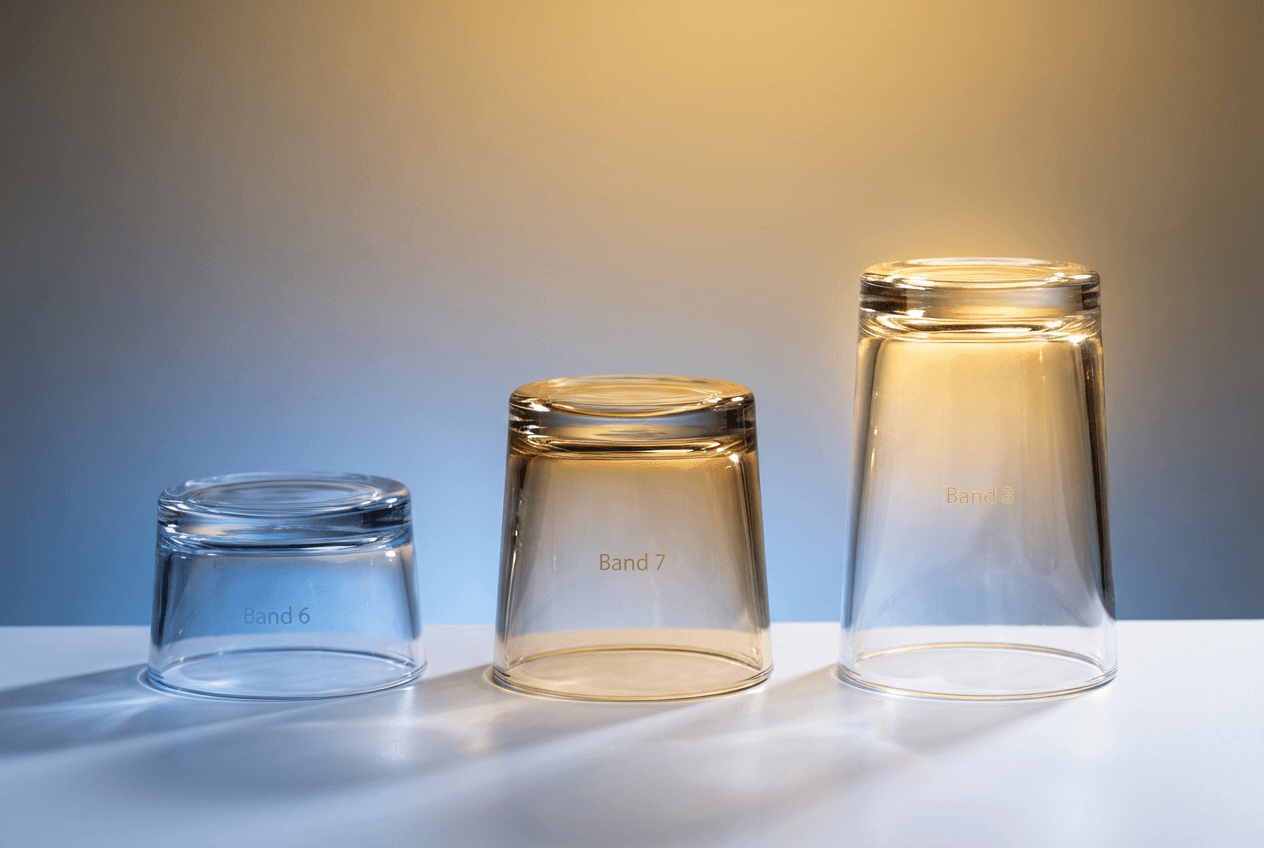
Here's what actually changes at each band level — with sample responses to the same question: "What do you think about working from home?"
| Criteria | Band 6 | Band 7 | Band 8 |
|---|---|---|---|
| Fluency | Willing to speak at length but hesitates frequently. May lose track of ideas mid-sentence. | Speaks at length without noticeable effort. Some self-correction but doesn't disrupt flow. | Speaks fluently with only rare hesitation. Ideas develop naturally and logically. |
| Vocabulary | "Working from home is good because you save time. It's also comfortable." | "Remote work definitely has its advantages — the flexibility is a real plus, and you avoid the daily commute." | "The shift to remote work has fundamentally changed how people balance their professional and personal lives — though I'd argue the boundaries have become more blurred, not less." |
| Grammar | Mostly simple sentences. Complex attempts often have errors. | Mix of simple and complex. Errors happen but don't interfere with meaning. | Wide range of complex structures used accurately. Errors are rare and minor. |
| Pronunciation | Generally understood, but mispronunciations cause occasional confusion. | Clear pronunciation with effective use of stress and intonation. | Sustained, natural pronunciation across the full range of features. |
Common Traps That Keep You at Band 6
-
Memorizing full answers. Examiners in 2026 are specifically trained to identify rehearsed responses — they'll interrupt you or ask unexpected follow-up questions. The fix? Practice speaking about topics, not reciting scripts.
-
Forcing "impressive" vocabulary. Using words like "plethora" or "myriad" when "many" or "a wide range" sounds more natural actually lowers your lexical resource score. Examiners prefer accurate, natural usage over forced complexity.
-
Speaking too fast. Speed ≠ fluency. Coherence matters more than pace. An examiner would rather hear a well-organized answer at a moderate speaking speed than a rushed one that jumps between ideas.
-
Avoiding grammatical risk. Sticking only to simple grammar guarantees you'll stay at Band 6 on the IELTS speaking test. You need to attempt complex structures — even if you occasionally make errors — to demonstrate your grammatical range.
How to Run Your Own IELTS Speaking Practice Test
The IELTS speaking test rewards one thing above all: spontaneous fluency. That's the ability to express your thoughts clearly, in real time, without long pauses. It's the same core skill tested in the TOEFL speaking section, and it only develops through regular, actual speaking practice — not reading sample answers or memorizing task responses.

Here's how to make your IELTS speaking exam practice as effective as possible:
1. Simulate the full test under timed conditions Use the sample questions in this guide as a complete IELTS speaking practice test. Set a timer for each part and answer aloud — record yourself and listen back. You'll catch fluency issues, filler words, and grammar patterns you didn't notice while speaking.
2. Practice Part 3 discussion tasks with a conversation partner Abstract Part 3 questions are the hardest to practice alone because they require you to think and respond spontaneously. This is where conversation practice with an AI tutor becomes genuinely useful — you get an unlimited speaking partner who adapts to your level and never judges your mistakes. Daily AI conversation builds exactly the spontaneous speaking fluency that IELTS demands.
3. Build task-specific vocabulary For each common IELTS sample topic (technology, education, environment, health, work), learn 10–15 precise words and collocations. Use them in spoken sentences, not just flashcards. Speaking them aloud is what transfers vocabulary from your passive reading knowledge to your active speaking ability.
4. Focus on your weakest scoring criteria If your vocabulary is already strong but grammar holds you back, spend 80% of your practice time on grammar structures in conversation. Track your daily speaking practice time to build consistent habits — even 15–20 minutes of focused conversation each day makes a measurable difference over a few weeks.
5. Address speaking anxiety directly Many IELTS candidates lose marks not because of low English ability, but because test anxiety causes them to freeze, speak too quietly, or give artificially short answers. If this sounds familiar, our guide on overcoming the fear of speaking English offers practical strategies. The key: the more you practice speaking in low-pressure environments, the more automatic your English becomes — so on test day, you focus on your ideas rather than searching for words.
Want a broader roadmap for building your overall English fluency? That guide covers the strategies that accelerate improvement across all four IELTS speaking criteria simultaneously.
Frequently Asked Questions
Can I take notes during Part 2 of the IELTS Speaking test?
Yes. You're given a pencil and paper during Part 2 and get 1 minute of preparation time. You can write brief notes — keywords, not full sentences — to help structure your speaking task. You can't take the notes with you when the test ends.
What happens if I don't understand a question during the IELTS Speaking test?
Ask the examiner to repeat or rephrase it. In Part 1 and Part 3, the examiner can reword a question. In Part 2, they can clarify the task card topic. Asking for clarification does not lower your band score — but pretending to understand and giving an off-topic answer will.
Is there a minimum passing score for IELTS Speaking?
There's no universal "pass" or "fail" on the IELTS test. The band score you need depends entirely on the institution or immigration program you're applying to. Most universities require between Band 6.0 and 7.5 overall, and some specify a minimum Speaking band separately. Always check your specific program's requirements.
How long should my answers be in Part 1?
Aim for 2–4 sentences per question in the Part 1 speaking task. One-word or one-sentence answers limit the sample of language the examiner can assess. But don't ramble for 30+ seconds on a simple Part 1 question — save your extended responses for the Part 2 and Part 3 tasks.
Can I use American English or British English in the IELTS Speaking test?
Either is perfectly acceptable. You won't lose marks for choosing American pronunciation over British, or vice versa. Just stay consistent within your test — don't switch between "schedule" (/ˈʃedjuːl/) and "schedule" (/ˈskedʒuːl/) mid-conversation. Practicing with both American and British accents helps you develop this consistency.
Does the IELTS Speaking test differ between Academic and General Training?
No. The speaking test is identical for both IELTS Academic and General Training — same questions, same format, same task types, same scoring criteria. Only the reading and writing sections differ between the two test versions. So any IELTS speaking practice test or sample materials you use will apply to both.
Can I retake just the Speaking section if I'm unhappy with my score?
Yes. IELTS now offers a One Skill Retake option. If your listening, reading, and writing scores meet your target but Speaking doesn't, you can retake just that one section within 60 days of your original test. This is available at select test centers — check with your local center for availability.