Duolingo taught you words. No one taught you to speak.
PracticeMe: real voice conversations with an AI tutor, 24/7.
English Pronunciation Practice for Beginners: Key Sounds

You know the grammar rules. You've memorized vocabulary lists. But when you open your mouth to speak English, the words come out... wrong. If you're looking for english pronunciation practice for beginners that actually shows you how to make each sound — not just tells you what sounds exist — this guide is for you.
Quick Summary: English has about 44 distinct sounds, and many don't exist in other languages. This guide covers english pronunciation practice for beginners through the most challenging sounds — TH, R vs L, short and long vowels, W vs V, and consonant clusters — with exact mouth positions, practice words, and minimal pair exercises for each sound. There's also a 10-minute daily warm-up routine to build lasting improvement.
Why English Pronunciation Practice for Beginners Starts With Sounds
Here's something most English courses won't tell you: native speakers are remarkably forgiving of grammar mistakes, but they struggle with pronunciation errors.
Say "I goed to the store yesterday" and people understand you perfectly. But mispronounce "three" as "tree" or "very" as "berry" and suddenly you're saying completely different English words with completely different meanings. Effective english pronunciation practice focuses on the specific sounds that cause real misunderstandings — not abstract phonetic theory.
Pronunciation is the difference between being understood on the first try and having to repeat yourself five times. It's also a huge confidence factor — many English learners develop a fear of speaking a foreign language simply because they've been corrected or misunderstood too many times.
The good news? You don't need to sound like a native English speaker. You need to sound clear. And that starts with mastering the specific sounds that trip up most beginners. Let's work through each one with step-by-step mouth positions so you can practice english pronunciation right now.
The TH Sounds: English's Most Unique Consonant
The TH consonant sound is the one almost every non-native English speaker struggles with. Most languages on Earth simply don't have it. English actually has two TH sounds, and mixing them up or replacing them with other consonants is one of the most common pronunciation mistakes.

Voiceless TH /θ/ — as in "think"
How to position your mouth: Place the tip of your tongue lightly between your upper and lower front teeth. It should be barely visible. Now blow air gently over your tongue and through the gap between your tongue and teeth. No vibration in your throat — this is a quiet, airy consonant sound.
A helpful trick: Start by saying "sss" (like a snake). Now slowly move your tongue forward until the tip sits between your teeth. The airflow stays the same, but the sound shifts from /s/ to /θ/. This technique comes from how speech therapists teach the TH sound, and it works brilliantly for adult English learners too. The University of Iowa's Sounds of Speech project has excellent visual diagrams of this tongue placement if you want to see an animated version.
Practice words: think, three, bath, tooth, healthy
Minimal pairs (words that only differ by this one sound):
- think / sink
- thin / tin
- three / free
- math / mass
- thought / taught
Common mistake: Speakers of Spanish, French, and many Asian languages often replace /θ/ with /t/, /s/, or /f/. If people hear "I tink it's good" instead of "I think it's good," this is the consonant sound to fix first.
Voiced TH /ð/ — as in "the"
How to position your mouth: Exactly the same as voiceless TH — tongue tip between your teeth. The only difference? You add voice. Place your hand on your throat and you should feel a vibration as you pronounce this sound.
A helpful trick: Start by saying "zzz" (like a buzzing bee). Now move your tongue forward between your teeth while keeping the buzzing going. That's the voiced /ð/ sound.
Practice words: the, this, that, mother, breathe
Minimal pairs:
- they / day
- then / den
- those / doze
- breathe / breeze
- there / dare
Common mistake: Replacing /ð/ with /d/ or /z/. "De" instead of "the" or "muzzer" instead of "mother." If your tongue stays behind your teeth when you try to pronounce these English words, you're making the wrong sound — push it forward until the tip is visible.
R vs L: The Consonant Pair That Changes Word Meaning
This pair causes the most confusion in real English conversation because R and L appear in so many common words. Swapping these consonants doesn't just sound off — it creates entirely different words with different meanings.
The R/L distinction is especially difficult for speakers of Japanese, Korean, Chinese, and several Southeast Asian languages, where these two sounds either don't exist as separate consonants or are produced very differently. Research in linguistics confirms that when your native language doesn't distinguish between two phonemes, your brain literally can't hear the difference at first — it takes targeted practice to retrain your ear.
How to Pronounce the English R Sound
Mouth position: Curl the tip of your tongue slightly backward — but here's the key — your tongue should never touch the roof of your mouth. Your lips round slightly forward, almost like you're about to whistle. The sides of your tongue press gently against your upper back teeth.
Think of it as a "floating" sound — your tongue hovers without making contact anywhere.
How to Pronounce the English L Sound
Mouth position: Press the tip of your tongue firmly against the bumpy ridge just behind your upper front teeth (called the alveolar ridge). Air flows around the sides of your tongue. Your lips stay relaxed and neutral — no rounding.
The key difference: for L, your tongue makes solid contact with the ridge. For R, it doesn't touch anything.
English pronunciation practice words:
| R words | L words |
|---|---|
| right | light |
| red | led |
| road | load |
| arrive | alive |
| fry | fly |
Minimal pairs for R/L pronunciation practice:
- right / light
- rice / lice
- road / load
- pray / play
- fry / fly
Practice tip: Say "la-la-la" and feel where your tongue hits the ridge. Now say "ra-ra-ra" and notice how your tongue curls back without touching. Alternate between them: "la-ra-la-ra." Speed up gradually. This is one of the most effective english pronunciation exercises for beginners because you can feel the physical difference immediately.
Short vs Long Vowel Sounds: Small Differences, Big Misunderstandings
English uses approximately 15 vowel sounds but only has 5 vowel letters (a, e, i, o, u). This mismatch confuses virtually every English learner. The trickiest part? Many vowel sounds come in short/long pairs where the difference is subtle but the meaning of the word changes completely.

/ɪ/ vs /iː/ — "ship" vs "sheep"
This is probably the most famous minimal pair in english pronunciation practice.
Short /ɪ/ (ship): Relax your tongue. Jaw barely opens. The vowel sound is quick and clipped — in and out fast. Your lips stay neutral.
Long /iː/ (sheep): Push your tongue higher toward the roof of your mouth. Spread your lips wider — almost like a smile. Hold the vowel sound longer.
The quick test: If you're smiling, you're probably making the right /iː/ sound.
Practice pairs: ship/sheep, bit/beat, sit/seat, hit/heat, lip/leap
/ʊ/ vs /uː/ — "full" vs "fool"
Short /ʊ/ (full): Lips are loosely rounded. The vowel sound is relaxed, short, and sits in the back of your mouth.
Long /uː/ (fool): Push your lips forward into a tight circle — like you're blowing out a candle. Hold the vowel sound longer. Your tongue pulls back and up.
Practice pairs: full/fool, pull/pool, look/Luke, book/boot, could/cooed
/e/ vs /æ/ — "bed" vs "bad"
Short /e/ (bed): Medium jaw opening. Tongue sits in the middle of your mouth.
Wide /æ/ (bad): Drop your jaw much wider. Your tongue pushes down and forward. This vowel sound is wider and flatter — almost like a short "ah" combined with "eh."
Try it: Say "bed." Now keep everything the same but push your jaw open wider and flatten the vowel. You should land on pronouncing "bad."
Practice pairs: bed/bad, set/sat, men/man, pen/pan, met/mat
W vs V: When Your Lips and Teeth Do Different Jobs
Native English speakers barely think about these consonant sounds, but for many learners — especially speakers of German, Hindi, Turkish, and several Slavic languages — the W and V sounds feel almost identical.
They're not. They use completely different parts of your mouth to pronounce.

W sound: Round your lips into a small circle (like blowing a kiss). Your teeth don't touch anything. The back of your tongue rises toward the soft palate. This consonant is produced entirely with the lips.
V sound: Your upper front teeth rest gently on your lower lip. Push air through that gap, creating friction. You should feel a buzzing vibration where teeth meet lip.
The test: Put your finger on your lower lip. For V, you'll feel your teeth pressing down. For W, your finger just feels your lips rounding — no teeth involved.
Practice english pronunciation words:
| W words | V words |
|---|---|
| water | very |
| wait | voice |
| word | visit |
| wonder | over |
| away | love |
Minimal pairs: wine/vine, west/vest, wet/vet, wail/veil, worse/verse
Consonant Clusters: When English Sounds Stack Up
English loves stacking consonants together — sometimes three consonant sounds in a row at the start of a word. If your native language typically puts a vowel between every consonant (like Japanese or Spanish), these clusters feel like a tongue obstacle course.
Duolingo taught you words. No one taught you to speak.
PracticeMe: real voice conversations with an AI tutor, 24/7.
Beginning Consonant Clusters
These groups of consonants appear at the start of English words:
- str-: street, strong, strange, straight, stress
- spl-: splash, split, splendid
- spr-: spring, spread, spray
- scr-: screen, scratch, scream
Common mistake: Inserting an extra vowel sound before the consonant cluster. "Eh-street" instead of "street" or "eh-spring" instead of "spring." The fix? Start with the /s/ sound alone, then slide directly into the next consonant without adding any vowel in between.
Practice drill: Say "sss...treet" — hold the S consonant, then release into the cluster without pausing or adding a vowel sound. Gradually reduce the gap until it's one smooth word.
Ending Consonant Clusters
These consonant groups appear at the end of words and are just as tricky to pronounce correctly:
- -ngs: rings, songs, things, strings
- -nks: thinks, drinks, banks, thanks
- -sts: tests, lists, costs, posts
- -sks: tasks, masks, desks, risks
Pronunciation tip: For ending consonant clusters, say the word slowly and hold each final consonant sound distinctly. "Ring-z," "think-s," "tes-ts." Then speed up until they blend naturally. Don't drop the final consonants — this common habit makes English words harder for listeners to understand.
Word Stress Patterns: The Secret Beginners Miss
Here's something that might surprise you: English is a stress-timed language. Some syllables in every word are pronounced louder, longer, and at a higher pitch than others. Getting the word stress wrong can make you completely unintelligible — even if every individual sound is perfect.

Two Key Word Stress Rules for English
Rule 1: Most two-syllable nouns stress the first syllable (~80% of the time)
- TA-ble, WA-ter, DOC-tor, MU-sic, CIT-y
Rule 2: Many two-syllable verbs stress the second syllable
- be-LIEVE, re-LAX, be-COME, de-CIDE, re-PEAT
When Stress Changes the Word's Meaning
English even has word pairs where stress alone determines whether the word is a noun or verb:
| Noun (first syllable stressed) | Verb (second syllable stressed) |
|---|---|
| RE-cord (a vinyl record) | re-CORD (to record a video) |
| PRE-sent (a gift) | pre-SENT (to present something) |
| OB-ject (a thing) | ob-JECT (to disagree) |
| PER-mit (a document) | per-MIT (to allow) |
The Suffix Shortcut for Pronouncing English Words
Words ending in -tion or -sion always stress the syllable before the suffix:
- edu-CA-tion, de-CI-sion, in-for-MA-tion, pro-NUN-ci-a-tion
Words ending in -ic follow the same stress pattern:
- fan-TAS-tic, dra-MA-tic, re-a-LIS-tic
Sentence Intonation: The Music of English Speaking
Individual sounds and word stress are only part of the pronunciation puzzle. English sentences also have a melody — a pattern of rising and falling pitch called intonation. Using the wrong intonation pattern can turn a statement into a question, or make you sound uncertain when you're being definitive.
Falling intonation ↘ — for statements and wh-questions:
- "I'm going to the store." ↘
- "Where do you live?" ↘
Rising intonation ↗ — for yes/no questions:
- "Are you coming tonight?" ↗
- "Do you like coffee?" ↗
Practice exercise: Take any English sentence — "I finished my homework" — and say it twice. First as a flat statement (pitch drops at the end). Then as a question (pitch rises at the end). Feel the difference? That's English intonation at work.
Intonation patterns differ noticeably between accents. Our guides on how to learn an American accent and how to learn British pronunciation cover those accent-specific differences in detail.
Your 10-Minute Daily Pronunciation Warm-Up Routine
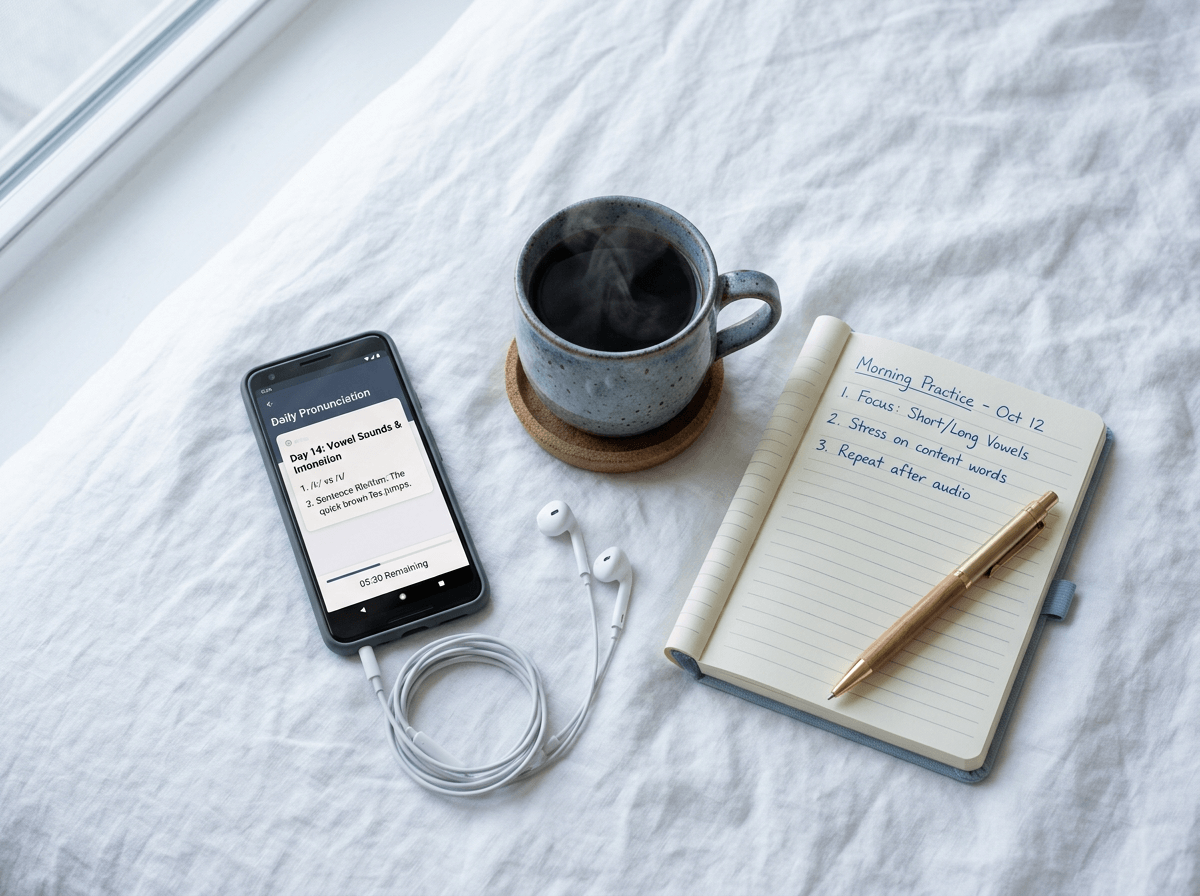
Knowing how to make English sounds is one thing. Getting your mouth to produce them automatically during conversation is another. This daily warm-up routine trains your muscles so proper pronunciation becomes second nature — think of it as a workout for your mouth that takes less time than making coffee.
Minutes 1–2: Wake Up Your Mouth
- Lip buzzes: Press your lips together and blow air through them to make a "brrr" motorboat sound. Do this for 20 seconds.
- Tongue circles: Run your tongue around the outside of your teeth — first clockwise, then counterclockwise. 5 circles each way.
- Jaw stretches: Open your mouth as wide as comfortable, hold for 3 seconds, close. Repeat 5 times.
These warm-up exercises loosen the muscles you need for clear English pronunciation and speaking.
Minutes 3–4: TH Sound Drill
Alternate between the voiceless and voiced TH consonant sounds:
- Say each word slowly: think, this, three, that, through, them, bath, breathe
- Repeat the set 3 times, getting slightly faster each round
- Focus on keeping your tongue tip between your teeth as you pronounce each word
Minutes 5–6: Minimal Pair Speed Rounds
Pick three minimal pairs and alternate between them to practice english pronunciation:
- ship ↔ sheep (×5)
- right ↔ light (×5)
- wine ↔ vine (×5)
Start slow. By the third round, try to switch quickly while keeping each word clearly distinct.
Minutes 7–8: Read Aloud with Exaggerated Word Stress
Pick any paragraph — a news article, a recipe, a text message. Read it out loud and exaggerate the stressed syllables. Make them louder, longer, and higher-pitched than feels natural.
This trains your ear and mouth to recognize English word stress patterns. Over time, the exaggeration fades into natural-sounding rhythm and more fluent speaking.
Minutes 9–10: Record and Compare
Use your phone to record yourself saying these 5 sentences. Each one practices different sounds from this guide:
- "I think three thousand people went to the theater."
- "She arrived late and left really early."
- "Would you like water or a very cold beverage?"
- "The strong spring wind split the old ship's sail."
- "I'd like to present my present to the president."
Play it back. Don't judge yourself harshly — just listen. Can you hear the TH sounds? Are your R and L consonants distinct? Does your word stress pattern sound right? Each day, you'll notice small improvements in how you pronounce English words.
From Pronunciation Drills to Real English Conversations
Here's the truth about pronunciation drills: they build awareness, but they can only take you so far. The real test of your english pronunciation practice is whether you can produce these sounds while actually speaking — when you're thinking about what to say, not how to say it.
That's the gap between pronunciation knowledge and pronunciation fluency. And the only way to bridge it is through real conversation practice where you apply everything you've learned.

Practice Me is built for exactly this kind of speaking practice. You have real voice conversations with AI tutors who adapt to your English level — meaning you can practice without worrying about being judged or slowing someone down. Choose between American and British accents, and the app tracks new vocabulary from your conversations automatically.
For beginners working on pronunciation, the key advantage is unlimited speaking time. You can repeat, pause, try sounds again, and speak for as long as you need — 24 hours a day, 7 days a week. There's no embarrassment, no scheduling conflicts, and no pressure. The AI tutors adapt to your level, making it ideal for beginners who need patience and repetition to build pronunciation confidence.
If you're working toward broader fluency goals, our guide on how to become fluent in English covers the full picture beyond pronunciation — including listening comprehension, vocabulary building, and learning to think in English. For subscription details, see our pricing page.
Frequently Asked Questions
How long does it take to improve English pronunciation?
Most learners notice measurable improvement within 2–4 weeks of daily focused pronunciation practice (even just 10 minutes a day). However, building automatic pronunciation habits — where correct English sounds come out without conscious thinking — typically takes 2–3 months of consistent practice. The key factor is daily repetition, not marathon study sessions. The BBC's pronunciation workshop is a great free resource to supplement your practice with native speaker demonstrations.
What is the hardest English sound for non-native speakers?
The TH sounds (/θ/ and /ð/) are consistently ranked as the most difficult English consonant sounds to pronounce because very few languages worldwide use them. The R/L distinction is a close second, particularly for speakers of East Asian languages. That said, the hardest sound for you depends entirely on your native language — a Spanish speaker and a Japanese speaker will struggle with completely different English sounds.
Should I focus on American or British pronunciation?
Pick one accent and stay consistent. The consonant and vowel sounds covered in this english pronunciation practice guide apply to both accents, but intonation patterns and certain vowel sounds differ. If you're unsure, choose the English accent you hear most often in daily life, work, or studies. Practice Me offers both American and British accent options, so you can practice whichever you prefer.
Can I improve my English pronunciation without a teacher?
Absolutely — especially for the foundational sounds covered here. A mirror (to check tongue and lip position), a phone recorder (to hear how you pronounce words), and consistent daily practice will get you further than most people expect. AI-powered speaking tools like Practice Me add the real conversation element that traditional self-study lacks, letting you practice english pronunciation in actual speaking situations rather than just isolated drills.
How do I know if my pronunciation is correct?
Three practical methods: Record and compare — record yourself saying english pronunciation practice words and play it back against a native speaker model. Minimal pair test — say both words in a pair to someone and check if they can distinguish them (if they can't tell "ship" from "sheep," your vowel sounds need more work). Conversation check — if people understand you on the first try without asking you to repeat yourself, your English pronunciation is working. You don't need to sound like a native speaker — you need to sound clear.