Duolingo taught you words. No one taught you to speak.
PracticeMe: real voice conversations with an AI tutor, 24/7.
Hard English Words for Spanish Speakers + Pronunciation

If you speak Spanish and you've ever tried to say "squirrel" or "comfortable" out loud in English, you already know the struggle. English pronunciation isn't just hard for Spanish speakers — it's hard in very specific, predictable ways that come directly from the differences between the two languages.
Once you understand why certain hard English words for Spanish speakers cause so much trouble, fixing your pronunciation gets dramatically easier. Instead of memorizing random lists, you can target the exact sound patterns that don't exist in the Spanish language and practice them until your mouth builds the right muscle memory.
Quick Summary: English has nearly twice the sounds of Spanish (44 phonemes vs. 24), creating specific pronunciation traps around TH sounds, vowel length, the V/B distinction, consonant clusters, silent letters, and word stress. Below are 37 of the hardest words to pronounce for Spanish speakers, organized by challenge type with phonetic spellings, common mistakes, and tips.
Why English Is So Difficult to Pronounce for Spanish Speakers
This isn't about intelligence or effort — it's physics and muscle memory rooted in fundamental differences between how the English and Spanish languages use sound.
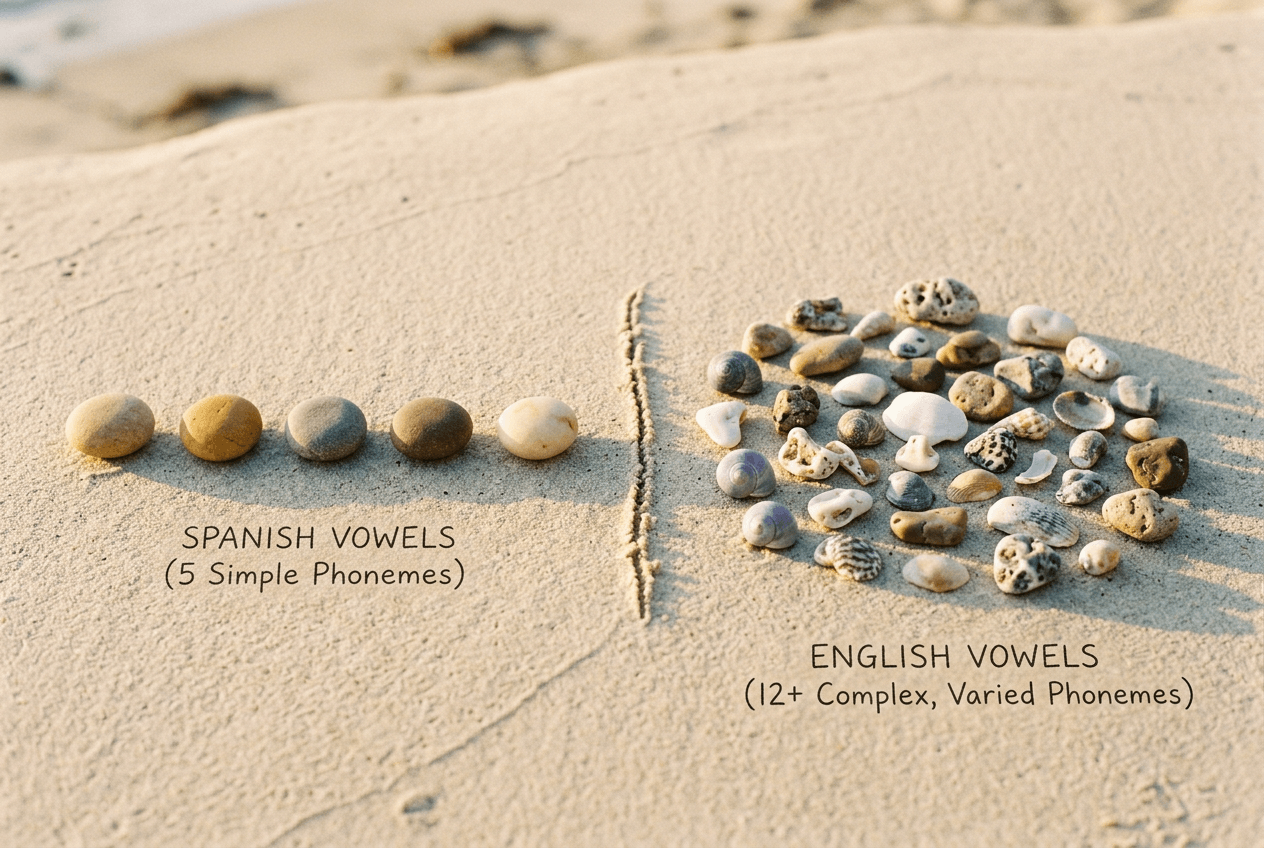
Spanish has approximately 24 phonemes (distinct sounds). English has about 44, according to comparative linguistic research. That means roughly 20 English sounds simply don't exist in the Spanish language — your mouth has literally never practiced making them.
Here's where the pronunciation gap hits hardest:
- Vowels: Spanish has 5 vowel sounds. English has 12+ pure vowels plus 8 diphthongs. Multiple English vowels "collapse" into a single Spanish vowel, making words like ship and sheep sound nearly identical to Spanish-trained ears.
- Consonants: Sounds like /θ/ (the TH in "think"), /v/, /dʒ/ (the J in "judge"), and /z/ don't appear in the Spanish sound system at all. Spanish speakers must substitute the closest sounds they know.
- Spelling vs. sound: Spanish is nearly 100% phonetic — you pronounce what you see. English is famously inconsistent. The letters "ough" alone are pronounced at least 6 different ways (through, though, thought, tough, cough, bough).
Understanding these gaps is your foundation. Now let's tackle the actual difficult English words, organized by challenge type so you can practice each problem systematically.
If you're working on improving English speaking as a non-native speaker, recognizing these L1 interference patterns is the first step toward fixing them.
The TH Sounds (/θ/ and /ð/)
Neither the voiceless TH (/θ/ as in "think") nor the voiced TH (/ð/ as in "this") exists in the Spanish language. This is the pronunciation challenge most people associate with Spanish-accented English. Spanish speakers typically substitute /t/, /d/, or /s/ for both TH sounds because those are the closest sounds they already know.
The fix for all TH words: Place the tip of your tongue between your upper and lower front teeth. For voiceless /θ/, push air over your tongue without vibrating your vocal cords. For voiced /ð/, add vocal cord vibration. It feels awkward — that's normal, because your tongue has never done this before.
Through — /θruː/ Spanish speakers often say "tru" or "dru." The voiceless TH starts with tongue between teeth, then you transition smoothly into the "roo" sound. This word is pronounced nothing like you'd expect from the spelling. "We drove through the tunnel in about ten minutes."
Thought — /θɔːt/ Often pronounced "tought" or "dought" by Spanish speakers. Same voiceless TH, followed by the "aw" vowel (like "ball," not the Spanish "o"). The "-ought" ending is pronounced identically in "bought," "brought," and "fought." "I thought the meeting started at nine."
Three — /θriː/ Frequently pronounced like "tree," which is a completely different English word. The only difference between "three" and "tree" is that initial tongue-between-teeth position. "There are three options on the menu."
Clothes — /kloʊðz/ Tricky enough that even native speakers simplify it. The correct pronunciation has a voiced TH /ð/ near the end, though fast speech often reduces it to /kloʊz/. "Pack warm clothes — it's going to be cold."
Months — /mʌnθs/ The consonant cluster /nθs/ is brutal. Spanish speakers often simplify it to "mons." Practice saying "month" first, then add a quick /s/. "I've been studying English for six months."

Short vs. Long Vowels
This might be the single biggest English pronunciation challenge for Spanish speakers overall. Spanish does not distinguish between short and long vowels at all. Every Spanish vowel has one consistent length. In English, vowel length changes meaning completely, and getting this wrong causes real misunderstandings.
Ship — /ʃɪp/ (not "sheep" /ʃiːp/) The short /ɪ/ doesn't exist in Spanish. It sits between the Spanish "i" and "e" — a quick, relaxed sound with your tongue slightly lower than for "ee." Mixing these up causes genuine confusion in English conversation. "The ship arrived at port this morning."
Comfortable — /ˈkʌmf.tər.bəl/ Spanish speakers often say "com-for-TAH-bleh," pronouncing every syllable. In English it's only 3 syllables: "KUMF-ter-bull." The middle essentially disappears. This is one of the most commonly mispronounced English words by Spanish speakers. "This chair is really comfortable."
Focus — /ˈfoʊ.kəs/ The "o" here isn't the Spanish "o" — it's the English diphthong /oʊ/, starting as "oh" and gliding toward "oo." Spanish speakers use a flat "o" instead, which sounds noticeably different to English ears. "Let's focus on the main problem first."
Woman / Women — /ˈwʊm.ən/ vs. /ˈwɪm.ɪn/ The spelling changes in the second syllable, but the pronunciation change happens in the first. "Woman" has /ʊ/ (like "book"); "women" has /ɪ/ (like "bit"). Even native English speakers acknowledge this is confusing. "One woman stood up. Then three women followed."
Live (verb) /lɪv/ vs. Live (adjective) /laɪv/ Same spelling, different vowels, different meanings. "I live here" uses short /ɪ/. "A live performance" uses /aɪ/. Spanish speakers often default to one vowel for both because Spanish words are pronounced consistently regardless of context. "I live downtown." / "We saw a live concert."
The V vs. B Mix-Up
In Spanish, "b" and "v" represent the exact same phoneme — both lips come together. In English, B and V are completely different consonants. This mix-up persists even among advanced Spanish speakers with near-native English fluency, which makes it one of the most stubborn hard English words for Spanish speakers to fix.
The fix: For English V, your lower lip touches your upper teeth. Air pushes through the gap while your vocal cords vibrate. For B, both lips press together and release. Say "berry" then "very" slowly — pay attention to where your lip makes contact.

Very — /ˈver.i/ The classic example. Spanish speakers say "berry," which is an entirely different English word. Lower lip to upper teeth — that's the key. "That was very helpful, thank you."
Vocabulary — /voʊˈkæb.jə.ler.i/ Double challenge: starts with V and contains a B. Practice switching between the two sounds within the same word. The V is pronounced with lip-to-teeth, then the B with lip-to-lip. "Reading is a great way to build your English vocabulary."
Available — /əˈveɪ.lə.bəl/ V comes early, B comes late. Many Spanish speakers make both sounds identical when this word is pronounced quickly. "Is this seat available?"
Village — /ˈvɪl.ɪdʒ/ Often pronounced "billage." The V and the final /dʒ/ (a J sound that also doesn't exist in Spanish) make this a double challenge — two unfamiliar sounds in one difficult English word. "We visited a small village in the mountains."
The Sneaky "E" Before S-Consonant Clusters
Spanish never allows words to begin with "s" followed by another consonant. The language always adds an "e" first — that's why "Spain" is España and "study" is estudiar.
This habit transfers directly into English. Spanish speakers instinctively add a phantom "e" before these words, and most don't even realize they're doing it because the process is completely unconscious.
The fix: Make a long "ssssss" hissing sound first. Then, without adding any vowel, launch into the next consonant. sssss-top. sssss-peak. It feels unnatural — it is unnatural for your Spanish-trained mouth.
Stop — /stɒp/ (not "estop") "Stop at the next traffic light."
Speak — /spiːk/ (not "espeak") "Do you speak English? I need directions."
Street — /striːt/ (not "estreet") "The restaurant is on the next street."
Strength — /streŋθ/ (not "estrength") Combines the S-cluster problem and a TH sound. Two hard English sounds for Spanish speakers in one word. "Building pronunciation skills takes patience and strength."
Scratch — /skrætʃ/ (not "escratch") Three consonants in a row. No wonder your brain wants to add an "e." "Don't scratch the table with those keys."
Duolingo taught you words. No one taught you to speak.
PracticeMe: real voice conversations with an AI tutor, 24/7.
The English J Sound (/dʒ/)
The English "J" (/dʒ/ as in "jump") doesn't exist in the Spanish language. The Spanish "j" is a completely different sound — the throaty /x/ in "jalapeño." Spanish speakers typically substitute a /y/ sound, turning "joke" into "yoke."
The fix: Press your tongue against the ridge behind your upper teeth (the "D" position), then release it with a buzzing "zh" sound. It's "d" + "zh" combined into one motion — a "D" that turns into buzzing as you release.
Joke — /dʒoʊk/ (not "yoke") "He told a funny joke at dinner."
Jewelry — /ˈdʒuːl.ri/ (not "yoolery") Only two syllables: "JOOL-ree." Spanish speakers often add a third syllable when this word is pronounced. "She designs handmade jewelry."
Judge — /dʒʌdʒ/ (not "yudge") Two /dʒ/ sounds in one word — at the beginning and end. "The judge made her decision this morning."
General — /ˈdʒen.ər.əl/ (not "yeneral") English "g" before "e" often produces the /dʒ/ sound, which is not obvious from spelling and is rarely pronounced this way by Spanish speakers unfamiliar with the pattern. "The general direction is north."
January — /ˈdʒæn.ju.er.i/ (not "yanuary") Starts with /dʒ/ and has an unusual vowel pattern in the middle. "The project launches in January."
Silent Letters That Break the Rules
Spanish speakers expect every letter to be pronounced because the Spanish language is almost entirely phonetic. English doesn't follow these rules. Silent letters are among the most frustrating hard English words for Spanish speakers because there's no consistent pattern — you often just have to memorize which letters stay quiet.

Receipt — /rɪˈsiːt/ The "p" is completely silent. ESL teachers report this trips up even Spanish speakers with otherwise flawless English pronunciation. They always want to pronounce that P. "Can I have the receipt, please?"
Knife — /naɪf/ The "k" is silent. This applies to all "kn-" English words: know, knee, knock, knight, knot. None of the K's are pronounced. "Pass me the knife, please."
Wednesday — /ˈwenz.deɪ/ The first "d" and second "e" are both silent. It's pronounced "WENZ-day" — barely recognizable from the spelling. "The meeting is on Wednesday."
Salmon — /ˈsæm.ən/ The "l" is silent. Many Spanish-speaking English learners have been saying "sal-mon" for years before discovering this. It's pronounced "SAM-un." "We ordered grilled salmon for dinner."
Debt — /det/ The "b" is silent. Same pattern in "doubt" and "subtle." "They paid off their debt in two years."
Subtle — /ˈsʌt.əl/ Silent "b" again. Only two syllables when correctly pronounced: "SUT-ul." "There's a subtle difference between the two colors."
Island — /ˈaɪ.lənd/ The "s" is completely silent. Pronounced "eye-land" — one of those English words where the spelling actively misleads Spanish speakers about how it should sound. "We took a boat to the island."
Word Stress and the Schwa (/ə/)
In Spanish, stress follows predictable rules with accent marks. English word stress is wildly unpredictable and changes meaning — the noun is "REcord" but the verb is "reCORD." Getting stress wrong can make you unintelligible, even if every individual sound is pronounced correctly.
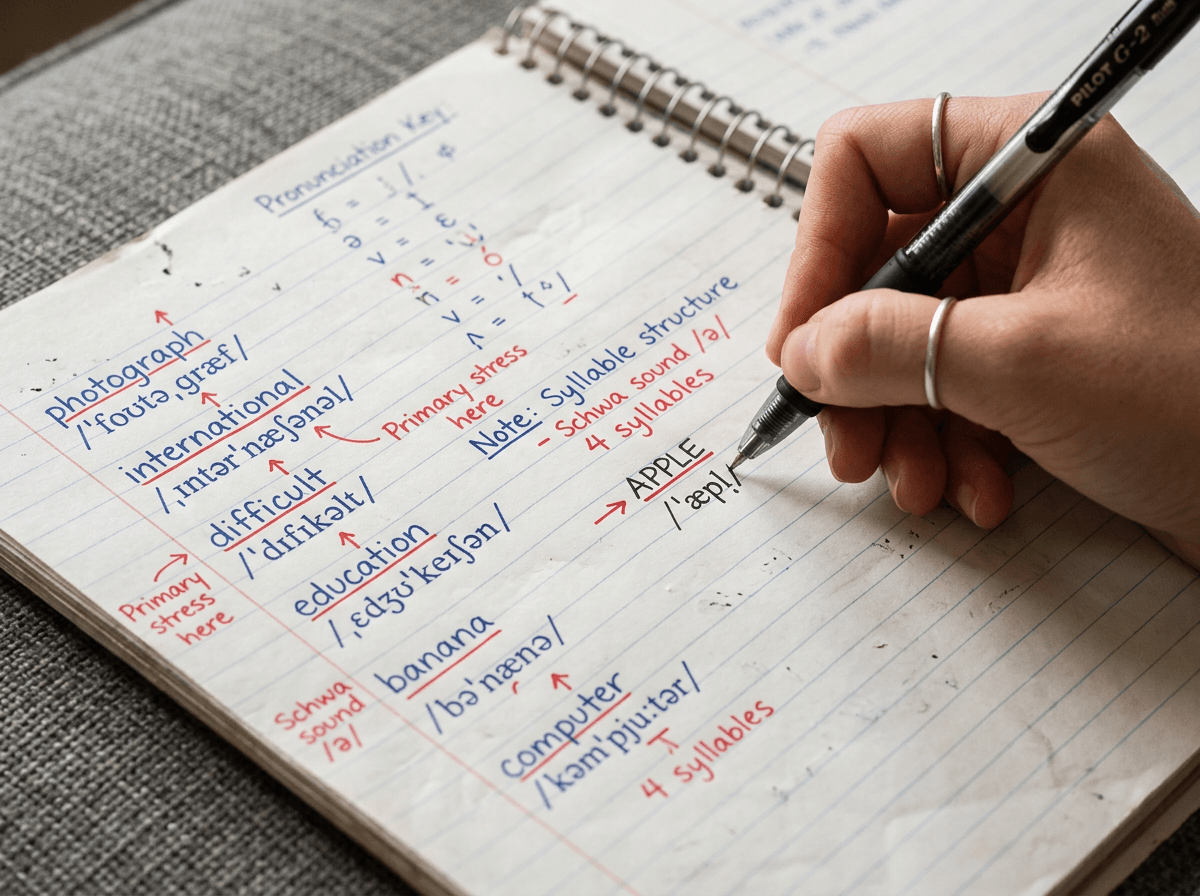
The schwa /ə/ is closely related: it's the most common vowel sound in the entire English language, but it doesn't exist in Spanish. It's that lazy, unstressed "uh" — the "a" in "about," the "o" in "comfortable." Spanish speakers pronounce every syllable fully instead of reducing unstressed syllables to this neutral sound. This makes the words below some of the hardest to pronounce for Spanish speakers.
Temperature — /ˈtem.prə.tʃər/ (not "tem-peh-rah-TOO-rah") Only 3 syllables in natural English, not 5. The "era" collapses into a schwa. Stress goes on the first syllable. "The temperature dropped below freezing last night."
Literature — /ˈlɪt.ər.ə.tʃər/ (not "lee-teh-rah-TOO-rah") First vowel is short /ɪ/ (not "ee"), and "-ture" is pronounced "chur." The word is barely recognizable when pronounced the way English spelling suggests to Spanish-speaking eyes. "She studied English literature in college."
Photography — /fəˈtɒɡ.rə.fi/ (not "FOH-toh-grah-fee") Stress falls on the second syllable. The first syllable reduces to a schwa — it's pronounced "fuh-TOG-ruh-fee," not with a full "fo" sound. "She's been interested in photography since high school."
Chocolate — /ˈtʃɒk.lət/ (not "choh-coh-LAH-teh") Two syllables, not four: "CHOK-lit." The middle completely disappears when this word is pronounced by native English speakers. "Would you like some chocolate?"
Interesting — /ˈɪn.trɪ.stɪŋ/ (not "een-teh-reh-STEENG") Three syllables, not five. The "ere" collapses. Stress is on the first syllable. This word is pronounced with much less emphasis on the ending than Spanish speakers typically give it. "That's a really interesting idea."
The English R
The English R and the Spanish R are fundamentally different sounds. The Spanish R involves the tongue tapping or trilling against the alveolar ridge behind your upper teeth. The English R involves the tongue curling back without touching anything at all — a completely different mouth movement.
The fix: Pull your tongue back and curl the tip up and back slightly. Your tongue shouldn't touch the roof of your mouth. Round your lips. The English R comes from tongue shape, not contact — the opposite of the Spanish R.
World — /wɜːrld/ The /ɜːr/ + /ld/ combination makes this one of the most difficult English words for Spanish speakers to pronounce. Practice "were" + "ld" separately, then combine. "It's one of the best restaurants in the world."
Rural — /ˈrʊr.əl/ Two English R sounds back-to-back with a vowel between them. This word is a tongue twister even for some native English speakers. "They moved to a rural area outside the city."
Squirrel — /ˈskwɪr.əl/ A consonant cluster (skw-), an R sound, and a schwa — all in one short word. Many Spanish speakers consider "squirrel" the single hardest English word to pronounce. That's fair — it's genuinely brutal. "A squirrel ran across the park bench."
Girl — /ɡɜːrl/ The /ɜːr/ vowel (same as "world" and "bird") doesn't exist in the Spanish language. It's produced by pulling the tongue back and up, without the rounding you'd use for a standard R. "The girl next to me speaks three languages."
How to Practice These Hard English Words for Spanish Speakers
Reading pronunciation guides is a solid start, but pronunciation is a physical skill — like a sport. You need to actually produce the sounds, receive feedback, and repeat until the patterns become automatic in your mouth.

Here's what works for improving English pronunciation for Spanish speakers:
1. Minimal pair drills. Pick one sound category and practice word pairs that differ by only that sound — ship/sheep, very/berry, three/tree. Say them back and forth until you can hear and feel the difference. These pairs train your ear and mouth simultaneously.
2. Record yourself. Use your phone to record these words, then compare to native pronunciation. You'll catch mistakes your brain filters out in real time — this simple technique reveals pronunciation gaps you didn't even know you had.
3. Practice in sentences, not isolation. Saying "through" alone is much easier than saying "We drove through the tunnel" because sounds change in connected speech. Practice the example sentences in this article out loud to build real conversational habits.
4. Have real conversations. The most effective pronunciation practice happens in actual conversation, where you're thinking about what to say while managing how to say it. Practice Me gives you real-time voice conversations with AI tutors who adapt to your level — you can work through these difficult English words in natural context, 24/7. Your vocabulary gets saved automatically, which helps when you're building vocabulary through conversations.
5. Focus on one category at a time. Don't try to fix everything simultaneously. Spend a week on TH sounds, then a week on vowel pairs, then the V/B distinction. Systematic, focused practice consistently beats scattered effort for Spanish speakers learning English pronunciation.
For a structured daily routine, our guide to English pronunciation practice for beginners includes a 10-minute warm-up you can follow. You can also explore the best English pronunciation apps for dedicated tools, or start with English speaking practice for beginners if you're still building foundational confidence.
Frequently Asked Questions
What is the hardest English sound for Spanish speakers?
Most linguists and ESL teachers point to the TH sounds (/θ/ and /ð/) as the most noticeable difficulty, because they simply don't exist anywhere in Spanish. However, the short-versus-long vowel distinction is arguably more impactful since it affects far more English words and causes more frequent misunderstandings. The TH sounds are the most visible pronunciation challenge, but vowel confusion is the most widespread problem for Spanish speakers.
Why do Spanish speakers add an "e" before English words starting with S?
Because Spanish phonology doesn't allow words to begin with "s" + another consonant. Every Spanish word with this pattern adds an "e" first: school → escuela, Spain → España, special → especial. Spanish speakers' brains apply this rule automatically when speaking English — it happens unconsciously, which makes it one of the hardest pronunciation habits to break.
How long does it take to fix English pronunciation habits?
Individual sounds (like the TH) can improve noticeably within 2–4 weeks of daily focused practice. Fully retraining ingrained habits across all your speech typically takes 3–6 months. The key is focused practice on specific sounds — not general "speak more English" advice. Conversation-based practice, where you use hard English words in real context, speeds up improvement significantly because it trains your mouth under real communication pressure.
Can you completely lose a Spanish accent in English?
Some people achieve this with dedicated work over many months. But eliminating your accent shouldn't be the primary goal — accents carry identity and culture. The practical goal is intelligibility: being clearly understood by English speakers. You can have a noticeable Spanish accent and still communicate with perfect clarity. Focus on the specific sounds that cause actual confusion — TH, vowel pairs, V/B — rather than chasing "accentless" English, which is an unrealistic standard that even many native English speakers don't meet across different dialects.