Duolingo taught you words. No one taught you to speak.
PracticeMe: real voice conversations with an AI tutor, 24/7.
Business English Speaking Practice for Professionals

You've prepared for the meeting. You know your numbers. You understand the strategy. But when it's your turn to speak, the English words don't come out the way they sound in your head — and you realize you need real business English speaking practice, not another grammar lesson.
If you've ever frozen during a presentation, stumbled through small talk at a conference, or accidentally said "I will revert back" on a client call, you're not alone. For non-native speakers working in global companies, the gap between knowing English and performing in English under pressure is where careers get stuck.
Quick Summary: Business English speaking practice is the fastest way to close the gap between understanding English and actually using it confidently at work. The key? Practice out loud, in realistic business scenarios, with immediate feedback. Practice Me's AI tutors let you rehearse any business conversation 24/7, judgment-free, so you're prepared when it matters.
Why Business English Speaking Skills Make or Break Careers
As Harvard Business Review reported, 1.75 billion people now speak English at a useful level — and multinational companies like Airbus, Samsung, and Microsoft have mandated English as their corporate language. Research shows employees with strong business English skills are 18% more likely to progress faster through job grades and more likely to receive salary increases.
But here's what most professionals miss: there's a massive difference between understanding English and being able to speak it under pressure. You can ace a grammar test and still freeze when your CEO asks you a direct question in a board meeting.
Speaking is the hardest language skill to develop because it demands everything at once — vocabulary recall, grammar, pronunciation, cultural awareness, confidence — all in real time. You can't pause a live business conversation to look up a word. You can't edit your pronunciation the way you'd edit an email.
That's why professionals who invest specifically in business English speaking practice — not just reading or listening — see the fastest career returns. Industry surveys consistently find that over 70% of professionals say unclear English causes delays or misunderstandings at work. Every miscommunication in a meeting or negotiation has a real cost: a delayed decision, a confused client, a promotion that goes to someone who simply sounds more confident.
5 Business Scenarios Where Your English Speaking Skills Get Tested
Not all business English is the same. A casual networking chat requires completely different language skills than a formal negotiation. Here are the five scenarios where your speaking abilities get tested most — and the exact phrases that work in each.

Leading and Participating in Meetings
Meetings are where careers are built. If you can contribute clearly and steer discussions, people notice. If you stay quiet because you're unsure how to phrase your point in English, you become invisible.
The challenge isn't just vocabulary — it's the speed. Native English speakers jump in, interrupt, build on each other's ideas. By the time you've mentally translated your point, the conversation has moved on.
Phrases that work:
- "I'd like to build on what [name] just said..." — joins you to the conversation naturally
- "Could we circle back to [topic]?" — redirects without sounding aggressive
- "Just to make sure I understand — are we saying that...?" — buys you time while showing engagement
- "To summarize where we are..." — positions you as the person bringing clarity
The key to improving: practice these phrases until they're automatic, not something you construct in the moment.
Giving Presentations and Pitches
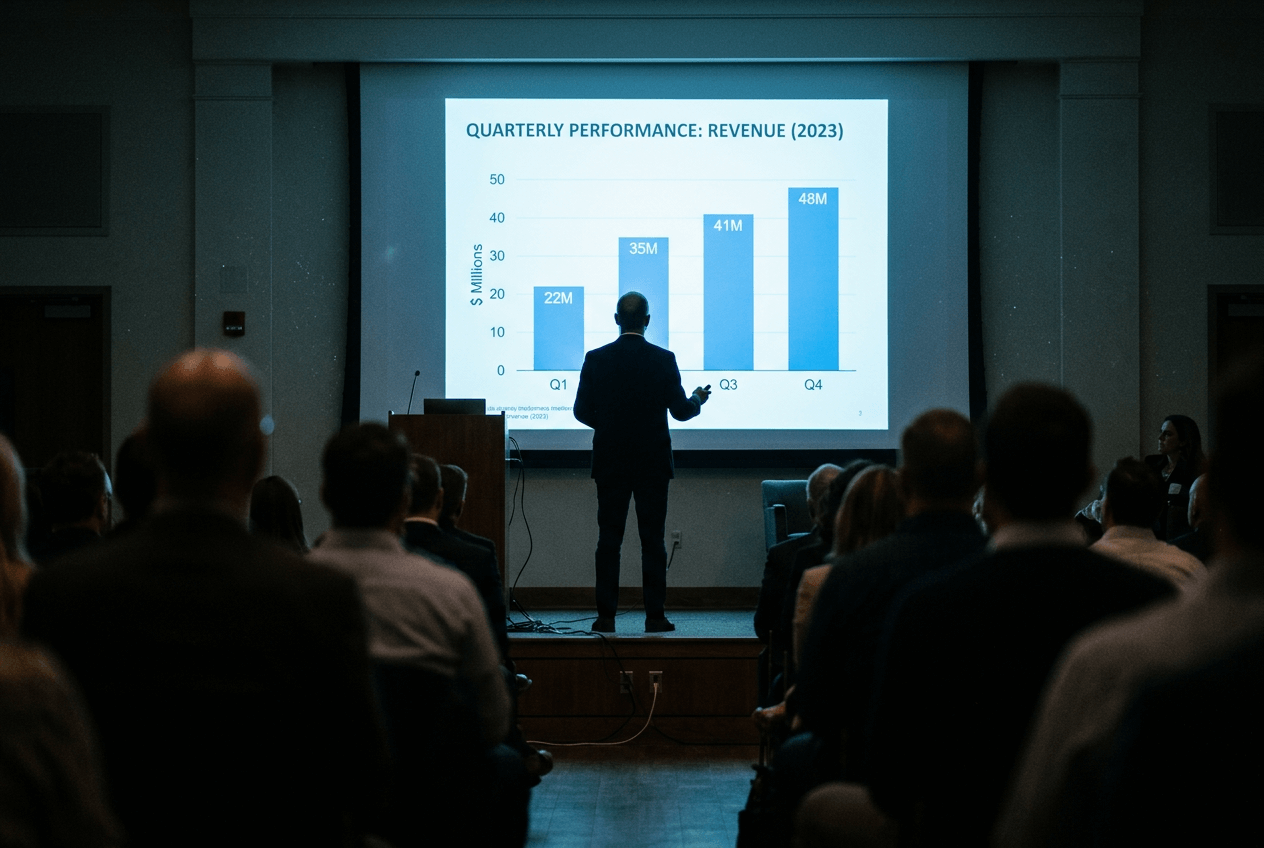
Presentations terrify most people — in any language. Doing it in English as a non-native speaker adds another layer of pressure. You're not just worried about your content; you're worried about your pronunciation, your filler words, and whether "Let me walk you through this" sounds natural or rehearsed.
Phrases that work:
- "Let me walk you through the key findings..." — strong, confident opening
- "As you can see from the data..." — transitions between points smoothly
- "What I'd like to highlight here is..." — directs attention without being pushy
- "I'd be happy to go into more detail on that." — handles Q&A gracefully
The secret to good presentations in English isn't memorizing a script. It's speaking practice — rehearsing out loud enough times that the structure becomes natural, so you can focus on connecting with your audience instead of searching for words.
Networking and Professional Small Talk

This is the skill most professionals underestimate — and the one that opens the most doors. You can survive a meeting by staying focused on the agenda. But networking events, conference dinners, and pre-meeting chitchat? That's where deals and career opportunities actually start.
Phrases that work:
- "What brought you to this event?" — much better than "What do you do?"
- "I'm based out of [city], working on [area]." — clean, efficient self-introduction
- "How did you get into [their field]?" — shows genuine curiosity
- "It was great connecting with you. Let's stay in touch." — closes the conversation professionally
Small talk in English has unwritten rules that vary by culture. Americans tend to be casual and personal quickly. British professionals lean more formal at first. Learning both communication styles gives you a genuine advantage when working across global teams.
Client Calls and Video Conferences
Remote work has made English-language video calls a daily reality for millions of professionals worldwide. There's no body language to lean on, connections drop, and everyone talks over each other. Your spoken English needs to be clear enough to survive bad audio and cultural differences.
Phrases that work:
- "Just to confirm — the deadline is [date], correct?" — prevents costly misunderstandings
- "Would it be possible to push the timeline by a few days?" — polite negotiation
- "Let me get back to you on that by end of day." — buys time without looking unprepared
- "I want to make sure we're aligned on next steps." — closes with clarity
On client calls, precision matters more than fluency. A clear, slightly slower delivery builds more trust than a fast-but-garbled one.
Negotiations and Persuasion
Negotiations in English are high-stakes. One wrong phrase can shift the power dynamic. Saying "We need this" sounds desperate. Saying "We'd be open to exploring options on this" sounds strategic.
Phrases that work:
- "What if we were to [alternative proposal]?" — introduces your position as a suggestion
- "I see where you're coming from. However..." — acknowledges their side before countering
- "We're flexible on [term], but [term] is important to us." — shows both give and boundaries
- "Let me make sure we're on the same page before we move forward." — slows things down when needed
In negotiations, the language you use signals confidence, status, and intent. Practicing these phrases until they feel natural — not scripted — can genuinely change the outcome of a deal.
7 Business English Mistakes That Undermine Your Credibility
Even advanced English speakers trip on these. And unlike a grammar error in an email (which autocorrect might catch), speaking mistakes happen live, in front of colleagues and clients who form instant judgments.
1. Wrong prepositions "We need to discuss about the proposal" → "We need to discuss the proposal." "I'm responsible of this project" → "I'm responsible for this project." Small errors? Yes. But native speakers notice instantly, and they affect how competent you sound.
2. Overusing business buzzwords Saying "Let's leverage our synergies to move the needle on bandwidth" makes you sound like a corporate parody. Clear, direct language always wins: "Let's work together to fix this."
3. Being too direct (or too indirect) "This plan won't work" might be perfectly normal in German or Dutch business culture — but in English, it can sound blunt. On the other hand, being too indirect ("Perhaps it might be worth considering whether the plan could potentially be improved...") makes you sound unsure. The sweet spot: "I have some concerns about this plan. Can I walk you through them?"
4. Excessive hedging "I think maybe we could possibly try..." isn't diplomacy — it's a confidence killer. Compare with: "I'd suggest we try [approach]. Here's why."
5. Translating idioms literally Every language has expressions that make zero sense translated word-for-word into English. A German professional might say "I only understand train station" (meaning "I'm lost"). A Spanish speaker might say "throwing the house out the window." These create confusion, not connection.
6. Speaking too formally in casual contexts "I would like to inquire about the current status of your deliverables" in a casual Slack message makes you sound robotic. "Hey, quick update — where are we on the deliverables?" works better. Learning to read the room and adjust your tone is a crucial business English communication skill.
7. Rushing when nervous When anxiety kicks in, non-native speakers tend to speed up. Ironically, this makes mistakes worse and comprehension harder. The fix: deliberately slow down. Pauses don't make you sound less competent — they make you sound more authoritative.
If any of these sound familiar, don't worry. Awareness is the first step. The second step is consistent practice until the correct version becomes your default. If speaking anxiety is something you struggle with, learn more about overcoming the fear of speaking English.
Duolingo taught you words. No one taught you to speak.
PracticeMe: real voice conversations with an AI tutor, 24/7.
How to Practice Business English Speaking Effectively
Most professionals know they need to improve their English. The problem is figuring out how to practice in a way that actually transfers to real work situations. Here's what works — and what doesn't.
Simulate Real Scenarios Out Loud

This is non-negotiable. Reading business English phrases silently does almost nothing for your speaking skills. Your brain processes spoken language and written language through completely different pathways.
What works: practice the exact scenario you're facing. Have a quarterly review presentation on Friday? Practice it out loud — not just the slides, but the Q&A. Have a client call tomorrow? Rehearse your key points, including how you'll handle objections.
Record yourself and listen back. You'll catch filler words ("um," "so," "basically") and pacing issues you'd never notice in the moment.
Build a Phrase Bank, Not Just Vocabulary Lists
Learning isolated vocabulary words ("negotiate," "proposal," "stakeholder") is far less useful than learning complete expressions you can deploy instantly in conversation.
Instead of memorizing the word "deadline," learn the whole phrase: "Would it be possible to extend the deadline by a week?" That's what you'll actually need to say in a meeting. Your brain retrieves complete phrases faster than it assembles individual words into sentences on the fly.
Organize your phrases by scenario — meetings, presentations, networking, client calls — so you can review the right set before the right situation. (See the quick-reference section below.)
Get Feedback Without the Judgment
Here's the real barrier for most professionals: they avoid speaking practice because the available options are unappealing. Practice with colleagues? You'll look incompetent. Hire a private tutor? You need to schedule weeks out, and sessions are expensive. Practice alone in front of a mirror? You get zero feedback on pronunciation or phrasing.
What you actually need is a patient, always-available practice partner who corrects your mistakes without judging you, adapts to your English level, and lets you practice the specific scenario you're preparing for — whether that's a board presentation, a networking conversation, or a salary negotiation.
That's exactly what AI-powered English speaking practice was built for.
Practice Business English Speaking With AI Tutors — Anytime, Anywhere

Practice Me gives you something that didn't exist before: a way to rehearse real business conversations, out loud, with an AI tutor that responds like a native English speaker — available 24/7 on your iPhone or iPad.
Here's how professionals use it for business English speaking practice:
Before a big meeting: Open Practice Me, choose a tutor, and say: "I need to practice presenting quarterly results to my team." The AI tutor role-plays as your audience, asks follow-up questions, and helps you find the right phrasing.
Preparing for a client call: Practice handling objections, clarifying project timelines, or negotiating contract terms — in a realistic voice conversation that feels like an actual phone call.
Working on networking skills: Simulate small talk with a conference contact. Practice introducing yourself, asking questions, and closing the conversation naturally.
Three AI tutors — different styles, different accents:
- Sarah, Oliver, and Marcus each bring a different conversational approach, so you can practice with the personality that matches your real-world situation.
- American and British accents let you prepare for working with teams on either side of the Atlantic.
Smart vocabulary tracking automatically saves every new business term you encounter during conversations. That phrase you practiced for your quarterly review? It's saved and ready to review later.
Why professionals choose Practice Me over traditional English learning methods:
- No scheduling. Practice 10 minutes before your meeting, not 10 days before.
- No judgment. Make mistakes freely — that's how real language learning happens.
- Unlimited conversations for one flat price — practice as much as you need.
- Available at 6 AM before your Tokyo call, or at 11 PM after your New York debrief.
Your English is already good enough to understand this page. Now make it good enough to perform under pressure.
See Practice Me plans and start practicing →
Also preparing for job interviews in English? Check out our dedicated English interview practice guide.
Business English Conversation Starters: Quick Reference

Bookmark this section. Pull it up on your phone before your next meeting, call, or networking event.
Starting a meeting:
- "Shall we get started? I know everyone's time is valuable."
- "Thanks for joining. Let's dive right in."
- "Before we begin, does anyone have anything to add to the agenda?"
Giving your opinion:
- "From my perspective..."
- "Based on the data, I'd recommend..."
- "I'd push back slightly on that — here's why."
Handling disagreement:
- "I see it differently, and here's my reasoning."
- "That's a valid point. I'd also consider..."
- "Can we look at this from another angle?"
Closing a conversation or call:
- "Let me summarize the key takeaways."
- "I'll send a follow-up email with the action items."
- "Thanks, everyone. Let's reconnect next [day]."
Networking openers:
- "What's been the highlight of the event so far?"
- "I saw your talk on [topic] — I'd love to hear more about [specific point]."
- "I work in [field]. Always interesting to hear how [their field] approaches [shared topic]."
Want to practice using these phrases in a real English conversation? Download Practice Me and try them with an AI tutor right now.
For a deeper dive into building overall English fluency, read our guide on how to become fluent in English.
Frequently Asked Questions
How long does it take to improve business English speaking skills?
Most professionals notice meaningful improvement within 4-8 weeks of consistent daily practice (15-30 minutes per day). The key word is speaking practice — passive listening or reading doesn't transfer to speaking skills at the same rate. Professionals who use Practice Me's AI tutors for daily business English speaking practice report building confidence faster because they can rehearse the exact scenarios they face at work.
What's the difference between general English and business English?
General English covers everyday communication — ordering food, asking for directions, chatting with friends. Business English adds a layer of professional vocabulary (stakeholders, deliverables, ROI), formal communication patterns (hedging, diplomatic language), and scenario-specific skills (presenting data, negotiating terms, leading meetings). You need a solid general English foundation, but business English speaking skills are where career advancement happens.
Can I practice business English without a human tutor?
Yes — and for many busy professionals, it's actually more effective. Human tutors require scheduling, cost a premium per session, and the formality of a structured lesson can feel quite different from a real business conversation. AI-powered speaking practice with Practice Me gives you the same conversational experience on demand, for a fraction of the cost. You can practice at midnight before a morning presentation — something no human tutor would agree to.
How do I prepare for a presentation or meeting in English?
Three steps: First, outline your key points and the specific English phrases you'll use (borrow from the quick reference above). Second, practice delivering them out loud — not silently in your head. Third, rehearse the Q&A. Most presenters prepare slides but not their responses to tough questions, which is exactly where they stumble. Practice Me lets you simulate the entire experience: deliver your presentation to an AI tutor, then handle their follow-up questions in real time.
Is business English harder than everyday English?
In some ways, yes. Business English requires more precise vocabulary, a professional tone, and the ability to navigate cultural expectations across different work environments. But in other ways, learning business English is actually easier — business conversations follow predictable patterns. Meetings have agendas, presentations have structures, negotiations have phases. Once you learn those patterns and their associated phrases through consistent speaking practice, you can handle most professional situations with confidence.