Duolingo taught you words. No one taught you to speak.
PracticeMe: real voice conversations with an AI tutor, 24/7.
English Interview Practice: Ace Job Interviews in English

You've spent weeks perfecting your resume. You've rehearsed answers in your head a hundred times. But when the hiring manager says "Tell me about yourself," your mind goes blank, your accent feels heavier, and that perfectly structured answer dissolves into a nervous ramble.
Sound familiar? You're not alone — and your English skills aren't the problem. What you need is real english interview practice — the kind where you say your answers out loud, not just think them.
Quick Summary: Most non-native English speakers don't lose job interviews because of grammar. They lose them because they haven't practiced saying their answers out loud under pressure. This guide covers the 15 most common interview questions with sample answer frameworks, the STAR method for behavioral questions, the specific mistakes non-native speakers make (and how to fix each one), plus a section on US citizenship interview preparation. The key? English speaking practice for interview situations — out loud, repeatedly, until it feels natural.
Why English Interview Practice Matters More Than You Think
Here's a reality check most interview guides won't give you: research from the University of Queensland — a meta-analysis reviewing 27 studies with over 4,500 participants — found that job candidates with non-standard accents are consistently rated as less hireable than those with standard accents. Even when qualifications were identical.
That's unfair. But it's also something you can prepare for and work around with the right practice.
The fix isn't eliminating your accent (don't try — it's part of who you are). The fix is delivering your interview answers so clearly and confidently that your accent becomes irrelevant. And the only way to build that confidence? English speaking practice for interviews — saying your responses out loud, repeatedly, until they flow naturally.
Most non-native English speakers who struggle in job interviews don't actually have a language problem. As one experienced professional on Reddit put it: "Your English skills aren't the problem — it's about interview-specific communication under pressure."
The real gap isn't between your English level and "perfect English." It's between knowing what to say and being able to say it smoothly when a hiring manager is evaluating you. That's exactly what interview practice closes — the gap between preparation and confident performance.
15 Common Job Interview Questions (With Sample Answers)
Every English-language job interview follows a predictable pattern. Master these 15 questions through regular practice, and you'll handle about 80% of what interviewers throw at you. For each one, practice the answer framework out loud — not just reading it silently.
Opening Questions
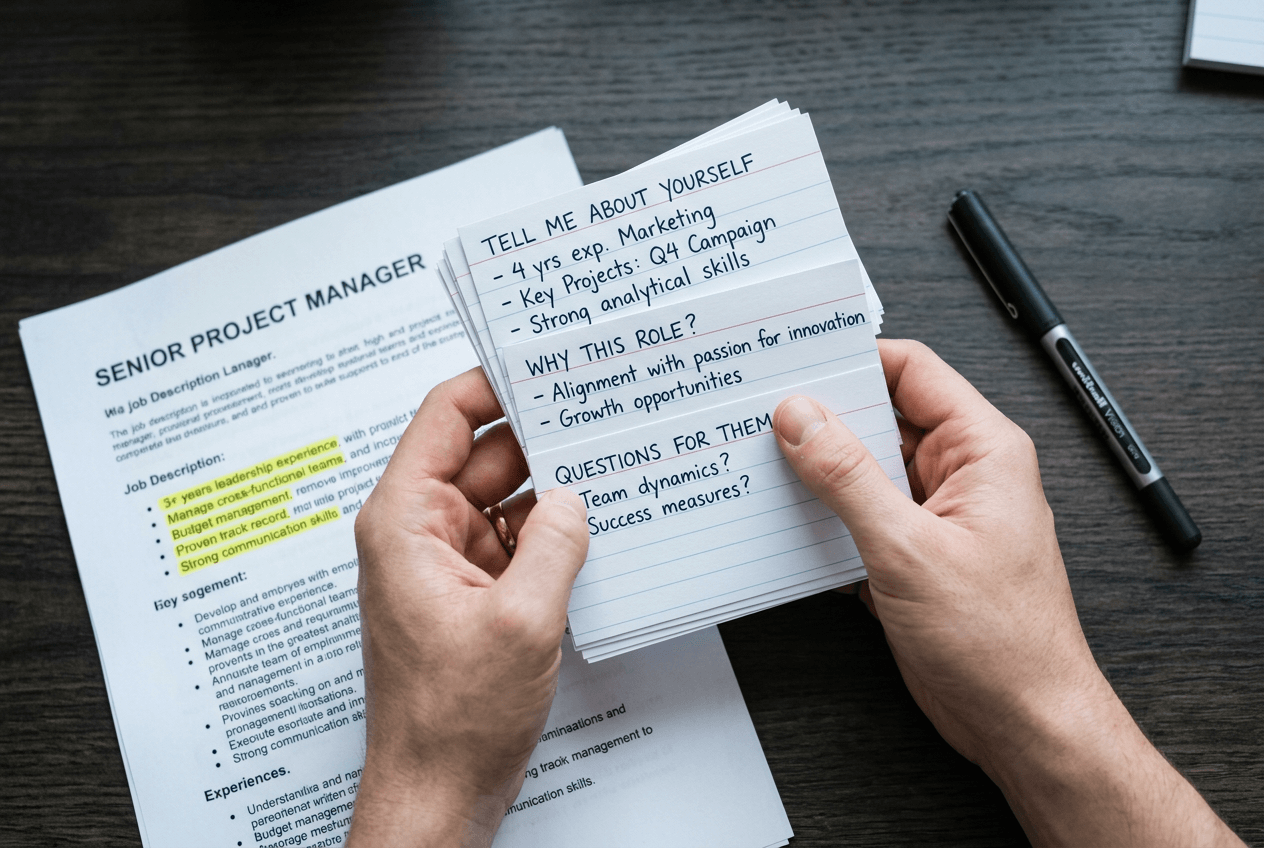
1. "Tell me about yourself."
This isn't an invitation to share your life story. It's a 30-60 second elevator pitch about your professional identity. Keep it focused on relevant work experience and skills the employer is looking for.
Framework: "I'm a [role/field] with [X years] of experience in [industry]. Most recently, I [key achievement or responsibility]. I'm particularly strong at [relevant skill], which is why I'm excited about this opportunity to [connection to the role]."
2. "Why are you interested in this position?"
Connect your skills and experience to their specific needs. Show you've done your research on the company.
Framework: "I've been following [company name]'s work in [specific area], and I admire [something specific]. My background in [relevant experience] aligns well with what you're looking for, especially [specific requirement from the job posting]."
3. "What do you know about our company?"
Don't recite their Wikipedia page. Mention something specific and recent — a product launch, a company value, a news article you read about them. This shows genuine interest and preparation.
4. "Walk me through your resume."
Similar to "tell me about yourself" but more chronological. Hit the highlights of your career — don't explain every job. Spend the most time on your most recent and relevant work experience.
Skills and Strengths Questions
5. "What are your greatest strengths?"
Pick 2-3 strengths directly relevant to the job you're applying for. Back each one with a brief, specific example from your work experience.
Example: "I'd say my biggest strength is problem-solving. In my last role, when our main supplier suddenly went out of business, I identified and vetted three alternatives within 48 hours, so production was only delayed by one day."
6. "What is your biggest weakness?"
Name a real (but not devastating) weakness, then explain what you're actively doing to improve. This question tests self-awareness — employers value honest candidates who are working to grow.
Example: "I sometimes spend too much time making sure everything is perfect before submitting work. I've been working on this by setting personal deadlines earlier than the actual due date, which forces me to balance quality with efficiency."
7. "Why should we hire you?"
This is your closing argument. Summarize what makes you uniquely qualified for the position and the value you'd bring to their team.
Framework: "You need someone who can [key job requirement]. I've done exactly that at [previous company], where I [specific result]. Plus, my experience with [unique skill] means I can [additional value you'd bring]."
8. "Where do you see yourself in five years?"
Show ambition, but keep it realistic and aligned with the role. The employer wants to see you're thinking about professional growth, not that you plan to leave the company in six months.
Behavioral and Situational Questions
These interview questions start with "Tell me about a time when..." and they're where most job interviews are won or lost. We'll cover the STAR method for answering these below, but here are the most common behavioral questions to prepare for:
9. "Tell me about a time you handled a conflict at work."
10. "Describe a challenge you overcame."
11. "Give me an example of when you demonstrated leadership."
12. "How do you handle tight deadlines or pressure?"
13. "Tell me about a time you failed. What did you learn?"
For all of these, the interviewer doesn't want theoretical answers ("I would..."). They want real stories from your work experience ("I did..."). Prepare specific examples you can deliver confidently with clear results.
Closing Questions
14. "What are your salary expectations?"
Research the market range for the role beforehand. Give a range, not a single number: "Based on my research and experience, I'd expect something in the range of $X to $Y, but I'm open to discussing the full compensation package."
15. "Do you have any questions for us?"
Always say yes. Prepare at least 3 questions before the job interview. Strong ones include:
- "What does a typical day look like in this role?"
- "What are the biggest challenges the team is facing right now?"
- "How do you measure success for this position?"
Not having questions signals you're not genuinely interested. This is a mistake non-native English speakers make frequently — they're so relieved the interview is ending that they skip this critical step.
The STAR Method: Your Framework for Behavioral Interview Questions
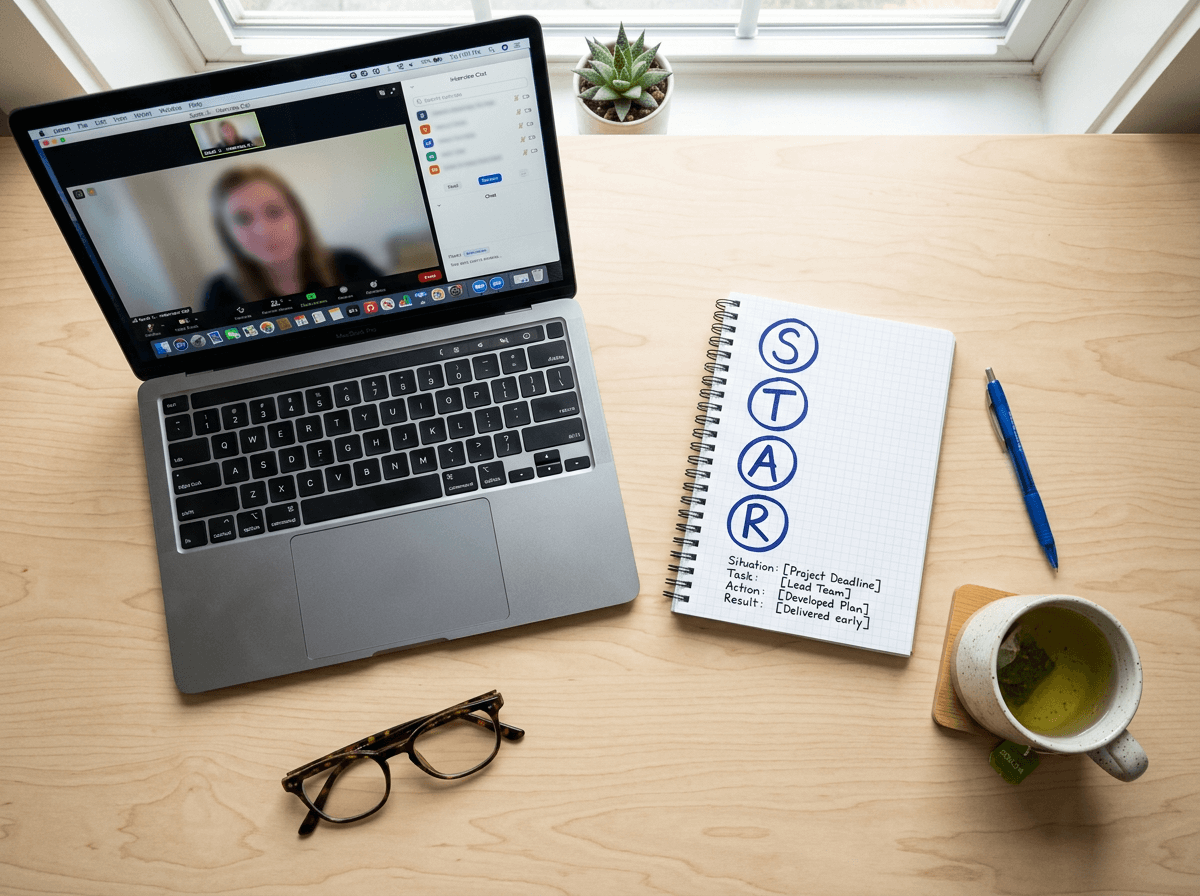
The STAR method is the best framework for answering behavioral interview questions. It gives you a clear structure to follow when the hiring manager asks about your past experience, which is especially valuable when you're speaking English as a second language and your brain wants to wander under pressure.
S — Situation: Set the scene. Where were you? What was the context? (1-2 sentences)
T — Task: What was your responsibility or goal? What problem needed solving? (1 sentence)
A — Action: What specifically did you do? This is the core of your answer. (2-3 sentences)
R — Result: What happened because of your actions? Use numbers and specific outcomes if possible. (1-2 sentences)
A STAR Answer in Action
Question: "Tell me about a time you solved a difficult problem at work."
Answer: "At my previous company, we discovered a week before launch that our main vendor couldn't deliver a critical component. (Situation) As the project lead, I needed to find an alternative without delaying our timeline. (Task) I contacted five alternative suppliers, negotiated an expedited production schedule with the best one, and restructured our assembly process to accommodate the slightly different specifications. (Action) We launched on time and the client never knew there was an issue. That vendor is now one of our top suppliers. (Result)"
Total speaking time: about 45 seconds. Clear, specific, and easy to follow — the kind of concise response hiring managers love.
Pro tip for non-native English speakers: Write out 3-5 STAR stories from your work experience and practice saying them out loud until they feel natural. Don't memorize them word-for-word — memorize the structure and key details, then practice free-talking through them. Each run will sound slightly different, and that natural variation is what makes your answers authentic whether you're in a mock interview or the real thing.

6 Common Mistakes Non-Native Speakers Make in English Interviews
These aren't grammar mistakes. They're delivery and communication mistakes that cost non-native English speakers job offers — even when their language skills and professional experience are strong.
Duolingo taught you words. No one taught you to speak.
PracticeMe: real voice conversations with an AI tutor, 24/7.
1. Memorizing Answers Word-for-Word
When you recite a memorized script during a job interview, it sounds flat and robotic. Worse, if the interviewer interrupts or rephrases the question, you lose your place entirely.
Fix: Memorize key points and phrases, not full paragraphs. Practice talking through your points in different ways each time you rehearse. This builds the flexibility you need for real conversations.
2. Using Overly Formal or Academic Language
"I would be most grateful for the opportunity to utilize my extensive competencies within your esteemed organization." Real professional English in the workplace is much simpler than what language textbooks teach.
Fix: Aim for professional but conversational. "I'm excited about this role because my experience in [X] is exactly what your team needs" is stronger and more natural for any job interview.
3. Excessive Filler Words
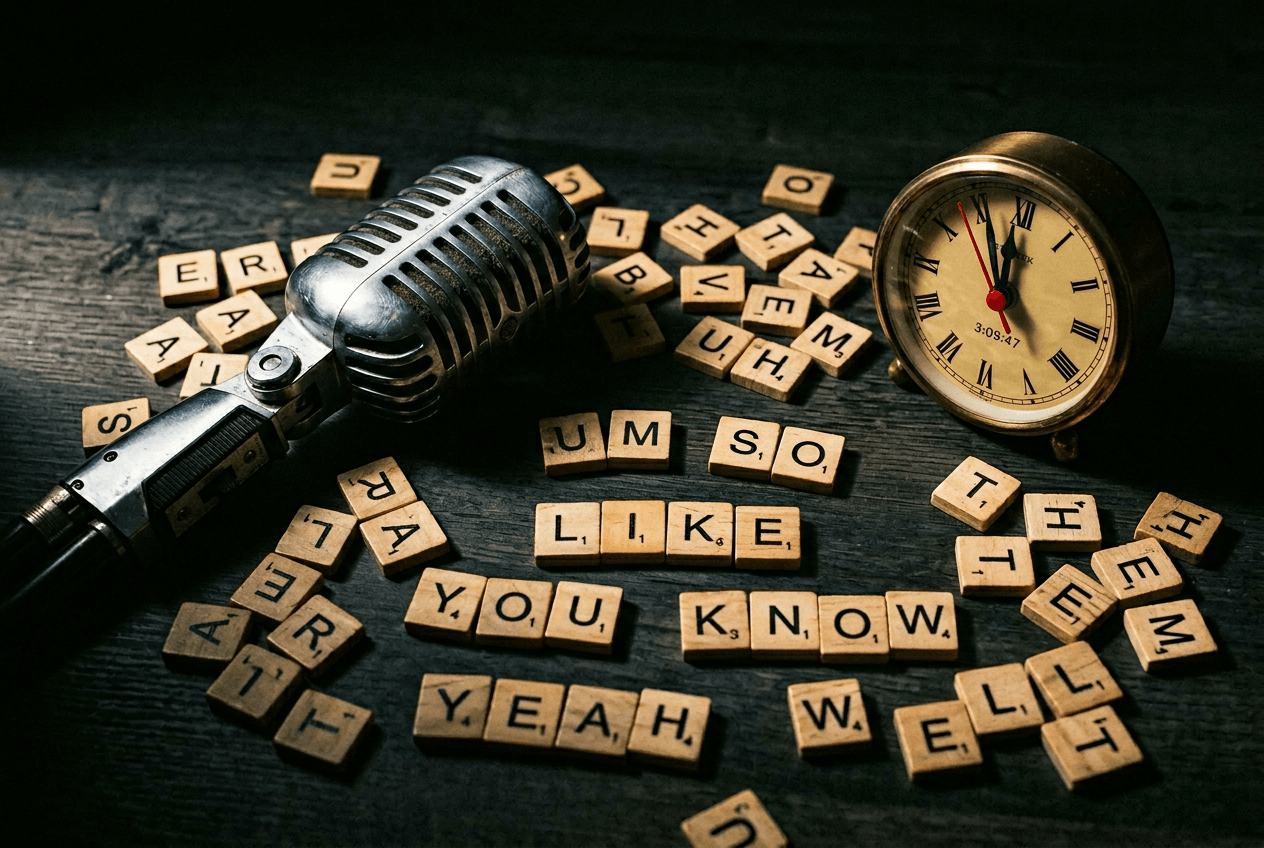
"Um," "uh," "so," "like," "you know" — everyone uses filler words, but non-native speakers often rely on them more while mentally translating. Hiring managers notice when every other word is "um."
Fix: Replace filler words with brief pauses. A 1-2 second pause while you gather your thoughts sounds confident. A string of "um, so, like, you know" sounds uncertain. Practice pausing deliberately during your mock interview sessions — it feels awkward at first but sounds completely natural to the listener.
4. Being Too Long-Winded
Non-native speakers often over-explain to make sure they're understood. But in interviews, concise answers demonstrate stronger communication skills. Aim for 60-90 seconds per response for behavioral questions.
Fix: Answer the question, give one strong example with a clear result, and stop. If the interviewer wants more detail, they'll ask a follow-up question.
5. Skipping Small Talk
The 2-3 minutes before the formal interview starts — "How's your day going? Did you find the office okay?" — aren't throwaway moments. Interviewers are already forming impressions of your communication skills and confidence.
Fix: Practice basic small talk responses. "I'm doing well, thank you! The office is great — I love the location. How's your week going?" Simple, warm, human. If conversational English is a challenge beyond just interviews, our guide on becoming fluent in English can help you build that foundation.
6. Not Asking for Clarification
If you don't understand a question, guessing and giving an off-base answer is worse than asking the interviewer to repeat it. Many non-native speakers fear that asking for clarification makes them look incompetent in front of the hiring manager.
Fix: Use professional phrases: "Could you rephrase that?" or "Just to make sure I understand — are you asking about [X]?" This actually demonstrates strong communication skills that any employer values.
How to Practice Interview Responses Out Loud
Reading interview tips is useful preparation. But reading about interviews doesn't prepare you for the experience of speaking under pressure — any more than reading about swimming teaches you to swim. You need actual english interview practice where you speak out loud, ideally with someone (or something) that talks back.

Here's what actually works for building english speaking practice for interview confidence:
Record yourself. Answer a common question, record it on your phone, play it back. You'll immediately hear what sounds natural and what sounds rehearsed. Time yourself — if any single answer goes past 90 seconds, tighten it up. Review your speaking pace and body language too.
Practice with a timer. Set a 60-second timer and answer a behavioral question using the STAR method. This trains your brain to organize thoughts quickly before speaking and get to the point — a critical skill for any job interview.
Shadow native speakers. Find interview preparation videos on YouTube, listen to how native speakers pace their responses, and repeat after them. Pay attention to rhythm and intonation, not just the words they choose.
Do a mock interview with AI. The biggest limitation of solo practice is that it's one-directional — you're not responding to unexpected follow-up questions or adapting in real time. That's where AI-powered speaking practice fills the gap. You can have actual back-and-forth conversations that simulate real interview pressure.
With Practice Me, you can practice answering job interview questions out loud with AI tutors who respond naturally, ask follow-up questions, and adapt to your English level. It feels like a real phone conversation — not like talking to a chatbot. And since it's available around the clock, you can squeeze in a mock interview session at midnight before your morning interview. If speaking anxiety has been holding you back from practicing with real people, a judgment-free AI partner removes that barrier entirely.
US Citizenship Interview: English Speaking Practice for the Naturalization Test
Job interviews aren't the only high-stakes English interviews. If you're preparing for your US naturalization interview, english speaking practice for US citizenship interview preparation is equally critical — and something most study guides overlook entirely.

What the Citizenship Interview Involves
The naturalization interview has five key steps:
- Oath — You swear to tell the truth
- N-400 Review — A USCIS officer goes through your application and asks about your answers
- English Reading Test — Read 1-3 sentences aloud
- English Writing Test — Write 1-3 sentences
- Civics Test — Answer questions about US history and government
Here's what most people miss: your English speaking ability is evaluated throughout the entire interview, not just during a formal "speaking test." The USCIS officer assesses your spoken English during the N-400 review conversation. If you can't understand their questions or articulate clear answers about your own life, it directly affects your result.
The 2025 Civics Test Changes
If you filed your N-400 application on or after October 20, 2025, you'll take the updated civics test:
- 128 possible civics questions (up from 100 on the previous test)
- 20 questions asked during your interview (up from 10)
- 12 correct answers needed to pass (up from 6)
- You fail if you get 9 wrong — the officer stops asking at that point
The test format is harder, but you also have more chances to demonstrate your knowledge. The critical thing is that all answers must be given verbally — you can't write them down. You need to speak clearly enough for the officer to understand and mark your answer as correct. This is where english interview practice for the civics portion really pays off.
N-400 Form Review Tips
During the N-400 review, the officer will ask you about information on your application — your travel history, employment, marital status, and more. These questions seem simple, but answering them under pressure in English can trip you up when you're nervous.
Practice saying these out loud:
- "I traveled to [country] for [duration] to visit [family/for work]."
- "I have been employed at [company] since [date] as a [position]."
- "I have been married for [X] years. My spouse's name is [name]."
- "I have lived at my current address for [X] years."
The more you practice verbalizing these facts about your own life in English, the smoother your citizenship interview will go. Using an AI speaking partner like Practice Me lets you rehearse these exact conversations — telling the AI about your personal history, your travel, your work experience — until the words flow naturally and confidently.
Start Your English Interview Practice Today
Whether you're preparing for a job interview at a new company or a US citizenship interview, the fundamental challenge is the same: you need to practice speaking your answers out loud, get comfortable with unexpected questions, and build the confidence to perform under pressure.
That's exactly what Practice Me was built for. Unlike flashcard apps or grammar tools, Practice Me gives you real voice conversations with AI tutors who listen, respond, and adapt — like practicing with a patient, judgment-free friend who's available 24/7.
Here's why it works for english interview practice:
- Real voice practice — Not typing. Speaking. The same skill you actually use when sitting across from a hiring manager.
- Adaptive conversations — AI tutors adjust to your English level and can simulate interview-style questions and follow-ups.
- American and British accents — Practice understanding different English accents you might encounter with different interviewers.
- No judgment — Make mistakes, stumble, start over. Nobody's evaluating you. That's the whole point of practice.
- Unlimited conversations — Run through your mock interview as many times as you need until every answer feels natural.
Your interview skills will improve fastest when you combine knowing the right answers (which you now have from this guide) with practicing them out loud repeatedly. Ready to start? Download Practice Me and try running through your "Tell me about yourself" answer tonight.
For more business English speaking practice beyond interviews — meetings, presentations, client calls — Practice Me covers those scenarios too. View pricing →
Frequently Asked Questions
How can I practice English for a job interview at home?
Record yourself answering common interview questions and review the recordings. Time your responses (aim for 60-90 seconds for behavioral questions). Use AI conversation tools like Practice Me for real back-and-forth english speaking practice. The key to effective interview preparation is practicing your answers out loud — reading silently doesn't prepare your mouth and brain for the real thing.
How long should I prepare for an English job interview?
Give yourself at least 1-2 weeks of daily practice. Spend the first few days researching the company and preparing your STAR stories. Then shift to speaking practice — answer each of the 15 common questions out loud at least 5 times. By interview day, your answers should feel natural without being memorized word-for-word.
What is the best way to practice for a US citizenship interview?
Focus on three areas: (1) memorize your N-400 form answers and practice saying them aloud clearly, (2) study the 128 civics questions and practice answering them verbally in English, and (3) practice basic English conversation so the USCIS officer can properly assess your speaking ability during the interview. The official USCIS study materials are the best starting point for civics questions.
How do I stop being nervous speaking English in a job interview?
Nervousness decreases with repetition and preparation. The more times you've said your answers out loud, the calmer you'll feel in the actual interview. Practice in low-pressure environments first — with an AI speaking partner, with a friend, or even talking to yourself in the mirror. Also remember: most hiring managers don't expect perfect English from non-native speakers. They're evaluating your skills, experience, and fit for the role — not grading your grammar.
Can AI help me practice for job interviews in English?
Yes — and it's one of the most effective methods available for english interview practice. AI conversation tools let you practice answering questions out loud and get real-time verbal interaction, which is something flashcards and written guides can't provide. The advantage of an AI mock interview over practicing alone is that AI asks follow-up questions you can't predict, building the same adaptive-thinking skills you need when speaking with a real hiring manager. Practice Me's AI tutors are designed for exactly this kind of speaking practice.