Duolingo taught you words. No one taught you to speak.
PracticeMe: real voice conversations with an AI tutor, 24/7.
How to Go from B2 to C1 in English Speaking [Plan]
![How to Go from B2 to C1 in English Speaking [Plan]](https://cdn.babyseo.ai/images/practiceme.app/b2-to-c1-english-speaking/b2-to-c1-english-plateau-summit-hero.webp)
If you've been "almost fluent" in English for years — following films, getting through podcasts, holding your own in meetings — but the leap to genuinely advanced English speaking keeps slipping away, you're not failing. You're standing on the most crowded plateau in language learning.
Scroll through r/EnglishLearning and you'll see the same post on repeat: "I'm B1–B2 and I've been stuck here for years. Nothing works." Here's what most advice on how to go from B2 to C1 English speaking misses: the strategies that carried you from beginner to upper-intermediate stop working at this stage. The jump isn't about doing more of the same — it's about doing different things on purpose.
This guide gives you the why and the exact how: the four specific gaps that separate B2 speakers from C1 speakers, the activities that close them, and a 12-week plan you can start today.
Quick Summary: Going from B2 to C1 in English speaking takes roughly 200 hours of focused practice — Cambridge's estimate for one level jump — but only if that practice is targeted. The B2 plateau happens because learners keep recycling familiar vocabulary on the same few topics. To break through, you need to roughly double your active vocabulary, master collocations and idiomatic phrasing, and build spontaneous fluency across unfamiliar topics. The fastest route is high-volume speaking on varied subjects, with feedback that pushes C1-level language.
Why B2 to C1 Is the Hardest Jump in English
Here's a number that surprises people. According to Cambridge Assessment English, it takes roughly 200 guided learning hours to move from B2 to C1 — about the same as any other single jump on the CEFR ladder. So why does this one feel like running through wet concrete?
Two reasons. First, there's a stubborn myth about the hours. The widely-quoted Cambridge figures — A2 ≈ 180–200 hours, B1 ≈ 350–400, B2 ≈ 500–600, C1 ≈ 700–800 — are cumulative. They count everything from your very first lesson. So the "500–600 hours" you've seen online is what it takes to reach B2, not the extra work for C1. The incremental jump is "only" about 200 guided hours. But "guided" means structured lessons; add the self-study, reading, and real conversations around them and the true investment is considerably bigger.
Second — and this is the real culprit — speaking is a productive skill, and productive skills always lag behind receptive ones. You can understand C1-level English (fast native speech, films, the news) long before you can produce it. Plenty of learners are a "reading C1" while still a "speaking B2." Recognizing language is easy; retrieving it under time pressure is hard.
Add the well-documented intermediate plateau — second-language researchers have noted for decades that the rate of improvement slows sharply as proficiency rises — and you get the perfect storm. The early levels deliver fast, obvious wins. The intermediate to advanced English stretch delivers slow, invisible ones.
The mindset shift that fixes this comes from a brilliant line on r/languagelearning: "You get to C1 by doing C1 things. You don't get to C1 by doing all the things that got you to B2, just more often." Tape that to your wall. We'll come back to it.
Not sure you're actually at B2 yet? Take a quick English fluency test first, or skim the CEFR levels guide — there's no point chasing C1 tactics if you're really a strong B1.
B2 vs C1: What Actually Changes When You Speak
The official Council of Europe descriptors spell out the difference, and one phrase does most of the heavy lifting.
A B2 speaker can "interact with a degree of fluency and spontaneity that makes regular interaction with native speakers quite possible without strain."
A C1 speaker can "express ideas fluently and spontaneously without much obvious searching for expressions" and "use language flexibly and effectively for social, academic and professional purposes."
That phrase — without much obvious searching for expressions — is the whole game. At B2 you get there, but the listener can sometimes hear you assembling the sentence. At C1, the words arrive when you need them, in the right register, with the right collocation. Here's the practical breakdown:
| Dimension | B2 (Upper-Intermediate) | C1 (Advanced) |
|---|---|---|
| Vocabulary | ~4,000–5,000 word families; everyday + some abstract | ~8,000+; precise, specialized, abstract |
| Fluency | Generally smooth; occasional visible word-searching | Spontaneous; few pauses, even on new topics |
| Grammar | Good control of common structures | Complex structures used naturally and flexibly |
| Idiom & register | Understands most; uses cautiously | Shifts register easily; idiomatic and natural |
| Cohesion | Connects ideas with basic linkers | Weaves ideas with varied connectors and signposting |
| Under pressure | Comfortable on familiar topics | Comfortable on unfamiliar topics too |
(Those vocabulary sizes are estimates — researchers disagree on exact thresholds — but the shape is reliable: reaching C1 means roughly doubling the words you can actively deploy.)
So the goal isn't to "communicate successfully." You already do that. The goal is to communicate with precision, flexibility, and ease — to stop reaching for the simplest available word and start choosing the best word, fast.
The B2 Plateau: 4 Reasons You're Stuck

If you've stalled for a while, one or more of these is the reason.
1. You live in your comfort-topic bubble. Most B2 learners cycle through the same three or four subjects — work, hobbies, travel, daily routine — and get very good at them. But as one popular Reddit comment put it: "You won't expand your vocabulary if the media you consume is always about the same 3 topics." Your everyday vocabulary is polished; your vocabulary for economics, ethics, science, or art is starving.
2. Your fluency collapses under pressure. Ask a B2 speaker about their weekend and they're smooth. Ask them to argue whether remote work is hollowing out cities, or to explain a concept from their job to a 10-year-old, and the pauses appear. C1 is precisely the ability to stay fluent when the topic is new.
3. Your "good enough" habits have fossilized. This is the cruel twist: the more you practice, the more automatic your current habits become — including the mediocre ones. Your brain has optimized for "understood successfully," not "expressed precisely," and that autopilot is hard to interrupt. Teachers see it constantly — learners stuck "using the same patterns, the same language forms and the same vocabulary."
4. Motivation quietly evaporates. At B2 you can already get by, so the external pressure that drove your early progress disappears. It becomes easy, as one learner admitted, to "compromise and fall into complacency." Many learners also grow hyper-aware of their mistakes, which — paradoxically — makes them speak less. And less speaking means less progress.
Notice the common thread: every one of these is solved by deliberately leaving your comfort zone. Which brings us to the gaps.
The 4 Gaps You Must Close to Speak at C1

Breaking the B2 plateau isn't vague. There are four concrete gaps, and you can attack each one directly.
Gap 1: Active vocabulary (passive → active)
You almost certainly recognize far more words than you can use. The C1 jump is largely about converting passive vocabulary into active vocabulary — words you can retrieve in half a second, mid-sentence.
How to close it: Stop collecting words you'll never say. When you meet a useful new word, force it into output within 48 hours — write three quick sentences with it, then say them aloud. Keep a tight "active list" of 15–20 words a week and actually use them in conversation. Recognition is free; retrieval is earned through production. (More on this in our guide to build vocabulary through conversations.)
Gap 2: Collocation mastery
Native speakers don't store words one by one — they store chunks. They say "heavy rain," "make a decision," and "a strong argument" without thinking. Get the partnership slightly wrong ("do a decision," "strong rain") and you sound stuck at B2 even when every individual word is correct.
How to close it: Learn words in their natural partnerships, not in isolation. Our guide to master English collocations breaks down 100 high-frequency pairs by type — start there, then notice collocations everywhere you read.
Gap 3: Idiomatic and nuanced expression
C1 speakers handle figurative language, phrasal verbs, and register shifts comfortably. They know when "kids" beats "children," when to say "wrap up" instead of "finish," and how a single idiom can land an idea in three words.
How to close it: Build a working stock of natural expressions and deploy them in the right context. Mine our lists of common English idioms, business English idioms, and phrasal verbs for conversation. The trick isn't memorizing 500 idioms — it's using 50 of them naturally.
Gap 4: Spontaneous fluency across unfamiliar topics
This is the gap that defines C1. Can you speak coherently, on the spot, about a subject you didn't prepare for? That ability comes from one thing only: lots of reps speaking on varied topics. Deliberately speak about things outside your comfort zone every day, and tolerate the discomfort — the activities below are built for exactly this.
Speaking Activities That Actually Push You to C1

Reading about C1 won't make you C1. Doing C1 things will. Here are the highest-leverage speaking activities — all doable alone.
The 2-minute impromptu speech. Pick a random prompt ("Should cities ban cars?", "Explain your job to a child," "Is honesty always the best policy?"). Set a timer and talk for two minutes without stopping — no notes. This is the single best drill for spontaneous fluency because it forces retrieval under mild pressure, exactly the C1 skill.
Debate yourself. Choose a topic and argue for it for two minutes, then against it for two minutes. You'll be forced to reach for concession language ("admittedly," "that said," "while it's true that…") and the kind of balanced, nuanced phrasing that real C1 conversations reward.
The paraphrase and upgrade drill. Say a simple sentence, then say it two more ways, each more sophisticated: "It's a big problem" → "It's a significant issue" → "It's a pressing challenge we can't afford to ignore." This directly trains the precision and range that separate C1 from B2.
Summarize a TED talk from memory. Watch a 10–15 minute TED talk on an unfamiliar subject, then summarize it aloud in 90 seconds — main argument, two supporting points, your own reaction. You absorb new topic vocabulary and practice reproducing it.
Narrate at a higher register. Describe your day, a news story, or a process out loud — but consciously upgrade your word choice, tighten your grammar, and link your ideas with discourse markers and connectors. It feels stiff at first; that stiffness is you building new pathways.
To add structure and variety, work through role-play scenarios, sharpen formal delivery with presentation tips for non-native speakers, and practice the micro-skills that keep a conversation going when you don't know what to say next.
Duolingo taught you words. No one taught you to speak.
PracticeMe: real voice conversations with an AI tutor, 24/7.
Read Wide: Feed the Vocabulary Machine

Speaking is the engine, but reading is the fuel. You can't actively use words you've never met — and you only meet advanced vocabulary by reading and listening widely.
The key word is widely. If you only read about football and tech, you'll have a rich football-and-tech vocabulary and nothing else. C1 demands range, so deliberately rotate domains: long-form journalism, opinion essays, popular science, literary fiction, business writing, history, culture. Each domain hands you a different slice of the vocabulary you're missing.
How much? Heavy-immersion learners often cite benchmarks like ~10,000 pages of reading plus a few hundred hours of native-level listening to break from B-level to C-level. Don't treat that as gospel — treat it as a reminder that volume matters and there are no shortcuts around input.
The step most learners skip: turn input into output. Reading alone builds passive knowledge. After an article, summarize it aloud and consciously reuse three new words or collocations in your next conversation. That's the bridge from "I've seen that word" to "I can say that word." For a full system, see our guide to build English immersion at home.
How to Track Your Progress from B2 to C1
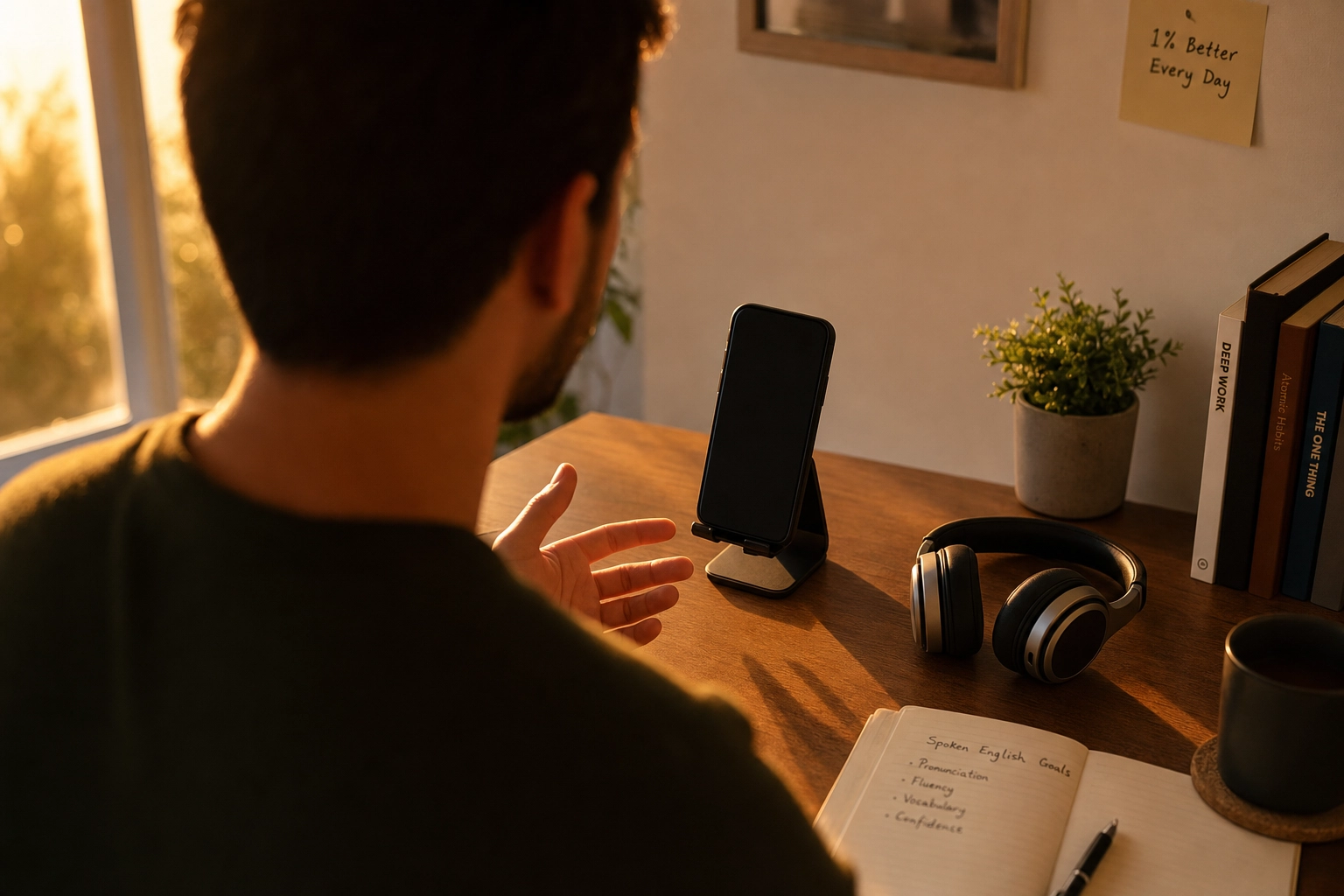
The plateau is partly an illusion — you're often improving in ways too small to notice day to day. Measurement makes that progress visible and keeps you going.
Record a 2-minute monologue every month. Use the same prompt each time ("Describe a challenge you overcame"). Save the recordings. Comparing month one to month three is the most motivating thing you'll do — you'll hear fewer pauses, richer words, smoother grammar.
Track your vocabulary diversity score. In linguistics, lexical diversity is measured with the type-token ratio (TTR): the number of unique words (types) divided by the total number of words (tokens). A speaker who uses 90 different words in a 120-word answer is far more lexically diverse than one who recycles 50. You can DIY this: transcribe your monthly monologue (auto-transcription is fine), then count unique meaningful words against the total. One caveat — TTR naturally drops as samples get longer, so always compare same-length clips (your fixed 2-minute monologue is perfect for this). Watch the unique-word count climb over time.
Watch your fluency metrics. Three are easy to self-measure: words per minute (advanced speakers typically land around 120–150 wpm in conversation), pause frequency (are the long "uhh" gaps shrinking?), and self-corrections (fewer false starts means more automaticity). Our English fluency test walks through these speaking-specific metrics in detail.
Use a C1 milestone checklist. You're approaching C1 speaking when you can: talk for two minutes on an unfamiliar topic without freezing; use idioms and collocations without translating in your head; shift between casual and formal registers; and self-correct mid-sentence without losing your thread. (If you still translate first, our guide on how to learn to think in English tackles that bottleneck directly.)
How to Go from B2 to C1 English Speaking: Your 12-Week Plan
Here's a realistic, speaking-first plan at roughly 45–60 minutes a day, built in three four-week phases that escalate from foundations to full spontaneity. It's speaking-first by design — light writing and grammar work support it, but your mouth does the heavy lifting.
| Week | Focus | Daily habit (45–60 min) | Speaking output goal |
|---|---|---|---|
| 1 | Widen your topics | Read 1 article from an unfamiliar domain; note 10 words | 1 × 2-min monologue (baseline recording) |
| 2 | Active vocab system | Use 15 new active words in spoken sentences | 2 × 2-min impromptu speeches |
| 3 | Collocations | Study 1 collocation type; reuse it in speech | Summarize 1 TED talk aloud |
| 4 | Phase 1 review | Mixed review + record monologue #2 | 15-min free conversation |
| 5 | Idioms & phrasal verbs | Learn 10 idioms/phrasal verbs; use 5 aloud | Debate yourself: 1 topic, both sides |
| 6 | Register control | Say each idea casually and formally | 3 × 2-min impromptu speeches |
| 7 | Complex grammar | Drill conditionals, relative & cleft sentences in speech | Explain a complex idea simply, aloud |
| 8 | Phase 2 review | Mixed review + record monologue #3 | 20-min conversation on a new topic |
| 9 | Spontaneity | Random-prompt speeches, zero prep | 4 × 2-min impromptu speeches |
| 10 | Paraphrase & precision | Upgrade-drill 10 simple sentences daily | Debate a current-events topic |
| 11 | Fluency under pressure | Speak on topics you usually avoid | Summarize a news story + give your opinion |
| 12 | Polish & assess | Light review; record monologue #4 | Mock C1 speaking task; compare to Week 1 |
Adjust freely — the structure matters more than the specifics. Phase 1 widens your inputs and builds a vocabulary habit. Phase 2 adds range through collocations, idioms, register, and grammar. Phase 3 trains pure spontaneity and polish. For the bigger picture beyond speaking, our broader fluency roadmap ties the four skills together.
Where Practice Me Fits: High-Volume Speaking on Demand

Look back at the four gaps and the activities that close them. They share one requirement: a huge amount of speaking output, on varied topics, with something pushing you upward. That's the exact thing most B2 learners can't get. Conversation partners are expensive, scheduled, and easy to slip into comfortable small talk with.
This is the bottleneck Practice Me is built to remove. It gives you real-time voice conversations with AI tutors, available 24/7, with no daily cap on the Pro plan — so you can run the 2-minute impromptu speeches, the debates, and the topic-variety reps as many times as you want. Because it's an AI, it's completely judgment-free: you can stumble, restart, and try a fancy new word without anyone raising an eyebrow.
A few features map directly onto the C1 gaps:
- Adaptive conversation can stretch you toward more advanced, C1-level vocabulary instead of letting you coast on comfortable B2 phrasing.
- Topic starters push you out of your comfort-topic bubble and onto unfamiliar subjects — the single biggest plateau-breaker.
- Cross-session memory means the tutor remembers you, so it can keep circling back to the words and structures you tend to dodge.
- American and British accents let you tune both your ear and your output to the variety you're targeting.
One honest note: Practice Me is built for speaking practice, not official test scoring — it won't hand you a certified C1 result. What it does is solve the volume problem, which is the real reason most people stay stuck. If you want to try the approach, here's how to practice English with AI.
Frequently Asked Questions
How long does it really take to go from B2 to C1 in English speaking?
Cambridge estimates about 200 guided learning hours for the B2→C1 jump, but that's classroom time only. With consistent self-study and real speaking practice, most motivated learners need somewhere between 6 and 12 months. Speaking specifically can take longer than the other skills because producing language is harder than understanding it.
Why do I understand everything but still speak at a B2 level?
Because understanding (a receptive skill) develops faster than speaking (a productive skill). You can recognize a word in context long before you can retrieve it instantly mid-sentence. The fix is output: the more you speak, the more passive vocabulary converts into active vocabulary you can actually use.
Can I reach C1 speaking without living in an English-speaking country?
Yes. Location matters far less than deliberate practice volume. What learners abroad get automatically — constant, varied speaking — you can recreate with daily impromptu speaking, wide reading, and consistent conversation practice. Plenty of people reach C1 entirely through self-study and online tools.
Do I need to pass a C1 exam like CAE or IELTS to be considered C1?
No — your ability and a certificate are different things. You can speak at a C1 level without a certificate, and you might want one for university or work. If your goal is the certificate, practice with that exam's specific speaking format. If your goal is real-world fluency, focus on the gaps and activities in this guide.
Is B2 already fluent — do I even need to reach C1?
B2 is often called "fluent" and is enough for most jobs, travel, and daily life. You need C1 if you want to study at a top university, work in demanding professional or academic settings, or simply express yourself with native-like precision and ease. If B2 already meets your goals, that's a perfectly valid place to stay.
How do I know when I've actually reached C1 in speaking?
You're there when you can speak for two minutes on an unfamiliar topic without freezing, use collocations and idioms without translating in your head, shift between casual and formal registers, and self-correct without losing your flow. Record yourself, compare against the C1 descriptors above, and — for an external check — take a structured English fluency test.
The B2 plateau is real, but it isn't permanent. The learners who break through aren't more talented — they simply stop doing B2 things and start doing C1 things: speaking more, on harder topics, with words that stretch them. That, in one sentence, is how to go from B2 to C1 English speaking. Pick one activity from this guide, open your mouth today, and start logging the reps — C1 is a practice problem, and practice is something you fully control.