Duolingo taught you words. No one taught you to speak.
PracticeMe: real voice conversations with an AI tutor, 24/7.
English Collocations: 100 Phrases to Sound Fluent

A grammatically perfect English sentence can still sound completely wrong. Tell a native speaker "I did a big mistake yesterday" and they'll understand you — but something will feel off. The grammar is fine. The vocabulary is correct. What's missing? You broke a collocation.
English collocations are the invisible glue of fluent speech. They're the reason we say "make a mistake" instead of "do a mistake," "heavy rain" instead of "strong rain," and "pay attention" instead of "give attention." Learn the right ones, and your English transforms from technically correct to genuinely natural.
Quick Summary: English collocations are fixed word pairings that native speakers use instinctively — like "make a mistake" or "strong coffee." This guide covers 100 essential collocations across five categories (make/do, adjective+noun, verb+noun, adverb+adjective, business), shows the common wrong versions for each, and explains why real-time conversation practice — not flashcard memorization — is how you actually internalize them.
What Are English Collocations?
A collocation is a combination of two or more words that habitually appear together in natural English. The pairing isn't dictated by grammar — it's dictated by usage. Native speakers have heard and used these combinations so often that any other pairing sounds strange, even when it's technically correct.
Take rainfall, for example:
- ✅ heavy rain (natural)
- ❌ strong rain (grammatical but wrong-sounding)
- ❌ big rain (grammatical but wrong-sounding)
Both "strong" and "big" could logically describe intense rainfall. But English speakers don't say it that way. They say "heavy rain." That's a collocation — a word partnership fixed by convention rather than rule.
Collocations are different from idioms and phrasal verbs, though learners often confuse all three:
- Collocations have literal meaning (heavy rain = a lot of rain)
- Idioms have figurative meaning (kick the bucket = die)
- Phrasal verbs combine a verb with a particle that changes its meaning (look up, give in, run out)
The five main patterns of English collocations you'll encounter are:
| Type | Example |
|---|---|
| Verb + noun | make a decision, catch a cold, pay attention |
| Adjective + noun | heavy rain, strong coffee, deep sleep |
| Adverb + adjective | completely different, highly recommended |
| Verb + adverb | work hard, speak fluently, drive carefully |
| Noun + noun | bus stop, coffee table, job interview |
Native speakers absorb thousands of these implicitly through years of exposure. Non-native learners have to catch up intentionally — and that's where most English courses fall short.
Why Collocations Are the Secret to Sounding Fluent
In 1983, linguists Andrew Pawley and Frances Syder made a discovery that still shapes how we understand fluency today: native speakers don't build sentences word by word. They pull from a mental warehouse of pre-assembled chunks — thousands of formulaic language patterns they've heard and used repeatedly.
This is why fluent English speakers talk fast without hesitating. They're not composing original sentences from scratch. They're retrieving prefabricated combinations:
- "make a decision" → one chunk, one retrieval
- "catch a cold" → one chunk, one retrieval
- "meet a deadline" → one chunk, one retrieval
Learners who focus only on individual vocabulary words have to assemble these phrases in real time — and that assembly takes cognitive effort. The result? Hesitation, unnatural phrasing, and that familiar feeling of "thinking in my first language and translating word by word."

Research on language chunking confirms the pattern: learners who practice collocations as whole units speak faster, with fewer pauses, and with less mental strain. Grammar tells you HOW to combine words. Collocations tell you WHICH words actually combine. You need both, but grammar alone won't get you past the "textbook English" ceiling.
If you've ever watched two fluent non-native speakers talk, you've probably noticed they understand each other perfectly — but the rhythm sounds slightly unnatural. That's missing collocations. The grammar is correct; the chunks aren't. This is closely related to why it helps to stop translating and speak English naturally — translation produces word-by-word output, while real fluency requires chunk-by-chunk retrieval.
The 5 Types of English Collocations
Before we dive into the 100 examples, here's a quick overview of the five main collocation patterns. Once you start noticing these categories, you'll spot them everywhere — in movies, podcasts, songs, and everyday conversations.
1. Verb + Noun — make a decision, catch a cold, have lunch, take a break. The verb and noun function as a unit.
2. Adjective + Noun — heavy rain, strong coffee, deep sleep, close friend. Specific adjectives pair with specific nouns.
3. Adverb + Adjective — completely different, deeply concerned, highly recommended. Certain intensifiers go with certain adjectives.
4. Verb + Adverb — work hard, speak fluently, whisper softly. The adverb describes how the action is performed.
5. Noun + Noun — bus stop, coffee table, traffic jam, job interview. Two nouns form a compound concept.
The first three categories are where learners make the most mistakes — so that's where this guide focuses. Add business collocations (a specialized verb+noun subcategory) and a section on the 10 most commonly confused pairings, and you'll cover the combinations that make the biggest difference in how natural your English sounds. For broader vocabulary building, see our guide on building English vocabulary through conversations.
20 Make vs Do Collocations (The #1 Confusion)
If there's one confusion that trips up nearly every English learner, it's the difference between "make" and "do." The general rule:
- MAKE = create, produce, or bring something into existence
- DO = perform an activity, task, or duty
That rule gets you about 80% of the way there. The rest requires exposure. Here are the 20 most important make/do collocations with the wrong versions learners commonly produce.
10 Essential MAKE Collocations
1. make a decision — not do a decision "I need to make a decision by Friday." (British English occasionally uses "take a decision" in formal contexts, but "make" is standard globally.)
2. make a mistake — not do a mistake "Everyone makes mistakes. Don't worry about it."
3. make an effort — not do an effort "She's making an effort to speak English every day."
4. make a phone call — not do a phone call "Give me five minutes — I need to make a phone call."
5. make a choice — not do a choice "You have to make a choice between the two options."
6. make progress — not do progress "I'm making real progress with my pronunciation."
7. make money — not do money "He makes good money as a translator." ("Earn money" also works.)
8. make friends — not do friends "It's hard to make friends in a new city."
9. make noise — not do noise "The kids are making too much noise."
10. make sense — not do sense "Sorry, that doesn't make sense to me."
10 Essential DO Collocations
11. do homework — not make homework "Have you done your homework yet?"
12. do the laundry — not make the laundry "I need to do the laundry this weekend."
13. do the dishes — not make the dishes "I'll cook if you do the dishes." ("Wash the dishes" is also natural.)
14. do business — not make business "It's a pleasure to do business with you."
15. do exercise — not make exercise "You should do more exercise." ("Work out" is also common.)
16. do a favor — not make a favor "Can you do me a favor?"
17. do research — not make research "I need to do more research before I decide."
18. do your best — not make your best "Just do your best — that's all anyone can ask."
19. do damage — not make damage "The storm did serious damage to the roof."
20. do well — not make well "She's doing well at her new job."
Pro tip: When you hear a native speaker use make or do with a noun you haven't seen before, write it down. Patterns start emerging. "Make" tends to go with things you create or produce (plans, decisions, meals, noise, money). "Do" tends to go with activities, chores, and performance (housework, exercise, favors, research).
20 Adjective + Noun Collocations You Hear Every Day
These collocations pair descriptive words with nouns in fixed combinations. They're everywhere in daily conversation, and getting them wrong is one of the fastest ways to sound non-native.
Weather and Natural World
21. heavy rain — not strong rain or big rain "We had heavy rain all weekend."
22. strong wind — not heavy wind or powerful wind "Watch out — there are strong winds forecast."
23. bright sunshine — not strong sunshine "The kitchen gets bright sunshine in the morning."
24. thick fog — not heavy fog (though "dense fog" works) "The thick fog made driving dangerous."
25. bitter cold — not strong cold "It was bitter cold that January."
Food and Drink
26. strong coffee — not powerful coffee or heavy coffee "I need strong coffee to get through this morning."
27. fast food — not quick food or rapid food "We grabbed some fast food on the way."
28. rich dessert — not heavy dessert "That chocolate cake was a rich dessert."
29. heavy meal — not strong meal "I can't work after a heavy meal."

People and Emotions
30. close friend — not near friend or tight friend "She's a close friend from university."
31. deep sleep — not heavy sleep (though "heavy sleeper" describes a person) "I fell into a deep sleep within minutes."
32. serious problem — not strong problem (big problem is acceptable) "We have a serious problem here."
33. strong accent — not powerful accent (heavy accent is acceptable) "He speaks English with a strong French accent."
Abstract Concepts
34. hard work — not strong work or heavy work "It takes hard work to reach fluency."
35. common sense — not normal sense or usual sense "Just use common sense."
36. full attention — not complete attention "You have my full attention."
37. major issue — not strong issue (big issue is acceptable) "That's a major issue we need to address."
38. top priority — not main priority (first priority is acceptable) "Safety is our top priority."
39. strong argument — not hard argument (powerful argument is acceptable) "She made a strong argument for the new plan."
40. tight schedule — not hard schedule (busy schedule is an acceptable alternative) "I'm on a tight schedule today."
20 Verb + Noun Collocations for Everyday Conversation
These are the verb-noun combinations you'll hear constantly in natural English. They cover daily routines, communication, work, and time — so getting them right immediately makes your speech sound more fluent.
Daily Life
41. catch a cold — not take a cold ("get a cold" is acceptable casually, but "catch a cold" is the standard collocation) "I caught a cold last week and I'm still coughing."
42. take a break — not do a break or make a break "Let's take a break for 10 minutes."
43. have lunch — not take lunch ("eat lunch" works, but "have lunch" is the natural collocation) "Want to have lunch together tomorrow?"
44. take a shower — not do a shower (American English; "have a shower" is British) "I'll take a shower and be ready in 20 minutes."
45. take a nap — not do a nap or sleep a nap "I'm going to take a quick nap."
Communication
46. pay attention — not give attention or make attention "Pay attention — this is important."
47. give advice — not make advice or tell advice "Can I give you some advice?"
48. tell a joke — not say a joke "He told a joke and everyone laughed."
49. tell the truth — not say the truth "Just tell me the truth."
50. ask a question — not make a question or do a question "Can I ask you a question?"
51. take notes — not do notes ("make notes" is acceptable in some contexts) "Take notes during the meeting."

Work and Study
52. hold a meeting — not do a meeting or make a meeting "We'll hold a meeting tomorrow at 10."
53. set goals — not put goals ("make goals" is acceptable, but "set" is standard) "Set realistic goals for yourself."
54. raise awareness — not lift awareness or grow awareness "The campaign aims to raise awareness about mental health."
55. reach a conclusion — not make a conclusion ("come to a conclusion" also works) "We reached a conclusion after three hours of discussion."
56. keep quiet — not be quiet (different meaning) or stay quiet (acceptable) "Please keep quiet during the exam."
Time and Money
57. save time — not win time (don't confuse with "make time" = create space in schedule) "Using templates saves time."
58. waste money — not lose money (different meaning) or spend money badly "Don't waste money on things you won't use."
59. gain weight — not take weight or get weight "I gained weight over the holidays."
60. lose patience — not finish patience or run patience "I'm losing patience with this situation."
20 Adverb + Adjective Collocations That Sound Natural
This is where many advanced learners still sound slightly off. Adverbs don't pair randomly with adjectives. "Deeply concerned" sounds right, but "deeply happy" sounds wrong — even though the grammar is identical. The combinations are fixed by convention.
Duolingo taught you words. No one taught you to speak.
PracticeMe: real voice conversations with an AI tutor, 24/7.
Complete Intensifiers
61. completely different — not deeply different ("totally different" also works) "Their approach is completely different from ours."
62. absolutely right — not deeply right ("completely right" is acceptable) "You're absolutely right about that."
63. utterly exhausted — not deeply exhausted or fully exhausted "After the flight, I was utterly exhausted."
64. perfectly normal — not deeply normal ("completely normal" works) "It's perfectly normal to feel nervous before a presentation."
Serious and Negative States
65. deeply concerned — not heavily concerned ("strongly concerned" is acceptable) "The doctors are deeply concerned about his recovery."
66. seriously injured — not deeply injured (heavily injured is acceptable) "Three people were seriously injured in the accident."
67. bitterly disappointed — not strongly disappointed (deeply disappointed works) "She was bitterly disappointed by the result."
68. strongly opposed — not heavily opposed (deeply opposed works) "The community is strongly opposed to the new highway."
69. deeply sorry — not heavily sorry (very sorry is acceptable but less emphatic) "I'm deeply sorry for your loss."
Certainty and Likelihood
70. highly likely — not strongly likely or deeply likely "It's highly likely that prices will rise."
71. highly unlikely — not strongly unlikely or deeply unlikely "It's highly unlikely we'll finish today."
72. widely available — not largely available (broadly available is less idiomatic) "This medication is widely available."
73. virtually impossible — not deeply impossible (practically/nearly impossible works) "It's virtually impossible to predict."
74. severely limited — not deeply limited (heavily limited is acceptable) "Options are severely limited at this point."
Positive Intensifiers
75. fully aware — not deeply aware ("completely aware" is acceptable) "I'm fully aware of the risks."
76. highly recommended — not deeply recommended ("strongly recommended" works) "This restaurant is highly recommended."
77. extremely important — not heavily important ("highly important" works) "This meeting is extremely important."
78. incredibly useful — not deeply useful ("highly useful" works) "The feedback was incredibly useful."
79. well aware — not strongly aware ("fully aware" works) "He's well aware of the deadline."
80. vitally important — not heavily important "It's vitally important that we get this right."
Why this category is tricky: Adverb+adjective collocations often defy translation. Your first language might use one general intensifier for everything, but English requires specific pairings. This is why they're so hard to memorize from lists — you need to hear them in context enough times that the right combinations start to feel automatic.
20 Business English Collocations for Work
If you work in English — or plan to — these are non-negotiable. Business collocations are even more fixed than everyday ones because professional language tends toward standardization.
Meetings and Communication
81. hold a meeting — not do a meeting or make a meeting "We're holding a meeting on Thursday."
82. attend a conference — not visit a conference ("go to a conference" is acceptable but less formal) "She attended a conference in Berlin last month."
83. take minutes — not write minutes or make minutes "Who's going to take minutes today?"
84. raise concerns — not lift concerns or tell concerns "Several board members raised concerns about the budget."
85. give feedback — not make feedback or do feedback "I'd appreciate your feedback on this draft."
Deals and Negotiations
86. close a deal — not finish a deal or end a deal "We're close to closing the deal."
87. reach an agreement — not find an agreement ("make an agreement" is acceptable) "After hours of talks, they reached an agreement."
88. sign a contract — not make a contract (write a contract means drafting, different meaning) "Both parties signed the contract yesterday."
89. negotiate terms — not make terms (discuss terms has a different nuance) "We still need to negotiate the terms."
90. seize an opportunity — not catch an opportunity ("take an opportunity" is acceptable) "She seized the opportunity to present her idea."

Performance and Results
91. meet a deadline — not catch a deadline ("make a deadline" is acceptable casually) "Can we meet the deadline?"
92. hit a target — not make a target ("reach a target" is acceptable) "The team hit its quarterly target."
93. deliver results — not make results ("bring results" is acceptable) "We need to deliver results this quarter."
94. exceed expectations — not pass expectations or overcome expectations "The launch exceeded our expectations."
95. set targets — not put targets or make targets "Set clear targets for your team."
Strategy and Action
96. launch a product — not start a product (different meaning) "We launched a new product last quarter."
97. secure funding — not win funding ("get funding" is acceptable but less formal) "The startup secured funding in March."
98. address an issue — not treat an issue (solve an issue has a different nuance) "We need to address this issue before it grows."
99. give a presentation — not do a presentation ("make a presentation" is acceptable) "She gave a presentation on market trends."
100. make a pitch — not do a pitch ("give a pitch" is acceptable) "He made a strong pitch to the investors."
For more work-specific language, you can also study our guide to business English idioms that pair well with these collocations in meetings and negotiations.
Top 10 Most Commonly Confused English Collocations
These are the errors you'll hear most often — and the ones that most instantly mark someone as a non-native speaker. Most come from direct translation from other languages. Learn these and you'll immediately sound more natural.
1. make a mistake ✅ — not do a mistake ❌ Many languages use "do" here. English treats mistakes as things you create, not perform. Spanish learners in particular say hacer un error → do an error out of habit. This maps onto a broader challenge for Spanish speakers covered in our hard English words for Spanish speakers guide.
2. take a photo ✅ — not make a photo ❌ German, French, and Spanish all use "make" for photography (faire une photo, hacer una foto, ein Foto machen). English uses "take."
3. heavy rain ✅ — not strong rain or big rain ❌ Intensity of precipitation in English uses "heavy." Wind uses "strong." Don't mix them up.
4. strong coffee ✅ — not powerful coffee ❌ Concentration of flavor uses "strong," not "powerful." Same pattern with tea, alcohol, and medicine.
5. pay attention ✅ — not give attention or make attention ❌ Attention is something you "pay" in English — as if it's a cost. Nearly every learner gets this wrong at first because most languages use "give" here.
6. catch a cold ✅ — not take a cold ❌ We "catch" illnesses as though they're spreading objects. "Get a cold" is acceptable in casual speech, but "catch a cold" is the standard collocation.
7. tell a lie / tell the truth ✅ — not say a lie or say the truth ❌ You "tell" stories, jokes, lies, truths, and secrets. You "say" words, phrases, and sentences. Different verbs, different rules.
8. make a decision ✅ — not do a decision ❌ And for many learners whose English education was British: "take a decision" exists but sounds overly formal in modern speech. Use "make."
9. turn on the TV ✅ — not open the TV ❌ Spanish, French, and Arabic speakers often say "open/close" for electronics because that's what their languages do. English uses "turn on/off" for anything electronic — TVs, radios, lights, computers.
10. do homework ✅ — not make homework ❌ Homework is an activity you perform, not something you create. Same for the laundry, the dishes, and exercise.

Why you make these mistakes: Almost all collocation errors come from one of three sources — direct translation from your first language, overgeneralizing an English rule that has exceptions, or never hearing the correct form enough times for it to stick. The fix is the same in every case: more high-quality input and more speaking practice.
Why You Can't Learn Collocations From a List Alone
You could memorize every collocation in this article tomorrow. You'd recognize them instantly when reading. And in your next conversation, you'd still freeze up and say "do a mistake."
That's not a failure of effort — it's how language learning works. There's a huge gap between recognition (you see it and understand it) and production (you retrieve it in real time under conversational pressure).
Here's what separates the two:
- Recognition practice = reading lists, doing flashcards, reviewing vocabulary apps. Builds passive knowledge.
- Production practice = saying the words aloud in real conversations. Builds active retrieval.
You know this from your own language. You recognize tens of thousands of words you'd never use in speech. Your active vocabulary is a small fraction of what you understand.

Collocations magnify this problem because they're fixed chunks. You can't assemble them logically from individual words — you have to retrieve the whole unit. And retrieval speed only comes from repeated practice pulling the chunk out of memory under pressure.
Writing helps, but it doesn't fully solve the problem. When you write, you have time to pause, reconsider, and edit. Spoken conversation gives you none of that. A collocation either comes out automatically or it doesn't.
This is why silent reading, no matter how much you do, never fully converts to fluent speech. You can know "make a mistake" is correct and still produce "do a mistake" in a stressful moment. The neural pathways for retrieval-under-pressure are different from the pathways for recognition.
The solution isn't more studying. It's more speaking.
How Conversation Practice Builds Collocational Intuition
Real conversation does something flashcards can't: it forces you to retrieve language in real time, under social pressure, in meaningful context. That's exactly how native speakers built their collocation knowledge — not from lists, but from thousands of hours of conversation.
Here's what happens when you practice collocations in actual dialogue:
You hear chunks in natural context. Every native speaker you talk to produces dozens of collocations per minute. "Make sense." "Take a look." "Have a good one." The more you hear these in real conversational moments, the more your brain encodes them as single units.
You're forced to retrieve under pressure. When it's your turn to speak, you don't have time to consult a mental list. You grab whatever comes out fastest. Repeated practice makes the correct collocation — not the translated-from-your-first-language version — the one that comes out first. This is the same principle behind learning how to think in English.
Mistakes get noticed and corrected immediately. When you say "do a mistake" and your conversation partner rephrases as "make a mistake" naturally, your brain gets a micro-correction. That's more effective than any textbook explanation.
Emotional and social context strengthens memory. A collocation used during a funny conversation or an interesting debate sticks in memory far longer than the same chunk reviewed 20 times on a flashcard. Your brain tags it with meaning.
You meet collocations you'd never find in a textbook. Natural speech is full of chunks that grammar books ignore. "Give it a shot." "Fair enough." "No worries." These are close cousins to English idioms for everyday conversation and English filler words — all part of the same lexical fabric of natural speech.
The challenge is obvious: how do you get enough conversation practice when language partners are expensive, scheduling is hard, and you feel self-conscious about making mistakes in front of a human?
This is where AI-based speaking practice changes the game. Apps like Practice Me let you have real-time voice conversations with AI tutors 24/7 — no scheduling, no judgment, no time limits. You can talk to Sarah, Oliver, or Marcus — three tutors with distinct personalities and American or British accents — about everyday topics, work, travel, or academic subjects. Every conversation puts you in the retrieval-under-pressure situation that builds collocational intuition.
The app also saves vocabulary and phrases automatically as you speak, so you can review the collocations that came up in conversation later. Combined with a simple daily habit, this loop — hear, use, review, repeat — is the fastest way to convert collocations from words you recognize into chunks you actually produce. This kind of self-directed practice is especially useful for improving English speaking as a non-native speaker and for anyone who wants to learn how to speak English fluently and confidently.
If you've been stuck at that "grammatically correct but sounds unnatural" ceiling, collocations are almost always the missing piece.
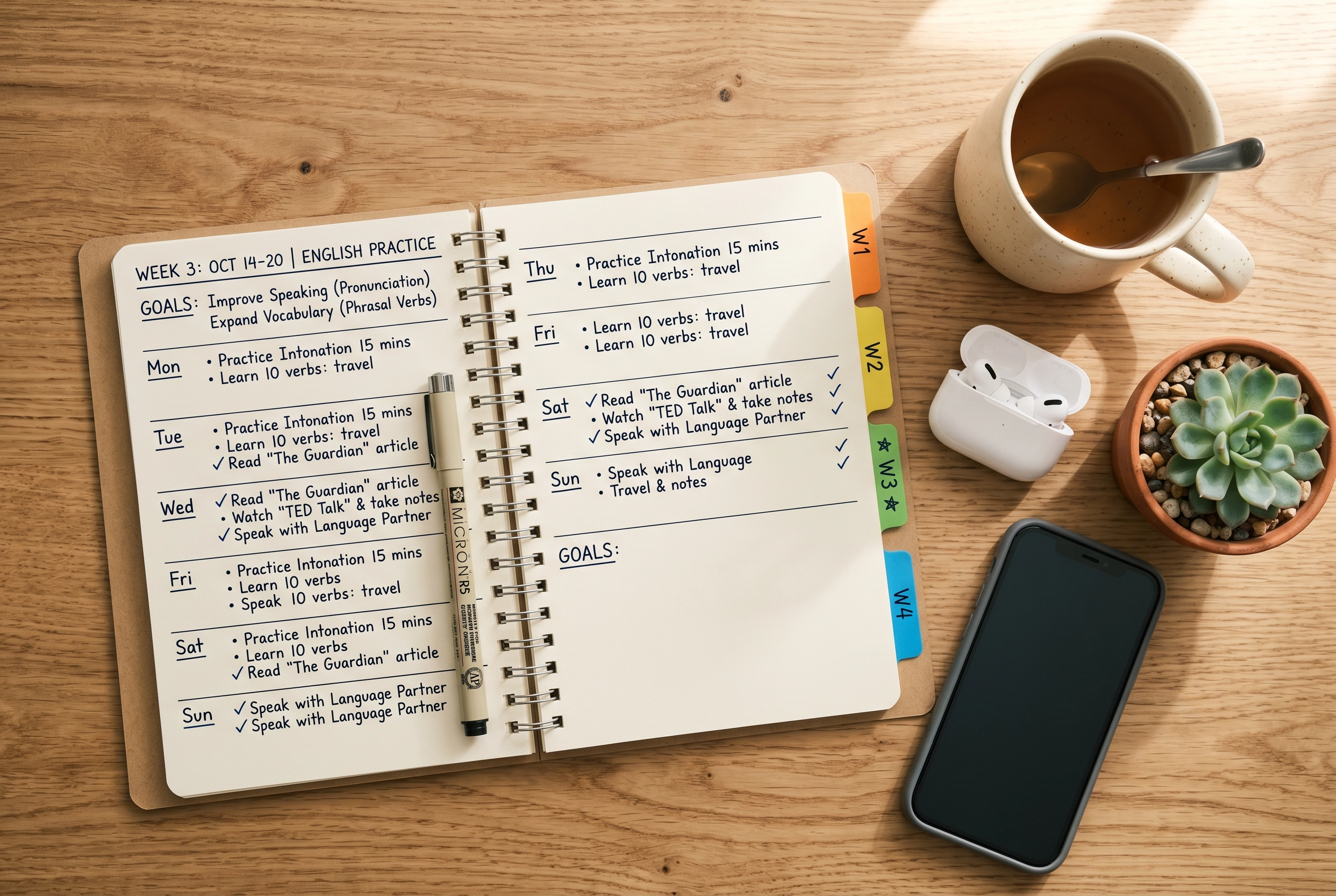
A 4-Week Plan to Internalize English Collocations
Reading through 100 collocations once won't make them yours. Here's a realistic plan to actually internalize them through daily practice.
Week 1: Master Make vs Do
Focus exclusively on the 20 make/do collocations from earlier. Your goal: use each one out loud in at least three conversations this week.
- Daily practice (10 minutes): Pick 3 make/do collocations. Create a sentence with each. Say each sentence aloud five times.
- Active conversation: In every speaking session (with an AI tutor, language partner, or yourself), consciously work in at least 2 of the week's target collocations.
- Listening input: Watch 15 minutes of English content daily. Write down every make/do collocation you hear. Compare to your list.
Week 2: Add Adjective + Noun Pairs
Layer in the 20 adjective+noun collocations. Weather, food, and emotional descriptors show up constantly in daily conversation.
- Daily practice: Same format — 3 target collocations, used aloud, integrated into speaking practice.
- Movies and podcasts: Pay attention to how speakers describe weather, food, and people. You'll hear these patterns constantly.
- Journaling: Write one paragraph a day using that week's collocations. Then read it aloud — which is more important than writing it.
Week 3: Verb+Noun and Adverb+Adjective
This week adds two categories. Use the verb+noun collocations in everyday descriptions (what you did, how you felt, what happened). Use adverb+adjective combinations to describe reactions and evaluations.
- Daily practice: 5 collocations per day, mixing both categories.
- Shadowing: Try shadowing English speakers for 10 minutes a day to internalize natural rhythm and chunking.
- Conversation focus: In AI tutor sessions, choose topics that force you to use these chunks — talk about recent events, health, or opinions.
Week 4: Business Collocations in Context
If you work in English, this week is critical. If you don't, spend this week cycling back through weeks 1-3 with harder combinations.
- Role-play: Practice job interview scenarios, meeting discussions, and negotiation conversations using business collocations.
- Deadline pressure: Time yourself responding to questions — forcing speed helps convert collocations from slow retrieval to automatic production.
- Review week: Go back through the Top 10 Most Confused list. Which ones still trip you up? Those need extra practice.
Ongoing: Build a Collocation Habit
After four weeks, don't stop. Add one new collocation a day to an active vocabulary journal — but only record collocations you've actually used in conversation that day, not just read. The rule: if you haven't said it out loud, it doesn't count.
Combine this with a daily English speaking practice routine of 15-20 minutes, and you'll build a collocation vocabulary that makes your English sound genuinely natural over a few months.
Frequently Asked Questions
What's the difference between a collocation and an idiom?
Collocations have literal meaning — "heavy rain" really does mean a lot of rain, and "strong coffee" really does mean concentrated coffee. Idioms have figurative meaning that you can't guess from the individual words — "kick the bucket" doesn't involve kicking or buckets; it means to die. Both are fixed word combinations, but idioms require knowing the cultural meaning while collocations just require knowing the conventional pairing.
How many English collocations should I learn?
Native speakers know thousands, but you don't need all of them. Research based on large language corpora like the British National Corpus suggests the most frequent 500 collocations cover roughly 80% of everyday conversation. Focus on learning them in categories (make/do, weather, emotions, business) rather than randomly. Quality beats quantity: 50 collocations you've actually used in conversation are worth more than 500 you recognize but freeze up on when speaking.
Are collocations the same in American and British English?
Most high-frequency collocations are shared, but some differ. British speakers say "have a shower" and "at the weekend"; Americans say "take a shower" and "on the weekend." British English occasionally uses "take a decision" in formal contexts, while American English uses "make a decision." If you're studying a specific variety, pay attention to the accent and regional preferences of your practice partner — our British English idioms and American English idioms guides can help you spot the differences.
Do native speakers actually notice collocation errors?
They'll understand you — but something will sound slightly off. In casual settings most native speakers won't correct you because it feels impolite or the meaning is clear. In professional settings, natural collocation use signals fluency and competence, while unusual combinations can distract from your message. The fact that most native speakers don't correct collocation errors is actually the problem — you can keep making the same mistake for years without realizing it. This is why feedback-oriented practice (with a tutor, AI or human) matters more than conversation volume alone.
What's the fastest way to learn English collocations?
The input-output loop: hear chunks in real context, then use them immediately in your own speech. Reading lists builds recognition but not production. Voice-based practice — whether with a human partner or an AI English tutor — forces active retrieval, which is how collocations actually become automatic. Start with high-frequency patterns (make/do, take/give, heavy/strong), practice aloud daily even if just for 10 minutes, and prioritize real conversation over silent study.
Can I learn collocations just by watching movies and TV shows?
Watching English content helps with recognition — you'll start to notice collocations you previously ignored. But watching alone is passive. Without production practice, those chunks stay in your receptive vocabulary. The best approach combines input (movies, podcasts, conversations) with immediate output (speaking practice where you consciously use the collocations you've heard). Shadowing techniques, where you repeat what native speakers say in real time, bridge the gap between input and production effectively.