Duolingo taught you words. No one taught you to speak.
PracticeMe: real voice conversations with an AI tutor, 24/7.
Daily English Speaking Practice: A 15-Minute Routine

You don't need an hour. You don't need a classroom or a teacher. You don't even need a conversation partner who already speaks fluent English.
What you need is 15 focused minutes and a routine that actually works.
Most English learners spend weeks searching for english speaking practice methods beginners can actually stick with — downloading language learning apps they'll never open, bookmarking online videos they'll never watch, buying courses they'll never finish. The search for the "perfect way" to improve your skills becomes the excuse not to start.
Here's the truth: the specific method matters far less than showing up every day to speak English out loud. And just 15 minutes of focused practice is enough to start building real communication skills and confidence.
This guide gives you a structured daily English speaking practice routine you can follow starting today. Each session breaks into four activities — warm-up, focused practice, conversation, and review — totaling exactly 15 minutes. Follow it Monday through Friday with themed variations, and you'll improve your pronunciation, fluency, and confidence within weeks.
Quick Summary: A daily 15-minute English speaking practice routine broken into 4 blocks — warm-up (3 min), focused practice (5 min), AI conversation (5 min), and review (2 min) — is enough to build real fluency when done consistently. This guide includes the full routine, a Monday-to-Friday themed weekly schedule, and tips for tracking your speaking progress.
Why 15 Minutes of Daily English Practice Works Better Than You Think
It sounds too easy, right? Fifteen minutes can't make a real difference in your English language learning.
Except research says otherwise.
A meta-analysis of 48 experiments involving over 3,400 language learners found that spaced practice — short sessions distributed across multiple days — consistently outperforms longer, less frequent study sessions for second language acquisition. Some studies show distributed practice produces up to 240% better retention than massed practice, where you try to cram the same total hours into fewer, longer lessons. Another study found that just 3 minutes of daily spaced vocabulary activities tripled long-term word retention.
Here's the simple math: 15 minutes a day, five days a week, gives you 1 hour and 15 minutes of focused English speaking practice every week. That's roughly 5 hours per month and over 60 hours per year — all from a commitment that takes less time than scrolling your phone over coffee.
The key word is focused. Passively listening to English doesn't count. Reading vocabulary lists silently doesn't count. You need to open your mouth and speak out loud. Every single minute of this routine involves active speaking — no grammar drills, no writing exercises, just you talking and using the language.
There's a neurological reason short daily sessions help you get better faster, too. Each session activates language-processing networks in your brain. Sleeping between sessions lets your brain consolidate what you learned. Five 15-minute sessions build stronger neural pathways than one 75-minute class on Saturday — your brain needs rest between lessons to turn practice into permanent skills.
English Speaking Practice Methods Beginners Can Follow in 15 Minutes
Here's the complete routine structure. The specific content changes based on the day's theme (covered in the weekly schedule below), but the four-block format stays the same:
| Block | Time | What You Do |
|---|---|---|
| 🔥 Warm-Up | 3 minutes | Tongue twisters + reading aloud |
| 🎯 Focused Practice | 5 minutes | Shadowing OR pronunciation drills |
| 💬 Conversation | 5 minutes | Real-time voice speaking with an AI tutor |
| 📝 Review | 2 minutes | New vocabulary + improvement notes |
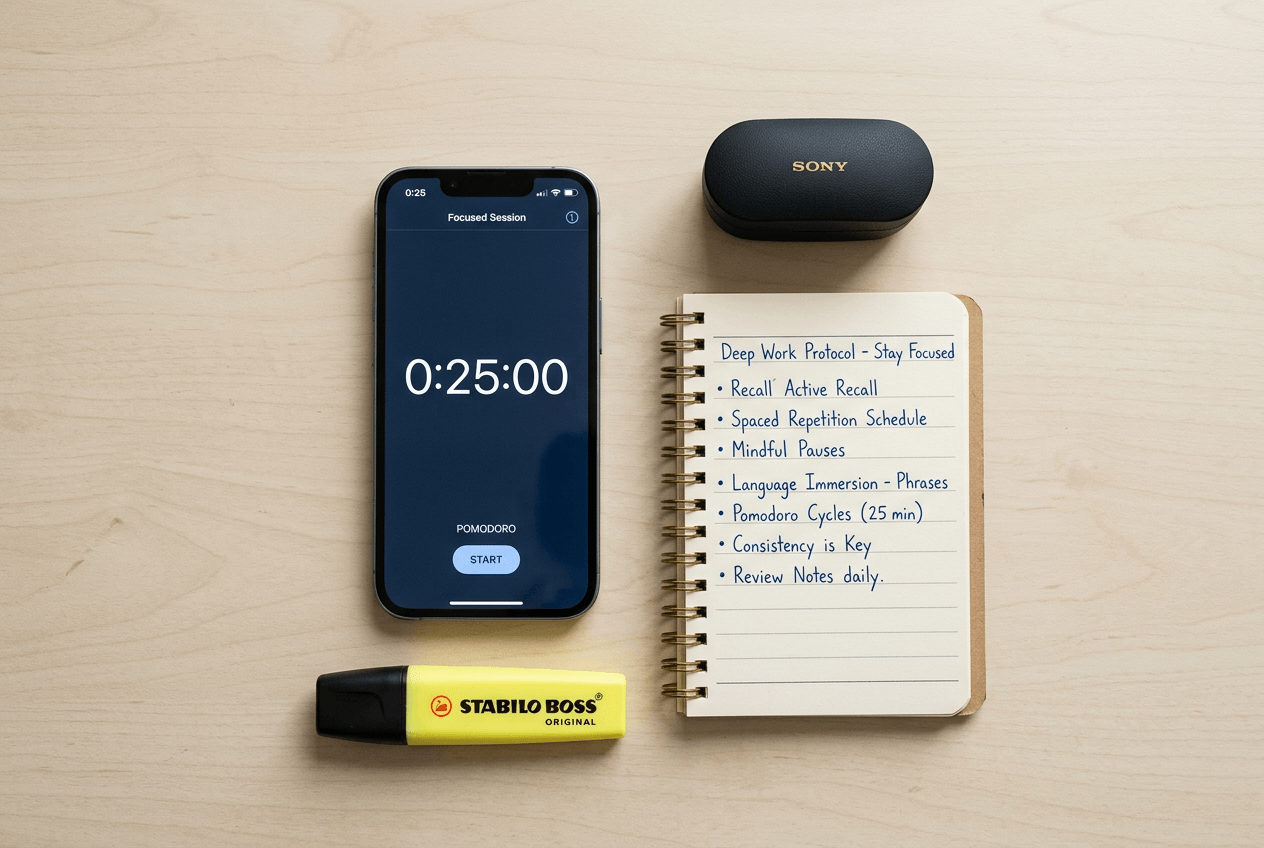
Set a timer for each block. This prevents spending too long on warm-ups and rushing through the activities that matter most. Unlike traditional English classes or online courses with a teacher, this routine is entirely self-directed — you practice whenever it works for you, wherever you are comfortable.
Block 1: Warm Up Your Mouth (3 Minutes)
Think of this like stretching before exercise. Your mouth, tongue, and jaw need activation before they can produce English sounds smoothly — especially sounds that don't exist in your native language.
Minute 1: Tongue Twisters
Pick one tongue twister and repeat it 3–4 times, getting faster each round:
Beginner level:
- "She sells seashells by the seashore."
- "Red lorry, yellow lorry, red lorry, yellow lorry."
Intermediate level:
- "How much wood would a woodchuck chuck if a woodchuck could chuck wood?"
- "Peter Piper picked a peck of pickled peppers."
Advanced level:
- "The sixth sick sheik's sixth sheep's sick."
- "Imagine an imaginary menagerie manager managing an imaginary menagerie."
Don't mumble. Exaggerate the sounds. Feel the physical difference between "sh" and "s," between "th" and "t." This trains your mouth to find these positions quickly in natural conversation and helps improve your English pronunciation over time. Don't worry about making mistakes — the point is to get your mouth moving.

Minutes 2–3: Read a Headline Aloud
Pull up any English news site — BBC, Reuters, or your phone's news feed. Pick one headline and its opening paragraph. Read the text aloud slowly, then try again at a natural speaking pace.
This exercise does two things: it gets you speaking real, current English words and phrases (not stale textbook language), and it warms up your reading-to-speaking pipeline — the ability to see written English and produce it verbally without hesitation. Both of these skills help build the confidence you need for the conversation block ahead.
Block 2: Focused Speaking Practice (5 Minutes)
This is the core skill-building block where you work to improve specific aspects of your spoken English. You have two effective options:
Option A: Shadowing a Native Speaker (Recommended Most Days)
Shadowing is a popular language learning technique where you listen to a native English speaker and repeat what they say in real time — not after they finish, but while they speak, with just a 1–2 second delay.
Here's how to try it yourself:
- Find a 2–3 minute audio clip. English podcasts, YouTube videos, or TED Talks all work. Choose someone who speaks clearly.
- Play the clip and start repeating. Match their pronunciation, rhythm, and intonation as closely as you can.
- Don't pause. If you fall behind, skip ahead and catch the next sentence.
Why is shadowing so effective? A 2025 systematic review of shadowing research in second language education confirms it significantly improves pronunciation accuracy and speaking fluency. It works because you're physically producing sounds at a native pace, training both your listening skills and speaking muscles at the same time.

Start with slow, clear speakers. As you get better, try faster speakers or people with different accents to broaden your listening comprehension and give yourself new opportunities to learn.
Option B: Pronunciation Drills
On days when you want to target specific sounds, swap shadowing for focused drills:
- Minimal pairs: Practice words that differ by one sound — "ship/sheep," "bat/bet," "light/right," "think/sink." Say each pair 5 times, exaggerating the difference.
- Problem sounds: Most English learners and students struggle with certain sounds. Common trouble spots include "th" (think, this), "r" vs. "l" (right, light), "v" vs. "w" (very, well), and vowel sounds like "ship" vs. "sheep." Identify your weak spots and drill them until they feel natural.
Block 3: AI Conversation Practice (5 Minutes)
This is where everything comes together. You've warmed up and practiced specific sounds and phrases — now use English in a real conversation.
Open Practice Me and start a voice conversation with one of the AI tutors. Pick a topic related to the day's theme, or talk freely about whatever you want to discuss.
Why is conversation the most important block? Because speaking English in a live exchange forces your brain to work differently than drills, grammar study, or repetition exercises:
- Think of what to say (not just repeat someone's words)
- Form sentences in real time (no script to read)
- Listen and respond (real two-way communication)
- Handle the unexpected (you can't predict what the tutor asks)
This is the gap most english speaking practice methods for beginners miss. Drills build individual pieces. Conversation is where you assemble them under pressure — and that's how people actually learn to speak English fluently.
Practice Me's AI tutors — Sarah, Oliver, and Marcus — adapt to your level automatically. Beginners get simpler vocabulary and a slower pace to help them follow along. You can choose between American and British accents to train your ear for the pronunciation you need most.
The biggest advantage: zero judgment. No awkward silences or embarrassment. Making mistakes is expected and welcome — that's how you learn. If speaking anxiety has held you back — and research suggests this is one of the biggest barriers for people learning a new language — a judgment-free AI conversation removes that obstacle. (Read more about overcoming the fear of speaking a foreign language.)
Block 4: Review and Reflect (2 Minutes)
Two minutes of review turns today's practice into lasting improvement.
Minute 1: Review New Vocabulary Words
During your conversation, you encountered new words or phrases. With Practice Me, vocabulary from conversations is automatically tracked and saved.
Review today's words. Say each aloud. Try using each one in a new sentence you create yourself. This active recall helps transfer vocabulary into long-term memory far more effectively than just reading a list.
Minute 2: Note What to Improve
Ask yourself: What was hardest today?
Maybe a specific sound was difficult. Maybe you couldn't find the right words for an idea. Maybe your speaking pace felt slow. Write it down — tomorrow's practice targets that weakness. This creates a feedback loop that makes every session better and more personalized to your needs.

Duolingo taught you words. No one taught you to speak.
PracticeMe: real voice conversations with an AI tutor, 24/7.
Your Weekly English Speaking Practice Schedule
Repeating the same activities every day gets boring. Themed days keep your daily practice fresh and help you build different English communication skills across the week.
Monday: Pronunciation Focus
- Warm-up: Tongue twisters targeting specific sounds (th, r/l, v/w)
- Focused Practice: Minimal pair drills or pronunciation exercises
- AI Conversation: Ask your Practice Me tutor to use words with your target sound in natural sentences
- Review: Note which sounds are easier than last Monday
Tuesday: Role-Play Scenarios
- Warm-up: Read a restaurant menu, hotel listing, or ad aloud
- Focused Practice: Shadow a dialogue between two English speakers
- AI Conversation: Practice a real-life situation — ordering food, checking into a hotel, making an appointment, or asking for directions. These everyday situations give you opportunities to learn practical phrases you'll actually use when talking with native speakers.
- Review: Write down 2–3 useful new phrases
Wednesday: Storytelling
- Warm-up: Read a short English news story aloud
- Focused Practice: Shadow a storytelling podcast or narrative clip
- AI Conversation: Tell your tutor about your day, retell a movie, or describe something interesting. Use past tense, sequencing words (first, then, after that, finally), and descriptive vocabulary to tell a better story each week.
- Review: Note words you wanted but couldn't find
Thursday: Debate and Opinions
- Warm-up: Read an opinion headline and react aloud
- Focused Practice: Shadow a speech or TED Talk where someone argues a point
- AI Conversation: Pick a topic and express your opinion. Practice useful expressions like "In my opinion," "I believe that," and "On the other hand." This helps you speak English with more nuance and depth.
- Review: Note one new expression you used
Friday: Free Conversation
- Warm-up: Any tongue twister or reading — your choice
- Focused Practice: Shadow whatever English clip interests you
- AI Conversation: No theme — just talk. Practice flowing, natural English conversation. Discuss your week, your plans, your hobbies. This free-form speaking is the closest to real conversations with native English speakers, and it's where you'll feel your fluency improving most.
- Review: Compare how today felt vs. last Friday
Weekend (Optional): Take a break. For light practice, try watching an English show without subtitles, singing along to English songs, listening to a podcast, or reviewing vocabulary from the week.

Here's the full week at a glance — save this for quick daily reference:
| Day | Warm-Up (3 min) | Focused Practice (5 min) | AI Conversation (5 min) | Review Focus |
|---|---|---|---|---|
| Mon | Sound-focused tongue twisters | Minimal pair drills | Practice target sounds | Track pronunciation |
| Tue | Read a menu or ad aloud | Shadow a dialogue | Role-play a scenario | Save useful phrases |
| Wed | Read a news story aloud | Shadow a narrative | Tell a story about your day | Note missing vocabulary |
| Thu | React to an opinion headline | Shadow a speech | Express an opinion | Note new expressions |
| Fri | Free choice | Shadow any clip | Free conversation | Compare to last Friday |
How to Track Your English Speaking Progress
Improvement in spoken English is hard to notice day-to-day. Tracking turns invisible progress into visible proof that keeps you motivated to continue learning and practicing.

Practice Me's built-in progress tracking monitors three areas:
- Speaking time: Minutes in conversation daily and weekly. Aim for 5+ minutes per session.
- Vocabulary growth: New words automatically saved from conversations. Watch this number climb.
- Improvement trends: Patterns in speaking frequency, word variety, and streak length.
What to expect:
- After 1 week: The routine feels natural. Tongue twisters are faster. Your mouth feels more comfortable with English sounds.
- After 1 month: ~20 hours of practice. Common phrases flow naturally. Your vocabulary has grown significantly.
- After 3 months: ~60 hours complete. Longer conversations, more fluent opinions, quicker responses.
Consistent daily English speaking practice produces real, measurable results for most learners. For the full picture of the fluency journey, read our guide on how to become fluent in English.
Tips to Help Your English Practice Habit Stick
The best routine is the one you actually follow. Here's what helps people succeed:
Anchor it to an existing habit. Practice right after your morning coffee, during lunch, or before bed. Connecting new habits to existing ones makes them far easier to maintain.
Talk to yourself in English outside the routine. Narrate what you're doing — "I'm making breakfast," "I need to go to the store" — even for 30 seconds. This creates extra opportunities to speak English without adding formal practice time.
Start with three days per week. Monday, Wednesday, and Friday works well. Add more days once you're comfortable with the routine.
Don't chase perfection. Some days you'll speak fluently. Some days you'll stumble. Mistakes are a normal part of learning a new language — not a sign of failure.
Record yourself once a week. Record a 1-minute speaking clip on the same topic each week. Listen back after a month — you'll hear clear improvement in your own English. This is one of the most motivating things you can do for yourself.
Use progress data as motivation. Watching your speaking time and vocabulary grow week over week helps you stay committed when progress feels slow.
Tell someone. A quick "I'm practicing English speaking for 15 minutes daily" text to a friend creates real accountability. For more strategies, check out our tips to improve your English speaking skills.
Frequently Asked Questions
What if I can only practice for 10 minutes?
Ten minutes is still valuable. Shorten focused practice to 3 minutes and AI conversation to 3 minutes. Consistency matters more than session length. Find more strategies for practicing English speaking alone.
Do I need to follow the exact weekly schedule?
No. The themed days help prevent boredom and help you build different skills, but they're a framework, not rules. Your engagement matters more than rigid adherence.
Can I do this without a speaking partner?
Yes — that's exactly what this routine is for. Blocks 1 and 2 are solo. Block 3 uses Practice Me as your AI conversation partner, available 24/7. The routine is built for independent learners who want to practice speaking English on their own, without a teacher or class.
How long until I notice improvement?
Most consistent learners feel more comfortable speaking English within 2–3 weeks. Measurable improvements — better pronunciation, larger vocabulary, faster sentences — typically appear after 4–6 weeks. Language learning takes time, but daily practice creates compounding returns.
Is this suitable for complete beginners?
Absolutely. Use simpler tongue twisters, slower shadowing clips, and basic topics (introduce yourself, describe your family, talk about your routine). Practice Me's AI tutors adjust vocabulary, speed, and complexity to match your level — even if you only know a few words and simple phrases, the conversation meets you where you are and helps you improve.
Your English fluency won't build itself — but it doesn't require a massive time commitment. Fifteen minutes. Four blocks. Five days a week. These are the most effective english speaking practice methods beginners can use to start building real fluency today.
Set a timer, start tomorrow, and let consistency do the heavy lifting.