Duolingo taught you words. No one taught you to speak.
PracticeMe: real voice conversations with an AI tutor, 24/7.
30+ American English Idioms for Daily Conversation
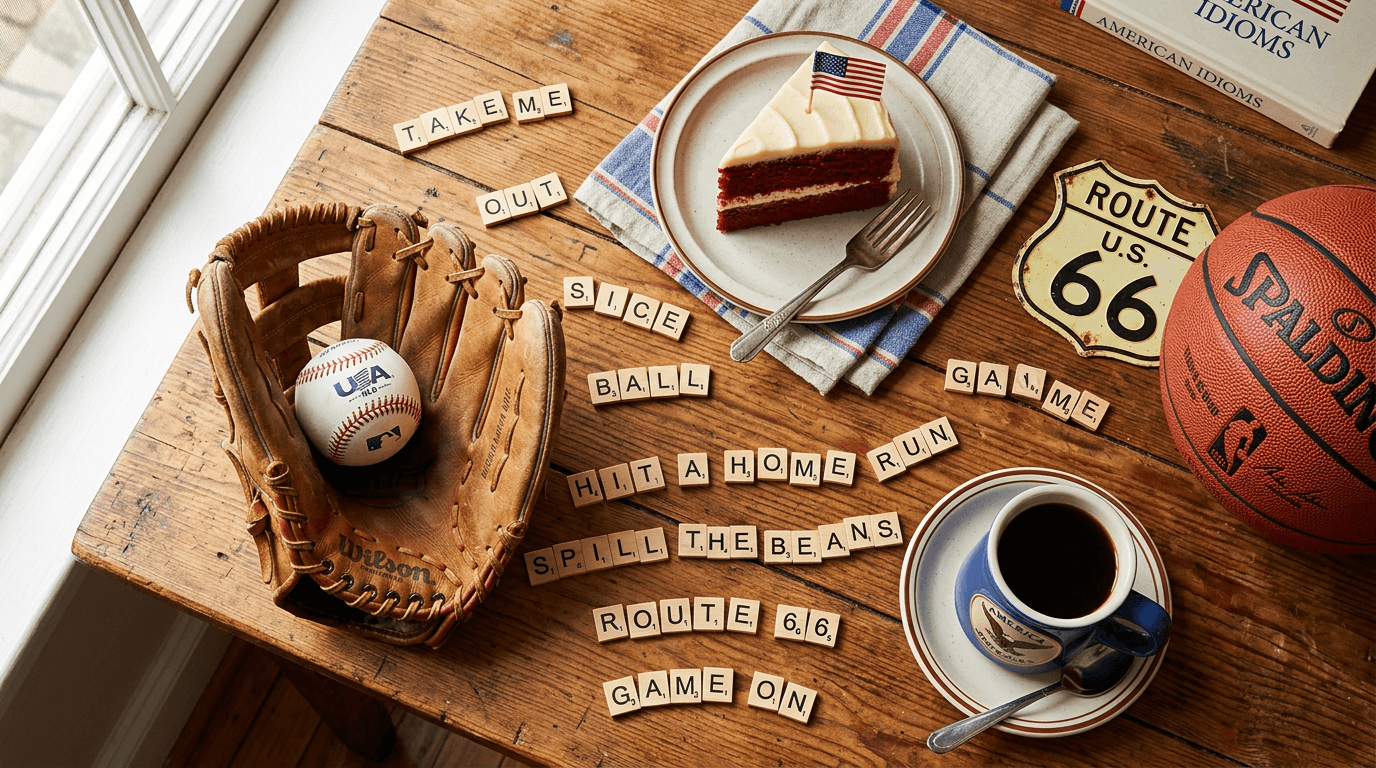
Americans don't just speak English — they speak in idioms. From the baseball diamond to the drive-through, common American English idioms are packed into conversations so naturally that native speakers don't even notice them. But for someone learning the language, they can sound like complete gibberish.
"Let's touch base." "That was a slam dunk." "I'll take a rain check." If you've heard something like this and had absolutely no idea what was happening, you're not alone. American English idioms are one of the biggest gaps between textbook English and real-world fluency.
Quick Summary: This guide covers 36 American English idioms organized by real daily situations — greetings, work, sports metaphors, food, driving, and social life. Each idiom includes its meaning, a dialogue example, British English equivalent, formality level, and regional notes.
Why American English Idioms Trip Up Even Advanced Learners
You can nail grammar, ace vocabulary tests, and still feel lost in a casual American conversation. Why? Idioms.
Native English speakers use roughly 3–4 idiomatic expressions per minute in casual speech. In a 10-minute conversation, that's 30–40 idioms — and if you're only catching the literal meaning, you're missing something important in every exchange.
Most idiom lists are alphabetical or random. Nobody learns a language that way. You learn by situation — what someone would say at work, at a party, or in an Uber. That's how this guide works.
If you want to practice using these idioms naturally, Practice Me's American accent tutors — Sarah and Marcus — use them in real-time voice conversations, so you'll hear and practice them in context now rather than reading something on a page.
How to read each entry:
- Meaning — What the idiom actually means
- Dialogue — A natural exchange showing how it's used
- 🇬🇧 British equivalent — The British version (or "uniquely American" if there isn't one)
- Formality — 🟢 Casual · 🟡 Neutral · 🔴 Formal-ish
- Region — Where you'll hear it most

American English Idioms for Greetings and Small Talk
These are the idioms you'll hear within the first 30 seconds of any American conversation.
1. What's up? A casual greeting — not actually asking what's above you.
A: "Hey, what's up?" B: "Not much, just grabbing coffee."
🇬🇧 "Alright?" · 🟢 Casual · 📍 Nationwide
2. How's it going? "How are you?" — but Americans don't expect a real answer. "Good" or "Not bad" works.
A: "How's it going, man?" B: "Can't complain."
🇬🇧 "How are you keeping?" · 🟡 Neutral · 📍 Nationwide
3. Long time no see I haven't seen someone in a while. Used when you bump into someone unexpectedly.
A: "Hey! Long time no see! What have you been up to?"
🇬🇧 Same (universal) · 🟡 Neutral · 📍 Nationwide
4. Catch you later Goodbye. Variations: "Catch ya later," "Later," "Peace."
A: "I gotta run. Catch you later!" B: "Later!"
🇬🇧 "Cheers" or "Ta-ra" · 🟢 Casual · 📍 Nationwide
5. Shoot the breeze Chat casually about nothing important.
A: "We were just shooting the breeze about the game last night."
🇬🇧 "Have a chinwag" · 🟢 Casual · 📍 More common in the South and Midwest
6. Break the ice Start a conversation or ease tension where someone might feel awkward.
A: "I told a joke to break the ice at the networking event."
🇬🇧 Same (shared) · 🟡 Neutral · 📍 Nationwide
Common American Idioms Used at the Office
American work culture has its own idiom ecosystem used in meetings, emails, and Slack messages constantly.
7. Touch base Check in briefly with someone about something.
A: "Can we touch base about the Q3 numbers after lunch?"
🇬🇧 "Touch base" (borrowed) · 🟡 Business neutral · 📍 Corporate settings
8. Circle back Return to a topic later. Someone suggests this when they want to postpone something.
A: "Let's circle back on the budget after we hear from finance."
🇬🇧 "Come back to it" · 🟡 Business neutral · 📍 Sometimes mocked as corporate jargon
9. Think outside the box Be creative, approach something differently.
A: "We need to think outside the box — the usual approach isn't working."
🇬🇧 Same (universal) · 🟡 Neutral · 📍 Nationwide
10. Get the ball rolling Start something — a process, project, or activity.
A: "Let's get the ball rolling on the new hire. Post the job today?"
🇬🇧 Same (shared) · 🟡 Neutral · 📍 Nationwide
11. Crunch time A critical period when something must be completed under pressure.
A: "It's crunch time — the presentation is tomorrow."
🇬🇧 "Crunch time" (adopted from American English) · 🟡 Neutral · 📍 Nationwide
12. On the same page In agreement. Used when someone wants to confirm everyone's aligned.
A: "Before the client meeting, let's make sure we're on the same page."
🇬🇧 "Singing from the same hymn sheet" · 🟡 Business · 📍 Nationwide
For more work scenarios, see our business English speaking practice guide.

Sports Idioms in American English
Americans love sports so much that baseball, football, and basketball metaphors are now used everywhere — even by someone who's never watched a game.
13. Knock it out of the park Do something exceptionally well. (Baseball — hitting a home run.)
A: "How was her pitch?" B: "She knocked it out of the park."
🇬🇧 "Knock it for six" (cricket) · 🟢 Casual · 📍 Nationwide
14. Step up to the plate Take responsibility. (Baseball — the batter's position.)
A: "With the manager out, someone needs to step up to the plate."
🇬🇧 "Step up to the mark" · 🟡 Neutral · 📍 Nationwide
15. Hail Mary A desperate last-chance attempt. (American football — a long pass.)
A: "Applying to that job was a Hail Mary, but I got the interview!"
🇬🇧 Uniquely American — no direct equivalent · 🟢 Casual · 📍 Nationwide
16. Monday morning quarterback Someone who criticizes decisions after the fact.
A: "Stop being a Monday morning quarterback — you didn't have a better idea."
🇬🇧 "Armchair critic" · 🟢 Casual · 📍 Nationwide
17. Move the goalposts Change rules or expectations after something has started.
A: "Every time I meet the deadline, they move the goalposts."
🇬🇧 Same (football/soccer — shared) · 🟡 Neutral · 📍 Nationwide
18. Drop the ball Make a mistake, fail to follow through.
A: "I dropped the ball — forgot to attach the file."
🇬🇧 Same (adopted) · 🟡 Neutral · 📍 Nationwide
19. Slam dunk A sure thing. Now used far beyond basketball.
A: "That client deal was a slam dunk."
🇬🇧 "Dead cert" · 🟢 Casual · 📍 Nationwide
Duolingo taught you words. No one taught you to speak.
PracticeMe: real voice conversations with an AI tutor, 24/7.
American Food and Drink Idioms
These common American English idioms pop up everywhere — from office chats to something your friend casually says at a party.
20. Piece of cake Very easy. Something that requires no effort.
A: "How was the exam?" B: "Piece of cake."
🇬🇧 "Doddle" or "piece of cake" (shared) · 🟢 Casual · 📍 Nationwide
21. Spill the beans Reveal a secret. Used when someone gives away information.
A: "Who spilled the beans about the surprise party?"
🇬🇧 Same (shared) · 🟢 Casual · 📍 Nationwide
22. Bring home the bacon Earn a living.
A: "She works two jobs to bring home the bacon."
🇬🇧 Same (originated in 12th-century England) · 🟡 Neutral · 📍 Nationwide
23. The whole enchilada Everything. The complete picture.
A: "Don't just give me the summary — the whole enchilada."
🇬🇧 "The full monty" · 🟢 Casual · 📍 More common in the Southwest
24. Cool as a cucumber Calm under pressure.
A: "Server crashed during the demo, but she stayed cool as a cucumber."
🇬🇧 Same (shared) · 🟡 Neutral · 📍 Nationwide
25. In a pickle In a difficult situation.
A: "I double-booked meetings. I'm in a real pickle."
🇬🇧 Same (Shakespeare used this in The Tempest) · 🟢 Casual · 📍 Nationwide
Expand your vocabulary beyond idioms — see our guide to complex English words to sound more fluent.

Driving Idioms: American Car Culture in the Language
America is a car country — 90% of households own at least one vehicle. These American idioms reflect that now-ingrained car culture.
26. Backseat driver Someone who gives unwanted advice about something they're not doing.
A: "Stop being a backseat driver — I know how to get there!"
🇬🇧 Same (adopted) · 🟢 Casual · 📍 Nationwide
27. Pedal to the metal Full speed, maximum effort.
A: "Two weeks until launch — pedal to the metal, everyone."
🇬🇧 "Put your foot down" · 🟢 Casual · 📍 More common in Southern/Midwest states
28. Hit the road Leave, start a journey.
A: "Getting late. We should hit the road."
🇬🇧 Same (widely adopted) · 🟢 Casual · 📍 Nationwide
29. Fender bender A minor car accident.
A: "Late because of a fender bender on the highway. Nobody hurt."
🇬🇧 "Prang" or "bump" · 🟢 Casual · 📍 Nationwide
30. In the fast lane Living an exciting, busy lifestyle.
A: "Since the promotion, she's living in the fast lane."
🇬🇧 Same (shared) · 🟡 Neutral · 📍 Nationwide
Social American Idioms for Hanging Out
These come up when making plans, meeting someone new, or navigating American social life.
31. Rain check Postpone to later. (From baseball — a ticket for a rained-out game.)
A: "Can't make dinner tonight. Rain check?" B: "Thursday?"
🇬🇧 Uniquely American — Brits say "another time?" · 🟢 Casual · 📍 Nationwide
32. Third wheel The unwanted extra person with a couple.
A: "I felt like a total third wheel at dinner."
🇬🇧 "Gooseberry" · 🟢 Casual · 📍 Nationwide
33. Hit it off Get along with someone immediately.
A: "Met my roommate's friend — we totally hit it off."
🇬🇧 Same (shared) · 🟢 Casual · 📍 Nationwide
34. Ghost someone Suddenly stop responding to someone without explanation.
A: "Three dates, then he ghosted me."
🇬🇧 Same (modern, from U.S. dating culture) · 🟢 Very casual · 📍 Younger speakers
35. Hang out Spend time casually.
A: "Want to hang out this weekend?"
🇬🇧 "Meet up" · 🟢 Very casual · 📍 Nationwide
36. Bail Cancel plans or leave suddenly.
A: "She bailed on us last minute."
🇬🇧 "Flake out" · 🟢 Very casual · 📍 More common on the West Coast
British vs. American Idiom Face-Off
Same idea, completely different words. Here's how American and British English idioms diverge:
| Situation | 🇺🇸 American Idiom | 🇬🇧 British Idiom |
|---|---|---|
| Amazing success | Knock it out of the park | Knock it for six |
| Easy task | Piece of cake | Doddle |
| Everything | The whole nine yards | The full monty |
| Surprise obstacle | Throw a curveball | Throw a spanner in the works |
| Give up | Throw in the towel | Throw in the towel (shared!) |
| Take responsibility | Step up to the plate | Step up to the mark |
| After-the-fact critic | Monday morning quarterback | Armchair critic |
| Unwanted third person | Third wheel | Gooseberry |
| Add your opinion | Put in your two cents | Put in your tuppence worth |
| Sure thing | Slam dunk | Dead cert |
| Go full speed | Pedal to the metal | Put your foot down |
| Not your business | Stay in your lane | Mind your own beeswax |
American idioms lean heavily on sports, while British idioms draw from everyday life and cricket. Explore our companion guide to British English idioms for the other side, or browse the full collection on our common English idioms hub.

Regional American Idioms: A Quick Guide
America is huge, and how someone talks in Mississippi is different from Manhattan. Here are regional expressions used in specific parts of the country.
The South 🤠
- "Bless your heart" — Genuine sympathy or a polite way to call someone clueless.
- "Fixin' to" — About to do something. "I'm fixin' to head out."
- "Y'all" — You all. The most useful word the South gave English.
- "Might could" — A double modal. "I might could help you with that."
New York City 🏙️
- "Deadass" — Seriously. "I'm deadass tired right now."
- "Mad" — Very (intensifier). "That pizza was mad good."
- "Schlep" — Carry something tediously. (From Yiddish.) "Had to schlep across town."
California ☀️
- "Hella" — Very. "That was hella good." (NorCal origin.)
- "Stoked" — Really excited. "I'm stoked about the road trip."
- "Lowkey / Highkey" — Subtly / obviously. "I'm lowkey nervous."
Understanding regional idioms helps you sound more natural when you speak English fluently and confidently. Want to master American pronunciation too? See how to learn an American accent.

How to Practice American English Idioms Naturally
Reading this list is step one. Using these idioms in real conversation is what makes them stick.
-
Learn 2–3 per day. Pick idioms relevant to your life now — work idioms for professionals, social idioms for travelers.
-
Practice in conversation. Idioms need context and timing. Practice Me's tutors Sarah and Marcus use natural American accents and idioms in their responses — so you hear "let's touch base" in a real flow, not a textbook.
-
Record yourself. During daily English speaking practice, try one new idiom. Listen back.
-
Watch American shows. Sitcoms are idiom goldmines. When you hear something, write it down and use it in your next conversation.
-
Let vocabulary build naturally. Idioms from Practice Me sessions get saved to your vocabulary automatically. Explore more conversation practice topics to keep building.
Ready? Start a conversation with Sarah or Marcus on Practice Me and see how many American English idioms come up naturally.
Frequently Asked Questions
How many idioms does the average American use daily?
Native speakers use an estimated 3–4 idiomatic expressions per minute in casual conversation. Over a full day, that's hundreds. You don't need all of them — the 36 common American idioms in this guide cover the vast majority of something you'll encounter.
What's the difference between American idioms and American slang?
Idioms are fixed phrases with figurative meaning — "piece of cake" always means "easy." Slang is more flexible and evolves faster. "Ghosting" started as slang and is now becoming an established English idiom. Idioms are generally more stable and understood by someone across all age groups.
Do I need to learn American idioms for the TOEFL test?
The TOEFL uses standard American English, which includes common idioms. You won't be tested on definitions directly, but understanding them helps you follow conversations and lectures. See our TOEFL speaking practice topics guide.
Can American idioms be used in formal writing?
Most are best suited for spoken English and informal writing. In formal academic writing, use direct language. However, in business English speaking situations — meetings, presentations, calls — idioms like "touch base" and "on the same page" are completely appropriate and something professionals use daily.