Duolingo taught you words. No one taught you to speak.
PracticeMe: real voice conversations with an AI tutor, 24/7.
How to Speak English Fluently & Confidently: 10 Tips

You already know more English than you think. The grammar rules, the vocabulary lists, the hours spent studying — it's all in there somewhere. So why does your mind go blank the moment you need to actually speak? If you want to learn how to speak English fluently with confidence, the answer isn't more textbooks — it's more talking.
You're not alone in this struggle. Research shows that one-third to one-half of language learners experience debilitating anxiety when speaking. The problem isn't your English — it's that most learning methods focus on reading and writing while ignoring the skill that matters most for fluency: talking.
Quick Summary: Speaking English fluently and confidently comes down to daily speaking practice, not more studying. This guide gives you 10 evidence-based strategies — each with a specific daily exercise you can start today. Total time needed: just 15–20 minutes a day.
The 10 tips below aren't generic advice you've read a hundred times. Each one includes a concrete exercise with a specific time commitment, so you know exactly what to do and for how long. Whether you're preparing for work, travel, or daily life, these strategies will help you speak English fluently with confidence faster than traditional methods.
1. Think in English (Stop Translating in Your Head)
Here's what happens when you translate: you hear something in English, convert it to your native language, form a response in your native language, then translate it back to English. That's four steps for something that should be one.
This translation bottleneck is the #1 reason conversations feel slow and exhausting. Research on inner speech and second language acquisition confirms that learners who develop the ability to think in their target language experience a fundamental shift — not just faster speech, but an entirely different relationship with the language.
The good news? You can train yourself to think in English. Start by narrating your daily life internally. Making coffee? Think "I'm pouring water into the kettle" instead of translating from your first language. Stuck at a red light? Describe what you see around you in English.
It feels awkward at first. That's normal. Your brain is literally building new neural pathways.
Daily Exercise: The Narration Challenge (5 minutes)
Pick one routine activity — your morning shower, your commute, cooking dinner — and narrate every action in English inside your head. When you hit a word you don't know, don't switch to your native language. Describe it differently. "The thing that holds coffee" works until you learn "mug." Write down those gap words afterward and look them up. Tomorrow, you'll know them.
2. Shadow Native Speakers
Shadowing is one of the most effective — and most underused — techniques for learning to speak English fluently. You listen to a native English speaker and repeat what they say in real-time, matching their rhythm, intonation, and pace as closely as possible.
A 2025 systematic review of shadowing research found that the technique consistently improves comprehensibility, fluency, and prosody. Learners in the studies described it as "interesting, enjoyable, and effective." The key is that shadowing trains your mouth and your ears simultaneously — you're not just understanding English, you're physically practicing how it sounds.
Think of it like learning a song. You don't memorize lyrics word by word — you hear the melody and sing along until it becomes natural. Shadowing does the same for English speech patterns.
Daily Exercise: The Shadow Session (10 minutes)
- Pick a 2–3 minute clip from a podcast, YouTube video, or TV show. Choose someone whose speaking style you admire.
- Play one sentence, then pause. Repeat it out loud, copying the speaker's tone, speed, and emphasis.
- Rewind and try again if it didn't feel right. Aim for 3–5 repetitions per sentence.
- Once a week, record your shadow session and compare your version to the original.
Great sources to shadow: TED Talks (clear speakers, varied accents), BBC podcasts (British English), or NPR stories (American English).
3. Speak Every Day — Even Just 10 Minutes
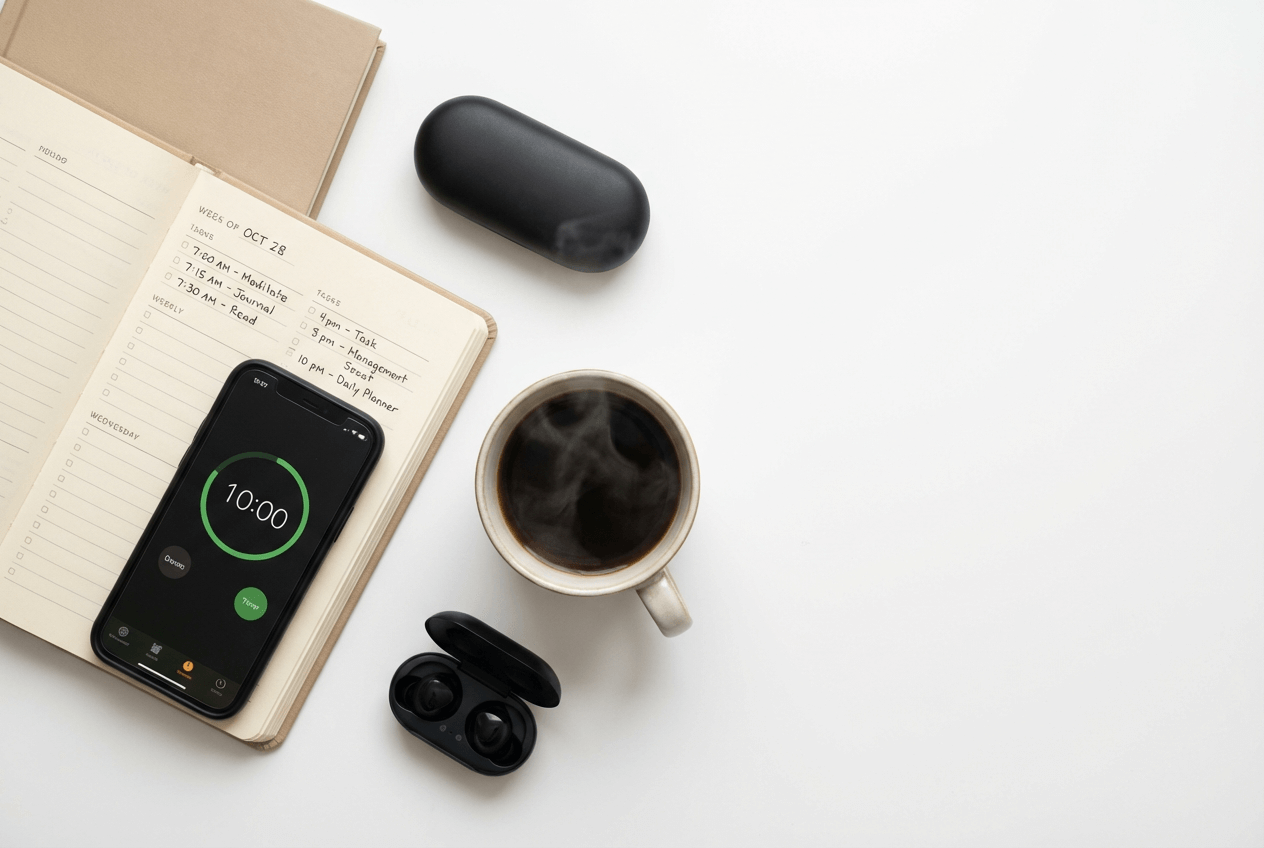
Most English learners have a backwards approach: they study for hours on weekends and barely speak all week. But language fluency works like fitness. A 10-minute daily workout beats a 2-hour weekend marathon every time.
Short, consistent speaking practice sessions work better because your brain consolidates language skills during sleep. When you practice daily, you trigger this consolidation process every night. When you cram once a week, you get just one consolidation cycle — and lose most of what you practiced before the next session.
The University of Melbourne runs a 10-Minute English program proving that focused daily micro-sessions lead to measurable improvement in fluency. The trick is making it so easy you can't say no.
If you're looking for ways to keep up daily practice without a conversation partner, check out our guide to practicing English speaking alone.
Daily Exercise: The 10-Minute Speaking Sprint
Set a timer for 10 minutes. Pick a topic — anything: your weekend plans, a movie you watched, what you'd do with a million dollars. Now speak about it nonstop in English. Don't pause to think of the perfect word. Don't correct yourself mid-sentence. Just keep talking.
Rate your comfort level from 1–5 after each sprint. Within two weeks, you'll notice the number climbing.
Topic ideas to get you started:
- Describe your best friend to a stranger
- Explain how to cook your favorite meal
- Argue for or against working from home
- Tell a story from your childhood
4. Learn Phrases and Chunks, Not Isolated Words
Here's a secret about native English speakers: they don't construct sentences word by word. They pull from a mental library of ready-made chunks. Phrases like "to be honest," "I was wondering if," and "it depends on" roll off the tongue automatically — no assembly required.
When you memorize individual words, you still have to build every sentence from scratch. When you learn phrases, you have pre-built pieces that slot together naturally. This is why someone who knows 3,000 words can sometimes speak more fluently than someone who knows 10,000 — they learned their vocabulary in context.
Focus on these types of chunks:
- Collocations: "make a decision" (not "do a decision"), "heavy rain" (not "strong rain")
- Conversational fillers: "Let me think about that," "That's a great question," "What I mean is..."
- Opinion phrases: "In my experience," "The way I see it," "I'd argue that..."
These give you the scaffolding to sound natural even when your grammar isn't perfect.
Daily Exercise: The Phrase Collector (5 minutes)
Watch, read, or listen to English content for 5 minutes. Write down 3 phrases that native speakers use naturally. Say each one out loud 3 times. Then create your own sentence using each phrase. Before picking new phrases tomorrow, review yesterday's three.
5. Use AI Tutors for Judgment-Free Speaking Practice

Let's address the elephant in the room: you know you need to speak more English, but the fear of being judged makes you avoid it. Research published in Humanities and Social Sciences Communications found that AI-powered conversation tools create "safe, judgment-free environments" where learners engage in authentic conversational practice without fear of social consequences. The study reported effect sizes of 0.84–0.90 across pronunciation, fluency, vocabulary, and grammar — meaning the improvements were both measurable and genuinely significant.
This is exactly the problem Practice Me was designed to solve. Instead of typing text back and forth, you have real voice conversations with AI tutors — the kind that feel like an actual phone call. You pick a tutor personality (Sarah, Oliver, or Marcus), choose an American or British accent, and just... talk.
There's no one to impress. No awkward silences where the other person looks impatient. No worrying about wasting a human tutor's time with beginner mistakes. Just real-time speaking practice available 24/7 on your iPhone or iPad.
What makes this particularly effective for building confidence is that the tutors adapt to your level. If you're a beginner, conversations are simpler. As you improve, they become more complex. And every new word that comes up gets automatically saved to your vocabulary tracker — no flashcard apps needed.
For learners who freeze up around real people, this approach is a game-changer. You build the muscle memory and confidence in a private, judgment-free space — so when you do speak English with real people, you've already practiced what it feels like to be fluent.
Daily Exercise: The AI Conversation Warm-Up (10 minutes)
Open Practice Me and have a 10-minute voice conversation with one of the AI tutors. Pick a topic that's relevant to your life — your job, your hobbies, plans for the weekend. Speak naturally and don't overthink grammar. After the conversation, review any new vocabulary that was saved. Use those words in a sentence before your next session.
Use this as a warm-up before real-world English conversations — like stretching before a run.
6. Embrace Your Mistakes (They're Your Best Teachers)

Perfectionism is the single biggest obstacle to speaking English fluently and confidently. Not grammar. Not vocabulary. Perfectionism.
Here's what most learners don't realize: native English speakers make mistakes constantly. They say "me and him went" instead of "he and I went." They mispronounce words. They lose their train of thought mid-sentence. The difference is they don't stop talking because of it.
Every mistake you make while speaking is a data point, not a failure. It tells you exactly what to work on next. The learner who makes 50 mistakes a day is improving faster than the one who makes zero — because zero mistakes means zero speaking practice.
If fear of speaking English is something you genuinely struggle with, read our deep dive on overcoming xenoglossophobia (the fear of speaking a foreign language). It's more common than you think, and there are specific strategies to work through it.
Daily Exercise: The Mistake Journal (3 minutes)
At the end of each day, write down 1–2 mistakes you made while speaking English. Next to each mistake, write the correct version. That's it. No beating yourself up — just observation.
Over time, this journal becomes a personalized study guide showing exactly which patterns trip you up. And the act of writing mistakes down means you've already started fixing them.
Duolingo taught you words. No one taught you to speak.
PracticeMe: real voice conversations with an AI tutor, 24/7.
7. Record Yourself and Listen Back
You sound different than you think you do. That's not a bad thing — it's an opportunity for faster English learning.
Recording yourself speaking English is one of the fastest ways to identify patterns you'd never notice in real-time. Maybe you drop the endings of words. Maybe your intonation is flat when asking questions. Maybe you use the same filler phrase 15 times per minute.
You won't hear any of this while you're speaking. But you'll catch it immediately on playback.
The other benefit is motivation. Save your recordings. Listen to one from a month ago and compare it to today. The improvement will surprise you — and that proof of progress fuels more practice and builds real confidence.
Daily Exercise: The 2-Minute Recording
Answer one of these questions out loud and record yourself for 2 minutes:
- What did you do today?
- What's your opinion on [any current topic]?
- Tell a story about something funny that happened to you.
Listen back once. Identify one thing to improve tomorrow — just one. Focus on that single element in tomorrow's practice. Small, targeted improvements compound fast.
8. Practice with Different Accents and Contexts

Real English doesn't sound like a textbook. A customer service agent in Texas, a professor in London, and a startup founder in Sydney all speak English — but it sounds wildly different each time.
If you only practice listening to one accent, you'll struggle the moment you encounter another. Exposure to different accents builds your comprehension and makes you a more adaptable English speaker.
This is one reason why Practice Me offers both American and British accent options for its AI tutors. Switching between accents during your practice sessions trains your ear and gives you flexibility. For a deeper exploration, check out our guides on learning American English accents and British English accents.
Daily Exercise: The Accent Rotation
Alternate your English media by accent:
- Monday/Wednesday/Friday: American English (podcasts, shows, movies)
- Tuesday/Thursday/Saturday: British English (BBC content, UK podcasts, British films)
- Sunday: Wild card — try Australian, South African, Indian English, or any variety you're less familiar with
Spend 5 minutes listening, then repeat 3–5 phrases in the accent you heard. Notice the differences in vowel sounds, rhythm, and stress patterns. You're not trying to perfect every accent — just training your ear to understand them all.
9. Build Vocabulary Through Real Conversations (Not Flashcards)

Flashcards have their place, but they're terrible at building speaking vocabulary. You might recognize a word on a card and still freeze when trying to use it in conversation. That's because passive recognition and active production are completely different brain processes.
Words you learn during actual conversations — when you needed them, when you felt the gap — stick in your memory far better. The emotional context of "I didn't know the word for 'deadline' and struggled to explain myself" is powerful glue for memory.
This is why conversation-based learning is so effective for building English fluency. Apps like Practice Me automatically track new vocabulary that comes up during your voice conversations, creating a personalized word bank from your real speaking practice. You can explore more about this approach in our guide to building English vocabulary through conversations.
Daily Exercise: The Conversation Vocabulary Mine (10 minutes)
Have a 10-minute English conversation — with an AI tutor, a language partner, a friend, or even yourself. Afterward, write down 3 words you either:
- Didn't know and had to work around
- Knew but struggled to recall quickly
- Heard for the first time
Look up each word and use it in a brand new sentence out loud. These are now your words — earned through real conversation, not a word list.
10. Set Realistic Milestones (Not Just "Become Fluent")
"I want to speak English fluently" is a dream, not a goal. It has no deadline, no measurement, and no milestones along the way. That's why it feels overwhelming and leads to giving up.
Break fluency into specific, achievable milestones:
| Milestone | What It Looks Like |
|---|---|
| Survival English | Order food, ask for directions, introduce yourself |
| Social comfort | Have a 5-minute casual conversation without long pauses |
| Work-ready | Participate in meetings, give short presentations |
| Confident speaker | Debate topics, tell stories with emotion, handle unexpected questions |
Each milestone is worth celebrating. When you reach "social comfort," that's real, measurable progress — even if you're not "fluent" yet.
Track your progress with concrete numbers: minutes spent speaking per week, number of new vocabulary words learned, or how long you can talk about a topic without pausing. Practice Me's progress tracking shows your speaking time, vocabulary growth, and improvement trends — giving you hard evidence of how far you've come.
For a complete roadmap to fluency with realistic timelines, see our guide to becoming fluent in English.
Daily Exercise: The Weekly Check-In (5 minutes, once a week)
Every Sunday, spend 5 minutes reviewing your week:
- How many minutes did you speak English this week?
- What felt easier than last week?
- What's your micro-goal for next week? (Example: "Use 3 new phrases in conversation" or "Shadow one podcast episode")
Write it down. Having a specific target for the week ahead gives your practice direction and keeps your confidence growing.
Putting It All Together: Your Weekly Practice Schedule

You don't need to do all 10 exercises every day. Here's a sample 15–20 minute daily schedule that rotates through the tips:
| Day | Exercise 1 (5 min) | Exercise 2 (10 min) |
|---|---|---|
| Monday | Narration Challenge | AI Conversation Warm-Up |
| Tuesday | Phrase Collector | Shadow Session |
| Wednesday | Narration Challenge | 10-Minute Speaking Sprint |
| Thursday | Phrase Collector | AI Conversation Warm-Up |
| Friday | Accent Rotation | Conversation Vocabulary Mine |
| Saturday | Shadow Session | 2-Minute Recording + Mistake Journal |
| Sunday | Weekly Check-In | Free practice (anything you enjoy) |
Adjust this based on what works for you. The only rule: speak English every single day, even if it's just for 5 minutes. Consistency is the one non-negotiable ingredient of learning to speak English fluently with confidence.
Ready to start with tip #5 right now? Practice Me's AI tutors are available 24/7 — no scheduling needed. Plans start at a low weekly price.
Frequently Asked Questions
How long does it take to speak English fluently?
There's no universal timeline — it depends on your starting level, how much you practice, and what you consider "fluent." Most learners who practice speaking daily (even 15–20 minutes) notice meaningful improvement within 3–6 months. Reaching conversational comfort typically takes 6–12 months of consistent effort. The key is daily practice, not total hours. Someone who speaks English 15 minutes every day will progress faster than someone who studies 3 hours once a week.
Can I become fluent without living in an English-speaking country?
Absolutely. With the internet, AI tutors, podcasts, streaming services, and online English learning communities, you can create an immersive English environment from anywhere in the world. Many successful English speakers have never lived abroad. The strategies in this guide — especially thinking in English, shadowing native speakers, and using AI tutors for daily conversation practice — can replicate much of the immersion experience you'd get living in an English-speaking country.
How can I stop being nervous when speaking English?
Speaking anxiety usually comes from fear of judgment, not lack of knowledge. The most effective solution is to practice in low-pressure environments first — talking to yourself, recording voice memos, or having conversations with AI tutors where no one is watching or evaluating you. As you build muscle memory for speaking, the anxiety naturally decreases. For a detailed guide, read our article on overcoming the fear of speaking a foreign language.
Is 10 minutes of daily practice really enough to improve my English?
Ten minutes of speaking practice daily is far more effective than an hour of passive studying. That said, more is better — 15–20 minutes is ideal for noticeable progress. The important thing is consistency. Ten minutes every day beats two hours on Saturday. Your brain processes and consolidates language learning during sleep, so daily practice triggers this cycle every night.
What's the fastest way to improve English speaking confidence?
Speak as much as possible in environments where you feel safe. AI conversation tools, self-talk exercises, and recording yourself all build fluency without social pressure. Then gradually increase the stakes — talk to a language exchange partner, join online English conversations, start speaking at work. Confidence doesn't come before speaking; it comes from speaking. Every conversation you have — even a short, imperfect one — deposits into your confidence account.