Duolingo taught you words. No one taught you to speak.
PracticeMe: real voice conversations with an AI tutor, 24/7.
5 English Shadowing Exercises for Faster Fluency
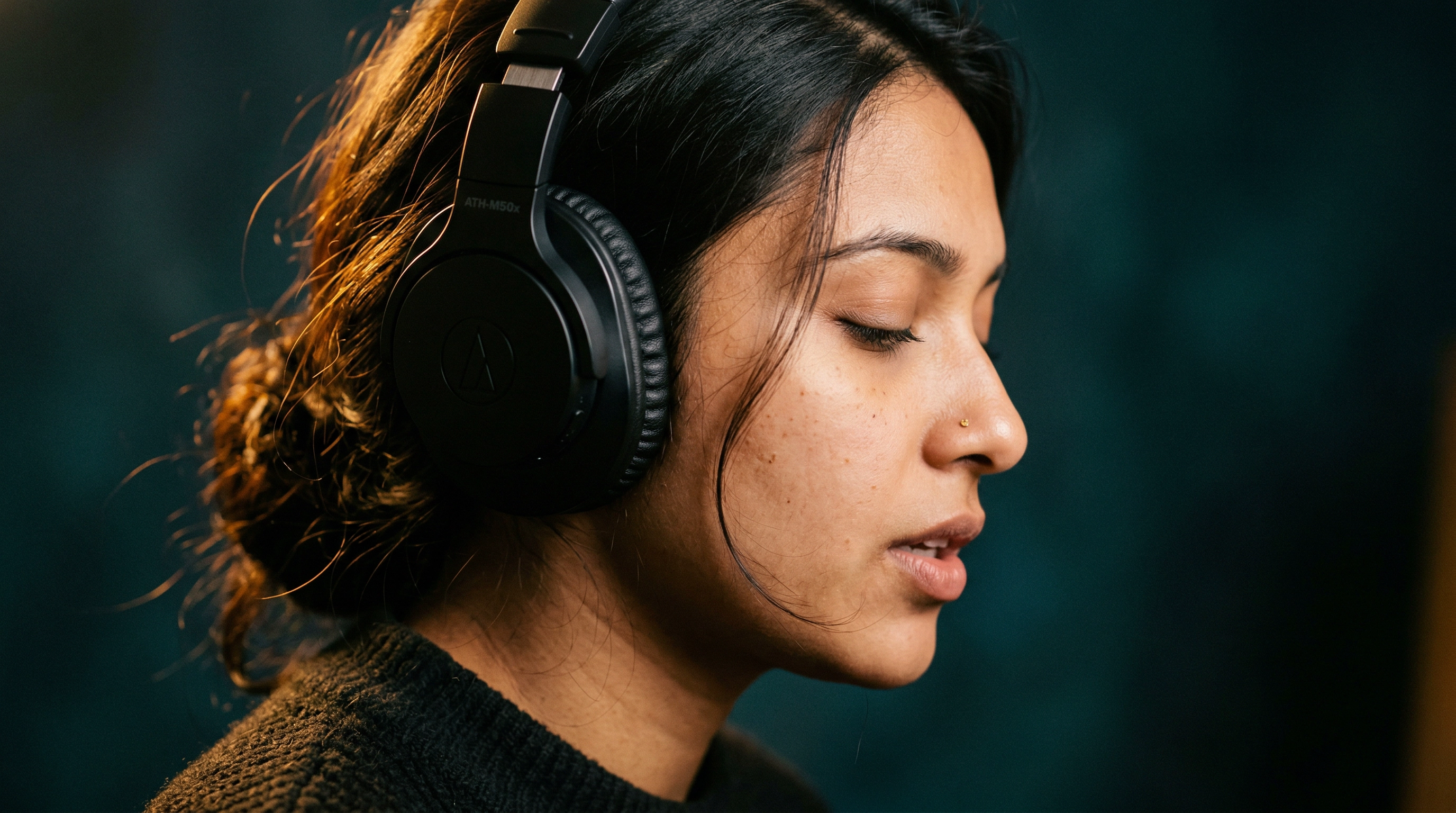
Most English shadowing practice fails because there's no progression. Learners find a podcast, repeat along for ten minutes, and wonder why their speaking doesn't improve after months. The problem isn't shadowing itself — it's practicing the same way every session without building toward anything.
Quick Summary: Five shadowing exercises that build from beginner to advanced: Mirror Shadowing (pause-and-repeat), Delayed Shadowing (2–3 second echo), Speed Shadowing (real-time matching), Selective Shadowing (isolate one feature), and Conversation Shadowing (shadow then respond). Includes a 14-day workout schedule. Start at Exercise 1 regardless of your level.
The fix is structure. Linguistics research identifies three distinct shadowing stages — complete, selective, and interactive — each building different listening and speaking skills. A 2025 systematic review of 44 studies confirmed that structured shadowing programs produce significantly better pronunciation and fluency gains than random repetition. Whether you're learning English for IELTS speaking, job interviews, or everyday conversation, these shadowing practice exercises help you improve the right way.
The five exercises below follow this research-backed progression. You'll need headphones, audio material (recommended sources included for each), and 10–20 minutes per session. For a broader overview of how the technique works and why it's effective, read our complete shadowing guide.

Exercise 1: Mirror Shadowing
Level: Beginner | Time: 10 min | Focus: Individual sounds & basic rhythm
Mirror shadowing is the simplest form: hear a sentence, pause the audio, say it back. Think of it as tracing before drawing freehand — you're building muscle memory for English sounds your mouth hasn't learned to pronounce yet.
How to do it:
- Pick clear, slow audio. BBC Learning English clips, slow news podcasts, or free audiobook samples all work well for learning.
- Set playback speed to 0.75x. YouTube, podcast apps, and most media players support this.
- Play one sentence, then pause.
- Repeat it, matching the speaker's pronunciation, rhythm, and intonation as closely as you can.
- Replay the original audio. Did you catch the vowel sounds? The stress pattern? Adjust and try again.
- Move to the next sentence when yours sounds clean.
If English pronunciation feels overwhelming, start with our guide to pronunciation practice for beginners — it covers the specific sounds most learners struggle with.
Progress markers:
- Week 1: Repeat 5 consecutive sentences without stumbling
- Week 2: Repeat 10 sentences cleanly
- Milestone: You catch yourself mimicking a speaker's rhythm unconsciously

Exercise 2: Delayed Shadowing
Level: Beginner-Intermediate | Time: 10–15 min | Focus: Working memory & retention
Now things get demanding. In delayed shadowing, you don't pause the audio. It keeps playing while you repeat what the speaker said 2–3 seconds behind them — listening to new words while still speaking old ones.
This feels awkward at first — that's the point. Your brain has to simultaneously listen to new English and reproduce what it just heard. This trains your phonological working memory — the mental loop that holds and processes sounds. It's the same system you rely on during real conversations when you're listening and forming a response at the same time.
How to do it:
- Choose audio content you mostly understand (~80% comprehension). TED Talks at normal speed, interview podcasts, and YouTube videos with clear speakers are all good options for this listening exercise.
- Press play. Let the speaker get 2–3 seconds ahead, then start repeating what they said.
- Don't pause — shadow continuously, always trailing behind the audio.
- Start with 30-second stretches. You'll lose the thread often. That's normal.
- Restart the clip and try again. Build to 1 minute, then 2, then 5.
Progress markers:
- Week 1: Maintain a 2-second delay for 30 seconds of continuous listening and speaking
- Week 2: Maintain a 3-second delay for 2+ minutes
- Milestone: Shadow a full TED Talk segment without losing your place

Exercise 3: Speed Shadowing
Level: Intermediate | Time: 10–15 min | Focus: Fluency & connected speech
Speed shadowing is the classic technique used in interpreter training. You speak simultaneously with the audio — your voice and the speaker's overlapping in real time.
This is where you learn connected speech: how native speakers link words ("want to" → "wanna"), drop sounds ("last night" → "las' night"), and use weak forms ("can" → /kən/). These patterns are invisible on paper but a huge part of what separates textbook English from natural-sounding speaking. Learning to hear and reproduce them is key to getting fluency in English.
How to do it:
- Use real-speed audio content — news broadcasts, YouTube videos, or podcasts at 1x. Avoid slowed-down learning materials.
- Start with a 30-second audio clip. Press play and shadow simultaneously.
- Don't chase every word. Aim for rhythm and flow first — accuracy comes with repetition.
- Record yourself. Compare your recording to the original. Where did you fall behind? Those are the things to work on.
- Repeat the same clip 3–5 times. Each pass gets smoother. Research shows this repetition count builds automatic speech patterns.
Progress markers:
- Week 1: Catch 60–70% of words in a 1-minute clip
- Week 2: Catch 85–90% in a 2-minute clip
- Milestone: Connected speech patterns start showing up in your own English conversations

Exercise 4: Selective Shadowing
Level: Intermediate-Advanced | Time: 15 min | Focus: Targeting specific pronunciation features
Instead of shadowing everything, you narrow your focus to one element per session. This approach — based on linguist Tim Murphey's framework and developed further by Hamada (2024) as a targeted training method — is how you fix persistent pronunciation problems instead of just improving generally.
Pick ONE variation per session:
Intonation only: Hum or use "da-da-DA-da" instead of actual words. You're isolating English melody — the rises and falls, the stress peaks on important words. This is one of the most important things for sounding natural when you speak.
Consonant focus: Shadow the full text but concentrate on consonant sounds your native language doesn't have — /θ/ ("think"), /ð/ ("this"), /r/ vs /l/, or final consonant clusters. Really listen to how each sound is produced.
Stress patterns: Shadow while tapping on stressed syllables. English is stress-timed, meaning stressed syllables arrive at roughly equal intervals with unstressed syllables squeezed between them. Getting this right transforms "robotic" English into natural speech.

For accent-specific tips on what to listen for, read our guides on learning the American accent and learning a British accent.
Progress markers:
- Week 1: Identify and reproduce intonation patterns from 3 different speakers
- Week 2: Transfer specific features from your shadowing practice into free speaking
- Milestone: Someone comments that your English pronunciation sounds "more natural"

Duolingo taught you words. No one taught you to speak.
PracticeMe: real voice conversations with an AI tutor, 24/7.
Exercise 5: Conversation Shadowing
Level: Advanced | Time: 15–20 min | Focus: Interactive fluency
This is where shadowing transforms from imitation into real communication training. Conversation shadowing adds a second phase: after you shadow a speaker's response, you create your own reply. It's the most advanced form of English shadowing practice — and the exercise that directly improves your ability to speak in real conversations.
Murphey called this "interactive shadowing" because it bridges controlled listening practice and spontaneous speaking. It's particularly valuable for learners preparing for IELTS speaking tests, professional English, or anyone who wants to speak more confidently.
The Two-Phase Method:
Phase 1 — Shadow: Listen to a dialogue (a podcast interview, a video scene, or a live conversation). Shadow one speaker's responses, matching their pronunciation and rhythm exactly.
Phase 2 — Respond: Replay the same audio section. This time, don't echo — create your own response. The other speaker asks a question, and you answer naturally using the pronunciation patterns you just absorbed.
This works because Phase 1 gives you a "template" for how English should sound, and Phase 2 forces you to produce original speech using that template. You're learning by listening and then speaking — the natural order of language learning.

Why Practice Me Makes This Exercise Easier
Traditional conversation shadowing requires finding dialogues, isolating speakers, and replaying audio segments repeatedly. With Practice Me's AI tutors, conversation shadowing happens live:
- Shadow in real time. The AI tutor speaks — repeat their response to absorb the pronunciation, then reply in your own words.
- Pick your accent. Practice shadowing with American or British English tutors to target the specific pronunciation patterns you're learning.
- Vocabulary sticks. New words from your shadowing conversations are saved and tracked automatically — no separate vocabulary notebook needed.
- No awkward replaying. The conversation flows naturally. Shadow one response, speak freely, shadow again. It's interactive shadowing with a patient partner available 24/7.
If you're looking for more ways to practice English speaking alone, conversation shadowing with an AI tutor is one of the most effective methods available.
Progress markers:
- Week 1: Complete 5-minute sessions alternating between shadowing and responding
- Week 2: Extend to 15-minute conversations with smooth transitions
- Milestone: Pronunciation patterns from shadowing start appearing in your unrelated English conversations
Your 14-Day English Shadowing Practice Schedule
Like any skill, shadowing improves fastest with a plan. Here's how to combine all five exercises into a structured two-week program. Each day takes 10–20 minutes — easily part of a daily English speaking routine.

| Day | Exercise | Focus | Time |
|---|---|---|---|
| 1 | Mirror Shadowing | Get comfortable with pause-and-repeat | 10 min |
| 2 | Mirror Shadowing | Same audio material, focus on vowel sounds | 10 min |
| 3 | Delayed Shadowing | Introduce 2-second delay while listening | 10 min |
| 4 | Delayed Shadowing | Extend delay to 3 seconds | 15 min |
| 5 | Speed Shadowing | First try at simultaneous shadowing | 10 min |
| 6 | Speed Shadowing | Same clip, repeat 3–5 times | 15 min |
| 7 | Review Day | Re-do your weakest exercise | 10 min |
| 8 | Selective: Intonation | Shadow only pitch patterns | 15 min |
| 9 | Selective: Consonants | Focus on your problem sounds | 15 min |
| 10 | Speed Shadowing | New audio material at full speed | 15 min |
| 11 | Conversation Shadowing | Shadow + respond to a dialogue | 15 min |
| 12 | Conversation Shadowing | Full session with Practice Me | 20 min |
| 13 | Selective: Stress | Tap stressed syllables while shadowing | 15 min |
| 14 | Conversation Shadowing | Extended free conversation + shadowing | 20 min |
Tips for making it stick:
- Record yourself on Day 1 and Day 14. Compare the recordings — the improvement in your English is usually obvious.
- Practice shadowing at the same time each day. Consistency matters more than duration.
- If an exercise feels too hard, drop back one level. Each exercise builds on the last.
For more strategies to improve your English speaking by yourself, read our broader tips to improve English speaking skills.
Frequently Asked Questions
How long should each shadowing session be?
Start with 10 minutes and build to 20. Research shows 10–15 minute English shadowing practice sessions, 3–5 times per week, produce measurable improvement in pronunciation and fluency over 4–6 weeks. Going longer can cause listening fatigue, which reduces the quality of your repetitions.
Can beginners start with Speed Shadowing?
You can try, but you'll likely get frustrated. Mirror Shadowing and Delayed Shadowing build the foundational listening and speaking skills that make Speed Shadowing productive. Follow the 14-day schedule — it's designed to ramp up gradually so each exercise feels challenging but achievable.
What materials work best for English shadowing practice?
For beginners: BBC Learning English clips, slow news podcasts, and free audiobook samples. For intermediate learners: TED Talks, interview podcasts, and YouTube videos at normal speed. For advanced learners and IELTS candidates: fast-paced news, movie dialogues, and real-time AI conversations with Practice Me. The key is picking audio content where you understand about 80% of the words — hard enough to learn English from, easy enough to keep up with.
How quickly will I see results from these shadowing exercises?
Most learners notice improved rhythm and pronunciation within 2 weeks of consistent practice. Broader fluency gains — speaking more smoothly and confidently in real English conversations — typically show up around 4–6 weeks. A 2025 study found that even untrained listeners could detect pronunciation improvement after structured shadowing.
Should I use a transcript while shadowing?
For Exercises 1–2 (Mirror and Delayed Shadowing), yes — reading a transcript helps you check accuracy and learn new vocabulary. For Exercises 3–5, try without one first. At that stage you're training your listening and speaking reflexes, not your reading comprehension. If you're completely lost, glance at a transcript briefly, then go back to audio-only listening.