Duolingo taught you words. No one taught you to speak.
PracticeMe: real voice conversations with an AI tutor, 24/7.
Shadowing English: The Complete Practice Guide [2026]
![Shadowing English: The Complete Practice Guide [2026]](https://cdn.babyseo.ai/images/practiceme.app/shadowing-english-guide/shadowing-english-speaking-practice-guide.png)
Shadowing English is the single most effective speaking technique that most learners have never tried. You listen to a native speaker and repeat what they say almost simultaneously — not after a pause, but while they're still talking. It feels strange at first. Within 30 days, it can transform how you sound.
Quick Summary: Shadowing is a language learning technique where you repeat spoken English in near-real-time — like an echo, not a parrot. Research shows it strengthens the brain's phonological loop, improving pronunciation, rhythm, and fluency faster than passive listening or dictation alone. This guide covers exactly how to shadow English, what materials to use, and includes a 30-day shadowing challenge you can start today.
What Is Shadowing English (and Why Learners Swear By It)?
Shadowing English means listening to spoken English and repeating it almost immediately — within a fraction of a second — while the audio is still playing. You're not pausing and repeating. You're speaking over the speaker, like a real-time echo.
This is what separates shadowing from simple repetition or dictation exercises. When you pause-and-repeat, your brain has time to translate, think, and construct. When you shadow, there's no time for that. Your mouth has to keep up with your ears, forcing your brain to process English as English — not as a translation from your native language.
The technique was formalized by Japanese researcher Katsuhiko Tamai in 1992 and later popularized by Alexander Arguelles, a hyperglot who speaks over 50 languages. Arguelles famously shadows while walking briskly outdoors — an approach he's used daily for decades to learn and maintain his languages.

But you don't need to walk laps around your neighborhood. You just need 15 minutes, headphones, and something worth listening to.
Shadowing English has been a staple in interpreter training for years. Simultaneous interpreters practice it to build the mental agility needed to listen and speak at the same time. The good news? Those same cognitive benefits work just as well for English learners at any level who want to improve their English speaking skills.
Why Shadowing English Works: The Neuroscience of Sound Memory

Shadowing isn't just a clever trick — it rewires how your brain processes language. Here's what happens under the hood.
Your brain has a system called the phonological loop, a part of working memory described by psychologist Alan Baddeley. This loop temporarily stores sounds and replays them — it's basically a mental echo chamber. When you shadow English, you force this loop into overdrive: hearing, storing, and reproducing sounds all at once.
A brain imaging study from Tohoku University found that participants who completed shadowing training showed measurable changes in the left cerebellum — a region directly tied to the phonological loop. Their brains literally reorganized to process language sounds more efficiently. That's not a metaphor. Shadowing causes actual neural plasticity.
Research by Kadota (2012) showed that shadowing boosts phonological encoding — the brain's ability to capture and retain the sound patterns of new words and phrases. This is why people who shadow regularly report remembering vocabulary better: they've heard it, said it, and physically felt their mouth form the sounds.
A 2025 systematic review analyzed 44 studies on shadowing for pronunciation and confirmed measurable improvements across multiple learner populations.

Here's what shadowing English trains simultaneously:
- Pronunciation — your mouth learns the physical movements for each sound
- Prosody and intonation — you absorb the "music" of English (pitch rises, falls, emphasis)
- Rhythm and stress — you learn which words get stressed and which get swallowed
- Listening comprehension — decoding fast, connected speech becomes easier
- Vocabulary retention — speaking new words aloud creates stronger memory traces than dictation or passive reading
- Implicit grammar — you internalize sentence structures without consciously studying rules
No single technique targets this many skills at once. That's why shadowing English has gained such a devoted following among serious language learners.
The 5-Step Shadowing Method for English Practice
Here's exactly how to practice shadowing English, whether you're a beginner or advanced learner. Each step builds on the last — don't skip ahead.
Step 1: Choose Your Audio
Pick a clip that's 1–2 minutes long. It should be at your level or slightly above — you want to understand at least 80% of the words. If you're drowning in unfamiliar vocabulary, the material is too hard.
Good sources: English learning podcasts, audiobook excerpts, TED Talk clips, VOA Learning English segments, or AI tutor conversations (more on materials below).
Step 2: Listen First (Don't Speak Yet)
Play the clip once or twice without repeating anything. Just listen. Understand the content. Notice words you don't know. Get a feel for the speaker's rhythm and pace.
This step matters more than most people think. Shadowing without understanding is just noise-making. You need comprehension before imitation — otherwise you risk mindless parroting, which doesn't stick.
Step 3: Shadow With a Transcript
Now play the audio again, but this time speak along with the speaker while reading the transcript. This is "training wheels" shadowing — your eyes help your ears. Follow the text as you repeat, matching the speaker's speed and intonation.
If you're working on English pronunciation practice as a beginner, start here and stay here until it feels comfortable. There's no shame in using the transcript for weeks.
Step 4: Shadow Without a Transcript
Drop the transcript. Play the audio and shadow using only your ears. This is where the real cognitive workout happens — your brain is doing the full phonological loop exercise without visual support.
Don't worry about getting every word perfect. Focus on the flow: the rhythm, stress, and intonation patterns. If you miss a word, keep going. Don't stop to restart.
Step 5: Record Yourself and Compare

Use your phone to record yourself shadowing. Then play your recording side-by-side with the original. You'll immediately hear where your pronunciation, rhythm, or intonation differs.
This is uncomfortable — nobody loves hearing their own voice. But it's the fastest way to close the gap between how you think you sound and how you actually sound. Self-monitoring is what separates people who shadow daily for years without improving from those who make real progress in weeks.
Choosing the Right Shadowing Material
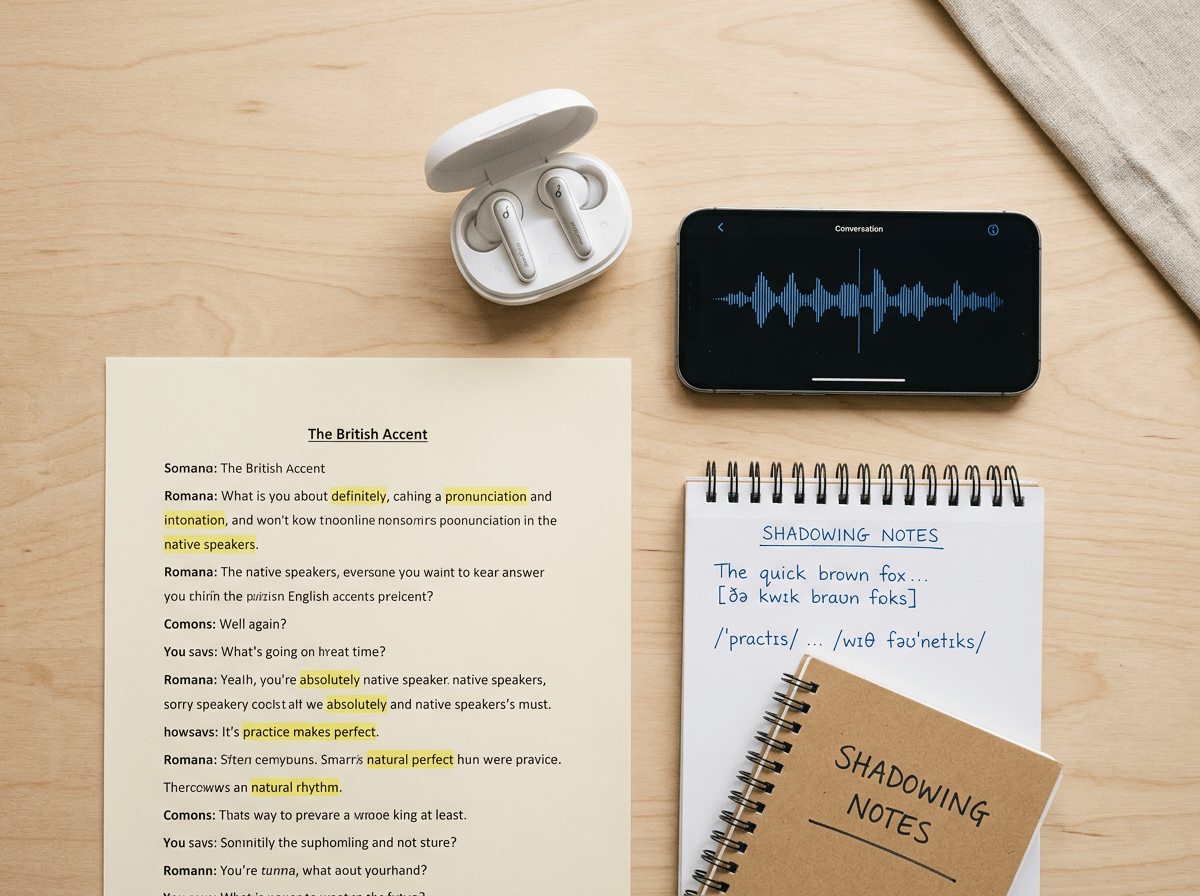
Your material choice makes or breaks your shadowing English practice. Here's how to pick wisely.
Podcasts are excellent for intermediate and advanced learners. They use natural speech patterns, contractions, and connected speech. Look for English learning podcasts that provide transcripts for Step 3.
Audiobooks offer clear, well-paced narration. They're great if fast native speech overwhelms you. The downside: audiobook English is often more formal than everyday conversation.
YouTube and TED Talks give you visual context (facial expressions, gestures) plus subtitles. Useful, but resist the urge to watch instead of shadow — your focus should be on your ears and mouth.
AI conversations are where shadowing English gets really interesting. Unlike pre-recorded audio, a conversation with an AI tutor adapts to your level in real time. The AI doesn't speak too fast or too slow — it matches you. And here's what no podcast or dictation exercise can do: after you shadow a response, you can actually reply.
Practice Me's AI tutors are designed for exactly this. Choose an American or British accent tutor, start a conversation on any topic, and shadow their responses before replying with your own words. Your vocabulary gets saved automatically, so you can review the exact words you practiced. It's shadowing that transforms into real speaking practice — available 24/7, with no scheduling, no judgment, and no awkward silences.
The key criteria for any shadowing material:
- Clear audio quality (no heavy background noise)
- At or slightly above your current English level
- A topic that genuinely interests you
- Transcripts available (at least for early practice stages)
Duolingo taught you words. No one taught you to speak.
PracticeMe: real voice conversations with an AI tutor, 24/7.
American vs. British English: Choosing Your Shadowing Path

Here's a rule most shadowing guides miss: pick one accent and stick with it during your daily shadowing practice sessions.
Shadowing builds muscle memory. Your mouth literally learns specific physical movements for each sound. If you shadow American English on Monday and British English on Tuesday, you're training conflicting muscle patterns — confusing and counterproductive for your pronunciation practice.
American English shadowing focuses on the rhotic "R" (the R is always pronounced), the flap T (where "water" sounds like "wah-der"), and wider vowel sounds. If this is your path, check out our guide on learning an American accent.
British English shadowing emphasizes non-rhotic speech (dropping the R in words like "car"), distinct vowel sounds, and different stress patterns. Our guide on learning a British accent covers the specific sounds to focus on.
Neither accent is "better." Choose the one you'll use most — for work, travel, or personal preference — and commit to it during your daily shadowing sessions. You can always explore the other accent later once your foundation is solid.
With Practice Me, this choice is built in. Pick an American English tutor or British English tutor, and every conversation reinforces the same accent patterns. That consistency is exactly what effective shadowing English practice requires.
7 Common Shadowing Mistakes (and How to Fix Them)
After researching dozens of learner experiences and academic studies on the shadowing technique, these are the mistakes that hold English learners back:
1. Mindless parroting. Repeating sounds without understanding what you're saying. Always listen for comprehension first (Step 2 exists for a reason).
2. Starting without a transcript. If you're a beginner or lower-intermediate learner, skipping the transcript phase is like removing training wheels before you can balance. Use it until shadowing feels natural.
3. Material that's too difficult. If you understand less than 80% of the words, the clip is too hard. Lower the difficulty or slow down the playback speed to 0.75x — this is a tip many experienced learners swear by.
4. Sessions that are too long. Shadowing is cognitively intense. Research by Hamada (2016) found that 10–15 minutes of practice, 3–4 times per week, produced significant improvement in English speaking. More isn't better — fatigue is.
5. Never recording yourself. Without recording, you have no objective feedback on your pronunciation. Record yourself at least once a week and compare to the original.
6. Mixing accents between sessions. As covered above — pick one accent per shadowing period. Consistency builds clean muscle memory for your pronunciation.
7. Making shadowing your only speaking practice. Shadowing builds the physical and cognitive foundations of English speaking, but it's not conversation. You still need to practice English speaking alone or with partners where you form your own thoughts and respond spontaneously. Shadowing is the warmup; conversation is the game.
The 30-Day English Shadowing Challenge

Ready to see real results? Here's a week-by-week plan based on what research and experienced language learners recommend.
Week 1: Foundation (Days 1–7)
- Time: 10 minutes daily
- Method: Shadow WITH transcript (Step 3)
- Material: Easy content — slow English podcasts, beginner audiobooks, or AI conversations at a comfortable pace
- Goal: Build the daily habit. Get comfortable speaking along with audio. Don't worry about perfection.
- Action: Record yourself on Day 1. This is your baseline — you'll want it later.
Week 2: Building Confidence (Days 8–14)
- Time: 15 minutes daily
- Method: Start with transcript, then try dropping it for passages you've already practiced
- Material: Same difficulty level, but try new English topics to broaden your vocabulary
- Goal: Begin transitioning from reading-along to ears-only shadowing on familiar content
Week 3: Pushing Limits (Days 15–21)
- Time: 15 minutes daily
- Method: Shadow WITHOUT transcript (Step 4)
- Material: Slightly faster or more complex audio. Try natural English conversation speeds.
- Goal: Shadow at full speed without visual support. Focus on matching rhythm and intonation, not word-perfect accuracy.
Week 4: Integration (Days 22–30)
- Time: 15 minutes shadowing + 10 minutes conversation
- Method: Shadow for the first half, then switch to free English conversation
- Material: Use the same topics from shadowing as conversation starters
- Goal: Bridge shadowing into real speaking. This is where Practice Me conversations shine — shadow your AI tutor's response, then reply with your own words. You're not just imitating anymore; you're producing English.
- Action: Record yourself on Day 30. Compare with Day 1. You'll hear the difference.
This timeline aligns with published research. Hamada (2016) found that lower-intermediate learners showed significant improvement in just 6 weeks at 10–15 minute sessions. A focused 30-day shadowing challenge at this intensity can produce noticeable gains in pronunciation, rhythm, and overall English fluency.
Want to build on your progress after the challenge? Pair shadowing with a daily English speaking practice routine to keep the momentum going, or learn how to build vocabulary through conversations.
Frequently Asked Questions
How long should I shadow English each day?
Start with 10 minutes and work up to 15. Research by Tamai (1992) found that 15–20 minutes of daily shadowing practice over several weeks produced strong improvements. Kadota (2007) recommends 3–5 hours per week for measurable fluency gains. Going beyond 20 minutes in a single session usually leads to mental fatigue without extra benefit — keep it focused.
Can beginners do English shadowing practice?
Yes — with modifications. Beginners should always use a transcript (Step 3), choose slow audio, and focus on short clips (30 seconds to 1 minute). If simultaneous shadowing feels too fast, start with pause-and-repeat to build your ear, then graduate to true shadowing as your listening comprehension improves. Our guide to English pronunciation practice for beginners is a solid starting point.
Does shadowing actually improve English pronunciation?
The evidence is strong. A 2025 systematic review of 44 studies confirmed that shadowing improves second-language pronunciation. A study at National Taiwan University found significant gains in intonation, fluency, and overall pronunciation among students who practiced shadowing consistently. The key word is consistently — occasional shadowing won't cut it.
What's the difference between shadowing and repeating?
Shadowing is near-simultaneous — you speak while the audio plays, staying just a fraction of a second behind. Repeating (and dictation) means you pause the audio, then say or write what you heard. Shadowing forces faster processing because there's no time to translate or overthink. Both are useful, but shadowing trains your brain to think in English rather than about English.
Can I shadow with AI conversations instead of recordings?
Absolutely — and in some ways, it's more effective than shadowing pre-recorded audio. Static recordings are the same speed and difficulty every time. An AI conversation adapts to your English level and responds to what you say. With Practice Me, you can shadow your AI tutor's responses and then continue the conversation naturally. That means you're training both imitation skills (shadowing) and production skills (responding) in a single session. It's available anytime, with your choice of American or British accent — and it never gets tired of repeating itself.
Shadowing English isn't complicated. It's 15 minutes, headphones, and the willingness to sound a little silly at first. But those 15 minutes of daily practice activate parts of your brain that passive listening never reaches.
Start the 30-day challenge. Record Day 1. And when you listen back on Day 30, you'll understand why polyglots, interpreters, and serious language learners have used shadowing for decades.
The only question left is which accent you'll shadow first. Pick one, press play, and start speaking — even if it feels strange. Especially if it feels strange. That's how you know it's working.
If you want to go deeper, learn how to speak English fluently and confidently or explore more ways to practice English speaking alone at home.