Duolingo taught you words. No one taught you to speak.
PracticeMe: real voice conversations with an AI tutor, 24/7.
How to Stop Translating & Speak English Naturally

You're mid-conversation in English. Someone asks you a question. Your brain immediately starts translating — hear the English words, convert to your native language, form a response, translate back, then finally speak. By the time you finish this exhausting mental relay, there's an awkward pause and the moment has passed.
If you've been wondering how to think in English and stop translating, you're not alone. This is the single biggest barrier between intermediate learners and real fluency. And while the fundamentals of thinking in English cover the basics — labeling objects, changing your phone language, simple self-narration — this guide goes deeper. Here, you'll learn advanced techniques to help you stop translating in your head and start speaking English naturally without thinking in your native language first.
Quick Summary: Your brain translates because it learned English through your native language, creating a processing habit that doubles cognitive load. To speak English without translating, you need to progress through 5 phases — from awareness to automatic English thinking — using exercises like verbal brain dumps, response prediction, word association chains, and real-time narration. The 21-day No-Translation Challenge at the end gives you a structured daily program to help yourself make this shift permanent.
How to Think in English and Stop Translating: Why Your Brain Does It
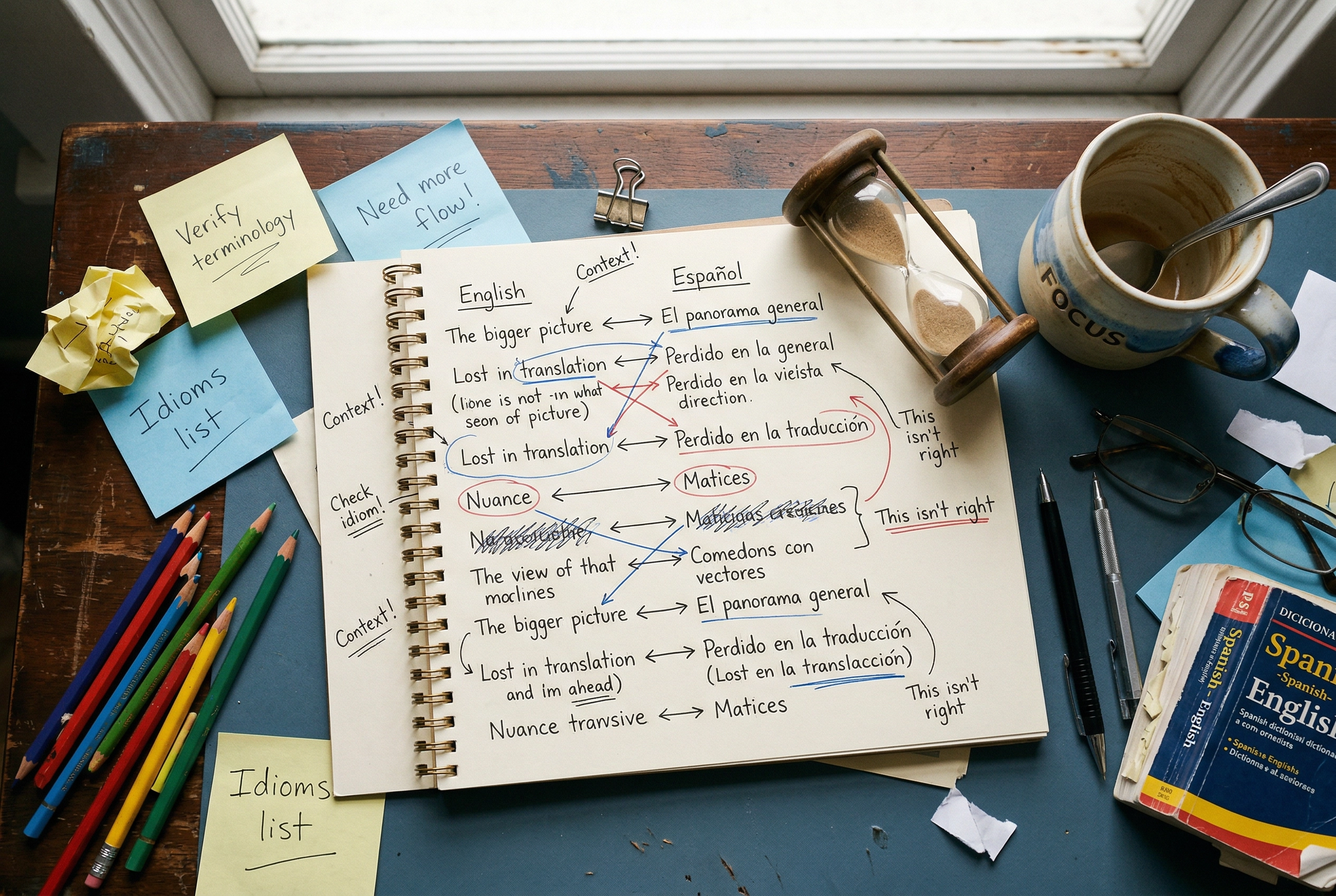
The translation habit isn't a flaw in how you learned English — it's how every brain initially processes a second language. Understanding the science helps you stop blaming yourself and start fixing the real problem.
When you first started learning English, your brain didn't build new pathways from scratch. It piggybacked on your native language. The English word "table" connected to your native word for table first, which then connected to the actual concept. Every piece of English vocabulary was routed through your first language like a detour on a highway.
Neuroscience calls this controlled processing. It's slow, effortful, and demands enormous mental energy. fMRI studies show that less proficient bilingual speakers activate significantly more of the dorsolateral prefrontal cortex (Brodmann areas 45, 47, and 10) when speaking their second language compared to their first. Your brain is literally working overtime — recruiting executive function resources that native English speakers don't need for the same task.
Here's why this matters when you're speaking English: translating doubles your cognitive load. Instead of one processing step (hear → respond), you're running five (hear English → decode in L1 → process meaning → form L1 response → translate to English → speak). Meanwhile, the other person is waiting for your words. The pressure builds. Your cognitive resources get stretched thinner. And the translation gets even slower — a vicious cycle that makes speaking English naturally feel impossible.
The goal is automaticity — the point where your brain processes English directly, without the native language detour. Research published in Nature Communications shows that highly automatic language processing relies on posterior brain regions (BA 44), while controlled, effortful processing engages more anterior prefrontal areas. As you build English automaticity, your brain literally shifts where it processes the language — from the effortful prefrontal cortex to the fast, automatic regions.
The critical insight: you can't study your way to automaticity. Grammar drills, vocabulary lists, and textbook exercises won't help you get there. Automaticity only comes from repeated, real-time practice — the kind where your brain doesn't have time to take the translation shortcut. Learning how to think in English and stop translating requires that you practice speaking again and again until the direct pathway becomes stronger than the detour.
The 5 Phases of Thinking in English (From Translating to Automatic)

Learning how to stop translating when speaking English isn't an overnight switch. It's a gradual transition that happens in predictable phases. Knowing where you are on this journey helps you choose the right exercises, track your progress, and stay patient with yourself.
Phase 1: Awareness You start catching yourself translating mid-sentence. You notice the gap between hearing English words and understanding them — that brief moment where your brain routes through your native language. This awareness itself is progress. Most English learners don't even realize they're translating until someone points it out.
Phase 2: Forced English Thinking You consciously push yourself to form thoughts directly in English. It's exhausting and uncomfortable. Sentences come out slower and simpler than in your native language. You might feel like you've gotten worse at English. You haven't — you're just forcing your brain onto the harder, direct path instead of the familiar detour.
Phase 3: Mixed Thinking Some thoughts start arriving in English automatically — especially about familiar topics or everyday situations. Others still get routed through your native language, particularly abstract concepts, emotional responses, or unfamiliar vocabulary words. You'll shift between languages depending on context, tiredness, and comfort level. This is where most intermediate learners spend the longest time.
Phase 4: Natural English Thinking English becomes the default for most situations. You start thinking in English without trying. Your native language only surfaces for highly emotional moments or very specialized concepts you originally learned exclusively in your first language. At this point, you can speak English naturally without thinking in your L1 first.
Phase 5: Automatic You stop noticing which language you're thinking in. During conversation, there's no translation layer — just thought flowing directly into English speech. This is what it feels like to speak English fluently and confidently.
Important: Most learners don't move through these phases in a straight line. You might be in Phase 4 when discussing your job but drop back to Phase 2 when debating politics. Tiredness, stress, and emotional intensity can all push you back. That's completely normal. Progress isn't linear — it's situational, and the goal is to gradually expand the number of situations where you operate in Phases 4 and 5.
4 Advanced Exercises to Help Yourself Stop Translating in Your Head
If you've already tried the basics — labeling objects around yourself, switching your phone to English, narrating simple daily activities — it's time to level up. These four exercises specifically help you stop translating in your head during the moments that matter most: when you need to think and respond fast in a real English conversation. Each one targets the translation reflex differently, so practice all four for the best results.
The Verbal Brain Dump

Set a timer for 2 minutes. Start speaking English about anything. The rules are simple but strict:
- Don't stop speaking. If you run out of words, describe the silence itself: "I can't think of what to say right now, my mind is blank, I'm looking at the wall and I see a crack in the paint..."
- No switching to your native language. If you can't find a word, describe it instead: "the thing you use to open a bottle" rather than switching to your L1 for "corkscrew."
- Don't plan what you'll say. The whole point is spontaneous, unfiltered English output.
Why it works: The verbal brain dump overwhelms your translation reflex with sheer volume. When your mouth has to keep producing English words without pause, your brain simply doesn't have time to route through your native language. You're forcing the direct pathway because the indirect one is too slow to keep up.
Start at 2 minutes. Once that feels comfortable, push yourself to 5 minutes. Then 10. Record yourself and listen back — you'll hear your fluency improving week over week as the pauses get shorter and sentences get longer. This is one of the most effective ways to start thinking in English quickly.
Response Prediction
While watching any English content — a TV show, a podcast interview, a YouTube video — pause before a person responds to a question. Then predict what they'll say, out loud, in English.
It doesn't matter if you get the prediction right. What matters is that you're forcing your brain to formulate English responses proactively instead of reactively. You're building the exact same neural pathway you'll use in real conversation: hear something → generate a response in English → speak.
Start with predictable content (talk shows, interviews about familiar topics). Progress to more complex or spontaneous content (debates, unscripted podcasts). This exercise directly trains the "what do I say next?" muscle — the one that freezes and starts translating when you're under time pressure. Over time, it helps you learn to respond naturally in English without the L1 detour.
Word Association Chains
Say one English word out loud. Then immediately say the first related English word that comes to mind. Keep the chain going without pausing:
Example: coffee → morning → alarm → sleep → dream → travel → passport → airport → flight → clouds
The rules:
- No pausing to think in your native language
- No "correct" associations — any connection between words counts
- Keep the speed up — aim for 1 word per second
- If you get stuck, start a new chain from any random word
Why this exercise is powerful: Research on bilingual word associations (Meara, 2009) shows that L2 learners' mental word connections differ significantly from native speakers'. Native speakers link English words through meaning, sound, and context simultaneously. L2 learners tend to link words through L1 translation bridges. Word association chains help you build direct English-to-English connections in your vocabulary, gradually restructuring how your mental dictionary is organized. This makes it easier to speak English without translating every word first.
You can also build vocabulary through conversations that work the same way — creating English-to-English associations instead of English-to-L1 bridges that slow you down.
Real-Time Narration Under Pressure
You've probably tried narrating your day slowly — "I'm making breakfast. I'm pouring milk." This exercise takes that narration practice and adds time pressure to help you practice thinking in English at real conversation speed.
Narrate fast-moving situations where you don't have time to translate:
- Sports broadcasts: Describe what players are doing as it happens
- Cooking videos: Narrate the chef's actions in English while they're doing them
- Busy street scenes: Describe what's happening outside a café window in real time
- Conversations you overhear: Silently narrate (in your head) what people around you are saying and doing
The speed of real-life situations forces your brain to skip translation because there's simply no time for the L1 detour. Start with slower scenarios and gradually increase the pace yourself. When you can narrate a fast-paced cooking video in real time without freezing up, your brain has started to internalize direct English processing.
This technique pairs well with the English shadowing technique, where you repeat English speech as you hear it — another powerful way to help yourself bypass the translation step entirely. You might also want to explore tips to improve your English speaking skills for more exercises that complement these advanced techniques.
Duolingo taught you words. No one taught you to speak.
PracticeMe: real voice conversations with an AI tutor, 24/7.
The 21-Day No-Translation Challenge
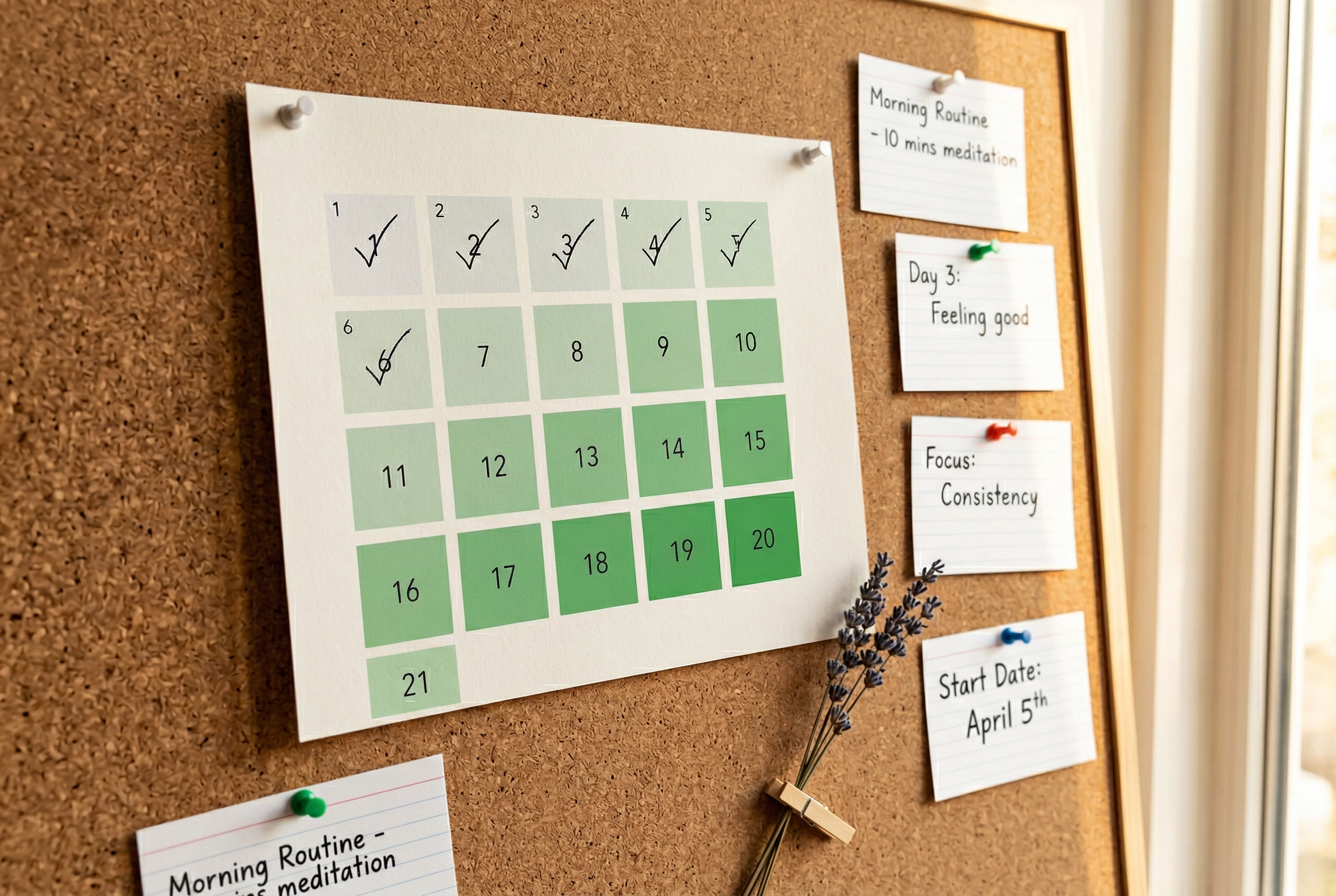
Knowing the exercises is one thing. Doing them consistently enough to actually rewire your brain is another. This 21-day challenge gives you a structured daily program that progressively helps you learn to speak English without translating in your head.
The time commitment starts small — just 10 minutes on Day 1 — and builds to 30 minutes by Week 3. Each week has a specific focus, and the exercises build on each other to help you make steady progress toward thinking in English naturally.
Week 1: Foundation (Days 1–7)
The goal this week is building awareness of when and where you translate. You can't fix a habit you don't notice.
| Day | Exercise | Time |
|---|---|---|
| 1 | Notice every time you translate today. Tally it on paper. | 10 min |
| 2 | Verbal brain dump — 2 minutes, any topic | 10 min |
| 3 | Label 30 objects in your environment in English without L1 | 10 min |
| 4 | Verbal brain dump — 3 minutes | 12 min |
| 5 | Narrate your entire morning routine out loud in English | 15 min |
| 6 | Word association chains — 5 rounds of 1 minute each | 15 min |
| 7 | Combine: brain dump (3 min) + narration (5 min) + journal reflection | 15 min |
End-of-week check: Which situations trigger the most translation? Write down your top 3 translation triggers in English.
Week 2: Escalation (Days 8–14)
Now you start to actively fight the translation habit with targeted practice and have your first real English conversations.
| Day | Exercise | Time |
|---|---|---|
| 8 | Response prediction with an English podcast — pause 5 times | 20 min |
| 9 | Verbal brain dump — 5 minutes without stopping | 20 min |
| 10 | 10-minute English-only thinking block (force all thoughts into English) | 20 min |
| 11 | Word association chains + real-time narration of a YouTube video | 20 min |
| 12 | First real-time conversation — practice English with an AI tutor for 10 min | 20 min |
| 13 | Response prediction + verbal brain dump combo | 20 min |
| 14 | 15-minute English-only thinking block + conversation practice | 25 min |
End-of-week check: How have your translation triggers changed? Rate yourself on the 5-phase scale.

Week 3: Integration (Days 15–21)
The final week pushes you into sustained thinking in English and conversation where translation doesn't stand a chance.
| Day | Exercise | Time |
|---|---|---|
| 15 | 20-minute English-only block with narration of your commute or walk | 25 min |
| 16 | Verbal brain dump (5 min) → AI conversation (10 min) | 25 min |
| 17 | Response prediction with a debate or English discussion video | 25 min |
| 18 | 30-minute English-only block: think, narrate, decide — all in English | 30 min |
| 19 | Word association chains (5 min) → AI conversation on an unfamiliar topic (15 min) | 30 min |
| 20 | Full morning routine narrated in English + 15-min conversation | 30 min |
| 21 | Everything in English from waking up until lunch. Journal the experience. | 30+ min |
End-of-challenge check: Where are you on the 5-phase scale now compared to Day 1? Write down which situations no longer trigger translation. You'll likely surprise yourself with how much progress you've made.
If you already have a daily English speaking practice routine, layer these exercises on top. If you don't have one yet, this challenge will help you start building one. For more ideas on how to practice between challenge days, check out our guide on how to practice English speaking alone.
Why Real-Time Conversation Helps You Stop Translating Fastest

Solo exercises build the foundation. They help strengthen the neural pathways for direct English processing and they're essential for getting started. But there's a ceiling to what you can achieve talking to yourself.
The translation reflex is most stubborn during live conversation — when another person is waiting for your response, when the topic shifts unpredictably, and when time pressure comes into play. To truly learn how to stop translating when speaking English, you need to practice in real conversation regularly.
This is where practicing English with an AI tutor becomes the ultimate tool to help yourself break the translation habit:
- No pause button. Practice Me's AI tutors keep the conversation flowing naturally. You can't stop to mentally translate because the conversation doesn't wait for you — just like a real English conversation wouldn't.
- No judgment. You stumble, freeze, or use the wrong words — and nothing bad happens. This removes the anxiety that makes translation worse (stress pushes your brain back into L1 processing).
- Unpredictable topics. When the AI tutor shifts the conversation, your brain is forced to think in English about something you didn't prepare for. That's exactly the muscle you need to build.
- Available 24/7. The 21-day challenge requires daily practice. Having a conversation partner always available means you never skip a day because "nobody was free."
The vocabulary you learn and use in these conversations gets saved automatically, so you can review the English words your brain is starting to connect directly to meaning — without needing L1 translation bridges.
Think of it this way: solo exercises teach your brain to start thinking in English. Real-time conversation teaches your brain to stay in English when it matters most. If you want to improve English speaking by yourself, combining solo exercises with AI conversation practice is the most effective approach — it builds the direct pathways and pressure-tests them in conditions that mirror real life.
Frequently Asked Questions
How long does it take to stop translating in your head?
It depends on your current English level, how much time you dedicate to daily practice, and how similar your native language is to English. Most learners start noticing a real shift (entering Phase 3 of mixed thinking) within 3–6 weeks of consistent daily practice. Full automaticity (Phase 5) typically takes several months of sustained effort. The 21-day challenge won't get you all the way to Phase 5, but it helps build the momentum and daily habits that get you there over time.
Is it normal to still translate complex or abstract words?
Yes — and this happens even to highly proficient bilingual speakers. Abstract concepts, technical vocabulary, and emotionally loaded words often retain a stronger connection to your first language for years. As you encounter and use these words more frequently in English conversations, the direct connections strengthen naturally. Don't force it — just keep using them in English and the L1 bridge will gradually weaken on its own.
What if I revert to translating when I'm tired or stressed?
Completely normal and expected. Cognitive fatigue pushes your brain toward the path of least resistance — your native language. This is backed by cognitive load research: when executive function resources are depleted, controlled L2 processing suffers first while automatic L1 processing persists. The fix isn't willpower — it's building so much automaticity through consistent practice that even your "tired brain" defaults to English. That level of automaticity takes time, but every practice session brings you closer to speaking English naturally without thinking in your native language.
Can I still use my native language for some things during the challenge?
Absolutely. The 21-day challenge isn't about punishing yourself for using your native language. It's about deliberately expanding the situations where you think and speak in English directly. Use your native language for complex emotional conversations, work tasks that require precision, or anything where forcing English would cause real problems. Over the course of the challenge, you'll find the balance naturally shifts as more situations become comfortable in English.
Does the 21-day challenge work for all language backgrounds?
The exercises work regardless of your native language background. However, speakers of languages structurally similar to English (Spanish, Portuguese, Dutch, German) may find the transition slightly faster because word order and many vocabulary roots overlap. Speakers of structurally different languages (Chinese, Japanese, Arabic, Korean) might spend more time in the earlier phases — but the endpoint and the exercises are exactly the same. The biggest variable isn't your native language — it's your practice volume and consistency.