Duolingo taught you words. No one taught you to speak.
PracticeMe: real voice conversations with an AI tutor, 24/7.
English Immersion at Home: A Complete DIY Guide

English immersion at home is the most underrated path to fluency in 2026. You don't need to move to London or New York. You don't need a costly study abroad program. With the right setup, you can build an English immersion environment in your living room that beats most one-month language trips.
This DIY guide walks through 10 specific strategies for English immersion at home, each with an action step and the daily time it takes. We'll also cover a sample weekly schedule, common mistakes, and the one thing most articles get wrong: passive input alone won't make you fluent. You need a system that includes daily speaking output.
Quick Summary: English immersion at home means engineering your daily life so English is your default input and output. The 10 strategies below combine passive exposure (media, devices, labels) with active practice (AI conversation, narration, voice journaling). Most people can build a working system in a weekend.
Why English Immersion at Home Actually Works
Linguist Stephen Krashen's input hypothesis, first published in 1977, says we acquire a language when we receive input slightly above our current level — what he calls "i+1." Comprehensible enough to follow, challenging enough to stretch us.
Research over 50 years shows that learners in immersive environments outperform classroom-only learners on fluency, listening, and confident speaking. The pattern holds whether the immersion happens abroad or at home.
The key word is immersion, not submersion. If you drop yourself into a Wall Street Journal article at A2 level, you're drowning, not learning. Immersion means input you can mostly follow with effort. Submersion is just frustration with extra steps.
The Missing Piece: Why Most DIY Plans Fail
Almost every "how to learn English at home" article focuses only on passive input. Watch Netflix. Read books. Listen to podcasts. That stuff is necessary, but it's not sufficient.
Passive input builds comprehension. You'll start understanding fast spoken English, picking up idioms, recognizing grammar. But your speaking will lag by months because speaking is a separate motor skill. It needs output — physically producing English with your mouth, in real time, under pressure.
Living abroad solves this automatically. You order coffee. You ask for directions. Forced output happens whether you like it or not. English immersion at home has to engineer that forced output deliberately. That's why this guide includes voice journaling, narration, AI conversation, and online communities — not just "watch more YouTube." Without active production, you build a learner who understands everything and can say almost nothing.
10 Strategies for English Immersion at Home
Each strategy has an action step and the daily time it takes. Don't try all 10 at once. Pick 3-4 to start, then layer in the rest.
1. Switch Every Device to English (5 minutes, once)
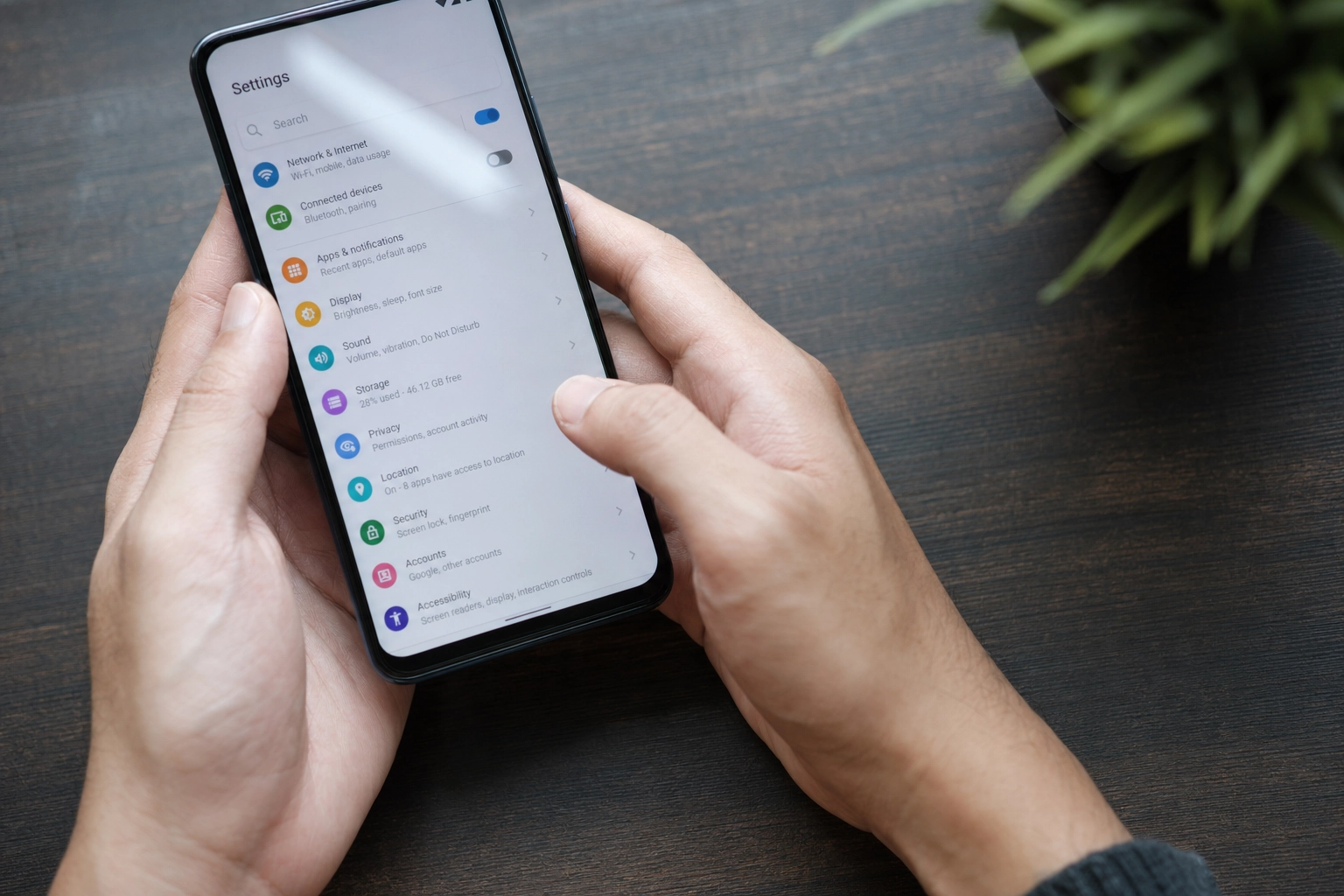
Action: Change the system language on your phone, laptop, browser, smart speaker, and main social apps to English. Today.
- iPhone: Settings → General → Language & Region → English
- Android: Settings → System → Languages → Add English → drag to top
- Browser: Chrome/Firefox settings → Languages → English
Why it works: The average person checks their phone 50-150 times per day, according to Pew Research data. Each glance becomes a free English lesson. You'll learn dozens of words you never deliberately studied.
Daily time: Zero after setup.
2. Consume English Media Daily (30–60 min/day)
Action: Replace one hour of native-language entertainment with English content. Same genres you already enjoy — just in English.
The progression that matters is your subtitle strategy:
- Beginner: English audio + native subtitles (you're really just reading)
- Better: English audio + English subtitles (the sweet spot)
- Best: English audio + no subtitles (full comprehension)
Stay in stage two longer than you think you need to. It's where most language acquisition happens.
Picks by level:
- Beginner: BBC Learning English's "6 Minute English," Peppa Pig (yes, really), Easy English on YouTube
- Intermediate: Friends, The Office, Modern Family, TED-Ed videos, NPR's Up First
- Advanced: Succession, The Daily podcast, BBC News, stand-up specials
Daily time: 30-60 minutes — replace existing entertainment.
3. Think in English Throughout the Day (free, ongoing)
Action: When you catch yourself thinking in your native language, switch the thought to English. Start simple: "I'm hungry. Where are my keys?"
Most learners spend 16 hours a day mentally rehearsing their native language. Even 30 minutes of internal English monologue per day rewires which language your brain reaches for first. Our guide on thinking in English and breaking the translation habit covers this in depth.
Daily time: Zero — runs in parallel with everything else.
4. Voice-Note Journal in English (5–10 min/day)
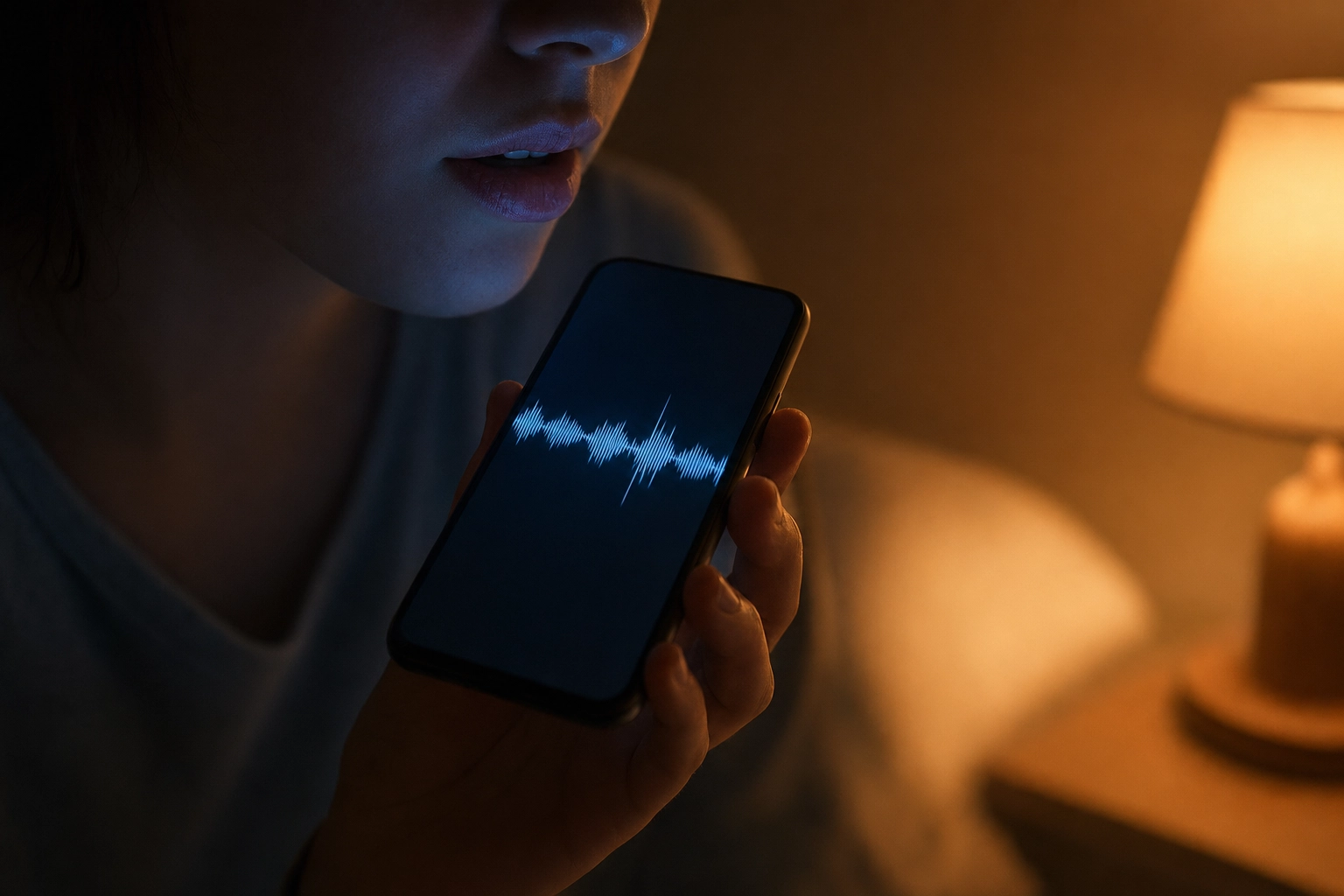
Action: Before bed, open your phone's voice memo app. Record yourself speaking about your day in English for 5 minutes. No script. No looking up words. Just speak.
Voice notes beat written journaling because they force three skills at once: thinking in English, producing it out loud, and self-monitoring your pronunciation. Save your recordings monthly. The progress you'll hear from month one to month three is the most motivating thing you can give yourself.
A simple structure for beginners: what I did today / one good thing / one hard thing / what I'll do tomorrow.
Daily time: 5-10 minutes, same time each day.
5. Narrate Your Daily Activities (free, ongoing)
Action: Talk through what you're doing, out loud, in English. Just when you're alone — cooking, cleaning, walking, getting dressed.
"Okay, I'm making coffee. Where's the filter? It's behind the sugar. Pour the water — wait, the water isn't boiling yet."
Narration trains the speaking-while-thinking skill that real conversation requires. It also surfaces vocabulary gaps you actually have. You'll discover you don't know the English word for spatula or drawer handle — and those are exactly the words you need.
Daily time: Integrated into existing activities — no new time required.

6. Talk to an AI Conversation Partner Daily (15–20 min/day)
Action: Have a real voice conversation in English every day. With a tutor, a language partner, or — most realistically for daily practice — an AI conversation app.
This is the strategy that closes the input-output gap traditional immersion can't fix. AI partners do three things human practice usually can't:
- Available 24/7. Motivation peaks at 11 PM after watching an English show? Practice immediately.
- Zero judgment. Beginners often go silent around native speakers. AI tutors don't sigh or roll their eyes.
- Adjustable difficulty. A good AI tutor adapts to your level — Krashen's i+1 in practice.
Practice Me's tutors specialize in different conversation types — everyday topics, job interviews, travel English, academic discussions. Pick American or British accents. If you've tried ChatGPT for English practice, you know text-based AI has limits. Voice is different. The motor skill of speaking only develops when you actually speak.
Daily time: 15-20 minutes minimum.

7. Join English-Speaking Online Communities (10–20 min/day)
Action: Pick one online community based on a hobby you actually care about — not "language learning." Read every day. Post a comment in English at least three times a week.
- Reddit: r/EnglishLearning is great for beginners. But better: r/cooking, r/gardening, r/photography. Native speakers there will respond to you like a peer.
- Discord: Many YouTubers host Discord servers where conversation happens in real time.
- Niche forums: Photography, fitness, gaming — pick yours.
Posting forces written output, which improves speaking too.
Daily time: 10-20 minutes — works during morning coffee or commute breaks.
Duolingo taught you words. No one taught you to speak.
PracticeMe: real voice conversations with an AI tutor, 24/7.
8. Label Household Items in English (30 min, once)
Action: Spend 30 minutes putting sticky notes on common household items with their English names. Focus on objects you use daily.
This is one of the oldest tricks in language learning, and it's still effective. Stick notes on your fridge, mirror, desk, bedside lamp, kitchen drawers. After two weeks, peel them off — by then the words are anchored to the physical objects in your home.
Skip exotic vocabulary. Label light switch, trash can, coat hanger, charger, remote control — the boring everyday words you'll use forever.
Daily time: Zero after the initial setup.
9. Set "English-Only" Time Blocks (1–2 hours/day)
Action: Pick a specific time window — for example, 7-9 PM every weekday — and commit to using only English during that block. Media, journaling, AI conversation, even talking to your pet. All English.
A defined block beats "more English throughout the day" for three reasons: it's bounded, so your brain accepts intense focus when there's a finish line; it builds compound effect (two hours concentrated beats six scattered 20-minute sessions); and it's testable — either you did it or you didn't.
Tell roommates or family in advance: "From 7 to 9, I'm in English-only mode." Most people are happy to support it.
Daily time: 1-2 hours of focus, same block every day.

10. Shadow English Audio During Commutes (20–40 min/day)
Action: Pick a podcast at your level. Play it at 0.9x speed. Listen and immediately repeat what you hear, copying the rhythm, intonation, and pronunciation. Do this on your commute, walking, or working out.
Shadowing is the technique professional interpreters use to train ears and mouths simultaneously. It hits pronunciation, listening, vocabulary, and grammar in one practice session. Read our complete shadowing guide and these shadowing exercises for level-specific drills.
Daily time: 20-40 minutes — on transit time you'd waste otherwise.
A Sample Weekly English Immersion Schedule
A realistic week for someone targeting 8-10 hours of total English exposure. Not a full-time student — a working adult with a job and a life.
| Day | Morning | Daytime | Evening (English-only) | Total |
|---|---|---|---|---|
| Monday | 30 min shadowing | Narrate lunch prep (10 min) | 20 min AI conversation + 5 min voice journal | ~65 min |
| Tuesday | 30 min English podcast | Online community (15 min) | 45 min Netflix with English subs + journal | ~95 min |
| Wednesday | 30 min shadowing | Narrate cooking (10 min) | 20 min AI conversation + journal | ~65 min |
| Thursday | 30 min YouTube on commute | Online community (15 min) | 45 min English book + journal | ~95 min |
| Friday | 30 min English podcast | Narrate walking break (10 min) | 30 min AI roleplay + 30 min English movie | ~100 min |
| Saturday | — | 90 min English documentary | 30 min AI conversation on a topic you love | ~120 min |
| Sunday | 20 min English audiobook | Online community (15 min) | 10 min voice journal reflecting on the week | ~45 min |
Weekly total: ~9 hours of focused English, plus background exposure from your English phone, labeled apartment, and internal monologue.
No day demands more than 2 hours. Speaking output happens daily. Sunday is intentionally light to prevent burnout. The English-only evening block does most of the heavy lifting.
How to Stay Consistent
Month one is exciting, month two is hard, month three is when most people quit. What works:
- Track minutes, not lessons. The number going up is what matters.
- The 80% rule. Hitting your routine 5-6 days out of 7 forever beats hitting 7 out of 7 for two weeks before quitting.
- Variety is built in. Bored of podcasts? Switch to audiobooks. Tired of your AI tutor? Try a different personality.
- Anchor it to identity. "I'm learning English" is fragile. "I speak English at 7 PM every day" is durable.
- Measure monthly, not daily. Listen to your voice journal from one month ago. Progress is invisible day-to-day and obvious month-to-month.
If motivation collapses, drop everything except 15 minutes of daily English speaking practice.
Common Mistakes That Sabotage English Immersion at Home
Submersion instead of immersion. Watching content that's too hard isn't immersion — it's noise. If you understand less than 70% of a podcast, drop a level.
Passive input only. Reading and watching English builds comprehension. Only speaking builds speaking. Six months of consuming English without ever opening your mouth is why you can't talk fluently. It's not a confidence problem — it's a practice problem.
Translating in your head. Every time you stop to translate, you reinforce the translation habit. Let unknown words pass.
Switching back to native language at hard moments. That's the moment learning stops. Push through with simpler English, gestures, or "the round thing in the kitchen, you know?"
Treating English like homework. Immersion isn't grammar drills. It's living part of your life in English. Our guides on improving English speaking by yourself and overcoming the fear of speaking English cover this in more depth.
Frequently Asked Questions
How long until English immersion at home shows results?
Most learners notice listening improvements within 2-4 weeks. Speaking confidence shifts at 6-8 weeks once daily output practice becomes habit. Real fluency — thinking and responding in English without hesitation — takes 3-6 months of daily practice. The timeline depends on whether you're getting active speaking output, not just passive input.
Can beginners do English immersion at home?
Yes, but match content to your level. Beginners need comprehensible input — content where you understand 70-80%. Children's shows, slow podcasts, short narrated videos work well. Avoid news broadcasts and fast comedies until you're intermediate. AI conversation partners with adjustable difficulty are easier than human partners because they slow down for you.
How many hours per day do I need?
About 1 hour per day produces noticeable progress. The sweet spot for working adults is 2-3 hours per day, mixing passive input with active output. Quality matters more than quantity: 30 minutes of focused speaking practice beats 2 hours of background English music.
Is English immersion at home as effective as traveling abroad?
For most learners in 2026, yes — and sometimes more so. Studying abroad creates forced output, which most home plans miss. But abroad programs are expensive, time-limited, and often surround you with other learners speaking your native language. English immersion at home combined with daily AI conversation practice replicates the forced-output element at a fraction of the cost.
Do I need to spend money on English immersion at home?
Most strategies are free: device language switching, YouTube and podcasts, narration, voice journaling, online communities, and household labels cost nothing. The piece worth paying for is daily speaking practice with feedback — an affordable monthly subscription for an AI conversation app, or a considerably higher hourly rate for a human tutor.
Start Building Your English Immersion at Home Today
Don't try all 10 strategies on day one. Trying to overhaul your life at once is the fastest way to quit by Wednesday.
Pick three to start. The combination most learners find effective:
- Switch your phone language to English (5 minutes, today)
- Set a 1-hour English-only block in the evening (start tonight)
- Have one daily AI conversation during that block (15-20 minutes)
Layer in media, narration, voice journaling, and shadowing over the next four weeks. After a month, you'll have a working English immersion environment running on autopilot.
The strategies that build comprehension are everywhere — Netflix, podcasts, YouTube, books. The piece that closes the loop, the daily speaking output, is what most learners struggle to find. That's the gap Practice Me was built to fill: voice conversations with AI English tutors who adapt to your level, available whenever you have 15 minutes free, judgment-free for as long as you need them.
Build the environment. The fluency follows.