Duolingo taught you words. No one taught you to speak.
PracticeMe: real voice conversations with an AI tutor, 24/7.
English for Flight Attendants & Cabin Crew Guide
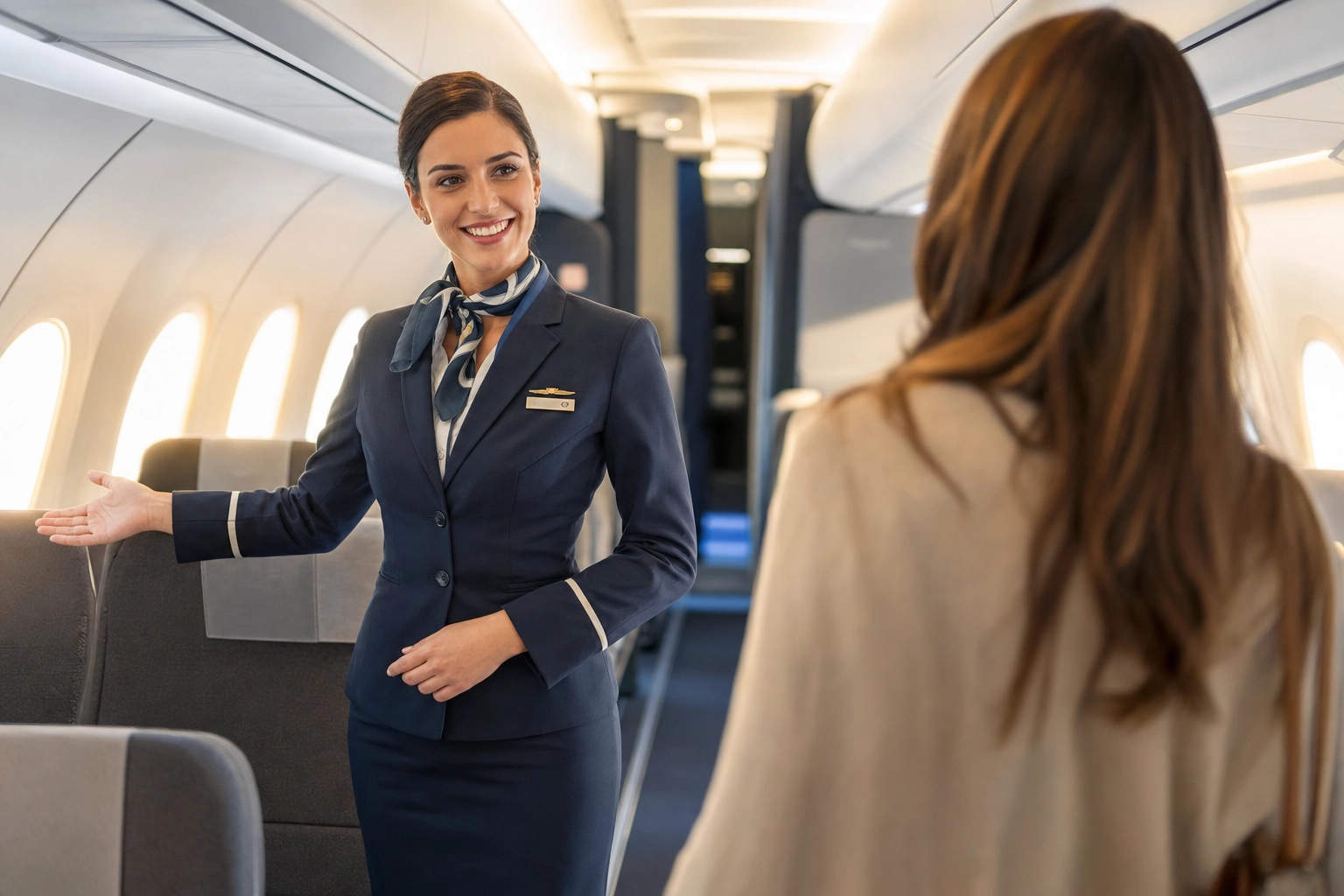
Every flight you've ever taken started the same way: a crew member at the door, smiling, saying "Welcome aboard." What you probably didn't notice is how much careful English sits behind that moment — and behind every safety briefing, meal service, and "please return to your seat" that follows.
For non-native speakers, English for flight attendants is the single biggest hurdle between you and the job. Airlines aren't testing whether you can recite a textbook. They want to know you can welcome a nervous passenger, deliver a safety demonstration word-perfectly, calm someone during turbulence, and ask "Is there a doctor on board?" without hesitating — in clear, intelligible English that anyone from São Paulo to Seoul can follow.
This guide is a working phrasebook for exactly that. Think of it as a practical set of cabin crew English phrases — and the vocabulary that goes with them — organised the way a flight actually unfolds: the real scripts crew use before, during, and after a flight, the announcements you'll deliver, the language for handling complaints and difficult passengers, and a straight, accurate answer on what ICAO Level 4 and "aviation English" really mean. Whether you're preparing for a cabin crew interview or brushing up for recurrent training, every phrase here is one you can practise out loud today.
Quick Summary: Flight attendants need clear, intelligible English across four moments — greeting and boarding, the safety demonstration, in-flight service, and irregular situations (turbulence, delays, complaints, medical and security events). ICAO Level 4 ("Operational") is the benchmark airlines use for aviation English, and it rewards being understood, not having a perfect accent. The fastest way to get there is to rehearse real scenarios out loud until the phrases are automatic.
Why English for Flight Attendants Is the Most Important Skill in the Cabin
There has never been a better time to want this job. In its 2025 Pilot and Technician Outlook, Boeing projected the world will need 1,000,000 new cabin crew members over the next 20 years — more than the number of new pilots and maintenance technicians combined. The fastest-growing regions are South Asia and Southeast Asia, where staffing needs are expected to roughly triple. Gulf and Asian carriers — Emirates, Qatar Airways, Singapore Airlines, AirAsia, IndiGo, and new entrants like Riyadh Air — run near-constant open days to fill their cabins.
Here's the catch: almost every one of those airlines makes English the gatekeeper. The interview is in English, the training manuals are in English, and the safety-critical commands you'll use in an evacuation are in English. This is true whether you call it English for flight attendants, English for cabin crew, or English for airline workers — the assessment is the same wall, and you have to get over it.
That wall exists for one reason: safety. When the International Civil Aviation Organization (ICAO) analysed roughly 28,000 incident and accident reports, more than 70% were connected to language-related problems. The two most-studied disasters in aviation history both involve miscommunication: the 1977 Tenerife runway collision that killed 583 people, and Avianca Flight 052 in 1990, where the crew told controllers they were "running out of fuel" instead of formally declaring an emergency — and ran out before they could land. Clear English in the cabin is not a nicety. It is part of the safety system.
So this guide skips the generic word lists. Instead, it gives you the phrases and scripts you'll actually use, in the order a flight happens.
Pre-Flight & Boarding: Greeting Passengers with Confidence
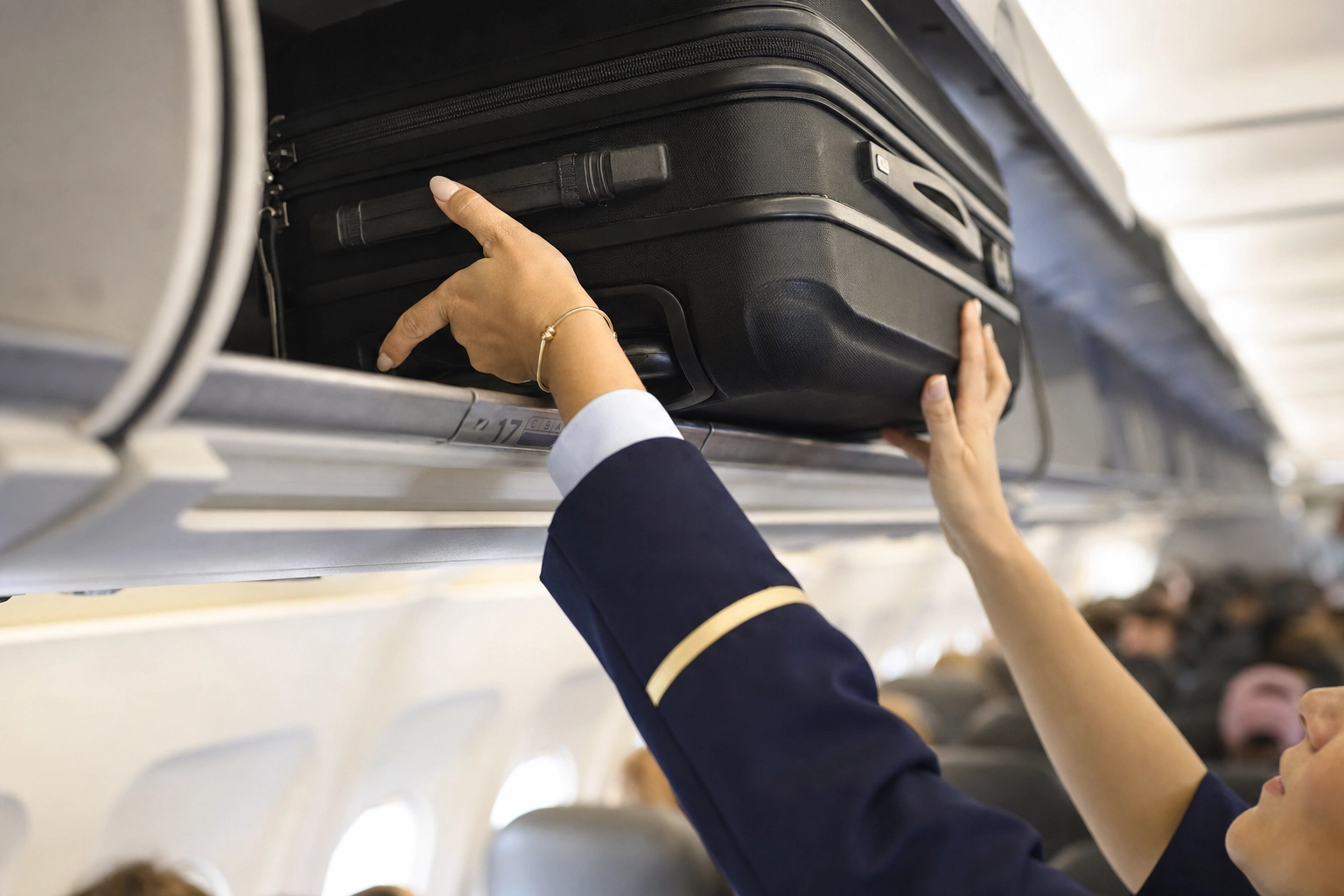
Boarding is your first impression, and it sets the temperature of the whole cabin. Passengers are often stressed, late, or jet-lagged — a warm, clear greeting tells them they're in good hands.
The golden rules: smile (it's audible), speak a little slower than feels natural, and keep your sentences short.
| Moment | What you say |
|---|---|
| Welcoming at the door | "Good morning, welcome aboard." |
| Checking the boarding pass | "May I see your boarding pass? … You're in 14C — just down the aisle on your left." |
| Helping someone find a seat | "Of course, let me show you. Right this way." |
| Offering help with bags | "Would you like a hand with that?" |
| An oversized cabin bag | "I'm afraid that bag is a little too large for the overhead bin — we'll need to check it for you." |
| Asking someone to sit down | "Could I ask you to take your seat so we can prepare for departure?" |
| Full overhead bins | "The bins here are full, but we'll find space for you a few rows back." |
Notice how often crew use softeners — "I'm afraid…", "Would you mind…", "Could I ask you to…". Indirect English sounds polite and professional, and it defuses tension before it starts. A lot of English also happens before passengers even reach the door, on the ground; our guide to airport and check-in English covers that side of the journey.
If greetings and introductions make you nervous, our walkthrough of how to introduce yourself in English has phrasing you can reuse almost word-for-word at an interview.
The Safety Demonstration: Word-for-Word Scripts
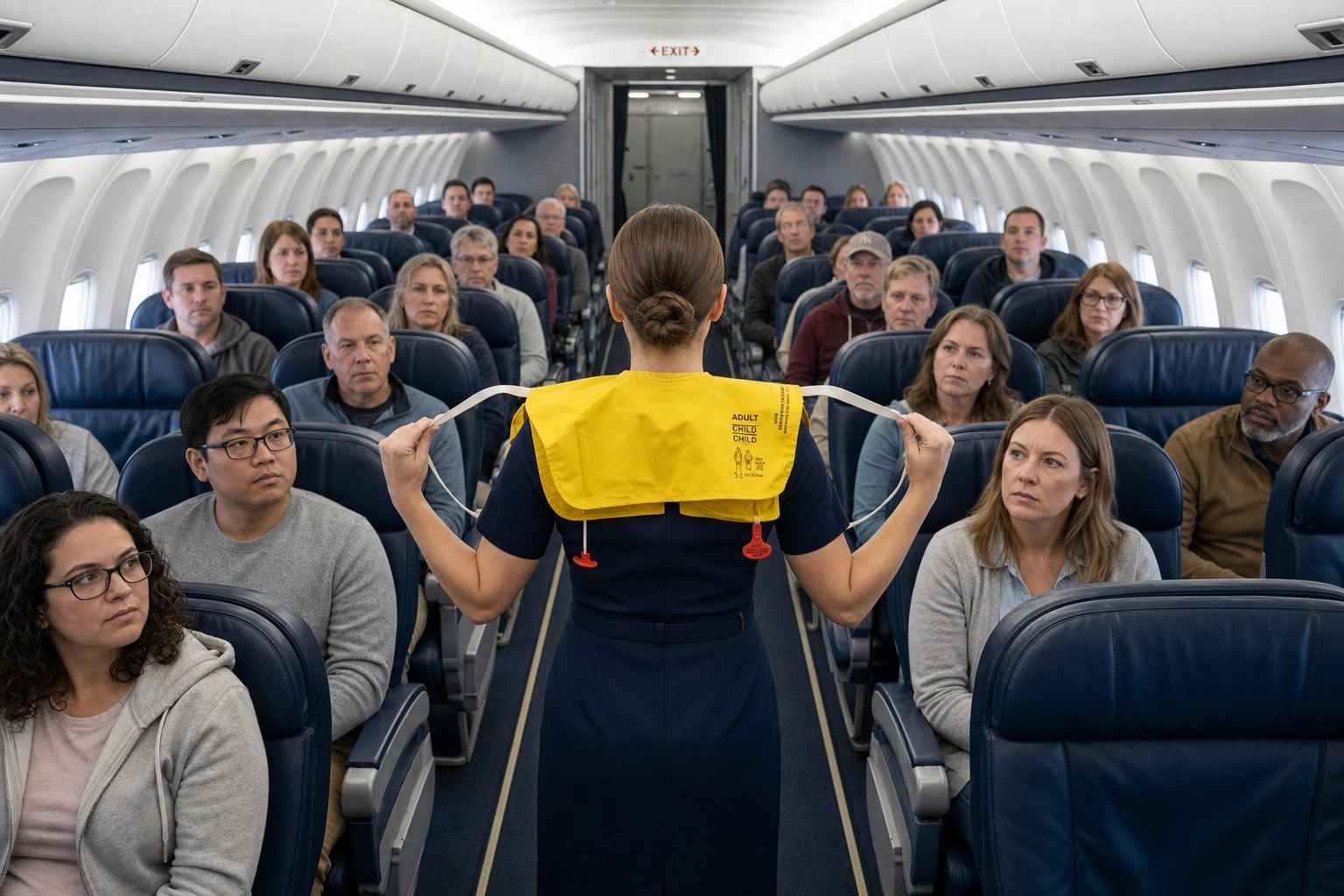
The safety demonstration is the one piece of English you must deliver perfectly, every single time. A frightened first-time flyer's understanding can depend on it. Every airline has its own wording, but the building blocks are remarkably consistent. Learn these, then adapt to your carrier's exact script.
Seatbelt: "To fasten your seatbelt, insert the metal tip into the buckle. To tighten it, pull the loose end of the strap. To release, simply lift the top of the buckle. We recommend you keep your seatbelt fastened whenever you are seated, even when the sign is off."
Oxygen mask: "In the unlikely event of a sudden loss of cabin pressure, oxygen masks will drop down from the panel above your seat. Pull the mask firmly toward you to start the flow of oxygen, place it over your nose and mouth, and breathe normally. The bag may not inflate, but oxygen is flowing. Please secure your own mask before helping others."
Life vest: "Your life vest is located under your seat. Slip it over your head, pass the strap around your waist, and pull it tight. To inflate, pull down firmly on the red tabs — but only once you have left the aircraft. Do not inflate your life vest inside the cabin."
Emergency exits: "Please take a moment to locate your nearest exit, keeping in mind that it may be behind you. In an emergency, floor-level lighting will guide you toward the exits. Leave all belongings behind and move quickly to the nearest usable exit."
Brace position: "In the unlikely event of an emergency landing, you will be told to brace. Bend forward, place your head against the seat in front of you, and put your hands over your head, as shown on your safety card."
Two things examiners and trainers listen for: pronounce the key verbs clearly — fasten, tighten, release, inflate, brace — and don't rush. A safety briefing delivered too fast is as useless as one nobody can hear.
In-Flight Service English: Drinks, Meals & the Trolley
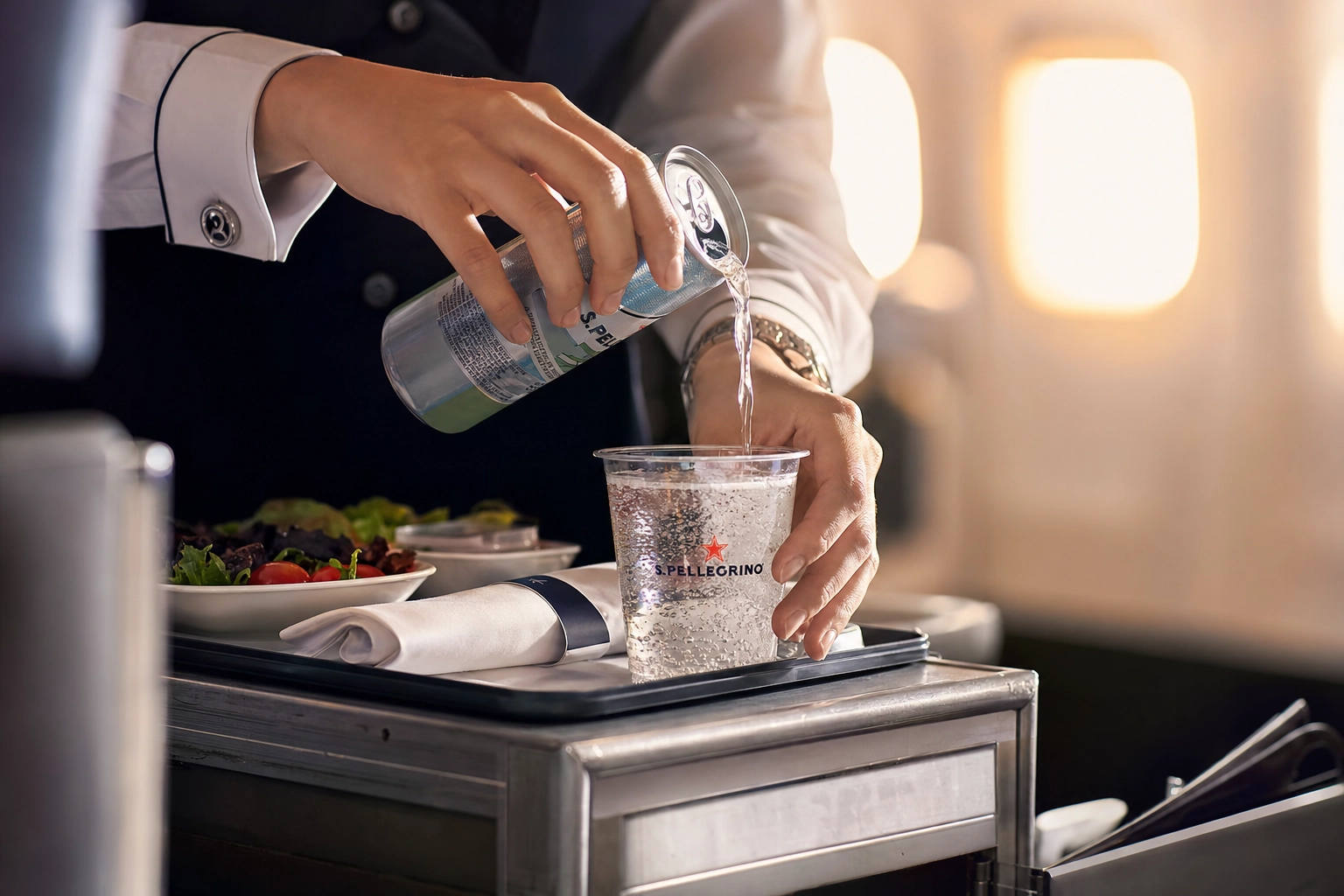
Once you reach cruising altitude, the trolley comes out of the galley and the same handful of phrases repeat hundreds of times. The skill is sounding warm and natural on the two-hundredth row, not just the first.
| Situation | What you say |
|---|---|
| Starting drink service | "Would you care for something to drink?" |
| Offering simply | "Anything to drink? Tea, coffee, water, juice?" |
| Hot drinks | "Tea or coffee for you?" |
| The classic meal choice | "We have chicken or pasta this evening — which would you prefer?" |
| Out of a choice | "I'm so sorry, we've just run out of the chicken. Would the pasta be alright?" |
| Checking back | "Can I get you anything else?" |
| Clearing trays | "May I take that for you?" |
The pattern to internalise is the polite question frame: "Would you care for…", "May I…", "Can I get you…". It's softer and more professional than a blunt "Do you want…". A little drinks-and-meals vocabulary goes a long way here too — sparkling or still water, with ice, a refill, duty-free. If keeping these little exchanges flowing feels hard, the techniques in our guide to keeping a conversation going in English transfer directly to the aisle.
Passenger Requests & Complaints: What to Say
Passengers ask for things constantly, and they complain when something's wrong. A good response follows a simple formula: acknowledge → apologise (if needed) → act.
| They ask or complain | You respond |
|---|---|
| "Could I get a blanket?" | "Of course, I'll bring you a blanket right away." |
| "Do you have headphones?" | "Yes, here you are. Let me know if you need anything else." |
| "My screen isn't working." | "I'm sorry about that. Let me try to reset it for you." |
| "My seat won't recline." | "I do apologise. Unfortunately this seat is fixed, but let me see if another one is free." |
| "I ordered a vegetarian meal." | "Let me check the list for your special meal — one moment, please." |
| "It's freezing in here." | "I'm sorry you're cold — I'll bring you a blanket and ask the flight deck to adjust the temperature." |
| A passenger looks unwell | "Are you feeling unwell? Can I get you some water?" |
Two things make complaints worse: over-promising ("No problem, I'll fix it!") and going silent. Even when you can't solve the problem, narrate what you're doing — "Let me check and come straight back to you" — so the passenger feels heard. Special meals have their own vocabulary worth memorising: vegetarian, vegan, halal, kosher, gluten-free, nut allergy, and diabetic meal.
Turbulence, Delays & Cabin Announcements (PA Scripts)
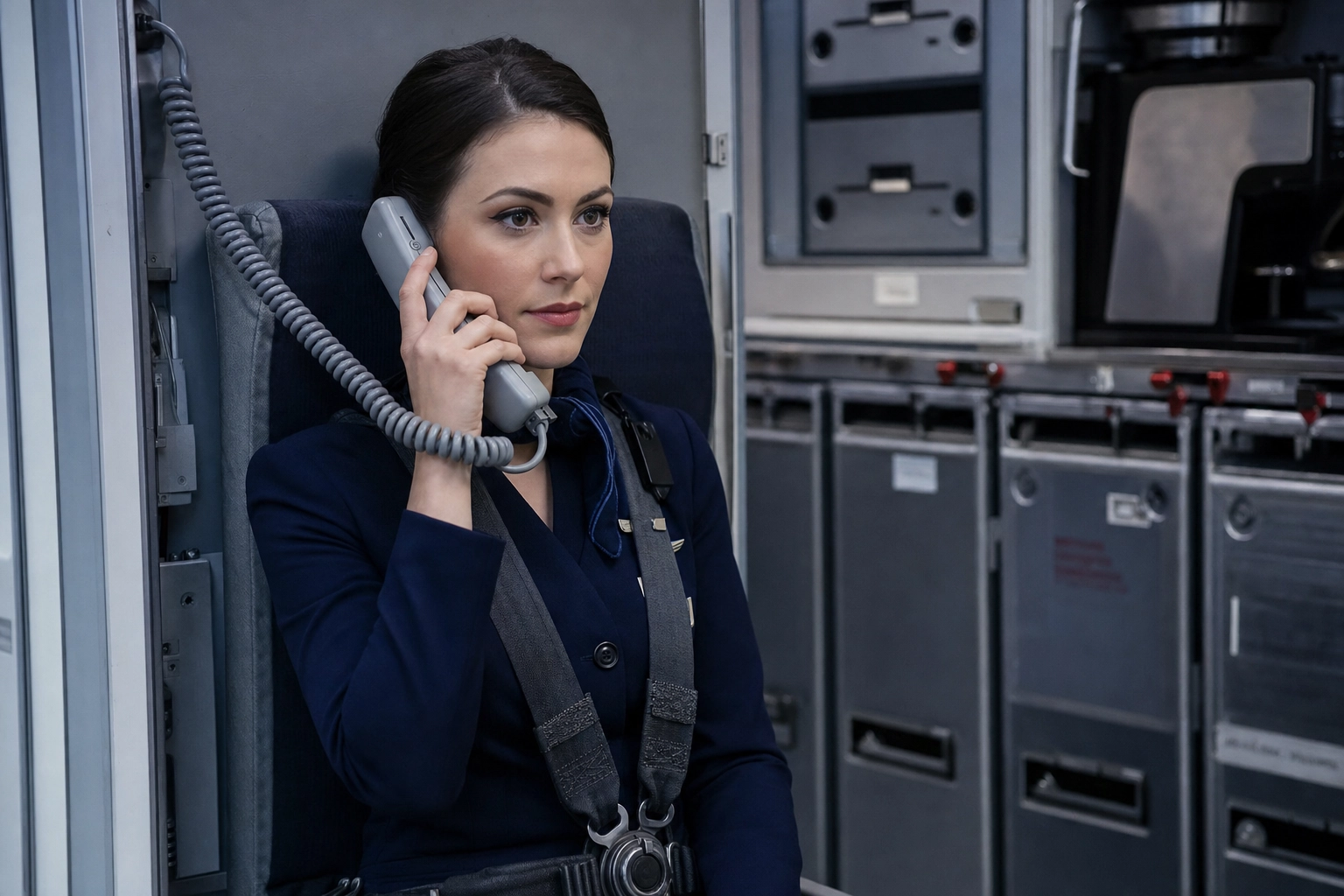
The public-address (PA) system is where shaky English gets exposed, because everyone is listening and you can't use body language to help. Slow down, pause between sentences, and pronounce numbers carefully ("flight three-four-seven," "approximately twenty minutes").
Boarding and preparing the doors (crew to crew): "Cabin crew, prepare doors for departure and cross-check."
Turbulence: "Ladies and gentlemen, the captain has switched on the fasten-seatbelt sign. We're expecting some turbulence ahead. Please return to your seat and fasten your seatbelt. For your safety, our cabin service will be suspended for now." Followed by: "Cabin crew, please take your seats."
Delay on the ground: "Ladies and gentlemen, thank you for your patience. We're currently number four for take-off and expect to be airborne in about ten minutes. We'll keep you updated." For a longer wait: "We apologise for the delay. We're waiting for our final paperwork from the ground crew and hope to be on our way shortly."
Welcome on arrival: "Ladies and gentlemen, welcome to Singapore, where the local time is 6:45 in the morning. Please remain seated with your seatbelt fastened until the captain switches off the seatbelt sign."
Delivering these with a steady, confident voice is a learnable skill — the same one public speakers use. Our tips on delivering announcements and presentations as a non-native speaker apply almost directly to PA work.
Duolingo taught you words. No one taught you to speak.
PracticeMe: real voice conversations with an AI tutor, 24/7.
Medical Emergencies: "Is There a Doctor on Board?"
Medical events happen on roughly one in every few hundred flights, and they're high-pressure moments where plain, precise English matters most. The famous call goes out over the PA:
"Ladies and gentlemen, if there is a doctor, nurse, or medical professional on board, please make yourself known to a member of the cabin crew."
While you wait for help, you'll need to assess the passenger with simple, clear questions:
- "Can you tell me what's wrong?"
- "Where does it hurt?"
- "Do you have any medical conditions?"
- "Are you taking any medication?"
- "How long have you been feeling like this?"
- "Are you allergic to anything?"
And to reassure them and the people nearby:
- "Try to stay calm — we're here to help, and we've called for a doctor."
- "Take slow, deep breaths for me."
- "We're going to take good care of you."
Crews also relay information to the flight deck and, on many airlines, to a ground-based medical service. That hand-off has to be clear and factual: "We have a male passenger, around 60, conscious but with chest pain and shortness of breath." Under stress, short sentences win.
Managing Difficult Passengers: Angry, Intoxicated & Refusing Alcohol
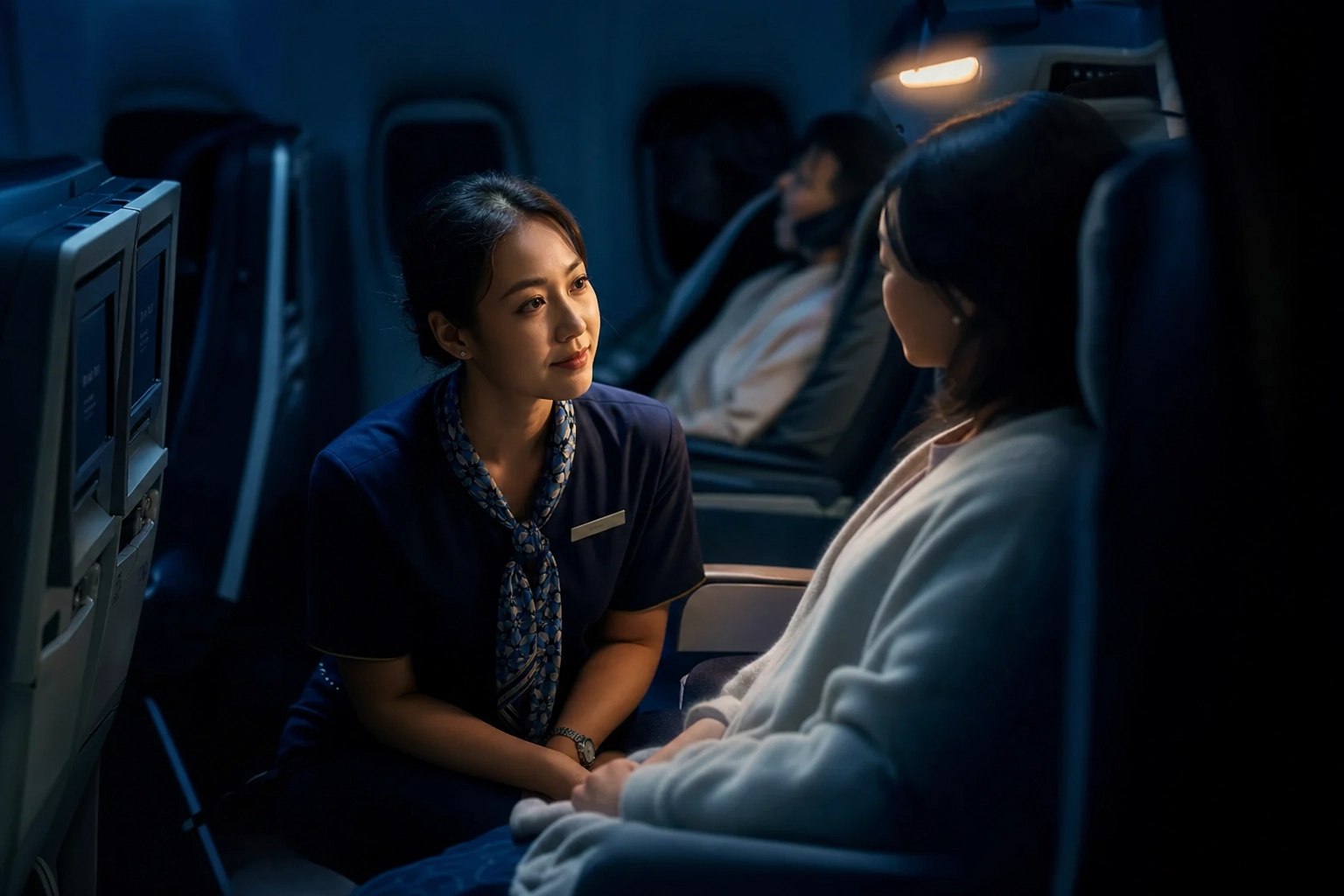
Some of the hardest English you'll use isn't in any textbook: calming an angry passenger, or telling someone they've had enough to drink. The goal is always to de-escalate — lower the temperature, don't win the argument.
De-escalation language that works:
- "I understand this is frustrating, and I want to help."
- "I hear you. Let's see what we can do together."
- "I'm sorry this has happened. Here's what I can do…"
- Lower your own voice; it tends to pull theirs down too.
Refusing more alcohol (a situation every crew faces): "I'm sorry, sir, but I'm not able to serve you any more alcohol on this flight. Can I bring you some water or a soft drink instead?"
Say it calmly, once, and don't bargain. If a passenger won't comply with a safety instruction — refusing to fasten a seatbelt, or smoking in the lavatory — stay firm and polite:
- "For everyone's safety, I do need you to fasten your seatbelt now, thank you."
- "I have to ask you to return to your seat."
- "This is an instruction from the captain, and I need you to follow it."
It helps to know the stakes: in most countries, disrupting a flight or interfering with crew is a criminal offence, and crew are legally entitled to refuse alcohol service. You'll rarely need to say this aloud, but the quiet authority it gives you shows in your voice. What to avoid: barking commands, sarcasm, arguing, or going toe-to-toe. Firm and polite beats loud and angry every time.
Cultural Sensitivity on International Routes
On a single long-haul flight you might serve passengers from a dozen countries. You don't need to be multilingual — English is the operational standard, especially for anything safety-related — but a few warm words in a passenger's own language build instant rapport. On Asian and Gulf carriers, baseline phrases in several languages are a genuine hiring advantage.
| Language | Hello | Welcome | Thank you | You're welcome |
|---|---|---|---|---|
| Mandarin | Nǐ hǎo | Huānyíng | Xièxie | Bù kèqì |
| Japanese | Konnichiwa | Yōkoso | Arigatō gozaimasu | Dō itashimashite |
| Korean | Annyeonghaseyo | Hwanyeong-hamnida | Gamsahamnida | Cheonmaneyo |
| Arabic | Marhaba | Ahlan wa sahlan | Shukran | Afwan |
| Spanish | Hola | Bienvenido/a | Gracias | De nada |
| French | Bonjour | Bienvenue | Merci | De rien |
Beyond words, cultural awareness is about small courtesies: using titles and surnames where formality is expected, being mindful of dietary and religious needs (halal and kosher meals, fasting during Ramadan), respecting personal space, and remembering that gestures don't always translate — a thumbs-up or a beckoning finger is considered rude in some cultures. When in doubt, default to warm, formal, and clear.
ICAO Aviation English & Level 4: What Crew Really Need
If you research this career for more than five minutes, you'll meet the phrase aviation English and the number ICAO Level 4. Here's what they actually mean — stated accurately, because a lot of websites get this wrong.
ICAO (the International Civil Aviation Organization, a United Nations agency) sets global language proficiency requirements so that crews and controllers from different countries can understand each other. Proficiency is measured on a six-level scale:
| Level | Name |
|---|---|
| 1 | Pre-elementary |
| 2 | Elementary |
| 3 | Pre-operational |
| 4 | Operational (minimum) |
| 5 | Extended |
| 6 | Expert |
You're rated in six skills — pronunciation, structure (grammar), vocabulary, fluency, comprehension, and interaction — and here's the key part: your overall result is the lowest of the six, not an average. Strong vocabulary won't rescue weak comprehension. Just as importantly, the rating scale rewards intelligibility, not a "perfect" accent — you don't need to sound American or British, only to be clearly understood.
One honest clarification that most guides skip: ICAO Level 4 is formally mandated for pilots and air traffic controllers who use the radio on international flights. Cabin crew aren't licensed under that exact rule. In practice, though, airlines set their own English standards for crew, and more and more of them benchmark to — or directly require — ICAO Level 4. Ryanair, for example, now requires new cabin crew to reach ICAO English Level 4 during training, and many Asian and Gulf carriers run their own Aviation English assessment as part of a flight attendant English test. If you're unsure where you stand, it's worth taking the time to assess your English level before you apply.
There's also recurrent training to plan for. An ICAO Level 4 rating typically has to be re-tested every three years (Level 5 every six years; Level 6 is usually permanent). That's why English isn't a one-time hurdle for crew — it's an ongoing part of the job, which is exactly why a sustainable practice habit matters.
How to Practise Cabin Crew English (Without a Partner)

Here's the problem with vocabulary lists: you can't memorise your way to fluency under pressure. You don't rise to the occasion — you fall back on what you've rehearsed. And you can't exactly book a real drunk passenger or a medical emergency to practise with.
The fix is roleplay: saying the real scenarios out loud, again and again, until the words come automatically. The most useful drills for crew are:
- A boarding-door greeting and a tricky oversized-bag conversation
- The full safety demonstration, timed, without notes
- A turbulence PA and a delay PA, focusing on clear numbers
- Refusing more alcohol to a persistent passenger
- An "is there a doctor on board?" call and the basic triage questions
- Common interview questions ("Tell me about a time you handled a difficult customer")
This is exactly where an AI speaking partner helps. With Practice Me, you have real-time voice conversations with AI tutors — in American or British accents — that can play the passenger, the angry traveller, or the interviewer, so you can rehearse these exact moments. It's judgment-free and available 24/7, it remembers you across sessions so it can build on your weak spots, and it lets you fail safely a hundred times before you ever do it for real. Our library of English roleplay scenarios is a good place to start, and you can see plans on the Practice Me Pro pricing page.
A simple weekly routine: pick two scenarios, run each one three times, and record yourself once. Listen back specifically for the safety-critical words and the numbers. If a nervous voice is your real obstacle, work through our speaking-confidence checklist alongside the drills.
Do that for a few weeks and the phrases in this guide stop being something you read and become something you say — which is the whole job.
Frequently Asked Questions
What level of English do flight attendants need?
Most international airlines expect a strong upper-intermediate to advanced level — broadly equivalent to ICAO Level 4 ("Operational") or higher, or roughly CEFR B2. In plain terms, you should be able to understand fast spoken English in a range of accents, deliver announcements clearly, and handle an unexpected situation (a complaint, a medical event, an angry passenger) without freezing. Fluency and clarity matter more than a perfect accent.
Do cabin crew need ICAO Level 4 or an aviation English certificate?
Strictly speaking, the ICAO Level 4 licence requirement applies to pilots and air traffic controllers, not cabin crew. However, airlines set their own English standards for flight attendants, and many now require or benchmark to ICAO Level 4 — Ryanair, for instance, requires new crew to reach Level 4 during training. Plenty of carriers run their own English assessment instead of issuing a formal certificate. The bottom line: you may not need a certificate, but you will be tested.
What English phrases do flight attendants use most?
The high-frequency ones are greetings ("Welcome aboard," "May I see your boarding pass?"), service phrases ("Would you care for something to drink?", "Chicken or pasta?"), the safety demonstration (seatbelt, oxygen mask, life vest, brace position), and problem-handling lines ("I'm sorry for the inconvenience, let me see what I can do"). Master those four groups of cabin crew English phrases and you can handle the vast majority of a normal flight.
How can I practise cabin crew English for an interview by myself?
Roleplay out loud. Pick real scenarios — a boarding greeting, a difficult passenger, "tell me about a time you solved a problem" — and rehearse them until they're automatic. Recording yourself, or practising with an AI tutor that plays the passenger or interviewer, gives you realistic, judgment-free repetition you can't get from a textbook. Focus on speaking clearly and calmly rather than memorising scripts word-for-word.
Which languages besides English help you get hired as cabin crew?
After English, the most valuable languages depend on the airline's routes. Mandarin Chinese, Arabic, Spanish, Japanese, Korean, French, German, and Hindi are all prized, because they map to the world's busiest travel markets. You don't need full fluency for a hiring edge — even confident greetings and courtesy phrases ("hello," "welcome," "thank you") in several languages signal that you can make international passengers feel at home.
How do flight attendants handle a drunk or angry passenger in English?
By de-escalating, not arguing. Lower your voice, acknowledge the feeling ("I understand this is frustrating"), and offer a clear choice or boundary ("I'm not able to serve you any more alcohol, but I can bring you water"). Stay calm, say it once, and don't bargain. Crew are trained — and legally entitled — to refuse alcohol service and to escalate if a passenger won't comply, but the first tool is always a calm, polite, firm tone.
The cabin is one of the most demanding English environments there is — warm one minute, safety-critical the next. But mastering English for flight attendants is entirely learnable, and the crews who sound effortless got there by rehearsing until it became second nature. Pick one scenario, say it out loud, and start today.