Duolingo taught you words. No one taught you to speak.
PracticeMe: real voice conversations with an AI tutor, 24/7.
English at the Airport: Phrases & Practice Guide
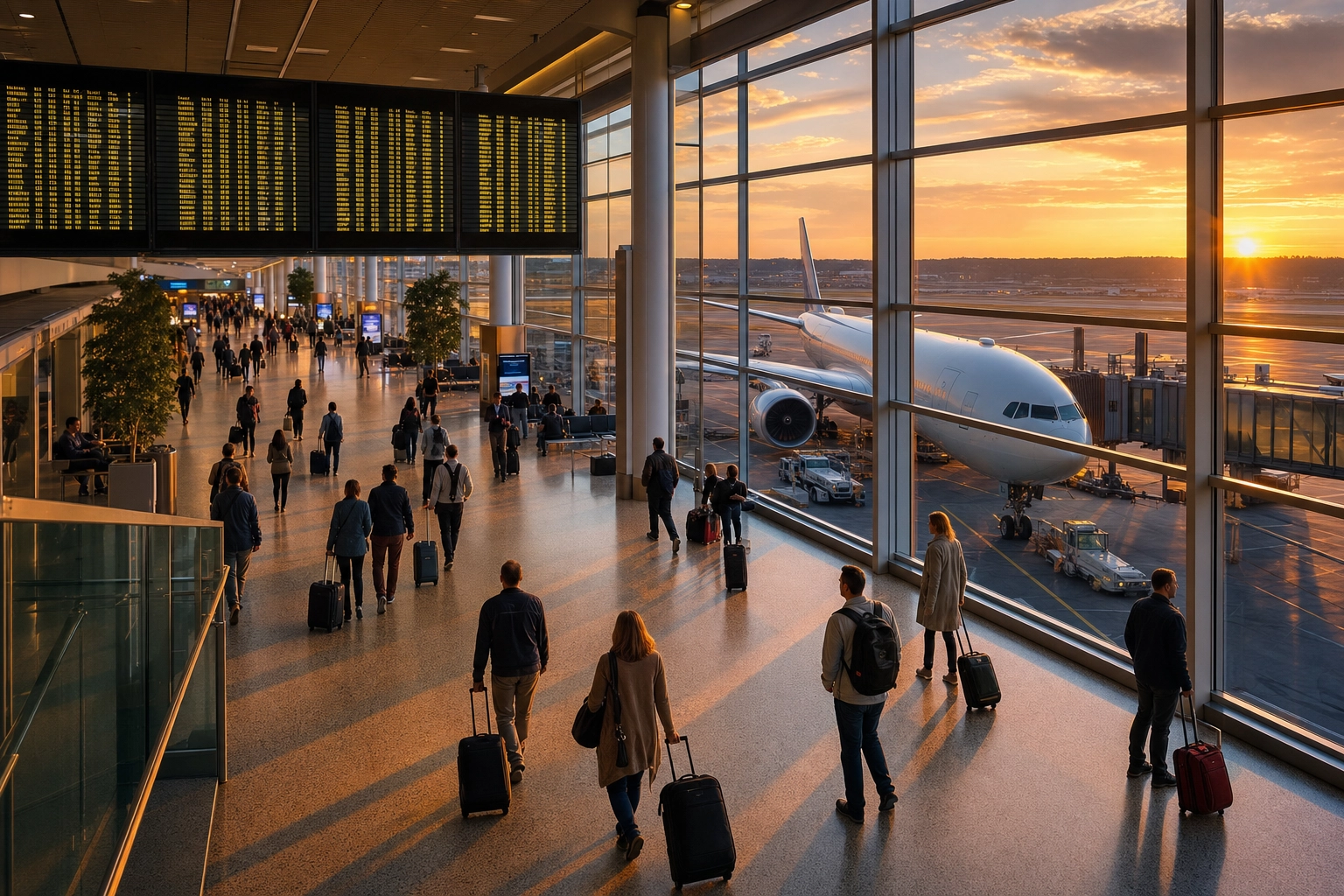
You've practiced English for months. You can hold a conversation about your job, your weekend, your favorite food. Then you land at JFK at 5am, an immigration officer barks something at you in a thick New York accent, and your mind goes completely blank.
This guide to English at the airport is built for that exact moment.
Below, you'll find every English interaction you'll have at an airport — from the check-in counter to the customs hall — with real phrases, full dialogue scripts you can rehearse out loud, and exactly what to say when you don't understand the officer in front of you.
Quick Summary: English at the airport is a high-stakes, formal, fast-paced version of the English you already know. The trick isn't more vocabulary — it's knowing the 8 stages, the 40 phrases that cover 90% of interactions, and the one clarifying phrase that fixes everything else: "Could you say that more slowly, please?" Rehearse the six dialogue scripts in this guide out loud (ideally with an AI partner) and you'll walk through any international airport without freezing.
Why English at the Airport Feels So Hard (Even at Intermediate Level)
Here's the honest truth: airport English isn't harder than the English you already speak. It just stacks every difficulty on top of every other difficulty, and gives you ninety seconds to respond.
In a normal conversation with a friend, you have time. You can pause. You can rephrase. If you don't catch a word, you ask, and nobody judges you.
At an airport, you have:
- Fast speech. Agents repeat the same script hundreds of times a day. By 2pm they're saying "Areyoucheckinganybags?" as one word.
- Heavy accents. A Texan TSA officer, a Scottish gate agent, and a Filipino flight attendant all speak English — but not the English in your textbook.
- Formal vocabulary. "Property Irregularity Report" is not in any beginner course.
- Intercom audio. Garbled, echoing, often half-volume, half-buzz.
- Time pressure. A line of fifty people behind you. A flight leaving in forty minutes. Every second of hesitation feels longer than it really is.
- Jet lag and adrenaline. Your brain at 3am after a red-eye is not your best brain.
Most travel English courses teach you vocabulary lists — carousel, jet bridge, customs declaration — and stop there. Knowing the words isn't enough. You need to have said the phrases out loud, under pressure, until they come without thinking. That's why this guide to English at the airport is built around dialogue scripts you can rehearse, not lists you can memorize.
Your Airport Journey: Eight Stages Where You'll Need English
A typical international trip puts you in eight English-speaking situations on your way to and from the plane, in this order:
- Check-in counter — confirming your flight, checking bags, choosing a seat (5–10 minutes of speaking)
- Bag drop / oversize counter — only if you have heavy or oversized luggage (1–3 minutes)
- Security checkpoint — TSA or local equivalent, often very brief commands (1–2 minutes)
- Boarding gate — listening to announcements, asking the gate agent questions (variable)
- On the plane — flight attendants, your seat neighbors, meal service (multiple short exchanges)
- Immigration / passport control — at the arrival airport, formal interview (2–5 minutes)
- Customs — sometimes just a green/red channel, sometimes an interview (1–10 minutes)
- Baggage claim — usually silent, but problems land you at the lost luggage desk
Each stage has its own vocabulary, its own scripts, and its own anxiety triggers. Let's walk through them.
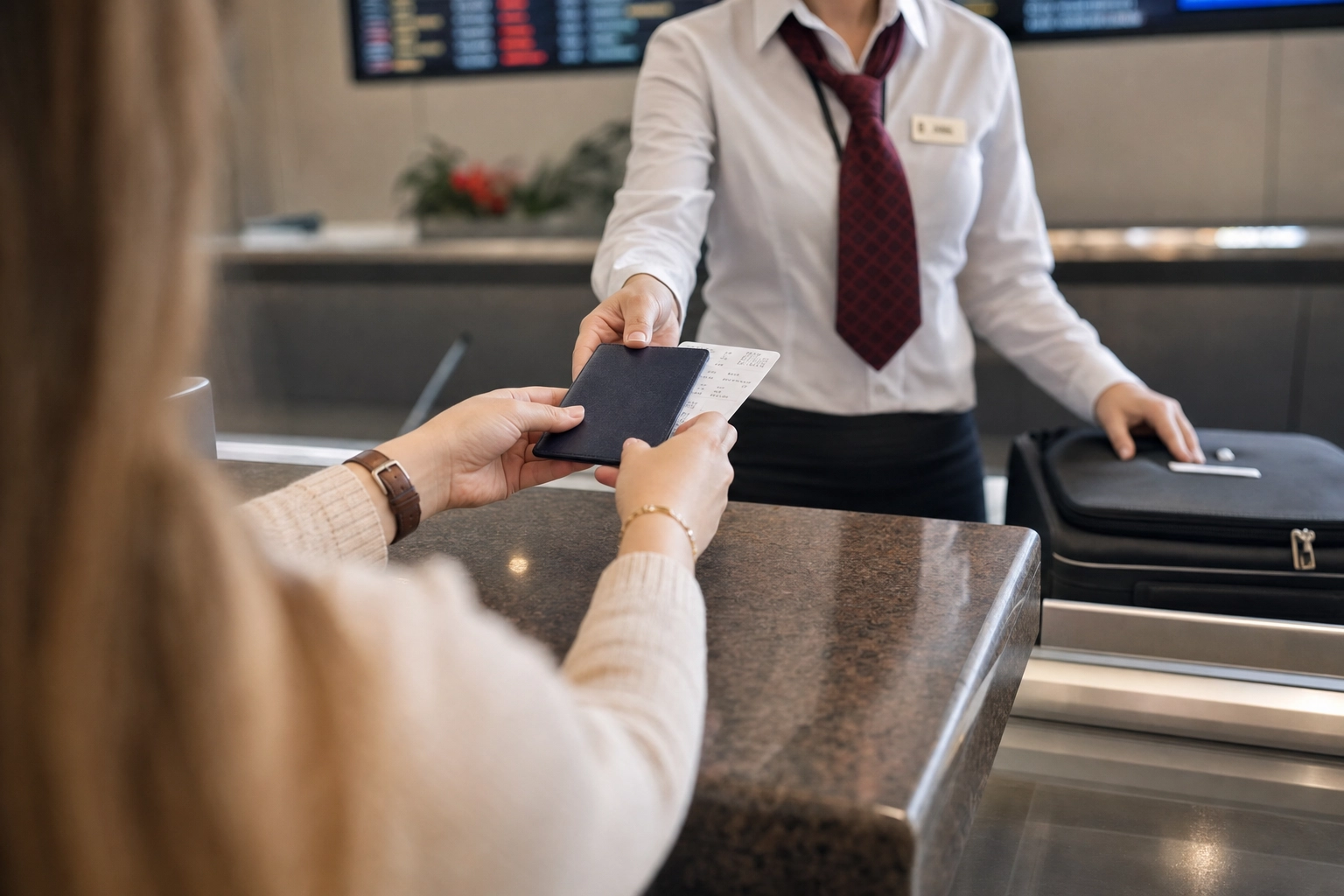
Stage 1: At the Check-In Counter
The check-in agent works through a fixed mental checklist. If you know the checklist, you can answer in your sleep.
What the agent will ask (in some order):
- "Where are you flying today?" or "What's your final destination?"
- "May I see your passport, please?"
- "Are you checking any bags?"
- "How many bags are you checking?"
- "Please place your bag on the scale."
- "Would you prefer a window or aisle seat?"
- "Did you pack the bag yourself?"
- "Has anyone given you anything to carry?"
What you say back:
- "I'm flying to São Paulo, with a layover in Madrid."
- "Here you go." (when handing over passport — sounds more natural than "here it is")
- "Just one to check, and one carry-on."
- "Window, please." or "An aisle seat, if possible."
- "Yes, I packed it myself." / "No, nobody has given me anything."
Questions you can ask:
- "Could I have an aisle seat near the front?"
- "Is there an extra-legroom seat available?"
- "How much does it weigh?" (if you're worried about the weight limit on your luggage)
- "Is there a fee for overweight luggage?"
- "Will my bag go straight through to my final destination, or do I need to collect it on the layover?"
- "What gate does it leave from, and what time is boarding?"
The weight problem. Most airlines allow 23kg (50 lbs) for one checked bag in economy. Over that, you'll typically pay a hefty overweight fee, or you can repack your luggage at the counter. If your bag is over, the agent will say something like "You're four kilos over" — at which point your best phrase is: "Could I move some things to my carry-on?" They'll let you.
Upgrade requests. Asking for a free upgrade rarely works in 2026, but it costs nothing to be polite: "If there's any chance of an upgrade today, I'd really appreciate being considered. Otherwise, no problem." Don't push it if they say no.
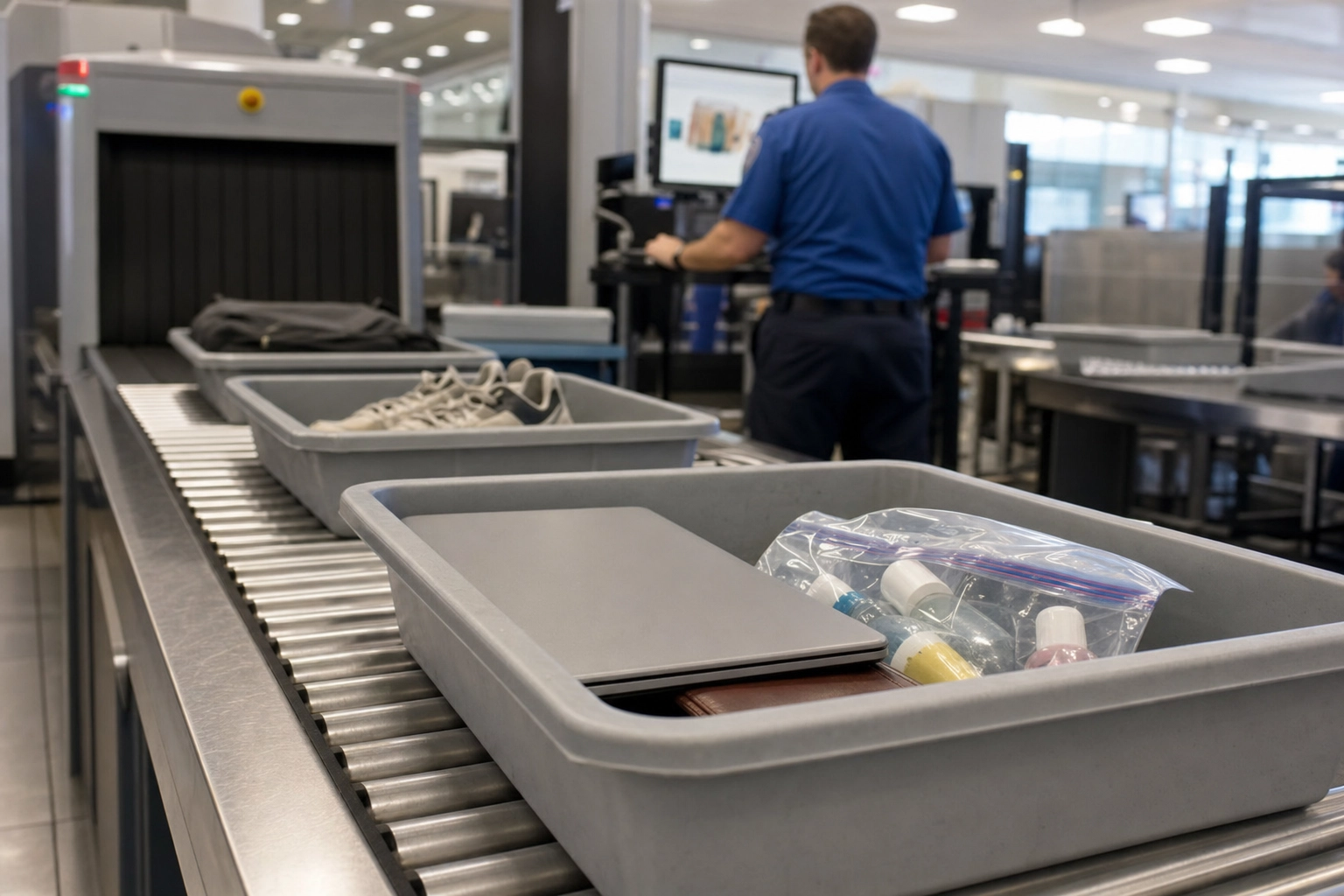
Stage 2: Security Checkpoint English
Security is where English at the airport gets brutally short. Officers give commands, not requests. Listen for verbs.
Commands you'll hear:
- "Boarding pass and ID, please."
- "Place your bag on the belt."
- "Take out your laptop." / "Laptops in a separate bin."
- "Liquids out, please."
- "Empty your pockets."
- "Take off your belt / jacket / shoes."
- "Step through the scanner."
- "Arms above your head." / "Arms out to the sides."
- "Step to the side, please." (this means you've been selected for extra screening — stay calm)
The 3-1-1 rule (still in effect in 2026 in the US):
- 3.4 ounces / 100ml per liquid container
- 1 quart-sized clear bag to hold them all
- 1 bag per passenger
That means your shampoo, contact solution, perfume, drinks — all under 100ml, all visible in one clear bag, pulled out of your carry-on for screening. Larger amounts go in your checked luggage.
The shoes rule changed. In July 2025, the TSA officially ended the mandatory shoe-removal policy for all passengers in the US. Most airports no longer require it. However: if the metal detector beeps, if your boarding pass has the "SSSS" mark for extra screening, or if you're flying outside the US, you may still be asked. Just have your shoes easy to slip on and off.
If the scanner beeps:
- "Could you step back and try again?"
- "Do you have anything else in your pockets? Keys, coins, phone?"
- "I'll need to pat you down — is that okay?"
Your phrases:
- "I have a laptop / tablet / camera — should I take it out?"
- "I have medication / a medical device in my bag."
- "Could you repeat that, please?"
- "Sorry, I don't understand — could you show me?"
⚠️ The one rule that overrides everything else: Never, ever joke about bombs, weapons, drugs, or anything dangerous at security. Even in your home country, even in a friendly tone, even with a smile. TSA officers and their counterparts worldwide are trained to take every statement literally. You can miss your flight, be detained, or be banned from flying for what you thought was a joke.
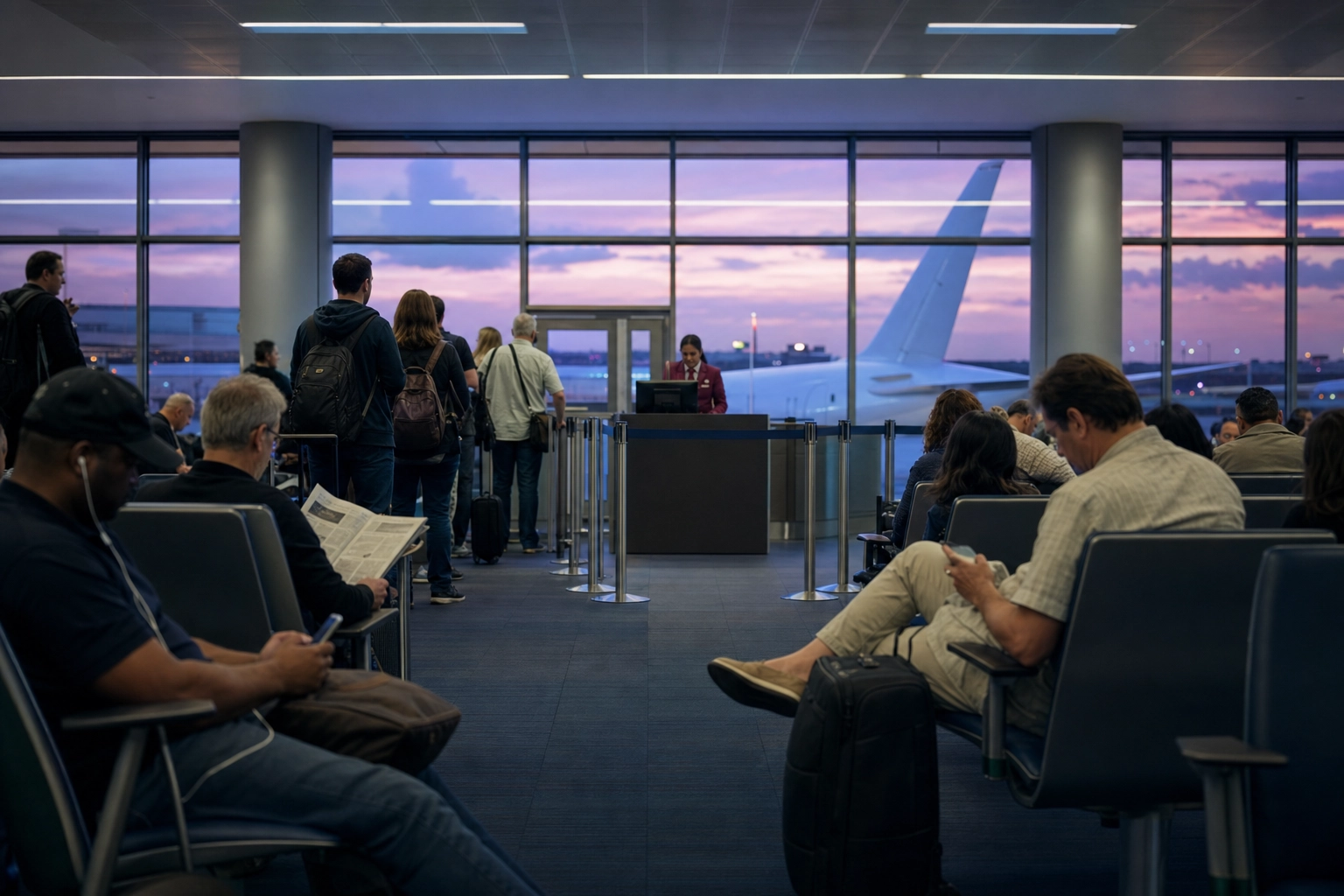
Stage 3: Boarding Gate Phrases & Announcements
The gate is where airport English becomes a listening test. You'll spend an hour sitting next to a speaker, and at some point your flight number will come on with critical information.
Announcements you need to catch:
- "Flight 778 to Tokyo is now boarding at Gate 22B." — boarding has started, head to the gate
- "There has been a gate change. Flight 442 to Paris will now depart from Gate 15." — move now
- "Flight 119 to Chicago has been delayed. New departure time is 4:45 PM." — you have more time
- "We're now boarding Group 3." — only your group, look at your boarding pass
- "This is the final boarding call for Mr. and Mrs. Chen on Flight 311." — if that's you, sprint
- "Passenger Ahmed Khan, please report to the gate immediately." — go to the desk
- "We're looking for volunteers to take a later flight." — they're overbooked; you might get compensation
The trick to understanding announcements: Don't try to understand every word. Listen for your flight number, your gate number, and action words (boarding, delayed, cancelled, final call, gate change, paging).
Boarding groups, decoded:
- Pre-boarding — passengers needing assistance, families with small children
- Priority / Group 1 — first class, business class, top-tier frequent flyers
- Groups 2–6 — economy passengers, usually by seat row (back of plane first)
- General boarding — anyone left
Phrases for the gate agent:
- "Excuse me, has the gate for Flight 778 changed?"
- "Is the flight on time?"
- "I'm in Group 4 — has that group started boarding yet?"
- "Could you put me on the standby list for the earlier flight?"
- "My connection is tight — is there any way to board the plane earlier?"
- "I think I missed my group — can I still board?"
Standby means you don't have a confirmed seat on a plane — you wait at the gate, and if someone doesn't show up, you take their spot. Useful when you've missed an earlier flight or want to fly home sooner.
Stage 4: On the Plane — Talking to Crew and Neighbors
Once you're in your seat, the speaking pressure drops dramatically. Most in-flight English is short, polite, and predictable.
Cabin vocabulary worth knowing:
- Seatbelt / belt — buckle it whenever the light is on
- Tray table — the small table that folds down from the seat in front
- Overhead bin / compartment — luggage storage above your head
- Aisle — the walkway between rows
- Window / middle / aisle seat — the three positions
- Galley — the kitchen area where attendants prepare food
- Lavatory — bathroom (the formal word you'll hear on planes)
- Recline — to lean your seat back
What flight attendants ask:
- "Chicken or pasta?"
- "Anything to drink?"
- "Are you finished with this?"
- "Could you put your seat upright for landing?"
- "Could you stow that under the seat in front of you?"
How to respond:
- "I'll have the chicken, please."
- "Just water, no ice."
- "Yes, please, you can take it."
- "Sure, no problem."
Polite requests during the flight:
- "Could I have a blanket / pillow / pair of headphones?"
- "Could I get a glass of water when you have a moment?"
- "I'd like to order another drink — what do you have?"
- "Could I have a customs declaration form, please?" (some flights still hand these out before landing)
- "I'm a little cold — could you turn down the air?"
- "Excuse me, I think this is my seat." (when someone is in it)
To your seat neighbor on the plane:
- "Excuse me, could I get past?" (to use the bathroom)
- "Sorry, would you mind if I switched seats with you? My partner is two rows back."
- "Are you using this armrest?"
If the flight has a meal in English and you'll need to talk through it more, our companion guide on ordering food in English covers cabin menus, dietary requests, and what to say when the food cart is two rows away.
Stage 5: Immigration Interview Questions
This is where most ESL travelers feel the worst anxiety — and it's almost completely unfounded. Immigration officers ask the same four or five questions to every passenger. Memorize your answers and you'll pass through in 90 seconds.
The four core questions:
- "What's the purpose of your visit?" — Why are you here?
- "How long will you be staying?" — Duration
- "Where will you be staying?" — Address / hotel
- "What do you do for work?" — Your job back home
Sample answers — keep them short:
| Question | Tourist | Business | Student | Visiting family |
|---|---|---|---|---|
| Purpose? | "Tourism." / "I'm here on vacation." | "Business meetings." | "I'm starting a master's program at [university]." | "I'm visiting my brother." |
| How long? | "Ten days." | "Three days." | "Two years — until June 2028." | "Three weeks." |
| Where staying? | "The Hilton in midtown." | "The Marriott near the conference center." | "Student housing at [university]." | "With my brother in Brooklyn." |
| Occupation? | "I'm a software engineer." | "I work in marketing for [company]." | "Currently a student." | "I'm a nurse." |
Common follow-up questions:
- "Do you have a return ticket?" — Yes, show it on your phone.
- "How much money do you have with you?" — Have a rough number ready in the local currency.
- "Who is your host?" / "What's their address?" — Have this written down or in your phone.
- "Have you been to this country before?" — Yes or no, and roughly when.
- "Are you traveling alone?" — Simple yes or no.
- "What's your employer's name?" — Just the company name.
What raises red flags:
- Vague answers. "I'm just going to travel around" is worse than "I'll spend four days in New York and three days in Boston."
- Contradicting your visa. If you have a tourist visa, never mention "work meetings" — say "client visits" or "industry conference" if relevant.
- Memorized robot-style delivery. Practice answers should sound like your English — not a script.
- Volunteering extra information. Answer the question asked. Don't explain.
The honesty rule: Lying to an immigration officer is a crime in most countries. If the truthful answer is complicated, give it anyway — "I'm visiting my partner; we've been together for two years" is better than inventing a fake hotel.
Stage 6: Customs Declaration
Customs is technically separate from immigration. Immigration controls people entering the country; customs controls stuff. After you get your passport stamped, you collect your luggage and walk through customs — sometimes silently, sometimes with an interview.
The famous question:
- "Do you have anything to declare?"
Most travelers answer "No" — and that's fine, as long as it's true. Here's what triggers a "yes":
Items you must always declare (US/UK/most countries):
- Cash over the declaration threshold (around ten thousand dollars in the US, a similar amount in pounds in the UK, or the local equivalent) — not illegal, just must be declared
- Fresh food, meat, dairy, fruit, vegetables, seeds, plants — agricultural rules are strict
- Alcohol over the duty-free limit — typically 1 liter for adults entering the US
- Tobacco over the limit — typically 200 cigarettes
- Gifts and purchases over the duty-free allowance — there's a set allowance for US residents returning home
- Medications, especially controlled substances (bring a prescription)
- Anything commercial — if you're carrying samples for work
Phrases for customs:
- "I have nothing to declare."
- "Yes, I have some food — tea and chocolate, for personal use."
- "These are gifts for my family."
- "I'm carrying [$X / £X] in cash."
- "Yes, I have medication — here's my prescription."
- "I declared everything on the form."
If asked to open your luggage: Stay calm, unlock it, step back, and let them work. Don't reach into the bag yourself unless asked. If they find something you didn't declare, the penalty is usually a fine plus duty — not a criminal charge — as long as you cooperate.
The food question. "Have you been on a farm in the last 14 days?" — common in the US, Australia, and New Zealand, where biosecurity is taken seriously. Answer honestly. If yes, you may need to have your shoes and luggage inspected.
Stage 7: Lost Baggage at the Carousel
You stand at the carousel. Bags keep coming. People around you grab theirs and leave. The belt empties. Your luggage is not there.
Where to go: The airline's baggage service desk (sometimes called lost luggage or baggage claims) is located near the carousels — usually within sight of where you're standing.
Bring with you:
- Your boarding pass
- Your baggage claim tag (the sticker the check-in agent gave you, usually attached to your boarding pass or printed on a receipt)
- A photo of your bag if you have one (take one before every flight from now on)
- Your destination address (hotel, friend's place) for delivery
Opening lines:
- "Hi — my bag didn't come out on Carousel 5. I just flew in from Doha on Flight QR-720."
- "Excuse me, I need to file a missing baggage report."
Describing your luggage:
- "It's a medium-sized hard-shell suitcase."
- "Black, with a bright red ribbon on the handle."
- "Around 23 kilos."
- "Samsonite, four wheels, with a TSA lock."
- "There's a luggage tag with my name and phone number on it."
Questions to ask the agent:
- "Has any luggage from this flight not made it onto the carousel?"
- "Where do you think it is now?"
- "Can you deliver it to my hotel when it arrives?"
- "What's my Property Irregularity Report number?"
- "Can I track it online?"
- "I have no clothes — am I entitled to an essentials reimbursement?"
The Property Irregularity Report (PIR) is the official document the airline files when your luggage doesn't arrive. You'll get a reference number — guard it. You'll need it for tracking, hotel delivery, insurance claims, and any compensation.
The 21-day rule: Most international airlines consider a bag "officially lost" after 21 days. Up until then, it's "delayed." For delays over 24 hours, most airlines reimburse essentials (clothes, toiletries) — usually a set daily amount, with receipts.
Stage 8: Missed Connection or Missed Flight
You land. Your inbound flight was late. By the time you sprint to your connecting gate, the door is closed. Now what?
The first decision: where to go.
- If you've just missed your connection and you have the same airline, go to the nearest customer service desk or rebooking counter — usually marked clearly, often near the gate.
- If you missed your flight because you arrived late at the airport, find the airline's main check-in or customer service desk in the terminal.
- Do not go back through security unless told to. The agent will route you correctly.
The crucial distinction: one ticket or two?
- One ticket (same booking, all flights): The airline is responsible. They will rebook you on the next available flight at no cost. If the delay is overnight, they'll typically provide a hotel and meal vouchers.
- Separate tickets: Even if both are the same airline, they have no obligation. You'll likely pay to rebook. This is why travel agents tell you to always book connections on a single ticket.
What to say (calm, polite, prepared):
- "Hi — I just missed my connection. My inbound flight from Munich was delayed by two hours, and the door had already closed when I got to Gate 22."
- "I'd like to be rebooked on the next available flight, please."
- "Is there an earlier option, or could you put me on standby?"
- "If I have to overnight here, will the airline cover a hotel?"
- "What about my checked luggage — where does it go?"
The phrases that make a difference:
- "What are my options?" — Open question, lets the agent help proactively.
- "I'd really appreciate your help." — Acknowledges they have discretion.
- "Is there anything else you can do?" — When the first offer isn't great, polite escalation.
What not to do: Don't shout. Don't blame the agent. Don't say "This is unacceptable." Gate agents have enormous discretion to bend rules for polite passengers and zero patience for hostile ones. Practicing exactly how to stay calm under pressure is one of the most valuable things you can do before traveling — see our guide to 10 English role play scenarios for more high-stakes practice situations.
Duolingo taught you words. No one taught you to speak.
PracticeMe: real voice conversations with an AI tutor, 24/7.
What to Say When You Don't Understand the Officer
This is the single most important section of this guide to English at the airport.
Most ESL travelers fail at airports not because they don't know enough English — but because they pretend to understand when they don't. They nod, they say "yes," they smile, and then they walk away having agreed to something they didn't catch.
The fix is one phrase:
"I'm sorry, could you say that more slowly, please?"
Airport staff hear this every day. They will not be offended. They will not think less of you. They will simply repeat themselves, slower and clearer.
Variations that work:
- "Could you repeat that, please?"
- "Sorry, I didn't catch that."
- "Could you speak a little more slowly? My English isn't perfect."
- "Could you say that one more time?"
- "Could you write it down?" (useful for gate numbers, times, money amounts)
Confirming what you heard:
- "So you said Gate 22B, departing at 4:30 — is that right?"
- "Just to confirm — I need to go to the customer service desk in Terminal 2?"
- "You said boarding closes at 4:00, correct?"
At immigration specifically: If the officer's accent or pace is genuinely beyond what you can follow, you have the legal right in most countries to request an interpreter. Phrasing: "I'm having trouble understanding. Could I speak with an interpreter in [your language], please?" Major international airports (JFK, LAX, Heathrow, Frankfurt, Singapore, Tokyo Haneda) have multilingual staff or phone-based interpretation services on call.
The pretending-to-understand trap, with real consequences:
- At security: Nodding "yes" when asked "Have you packed any liquids over 100ml?" — when you have — gets your bag pulled apart.
- At immigration: Nodding "yes" when asked "Are you here to work?" — when you're on a tourist visa — can end your trip immediately.
- At customs: Nodding "no" when asked about food — when you're carrying it — leads to fines.
When in doubt: ask. It's always cheaper than guessing.
Six Full Airport Dialogue Scripts to Practice Out Loud
The scripts below are designed for active practice, not reading. Here's how to use them:
- Read it once silently to understand the situation.
- Read it out loud, playing both parts. Slow first, then at natural speed.
- Cover the passenger lines and say them from memory while the officer/agent lines are visible. Then swap.
- Run the scenario again, changing the details (different destination, different bag, different problem). This is where real fluency builds.
If you have a practice partner, take turns. If you don't, an AI conversation partner can play the agent role with American or British accents — covered in more detail at the end of this guide.
Dialogue 1: Check-In Counter — Window Seat and an Overweight Bag
Setting: International check-in at Heathrow. You're flying to Toronto with two bags, one carry-on and one to check. You'd prefer a window seat.
Agent: Good morning. Passport, please. Where are you flying today? You: Good morning. I'm flying to Toronto. Here's my passport. Agent: Thank you. Any bags to check? You: Just one. And I have a carry-on. Agent: Place the checked bag on the scale, please. (you put it on the scale) Agent: That's 26 kilos — you're three kilos over the limit. There's a £40 fee, or you can move some things into your carry-on. You: Could I move a few items into my carry-on instead? Agent: Of course. Just put the bag aside, and come back when you're ready. (you repack and return) Agent: Better. That's 22 kilos — you're fine. Window or aisle today? You: Window, please, if there's anything available. Agent: Let me check… I have 27A, a window seat near the back. Does that work? You: That's perfect, thank you. Agent: Here's your boarding pass. Gate 47, boarding starts at 11:20. Have a good flight. You: Thanks very much.
Practice prompts:
- Replay the dialogue with the agent saying you're five kilos over — what do you say?
- Try requesting an extra-legroom seat instead. How would you phrase it?
- Repeat the gate number and boarding time back to the agent to confirm.
Dialogue 2: Security Checkpoint — Forgot to Take Out the Laptop
Setting: TSA checkpoint at Los Angeles International. You've put your bag through the X-ray, but you forgot your laptop was inside.
Officer: Whose bag is this? You: Mine. Officer: I'm going to need to re-screen it. Do you have a laptop or tablet inside? You: Oh — yes, sorry, I have a laptop. I should have taken it out. Officer: Take it out now and put it in a separate bin. Anything else electronic? Camera? E-reader? You: No, just the laptop. Officer: Any liquids over three-point-four ounces? You: I have a small bottle of contact solution — it's a hundred millilitres. Officer: That's fine, but it needs to be visible in the clear bag. Is it in the clear bag? You: Yes, it is. Officer: Okay. Send the bag through again, then come back through the scanner. (you do it) Officer: You're good. Have a nice day. You: Thank you.
Practice prompts:
- Run the same dialogue, but the officer asks about a power bank (which has a watt-hour limit on planes). How would you ask whether yours is allowed?
- Practice the phrase "I'm sorry, I should have taken it out" — apologetic but not over-apologizing.
- Imagine the officer asks you to step aside for extra screening. What's a calm response?
Dialogue 3: Immigration — Tourist Visit to See Family
Setting: US immigration at Newark Airport. You're a Brazilian tourist visiting your cousin in New Jersey for two weeks.
Officer: Passport, please. What's the purpose of your visit? You: I'm visiting my cousin. Officer: How long will you be staying? You: Two weeks — fourteen days. Officer: Where will you be staying? You: With my cousin in Newark. I have the address here. (show phone) Officer: And what's your cousin's name? You: Lucas Pereira. Officer: Is he a US citizen? You: He's a permanent resident — he has a green card. Officer: What do you do for work back home? You: I'm a dentist in São Paulo. Officer: Do you have a return ticket? You: Yes, here it is. (show phone) I fly home on the 25th. Officer: Welcome to the United States. Enjoy your visit. You: Thank you very much.
Practice prompts:
- Run it again with a hotel stay instead of family. Adjust your answers.
- The officer asks "Have you been to the US before?" — practice both yes and no answers.
- Try this dialogue with a Heathrow officer (British accent) and a JFK officer (American accent). Notice how the vocabulary stays the same but the rhythm differs.
Dialogue 4: Customs — Declaring Food Gifts
Setting: Customs at Sydney Airport. You're Korean, traveling with packaged gifts for your sister-in-law's family.
Officer: Good afternoon. Anything to declare today? You: Yes — I have some food. Tea and packaged snacks, all for my family. Officer: What kind of snacks? Any meat or fresh produce? You: No meat, no fresh fruit. They're packaged seaweed snacks, dried squid, and instant noodles. Officer: The dried squid I'll need to look at. Is it in a sealed package? You: Yes, completely sealed, with a label. Officer: Okay. Step over to the inspection table, please. Have you been on a farm in the last fourteen days? You: No, I haven't. Officer: Are you carrying any cash over ten thousand dollars? You: No, just about five hundred Australian dollars. (inspection of the squid) Officer: This is fine — commercially packaged and labelled. You're good to go. You: Thank you very much.
Practice prompts:
- Replace the food with something you'd actually bring from your country. What's the English name? How would you describe it?
- Practice answering "How long will it be in the country?" if asked about the food.
- Try the dialogue where the officer asks you to throw out one item. How do you respond politely?
Dialogue 5: Lost Baggage Desk
Setting: Doha to London. You've been at Carousel 4 for forty-five minutes. Your bag isn't there.
You: Hi — I'm sorry to bother you. My luggage didn't come out on the carousel. I flew in from Doha on Flight QR-3 this morning. Agent: I can help with that. Do you have your boarding pass and baggage claim tag? You: Yes — here. (hand them over) Agent: Let me look up your file… One moment… It looks like your bag is still in Doha. It didn't make the transfer. You: Oh no. When will it arrive in London? Agent: The next Doha flight lands at 8:45 tonight. If your luggage is on it, we can deliver it to your address by midnight. Where are you staying? You: The Premier Inn near King's Cross. I have the address here. (show phone) Agent: Great, I'll add that to the report. Could you describe the bag for me? You: Medium-sized, hard-shell, navy blue, with a yellow ribbon on the handle. Samsonite brand. Around 21 kilos. Agent: Got it. Here's your Property Irregularity Report — your reference number is QR-LHR-49217. You can track the bag online with this number, or call this hotline. We also reimburse up to fifty pounds for essential items tonight if needed — just keep your receipts. You: Thank you so much. One more question — what if it doesn't arrive tonight? Agent: Then we'll be in touch tomorrow morning by 10am with an update. The bag is almost always found within 24 hours. You: Thanks for your help.
Practice prompts:
- Describe a bag you actually own using five details (size, color, brand, distinguishing feature, what's inside).
- Practice politely asking "What if it's lost permanently?" — this is a real, valid question.
- Try the same dialogue but the agent says they can't deliver to your address. What's your next question?
Dialogue 6: Missed Connection Due to Delay
Setting: Frankfurt to Atlanta to Mexico City. Your Atlanta arrival was delayed by 90 minutes. Your Mexico City flight left without you.
You: Excuse me — I just missed my connecting flight to Mexico City. My inbound from Frankfurt was delayed. Agent: I'm sorry to hear that. May I see your boarding pass? You: Here you go. The Atlanta flight was at 3:15, but I only landed at 4:50. Agent: Let me check the options… The next flight to Mexico City is tomorrow morning at 8:40. There's nothing else tonight, unfortunately. You: Okay. Is there anything earlier as standby? Agent: I can put you on the standby list for the 6am flight, but it's already overbooked. The 8:40 is a confirmed seat. You: Let's go with the confirmed seat. Will the airline cover a hotel? Agent: Yes — since the delay was on us, you're eligible for a hotel voucher and meal vouchers. Here's the hotel near the airport. There's a shuttle every fifteen minutes from the arrivals hall. You: Thank you. And what about my checked luggage? Agent: Your bag is already tagged for Mexico City. It will go on tomorrow's flight with you. Just collect it as normal when you arrive. You: Got it. One last thing — could I please get the meal voucher? Agent: Of course. Here's a fifteen-dollar voucher for tonight and another for breakfast tomorrow. You: Thanks so much for sorting this out.
Practice prompts:
- Practice this dialogue but the rebooking is for two days later. What additional questions would you ask?
- Try the same scenario where you booked the flights on two separate tickets — the rules are different, the conversation tone is different.
- Rehearse the closing line — gratitude actually matters, and agents remember polite passengers.

How to Practice English at the Airport Before Your Flight
Reading dialogues silently doesn't prepare you for speaking. Your mouth needs the workout, not your eyes. Here's what actually works:
The three-step solo method:
- Shadow the script. Play an audio version (record yourself reading it slowly, or use a text-to-speech tool) and try to say each line a half-second after you hear it. This builds rhythm and pronunciation.
- Play one role. Cover the passenger lines. Read the agent's lines aloud, then say the passenger response from memory.
- Improvise. Use the same situation but change the details. Different destination, different bag color, different problem. This is where you stop reciting and start speaking.
Why an AI partner solves the bigger problem. The hard part of English at the airport isn't memorizing — it's responding to unexpected variations at speed. A real check-in agent might say "Sorry, that flight is fully booked in window seats today — I have a middle seat or an aisle. Which would you prefer?" — a curveball you never rehearsed.
That's where Practice Me comes in. The app lets you have real-time voice conversations with AI tutors who can role-play any of the eight airport scenarios above:
- Sarah plays an American check-in agent or TSA officer with a natural New York accent
- Oliver plays a British immigration officer at Heathrow — polite, formal, fast
- Marcus plays a no-nonsense customs officer who asks follow-up questions you didn't prepare for
The tutors remember you across sessions — so you can do a 15-minute "airport prep" each evening for the week before you fly, and each session builds on the last. You can ask the tutor to switch roles, change accents, or make the dialogue harder mid-conversation. Because it's judgment-free, you can fumble through the immigration interview ten times until it's automatic.
A simple practice plan for the week before you travel:
- Day 1: Check-in dialogue (10 minutes)
- Day 2: Security + boarding gate (15 minutes)
- Day 3: On the plane — flight attendant requests (10 minutes)
- Day 4: Immigration interview (15 minutes) — the most important one
- Day 5: Customs declaration (10 minutes)
- Day 6: Lost baggage + missed connection (15 minutes)
- Day 7: Full run-through, end to end (20 minutes)
By day 7, the phrases come without thinking. That's the goal.
Airport English Quick Reference: 40 Phrases You'll Actually Use
Screenshot this section to your phone before you fly. These are the workhorse phrases for English at the airport.
At the check-in counter:
- "I'd like to check in for my flight to [destination]."
- "I have one bag to check and one carry-on."
- "Could I have a window/aisle seat, please?"
- "Will my bag go straight through, or do I collect it on the layover?"
- "Is the flight on time?"
At security: 6. "Should I take my laptop out?" 7. "I have liquids in my carry-on — they're all under 100ml." 8. "I have medication in my bag." 9. "Could you repeat that, please?"
At the gate: 10. "Has the gate changed for Flight [number]?" 11. "Is the flight delayed?" 12. "Could you put me on the standby list?" 13. "I'm in Group [X] — has that started boarding?"
On the plane: 14. "Could I have a blanket / water / pillow?" 15. "I'll have the chicken, please." 16. "Excuse me, could I get past?" 17. "Could I have a customs form?"
At immigration: 18. "Tourism." / "Business." / "Visiting family." 19. "Ten days." / "Two weeks." / "Three months." 20. "Staying at the [hotel name] in [city]." 21. "I'm a [your job] in [country]." 22. "Yes, I have a return ticket — here it is."
At customs: 23. "I have nothing to declare." 24. "Yes, I have some packaged food for personal use." 25. "These are gifts for my family." 26. "I'm carrying about [amount] in cash."
Lost baggage: 27. "My luggage didn't come out on the carousel." 28. "Here's my boarding pass and baggage tag." 29. "It's a [size] [color] [type] bag with [feature]." 30. "Can you deliver it to my hotel?" 31. "What's my reference number?"
Missed connection: 32. "I missed my connecting flight — the inbound was delayed." 33. "What are my options?" 34. "Could you put me on standby for an earlier flight?" 35. "Will the airline cover a hotel?" 36. "What happens to my checked bag?"
Universal lifesavers: 37. "Could you say that more slowly, please?" 38. "So you said [X] — is that right?" 39. "Could you write it down?" 40. "Thank you so much for your help."
Frequently Asked Questions
What level of English do I need to fly internationally on my own?
Roughly A2 (elementary) to B1 (intermediate) on the CEFR scale, depending on the complexity of your trip. A direct flight where everything goes perfectly requires very little spoken English — most signs are visual, and check-in is increasingly self-service. A trip with a layover, an immigration interview, and potentially a lost bag requires comfortable B1. The good news: you don't need fluency for English at the airport — you need the specific 40 phrases above and the confidence to ask for clarification. A few hours of focused practice on airport scenarios can take a nervous A2 speaker through international travel without issues.
Is it rude to ask an immigration officer to repeat the question?
No — it's the smartest thing you can do. Immigration officers prefer a passenger who asks "Could you repeat that?" over one who guesses and gives a contradictory answer. Pretending to understand and saying "yes" when you mean "no" can end a trip very fast. Officers hear millions of non-native English speakers; they expect clarification requests. Stay polite, make eye contact, and ask. "I'm sorry, could you say that one more time?" is the universal lifeline.
What if I really can't understand the officer at all — can I ask for an interpreter?
Yes. At major international airports — JFK, LAX, Heathrow, Schiphol, Frankfurt, Dubai, Singapore, Tokyo Haneda, Sydney — interpretation services are available, either through multilingual staff or a phone-based interpreter. Say: "I'm having trouble understanding. Could I speak with an interpreter in [your language], please?" You may wait a few minutes, but this is your right at most immigration checkpoints. Don't be embarrassed to ask — it's far better than miscommunication on a record that follows your passport.
Should I memorize answers for immigration, or will that sound suspicious?
Memorize the content of your answers — destination, dates, address, occupation — not the exact wording. Robotic word-for-word recitations do raise flags. The goal is to know the facts cold so that even when you're tired and nervous, you can deliver them in natural-sounding English. Practice with different phrasings: "I'll be here for ten days," "About ten days," "Until the 25th" — they all mean the same thing. This is exactly where conversational practice with an AI tutor beats flashcards.
How early should I start practicing airport English before a trip?
One week of 15-minute daily sessions is enough for most learners to feel confident with English at the airport. Two weeks if you've never traveled internationally before. The key is daily practice, not cramming — your speaking muscles need time to absorb the rhythm. Start with the immigration dialogue (most anxiety) and check-in (most frequent), then add the other stages. If you only have one day, focus on the four immigration questions and the clarification phrase. Those alone will carry you.
Do TSA officers in 2026 still make me take off my shoes and laptop?
Shoes: No, in most US airports. The TSA ended its mandatory shoe-removal policy in July 2025 for general lanes, citing improved scanner technology. You may still be asked if the metal detector beeps or if you're selected for enhanced screening (the "SSSS" mark on your boarding pass). Outside the US, policies vary — many international airports still require shoes off. Laptops and electronics: Many newer scanners use CT technology that lets you leave laptops in your bag. Older lanes still require you to take them out. When in doubt, watch what the person ahead of you does, and listen to the officer's instructions when you arrive at the belt.
What's the difference between "customs" and "immigration" at the airport?
Immigration (also called passport control or border control) checks you — your passport, your visa, your right to enter the country. The officer stamps your passport. Customs checks what you're bringing — food, money, gifts, alcohol, anything that needs to be declared or taxed. Customs comes after you've collected your luggage. In some airports (US, Australia), you go through immigration first, get your bags, then walk through customs. In others (parts of Europe), customs is a green/red channel — green if you have nothing to declare, red if you do.
Can I use my phone translator at customs and immigration?
Yes — and many officers are used to it. If your English at the airport fails completely, holding up your phone with a translated question or pointing to a typed response is acceptable at almost every checkpoint. Some best practices: download offline translation packs before you fly (you may not have data), keep your phone in airplane mode but with translator apps cached, and don't try to translate complex legal questions — ask for an interpreter instead. For everyday phrases, a translator app is a perfectly normal traveler tool in 2026.
Start Practicing Airport English Today
You don't need to be fluent to travel confidently — you need to be rehearsed. The forty phrases above, the eight stages, the six dialogue scripts, and the one clarifying question ("Could you say that more slowly, please?") cover everything that 99% of travelers face for English at the airport.
The fastest way to make this real: open Practice Me and start a conversation with Sarah (American) or Oliver (British). Tell the tutor "Let's role-play the immigration interview at JFK" and you're in the scenario in seconds. No appointment, no scheduling, no judgment — just the rehearsal your brain needs before it's the real thing at 5am after a long flight.
Pair this with our broader English for travel guide for non-airport situations (hotels, restaurants, asking for directions), and you're ready for any international trip. If you're flying for work in aviation or hospitality, you'll also want our English for flight attendants and English for hospitality pages.
Three days of free trial. Fifteen minutes a day. By the time you board, the airport will feel like a script you already know.