Duolingo taught you words. No one taught you to speak.
PracticeMe: real voice conversations with an AI tutor, 24/7.
English for Travel: Essential Phrases & Practice Guide
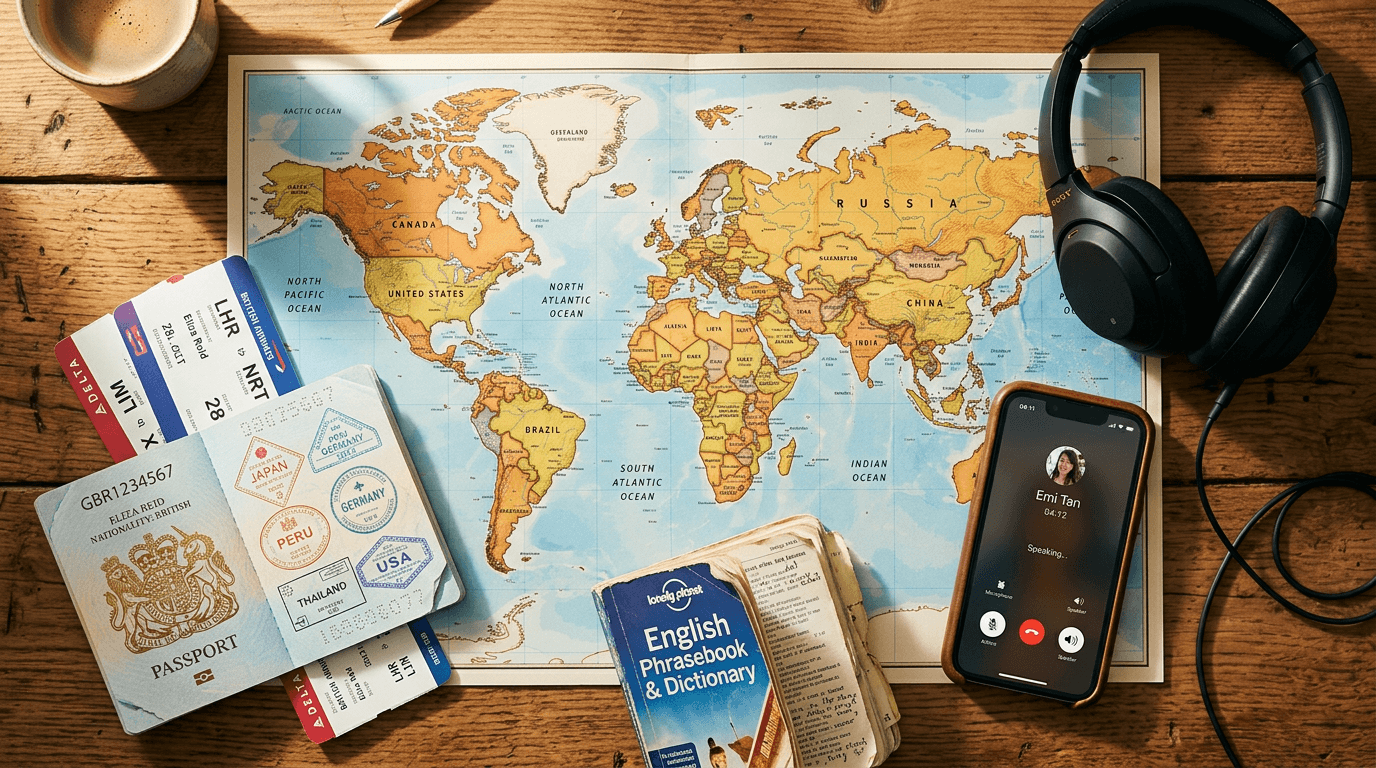
You've booked the flights, packed the bags, and pinned every landmark on Google Maps. But there's one thing no packing list covers: English for travel phrases you can actually say out loud with confidence — not just read off a screen.
That gap between knowing a phrase and actually saying it to a stranger is where most travelers freeze. A phrasebook can't fix that. Speaking practice can.
Quick Summary: This guide covers 70+ essential English for travel phrases organized by real scenarios — airports, hotels, restaurants, directions, shopping, emergencies, and making friends. Each section includes a sample dialogue, cultural tips, and pronunciation priorities. Plus, there's a 14-day pre-travel English practice plan to help you arrive confident instead of nervous.
Why English for Travel Phrases Need Practice, Not Just Reading
Here's what every traveler discovers on day one: reading English travel phrases from your phone screen is not the same as understanding a fast response from a ticket agent.
Travel English isn't about memorizing sentences. It's about training your ear and your mouth to work together in real time. You need to hear "Do you have anything to declare?" and respond naturally — not scroll through a PDF looking for the right words.
English is the world's most widely spoken second language, with over 2 billion speakers across 123 countries. That makes it the lingua franca of airports, hotels, and tourist areas globally. But knowing this doesn't help if you can't speak when it counts.
That's why speaking practice matters more than vocabulary lists. When you rehearse travel conversations out loud — saying the words, hearing a response, learning to ask follow-up questions — you build muscle memory. The phrases become reflexes instead of translations.
With Practice Me, you can simulate these exact travel scenarios with AI tutors who respond in real time — in American or British English. Think of it as a dress rehearsal for your trip, available 24/7 to help you learn and practice whenever you have time.
At the Airport: Check-In, Security & Gates
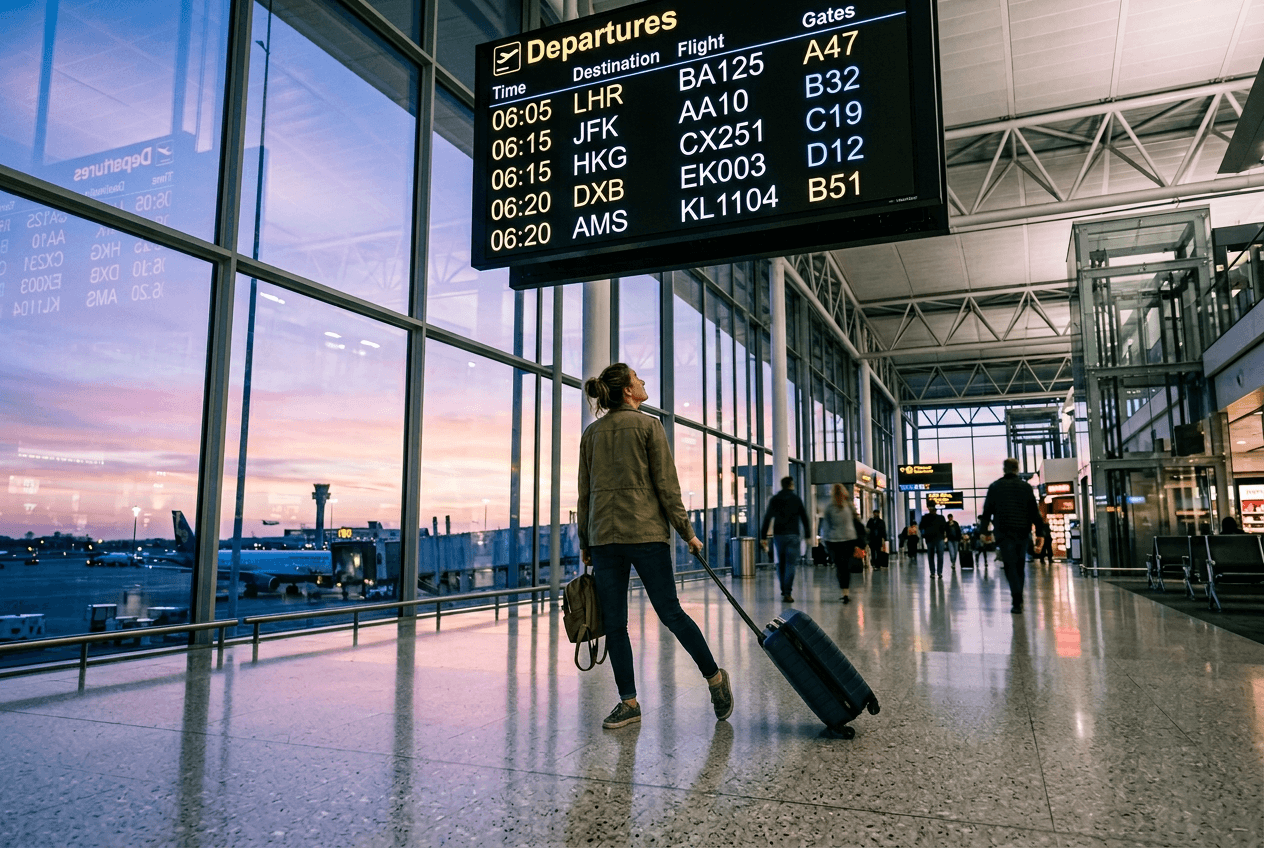
Airports are where travel anxiety hits hardest. Announcements are fast, signs are confusing, and every interaction has a time pressure. These essential English phrases will get you through.
10 Essential Airport Phrases:
- "I'd like to check in for my flight to [city], please."
- "Where is Gate [number]?"
- "Is my flight on time?"
- "I have a connecting flight to [city]."
- "Can I get a window / aisle seat, please?"
- "Where is the baggage claim?"
- "How long is the layover?"
- "I'd like to declare [item]."
- "Where can I find a currency exchange?"
- "Excuse me, which way to passport control?"
🗣️ Sample Dialogue — At the Check-In Counter:
You: Hi, I'd like to check in for my flight to London, please. Agent: Sure. Can I see your passport? You: Here you go. Agent: Would you like a window or aisle seat? You: Aisle, please. And is the flight on time? Agent: Yes, boarding starts at 2:45 at Gate B12. You: Thank you!
Cultural Tip: At security checkpoints in the US and UK, officers expect short, direct answers. Say "business" or "vacation" when they ask your purpose of travel — no need for a long explanation.
Pronunciation Priorities: Practice saying boarding pass (BORD-ing pass), connecting flight (kuh-NEKT-ing flight), and baggage claim (BAG-ij klaym) until they feel automatic.
Hotel Check-In: Getting Settled Smoothly
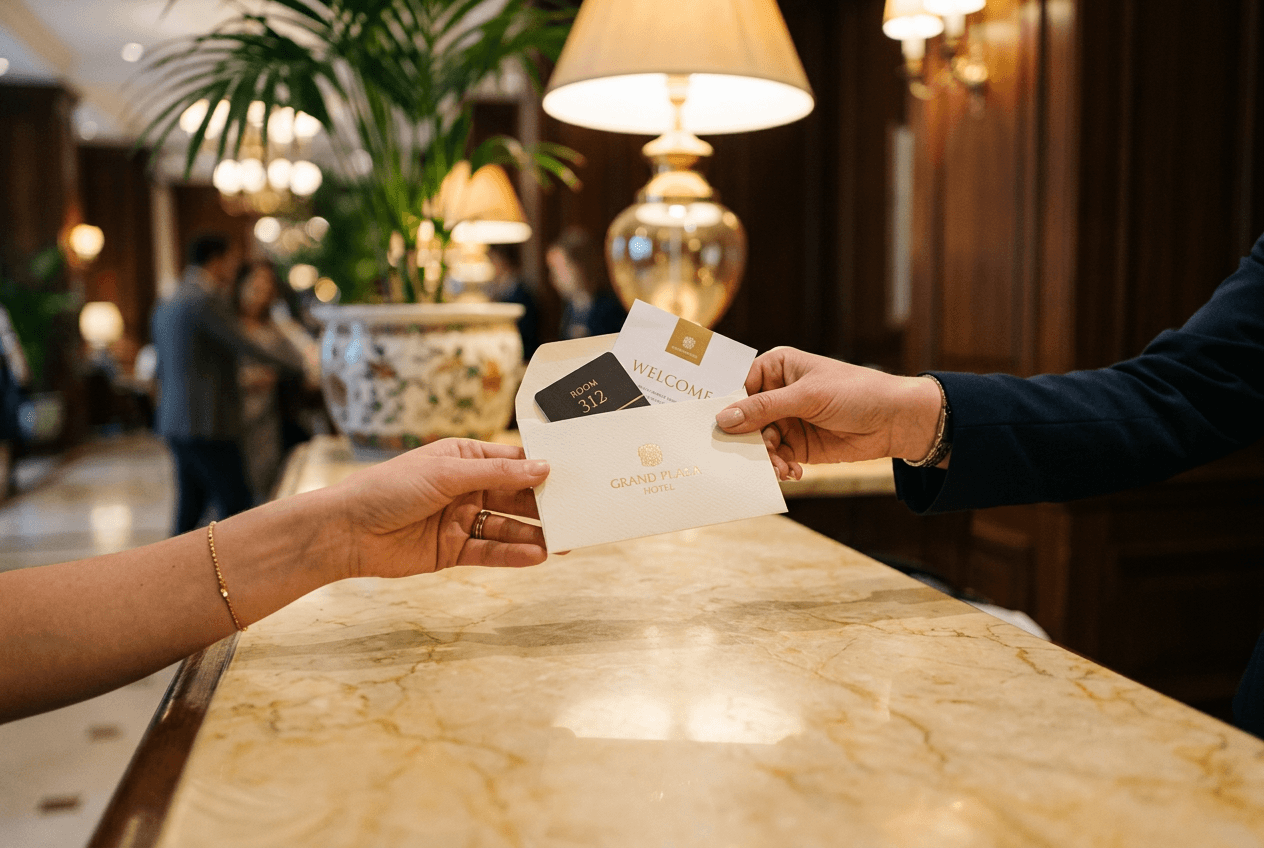
Your hotel interaction sets the tone for the whole trip. Nail this conversation and you'll feel capable of handling anything that comes next.
10 Essential Hotel Phrases:
- "I have a reservation under [your name]."
- "What time is check-out?"
- "Is breakfast included?"
- "Could I get a room on a higher floor, please?"
- "The Wi-Fi isn't working in my room."
- "Can I leave my luggage here after check-out?"
- "Where is the nearest ATM / pharmacy?"
- "Could I get an extra towel / pillow, please?"
- "Is there a shuttle to the airport?"
- "I'd like to extend my stay by one night."
🗣️ Sample Dialogue — Checking In:
You: Hello, I have a reservation under Park. P-A-R-K. Receptionist: Welcome! Let me pull that up. Yes, a double room for three nights? You: That's correct. Is breakfast included? Receptionist: Breakfast is served from 7 to 10 in the ground floor restaurant. You: Great. And what time is check-out? Receptionist: Check-out is at 11 AM. Here's your key — room 408, fourth floor. You: Thank you so much.
Cultural Tip: In the US, it's common to tip hotel staff — $1–2 per bag for bellhops, $2–5 per night for housekeeping (left on the nightstand with a note). In the UK and most of Europe, tipping hotel staff is appreciated but not expected.
Pronunciation Priorities: Reservation (rez-er-VAY-shun) trips up many speakers. Also learn to say amenities (uh-MEN-ih-teez) and receipt (rih-SEET — the 'p' is silent).
Ordering at Restaurants & Cafés
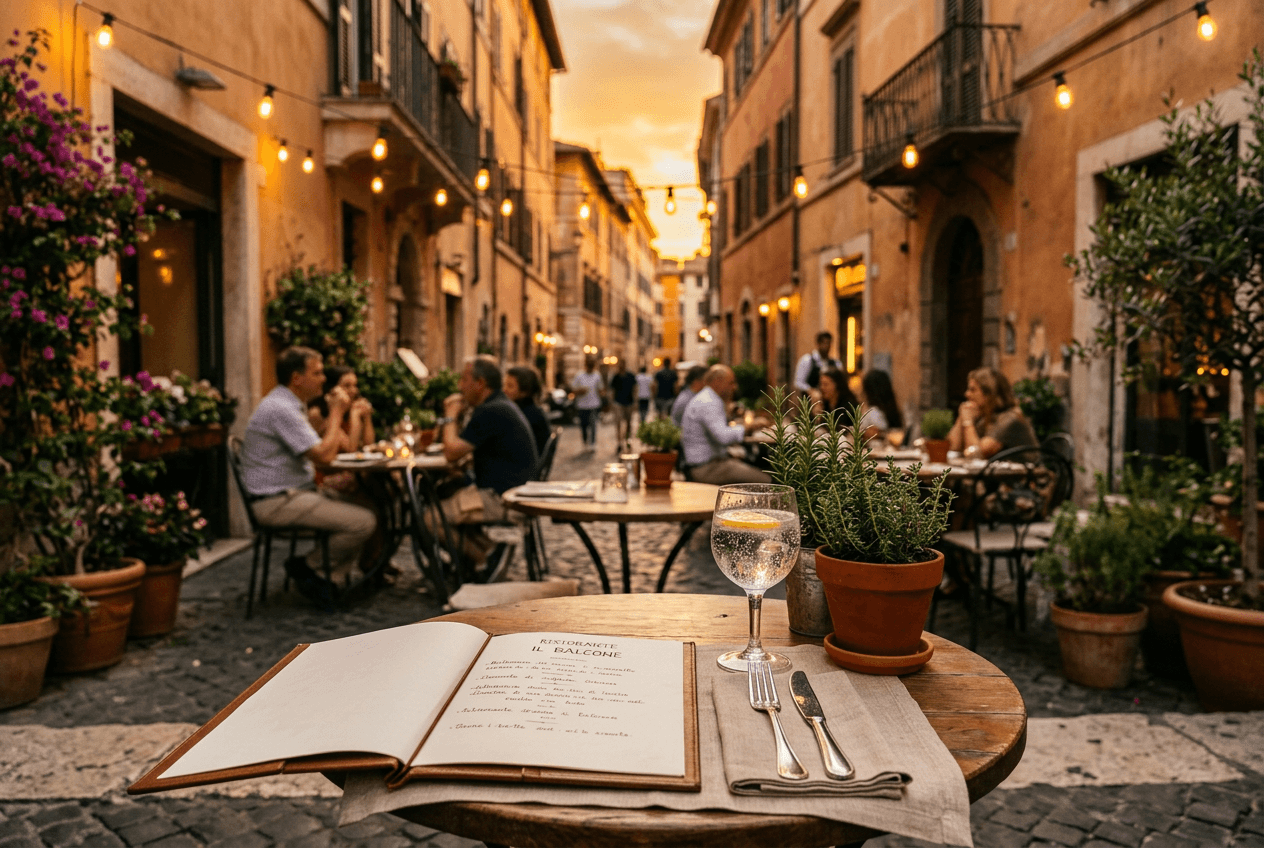
Dining out is one of the best parts of traveling — and one of the most nerve-wracking if you're not confident ordering in English. Learn these travel phrases and you won't have to just point at the menu and hope for the best.
10 Essential Restaurant Phrases:
- "A table for two, please."
- "Could I see the menu?"
- "What do you recommend?"
- "I'm allergic to [nuts / shellfish / dairy]."
- "I'd like the [dish name], please."
- "Could I have the bill / check, please?"
- "Is the tip included?"
- "Can I pay by card?"
- "Could we get some more water, please?"
- "Sorry, this isn't what I ordered."
🗣️ Sample Dialogue — Ordering Dinner:
You: Hi, could I see the menu, please? Server: Of course, here you go. Can I start you with something to drink? You: Just water for now, thanks. I'm allergic to nuts — could you help me find which dishes are nut-free? Server: Absolutely. The grilled chicken and the pasta are both safe. You: I'll have the pasta, please. Server: Great choice. Anything else? You: That's all, thank you.
Cultural Tip: In the US, tipping 15–20% is standard and expected at sit-down restaurants. In the UK, 10–12.5% is common but not obligatory. In many Asian and European countries, tipping is uncommon — ask "Is the tip included?" when in doubt.
Pronunciation Priorities: Allergic (uh-LER-jik) is a crucial word if you have food allergies — learn to say this clearly. Also practice appetizer (AP-uh-ty-zer) and the difference between water (American: WAH-ter) and water (British: WAW-tuh).
Asking for Directions & Getting Around
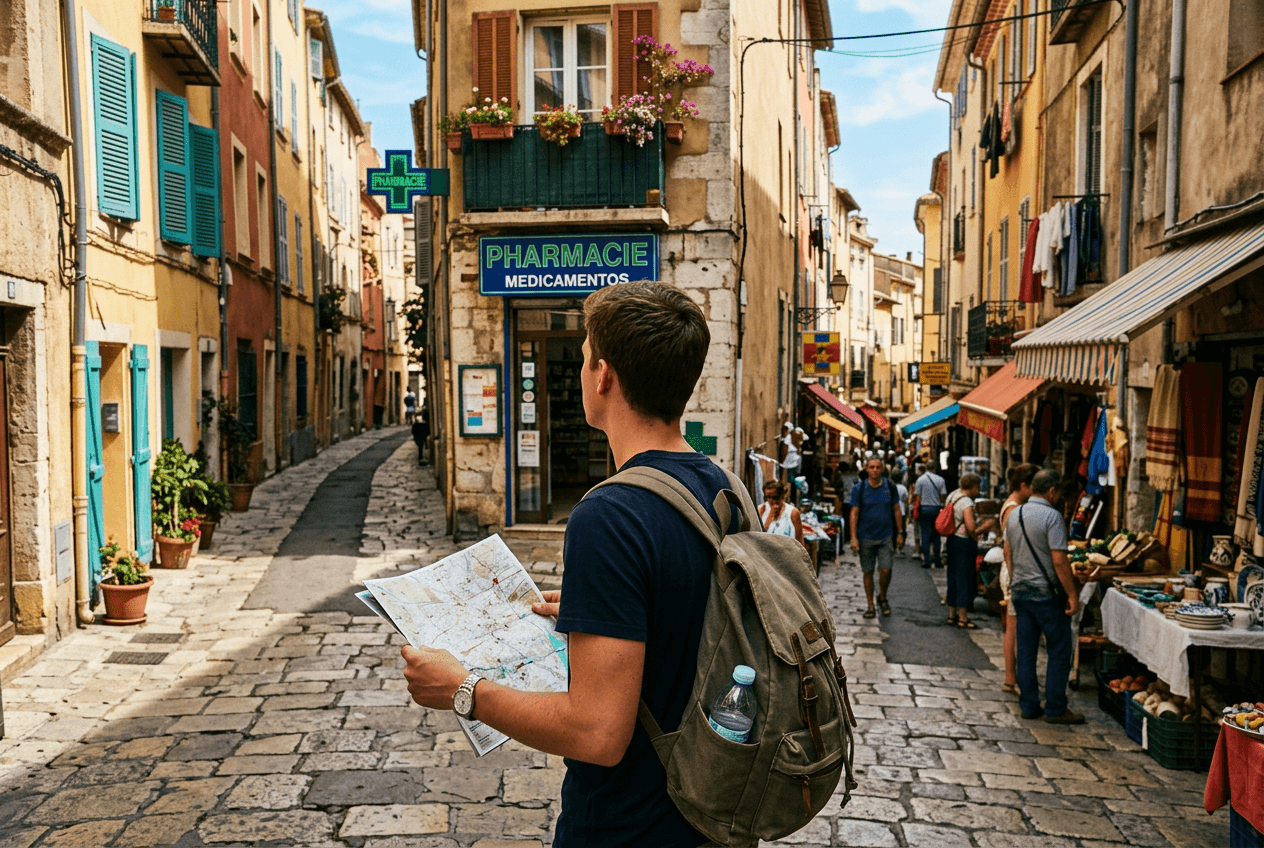
GPS helps, but it can't replace asking a real person when you're lost in a neighborhood with no signal. These English phrases for traveling give you a reliable backup plan.
10 Essential Direction Phrases:
- "Excuse me, how do I get to [place]?"
- "Is it within walking distance?"
- "Which way is the nearest subway / metro station?"
- "Can you show me on the map?"
- "How far is it from here?"
- "Do I go straight or turn left?"
- "Where is the nearest bus stop?"
- "Does this bus go to [destination]?"
- "What stop do I get off at?"
- "I think I'm lost. Can you help me?"
🗣️ Sample Dialogue — Asking a Local:
You: Excuse me, how do I get to the central market? Local: Sure! Walk straight for two blocks, then turn right at the pharmacy. It's on your left — you can't miss it. You: Two blocks straight, then right at the pharmacy? Local: Exactly. It's about a five-minute walk. You: Thank you so much for your help!
Cultural Tip: In the UK, you'll hear words like pavement (sidewalk), high street (main shopping street), and roundabout (traffic circle). In the US, distances are described in "blocks." Learning these regional words helps you follow directions without confusion.
Pronunciation Priorities: Straight ahead (strayt uh-HED) and intersection (in-ter-SEK-shun) are direction words you'll hear constantly. Practice them until they sound natural.
Duolingo taught you words. No one taught you to speak.
PracticeMe: real voice conversations with an AI tutor, 24/7.
Shopping & Bargaining
Whether you're grabbing souvenirs or replacing something you forgot to pack, shopping in English has its own vocabulary. Knowing the right phrases helps you ask questions with confidence.
10 Essential Shopping Phrases:
- "How much does this cost?"
- "Do you have this in a different size / color?"
- "Can I try this on?"
- "Where are the fitting rooms?"
- "Is this on sale?"
- "Do you accept credit cards?"
- "Could I get a receipt, please?"
- "Can I return this if it doesn't fit?"
- "Do you have anything cheaper?"
- "I'm just looking, thanks."
🗣️ Sample Dialogue — Buying a Gift:
You: Hi, how much does this scarf cost? Shopkeeper: That one's $25. You: Do you have it in blue? Shopkeeper: Let me check... yes, here you go. You: I'll take it. Can I pay by card? Shopkeeper: Of course. Would you like a bag? You: Yes, please. And a receipt, too. Thank you!
Cultural Tip: Bargaining is normal at street markets in Southeast Asia, Latin America, and parts of the Middle East. It's generally not acceptable in fixed-price stores in the US, UK, or Europe. A polite "Is this your best price?" lets you ask for a discount without offending anyone.
Pronunciation Priorities: Receipt (rih-SEET — the 'p' is silent), discount (DIS-count), and exchange (eks-CHAYNJ).
Emergencies: Essential Phrases That Could Save Your Trip
Nobody plans for emergencies, but knowing these travel English phrases can make a stressful situation manageable. Memorize the first three — they're the ones you may need to say fast.
10 Essential Emergency Phrases:
- "I need help!"
- "Please call an ambulance / the police."
- "I've lost my passport."
- "Where is the nearest hospital?"
- "I need to contact my embassy."
- "Someone stole my [bag / wallet / phone]."
- "I'm allergic to [substance] — this is an emergency."
- "I don't feel well. Is there a doctor nearby?"
- "Can you help me find [place / person]?"
- "I need to file a police report."
🗣️ Sample Dialogue — At the Embassy:
You: Hello, I've lost my passport. I need help getting a replacement. Staff: I'm sorry to hear that. Do you have a copy of your passport or any photo ID? You: I have a photo on my phone. Staff: Good. We'll need you to fill out this form. Processing takes about 3–5 business days. You: Is there anything I can use to travel in the meantime? Staff: We can issue a temporary travel document for you.
Cultural Tip: Emergency numbers vary by country: 911 in the US, 999 in the UK, 112 across the European Union. Save these in your phone before you travel, along with your embassy's local number.
Pronunciation Priorities: Practice saying emergency (ih-MER-jen-see), embassy (EM-buh-see), and allergic (uh-LER-jik) clearly. These are words where mispronunciation could cause real confusion when you need help fast.
Making Friends & Small Talk
Some of the best travel memories come from conversations with people you didn't plan to meet. These English phrases help you start those conversations with confidence.
10 Essential Social Phrases:
- "Hi, where are you from?"
- "Is this your first time here?"
- "What do you recommend seeing?"
- "How long are you traveling for?"
- "Do you want to grab a coffee / meal?"
- "Your English is really good!" (A compliment that opens doors.)
- "I'm from [country]. Have you been there?"
- "What's been the highlight of your trip so far?"
- "Can I add you on Instagram?"
- "It was great meeting you!"
🗣️ Sample Dialogue — At a Hostel:
You: Hi! Is this your first time in Barcelona? Traveler: Yeah, I just got here yesterday. You? You: Same! I'm here for a week. Where are you from? Traveler: Canada. You? You: South Korea. Have you found any good restaurants yet? Traveler: Actually, someone recommended a tapas place nearby. Want to go together tonight? You: That sounds great!
Cultural Tip: Safe conversation starters across most cultures include travel experiences, food, and local recommendations. Topics to generally avoid with people you just met: politics, religion, salary, and personal questions about age or weight. According to the British Council's guide on making friends abroad, keeping language simple and casual works better than trying to sound formal.
If you want to learn more conversation starters and practice small talk, our guide on English conversation practice topics covers 50+ topics for every level.
Your 14-Day Pre-Travel English Practice Plan
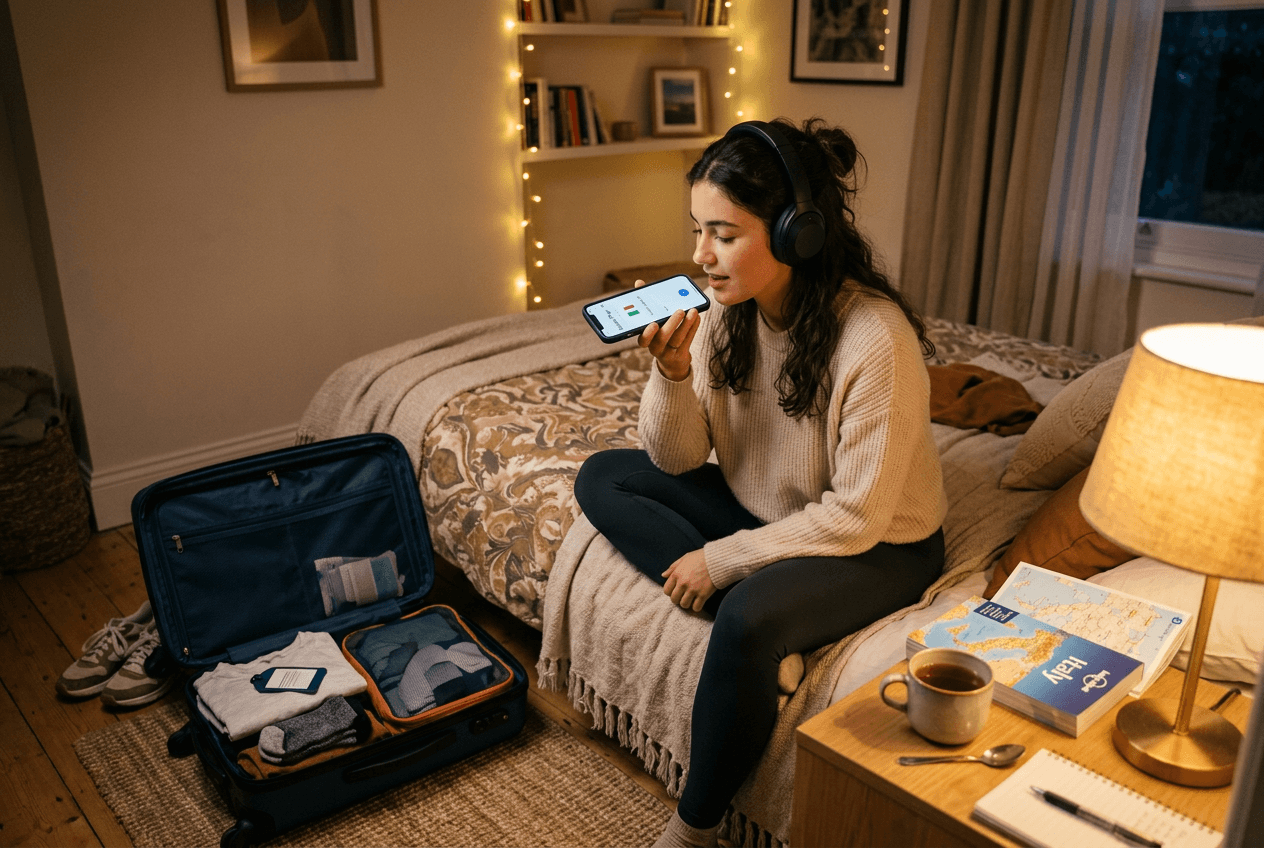
Knowing English for travel phrases is step one. Being able to say them naturally when a real person is waiting for your answer — that's step two. This two-week plan uses Practice Me to turn travel English into speaking reflexes. Just 15 minutes a day is all you need.
Week 1: Building Your Foundation
| Day | Focus | What to Practice |
|---|---|---|
| 1 | Greetings & Politeness | Say hello, please, thank you, excuse me — the words you'll use 50 times a day |
| 2 | Airport English | Simulate a check-in conversation and ask about your gate and flight time |
| 3 | Hotel Check-In | Practice making a reservation and asking about amenities |
| 4 | Restaurant Ordering | Order a meal, ask about allergens, and request the bill |
| 5 | Transportation | Ask for directions, buy a bus ticket, confirm your stop |
| 6 | Shopping Basics | Ask about prices, sizes, and paying by card |
| 7 | Review & Combine | Run through Days 1–6 scenarios back-to-back for fluency |
Week 2: Real-World Readiness
| Day | Focus | What to Practice |
|---|---|---|
| 8 | Emergency Phrases | Practice reporting a lost passport and asking for help finding a hospital |
| 9 | Small Talk & Socializing | Start conversations and talk about your trip and home country |
| 10 | Handling Misunderstandings | Learn to say "Sorry, could you repeat that?" and "I don't understand" |
| 11 | American Accent Day | Switch to an American-accent tutor and repeat Days 2–4 scenarios |
| 12 | British Accent Day | Switch to a British-accent tutor and repeat Days 5–6 scenarios |
| 13 | Full Trip Simulation | Go from airport → hotel → restaurant → sightseeing in one session |
| 14 | Confidence Run | Free conversation with your favorite tutor about your upcoming trip |
Why this works: Practice Me's AI tutors respond naturally, so you're not repeating phrases into silence — you're holding real conversations where you have to listen, think, and speak. The app automatically saves new vocabulary from your sessions, building your travel word bank without extra study time.
If you're brand new to English, start with our English speaking practice for beginners guide first. It covers foundational skills like greetings, numbers, and simple questions — then come back to this 14-day plan when you're ready.
Why Speaking Practice Beats Memorizing Phrase Lists
A phrasebook gives you words on a page. Conversation practice gives you confidence in the moment.
Here's the difference: when you memorize "Could I have the bill, please?" from a list, you can recognize it on paper. But when a waiter asks "Would you like anything else or are you ready for the check?" — you freeze. That's not the sentence you memorized, and the time pressure makes it worse.
Speaking practice trains you to handle variations. Practice Me's AI tutors don't follow a script. They ask follow-up questions and say things you don't expect — just like real people in real travel situations. This builds the flexibility you need to handle actual conversations, not just rehearsed ones.
If speaking English still feels intimidating, read our guide on overcoming the fear of speaking English. You can also learn to practice English speaking alone at home with daily exercises that build your foundation before your trip.
The key is to start practicing before your trip — not at the airport. Even a 15-minute daily speaking routine can transform how confident you feel when you land.
Ready to rehearse your trip? Start a travel conversation with Practice Me and speak with an AI tutor right now. Check our plans and pricing to find what fits your pre-travel timeline.
Frequently Asked Questions
How long before my trip should I start practicing travel English?
Two weeks is the sweet spot for most learners. The 14-day plan above covers every major travel scenario without cramming. If you have more time, a month of daily practice will make these English for travel phrases feel like second nature.
Can I practice English for travel as a complete beginner?
Yes. Start with our beginner's English speaking guide to learn foundational skills like greetings, numbers, and simple questions. Practice Me's AI tutors adapt to your level — they'll simplify their language and speak more slowly when you need it.
Should I practice American or British English for travel?
It depends on your destination. Heading to the US, Canada, or the Philippines? Practice with an American accent. Traveling to the UK, Australia, or India? British English will sound more familiar. Practice Me lets you switch between American and British accent tutors anytime, so you can train with both.
What's the fastest way to learn English travel phrases?
Speaking them out loud in context. Reading phrases silently is passive learning. When you say the words in a simulated conversation and hear a natural response, your brain processes the language actively. That's why voice-based practice is more effective than flashcards or phrasebooks for travel prep. Our guide on speaking English fluently and confidently explains the science behind active speaking practice.
Will these travel English phrases work in non-English-speaking countries?
In most tourist areas worldwide, yes. English is the most widely spoken second language globally, and you'll find English speakers at airports, hotels, popular restaurants, and tourist attractions in nearly every country. That said, learning a few words in the local language alongside your English always shows respect and is appreciated.