Duolingo taught you words. No one taught you to speak.
PracticeMe: real voice conversations with an AI tutor, 24/7.
English for Hospitality Workers: Hotel & Resort Guide
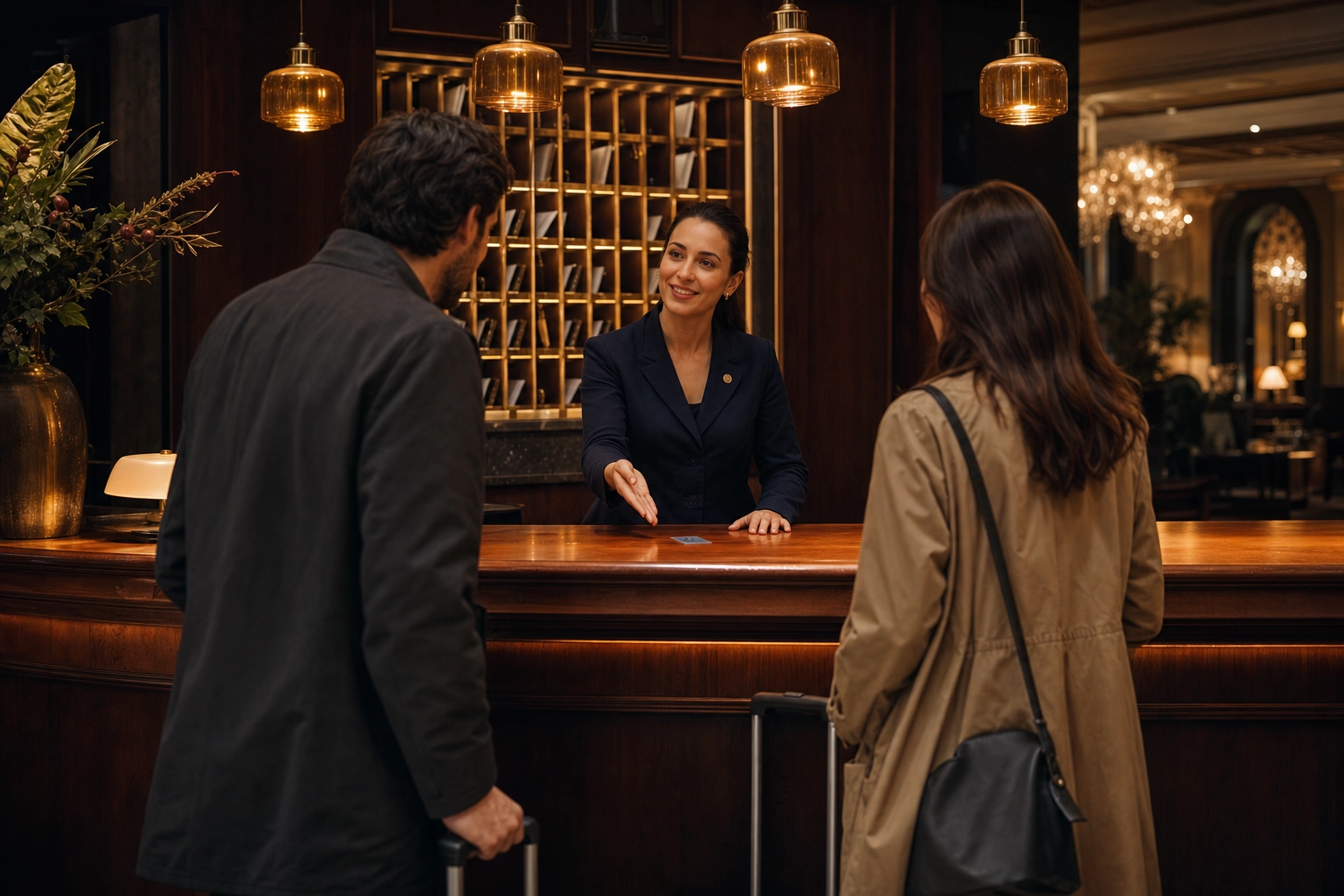
The hospitality industry will employ 371 million people globally in 2026, according to the World Travel & Tourism Council — roughly one in ten working adults on Earth. And no matter where that hotel sits — Manila, Mumbai, Cancún, Dubai — the working language at the front desk, in the spa, and on the late-night call about a broken air conditioner is almost always English.
This guide to English for hospitality is for the people doing the actual work: front desk agents, concierges, housekeepers, spa therapists, and resort staff who learned English in school but freeze the moment a customer says something they didn't expect. You'll get the vocabulary, the scripts, the pronunciation fixes for your specific first language, and eight full dialogue scripts you can rehearse out loud — tonight, alone, at 11 p.m. after your shift — until the words come without thinking.
Quick Summary: English for hospitality means mastering about 200 industry-specific words, a handful of polite scripts, and the pronunciation habits that make you instantly intelligible to guests from anywhere in the world. Forget grammar drills and generic courses — the fastest way to fluency is hearing yourself say the phrases out loud until they stop feeling like a foreign language.
Why English for Hospitality Decides Your Career
A guest decides whether they trust you in the first ten seconds. They aren't grading your grammar — they're listening for two things: Can I understand this person? and Does this person sound calm and in control?
In the hospitality industry, spoken English is your career ladder. Front desk supervisors, concierge lead positions, customer service management, sales, and operations — every step above housekeeping requires conversations. Not emails. Not written forms. Conversations, often with customers who are tired, frustrated, or in a hurry. The skills that matter aren't grammar-test skills; they're real-time customer service communication skills.
The good news: hospitality English is one of the most learnable specializations in the English language. The vocabulary is finite. The situations repeat. Master the patterns once and they pay you back every shift for the rest of your career. You don't need an expensive course or a year-long grammar program — students of this guide need targeted vocabulary, a focus on speaking, and many hours of practice out loud. The free approach below works for any hotel worker willing to put in the reps. Most learning happens in those repetitions, not in textbooks.
Hotel Front Desk Vocabulary: The 60 Words You Must Own
Most "hospitality English" lists are bloated with words you'll use twice a year. Here is the actual working vocabulary of a front desk agent in the hotel industry, organized by when you'll use it.
Reservation and arrival vocabulary
- Reservation — a confirmed booking. "I have a reservation under the name Patel."
- Booking — used interchangeably with reservation.
- Confirmation number — proves the booking exists.
- Walk-in — a customer with no reservation.
- Check-in — registering and getting a room. Usually 3 p.m.
- Check-out — settling the bill and leaving. Usually 11 a.m. or noon.
- Early check-in / Late check-out — outside the standard window.
- Express check-out — leaving without stopping at the desk.
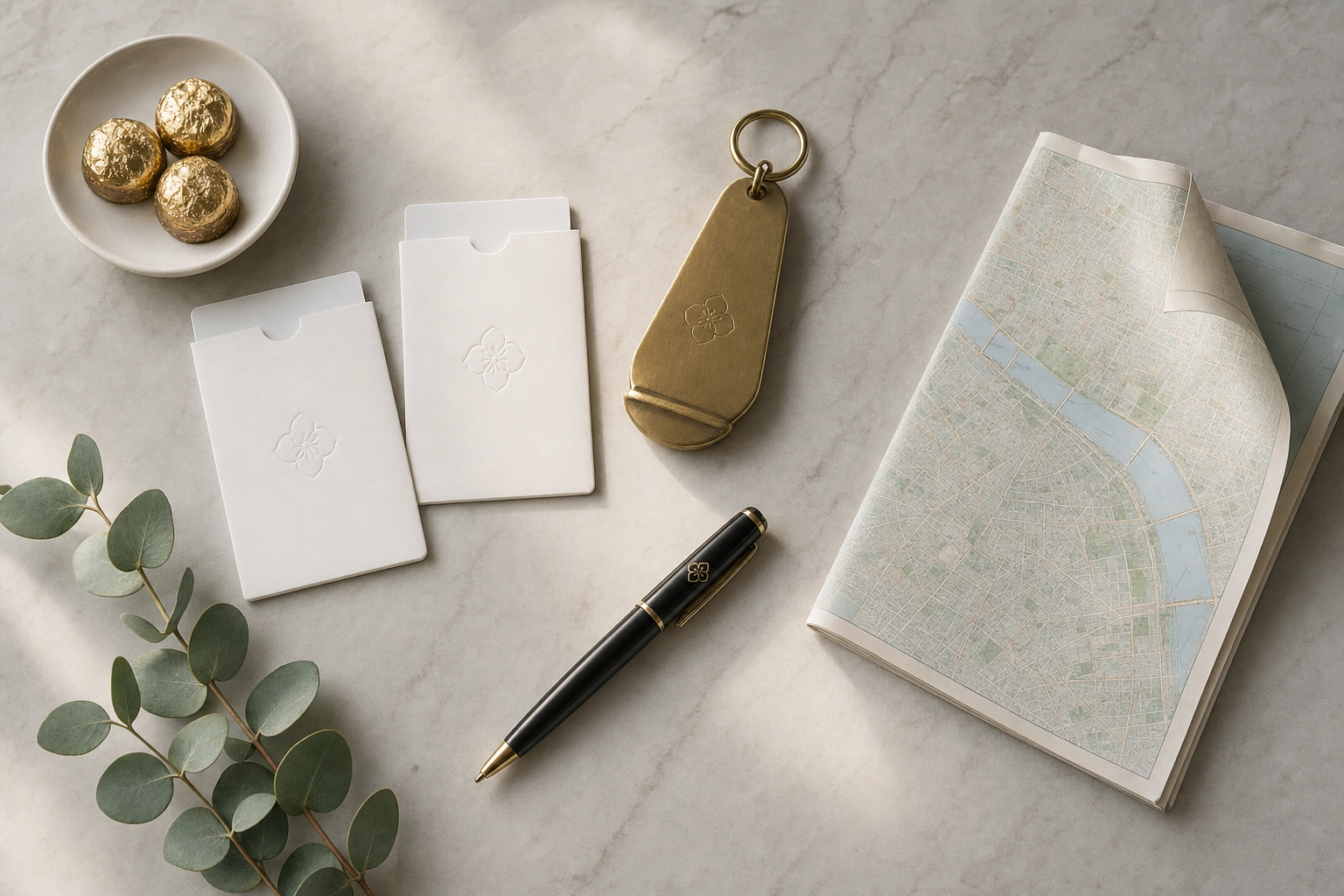
- Key card / Room key — the plastic card that opens the door.
- Folio — the itemized bill for the stay.
- Credit card authorization — a hold on the customer's card. Not a charge.
- Incidentals — minibar, room service, pay-per-view, laundry.
Room types and bed configurations
These English for hotel staff terms vary slightly between properties, but the vocabulary is universal:
- Standard room — base-tier, no upgrades.
- Deluxe room / Superior room — larger footprint or better view.
- Junior suite — open-plan with a sitting area; no separate bedroom. ("Suite" rhymes with "sweet" per the Cambridge Dictionary.)
- Executive suite — designed for business travelers.
- Presidential suite — top tier, multiple rooms.
- King / Queen / Twin / Double — bed sizes.
- Hollywood twin — two twins pushed together.
- Connecting rooms — internal door between two rooms.
- Adjoining rooms — next to each other, no internal door.
- Accessible room / ADA-compliant — mobility-friendly rooms.
- Single occupancy / Double occupancy — affects pricing.
Amenities, services, and billing
- Amenities vs facilities — Amenities are in the room. Facilities are at the hotel.
- Complimentary — free, included with the stay.
- Comp — short for complimentary, used as a verb.
- Upgrade — moving the customer to a better room.
- On the house — free, courtesy of the hotel.
- Room service — food delivered to the room.
- Turndown service — evening housekeeping prep for sleep.
- Housekeeping — daily cleaning.
- Valet — parking or clothes-pressing staff.
- Bellhop / Porter — luggage staff.
- Shuttle service — hotel transport.
- Concierge — guest services staff.
- Gratuity / Tip — service money.
- Master bill — company-paid bill for multiple rooms.
Guest Interaction Scripts: Front Desk Phrases That Work
Memorizing 200 vocabulary words doesn't help if you can't string them into a sentence under pressure. These are the phrasing patterns you'll use most often in common situations. Steal them word-for-word.
The greeting formula
Standard: "Good [morning / afternoon / evening], welcome to [Hotel Name]. How may I help you?"
Returning customer: "Welcome back, Mr./Ms. [Surname]. It's a pleasure to see you again."
Late arrival: "Good evening — I hope you had a smooth journey. Let me get you settled in quickly."
"How may I help you?" is more formal than "Can I help you?" Both are correct; "may" sounds more refined. The moment you have a name, use the surname with a title. For the wider art of opening a conversation, see our piece on how to introduce yourself in English.
Asking polite questions
Hospitality English runs on modal verbs. This is the one piece of grammar you must internalize, because the modal you choose signals your professionalism level:
- Could I have your... (more polite than "Can I have")
- Would you like... (more polite than "Do you want")
- May I see your... (most polite for asking to inspect something)
- I'm afraid I'll need to... (softens a rule the customer may not like)
Handling complaints: the LAST framework
When a customer complains, use LAST:
- L — Listen. Don't interrupt.
- A — Apologize for the experience before you know whose fault it is.
- S — Solve with a specific action and specific timeframe.
- T — Thank the customer for bringing it up.
Power phrases:
- "I completely understand how frustrating that must be."
- "Let me take care of that right away."
- "May I offer you [a comp drink / a room upgrade / a credit toward dinner] while we resolve this?"
- "I appreciate your patience."
For more on staying composed in stressful conversations, our guide on keeping a conversation going in English covers communication techniques that translate directly to complaint handling.
Late-night and emergency calls
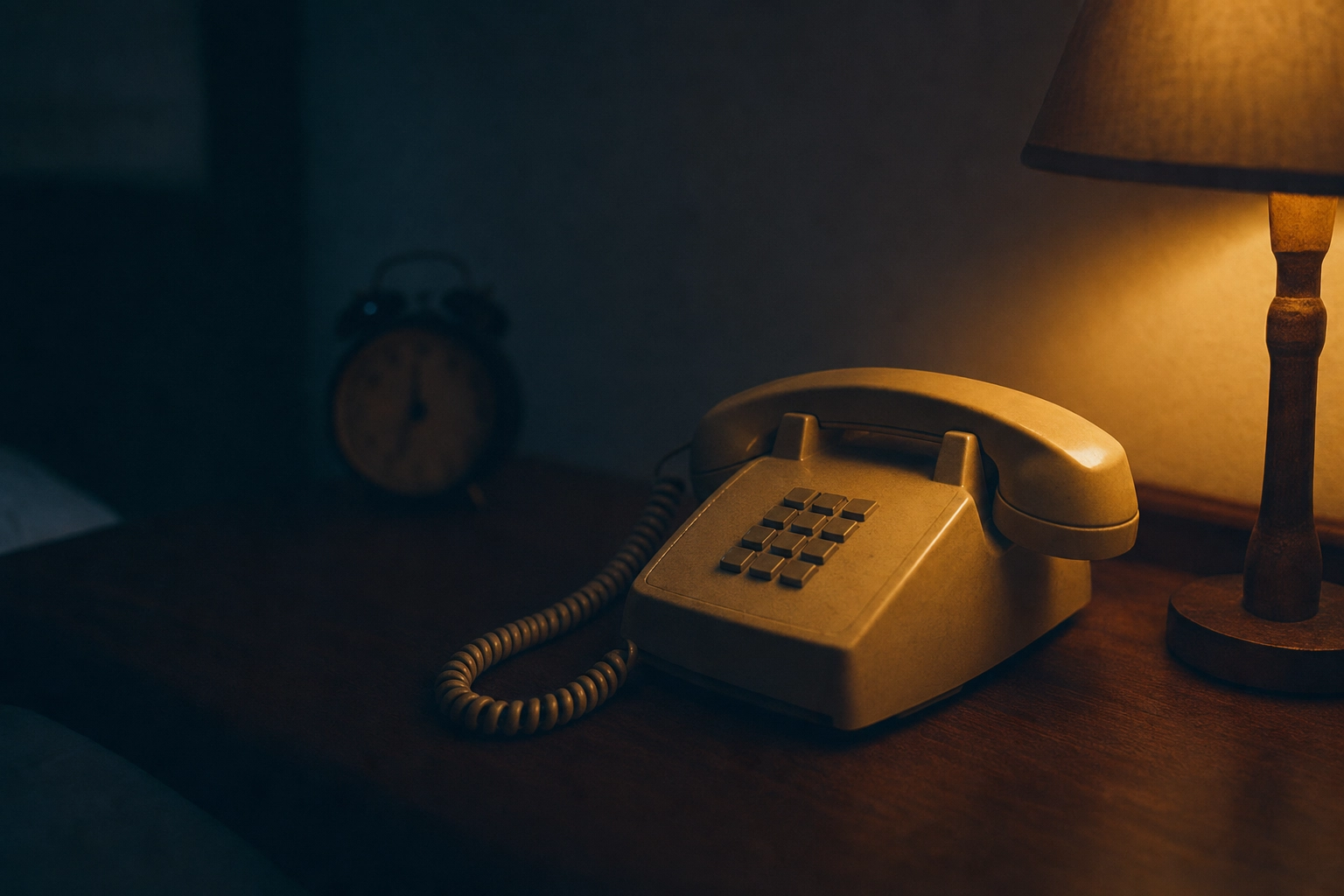
The phone rings at 2:47 a.m. The cadence of your voice does most of the work — slower, softer, calmer than daytime register.
- Lead with "Front desk, this is [Name] — how can I help?"
- Safety first: "Are you safe?"
- Acknowledge and dispatch in the same sentence: "I'm so sorry — I'll send someone up right now."
- Stay on the line if they sound frightened.
- Log every call in writing. Follow up after the issue is resolved.
Concierge English: Recommending Without Pushing
The concierge is the human Google of a luxury hotel. Your job is to give one or two specific, useful options — not a list of ten.
Restaurant recommendations
A good recommendation has four parts: cuisine, distance, price range, and a reservation tip.
"For Italian, I'd recommend Trattoria Bianchi — about a ten-minute walk, mid-range pricing, fully booked by seven. I can call ahead if you'd like."
Useful question stems for narrowing down customer preferences:
- "What kind of cuisine are you in the mood for tonight?"
- "Are you looking for something casual or special-occasion?"
- "Any dietary restrictions I should mention to the restaurant?"
- "Would you prefer to walk, or shall I arrange a taxi?"
Attractions, transportation, and weather
Match the suggestion to the guest:
- "If you have just one afternoon, I'd recommend..."
- "It's about a twenty-minute taxi ride, or roughly $15."
- "The metro is fastest, but the harbor ferry is more scenic."
- "Today will be warm — I'd recommend light clothing and water."
Local culture and discreet warnings
- "Just a small tip — at this temple, please remove your shoes before entering."
- "Tipping isn't customary here, but rounding up the bill is appreciated."
- "Photography is welcome in the main hall, but not in the prayer area."
Housekeeping and Maintenance Phrases
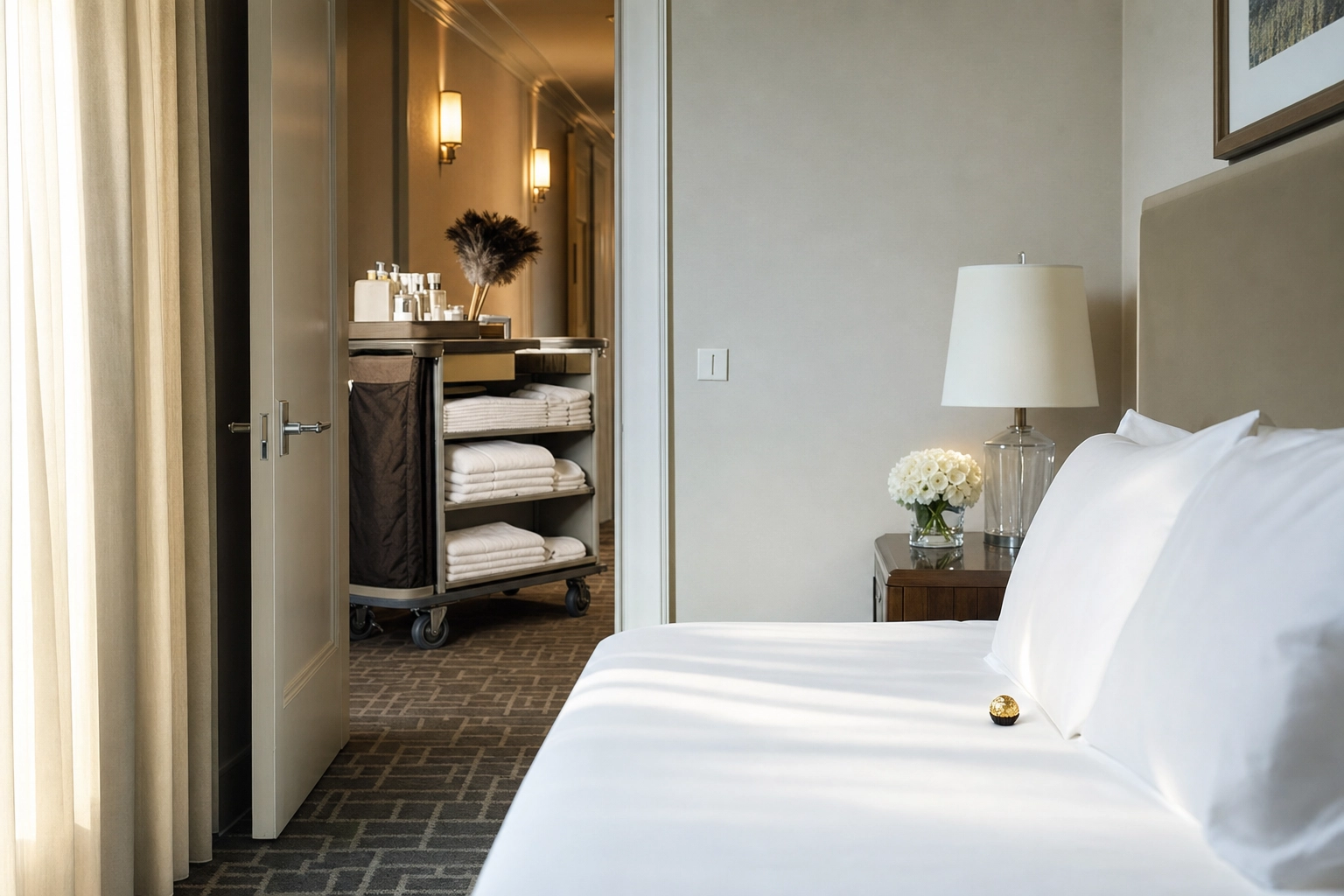
Housekeeping has its own short, polite vocabulary.
Knock-and-announce: "Housekeeping. May I come in?" Three sharp knocks, wait three seconds, repeat once.
If the customer is inside: "Good morning — sorry to disturb. Would you like your room serviced now, or shall I come back later?"
Turndown service: "Madam, I'm here from housekeeping — sorry to disturb you, may I turn down your bed?"
Reporting maintenance:
- "We have a leak in 412."
- "The AC in 207 isn't cooling. Guest is in the room."
Hotel-specific abbreviations:
| Code | Meaning |
|---|---|
| DND | Do Not Disturb |
| MUR | Make Up Room |
| VC / VR | Vacant Clean / Vacant Ready |
| OC | Occupied Clean |
| OOO | Out of Order |
| OOS | Out of Service |
| S/O | Sleep Out |
| SKIP | Skipper (left without paying) |
Resort and Spa Vocabulary
Resorts add a layer of vocabulary that city hotels rarely use. Learn these English for tourism workers terms — they show up constantly in spa bookings.
Meal plans
- EP (European Plan) — room only.
- CP (Continental Plan) — light breakfast.
- BB (Bed and Breakfast) — full breakfast.
- HB (Half Board) — breakfast and dinner.
- FB (Full Board) — all three meals.
- AI (All-Inclusive) — meals, snacks, most drinks.
Pool, beach, and recreation
- Pool deck, cabana, lounger, towel card, swim-up bar
- Beach club, beach attendant, palapa
- Watersports, paddleboard, kayak rental, snorkel set
- Activities desk
Spa treatments
- Swedish massage — relaxation, light to medium pressure.
- Deep tissue massage — firmer pressure for muscle tension.
- Hot stone massage — heated basalt stones.
- Aromatherapy massage — essential oils selected by the guest.
- Reflexology — pressure-point work on feet, hands, or ears.
- Facial — cleanse, exfoliate, mask, moisturize.
- Body scrub / Body polish — full-body exfoliation.
- Body wrap — product application then body wrap.
- Hammam — Middle Eastern steam bath.
- Couples treatment — two guests side-by-side.
Useful spa phrases:
- "Would you prefer a male or female therapist?"
- "How much pressure do you usually enjoy — light, medium, or firm?"
- "Are there any areas you'd like the therapist to focus on, or to avoid?"
- "Please arrive 15 minutes early to change and use the steam room."
Cultural Context: Politeness, Tone, and Addressing Guests
Hotel reception English isn't really about grammar — it's about tone, register, and small choices that signal "this person is a professional, not a stranger guessing at the script." This is where customer service skills separate the great from the merely good.
Addressing guests
- Default until you know their name: "Sir" or "Madam" (or "Ma'am" in American settings).
- Once you have a name: "Mr. / Mrs. / Ms. / Mx. [Surname]".
- Some Western guests will say "please, just call me John." Switch immediately, but only for that customer.
- Many Asian and Middle Eastern guests expect formal address throughout the stay.
- For groups, default to "folks" in American English, "everyone" internationally. Avoid "guys" in formal situations.
Tone choices that signal professionalism
| Casual (avoid) | Professional (use) |
|---|---|
| "Sure" / "Yeah" | "Certainly" / "Of course" |
| "No problem" | "My pleasure" / "Not at all" |
| "OK" | "Right away" / "Absolutely" |
| "Hang on" | "One moment, please" |
| "We don't have that" | "Unfortunately, that isn't available, but may I suggest..." |
| "I don't know" | "Let me find out for you" |
| "It's not my department" | "Let me connect you with the right person" |
Anticipation: the luxury hospitality difference
The biggest skill upgrade from "hotel worker" to "luxury hospitality professional" is anticipating instead of reacting.
Anticipation phrases:
- "I noticed you're checking out at 6 a.m. — may I arrange an early breakfast box for you?"
- "Since you're heading to the museum, would you like me to call ahead so they hold tickets?"
Duolingo taught you words. No one taught you to speak.
PracticeMe: real voice conversations with an AI tutor, 24/7.
Acknowledging without admitting fault
- ❌ "It was our mistake."
- ✅ "I'm so sorry to hear that — let me find out what happened."
Pronunciation Pitfalls by Native Language

A strong accent isn't the problem. Intelligibility is. Guests don't need you to sound like a BBC newscaster; they need to understand "Your room is on the fourth floor" the first time.
Here are the specific sounds that cause common hospitality miscommunications, organized by the first language most prevalent in global hotel staff.
Filipino and Tagalog speakers
- P vs. F: "pour" vs. "four", "pork" vs. "fork". A customer asking for a fork should not get a pork chop.
- V vs. B: "very" vs. "berry", "valet" vs. "ballet".
- Short I vs. long E: "check" vs. "cheek", "ship" vs. "sheep". Critical at check-in.
- SH vs. CH: "shoes" vs. "choose".
Hospitality words to drill: comfort, comp, deluxe, valet, beverage, voucher, available, complimentary.
Indian English speakers
Indian English is its own legitimate variety of the English language with hundreds of millions of speakers — but a few habits trip up American and European guests:
- Retroflex T and D: softening the T makes "thirty", "twenty", "city" land more naturally.
- V vs. W: "Welcome" (full lip-rounding) is different from "valid" (teeth on lip).
- Word stress: Ho-TEL (not HO-tel), re-CEP-tion, com-pli-MEN-tar-y.
- TH sounds: often replaced with hard T or D.
Hospitality words to drill: thirty, available, comfortable, schedule, reservation, voucher.
Mexican and Spanish-speaking staff
For deeper coverage, see our guide on hard English words for Spanish speakers.
- TH sounds: "thank you" becomes "tank you". "Three" becomes "tree".
- Adding "e" before S-clusters: "spa" becomes "espa". The fix: take a quick breath right before the S.
- V vs. B: "Valet" is not "ballet".
- Short I vs. long E: "sit" vs. "seat", "this" vs. "these".
Hospitality words to drill: thank, three, thirty, smoothie, spa, suite.
Vietnamese speakers
Vietnamese English has a distinct profile because the Vietnamese language is tonal with mostly open syllables:
- TH sounds replaced with T: "three" becomes "tree".
- Dropping final consonants: "check-out" becomes "che-ow". Finish your words.
- Final S/Z: "guests" and "guess" sound identical without the final S.
- Consonant clusters: "breakfast" (BR + KF + ST) — slow it down.
Hospitality words to drill: check-out, breakfast, guests, towels, beach, room service, smooth.
How to practice these sounds for real
Reading IPA charts doesn't fix pronunciation. Speaking does. The full breakdown of the hardest English words to pronounce by native language goes deeper, but you fix pronunciation by saying difficult words out loud, many times, in a context where it doesn't matter if you mess up — which is the gap an AI tutor fills.
8 Hotel and Resort Dialogue Scripts to Rehearse 24/7
These are the conversations English for hotel workers must master. For more on this method, our piece on English role play scenarios explains why dialogue rehearsal beats vocabulary lists, and why this is one of the most efficient ways of learning hotel English.
Script 1 — Standard Check-In
Guest: Hi, I have a reservation under the name Tanaka.
You: Good evening, Mr. Tanaka — welcome to the Riverside Grand. May I see a photo ID and the credit card you'd like to use, please?
Guest: Sure, here you go.
You: Thank you. I see you've booked a deluxe king for three nights, with breakfast included. Is that still correct?
Guest: Yes, that's right.
You: Perfect. I'll place a hold of $50 per night on your card for incidentals — that's just a hold, not a charge. Here are your two key cards. You're in room 812 — eighth floor. Breakfast is in the Garden Room from 6:30 to 10:30. Our wifi is complimentary, password welcome2026. Is there anything else I can help you with this evening?
Guest: No, that's perfect, thank you.
You: Enjoy your stay, Mr. Tanaka. Please don't hesitate to call the front desk — just dial 0 — if you need anything at all.
Pro tip: Front-load all the practical info so the customer doesn't have to come back to the desk.
Script 2 — Late Check-Out Request
Guest: Hi, my flight isn't until 8 p.m. Is there any way I can check out later than 11?
You: Of course, let me see what we can do. Our standard check-out is 11 a.m., and we can offer a complimentary late check-out until 1 p.m. — free of charge. After that, a half-day rate applies — that would be $95 for check-out up to 6 p.m. Would you like me to extend you until 1 for free, or would you prefer the later option?
Guest: 1 is fine, but where can I leave my bags after?
You: We have complimentary luggage storage right here at the desk. You're also welcome to use the lobby bar, the lounge, or the pool deck until your flight.
Guest: That works. Thanks so much.
You: My pleasure. I've extended your check-out to 1 p.m. Have a wonderful last day with us.
Script 3 — Restaurant Recommendation
Guest: We're looking for somewhere nice for dinner tonight — somewhere local, not too touristy.
You: Are you in the mood for any particular cuisine?
Guest: Open to suggestions. We had Italian last night.
You: In that case, I'd recommend Casa Madera — a family-run Mexican place, about a seven-minute walk through the old quarter. Their tasting menu is around $40 per person. They book up quickly, so I'd recommend reserving. Would you like me to call and hold a table for two?
Guest: Yes, for 7:30 if possible.
You: Wonderful — I'll call them now.
Script 4 — Handling a Noisy Neighbor Complaint
Guest (frustrated): I cannot sleep. The people in the room next to mine have been talking and laughing for over an hour.
You: Mr. Okoye, I'm so sorry — that's completely unacceptable. Let me take care of this right away. I'll send security up to politely ask them to keep it down within the next two minutes. If that doesn't resolve it, I'd like to offer to move you to an identical room on a quieter floor — no charge.
Guest: Let's see if they quiet down first.
You: Completely understood. Security will be there in two minutes, and I'll personally call you in fifteen. I'll also add a $50 credit to your account for the inconvenience.
Guest: Thank you, I appreciate that.
You: Thank you for letting us know, Mr. Okoye.
Pro tip: LAST framework executed in 30 seconds.
Script 5 — Housekeeping Knocks for Turndown
(Three knocks. Three-second pause.)
You: Housekeeping — turndown service.
(Door opens.)
Guest: Oh, hi.
You: Good evening, Mrs. Lee — sorry to disturb you. May I come in for turndown service? It only takes a couple of minutes.
Guest: Actually, we're about to head out for dinner — can you come back in 20 minutes?
You: Of course, no problem at all. I'll come back at 8.
Script 6 — Spa Booking
Guest (on phone): Hi, I'd like to book a massage for tomorrow.
You: What type of massage are you interested in, and do you have a preferred time?
Guest: Something for back tension — I've been traveling all week.
You: I'd recommend our 60-minute deep tissue massage, which is $140. We have openings at 11 a.m., 2 p.m., and 4:30.
Guest: Let's do 2.
You: Please arrive 15 minutes before your appointment to change and use our steam room. We recommend hydrating well today, and avoiding alcohol and heavy meals for two hours after the treatment. Is there anything you'd like the therapist to focus on?
Guest: Lower back, please. And I prefer firm pressure.
You: Perfect — I've noted both.
Script 7 — 2 a.m. Power Outage
Guest: The lights and the AC just went out in my room.
You: Mr. Patel, I'm so sorry — let me get someone up to you right away. First, are you safe? No injuries, no smoke or burning smell?
Guest: No, I'm fine, just woken up and it's pitch black.
You: Thank you. Maintenance is on the way — they'll be at your door within five minutes. They'll identify themselves as Hotel Engineering. I'll call you back in 15 minutes to make sure power is restored.
Guest: Thanks.
You: Take care, Mr. Patel.
Pro tip: Safety question first. Always.
Script 8 — VIP Arrival
You: Mrs. Adelakun, welcome back to the Grand Plaza. It's wonderful to see you again.
Guest: Thank you — it's good to be back.
You: I've taken the liberty of having your room ready early. You're in 1402, your usual corner suite, and I've made sure the room is set to 19 degrees as you preferred last time. I've also placed a fresh pot of jasmine tea on the table.
Guest: Oh, that's lovely.
You: Is there anything you'd like for tomorrow morning — a breakfast time, or perhaps the car arranged for your usual meeting?
Guest: Breakfast at 7:30, and yes, the car for 9.
You: Consider it done. Welcome home, Mrs. Adelakun.
Pro tip: Anticipation is the entire script.
How to Use Practice Me to Rehearse English for Hospitality
Reading these scripts isn't the same as saying them out loud. The whole point of English for hospitality is muscle memory under pressure. Most language learning apps don't address this gap — they teach you to read and write, not to speak under stress.
- Pick a tutor. Sarah and Marcus speak American; Oliver speaks British. Match the accent to your hotel's guests.
- Paste any script into the chat. The tutor plays the customer. You play the staff role.
- No judgment. Repeat the same opening line a hundred times until the rhythm lands.
- Vocabulary auto-saves into a custom hospitality glossary built from your weak spots.
- Cross-session memory. The tutor remembers your weak spots and brings them back.
- 24/7. Rehearse the 2 a.m. emergency call at 2 a.m. — when you'd actually need it.
Practice Me Pro comes with a free 3-day trial. Full details on the pricing page.
For more, see our guides on making small talk in English and English collocations that make you sound fluent.
Frequently Asked Questions
What level of English do you need to work in a hotel?
For housekeeping and back-of-house, CEFR A2 (basic) is often enough. For front desk, concierge, and customer service positions, you need B1 to B2 (intermediate). What matters more than the level is spoken confidence under stress. A B2 speaker who can think on their feet outperforms a C1 speaker who freezes.
Is American or British English better for hospitality jobs?
Match your accent to your hotel's typical guest mix. American chains in the US, Mexico, and Caribbean lean American. European luxury properties, Middle Eastern five-stars, and Commonwealth-country hotels (UK, Singapore, Hong Kong, Australia) lean British.
How long does it take to learn English for hospitality?
If you already have intermediate general English, you can master the core hospitality vocabulary in two to three weeks of consistent daily practice. Building real spoken fluency takes two to three months. A traditional grammar course can't get you there — only speaking practice can.
Do I need a formal hospitality English course to get a hotel job?
Not necessarily. A certificate from a recognized course can help, but no hiring manager has ever rejected a candidate who could clearly handle a check-in role play. The free preparation of rehearsing scripts in this guide will outperform an expensive course you only read.
What's the most important phrase for hotel staff to know?
"How may I help you?" If you can say it warmly and naturally, you've passed the ten-second test.
Can I learn hotel English without a teacher?
Yes, but only if you speak it out loud regularly. An AI tutor like Practice Me is built for exactly this gap: rehearsing the spoken side of language when no human partner is available. The script-and-repeat method works extraordinarily well for hospitality because the situations are so predictable.
Do guests really notice my accent?
Less than you think. Most guests notice clarity, not accent. Focus on the four or five sounds in your language that cause real intelligibility issues — the ones above — and ignore the rest.
What's the difference between hospitality English and business English?
Business English is the language of meetings and negotiations, with heavy reliance on idioms and written communication. Our guide on business English idioms covers that side. English for hospitality is concrete and immediate: a customer is in front of you and you need to handle it warmly. The vocabulary overlaps about 20%. The rhythm is unique to the hospitality industry.
How do I handle a complaint when I don't fully understand the customer?
Buy time with a confirmation phrase. "I want to make sure I understand correctly — you're saying that...?" If you still don't follow, "I apologize — could I ask you to explain that one more time, perhaps a little slower?" is far better than nodding through a problem you didn't catch.
English for hospitality isn't difficult — it's just specific. Two hundred words, a dozen patterns, the right tone, and the muscle memory to use them when a customer is standing in front of you tired and impatient. What no article or course can do is the part that actually matters — saying it out loud, many times, until it stops feeling foreign. That's the work that pays for itself on every shift, for the rest of your career.