Duolingo taught you words. No one taught you to speak.
PracticeMe: real voice conversations with an AI tutor, 24/7.
How to Introduce Yourself in English (With Examples)

You've studied English for years. You know grammar rules, you can read articles and watch movies. But the moment someone says "Tell us about yourself" in English, your mind goes blank and your heart starts racing.
You're not alone — learning how to introduce yourself in English is one of the most common struggles for non-native speakers. The good news? There's a simple framework that makes any English self-introduction feel natural, every single time.
Quick Summary: Use the Present–Past–Future framework to introduce yourself in English in any context. Start with who you are now, mention relevant background, then end with what excites you. Keep it 30–60 seconds for social settings, 60–90 seconds for interviews. Below you'll find 12+ ready-to-use self-introduction examples across five contexts (casual, professional, job interview, academic, and phone/video), plus body language tips, American vs. British customs, common mistakes, and practice exercises.
The One Framework That Makes Any English Self-Introduction Easy
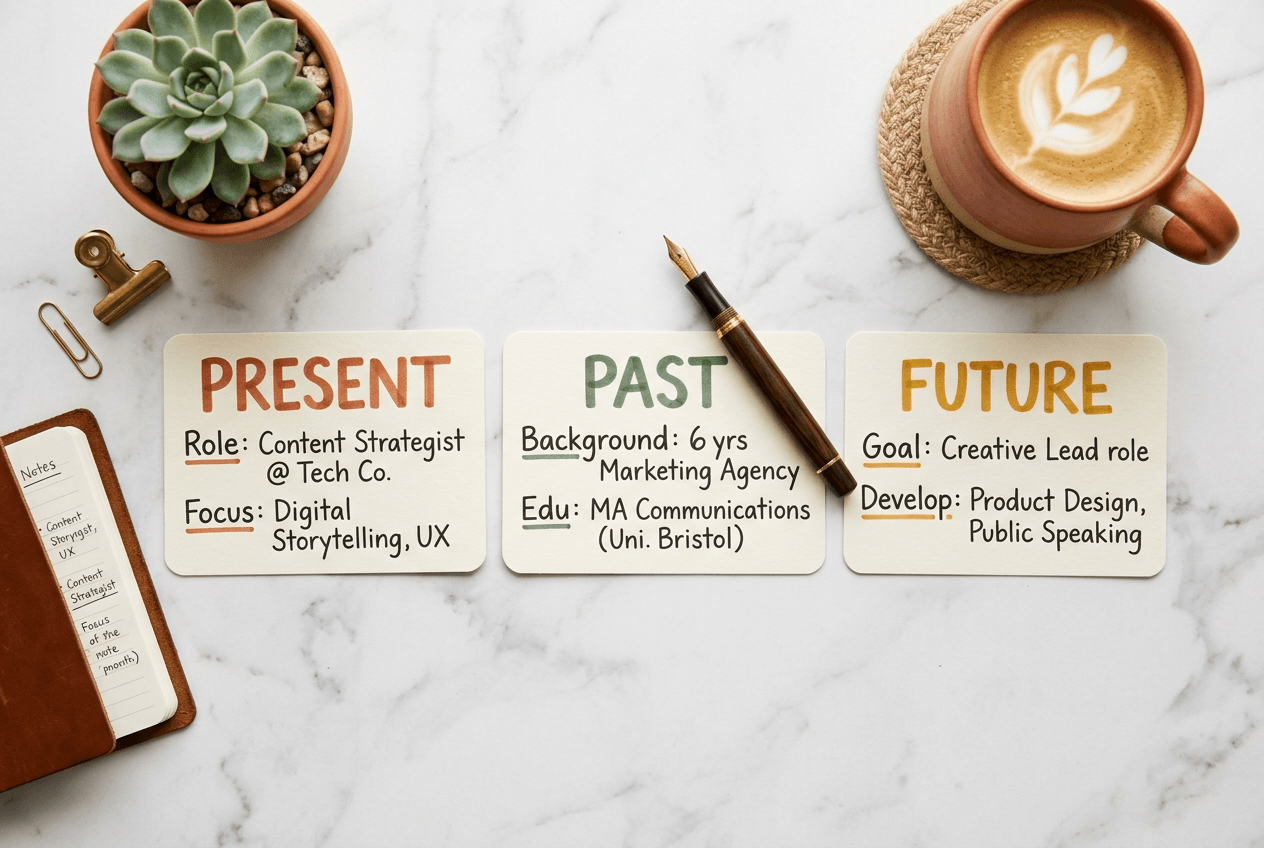
Forget memorizing a rigid script. The best way to introduce yourself in English follows a flexible three-part structure:
- Present — Who you are right now (your name, role, current situation)
- Past — Relevant background (experience, education, how you got here)
- Future — What's next (goals, excitement, what you're looking forward to)
This works because it gives your listener a complete picture in a natural order. It creates forward momentum — you're not just listing facts about yourself, you're telling a mini-story. And it gives you a clear ending point, so you never trail off with "um, yeah, that's basically it."
How long should it be? Aim for 30–60 seconds in casual settings, 60–90 seconds in professional or interview contexts. That's roughly 80–200 words spoken aloud. Shorter is almost always better — you can add details when someone asks follow-up questions.
Now let's see how to introduce yourself in English across five different situations, with examples at every level.
How to Introduce Yourself in English: Casual and Social Settings
At a party, a language exchange meetup, or while traveling — casual introductions should feel warm and relaxed. Use your first name, mention where you're from, and share something personal that invites conversation.
Key phrases to learn:
- "Hi, I'm [name]."
- "I'm from [city/country]."
- "I'm really into [hobby/interest]."
- "Nice to meet you!"
Beginner Example
"Hi, I'm Maria. I'm from Mexico City. I work as a teacher. I like cooking and traveling. Nice to meet you!"
Simple, clear, and friendly. At a beginner level, short sentences are perfectly fine — clarity matters more than complexity. You don't need fancy English to make a great first impression.
Intermediate Example
"Hey, I'm Maria! I'm originally from Mexico City, but I've been living in Toronto for about two years now. I'm a primary school teacher, and outside of work, I'm really into trying new restaurants and hiking. How about you?"
Notice the added detail and the question at the end — that turns your self-introduction into a conversation.
Advanced Example
"Hi there — I'm Maria. I moved to Toronto from Mexico City a couple of years ago, kind of on a whim, actually. I teach primary school, which keeps me on my toes, but on weekends you'll usually find me hunting down the best tacos in the city or dragging friends on hikes they didn't sign up for. What brings you here tonight?"
This version uses natural English idioms ("on a whim," "keeps me on my toes"), humor, and personality. It sounds like a real person, not a textbook.

How to Introduce Yourself in English: Professional and Networking Settings
Professional introductions need more structure. Lead with your name and role, then add context about what you actually do — not just your job title. End with why you're at this particular event or what you're looking for.
Key phrases to learn:
- "I work as a [role] at [company]."
- "I specialize in [area]."
- "My background is in [field]."
- "I'm here because [reason]."
Beginner Example
"Hello, my name is Kenji. I work as an engineer at Toyota. I design car parts. It's nice to meet you."
Direct and professional. Even with basic English vocabulary, this self-introduction communicates everything it needs to.
Intermediate Example
"Hi, I'm Kenji Tanaka. I'm a mechanical engineer at Toyota, where I work on electric vehicle components. I've been with the company for about six years now. I'm here today because I'm interested in the panel on sustainable manufacturing."
More context, more specificity. Mentioning why you're at the event gives the other person something to respond to and helps start a real conversation.
Advanced Example
"Great to meet you — I'm Kenji Tanaka. I lead the EV powertrain team at Toyota, so basically I spend my days trying to make electric motors smaller, lighter, and cheaper. Before that, I was at a startup in Osaka working on battery tech, which is actually how I got pulled into the electric vehicle space. I'm curious about the sustainability panel today — are you attending that one too?"
This reads like a real networking conversation. It tells a story, shows expertise, and opens a dialogue. If you want to master this kind of business English speaking practice, rehearsing with a conversation partner — even an AI one — makes a huge difference.

How to Introduce Yourself in English: Job Interview Context
The dreaded "Tell me about yourself." This isn't an invitation to recite your resume — it's your chance to frame your story in a way that connects directly to the role you want.
The Present–Past–Future framework is especially powerful when you need to introduce yourself in a job interview:
- Present: Your current role and one key responsibility
- Past: Relevant experience or achievement (quantify it if you can)
- Future: Why this specific role excites you
Keep it focused. Every sentence should answer the unspoken question: "Why should we hire you?"
If you're preparing for interviews in English, practicing your responses out loud is the single most effective thing you can do. Reading answers silently isn't the same — your mouth needs to form the words until they feel automatic.
Beginner Example
"My name is Priya Sharma. I am a software developer. I have three years of experience with Python and JavaScript. Before this, I studied computer science at Delhi University. I want to work at your company because I like your products and I want to grow my skills."
Clear and honest. The grammar is simple, but the structure is solid — that's what matters.
Intermediate Example
"I'm Priya Sharma, and I'm currently a software developer at a fintech startup in Delhi, where I build backend systems using Python. Over the past three years, I've helped migrate our main platform to a microservices architecture, which cut our deployment time by about 40%. I'm excited about this role because I'd love to work on larger-scale systems and learn from a more experienced engineering team."
Specific achievements with numbers make this introduction memorable. The "excited about" ending shows genuine interest.
Advanced Example
"Thanks for having me. I'm Priya — I've spent the last three years building backend infrastructure at a fintech startup in Delhi, primarily in Python. The project I'm most proud of is leading our migration to microservices, which took about eight months and brought our deployment cycles from weekly down to daily. What drew me to this role is your team's approach to infrastructure-as-code — it aligns with where I want to take my career, and honestly, the engineering blog posts from your team have taught me a lot already."
This version tells a story, shows genuine knowledge of the company, and demonstrates confidence without arrogance. For more English interview preparation strategies, including the STAR method and common mistakes non-native speakers make, check out our full English interview practice guide.

How to Introduce Yourself in English: Academic Settings
Whether you're starting a new class, joining a study group, or presenting at a conference — academic self-introductions should balance personal warmth with intellectual credibility.
Key phrases to learn:
- "I'm studying [subject] at [university]."
- "I'm in my [first/second/third] year of [program]."
- "My research focuses on [topic]."
- "I'm interested in [area] because [reason]."
Beginner Example
"Hi, I'm Ahmed. I'm a first-year student. I'm studying business at this university. I hope to learn a lot in this class."
Short and appropriate for a classroom setting where everyone introduces themselves briefly.
Advanced Example
"Hi everyone, I'm Ahmed Al-Rashid. I'm in my second year of the MBA program here, focusing on emerging markets. Before grad school, I worked in banking in Dubai for about five years, which is what got me interested in how capital flows into developing economies. I'm taking this elective because I want to understand the regulatory side better — looking forward to the case studies."
Notice how the advanced version connects past experience to current studies to future goals — the Present–Past–Future framework in action. If you're looking for more English conversation practice topics to build your academic speaking skills, we've compiled over 50 organized by level.
How to Introduce Yourself in English on a Phone or Video Call
Remote introductions require extra clarity. Without full body language cues, your voice and words do all the work. Here's how to adapt your English self-introduction for screens and phones.
Phone call tips:
- State your name clearly and slightly slower than normal
- Mention why you're calling within the first two sentences
- Smile while you speak — it genuinely changes your vocal tone (this is well-documented in communication research)
Video call tips:
- Make eye contact with the camera lens, not the screen
- Keep your background clean and well-lit
- A brief wave can replace a handshake naturally
Duolingo taught you words. No one taught you to speak.
PracticeMe: real voice conversations with an AI tutor, 24/7.
Phone Call Example
"Hi, this is Yuki Nakamura calling from Osaka Design Studio. I'm reaching out about the collaboration proposal you sent last week. Is this a good time to talk?"
Video Call Example
"Hey everyone — I'm Yuki Nakamura, joining from Osaka. I run the UX team at Osaka Design Studio, and I'll be your point of contact for this project going forward. Looking forward to working with you all."
On video calls, keep your self-introduction slightly shorter than you would in person — people's attention spans are shorter on screens, and you'll have time to share more as the meeting progresses.

Body Language and Tone: What Your Words Don't Say
Your words are only half the introduction. Research suggests people form first impressions in roughly seven seconds — long before you finish your second sentence. Here's what to focus on when you introduce yourself in English face-to-face.
What to do:
- Eye contact: Look at the person naturally, about 3–5 seconds at a time, then briefly glance away. On video calls, look at the camera lens.
- Smile: A genuine smile signals warmth and approachability. It also relaxes your voice and makes your English sound more natural.
- Posture: Stand or sit up straight with your shoulders relaxed. Uncross your arms — open body language invites conversation.
- Handshake: If the setting calls for one, make it firm but not crushing. One or two pumps is plenty.
- Pace: Nervous English speakers tend to rush. Consciously slow down by about 10–15%. Pausing between sentences sounds more confident than filling silence with "um."
What to avoid:
- Looking at the floor while speaking
- Fidgeting with your hands, phone, or hair
- Speaking so softly people need to lean in to hear you
- Crossing your arms (this signals defensiveness, not confidence)
If body language feels overwhelming on top of finding the right English words, remember: you can practice both at the same time. Stand in front of a mirror and introduce yourself out loud. Or practice with an AI tutor where you can focus on your speaking without worrying about being judged — the kind of consistent daily English speaking practice that builds lasting confidence over time.
American vs. British Introduction Customs
If you're learning English, you'll notice that American and British speakers introduce themselves quite differently. Understanding these cultural nuances helps you adapt your self-introduction to your audience.
| American Style | British Style | |
|---|---|---|
| Tone | Warm, enthusiastic, direct | Reserved, polite, understated |
| Names | First names almost immediately | Titles or surnames used longer |
| Personal details | Shared early ("I have two kids!") | Shared gradually, after rapport builds |
| Handshake | Firm grip | Moderate, brief |
| Small talk | Quick, then to the point | Expected before any business talk |
| Compliments | Given freely ("Love your jacket!") | More restrained |
American introduction example:
"Hey! I'm Jake. Great to meet you. So, what do you do?"
Americans tend to be direct and move to personal questions quickly. Don't be surprised if someone asks about your work within 30 seconds of meeting you — it's not rude, it's standard.
British introduction example:
"Hello, I'm James. Lovely to meet you. Terrible weather we're having, isn't it?"
British introductions often start with small talk about the weather, the event, or the journey to get there before moving to personal topics. Jumping straight to "What do you do?" can feel abrupt in a British context.
An interesting cultural note: traditionally in Britain, it was considered improper to introduce yourself with "Mr." or "Mrs." — you'd simply say your surname. As etiquette expert William Hanson has noted, Americans are "more effusive immediately" while the British tend to build warmth gradually.
Which style should you learn? Both — adaptability is the real skill. Practice Me offers AI tutors with both American and British accents, so you can rehearse your self-introduction in whichever style you need, or switch between them to become comfortable in any English-speaking context.

5 Common Mistakes When Introducing Yourself in English
1. Making It Too Long
The mistake: Telling your entire life story when someone just wants the highlights.
The fix: Set a mental timer. If your self-introduction takes longer than 60 seconds in a social setting (or 90 seconds in an interview), you're saying too much. Practice trimming until every sentence earns its place.
2. Being Too Formal for the Context
The mistake: Saying "Good day. My name is Carlos Rodriguez. I am an accountant by profession" at a casual barbecue.
The fix: Match your register to the room. If other people are saying "Hey," don't start with "Good afternoon." Listen to how others introduce themselves first, then mirror that level of formality.
3. Overusing Filler Words
The mistake: "So, um, my name is, like, Carlos, and, uh, I work in, um, accounting."
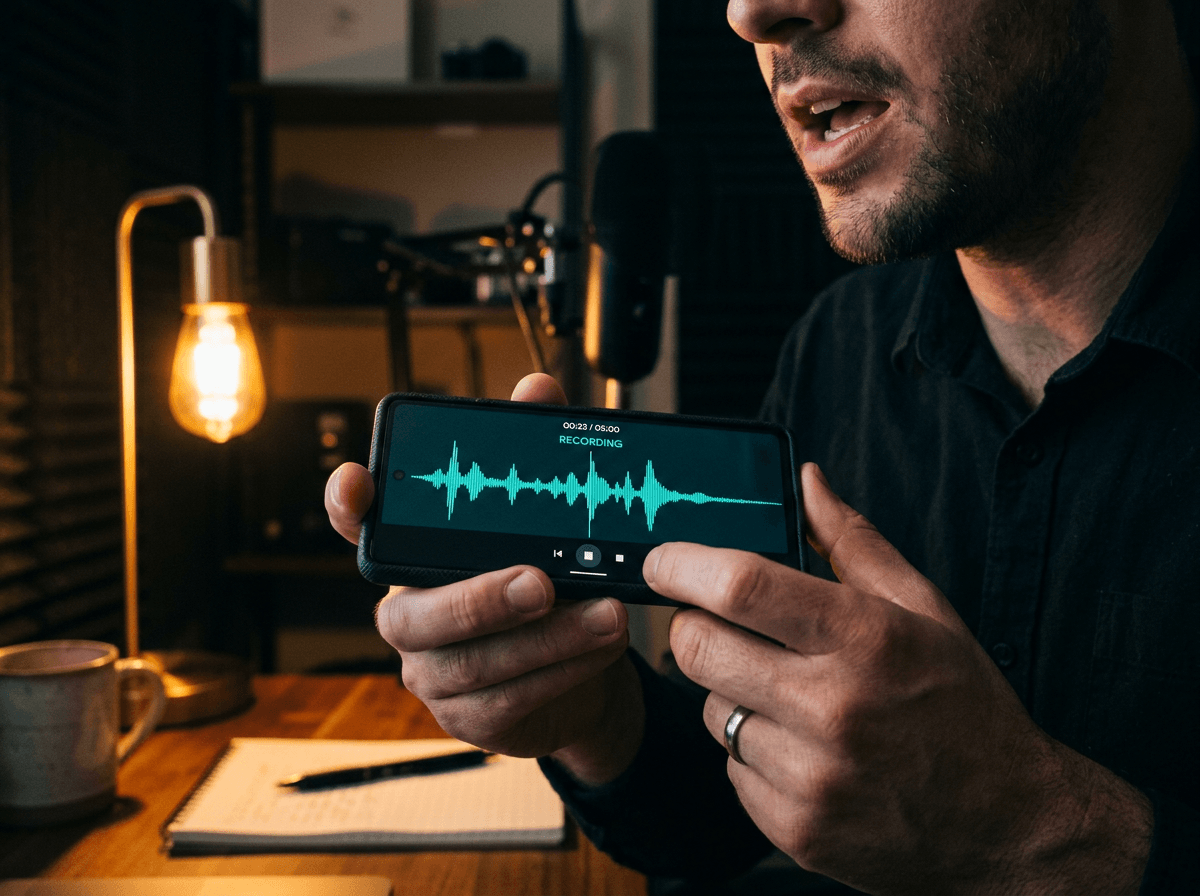
The fix: Filler words often come from rushing. Slow down. It's perfectly fine to pause silently while you think of the right English word. A pause sounds confident; "um" sounds uncertain. Recording yourself is the fastest way to catch this habit — most people don't realize how many fillers they use until they hear the playback.
4. Reciting a Memorized Script
The mistake: Delivering your introduction in a flat, robotic monotone because you memorized it word-for-word.
The fix: Memorize the structure (present, past, future), not the exact words. Know your three bullet points, but let the specific phrasing vary each time you practice. This keeps your delivery natural and conversational — which is how English actually sounds in the real world.
5. Forgetting to Show Personality
The mistake: Giving a technically correct English introduction that could belong to anyone: "I am a student. I study economics. I like reading."
The fix: Add one specific, memorable detail. Instead of "I like reading," try "I'm currently obsessed with science fiction — I just finished a book about time travel that completely blew my mind." Specific details make you interesting and give people something to ask about.
Practice Exercises to Improve Your English Self-Introduction
Reading about how to introduce yourself in English helps — but actually saying the words out loud is what builds real skill. Here are five exercises, ranked from easiest to most challenging:
Exercise 1: Write Three Versions Write out your self-introduction in English for three contexts: casual (meeting someone at a café), professional (a networking event), and interview ("Tell me about yourself"). Keep each under 100 words.
Exercise 2: Record and Listen Back Use your phone to record yourself delivering one of your introductions. Listen back carefully. Are there filler words? Is your pace too fast? Does it sound natural or robotic? Recording yourself feels awkward at first, but it's the fastest path to improvement.
Exercise 3: The 60-Second Challenge Set a timer for 60 seconds and introduce yourself in English. If you finish too early, add more detail. If you're still talking when the timer goes off, cut something. Do this five times and you'll find the perfect length.
Exercise 4: Mirror Practice Stand in front of a mirror and deliver your introduction while watching your body language. Are you making eye contact (with yourself)? Smiling? Standing confidently? This builds physical awareness alongside verbal fluency in English.
Exercise 5: Practice With an AI Conversation Partner The most effective practice simulates a real conversation. With Practice Me's AI tutors, you can introduce yourself in a real-time voice conversation — the tutor responds naturally, asks follow-up questions, and you get unlimited attempts with zero judgment. Try introducing yourself to Sarah (American accent) and then Oliver (British accent) to practice adapting your style to different English-speaking contexts.

If you tend to freeze up during introductions, you're not alone — and it's completely fixable. Start with our guide on how to overcome the fear of speaking English, then use these exercises to build confidence one practice session at a time.
For learners just starting their English journey, our English speaking practice for beginners page has additional resources designed for your level. And if you want to build vocabulary through conversations rather than flashcards, self-introductions are the perfect starting point — every time you practice, you reinforce the core vocabulary you'll use most often in English.
Frequently Asked Questions
How long should a self-introduction in English be?
In casual settings, aim for 30–60 seconds (about 80–150 words). For job interviews or professional presentations, 60–90 seconds works best. The key is saying enough to be memorable without going on too long. If someone wants more detail, they'll ask — that's the beauty of keeping your introduction concise.
What's the best way to start a self-introduction in English?
Start with a greeting and your name: "Hi, I'm [name]" works in almost every English context. Avoid the robotic "My name is [full name]" unless you're in a particularly formal setting. "Hi" or "Hey" signals warmth, while "Hello" or "Good morning" signals formality. Match your greeting to the room and you'll start off right.
How do I introduce myself in English if I'm nervous?
Preparation is the best cure for nerves. Write your introduction down, practice it out loud at least ten times, and record yourself once or twice to hear how it sounds. When the moment comes, take one deep breath before you start speaking, smile (this relaxes your voice), and remember that everyone feels a little nervous during introductions — even native English speakers. If anxiety around speaking English is a bigger challenge for you, read our full guide on how to overcome the fear of speaking English with proven, practical strategies.
Should I mention my nationality when introducing myself in English?
It depends on context. In social and academic settings, mentioning where you're from is a great conversation starter — people often have questions or connections to share. In professional settings, it's optional. If your background is relevant to your work (like "I bring experience from working in Southeast Asian markets"), include it. Otherwise, focus on your role and expertise. There's no single right answer here — go with what feels natural for the situation.
How can I practice English self-introductions alone?
The best solo methods are recording yourself on your phone, mirror practice for body language, and having voice conversations with AI conversation partners. Practice Me lets you have real-time voice conversations with AI tutors where you can rehearse your introduction, get natural follow-up questions, and refine your delivery without any judgment. Think of it as rehearsing with a patient friend who's available 24/7 and speaks with either an American or British accent.
If you want to speak English fluently and confidently, self-introductions are the perfect place to start. They're short enough to master quickly, you'll use them in almost every English conversation, and the confidence you build here carries into everything that follows.