Duolingo taught you words. No one taught you to speak.
PracticeMe: real voice conversations with an AI tutor, 24/7.
Hardest English Words to Pronounce (By Native Language)

What are the hardest words to pronounce in English? That depends entirely on who's asking. The words that trip you up are shaped by which language you already speak — and most pronunciation guides completely ignore this.
A Spanish speaker and a Japanese speaker don't struggle with the same English sounds at all. "Rural" is hard for everyone, but a Hindi speaker battles "west" vs "vest," while a Mandarin speaker wrestles with final consonants that seem to vanish. Your native language creates specific blind spots when you read and try to pronounce English words, and understanding yours is the fastest path to clearer speech.
This guide covers the hardest words to pronounce in English — first the universally brutal ones, then organized by native language background with IPA notation, meaning context, and specific fixes for each word. Whether you speak Spanish, Mandarin, Arabic, Hindi, or Japanese, you'll find your section below.
Quick Summary: The hardest English words to pronounce depend on your native language. Spanish speakers struggle with TH sounds and vowel distinctions. Mandarin speakers face R/L confusion and consonant clusters. Arabic speakers mix up P/B. Hindi speakers swap V/W. Japanese speakers add vowels between consonants. Below you'll find the trickiest words for each background — with IPA and targeted pronunciation tips.
The 10 Hardest Words to Pronounce in English (For Everyone)
Before diving into language-specific challenges, some hard English words to pronounce are objectively difficult — regardless of what language you speak.
English has what linguists call opaque orthography: the letters on the page often have a weak (or nonexistent) relationship to the sounds they represent. This happened because English borrowed words from French, Latin, Greek, Norse, and dozens of other languages — often keeping the original spelling while pronunciation evolved over centuries. When you read an English word for the first time, there's genuinely no reliable way to predict how it sounds.
The result? Silent letters, counter-intuitive consonant combinations, and vowel sounds that change the meaning of a word without changing its spelling.

Here are 10 of the most difficult English words to pronounce that stump nearly everyone:
| Word | IPA | Sounds Like | Why It's Hard |
|---|---|---|---|
| Rural | /ˈrʊrəl/ | ROOR-ul | Two R sounds sandwiching a vowel, then an L |
| Squirrel | /ˈskwɪrəl/ | SKWIR-ul | /skw/ cluster + /r/ + /l/ in two syllables |
| Worcestershire | /ˈwʊstərʃər/ | WOOS-ter-sher | Half the letters are silent |
| Colonel | /ˈkɜːrnəl/ | KUR-nul | The meaning is a military rank — but it sounds like "kernel" |
| Epitome | /ɪˈpɪtəmi/ | eh-PIT-uh-mee | That final "e" isn't silent — it's a full syllable |
| Sixth | /sɪksθ/ | SIKSTH | /ks/ then /θ/ forces your tongue to teleport |
| Mischievous | /ˈmɪstʃɪvəs/ | MIS-chuh-vus | Three syllables, not four — no "ee" before "vus" |
| Phenomenon | /fɪˈnɒmɪnən/ | fih-NOM-ih-nun | Four syllables with shifting stress |
| Queue | /kjuː/ | KYOO | Four silent letters. The meaning is "a line of people" but you'd never guess from the spelling |
| Choir | /kwaɪər/ | KWY-ur | Looks like it should rhyme with "chair" — it doesn't |
If you can nail all 10, you're ahead of many native English speakers. These are also great words to work into your daily English speaking practice routine. But the real pronunciation breakthroughs happen when you target the specific sounds your native language doesn't have.
Hard English Words to Pronounce for Spanish Speakers
Spanish speakers face a unique set of English pronunciation challenges because the two languages handle vowels, consonants, and rhythm very differently. If Spanish is your first language, these are the most common difficult words to pronounce and the specific sounds behind each one.
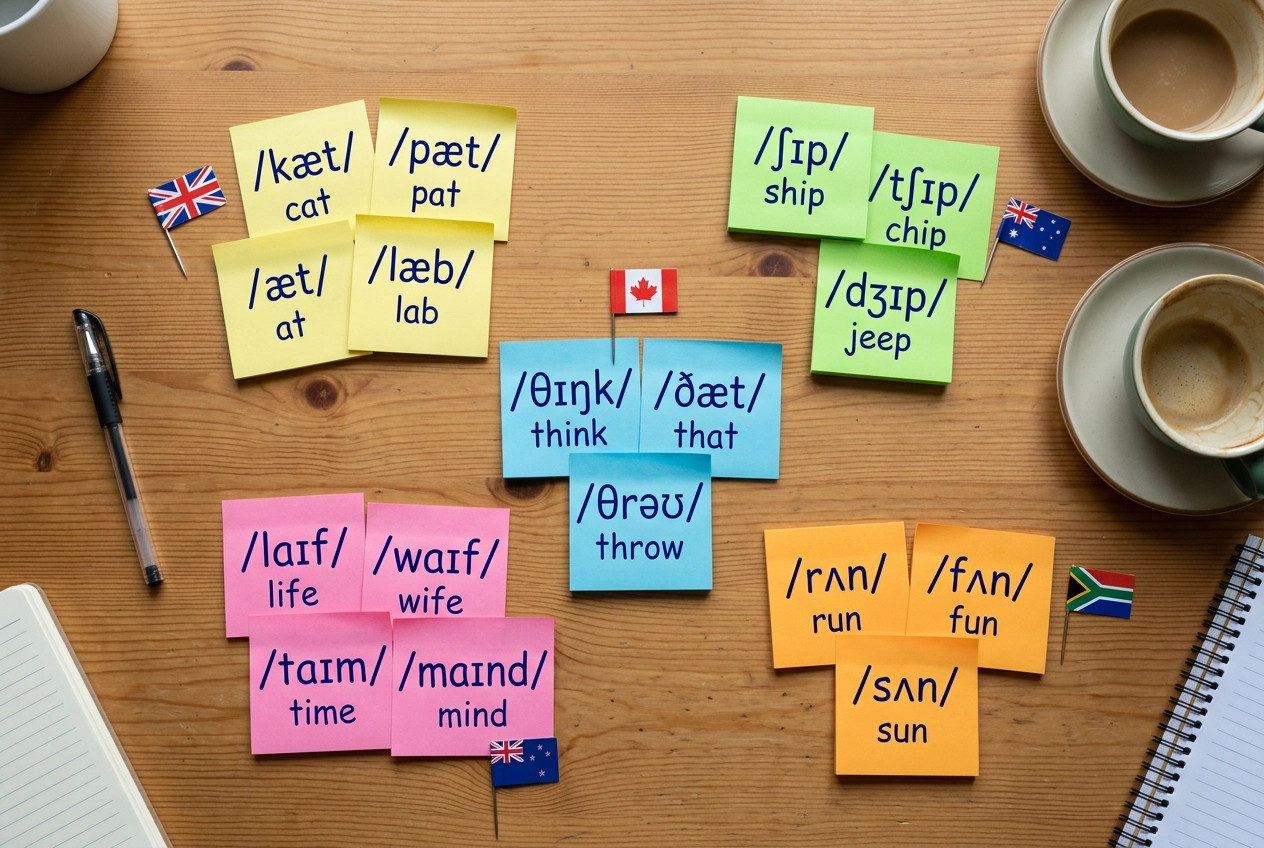
Why These Words Are Hard
- Vowel overload. Spanish has 5 vowel sounds. English has over 20. Word pairs like "ship/sheep," "cat/cut," and "full/fool" sound nearly identical to Spanish ears, yet carry completely different meanings.
- The TH sounds don't exist. English has two TH sounds — voiceless /θ/ ("think") and voiced /ð/ ("this"). Most Spanish speakers substitute /t/, /d/, or /s/.
- Initial S + consonant clusters. Spanish words never begin with /s/ + consonant, so you naturally add a vowel: "Spain" → "Espain."
- V and B sound identical in Spanish. English treats them as completely different sounds that change word meaning.
10 Words With Pronunciation Fixes
| Word | IPA | Common Error | Fix |
|---|---|---|---|
| Think | /θɪŋk/ | "tink" or "sink" | Tongue between teeth, blow air over it |
| Comfortable | /ˈkʌmftəbəl/ | "com-for-TAH-bleh" | Only 3 syllables: KUMF-ter-bul |
| Beach | /biːtʃ/ | Sounds like "bitch" /bɪtʃ/ | Hold the /iː/ longer — stretch it out |
| Cat | /kæt/ | Sounds like "cut" /kʌt/ | Open jaw wider for /æ/, almost like saying "ah" |
| Village | /ˈvɪlɪdʒ/ | "billage" | Top teeth on bottom lip + vibration = V |
| World | /wɜːrld/ | "worl" (drops the D) | Round lips for W, curl tongue for R, then L-D |
| Specific | /spəˈsɪfɪk/ | "espesific" | Start with "ssss" then add the P immediately |
| Wednesday | /ˈwɛnzdeɪ/ | "wed-NES-day" | The first D and the second E are silent when you read it aloud |
| Thorough | /ˈθʌroʊ/ | "toro" | TH + the "uh" vowel + "oh" ending |
| Vocabulary | /voʊˈkæbjəlɛri/ | "boh-kah-boo-LAH-ree" | V at the start (not B), schwa on unstressed syllables |
For a deeper breakdown, read our dedicated guide to hard English words for Spanish speakers.
Quick tip for Spanish speakers: The schwa /ə/ — that lazy "uh" sound — is the most common vowel in English but doesn't exist in Spanish. Learning to "under-pronounce" unstressed syllables is one of the biggest pronunciation improvements you can make. Practice using tongue twisters for pronunciation or follow our pronunciation practice for beginners guide with its 10-minute daily warm-up.
Hard English Words to Pronounce for Chinese (Mandarin) Speakers
Mandarin and English couldn't be more different phonetically. Mandarin is a tonal language with simple syllable structures (mostly consonant + vowel). English piles consonants together and uses stress patterns instead of tones to convey meaning. That makes many common English words extremely difficult to pronounce for Mandarin speakers.

Why These Words Are Hard
- R and L confusion. Mandarin's /ɻ/ sound is produced differently from English R and L. The distinction between "right" and "light" can be genuinely hard to hear, yet these words have completely different meanings.
- No consonant clusters. Mandarin syllables almost never stack consonants. An English word like "strengths" (/strɛŋkθs/) has six consonant sounds — a structure that doesn't exist in Chinese.
- Final consonants get dropped. Mandarin words mostly end in vowels or nasals. When you read English words aloud, word-final consonants like /d/, /t/, /k/, /z/ often disappear.
- Voiced vs voiceless confusion. English B/P, D/T, G/K work differently than Mandarin's aspirated/unaspirated system.
10 Words With Pronunciation Fixes
| Word | IPA | Common Error | Fix |
|---|---|---|---|
| World | /wɜːrld/ | "wo-d" (drops R, L) | Practice R and L separately, then combine |
| Girl | /ɡɜːrl/ | "guh" (drops R, L) | Hold the /ɜːr/ sound, then add L at the end |
| Strength | /strɛŋkθ/ | "suh-tren" | Build up: s→st→str, then add "ength" |
| Clothes | /kloʊðz/ | "clo-zuh" | KLOHZ — the TH is barely audible even for natives |
| Three | /θriː/ | "suh-ree" or "free" | Tongue between teeth + immediate R |
| Very | /ˈvɛri/ | "wery" | Top teeth on bottom lip, feel the vibration |
| Rice vs Lice | /raɪs/ vs /laɪs/ | Sound the same | R: tongue curls back, no contact; L: tongue tip touches ridge |
| Desks | /dɛsks/ | "des" (drops final cluster) | Hold the /s/ then add /ks/ — slow at first |
| Asked | /æskt/ | "as" | Three final consonants: /s/ + /k/ + /t/ |
| Vegetable | /ˈvɛdʒtəbəl/ | "we-ji-tah-bu" | Starts with V (not W), only 3 syllables in fast speech |
Quick tip for Mandarin speakers: Start practicing consonant clusters by working backward. Pronounce the last consonant first, then add one at a time: t → kt → skt (for "asked"). This builds muscle memory without the overwhelm. You can also build English vocabulary through conversations that naturally use these difficult words, and our guide on improving English speaking as a non-native has more targeted exercises.
Hard English Words to Pronounce for Arabic Speakers
Arabic speakers bring a rich consonant inventory to English — sounds like /x/, /ħ/, and /ʕ/ that English doesn't even have. But that advantage flips when English demands sounds that Arabic lacks. Here are the English words hard to pronounce that Arabic speakers should focus on.

Why These Words Are Hard
- P doesn't exist in Standard Arabic. The /p/ sound is absent, so "park" and "bark" merge — two completely different meanings become the same word.
- V doesn't exist either. Arabic speakers substitute /f/, turning "very" into "ferry" — again, a different word and meaning.
- Only 3 base vowels. Arabic has /a/, /i/, /u/ (with long/short variants). English has over 20 vowel sounds. The distinctions between "bat," "bet," "bit," "but," and "put" are hard to hear and even harder to pronounce.
- Arabic spelling is nearly phonetic. English's chaotic spelling-to-sound relationship feels arbitrary when you read new words.
Duolingo taught you words. No one taught you to speak.
PracticeMe: real voice conversations with an AI tutor, 24/7.
10 Words With Pronunciation Fixes
| Word | IPA | Common Error | Fix |
|---|---|---|---|
| Park | /pɑːrk/ | "bark" /bɑːrk/ | P is aspirated — hold paper near mouth, it should puff |
| Pepper | /ˈpɛpər/ | "bebber" | Every P needs that burst of air |
| Very | /ˈvɛri/ | "ferry" | Top teeth on bottom lip + voice vibration (not just air) |
| Village | /ˈvɪlɪdʒ/ | "fillage" | Same V fix — teeth on lip, feel vocal cords buzz |
| Church | /tʃɜːrtʃ/ | "shursh" | Starts with /t/ + /ʃ/ combined — tongue hits roof |
| Pull vs Pool | /pʊl/ vs /puːl/ | Sound the same | "Pool" holds the OO longer; "pull" is shorter, more relaxed |
| Bat vs But | /bæt/ vs /bʌt/ | Sound the same | "Bat": jaw drops, wide mouth; "But": relaxed center mouth |
| Psychology | /saɪˈkɒlədʒi/ | "puh-sychology" | The P is 100% silent — start with the S |
| Comfortable | /ˈkʌmftəbəl/ | "com-FOR-ta-bel" | Stress first syllable, swallow the middle |
| Penguin | /ˈpɛŋɡwɪn/ | "benguin" | Two separate challenges: P at start + /ŋɡw/ cluster |
Quick tip for Arabic speakers: The P/B distinction is purely about air pressure. Put your hand in front of your mouth: when you pronounce the word with P, it should produce a noticeable puff. B shouldn't. Practice these pairs: park/bark, pet/bet, pin/bin, pear/bear. Reading them aloud helps your mouth learn the difference. For structured practice, try our pronunciation practice for beginners daily routine, or explore ESL speaking practice activities for self-study.
Hard English Words to Pronounce for Hindi Speakers
Hindi and English share some history (both Indo-European languages), which helps with vocabulary and meaning recognition. But phonetically, there are deceptive traps — sounds that seem similar but work completely differently when you pronounce them in English.

Why These Words Are Hard
- V and W are allophones in Hindi. The letter व sounds like either V or W depending on context, and native Hindi speakers often can't hear the difference. In English, swapping them changes the meaning entirely (vine/wine, vet/wet).
- TH sounds don't exist. Hindi speakers substitute retroflex /ʈ/ or /ɖ/, making "think" sound like "tink" and "the" sound like "da."
- Hindi is phonetic — English isn't. Silent letters feel like lies. You read "Wednesday" and expect every letter to produce a sound. It doesn't.
- The /ʒ/ sound is missing. Words like "vision" and "pleasure" get pronounced with /dʒ/ instead, creating confusions like "version" → "virgin" — words with very different meanings.
10 Words With Pronunciation Fixes
| Word | IPA | Common Error | Fix |
|---|---|---|---|
| West | /wɛst/ | "vest" /vɛst/ | Round lips into a small O, push air — no teeth touching |
| Wine | /waɪn/ | "vine" /vaɪn/ | Same lip rounding — imagine blowing out a candle gently |
| Think | /θɪŋk/ | "tink" | Tongue between teeth, not behind them |
| The | /ðə/ | "da" | Same tongue-between-teeth position + voice vibration |
| Vision | /ˈvɪʒən/ | "virjun" | /ʒ/ is like /ʃ/ (sh) but with voice — no D before it |
| Pleasure | /ˈplɛʒər/ | "pledger" | That middle sound is /ʒ/, not /dʒ/ |
| Wednesday | /ˈwɛnzdeɪ/ | "wed-NEES-day" | First D is silent, second E is silent when you read it |
| Comfortable | /ˈkʌmftəbəl/ | "com-FOR-tay-bul" | Three syllables in natural speech, not five |
| Development | /dɪˈvɛləpmənt/ | "de-VE-lop-ment" (equal stress) | Stress falls on VEL — everything else stays soft |
| Psychology | /saɪˈkɒlədʒi/ | "puh-sy-cho-lo-gy" | P is silent. Start with the S sound. |
Quick tip for Hindi speakers: For V vs W, here's a physical test you can do right now — V requires your top teeth to touch your bottom lip. W requires your lips to round without any teeth involved. Practice in front of a mirror: say "vine, wine, vine, wine" and watch your mouth. You'll see and feel the difference. For more exercises, read our tips to improve English speaking skills, and if pronunciation anxiety holds you back, our guide on overcoming the fear of speaking English can help.
Hard English Words to Pronounce for Japanese Speakers
Japanese speakers face some of the biggest phonetic gaps when learning English. The Japanese sound system is built on a strict consonant-vowel pattern, and its single liquid consonant /ɾ/ (a quick flap) sits halfway between English R and L — making both of these sounds extremely difficult to pronounce correctly.
Why These Words Are Hard
- R/L confusion. Japanese has one sound where English has two. "Right" and "light," "rice" and "lice" — all can sound identical, despite meaning entirely different things.
- No consonant clusters. Japanese syllables follow a (C)V pattern. When English stacks consonants (str-, -nkths, -lds), Japanese speakers instinctively insert vowels: "strike" → "sutoraiku."
- Vowel additions after final consonants. "Dog" becomes "dogu," "desk" becomes "desuku." These extra syllables change how the word sounds.
- Only 5 vowels. English has over 20 distinct vowel sounds. The /æ/ (cat), /ʌ/ (cut), and /ɑː/ (car) distinctions are especially difficult to pronounce because these sounds don't exist in Japanese.
10 Words With Pronunciation Fixes
| Word | IPA | Common Error | Fix |
|---|---|---|---|
| Really | /ˈriːəli/ | "riari" or "leally" | R: curl tongue back without touching; L: touch ridge behind teeth |
| World | /wɜːrld/ | "warudo" | Practice: "wer" → "werld" — resist the urge to add vowels |
| Strength | /strɛŋkθ/ | "sutorengusu" | Start with "st-" only. Then "str-". Build gradually. |
| Clothes | /kloʊðz/ | "kurozusu" | Just say "KLOHZ" — it's one syllable |
| Through | /θruː/ | "suruu" | Tongue between teeth + R immediately after |
| Girl | /ɡɜːrl/ | "gaaru" | The /ɜːr/ sound is one merged vowel-R, then L at the very end |
| Rarely | /ˈrɛrli/ | Extremely difficult | R → vowel → R → L → vowel — practice each transition slowly |
| Library | /ˈlaɪbrɛri/ | "raiburari" | Starts with L (tongue on ridge), B in middle, R after |
| Comfortable | /ˈkʌmftəbəl/ | "konforutaburu" | Three syllables only: KUMF-ter-bul |
| Squirrel | /ˈskwɪrəl/ | "sukuireru" | The ultimate boss: /skw/ + /ɪr/ + /əl/ — two syllables |
Quick tip for Japanese speakers: Your biggest win is learning to resist adding vowels between consonants. When you catch yourself saying "desuku" for "desk," try holding the final /k/ with your mouth closed — no vowel escapes. Practice with a hand on your throat to feel when you're adding a sound that shouldn't be there. For more practice with complex English words, check out our vocabulary guide. You can also read our guide on how to practice English speaking alone for exercises without a partner.
Why Your Native Language Matters When You Practice Pronunciation

Generic pronunciation advice — "just listen and repeat" — ignores the reality that every learner arrives with a different set of challenges. A Mandarin speaker working on R/L distinction doesn't need the same exercises as an Arabic speaker mastering P/B. The hardest words to pronounce in English are different for every language background, and your practice should reflect that.
This is why conversation-based practice works better than isolated drills. In real conversation, you encounter hard sounds in context — not in a vacuum. You hear how words connect, how stress shifts, and how sounds change in natural speech. That's how you actually learn to pronounce them correctly.
Practice Me's AI tutors are available 24/7 for real-time voice conversation practice — in both American and British accents. You can focus English conversations on topics that naturally use your problem sounds, and the AI adapts to your level as you improve. If speaking English feels intimidating, an AI tutor offers a judgment-free space to practice without pressure.
If you're just starting out, our pronunciation practice for beginners guide has a 10-minute daily routine. Want to compare training approaches? We've reviewed the best pronunciation apps available right now. And for a complete roadmap to fluency, read our guide on how to become fluent in English.
Start with the sounds that are hardest for your specific background — not just the words everyone talks about. The tables above are your roadmap.
Frequently Asked Questions
What is the single hardest English word to pronounce?
For non-native speakers, "rural" (/ˈrʊrəl/) consistently ranks as the most difficult word to pronounce in English. The back-to-back R sounds separated by a short vowel, followed by an L, creates a combination that's challenging for virtually every language. "Squirrel" is a close second — German speakers in particular find it nearly impossible to read aloud correctly.
Why is English pronunciation so irregular?
English borrowed words from dozens of languages over centuries — French, Latin, Greek, Norse, Arabic, Hindi, and more. Words often kept their original spelling while the way people pronounced them evolved. The result is a language where "ough" can sound at least 6 different ways (though, through, rough, cough, thought, borough). When you read an English word, you're often reading history rather than phonetics. This is why learning to pronounce English requires practice and exposure, not just memorization.
How can I practice pronouncing difficult English words?
Start by identifying which sounds are hardest for your native language using the tables above. Then:
- Practice minimal pairs — two words that differ by one sound, like "ship/sheep" or "right/light" — to train your ear to hear the meaning difference
- Record yourself and compare to native speakers
- Use tongue twisters for pronunciation practice that target your specific problem sounds
- Have real conversations where you actually use these words — apps like Practice Me let you practice English speaking with AI anytime, which means more natural exposure to hard words in context
Do pronunciation challenges change with fluency level?
Yes. Beginners struggle with individual sounds (TH, R/L, vowel distinctions). Intermediate learners typically face word stress and rhythm issues — stressing the wrong syllable or giving equal weight to every syllable. Advanced learners work on connected speech: linking, elision (dropping sounds), and intonation — the meaning of a sentence shifts when you read it with different emphasis. Our guide on how to speak English fluently and confidently covers these stages.
Which English accent is easier to learn — American or British?
Neither is objectively "easier" — it depends on your exposure and goals. American English is more common in global media, so many learners find it more familiar to pronounce. British English (Received Pronunciation) has non-rhotic R (the R in "car" is soft), which some learners find simpler. The best approach is to pick one accent and be consistent. Read our guides on learning an American accent or a British accent to decide which suits you.