Duolingo taught you words. No one taught you to speak.
PracticeMe: real voice conversations with an AI tutor, 24/7.
How to Order Food in English: Phrases & Practice
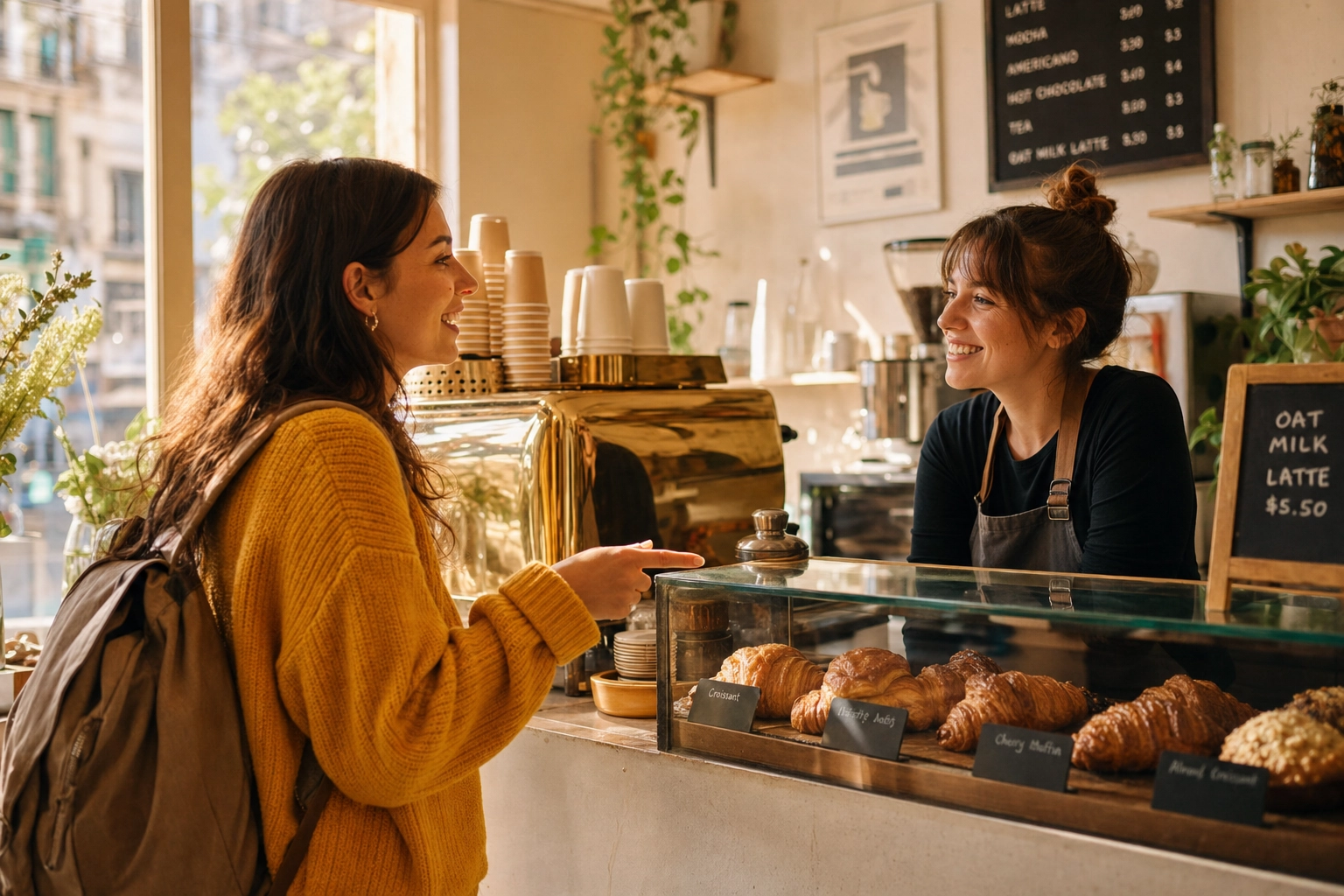
Your heart speeds up as the line shrinks. In a few seconds the barista will look at you and ask what you'd like — and your mind goes blank. If that feeling sounds familiar, you're in good company. Learning how to order food in English is one of the first real-world tests every English learner faces, and it can feel weirdly high-stakes for something as simple as buying a sandwich.
Here's the good news: ordering food follows a script. Cafés, drive-throughs, and white-tablecloth restaurants all run on a small set of predictable phrases. Once you know the pattern — and the handful of polite phrasings native speakers actually use — you can walk in, order with confidence, and walk out with exactly what you wanted. This guide gives you the phrases, the cultural rules, and five full dialogues you can rehearse out loud before you ever set foot in a restaurant.
Quick Summary: To order food in English, follow a simple four-step script: greet, order, answer a few questions, then pay and say thanks. Use polite phrasings like "Could I get…" or "I'd like…" (never "I want…"), always add "please" and "thank you," and learn the local rules for tipping and asking for the bill. Rehearse the five dialogue scripts at the end until the words come automatically.
The Universal Script Behind Almost Every Food Order
Whether you're at a food truck or a fine-dining restaurant, the conversation almost always moves through the same four stages:
- Greeting — A quick hello. ("Hi, how are you?")
- Ordering — You say what you want. ("Could I get a medium latte, please?")
- Clarifying questions — They ask a few things. ("For here or to go?")
- Paying and thanks — You pay and say thank you. ("Card, please. Thanks!")
That's it. Memorizing hundreds of random phrases is exhausting; recognizing this one pattern is freeing. When you know what's coming next, a fast-talking server stops being scary — you're just filling in the blanks of a script you already know. Learn that rhythm and you've basically mastered how to order food in English anywhere: the words change from place to place, but the structure almost never does. The rest of this guide walks through each stage, plus the specific situations (cafés, drive-throughs, allergies, the check) where the wording changes.
"I Want" vs. "I'd Like": The Politeness Trap
If you remember one thing from this guide, make it this: in English, how you ask is often more important than what you ask for. The phrase "I want a coffee" is perfectly grammatical, and a textbook may have taught it on day one. But in a café or restaurant, it lands as blunt — even a little demanding or childish. Native speakers almost never order that way.
Instead, English speakers soften requests with a politeness ladder. Here it is, from most casual to most formal:
| Phrasing | When to use it | Example |
|---|---|---|
| I want… | ❌ Avoid in service settings | I want a burger. |
| I'll have… / I'll get… / I'll take… | Casual, friendly, very common | I'll have the cheeseburger. |
| Can I have… / Can I get… | Polite everyday standard | Can I get a flat white? |
| Could I have… / Could I get… | A touch more polite | Could I get the soup, please? |
| I'd like… | Polished, works everywhere | I'd like the grilled salmon. |
| May I have… | Most formal | May I have the wine list? |
Notice what's doing the heavy lifting at the bottom of that ladder: the word please. In a long-running thread in the r/EnglishLearning community, the consensus is that the verb you choose matters far less than two small habits learners often skip — adding please to the request, and saying thank you when your food arrives. Drop those, and even a "correct" sentence can sound abrupt. Add them, and almost any phrasing sounds friendly.
There's an upper limit, too. "Could I please get the soup?" is about as polite as you ever need to be. Piling on extra words — "if it's not too much trouble, might I perhaps possibly…" — actually sounds odd, even sarcastic. Aim for warm and simple, not grovelling. For more on the small phrases that make you sound less like a textbook, see our guide to sounding more natural in English.
Casual Ordering: Cafés, Coffee Shops & Fast Food
Counter service is fast and informal. The line is moving, the staff are busy, and nobody expects a speech — they want a clear, friendly order. Keep it short.
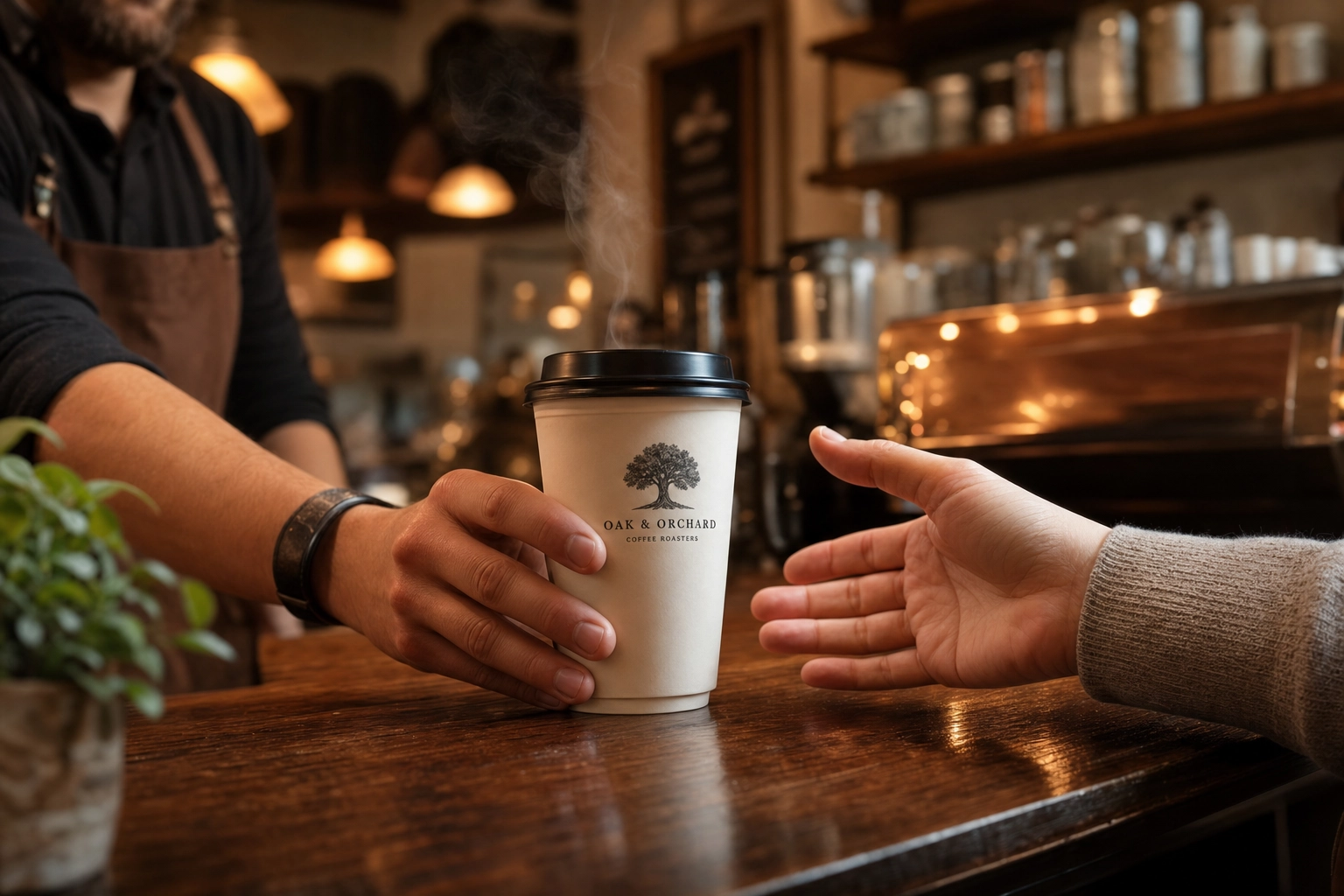
At the Coffee Shop (and Decoding Starbucks Sizes)
Most independent cafés use plain small, medium, and large. Big chains can be trickier. Starbucks, famously, uses Italian-inspired sizes that confuse even native speakers:
| Starbucks size | Roughly | Notes |
|---|---|---|
| Short | 8 oz | Not on the menu — you can still ask for it (hot drinks) |
| Tall | 12 oz | This is the "small" |
| Grande | 16 oz | The "medium" — grande is Italian for "large" |
| Venti | 20 oz hot / 24 oz iced | Venti means "20" in Italian |
| Trenta | ~30 oz | Iced drinks only; trenta means "30" |
You don't have to use those words — "a medium latte, please" works almost everywhere. The one question you'll nearly always hear at a café is "For here or to go?" (Are you drinking it in the shop, or taking it with you?). Answer with "For here" or "To go." In the UK you might hear "Eat in or takeaway?" instead.
Handy café phrases:
- "Can I get a grande oat-milk latte, please?"
- "I'll have a small black coffee — for here."
- "Could I get that decaf?"
- "Can I have it extra hot, with an extra shot?"
- "Do you have any oat milk?"
Fast Food & Counter Service
At fast-food counters, the magic word is combo (US) or meal (UK) — that's the main item plus fries and a drink bundled together, usually numbered on the board.
- "I'll get the number 3, please." (orders the whole combo)
- "Can I have a cheeseburger — no pickles?"
- "Just the sandwich on its own, please." (no combo)
- "Can I get that as a meal, with a Coke?"
- "To go, please." / "For here."
If you don't catch a price or a question, it's completely fine to say "Sorry, could you say that again?" Staff hear accents all day and won't mind one bit.
Sit-Down Restaurants: From the Door to "That Was Delicious"
Sit-down restaurants involve more steps and a little more conversation, but the same script applies — just stretched across the meal. You'll talk to your server several times: when you're seated, when you order drinks, when you order food, partway through the meal, and when you pay.
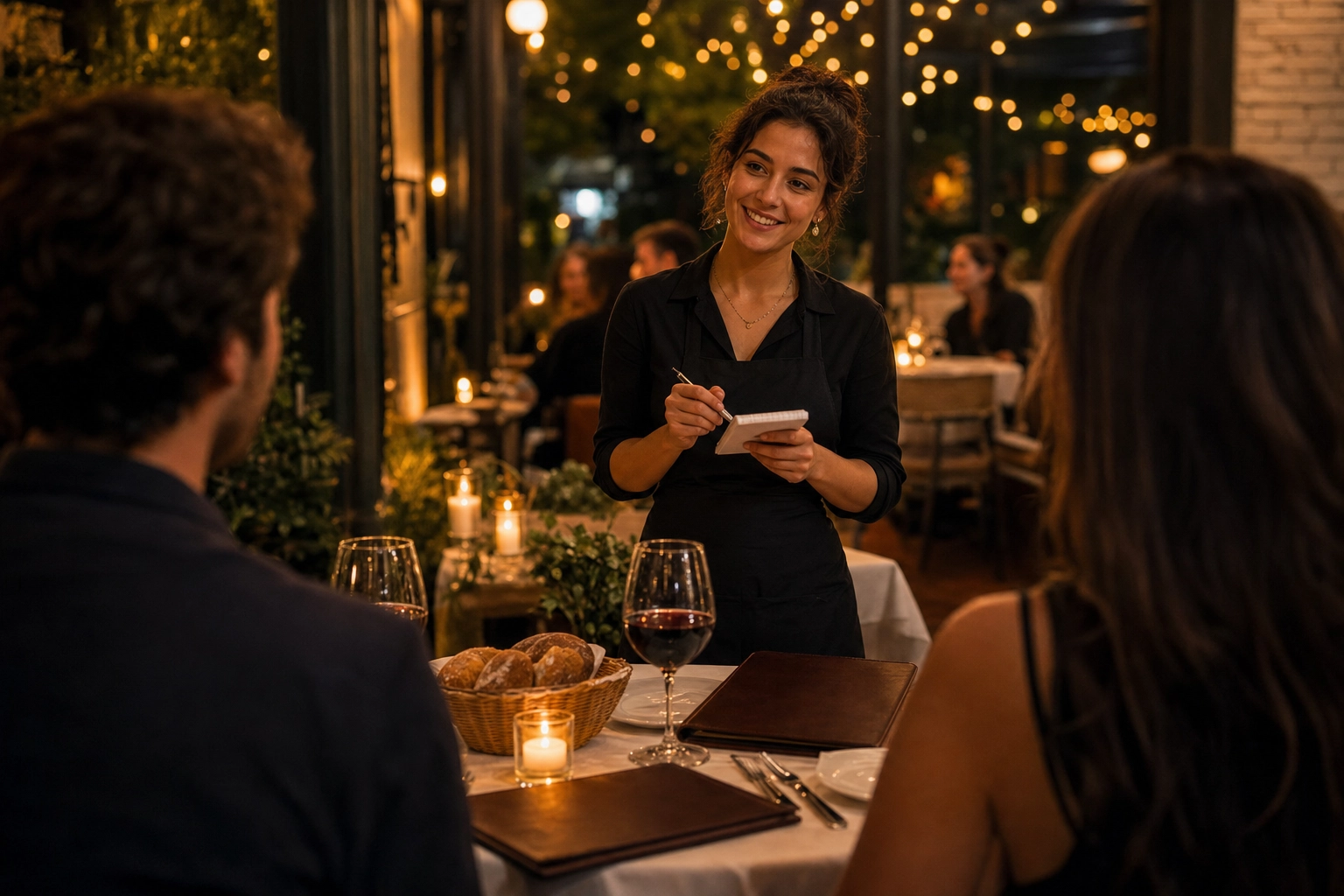
Getting Seated
If you booked ahead, you have a reservation (in the UK, you might also call it a booking).
- "Hi, I have a reservation under [name], for two."
- "We don't have a reservation — is there a table for three?"
- "Table for two, please."
The host may ask: "Do you have a reservation?", "How many in your party?" (party = your group, not a celebration), or "Would you prefer a booth or a table?"
Reading the Menu & Asking Questions
A few menu words differ by country. In the US, a small first dish is an appetizer and the main dish is the entrée; in the UK, that first dish is a starter, and confusingly "entrée" can sometimes mean the starter rather than the main. The shared terms — starter/appetizer, main course, side, dessert — are safe almost everywhere.
Don't be shy about asking questions. Servers expect them:
- "What do you recommend?"
- "What's in the [dish]?"
- "What are today's specials?"
- "Is this dish very spicy / very rich?"
- "Is it big enough to share?"
Need a moment? Say "Could we have a few more minutes, please?" And while you decide, natural English filler words like "um," "let me see," and "I think I'll go with…" buy you time without awkward silence. It also helps to build out your everyday English vocabulary so common menu words feel familiar before you arrive.
Placing Your Order
In a sit-down restaurant you often order in courses — starter first, then main. You can also order for other people at the table.
- "To start, I'll have the soup."
- "For my main, I'd like the grilled salmon, please."
- "She'll have the steak, and I'll get the pasta."
- "We'll share the calamari to start."
- "Could we get some bread for the table?"
Special Requests & Modifications
Restaurants customize orders constantly — you're not being difficult. The single most useful phrase is "on the side," which means a sauce or dressing arrives in a separate dish so you control how much you use.
- "Could I get the dressing on the side?"
- "No onions, please." / "Can you make it without cheese?"
- "Is it possible to get extra sauce?"
- "Could I swap the fries for a salad?"
- "Can I get this well done?"
Dietary Restrictions & Allergies: Phrases That Keep You Safe
This is the one situation where you should drop the soft, indirect phrasing and be clear and direct — your health may depend on it. Kitchens handle this every day and take it seriously.

Allergies:
- "I have a severe nut allergy. Does this contain any nuts?"
- "I'm allergic to shellfish — is there any in this dish?"
- "Could the kitchen double-check the ingredients for me?"
Vegetarian and vegan:
- "I'm vegetarian — which dishes have no meat?"
- "Do you have any vegan options?"
- "Is this cooked with any animal products or butter?"
Gluten-free and other needs:
- "Is this gluten-free?" / "Do you have a gluten-free menu?"
- "I can't eat gluten / dairy / pork."
- "Do you have any halal or kosher options?"
If your allergy is serious, say the word "allergy" out loud — it signals to the kitchen that this is a safety issue, not a preference, and staff will often change gloves or check labels. Here, clarity beats politeness every time.
When Something's Wrong: Sending Food Back Politely
Got the wrong dish, or something isn't cooked right? Speak up — politely, but clearly. Servers genuinely want to fix it, and staying quiet just leaves you with a meal you don't enjoy.
- Wrong order: "Excuse me, I think there's been a mix-up — I ordered the chicken, not the fish."
- Undercooked: "Sorry to bother you — I think this might be a little undercooked. Would you mind putting it back on for a few minutes?"
- Cold food: "This came out a bit cold. Could I get a fresh one?"
- Something's off: "I'm really sorry, but this doesn't taste quite right. Could I swap it for something else?"
The formula that works: a soft opener ("Excuse me" / "Sorry to bother you"), a calm statement of the problem, and a clear request — usually framed with "Would you mind…" or "Could I…". No anger required.
The Bill, Splitting & Tipping (Big Cultural Differences)
Here's a rule that surprises many visitors: in the US, UK, Canada, and Australia, your server usually won't bring the bill until you ask for it. Sitting at the table after you finish is normal and not rude — but when you're ready to leave, you'll need to flag it down.
Asking for the Check or Bill
Americans usually say check; Brits and most others say bill. Both work, and both sound better with a please.
- "Could we get the check, please?"
- "Can I have the bill when you get a chance?"
- "Whenever you're ready, we'll take the bill."
To get your server's attention, make eye contact and raise a hand slightly. Calling out across the room or snapping your fingers is considered rude in most English-speaking countries.
Duolingo taught you words. No one taught you to speak.
PracticeMe: real voice conversations with an AI tutor, 24/7.
Splitting the Bill
Eating with friends? These phrases sort out who pays:
- "Can we split the bill?" (divide it evenly)
- "Could we get separate checks?" (each person pays for their own)
- "Can we pay separately?"
- "I'll get this one." / "It's on me." (you're treating everyone)
- "Let's split it three ways."
- "Let's go Dutch." (informal — everyone pays their own share)
Tipping Around the World
Tipping is where confident travelers get tripped up, because the rules swing wildly from country to country. Tip too little in New York and you've offended your server; tip at all in Tokyo and you may offend yours. Here's a quick reference:
| Country / region | Typical restaurant tip | Notes |
|---|---|---|
| United States | 18–20% (up to ~22% for great service) | Tip on the full bill; card machines often prompt you |
| Canada | 15–20% | Similar to the US; ~18% is common |
| United Kingdom | 10–15% | Check for a 12.5% "service charge" already added — don't double-tip; pubs: no tip |
| Australia / New Zealand | Optional (~10%) | Not expected; appreciated for great service |
| Japan, South Korea, China | No tip | Can be seen as rude; great service is included in the price |
| Western Europe | Round up or 5–10% | Service often included; a small extra is kind |
In the US especially, tipping is deeply expected: a 2023 Pew Research Center survey found that 92% of American adults who eat at sit-down restaurants say they always or often tip. Before you add a tip anywhere, glance at the bill for an included "service charge" or "gratuity," and when in doubt, quietly ask a local. For a country-by-country breakdown, Wikipedia maintains a detailed list of tipping customs by country.
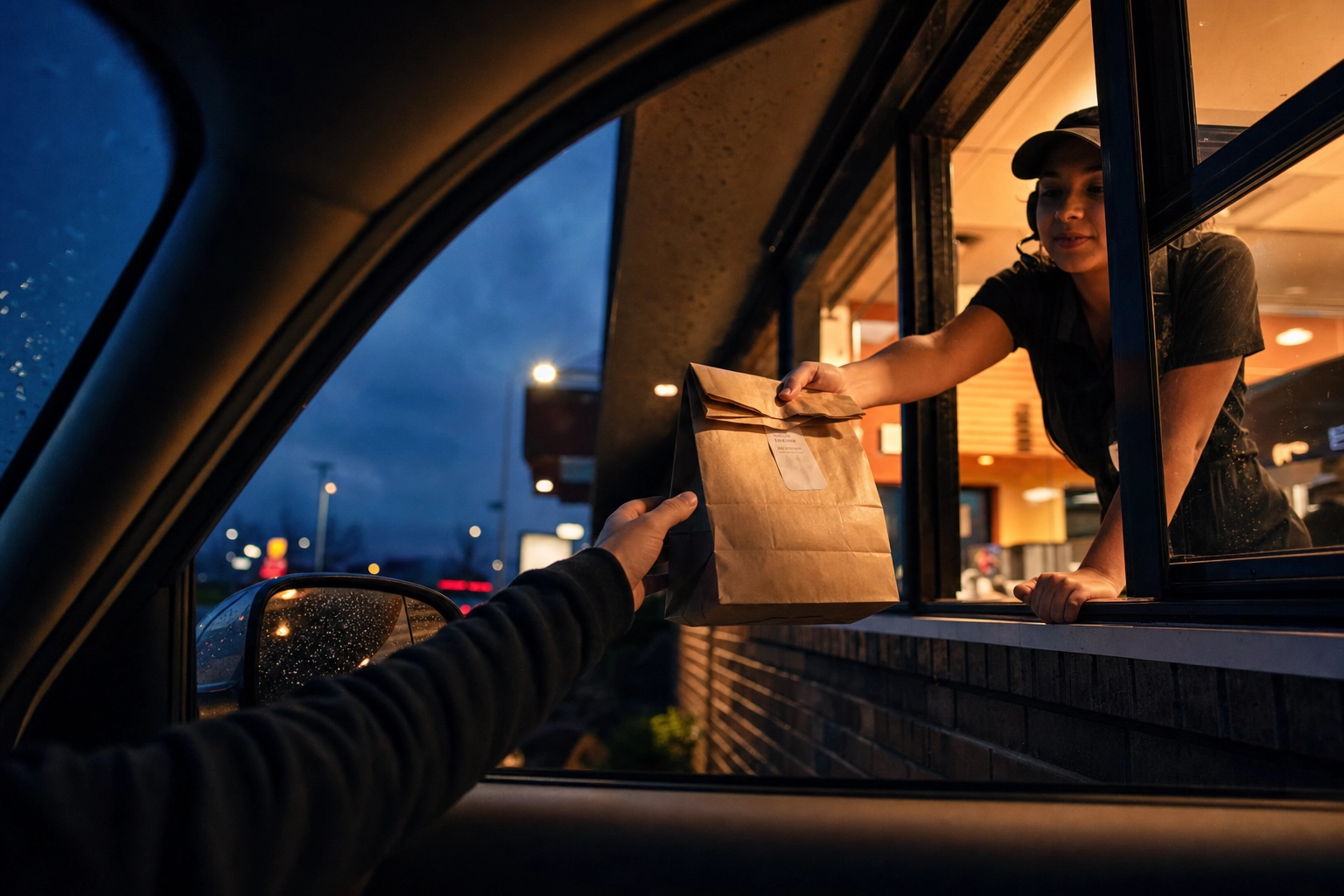
Takeout, Delivery & the Drive-Through
Not eating in? The vocabulary shifts a little depending on where you are and how you're getting your food:
- Takeout (US/Canada) = takeaway (UK/Australia): food you carry out.
- To go (US): used for both food and drinks — "a coffee to go."
- Pick up / collection: food you order ahead and collect yourself.
- Delivery: food brought to your door.
Ordering Takeout & Delivery
Ordering by phone or at the counter:
- "I'd like to place an order for pickup."
- "Is this for delivery or collection?"
- "Can I get two portions of [dish] to take away?"
- "How long will it be?" / "Roughly how long for delivery?"
- "Can I pay when I collect it?"
If you're ordering by phone, speak slowly and be ready to spell your name and repeat your address. It's normal for staff to read the order back to you — just confirm with "Yes, that's right."
Surviving the Drive-Through
The drive-through (UK: drive-thru) is its own challenge: you're talking to a crackly speaker you can't see. Here's what you'll typically hear, in order:
- "Welcome to [name] — what can I get started for you?"
- (You order.) "Will that be everything?" / "Anything else?"
- "Please pull forward to the first window." (sometimes the second)
- "Your total is nine dollars and forty cents at the window."
Survival tips: speak slowly and a little louder than usual, aimed toward the microphone. Muffled audio is normal — if you don't understand, just say "Sorry, could you repeat that?" They'll usually repeat your order back to you; confirm with "Yes, that's right," then drive forward to pay and collect.
Server Questions You'll Be Asked (and How to Answer)
Understanding the questions is half the battle — especially because native speakers run words together ("Are you ready to order?" can sound like "R'you-ready-da-order?"). Here are the most common questions you'll hear, and natural ways to answer:
| What the server says | What it means | How you might answer |
|---|---|---|
| "Are you ready to order?" | Ready to choose? | "Yes, I think so." / "Could we have a few more minutes?" |
| "Can I start you off with something to drink?" | Want a drink first? | "Just water for now, thanks." / "I'll have a lemonade." |
| "How would you like that cooked?" | (Steak) how done? | "Medium-rare, please." |
| "Are you still working on that?" | Have you finished? | "Yes, you can take it, thanks." / "I'm still going." |
| "How is everything?" | Is the meal okay? | "It's delicious, thank you!" |
| "Can I get you anything else?" | Want more? | "No, that's everything, thanks." |
| "Would you like a box?" | Take leftovers home? | "Yes, please." / "No, I'm fine, thanks." |
| "For here or to go?" | Eat in or take out? | "For here." / "To go, please." |
| "Together or separate?" | One bill or split? | "Separate, please." / "All together." |
If a server speaks too fast, it's never rude to ask them to slow down. The skill of catching these run-together phrases is called connected speech, and it gets much easier with listening practice. A friendly server may also chat while you eat, so it helps to be ready to make small talk in English too.
5 Dialogue Scripts to Rehearse Out Loud
Knowing phrases on paper is not the same as saying them when a real person is looking at you. The fix is rehearsal: read these scripts out loud, play both roles, and repeat each one until the words come without thinking. (You = you; Staff = the server or cashier.)
Script 1 — Coffee Shop (To Go)
- Staff: Hi there! What can I get for you?
- You: Hi! Could I get a grande cappuccino, please?
- Staff: Sure. For here or to go?
- You: To go, please.
- Staff: Anything else?
- You: No, that's everything, thanks.
- Staff: Can I get a name for the cup?
- You: It's Mei — M-E-I.
- Staff: Great. That'll be five dollars and twenty cents.
- You: Here you go. Thank you!
Script 2 — Fast-Food Counter
- Staff: Hi, welcome in. What can I get for you?
- You: Can I get the number 4 meal, please?
- Staff: Sure. What drink would you like with that?
- You: A Coke, please.
- Staff: For here or to go?
- You: For here.
- Staff: Anything else?
- You: That's all, thanks.
- Staff: That'll be eight ninety-nine — it'll be right up.
- You: Thank you!
Script 3 — Sit-Down Restaurant (Full Meal)
- Host: Hi, do you have a reservation?
- You: Yes, under Alex, for two.
- Host: Right this way. Your server will be with you shortly.
- Server: Can I start you off with something to drink?
- You: Could we get a sparkling water and a glass of red wine, please?
- Server: Of course. Are you ready to order, or do you need a few minutes?
- You: A few more minutes, please… Actually, what do you recommend?
- Server: The salmon is very popular tonight.
- You: Sounds great. To start, I'll have the soup, and for my main I'd like the salmon — could I get the sauce on the side?
- Server: Absolutely. And for you, sir?
- Guest: I'll have the steak, medium, please.
- Server: (later) How is everything?
- You: It's delicious, thank you!
- You: (at the end) Could we get the check when you have a chance? And could we pay separately?
Script 4 — Dietary Restriction / Allergy
- Server: Are you ready to order?
- You: Yes — but first, I have a severe nut allergy. Could you tell me which dishes are safe?
- Server: Let me check with the kitchen. The pasta and the grilled chicken are both nut-free.
- You: Perfect. I'll have the grilled chicken, please. And just to confirm — no nuts in the sauce?
- Server: I'll make a note for the kitchen.
- You: Thank you, I really appreciate it.
Script 5 — Drive-Through
- Speaker: Welcome to [name]! What can I get started for you?
- You: Hi — can I get a number 2 combo, please?
- Speaker: Sure. What drink with that?
- You: A lemonade, please.
- Speaker: Would you like to make it large for 50 cents more?
- You: No, regular is fine, thanks.
- Speaker: Okay, one number 2 combo with a lemonade — will that be everything?
- You: Yes, that's right.
- Speaker: Your total is seven eighty-five. Please pull forward to the first window.
Reading these once helps. Saying them ten times — out loud, with the rhythm and the pleases and the thank yous — is what makes them automatic. These scenarios are a perfect fit for English role-play practice, where you act out both sides until your responses feel natural.
How to Order Food in English With Total Confidence
By now you know how to order food in English on paper. The real test is saying it in real time, when a server is waiting and your brain wants to switch back to your native language. That gap — between knowing and saying — closes only with spoken practice, out loud.
A few things genuinely help:
- Rehearse out loud, not in your head. Mouthing the words silently doesn't build the muscle memory you need.
- Play both roles. Practicing the server's questions trains your ear to recognize them in the wild.
- Repeat until it's boring. Automatic beats perfect — you want to order without translating.
This is exactly what Practice Me is built for. You can role-play ordering food — at a café, a restaurant, or a drive-through — in real-time voice conversations with AI tutors in both American and British accents. It's judgment-free and available 24/7, so you can fumble, retry, and replay a scene as many times as you like, with no real cashier waiting and nobody to feel embarrassed in front of. The tutors even remember you across sessions, so today's practice builds on yesterday's. (Practice Me Pro includes unlimited conversations and a 3-day free trial.)
Pair these scripts with our speaking confidence checklist and a few tricks for keeping the conversation going, and learning how to order food in English stops being a source of dread. Rehearse it the same way you practiced introducing yourself in English — a little at a time, until it's second nature.
Frequently Asked Questions
Is it rude to say "I want" when ordering food in English?
It's not grammatically wrong, but in cafés and restaurants "I want…" sounds blunt and a little demanding to native ears. Use "I'll have…," "Could I get…," or "I'd like…" instead, and always add "please." The softer phrasing — plus a thank you when your food arrives — is what makes you sound polite and natural, not the verb itself.
What's the difference between "takeout" and "takeaway"?
They mean the same thing: food you order and carry out rather than eat in. Takeout is used in the US and Canada; takeaway is standard in the UK, Ireland, and Australia. Americans also say "to go" for both food and drinks ("a coffee to go"), while "to go" can sound a little unusual outside North America. All of them will be understood almost anywhere.
Do I have to tip when ordering food in the US?
At sit-down restaurants in the US, effectively yes — tipping 18–20% is strongly expected, and Pew Research found 92% of American diners always or often tip there. At a counter or café it's more optional, though card screens increasingly prompt you. Outside the US the rules change completely: the UK is around 10–15% (often with a service charge already added), while in Japan, South Korea, and China you generally shouldn't tip at all.
How do I politely ask for the bill in English?
Say "Could we get the check, please?" in the US, or "Could I have the bill, please?" in the UK. Make eye contact and raise your hand slightly to get your server's attention — never snap your fingers or shout. In most English-speaking countries the bill won't arrive until you ask, so you'll usually need to flag it down when you're ready to leave.
What should I say if I can't pronounce a dish on the menu?
Don't worry about perfect pronunciation — pointing works. Try "I'll have this one, please," while pointing at the menu, or "How do you say this?" Servers help with tricky dish names all the time. You can also describe it: "the chicken dish with the green sauce." Nobody expects you to nail every French or Italian menu word.
How can I practice ordering food in English before I travel?
Rehearse the five dialogue scripts above out loud until they're automatic, playing both the customer and the server. Practicing with a partner or an AI speaking app is even better, because it trains you to respond in real time rather than from memory. With Practice Me, you can role-play café, restaurant, and drive-through orders in American or British accents, 24/7, and repeat each scene as often as you need — no real cashier required.