Duolingo taught you words. No one taught you to speak.
PracticeMe: real voice conversations with an AI tutor, 24/7.
100 English Words You Need for Daily Conversations

You can know 5,000 English words and still freeze the moment a barista asks "for here or to go?" That's the gap most language learners hit — recognizing words on a page is not the same as having them ready when you actually need them.
This guide fixes that. One hundred everyday words — the core English vocabulary for daily use across every situation you'll bump into: ordering coffee, calling in sick, running errands, making weekend plans. Every word comes with IPA pronunciation, a short real-life dialogue, and a usage tip a native speaker would tell a friend.
Quick Summary: Master these 100 high-frequency words across eight everyday contexts — greetings, food, shopping, work, health, transport, emotions, and time. With about 1,000–1,500 active words, you can hold most daily conversations. This is the foundational English vocabulary for daily use, with pronunciation, example dialogues, and meaning notes for each entry.
How to Use This English Vocabulary for Daily Use
Each entry follows the same format:
- The word with its IPA pronunciation in slashes (the standard system Cambridge, Oxford, and Merriam-Webster use)
- A short dialogue showing how the word actually appears in spoken language between two people
- A usage tip — a collocation, a tone note, a common mistake, or a pronunciation trap
About the pronunciation symbols: don't panic. The slashes mean "this is how it sounds, not how it's spelled." The mark before a syllable (ˈ) means that syllable is stressed — said louder and longer. So in /ˈhæpi/, you stress HAP, not -py. You don't need to memorize IPA to use this list, but glancing at it helps when a word looks weird (like receipt — the p is silent). For more on sound and stress, see our guide on English pronunciation practice for beginners.
Read each dialogue out loud. Both roles. Even if you feel silly. Saying the words activates a different part of your brain than reading silently, and it's the part you actually need when someone speaks to you in real life. For more on this approach to learning, see our guide on how to build vocabulary through real conversations.
Greetings and Pleasantries (15 Words)
These 15 words handle the opening and closing of almost every social interaction in English — the verbal handshakes that wrap around real content. Get them automatic and you'll never feel awkward starting a conversation again. (For the longer phrases that often follow these words, see our guide on how to introduce yourself in English.)
1. Hello — /həˈloʊ/
A: Hello, is this the front desk?
B: Hello! Yes, how can I help you?
Tip: "Hello" works everywhere — formal, informal, in person, on the phone. When in doubt, default to it.
2. Hi — /haɪ/
A: Hi, I haven't seen you in ages!
B: Hi! I know, it's been forever.
Tip: "Hi" is more casual than "hello." Use it with friends, coworkers you know well, or in relaxed settings. Avoid it for first-time business emails or writing to someone formal.
3. Goodbye — /ɡʊdˈbaɪ/
A: I should head out now. Goodbye!
B: Goodbye, see you next week.
Tip: "Goodbye" sounds slightly formal in spoken language. Most native speakers say "bye" or "see you" in casual settings. Save the full word for professional or sentimental moments.
4. Thanks — /θæŋks/
A: Here's your coffee.
B: Thanks! Have a good day.
Tip: "Thanks" is the everyday short form of "thank you." For something bigger, upgrade to "thanks so much" or "thank you so much." The th sound — tongue between teeth — trips up many learners.
5. Welcome — /ˈwɛlkəm/
A: Thank you for the help.
B: You're welcome, anytime.
Tip: "Welcome" has two main meanings: greeting someone arriving ("Welcome home!") and replying to thanks ("You're welcome"). Don't say "welcome" alone in response to thanks — always "you're welcome."
6. Sorry — /ˈsɑri/
A: Sorry, I didn't catch your name.
B: No worries, it's Marcus.
Tip: "Sorry" works for apologies AND for asking someone to repeat themselves. In British English, people use it constantly — even when bumping into a chair.
7. Excuse (me) — /ɪkˈskjuz/
A: Excuse me, do you know where the restroom is?
B: Yes, just past the elevators on your right.
Tip: "Excuse me" is your magic phrase for getting attention politely. Use it before asking strangers anything. Different from "sorry" — "excuse me" comes BEFORE the request, "sorry" comes after a mistake.
8. Please — /pliz/
A: Could you pass the salt, please?
B: Sure, here you go.
Tip: "Please" softens any request. Skip it and you can sound rude — even with the same words. Position matters: "Please pass the salt" or "Pass the salt, please" both work; "Pass please the salt" doesn't.
9. Sure — /ʃʊr/
A: Can you help me carry this?
B: Sure, no problem.
Tip: "Sure" is the casual yes. It signals friendly agreement without being overly formal. In professional settings, "of course" or "absolutely" sound more polished.
10. Cheers — /tʃɪrz/
A: I just sent over the file.
B: Cheers, I'll take a look.
Tip: In British English, "cheers" often means "thanks" or "goodbye." In American English, it's mostly used when toasting drinks. Know your audience.
11. Pardon — /ˈpɑrdən/
A: The meeting is at half past two.
B: Pardon? Could you repeat that?
Tip: "Pardon?" politely asks someone to repeat themselves. More formal than "what?" or "huh?" In British English, people often say "pardon me" when bumping into someone too.
12. Pleasure — /ˈplɛʒər/
A: It was so nice meeting you.
B: The pleasure was mine.
Tip: "Nice to meet you" → "Nice to meet you too" or "The pleasure is mine" / "My pleasure." The second option sounds warmer and more refined. Notice the zh sound in the middle — like the s in "measure."
13. Greet — /ɡrit/
A: Did anyone greet the guests when they arrived?
B: Yes, Sarah was at the door.
Tip: "Greet" is the verb for the act of saying hello. You greet someone — you don't greet TO someone. Common in writing and formal speech; less common in casual chat.
14. Friendly — /ˈfrɛndli/
A: What's your new neighbor like?
B: Really friendly — she brought us cookies.
Tip: "Friendly" describes warm, welcoming behavior. Don't confuse with "friend" (a noun — a person). "She is friendly" is correct; "She is friend" is not.
15. Goodnight — /ˌɡʊdˈnaɪt/
A: I'm heading to bed. Goodnight!
B: Goodnight, sleep well.
Tip: Use "goodnight" only when someone is actually going to sleep or leaving for the night. If it's still afternoon, "goodbye" is correct. The gh in "night" is silent.

Food and Dining (15 Words)
Food vocabulary is some of the first English you'll need abroad — and the most rewarding to use because the situations are friendly. These 15 words handle restaurant ordering, kitchen talk at home, and mealtime small talk. Want practice scenarios? See our list of 50+ English conversation practice topics for restaurant role-plays.
16. Hungry — /ˈhʌŋɡri/
A: Are you hungry yet?
B: Starving. Let's eat.
Tip: "Hungry" describes the state. Native speakers often exaggerate with "starving," "famished," or "I could eat a horse." Don't say "I have hungry" — say "I am hungry."
17. Thirsty — /ˈθɜrsti/
A: Want some water?
B: Yes, please. I'm really thirsty.
Tip: Same pattern as hungry — "I am thirsty," not "I have thirsty." The th and the r together make this word a workout for many learners. Slow down on the first syllable.
18. Delicious — /dɪˈlɪʃəs/
A: How's the pasta?
B: Delicious! You have to try it.
Tip: "Delicious" is the upgrade from "good" or "tasty." Use it when food really impresses you. The middle ci sounds like sh. Don't overuse it — if everything is delicious, nothing is.
19. Order — /ˈɔrdər/
A: Are you ready to order?
B: Yes, I'll have the chicken sandwich, please.
Tip: "Order" is both a noun (your order) and a verb (to order). The phrase "ready to order?" is what waiters say worldwide. "I'll have…" is the most natural way to start your order.
20. Menu — /ˈmɛnju/
A: Can I see the menu, please?
B: Of course, here you go.
Tip: Stress the first syllable — MEN-yu, not men-YU. In casual American restaurants you'll often see "menu" for the printed list and "specials" for daily additions.
21. Bill — /bɪl/
A: Could we get the bill, please?
B: Sure, I'll bring it right over.
Tip: In American English, restaurant servers usually say "check" instead of "bill." Either works almost everywhere. "Bill" is also used for utility bills (electric, phone, etc.).
22. Tip — /tɪp/
A: How much should I tip?
B: Around 15 to 20 percent in the US.
Tip: "Tip" is both noun and verb. Tipping culture varies hugely — expected in the US, optional or rare in many other countries. Ask locally if you're unsure.
23. Reservation — /ˌrɛzərˈveɪʃən/
A: Do we need a reservation?
B: Yes, especially on Friday nights.
Tip: "Make a reservation" or "have a reservation." Don't say "book a reservation" — that's redundant. The -tion ending sounds like "shun."
24. Waiter — /ˈweɪtər/
A: I'll ask the waiter for more water.
B: Good idea, thanks.
Tip: "Waiter" (male) and "waitress" (female) are still common, but "server" is increasingly preferred as gender-neutral, especially in the US. All three are understood.
25. Recipe — /ˈrɛsəpi/
A: This soup is amazing! Can you share the recipe?
B: Sure, I'll text it to you.
Tip: Three syllables — RE-suh-pee. NOT "ree-CIPE" (which would rhyme with swipe). One of the most commonly mispronounced English words for learners.
26. Spicy — /ˈspaɪsi/
A: How spicy is the curry?
B: Pretty spicy — but not crazy hot.
Tip: "Spicy" means full of spice flavor — sometimes hot, sometimes just flavorful. "Hot" specifically means burns-your-tongue spicy. They're related but the meaning isn't identical.
27. Fresh — /frɛʃ/
A: Is the fish fresh?
B: Yes, it came in this morning.
Tip: "Fresh" applies to food (just made or harvested), air (clean), and even people (someone who's fresh is rude — a different meaning entirely). Context tells you which.
28. Snack — /snæk/
A: I'm getting hungry. Want a snack?
B: Yeah, do you have any chips?
Tip: "Snack" is a small meal between meals. Both noun ("a snack") and verb ("to snack on something"). The casual, friendly cousin of "meal."
29. Breakfast — /ˈbrɛkfəst/
A: Did you have breakfast yet?
B: Just coffee — I'm not really a breakfast person.
Tip: Stress the first syllable hard: BREK-fəst. The second syllable almost disappears. "Lunch" and "dinner" follow simpler patterns; breakfast is the tricky one of the three.
30. Cook — /kʊk/
A: Do you cook a lot at home?
B: Almost every night. I find it relaxing.
Tip: "Cook" is both verb (to prepare food) and noun (a person who cooks). For someone who cooks professionally, use "chef." For a home cook, "good cook" is a common compliment.

Shopping and Errands (15 Words)
From the corner store to online checkout, these 15 words cover the back-and-forth of buying things. A few have tricky pronunciations — watch for the silent letters.
31. Cash — /kæʃ/
A: Cash or card?
B: Cash, please.
Tip: "Cash or card?" is one of the most common questions you'll hear at any store. "Cash" specifically means physical bills and coins, not money in general (that's "money").
32. Card — /kɑrd/
A: I'll pay by card.
B: Tap or insert?
Tip: "Card" can mean credit, debit, or even gift card — context decides. "Pay by card" or "use my card" are both natural. Modern stores often ask "tap, insert, or swipe?"
33. Receipt — /rɪˈsit/
A: Would you like a receipt?
B: Yes, please — I need it for work.
Tip: The p is completely silent. It's pronounced "ree-SEET." This silent p trips up almost every English learner. The same pattern shows up in "psychology" and "pneumonia."
34. Discount — /ˈdɪskaʊnt/
A: Is there any discount on this?
B: Yes, it's 20% off this week.
Tip: "Discount" can be a noun (a discount) or verb (to discount). "Get a discount," "give a discount," and "at a discount" are the most common phrases. Stress the first syllable.
35. Sale — /seɪl/
A: Are these jeans on sale?
B: Yes, half off until Sunday.
Tip: "On sale" means reduced price. "For sale" means available to buy (like a house "for sale"). Easy to mix up — they sound similar but have different meanings.
36. Refund — /ˈrifʌnd/
A: Can I get a refund?
B: Of course, do you have the receipt?
Tip: As a noun (RE-fund), as a verb it shifts to "re-FUND." Both spellings are identical — only the stress changes. Context makes it clear which one you mean.
37. Cart — /kɑrt/
A: Should I grab a cart?
B: Yeah, we'll need one.
Tip: In US supermarkets it's a "cart"; in the UK it's a "trolley." Online shopping uses "cart" globally — "add to cart," "shopping cart." No silent letters here, just a clean kart sound.
38. Aisle — /aɪl/
A: Excuse me, where's the bread?
B: Aisle six, on your left.
Tip: The s is silent — pronounced exactly like "I'll." Not "ay-zull" or "ay-sull." A classic mispronunciation. The word means a passage between shelves in a store.
39. Cashier — /kæˈʃɪr/
A: Where do I pay?
B: The cashier is right by the exit.
Tip: Stress the second syllable: ka-SHEER. The person who handles your payment at a checkout. A "cash register" is the machine; a "cashier" is the person using it.
40. Size — /saɪz/
A: Do you have this in a smaller size?
B: Let me check the back.
Tip: For clothes, you say "what size are you?" — never "what is your size?" (technically correct but unnatural). US sizes differ from European and Asian sizes; always check labels.
41. Price — /praɪs/
A: What's the price for the small one?
B: Twelve ninety-nine.
Tip: "Price" is the cost of one specific thing. "Cost" is more general. "How much is it?" is more natural in casual speech than "what's the price?"
42. Bargain — /ˈbɑrɡən/
A: That jacket was only $30.
B: Wow, what a bargain.
Tip: "A bargain" means something at a great low price. "To bargain" (verb) means to negotiate. "What a bargain!" is a common compliment when someone gets a good deal.
43. Errand — /ˈɛrənd/
A: Where are you off to?
B: Just running a few errands.
Tip: "Errands" are small practical tasks — post office, grocery, dry cleaning. Almost always paired with the verb "run." Plural is more common than singular: "I have errands to run."
44. Browse — /braʊz/
A: Can I help you find something?
B: Just browsing, thanks.
Tip: "Just browsing" is the polite phrase to use when a store assistant offers help and you want to look around alone. Also used online: "browse the website."
45. Pickup — /ˈpɪkˌʌp/
A: Is this for delivery or pickup?
B: Pickup, please. I'll come by at six.
Tip: As one word ("pickup"), it's a noun — the act of collecting something. As two words ("pick up"), it's a verb. "I'll pick up the order at six" / "It's a pickup order." Both common in food and retail contexts.

Work and Office (15 Words)
Workplace English has its own rhythm — slightly more formal, full of recurring phrases. These 15 words form the spine of office life: meetings, emails, deadlines, and small talk by the coffee machine. To sound more natural in meetings, also see our guide on English filler words and conversation connectors.
46. Meeting — /ˈmitɪŋ/
A: Are you free at three?
B: No, I have a meeting until four.
Tip: "Have a meeting" or "be in a meeting" — never "make a meeting." If you set one up, you "schedule" or "set up" a meeting.
47. Deadline — /ˈdɛdˌlaɪn/
A: When's the deadline?
B: Friday at 5 PM, sharp.
Tip: "Meet a deadline" means submit on time. "Miss a deadline" means submit late. "A tight deadline" means very little time. Native speakers say it constantly — get comfortable using it.
48. Boss — /bɔs/
A: Who's your boss?
B: Her name is Anna — she runs the marketing team.
Tip: "Boss" is informal. In professional emails or formal writing, use "manager," "supervisor," or "director." "My boss" is fine in conversation; in writing, more specific titles read better.
49. Email — /ˈiˌmeɪl/
A: Did you see my email?
B: Not yet — I'll check now.
Tip: "Send an email" or "shoot an email" (casual). Both noun and verb: "I'll email you" / "I sent you an email." Not "a mail" — that means physical post.
50. Schedule — /ˈskɛdʒul/
A: What does your schedule look like tomorrow?
B: Pretty packed until lunch.
Tip: Pronunciation differs by region — Americans say "SKED-jool," British speakers say "SHED-yool." Both correct; pick whichever feels natural. As a verb: "I'll schedule it for Tuesday."
51. Project — /ˈprɑdʒɛkt/
A: How's the project going?
B: Slowly — we're behind schedule.
Tip: As a noun, stress the first syllable (PRA-ject). As a verb meaning "to predict" or "to display," stress the second (pro-JECT). "Working on a project" is the most common phrase.
52. Colleague — /ˈkɑliɡ/
A: Are you and Marcus close?
B: We're just colleagues — we work on the same team.
Tip: "Colleague" is more professional than "coworker," though they have the same meaning. In British English, "colleague" is more common; in American English, "coworker" is more casual. The -eague ending is just -eeg.
53. Client — /ˈklaɪənt/
A: I have a call with a client at noon.
B: Important one?
A: Pretty big account — I should prep.
Tip: "Client" usually means someone you provide a service to (like a lawyer's client). "Customer" usually means someone buying a product. Industries use them differently — listen for which fits your context.
54. Report — /rɪˈpɔrt/
A: Is the quarterly report ready?
B: Almost — I just need to finish the summary.
Tip: As a noun, a written or spoken account of something. As a verb, to tell information to someone or to say someone is your supervisor: "I report to the head of marketing."
55. Task — /tæsk/
A: What tasks do you have today?
B: Two reports and a budget review.
Tip: A "task" is a specific job or piece of work. Smaller scale than a "project." Most office software calls to-do items "tasks." Plural form ("tasks") is used as much as singular.
56. Office — /ˈɔfɪs/
A: Are you in the office today?
B: No, working from home.
Tip: "Office" can mean the physical building or your individual workspace. "I'm at the office" (the building); "she's in her office" (a specific room). "Office hours" means standard working hours.
57. Break — /breɪk/
A: I'm taking a quick break.
B: Okay, see you in fifteen.
Tip: "Take a break" is the natural phrase. "Lunch break," "coffee break," "five-minute break" — all common. Don't say "make a break" (that means escape, like in a movie).
58. Salary — /ˈsæləri/
A: Is the salary negotiable?
B: Yes, depending on experience.
Tip: "Salary" is a fixed annual or monthly payment. "Wage" is paid by the hour. "Pay" is the most general term. Asking about salary directly in a first conversation is considered rude in many cultures — including American.
59. Resume — /ˈrɛzəˌmeɪ/
A: Did you send your resume?
B: Yes, this morning.
Tip: When it means "CV," it's pronounced REZ-oo-may (three syllables, often written résumé with accents). When it means "to start again," it's pronounced re-ZOOM. Same spelling, completely different meaning and pronunciation.
60. Review — /rɪˈvju/
A: Have you had your annual review yet?
B: Next month — I'm a bit nervous.
Tip: "Review" can mean a performance evaluation at work, a critique of a book or movie, or the act of looking over something. Verb and noun, same form. "Review the document," "write a review."

Duolingo taught you words. No one taught you to speak.
PracticeMe: real voice conversations with an AI tutor, 24/7.
Health and Wellness (10 Words)
You don't want to learn medical English in an emergency. These 10 words cover the basics of describing how you feel, making appointments, and getting through pharmacy and clinic visits. They round out your English vocabulary for daily use whenever your body has something to say.
61. Doctor — /ˈdɑktər/
A: I think you should see a doctor.
B: Yeah, I'll book an appointment tomorrow.
Tip: "See a doctor" is the standard phrase. Often shortened to "see the doc." For specialists, you can say "see a dentist," "see a physiotherapist," etc. — same pattern.
62. Medicine — /ˈmɛdəsən/
A: Did you take your medicine?
B: Yes, after breakfast.
Tip: "Medicine" is the general word for any drug or treatment. "Medication" sounds slightly more formal or clinical. Never say "drugs" in this context — that often implies illegal substances in conversational English.
63. Headache — /ˈhɛdˌeɪk/
A: Are you okay?
B: Just a bit of a headache.
Tip: The ch is pronounced like k: HED-ake. Same pattern in "stomachache" and "toothache." Don't say "I have headache" — say "I have a headache" (you need the a).
64. Cold — /koʊld/
A: You sound terrible.
B: I think I'm catching a cold.
Tip: "A cold" (noun) is the illness. "Cold" (adjective) means low temperature. "Catch a cold" is the standard verb pairing. "I have a cold" means you're sick; "I am cold" means you need a sweater.
65. Tired — /ˈtaɪərd/
A: You look tired.
B: I am — didn't sleep much.
Tip: Two syllables: TIE-erd. Don't say "I have tired" — say "I am tired." Stronger feeling? Try "exhausted," "wiped out," or "drained." Useful for explaining why you can't go out tonight.
66. Hospital — /ˈhɑspɪtəl/
A: Where's the nearest hospital?
B: About ten minutes by car.
Tip: In American English, you say "go to the hospital." In British English, often "go to hospital" (no the). Both correct. For everyday illness you don't go to the hospital — you go to a clinic, urgent care, or your doctor's office.
67. Pain — /peɪn/
A: Where's the pain?
B: Lower back, mostly.
Tip: "Pain" describes physical hurt. "I have pain in my back" or "my back hurts" — both work. For specific types: sharp pain, dull pain, throbbing pain. Doctors will often ask you to describe it.
68. Allergy — /ˈælərdʒi/
A: Do you have any allergies?
B: Yes — peanuts and shellfish.
Tip: Always plural in this context: "allergies." The adjective is "allergic": "I'm allergic to peanuts." Critical word for restaurants, pharmacies, and travel. Worth practicing the pronunciation: AL-er-jee.
69. Healthy — /ˈhɛlθi/
A: How's your dad doing?
B: Really healthy — he started biking every morning.
Tip: "Healthy" describes both people ("she's healthy") and food ("a healthy meal"). The opposite is "unhealthy" — keep the prefix attached, don't say "not healthy" if you can avoid it.
70. Rest — /rɛst/
A: What did the doctor say?
B: Just to rest for a few days.
Tip: "Rest" as a verb means stop activity. As a noun, the relaxation itself ("get some rest"). It can also mean "the remainder" — "the rest of my day." Context decides which meaning applies.
Transportation (10 Words)
Getting around in a new city in English: these 10 words cover buses, trains, walking directions, and the universal experience of being late because of traffic.
71. Bus — /bʌs/
A: How did you get here?
B: I took the bus.
Tip: "Take a bus" or "catch a bus" (catch usually means just barely making it). The plural is "buses" — you'll sometimes see "busses" but it's unusual. "Bus stop" and "bus station" have different meanings — a stop is on the street; a station is the central terminal.
72. Train — /treɪn/
A: What time does the train leave?
B: Half past seven, platform four.
Tip: "Take the train" or "catch the train." A train "leaves" or "departs"; it "arrives." The place is a "train station" — only one word "station," not "train station station."
73. Subway — /ˈsʌbˌweɪ/
A: Is the subway running today?
B: Yeah, but there are delays on the red line.
Tip: "Subway" is the underground train in American cities. In London, it's "the Tube" or "the Underground." In other cities, "metro." All three describe the same thing — a useful example of how language varies by place.
74. Ticket — /ˈtɪkət/
A: Do I need to buy a ticket in advance?
B: Yes, especially on weekends.
Tip: "Buy a ticket," "get a ticket." "Ticket" also has a different meaning — a fine from police, as in "I got a parking ticket." Two completely different uses; context will tell you which.
75. Traffic — /ˈtræfɪk/
A: Sorry I'm late — there was so much traffic.
B: No worries, it happens.
Tip: "Traffic" is uncountable — say "a lot of traffic," not "many traffics." "Heavy traffic" means lots of cars; "light traffic" means few. The world's most universal excuse for being late.
76. Drive — /draɪv/
A: Do you drive to work?
B: Sometimes — but mostly I take the train.
Tip: "Drive" applies to cars and trucks. You don't "drive" a bicycle (you "ride" one) or a bus (the driver drives; passengers "take" or "ride" it). Past tense is "drove"; past participle is "driven."
77. Walk — /wɔk/
A: Should we drive or walk?
B: Let's walk — it's only ten minutes.
Tip: The l is silent in many accents — pronounced like "wok." A frequent word that natives often slur into one quick syllable. "Go for a walk" is the casual phrase for taking a stroll.
78. Late — /leɪt/
A: Sorry, I'm running late.
B: No problem, take your time.
Tip: "Running late" is the most common phrase for being behind schedule. "Late" can also mean recently deceased ("the late Mr. Smith") — a different meaning, but context makes this clear; you won't confuse the two.
79. Arrive — /əˈraɪv/
A: What time will you arrive?
B: Around eight.
Tip: "Arrive at" a specific place (arrive at the airport). "Arrive in" a city or country (arrive in Paris). Don't say "arrive to" — that's a common mistake from speakers of Romance languages.
80. Direction — /dɪˈrɛkʃən/
A: Excuse me, can you give me directions to the museum?
B: Of course — go straight, then left at the corner.
Tip: Usually plural ("directions") when asking for help getting somewhere. "Give directions," "ask for directions," "follow directions." Singular ("direction") usually means one general way: "north direction."

Emotions and Feelings (10 Words)
How you feel today is the universal small-talk topic. These 10 emotion words let you answer "how are you?" with more than just "fine" — and explain to a friend why you've been off lately.
81. Happy — /ˈhæpi/
A: You seem happy today.
B: I am — I just got a promotion.
Tip: "Happy" is the everyday positive feeling. Stronger versions: "thrilled," "ecstatic," "over the moon." Don't say "I have happy" — say "I am happy." A fundamental emotional word that scales up easily.
82. Sad — /sæd/
A: Are you okay?
B: Just a little sad — my best friend moved away.
Tip: "Sad" is the basic word. Stronger feelings: "heartbroken," "devastated." Lighter: "down," "blue," "bummed out." When someone says they're sad, asking "what's going on?" is a kind, natural follow-up.
83. Excited — /ɪkˈsaɪtɪd/
A: Are you excited about the trip?
B: So excited — I've never been to Japan.
Tip: "Excited about" something — not "excited for" something (though "excited for you" is also natural). Three syllables: ek-SAI-ted. Say it with energy or it sounds insincere.
84. Nervous — /ˈnɜrvəs/
A: How are you feeling about the interview?
B: Honestly, really nervous.
Tip: "Nervous about" something. Different from "anxious" — "nervous" is a short-term feeling of jitters before an event; "anxious" is deeper, longer-lasting. Common at job interviews, exams, first dates.
85. Bored — /bɔrd/
A: What do you want to do?
B: I don't know — I'm just bored.
Tip: "Bored" is how YOU feel; "boring" describes the thing. "I am bored because the movie is boring." Mix these up and you accidentally insult yourself: "I am boring" means YOU are dull, not the situation.
86. Worried — /ˈwɜrid/
A: Why do you look so serious?
B: I'm worried about my mom — she's been sick.
Tip: "Worried about" something or someone. The verb is "worry" — "don't worry" is one of the most common English reassurances. "Worried sick" describes an even stronger feeling.
87. Confused — /kənˈfjuzd/
A: Did the directions make sense?
B: Honestly, I'm still a bit confused.
Tip: "Confused about" something. Saying "I'm confused" is perfectly polite and useful — it's a way to ask for clarification without putting the speaker on the spot. Stronger versions: "lost," "totally lost." Better to admit it than fake understanding.
88. Proud — /praʊd/
A: Your son finished the marathon?
B: Yes — I'm so proud of him.
Tip: "Proud of" someone or something. Used both for personal achievement ("proud of myself") and for others ("proud of you"). It can also mean arrogant in negative contexts — tone usually clarifies the meaning.
89. Disappointed — /ˌdɪsəˈpɔɪntɪd/
A: How was the concert?
B: A bit disappointed, honestly. The sound was bad.
Tip: Five syllables — dis-uh-POINT-ed. "Disappointed in" a person ("disappointed in her behavior"). "Disappointed by/with" a thing ("disappointed by the meal"). One of the longer emotion words to pronounce; slow it down.
90. Stressed — /strɛst/
A: You've been quiet today.
B: Yeah — work has been really stressful, I'm pretty stressed.
Tip: "Stressed" describes you; "stressful" describes the situation. Same trap as bored/boring. "Stressed out" is a stronger casual version. Modern English uses this constantly — perhaps too often.
Time and Scheduling (10 Words)
Making plans, talking about your day, fitting things into a week. These 10 words are the building blocks of every sentence about when something happens.
91. Today — /təˈdeɪ/
A: What are your plans today?
B: Just errands and a workout.
Tip: "Today" goes at the start or end of a sentence — both natural. "Today, I have a meeting" or "I have a meeting today." Avoid placing it in the middle for now: "I today have a meeting" sounds wrong.
92. Tomorrow — /təˈmɔroʊ/
A: See you tomorrow?
B: Yes — same time, same place.
Tip: Three syllables — tuh-MA-roh. The double r is single in pronunciation. Common phrase: "tomorrow morning," "tomorrow afternoon," "tomorrow night." Same pattern works with yesterday.
93. Yesterday — /ˈjɛstərˌdeɪ/
A: When did you call her?
B: Yesterday afternoon.
Tip: Stress the first syllable — YES-ter-day. Used with past tense verbs only: "I went yesterday," not "I go yesterday." Also famously a Beatles song that helped a million students of English practice it.
94. Weekend — /ˈwikˌɛnd/
A: Any plans this weekend?
B: Hiking on Saturday, nothing Sunday.
Tip: "On the weekend" (American) or "at the weekend" (British) — both correct, regional preference. "This weekend" (the upcoming or current one). "The weekend" (in general). The most common small-talk topic on Friday and Monday.
95. Soon — /sun/
A: When will you finish?
B: Soon — give me ten minutes.
Tip: "Soon" is vague — could mean minutes, hours, or days depending on context. For precision, follow up with a time. "See you soon" is a friendly goodbye when you'll meet again, but not for a planned date.
96. Later — /ˈleɪtər/
A: Are you free now?
B: Not now, but later — maybe around five.
Tip: "Later" means later than now, not specified when. "See you later" is a casual goodbye even if you might not actually see them later — same as "ciao" or "bye." Compare with "soon" (sooner) and "in a bit" (very soon).
97. Early — /ˈɜrli/
A: When does the store open?
B: Early — I think six in the morning.
Tip: "Early" is the opposite of "late." "Early in the morning," "early in the year." Be careful: "I'm early" means you arrived ahead of schedule, not that you wake up early (that's "an early bird").
98. Busy — /ˈbɪzi/
A: Do you have a minute?
B: Sorry, I'm a bit busy right now. Can it wait?
Tip: Pronounced BIZ-ee, NOT BUZ-ee. The most useful polite excuse in English. "I'm busy this week" is a kinder version of "no." A "busy person" has lots of work; a "busy place" is crowded.
99. Free — /fri/
A: Are you free Friday night?
B: Yes — what's up?
Tip: "Free" as in available is a different meaning from "free" as in no cost — same word, two uses. "Are you free at three?" = available. "Is it free?" = no charge. Context always clarifies.
100. Appointment — /əˈpɔɪntmənt/
A: Do you have time at noon?
B: Sorry, I have a doctor's appointment.
Tip: "Make an appointment," "have an appointment," "cancel an appointment." Used for doctors, dentists, hairdressers, business meetings. Notice it's appointment, not appointmenT — the final t is light, not stressed.
How to Actually Remember These 100 Words
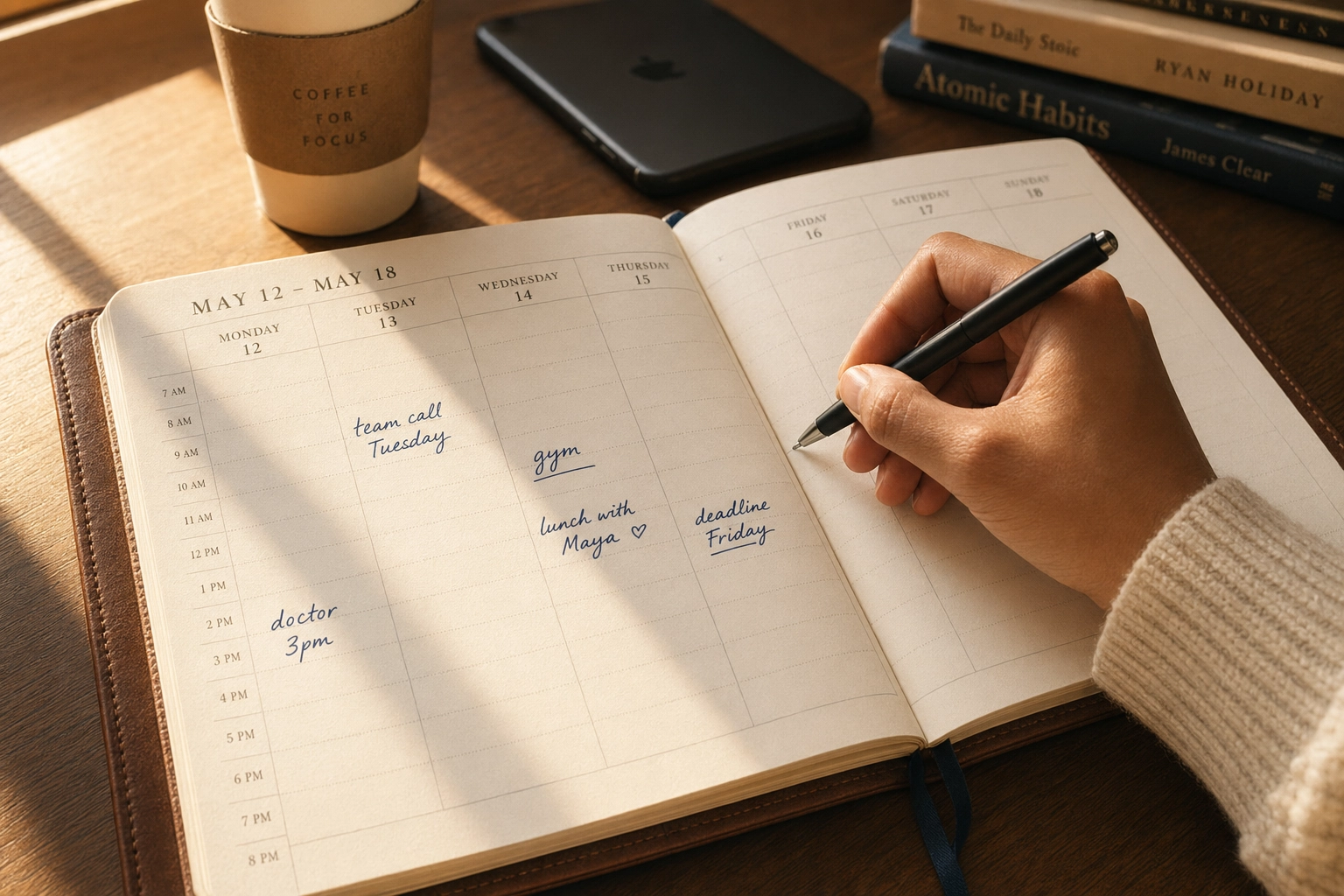
Here's the uncomfortable truth: reading this list once won't make these words yours. Without practice, you'll forget about half of them within a week — that's the forgetting curve, documented by memory researchers since the 1880s. The fix isn't reading harder. It's using the words. Building solid English vocabulary for daily use is a habit, not an event.
Strategy 1: Speak the dialogues aloud. Take any word entry and say both lines of the mini-dialogue out loud. Yes, both — Person A and Person B. This sounds silly but it's the single highest-leverage thing you can do. Reading is passive; speaking activates the muscles, the rhythm, and the recall pathway you actually need in conversation. Our English shadowing exercises take this further if you want a daily speaking practice technique.
Strategy 2: Use 5–7 new words a day in real talk. Trying to learn 100 words in one sitting is how you forget 95 of them. Pick a small handful, and find a way to use each one in a real conversation — even with yourself. Texting a friend in English counts. So does narrating your morning out loud: "I'm having breakfast. My coffee is hot. I'm a bit tired today." If you don't have someone to practice with, see our guide to practicing English speaking alone at home.
Strategy 3: Spaced repetition. Review the words at expanding intervals — once after a day, once after three days, once after a week. Memory research shows this beats cramming by a wide margin. Apps that schedule this for you exist, but even a simple notebook with dated review marks works fine. Many learners often combine spaced repetition with writing example sentences for a stronger memory trace.
Strategy 4: Make personal example sentences. The dialogues in this article are useful but generic. Your brain remembers things tied to YOUR life. Replace the sample sentences with ones from your day: "I ordered the spicy noodles at lunch," "My boss scheduled a meeting for Friday." The more personal, the better the encoding. Writing one sentence per word in a notebook — by hand — is one of the simple techniques that consistently works.
Strategy 5: Mind the active vs passive gap. You probably already understand most words on this list when you read them. That's passive vocabulary. The challenge is making them active — words you produce on demand when speaking. Linguists estimate it takes around 15–20 authentic uses for a word to graduate from passive to active. There are no shortcuts; you just have to keep using them.
For a deeper dive into the science of conversation-based learning, our guide on how to build vocabulary through real conversations covers the techniques in detail. And if you want a daily practice routine that's gentle but consistent, see our 15-minute daily English speaking practice routine.
From Word List to Real Fluency
The bridge between knowing 100 words and using 100 words is conversation. Not flashcards. Not reading. Not lectures. Conversation — where your brain has to retrieve the right word in real time, under mild pressure, and respond with something coherent.
That's hard if you don't have anyone to talk to. Most learners don't have a daily English-speaking partner, especially if they live in a country where English isn't the dominant language. Hiring a human tutor is one option, but it's expensive and requires scheduling.
This is where AI voice practice changes the math. With Practice Me, you can have natural voice conversations with AI English tutors any time of day — at 6 AM before work, on a long walk, or for ten minutes during your lunch break. The tutors adapt to your level, never get impatient, and give you unlimited online practice on the topics in this article: ordering food, scheduling appointments, talking about how you feel, navigating a workday in English.
The feature most relevant to vocabulary learning is automatic vocabulary saving. Every word you use during a conversation is saved to your personal vocabulary list — without you having to write it down. Instead of memorizing someone else's pre-made flashcards, you build your own English vocabulary for daily use from the words YOU actually used and want to remember. That emotional connection (you struggled to find this word, then nailed it) is exactly the kind of encoding that turns passive vocab into active vocab.
If speaking still feels intimidating, our guide to overcoming the fear of speaking English is worth reading first. The 100 words above won't help you much if you never let them out of your head. And once you're comfortable with the basics, see how to speak English fluently and confidently for the next stage of your language learning journey.
Frequently Asked Questions
How many English words do I need for daily conversation?
About 1,000–1,500 active words covers most basic daily conversations — ordering food, asking for directions, making small talk, handling errands. With 2,500–3,000 words, you understand around 90% of everyday English in conversations and standard reading. For full conversational fluency, most linguists estimate 3,000–10,000 words. The 100 words in this article are a focused starting block of high-frequency English vocabulary for daily use — they appear in virtually every English conversation you'll have. For a fuller plan, see our practical roadmap to English fluency.
Should I learn American or British English vocabulary first?
Most differences between American and British English are spelling and accent — the core vocabulary is shared. A few exceptions appear in this list (cheers, mate, bill vs. check, subway vs. underground), but well over 95% of the words have the same meaning and use in both. Pick whichever variant matches your goals: planning to work in the US? Start with our American English conversation practice topics. Studying in the UK? Lean British. Watching mostly Hollywood movies? You're absorbing American by exposure anyway. Once you're comfortable in one, the other comes naturally.
How long does it take to learn 100 daily English words?
With deliberate practice — 5–7 words a day, used in real sentences — most learners can recognize 100 words within 2–3 weeks. Active mastery (using the words comfortably and quickly in conversation) typically takes 4–8 weeks of consistent practice. Without speaking practice, retention drops sharply: research on the forgetting curve suggests you'll lose about 50% of new vocabulary within a week if you don't actively use it. Speaking the words out loud — even alone at home — is the single biggest accelerator.
What's the difference between basic and advanced English vocabulary?
Basic vocabulary is the high-frequency words used in roughly 90% of daily speech — the words on this list, plus another few hundred function words (the, is, and, etc.). Advanced English vocabulary is lower-frequency, more precise, or more formal — think meticulous, paradigm, nuance. Both matter, but basic words come first because they're the structural backbone of every sentence. Master daily vocabulary first; advanced words become much easier to learn once you have a strong base. They sit on top of conversational fluency, not next to it. Idioms and figurative phrases are the next layer — see our list of common English idioms for everyday conversation when you're ready.
Do I need to learn IPA pronunciation symbols?
Helpful but not required. Even partial IPA literacy pays off when you encounter words with weird spellings — receipt (silent p), aisle (silent s), colonel (pronounced "kernel"). Cambridge Dictionary, Oxford, and Merriam-Webster all use IPA, so it's a one-time investment that unlocks reliable pronunciation across resources. That said, audio is still the best teacher. Listen, repeat, record yourself, compare. IPA is a backup map; your ear is the compass. To work on the sounds beneath the symbols, see our English pronunciation practice for beginners.
Is this list too basic if I'm an intermediate English learner?
Not at all — even intermediate students of English often have gaps in their active daily vocabulary. You might know "disappointed" passively, but can you produce it without thinking when describing how a movie made you feel? Most intermediate learners have absorbed thousands of words from reading and watching shows but use a much smaller group in actual conversation. Use this list as an audit of your English vocabulary for daily use: read each word, and ask yourself whether you've used it out loud in the last month. The ones you haven't are gaps to close. For going beyond basics, 50+ common English idioms for everyday conversation is your next stop.
Your Next 100 Words
The goal isn't to memorize this list. The goal is to make these 100 words so automatic that you stop thinking about them — so that when a barista asks "for here or to go?" you answer without translating in your head. (Speaking of which — here's our guide on how to think in English instead of translating.)
Pick 10 words from this article right now. Read each dialogue out loud, twice. Then have one English conversation tomorrow — with a friend, a tutor, or with Practice Me's AI tutors — and try to use three of them. That's it. Repeat until the words feel boring because you've said them so often. That's exactly the moment they've become yours.