Duolingo taught you words. No one taught you to speak.
PracticeMe: real voice conversations with an AI tutor, 24/7.
English Speaking Confidence: The Complete Checklist

You've studied English for years. You can read articles, watch movies, even text fluently. But the moment someone asks you a question out loud — your mind goes blank, your throat tightens, and the words you definitely know somehow refuse to come out.
That gap between knowing English and speaking it is almost never about vocabulary. It's about English speaking confidence — and confidence isn't a personality trait you're born with. It's a skill you build, in stages, with the right practice.
This checklist is the most complete progression we've ever published. It synthesizes what works across forty Practice Me guides into five clear levels, each with specific action items to help you check off real progress. Find your starting point, work through it honestly, and watch the gap close.
Quick Summary: English speaking confidence is built through five sequential levels: Foundation (private practice), Building Blocks (basic conversations), Growing Skills (unscripted speech), Real-World Ready (high-stakes situations), and Fluent and Natural (thinking in English). Most learners get stuck because they try to skip levels. Work through each one in order — you'll build durable confidence, not just temporary courage.
Why Most English Learners Get Stuck Building Confidence
The dominant theory in language learning psychology — Stephen Krashen's affective filter hypothesis — argues that anxiety acts like a wall between your brain and the language input you're trying to absorb. When you're tense, your prefrontal cortex (the part that handles language) loses bandwidth to your amygdala (the part that handles threat). Researchers Horwitz, Horwitz and Cope formalized this in 1986, naming it Foreign Language Anxiety. Their finding still holds: the more anxious you feel, the worse you perform — even when you objectively know the material.
Here's the part most advice on building English speaking confidence misses. Confidence isn't built by waiting for anxiety to disappear. It's built by acting in spite of anxiety, in increasingly demanding situations, until your brain stops treating English as a threat. That's why this checklist is structured as a progression. You don't beat the fear by studying harder. You beat it by stacking small, specific wins — in the right order.
Most learners try to leap from "I'm scared to speak" straight to "I want to be fluent in business meetings." That gap is too wide. Every level you skip is a confidence collapse waiting to happen.
How to Use This Checklist
Read all five levels first to find your honest starting point. Most learners are surprised — they assume they're at Level 1 (foundation) when they're really stuck mid-Level 3, missing only one or two skills. Others assume they're at Level 4 (real-world ready) when they've actually skipped most of the foundation work and are running on adrenaline.
Three rules to help you use this checklist well:
- Move up only when 80% of items in your current level feel automatic, not effortful. Perfection isn't required. Effortlessness is.
- Don't skip levels. Every "shortcut" in language learning eventually demands the missed work back, with interest.
- Stay at each level for at least three weeks. Confidence needs reps, not understanding. You can't read your way through this.

Level 1: Foundation — Get Comfortable Before You Get Good
Goal of this level: Speak English out loud, alone, without your heart racing.
Level 1 is entirely private. No conversation partners, no audiences, no risk. The whole point is to break the association between "speaking English" and "being judged." Your nervous system has to learn that opening your mouth in English doesn't lead to embarrassment — and the only way to teach it that is repetition in a safe learning environment.
Most learners want to skip this stage because it feels childish. Don't. If you can't speak English comfortably to yourself, you absolutely cannot speak it comfortably to a stranger. Solo work is where English speaking confidence actually begins.
Level 1 Action Items
-
Name your specific fear. Is it making mistakes? Sounding "stupid"? Being judged for your accent? Failing in front of someone you respect? Write it down in one sentence. Vague fears are unbeatable; specific fears can be worked on. Our guide on overcoming the fear of speaking English covers the eight most common fear patterns and what to do about each.
-
Set a 12-week goal that's specific and measurable. "Become fluent" is not a goal. "Hold a 10-minute conversation about my job in English without rehearsing" is a goal.
-
Talk to yourself out loud for 5 minutes a day. Narrate your morning. Describe what you're cooking. Explain your weekend plans to no one. This sounds silly. It is also the single highest-leverage Level 1 habit.
-
Record a 1-minute voice memo in English daily. Listen back the next day without cringing. The first week you'll hate every recording. By week three, you won't. That's the muscle you're training.
-
Read English content aloud for 10 minutes daily. News articles, book chapters, your own emails — anything. This trains the physical mechanics (jaw, tongue, breath) without the cognitive load of generating sentences.
-
Build a 15-minute daily practice routine. The exact structure matters less than the consistency. Our 15-minute daily practice routine gives you a battle-tested template you can copy.
-
Choose one accent and commit. American or British. Switching back and forth at this stage scrambles your ear. You can branch out later — for now, pick one and stick with it.
-
Read our deep dives on solo practice. How to practice English speaking alone at home and how to improve English speaking by yourself cover the specific techniques that work without a partner. If you're a non-native speaker who studies primarily in their first language, our non-native speaker speaking guide addresses the unique self-practice challenges.
You've completed Level 1 when speaking English alone feels neutral — not exciting, not terrifying, just normal.
Level 2: Building Blocks — From Silent to Speaking
Goal of this level: Hold a 3-minute conversation about yourself without freezing.
Level 2 is where the actual speaking starts. The leap from solo practice to real conversation is the largest in this entire progression — most learners abandon their journey here. The cure isn't more vocabulary. It's a small set of patterns that help you get through the first 60 seconds of any conversation while your brain catches up.
Native speakers don't deliver flawless monologues. They use filler words, recycle stock phrases, and ask follow-up questions to buy time. Your job at Level 2 is to copy those exact strategies.
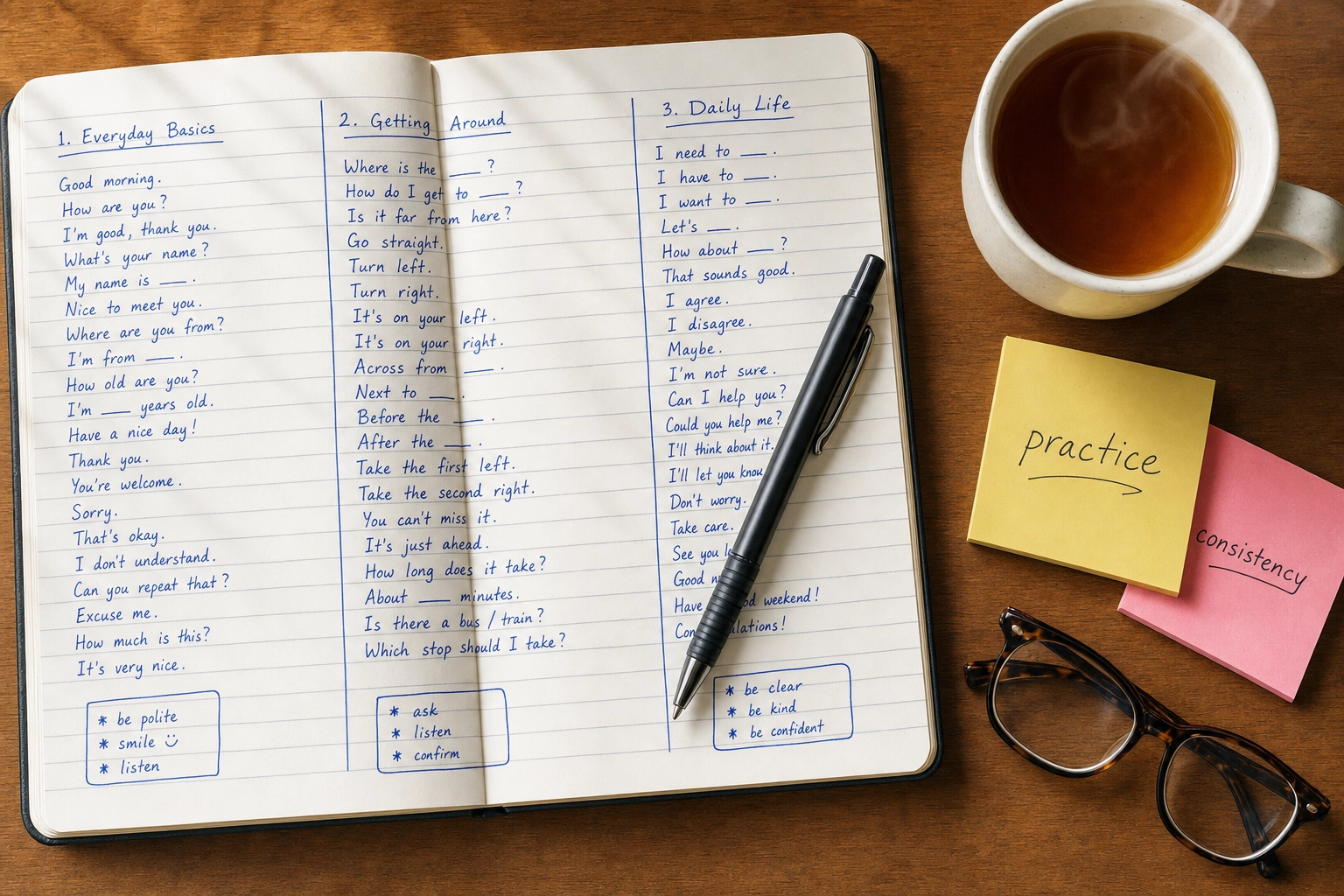
Level 2 Action Items
-
Master 10 filler words. Well, you know, I mean, like, actually, basically, sort of, kind of, the thing is, let me think. These aren't lazy speech — they're how native speakers buy thinking time without dead silence. Our English filler words and conversation connectors guide explains which ones signal fluency and which ones to avoid overusing.
-
Memorize a 90-second self-introduction at three levels. Casual ("I'm Maria, I'm from Madrid, I work in marketing"), professional ("My name is Maria Rodriguez, I lead growth marketing at..."), and personal ("I grew up in a small town outside Madrid, where..."). How to introduce yourself in English breaks down the exact structures and gives you 30+ example phrases.
-
Learn 20 small talk openers. "How's your week going?" "What brings you here?" "Have you been busy lately?" Small talk follows scripts more than people realize. Memorize the scripts.
-
Practice five universal follow-up questions. "Really, what do you mean?" "How did that go?" "What was that like?" "Why do you think that happened?" "Tell me more." These five questions can keep almost any conversation going for ten minutes.
-
Have one real low-stakes conversation per week. Order coffee in English. Ask a stranger for directions on Google Maps. Schedule one short AI tutor session. The medium matters less than the action.
-
Build a panic-phrase toolkit. "Sorry, could you repeat that?" "What does X mean?" "Let me think for a second." "I'm not sure how to say this in English." Memorizing graceful exits helps remove the worst-case fear.
-
Practice topical conversations daily. Our American English conversation practice guide and 50+ English conversation topics library give you starter prompts for hundreds of scenarios.
You've completed Level 2 when you can introduce yourself, have a 3-minute back-and-forth on a familiar topic, and gracefully handle moments when you don't understand something.
Level 3: Growing Skills — Speaking Beyond the Script
Goal of this level: Have an unscripted 10-minute conversation on a topic you didn't prepare for.
Level 3 is where most "intermediate plateau" learners get stuck for years. The reason is structural: at Level 2, you survived on memorized patterns. At Level 3, those patterns run out. You need generative skill — the ability to build new sentences in real time about topics you haven't rehearsed.
This level introduces three skills that separate a textbook speaker from a real one: vocabulary expansion through conversation, connected speech (the way native speakers actually pronounce words together), and pronunciation precision on the sounds your first language doesn't have. Each one compounds your English speaking confidence in a different direction.

Level 3 Action Items
-
Save 5 new words per day from real conversations — not from word lists. Words you struggled to find in actual speech are 10x more memorable than words you saw in a textbook. Our guide on building English vocabulary through conversations covers the exact extraction technique that works.
-
Run weekly role plays for situations you actually face. Job interview. Doctor's appointment. Apartment viewing. Returning a defective product. Don't role play scenarios you'll never encounter — practice the conversations you'll actually have.
-
Learn connected speech. Native speakers don't say "I am going to" — they say "I'm gonna." They link "get out" into "ged-out" and reduce "want to" into "wanna." Stop fighting it. Start using it.
-
Shadow native speakers for 10 minutes daily. Shadowing is the single most underrated technique in language learning. Our complete shadowing English guide and 5 shadowing exercises walk you through the method.
-
Drill your problem sounds. Almost every learner struggles with three or four sounds based on their first language. Our English pronunciation practice for beginners covers the high-leverage sounds, and 50 English tongue twisters gives you targeted exercises to help train your mouth. If you're working through a specific language profile, see the hardest English words to pronounce by native language.
-
Speak about a topic for 2 full minutes without stopping. Pick something at random — your favorite meal, last weekend, why you started learning English. Set a timer. Don't pause for more than 3 seconds. This builds the endurance Level 4 demands.
-
Push past your comfort zone once per week. Make a phone call instead of texting. Order at the counter instead of through an app. Ask a question in a meeting instead of staying silent. Confidence is built by accumulated small risks.
-
Run through self-study activities. Our 15 ESL speaking activities for self-study collection gives you exercises you can do without a partner.
You've completed Level 3 when an unfamiliar topic doesn't shut you down — you can think out loud in English, even imperfectly, for ten minutes straight.
Duolingo taught you words. No one taught you to speak.
PracticeMe: real voice conversations with an AI tutor, 24/7.
Level 4: Real-World Ready — Pressure-Tested Confidence
Goal of this level: Handle a 30-minute high-stakes conversation in English without losing your composure.
Level 4 is the level that opens doors. Job interviews, presentations, professional negotiations, public speaking, exam orals — situations where the stakes are real and the audience is real and you can't pause to look up a word. The skill isn't speaking more English. It's speaking under pressure without your fluency degrading.
The strategies at this level are different. You're no longer training for general fluency — you're training for specific high-stakes scenarios with their own conventions, vocabulary, and rhythm. This is where real-world English speaking confidence gets pressure-tested.

Level 4 Action Items
-
Prepare and deliver a 5-minute presentation. On any topic you know well. Record yourself. Watch the playback. Notice the pauses, the filler word loops, the moments your eyes break contact. Re-record until you watch it without wincing.
-
Run 10 mock job interview questions until your answers feel automatic. "Tell me about yourself," "What's your greatest weakness," "Why do you want this role" — these questions show up in 90% of interviews. Don't memorize scripts; build flexible templates that help you adapt to any phrasing.
-
Make 3 phone calls in English per week. Real or simulated. Phone English is the hardest mode because you lose facial cues, body language, and the ability to mime. If phone confidence is your goal, you have to log phone reps.
-
Master 20 business English idioms. Touch base, circle back, get the ball rolling, on the same page, take it offline, low-hanging fruit. These aren't optional in professional English — they're the connective tissue. Our 40+ business English idioms guide covers the ones that show up most often.
-
Handle interruptions gracefully. "That's a great point — let me address that first, then come back to your question." "If I could just finish this thought, I'll come back to you in a moment." These phrases buy authority without aggression.
-
Defend an opinion you actually hold. Pick something you believe in — a strong food preference, a political view, a workplace stance — and argue for it in English with someone who disagrees. Emotional speaking is a muscle. It needs separate training.
-
Take notes in English while listening. This splits your attention and forces real-time processing. It's the exact skill demanded by university lectures, work meetings, and standardized tests. If you're prepping for an exam, our TOEFL speaking practice topics guide covers the test-specific formats.
-
Run unscripted AI tutor sessions on professional topics. Practice walking through your resume, defending a project decision, or explaining your work to a non-expert. Our guide to practicing English speaking with AI covers the most useful prompts.
You've completed Level 4 when high-stakes English doesn't degrade your fluency — you sound roughly the same in a job interview as you do at brunch.
Level 5: Fluent and Natural — Speaking Without Translation
Goal of this level: Think directly in English. Use idioms naturally. Speak without internal rehearsal. Make jokes. Have arguments. Forget that English was ever a "second" language.
Level 5 isn't about more vocabulary or better grammar. By this stage, those are already in place. Level 5 is about psychology. It's the level where you stop treating English as something you're performing and start treating it as something you simply use.
This is also the level where most learners stop progressing — not because the work is hard, but because they don't realize there's still work to do. The plateau between "professionally functional" and "native-feeling" is invisible from below. Here's what's on the other side.

Level 5 Action Items
-
Catch yourself translating. When you notice your brain composing a sentence in your first language and then converting it, stop. Rebuild it directly in English from scratch. Our guides on thinking in English instead of translating and stopping translation to speak English naturally cover the specific mental drills that help you make this switch.
-
Master 50 high-frequency idioms in your chosen variety. Our libraries — 50+ common English idioms for everyday conversation, 30+ American English idioms, and 50 British English idioms Americans don't use — give you the exact vocabulary natives use. For variety, funny English idioms that make no sense (explained) is a more entertaining route into the same skill.
-
Use humor in English. Tell a joke. Make a sarcastic comment. Notice when something is funny and respond appropriately. Humor lives at the edge of fluency — it requires comfort with timing, ambiguity, and cultural reference.
-
Have a heated debate or emotional conversation entirely in English. Anger, excitement, sadness, frustration — emotions tend to drag you back to your first language. The cure is intentionally having those conversations in English until the language stops slipping under stress.
-
Stop apologizing for your accent or "level." "Sorry, my English is bad" is a self-fulfilling prophecy. People perceive you as your accent describes itself. Drop the apology.
-
Teach someone else something in English. Explain your job to a beginner. Walk a friend through how to do something you know well. Teaching is the ultimate test of fluency because it forces you to simplify, repeat, and adapt.
-
Embrace imperfection. Native speakers misuse words, flub grammar, and forget vocabulary constantly. Watch any unscripted interview. Fluent doesn't mean flawless. It means unbothered.
-
Reach 300+ hours of total speaking time. This is the consistency threshold most polyglots and language coaches converge on. Below 300 hours, even great strategies feel slow. Above 300 hours, things click. Our deep dives on speaking English fluently and confidently, the practical roadmap to English fluency, 15 proven strategies to learn English fast, and 15 expert tips to improve English speaking all reinforce the same point: hours beat hacks.
You've completed Level 5 when English stops being something you do and becomes something you are. There's no diploma for this. You'll just notice one day that you've forgotten what it felt like to be afraid.

What Each Level Actually Feels Like (Reader Self-Check)
Most learners can't honestly self-diagnose their level because the experience of being at each level is qualitatively different. Read these descriptions and find the one that matches your actual lived experience this week — not the one you wish matched. This honest self-check is the single most useful thing you can do to accelerate your English speaking confidence.
Level 1 feels like: Your stomach drops when someone addresses you in English. Your mind goes blank. You avoid situations where you might have to speak. You can read English fine; speaking feels like a different skill entirely.
Level 2 feels like: You can speak in familiar scripts (introductions, ordering food, basic small talk), but anything outside the script causes you to freeze. You're "fine if I prepare," not fine if surprised.
Level 3 feels like: You're comfortable in familiar contexts but get rattled in new ones. Long conversations are exhausting. You sometimes catch yourself avoiding complex thoughts because you don't have the words.
Level 4 feels like: You're functional in almost any situation, but high-stakes English (interviews, presentations, important meetings) requires preparation and produces residual anxiety. You sound less fluent under pressure than at brunch.
Level 5 feels like: English is just another tool. There's no internal translator. You make mistakes and don't care. You forget what it was like to be at the earlier levels — and only remember when you meet someone else struggling with the language.
Be honest. The level you're at is the level your hardest English moments this week revealed.
How Practice Me Was Built for Every Level of This Journey
Practice Me exists for one reason: every level above is dramatically harder without a judgment-free practice partner who's available when you actually have time to practice — late nights, lunch breaks, the bus ride home. Human tutors solve part of the problem, but they're expensive, scheduled, and (whether you admit it or not) a source of additional anxiety.
We built Practice Me as the partner that fits this exact progression. It's specifically designed to help you build English speaking confidence at every level:
-
At Level 1, you can practice alone with zero stakes. Our AI tutors won't judge a halting sentence or a wrong word. You can hang up at any time. Nobody is watching.
-
At Levels 2 and 3, our three tutor personalities — Sarah, Oliver, and Marcus — hold real conversations with you, save vocabulary you used or struggled with automatically, and adapt to your level over time. You can switch between American and British accents to train your ear.
-
At Level 4, specialized topics let you run mock job interviews, practice presentations, rehearse phone calls, and drill business English scenarios — as many times as you need, with the same patience every time.
-
At Level 5, unlimited unscripted conversations give you the one thing other learning apps can't: hours. Real fluency requires real talking time. Practice Me Pro removes every friction in logging that time. Meet the AI tutors and see Practice Me Pro pricing.
Practice Me is iOS and Android, English only, and built around real-time voice — not chat, not flashcards, not grammar drills. It's a focused tool for the one skill that actually transfers: speaking out loud, often, without fear.
Frequently Asked Questions
How long does it take to build confidence in English speaking?
Most learners notice meaningful confidence shifts within 4–8 weeks of consistent daily practice — even just 15 minutes a day. Full progression through all five levels typically takes 6–18 months, depending on your starting point, daily time investment, and how often you push past your comfort zone. The biggest variable isn't talent or starting level — it's consistency. Three months of 15 minutes daily beats three weekends of marathon study every time.
Can I build English speaking confidence without a tutor or partner?
Yes — Levels 1 and 2 can be done entirely solo. Self-talk, recording yourself, reading aloud, and shadowing all work without a partner. Levels 3 through 5 require some form of conversation partner, because the skills you're building (unscripted speech, real-time processing, emotional speaking) only develop through actual back-and-forth. Your options are: human tutors, language exchange partners, real-world situations, or AI tutors — whatever fits your schedule and stress tolerance. Most learners use a mix.
Why am I confident in lessons but freeze in real conversations?
Because classroom English is predictable and real English is improvised. In a lesson, you know roughly what topics will come up, what vocabulary you'll need, and how long you have to respond. In real conversations, none of that is true. The cure is unscripted practice in low-stakes situations — exactly what Level 3 is built around. This freeze pattern almost always means you skipped the unscripted-speaking work and jumped from rehearsed Level 2 conversations to real-world demands without the bridge.
Should I focus on accent or fluency first?
Fluency, every time. A clear non-native accent with fluent, confident speech is dramatically more effective than a "perfect" accent that hesitates every five words. Accent refinement makes sense at Level 4 or later, once your fluency is solid. Working on accent before fluency is like polishing a car you haven't built yet. Focus on saying things — clearly enough to be understood — and let the accent gradually shift as your ear improves.
How do I know when I've moved up a level?
When 80% of items in your current level feel automatic rather than effortful. Not perfect — automatic. The best self-test is recording yourself in a situation that matches your target level (a 5-minute self-talk for Level 1, a 3-minute self-introduction for Level 2, an unscripted monologue for Level 3, a mock interview for Level 4, a heated debate for Level 5) and listening back honestly. If most of it sounds like the level you're targeting, you're ready to move up. If you cringe more than three times, you've still got reps to log.