Duolingo taught you words. No one taught you to speak.
PracticeMe: real voice conversations with an AI tutor, 24/7.
Funny English Idioms That Make No Sense (Explained)

Imagine you're learning English, feeling pretty confident, and someone says, "Break a leg!" before your job interview. You're terrified. Then your friend says she "spilled the beans" and her boss wants her to "bite the bullet." It sounds like a crime scene, not a Tuesday at the office. Welcome to the world of funny English idioms — where nothing means what it literally says, and everyone just... goes along with it.
Quick Summary: English is packed with idioms that sound absolutely ridiculous when translated literally. This guide covers 30+ of the funniest English idioms, organized by "weirdness level" from mildly odd to completely unhinged. Each one includes its literal meaning, actual meaning, origin story, a conversation example, and equivalent expressions in Spanish, Chinese, Japanese, and Arabic. There's also a quiz to test yourself.
Why Funny English Idioms Sound Completely Insane
Here's a stat that might surprise you: research in corpus linguistics shows idiomatic expressions appear in roughly 4 out of every 10 sentences in casual English conversation. That means nearly half of everyday English is figurative — not literal.
For non-native speakers, this is a nightmare. You can know every word in "it's raining cats and dogs" and still have zero idea what someone is telling you. The words make sense individually. Together? Absolute chaos.
But here's the thing — English isn't uniquely weird. Spanish speakers talk about frogs growing hair. Chinese has snakes with extra feet. Japanese people wear cats on their heads. Arabic has donkeys climbing minarets.
Every language is delightfully insane. English just happens to have a lot of material to work with. The Merriam-Webster dictionary estimates there are over 25,000 idiomatic expressions in English alone.
This guide covers 30+ of the funniest English idioms that make no sense, ranked by how much they'd confuse someone hearing them for the first time. For each, you'll get the literal image it creates, what it actually means, where it came from, how you'd hear it in real English conversation, and how other languages express the same idea.
If you want idioms organized by practical use, check out our guides to common English idioms for conversation, American English idioms, British English idioms, and business English idioms.
How the Weirdness Scale Works
Each idiom gets a weirdness rating from ⭐ (mildly strange) to ⭐⭐⭐⭐⭐ (your brain will hurt). The ratings are based on one question: How confused would someone be if they translated this word-for-word into another language?
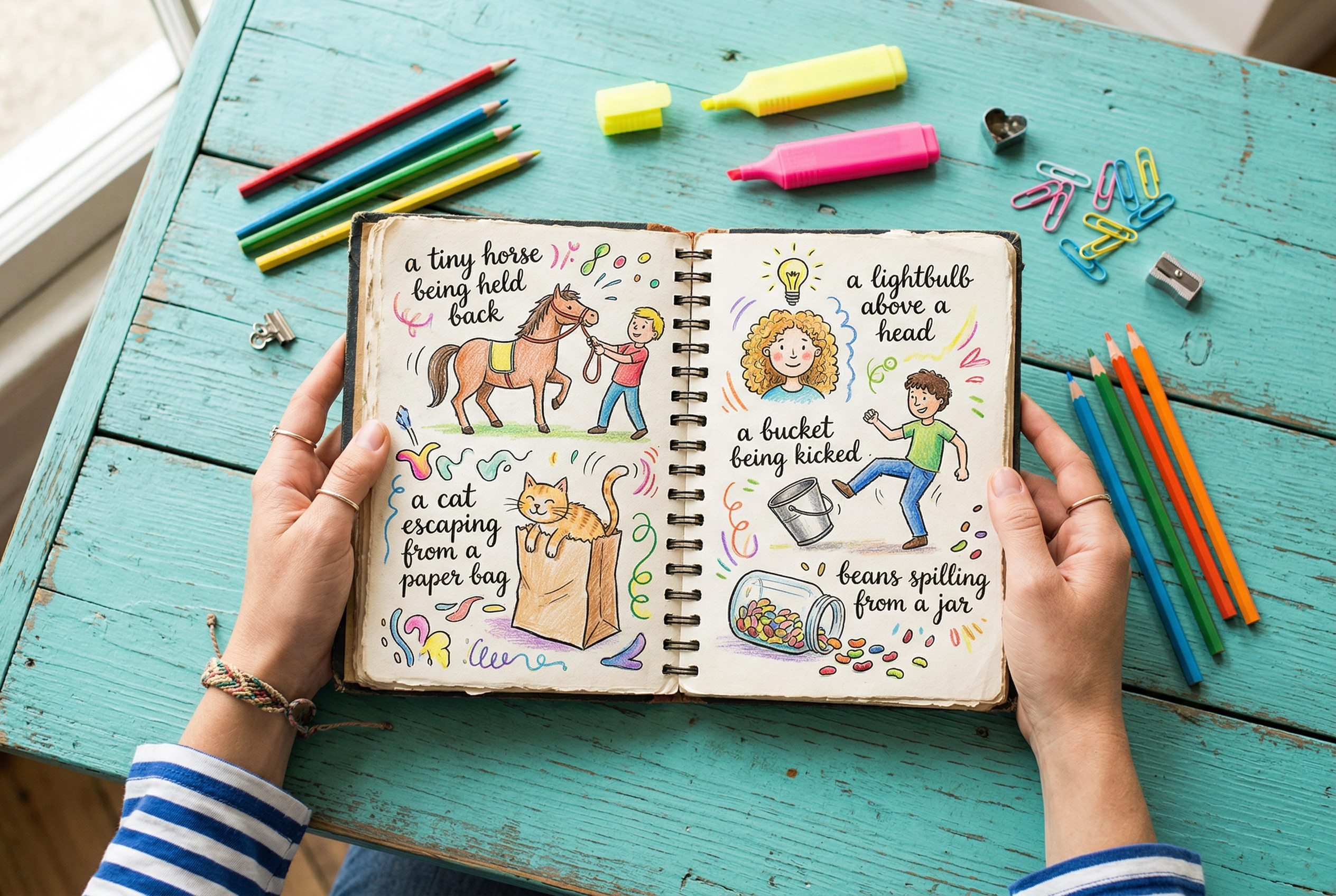
Track how many you already know as you read. If you recognize over 20, your English vocabulary is seriously impressive. (Need to level up? Try building vocabulary through real conversations.)
Level 1: Mildly Weird ⭐
These idioms are strange, but you can kind of squint and see the logic.

Piece of cake
Literal image: Someone hands you a cake instead of an answer. Actual meaning: Something very easy. Origin: This likely comes from 1870s cakewalk competitions, where the easiest dance moves won a cake as a prize. If something was "a piece of cake," it was so easy you'd win effortlessly. In conversation: "How was the driving test?" "Piece of cake — I passed on the first try." In other languages: Spanish: pan comido (eaten bread). Japanese: 朝飯前 asameshi mae (before breakfast). Arabic: أسهل من شربة ماء (easier than drinking water).
Break a leg
Literal image: Someone snapping their own femur on purpose. Actual meaning: Good luck! (Used especially in theater.) Origin: In theater, saying "good luck" was considered bad luck. One theory: "legs" are the side curtains on a stage, and "breaking the leg" meant stepping past them to perform — i.e., actually getting on stage rather than waiting in the wings. In conversation: "I have my final presentation tomorrow." "Break a leg! You've practiced enough." In other languages: In German, you say Hals- und Beinbruch! (Break your neck and leg!). In Spanish: ¡Mucha mierda! (Lots of... well, manure). Theater people worldwide have a strange relationship with luck.
Hit the sack
Literal image: Someone punching a bag of grain. Actual meaning: Go to bed. Origin: Before modern mattresses, people slept on sacks stuffed with hay or straw. You'd literally hit your sack to fluff it before sleeping. In conversation: "It's almost midnight — I'm going to hit the sack." In other languages: Spanish: irse al sobre (go into the envelope). Japanese: 布団に入る futon ni hairu (get into the futon) — more literal, honestly.
Bite the bullet
Literal image: Crunching down on live ammunition. Actual meaning: To endure something painful or difficult with courage. Origin: Before anesthesia, soldiers were given a leather strap or bullet to bite during battlefield surgery to cope with the pain. The phrase became common in English writing by the mid-1800s. In conversation: "I hate going to the dentist, but I just need to bite the bullet and book the appointment." In other languages: Chinese: 咬紧牙关 yǎo jǐn yá guān (clench your teeth). Spanish: apretar los dientes (tighten your teeth). Apparently, jaws do the heavy lifting across cultures.
Under the weather
Literal image: Standing beneath a cloud. Actual meaning: Feeling sick or unwell. Origin: Sailors who fell ill would go below deck to escape rough weather, literally getting "under" the weather on the ship's surface. Nautical terminology has given English dozens of common idioms. In conversation: "Maya's not coming today — she's feeling a bit under the weather." In other languages: Spanish: estar pachucho (to feel droopy). Arabic: مزاجي تعبان mazāji ta'bān (my mood is tired).
Burn the midnight oil
Literal image: Setting fire to a puddle of oil at midnight. Actual meaning: Working or studying late into the night. Origin: Before electricity, people used oil lamps. If you were still burning oil at midnight, you were working very late. This is one that makes perfect sense once you know the history. In conversation: "I've been burning the midnight oil all week studying for my exam." In other languages: Spanish: quemarse las pestañas (burn your eyelashes). Chinese: 挑灯夜读 tiǎo dēng yè dú (raise the lamp, study at night). Both involve burning things near your face, apparently. If you've been burning the midnight oil studying English, our daily English speaking practice routine might help you learn faster.
Level 2: Hold On, What? ⭐⭐
The logic starts to crumble here. These funny idioms require real backstory to make sense.

Spill the beans
Literal image: Accidentally dumping a can of beans on the floor. Actual meaning: To reveal a secret. Origin: One popular theory traces this to ancient Greece, where people voted by placing beans into jars. Spilling the jar revealed the secret votes prematurely. In conversation: "Don't tell Marcus about the surprise party — he'll definitely spill the beans." In other languages: Spanish: descubrir el pastel (uncover the cake). Chinese: 泄露秘密 xiè lòu mì mì (leak the secret — much more straightforward). Arabic: فضح السر fadaḥa as-sirr (expose the secret).
Let the cat out of the bag
Literal image: Opening a bag and a cat leaps out. Actual meaning: To reveal a secret (similar to "spill the beans"). Origin: In medieval markets, dishonest sellers would put a cat in a bag instead of a piglet. If someone "let the cat out of the bag," the fraud was revealed. This one comes from real market fraud — not mythology. In conversation: "We were planning a surprise trip, but my sister let the cat out of the bag." In other languages: In German, you buy the cat in the bag: die Katze im Sack kaufen (to buy a cat in a sack — meaning to buy something without checking it first). Swedish, Polish, Latvian, and Norwegian have similar versions, according to TED translators.
Cost an arm and a leg
Literal image: Paying for something with your actual limbs. Actual meaning: Extremely expensive. Origin: The exact origin is debated. One theory links it to portrait paintings — early American painters charged more for paintings that included arms and legs because they were more detailed to paint. A head-only portrait was much cheaper. In conversation: "Those concert tickets cost an arm and a leg, but it was totally worth it." In other languages: Spanish: costar un ojo de la cara (cost an eye from your face). Chinese: 天价 tiān jià (sky price). Arabic: بعيني ba'ayni (with my eye). Different body parts, same pain.
Hold your horses
Literal image: Physically restraining horses with your bare hands. Actual meaning: Slow down, be patient. Origin: This goes all the way back to Homer's Iliad, where charioteers were literally told to hold their horses steady. Over centuries, the meaning shifted from literal horse control to general patience. It's one of the oldest idioms still in common use. In conversation: "Hold your horses — let me finish explaining before you make a decision." In other languages: Spanish: para el carro (stop the cart). Arabic: على مهلك ala mahlak (at your ease). Chinese: 慢着 màn zhe (slow down). These idioms come up constantly in everyday English conversation.
Barking up the wrong tree
Literal image: A person yelling at the wrong tree in a forest. Actual meaning: Pursuing a mistaken course of action. Origin: Hunting dogs would chase raccoons or possums up trees, then bark at the base to alert the hunter. Sometimes, the animal would leap to a different tree, leaving the dog barking at the wrong one. In conversation: "If you think I broke your mug, you're barking up the wrong tree." In other languages: Spanish: ir descaminado (to be off-track). Arabic: يضرب في الحديد البارد yaḍrib fil-ḥadīd al-bārid (hitting cold iron).
Beat around the bush
Literal image: Someone hitting bushes with a stick for no reason. Actual meaning: Avoiding the main topic, being indirect. Origin: In medieval bird hunts, beaters would thrash bushes to flush out birds while hunters waited. Beating around the bush meant you weren't actually getting to the birds — just dancing around the edges. In conversation: "Stop beating around the bush and tell me what happened." In other languages: Spanish: andarse por las ramas (walk through the branches). Chinese: 拐弯抹角 guǎi wān mò jiǎo (turn corners and rub angles). Japanese: 遠回しに言う toomawashi ni iu (to speak in a roundabout way).
Level 3: That Can't Be Real ⭐⭐⭐
These weird English idioms are genuinely bizarre when you stop and think about them literally.

It's raining cats and dogs
Literal image: Actual cats and dogs plummeting from storm clouds. Actual meaning: It's raining very heavily. Origin: Multiple theories compete here. One points to Norse mythology, where cats symbolized heavy rain and dogs were associated with Odin, the storm god. Another suggests that in 17th-century England, heavy rains would wash dead animals through the streets, making it look like they'd fallen from the sky. The poet Henry Vaughan wrote about "dogs and cats rained in shower" in the 1650s. In conversation: "Take an umbrella — it's raining cats and dogs out there." In other languages: Spanish: llover a cántaros (raining pitchers). French: il pleut des cordes (it's raining ropes). Arabic: الدنيا بتمطر جرادل ad-dunya bitmaṭṭar garādil (the world is raining buckets).
Kick the bucket
Literal image: Someone angrily kicking a pail. Actual meaning: To die. (Informal, sometimes humorous.) Origin: The most common theory is grim: in slaughterhouses, animals were hung from a wooden beam called a "bucket." During slaughter, they'd thrash and kick against it. A darker folk etymology involves execution. In English, there are dozens of idioms that avoid directly saying "die" — this is the most famous. In conversation: "Old Mr. Henderson finally kicked the bucket at 97. He lived a full life." In other languages: French: casser sa pipe (break one's pipe). Polish: kopnąć w kalendarz (kick the calendar). Italian: tirare le cuoia (pull the leathers). Every language has creative euphemisms for death.
Cold turkey
Literal image: A frozen, uncooked Thanksgiving turkey. Actual meaning: Quitting an addiction abruptly, without tapering off. Origin: When someone goes through withdrawal, their skin develops goosebumps and becomes pale and clammy — resembling the skin of a plucked, cold turkey. In conversation: "He didn't use patches or anything — he quit smoking cold turkey." In other languages: Spanish: de golpe (suddenly). There isn't a direct equivalent in most languages — this one is uniquely English in its weirdness.
Pull someone's leg
Literal image: Physically yanking someone's leg out from under them. Actual meaning: To joke with someone, to tease. Origin: Theories vary. One connects it to 19th-century street thieves in London who would trip people by pulling their legs to rob them. Others link it to darker historical practices. Regardless, "having a laugh at someone's expense" is how it evolved. In conversation: "You won the lottery? Are you pulling my leg?" In other languages: Spanish: tomar el pelo (take someone's hair). French: mener en bateau (take someone by boat). Japanese: からかう karakau (to tease — no weird body parts involved).
A bull in a china shop
Literal image: A 2,000-pound bull rampaging through shelves of fine porcelain. Actual meaning: A clumsy or reckless person in a delicate situation. Origin: This phrase dates back to at least the early 1800s and paints such a vivid picture it barely needs explanation. (Fun fact: The MythBusters TV show once put actual bulls in a mock china shop. The bulls carefully avoided every single shelf. So much for that metaphor.) In conversation: "Don't invite Jake to the art gallery — he's like a bull in a china shop." In other languages: Spanish: como un elefante en una cacharrería (like an elephant in a pottery shop). The animal changes, but the destruction stays. These kind of colorful expressions are something you'll pick up naturally when you practice English speaking with AI.
Head over heels
Literal image: Someone's head... over their heels. That's just standing up normally. Actual meaning: Deeply, madly in love (or, less commonly, completely upside down). Origin: This idiom is genuinely backwards. The original phrase was actually "heels over head" — which describes tumbling or falling. Over time, it got flipped to "head over heels," which technically means standing upright. English speakers have been saying it wrong for centuries, and at this point, everyone's just committed. In conversation: "She's head over heels for her new coworker." In other languages: Spanish: estar loco/a de amor (to be crazy with love). German: Hals über Kopf (neck over head — at least they got closer to the tumbling).
Level 4: English Is Broken ⭐⭐⭐⭐
At this point, even native speakers can't explain why they say these things. These interesting English idioms have origins that are either lost, debated, or completely mysterious.

The whole nine yards
Literal image: An oddly specific amount of yard fabric. Actual meaning: Everything, the full extent. Origin: Nobody actually knows where this comes from — and it's been debated for decades. Theories include: WWII aircraft machine gun belts that were 27 feet (9 yards) long, the amount of fabric needed for a full men's suit, or the capacity of a concrete mixer truck. The New York Times has called it "the most prominent etymological riddle of our time." In conversation: "She went the whole nine yards for the wedding — live band, ice sculpture, everything." In other languages: Most languages just say "everything" without measuring it in yards.
Duolingo taught you words. No one taught you to speak.
PracticeMe: real voice conversations with an AI tutor, 24/7.
Bob's your uncle
Literal image: A man named Bob is your relative. Actual meaning: "And there you have it!" or "It's as simple as that." Origin: In 1887, British Prime Minister Robert ("Bob") Cecil appointed his nephew Arthur Balfour to a powerful government position. The public saw it as blatant nepotism — if Bob was your uncle, everything just worked out for you. It's one of the most distinctly British English idioms you'll encounter. In conversation: "Just press this button, type your password, and Bob's your uncle — you're logged in." In other languages: This one is uniquely British. Spanish has y listo (and done). French: et voilà.
By the skin of your teeth
Literal image: Your teeth have skin, and you're barely hanging onto it. Actual meaning: Just barely, by a very narrow margin. Origin: This comes directly from the Bible — Job 19:20: "I have escaped with only the skin of my teeth." Since teeth don't actually have skin, it means escaping with essentially nothing — the narrowest possible margin. In conversation: "I passed the exam by the skin of my teeth — one more wrong answer and I would've failed." In other languages: Spanish: por los pelos (by the hairs). Chinese: 千钧一发 qiān jūn yī fà (a thousand pounds hanging by a single hair). Arabic: بالكاد bil-kād (barely).
Cat got your tongue?
Literal image: A cat physically holding someone's tongue. Actual meaning: Why aren't you saying anything? Origin: Multiple theories: one involves the "cat-o'-nine-tails" whip used in the English navy, which would leave sailors speechless with pain. Another theory points to historical practices of punishment that left people unable to speak. Either way, this idiom sounds deeply unsettling when you think about it. In conversation: "You've been really quiet today. Cat got your tongue?" In other languages: Spanish: ¿Te comió la lengua el gato? (Did the cat eat your tongue?). Arabic: بلع لسانك bala' lisānak? (Did you swallow your tongue?).
Best thing since sliced bread
Literal image: Nothing could possibly surpass the invention of pre-cut bread. Actual meaning: Something that's excellent, a great innovation. Origin: Sliced bread was first sold in 1928 in Chillicothe, Missouri. The Chillicothe Baking Company advertised it as "the greatest forward step in the baking industry since bread was wrapped." The phrase stuck — and became the gold standard for anything impressive. Smithsonian Magazine has a great deep dive on this story. In conversation: "Have you tried that new coffee place? It's the best thing since sliced bread." In other languages: Most languages don't reference bread. French: le nec plus ultra (the utmost). Spanish: lo mejor desde la invención de la rueda (the best thing since the invention of the wheel).
Don't cry over spilled milk
Literal image: Sobbing inconsolably over a puddle of dairy. Actual meaning: Don't waste time being upset about something that's already happened and can't be undone. Origin: This dates to at least 1659 in British writing. The logic is straightforward: once milk is spilled, crying won't put it back. In conversation: "I know you missed the deadline, but don't cry over spilled milk — let's focus on next steps." In other languages: Spanish: a lo hecho, pecho (what's done, face it with your chest). Chinese: 覆水难收 fù shuǐ nán shōu (spilled water is hard to recover). Japanese: 覆水盆に返らず fukusui bon ni kaerazu (spilled water won't return to the tray). If you're preparing for professional English conversations, these idioms pop up a lot — our guide to business English idioms has 40+ more for the workplace.
Level 5: I Give Up ⭐⭐⭐⭐⭐
Maximum weirdness. These are the funniest English idioms because they are so far removed from their literal meaning that you simply have to memorize them — or better yet, hear them in context.
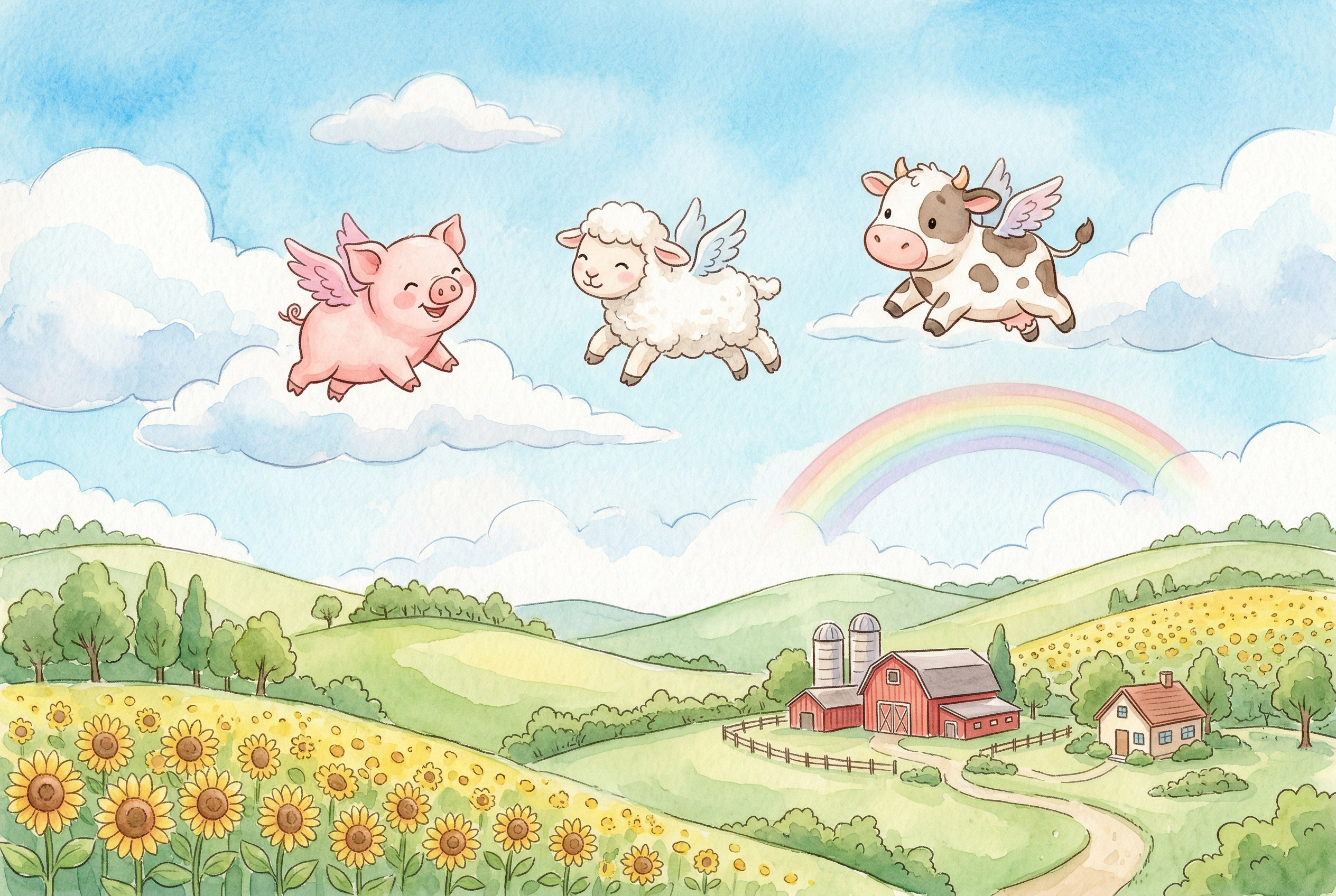
When pigs fly
Literal image: Pigs with wings, soaring through the sky. Actual meaning: Something that will never happen. Origin: This dates back to a 1616 English proverb collection. The idea is that pigs — heavy, ground-dwelling animals — will never fly, so the thing you're talking about will never happen either. In conversation: "You think he'll apologize? When pigs fly." In other languages: Spanish: cuando las ranas críen pelo (when frogs grow hair). Arabic: لما يطلع الحمار على المنارة lammā yiṭla' il-ḥumār 'ala al-manāra (when the donkey climbs the minaret). French: quand les poules auront des dents (when hens have teeth). Russian: когда рак на горе свистнет (when a lobster whistles on a mountain). Thai: ชาติหน้าตอนบ่าย ๆ (one afternoon in your next reincarnation). Every culture picks a different impossible animal feat, and they're all hilarious.
Put a sock in it
Literal image: Stuffing a sock into something. Actual meaning: Be quiet, stop talking. Origin: Before electronic volume controls, early gramophones used large horns to amplify sound. To lower the volume, people would literally stuff a sock into the horn. So "put a sock in it" = turn the volume down = stop being so loud. In conversation: "We're trying to study in here — put a sock in it!" In other languages: Spanish: cierra el pico (close your beak). Chinese: 闭嘴 bì zuǐ (shut your mouth). Japanese: 黙れ damare (be silent). English wins for creativity here.
Elephant in the room
Literal image: An actual elephant standing in someone's living room while everyone ignores it. Actual meaning: An obvious problem no one wants to discuss. Origin: This traces to a fable from 1814 by Ivan Krylov, where a man visits a museum, admires all the tiny details, but somehow misses the elephant. The idea: some problems are so big and uncomfortable that people pretend they don't exist. In conversation: "Look, the elephant in the room is that we're over budget and nobody's addressed it." In other languages: This idiom has been widely adopted across languages. Spanish uses it directly: el elefante en la habitación. Mandarin: 房间里的大象 fángjiān lǐ de dà xiàng. It appears in both American English idioms and business conversations frequently.
It's not my cup of tea
Literal image: Someone rejecting a specific cup of tea. Actual meaning: It's not something I enjoy or am interested in. Origin: The British love tea. By the early 20th century, saying something was "your cup of tea" meant it was to your liking. The negative version — "not my cup of tea" — became the polite British way of saying "I dislike that" without being rude. In conversation: "Horror movies? Not my cup of tea, honestly." In other languages: Spanish: no es lo mío (it's not my thing). Japanese: 好みではない konomi de wa nai (it's not my preference). The British version is just more... British. For more of these quintessentially British phrases, see our guide to British English idioms.
Steal someone's thunder
Literal image: Reaching into a storm cloud and taking the thunder. Actual meaning: To take credit for someone else's idea or upstage them. Origin: This has a very specific, verifiable origin. In 1704, playwright John Dennis invented a machine that simulated thunder for his play. The play flopped, but another theater started using his thunder technique. Dennis reportedly shouted, "They will not let my play run, but they steal my thunder!" The phrase survived long after anyone remembered the play. In conversation: "I was about to announce my promotion, but my coworker stole my thunder by sharing her engagement news." In other languages: Spanish: robar protagonismo (steal the spotlight). Chinese: 抢风头 qiǎng fēng tou (steal the limelight).
The pot calling the kettle black
Literal image: Kitchen cookware having a heated argument about skin color. Actual meaning: Criticizing someone for a fault you also have; being a hypocrite. Origin: This dates to Cervantes' Don Quixote (1620). In the era of open-fire cooking, both pots and kettles got covered in black soot — so the pot had no business criticizing the kettle for being dark. In conversation: "You're calling me messy? That's the pot calling the kettle black — look at your desk!" In other languages: Chinese: 五十步笑百步 wǔ shí bù xiào bǎi bù (the one who retreated 50 steps laughs at the one who retreated 100 steps). Spanish: le dijo la sartén al cazo (said the pan to the saucepan). Japanese: 目くそ鼻くそを笑う mekuso hanakuso wo warau (eye gunk laughing at nose gunk — Japanese wins this round).
Every Language Is Weird: Idiom Equivalents Around the World
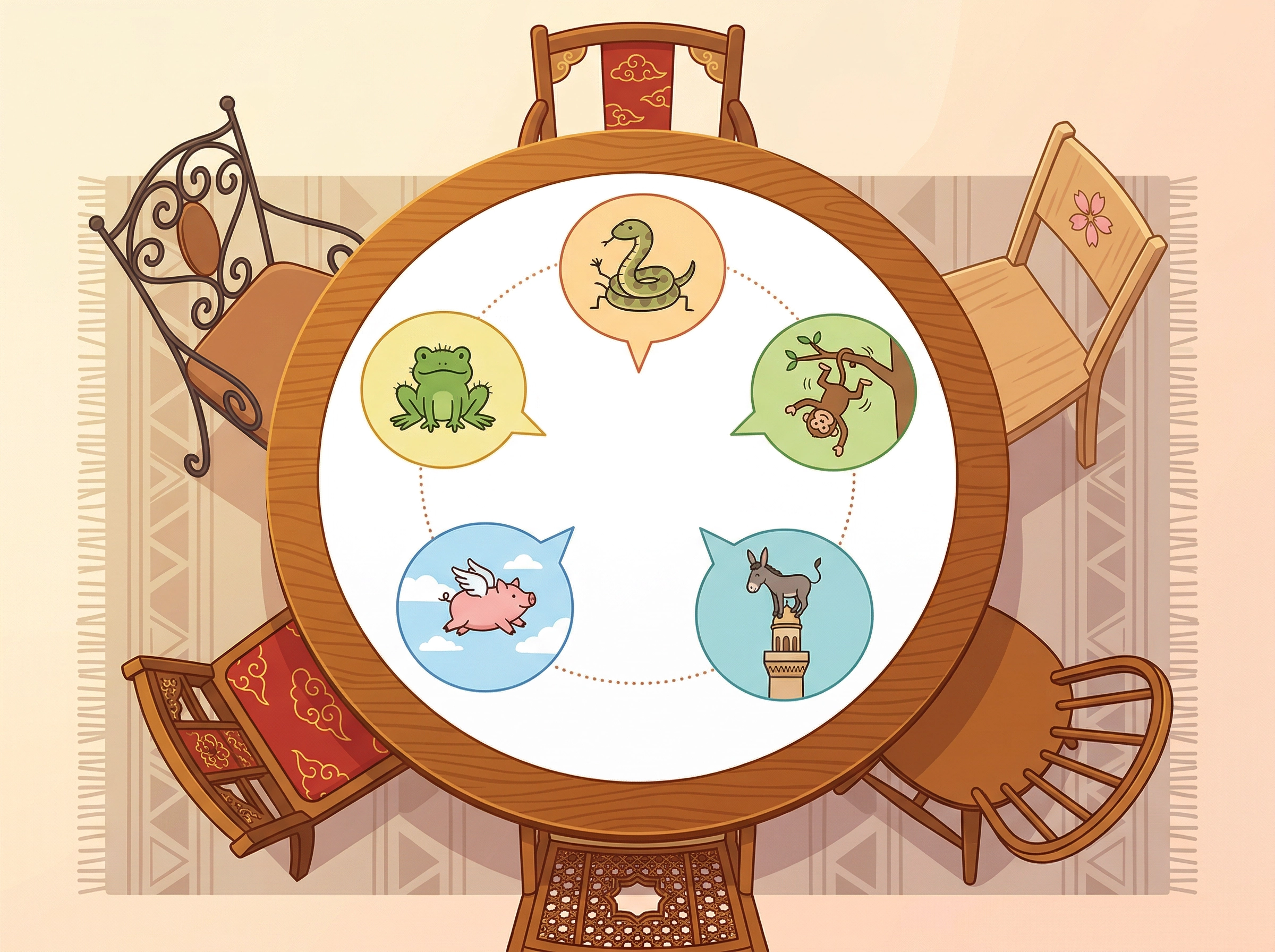
English doesn't have a monopoly on bizarre expressions. Here's how different languages express the same ideas — and they're often even stranger:
| Concept | English | Spanish | Chinese | Japanese | Arabic |
|---|---|---|---|---|---|
| Never going to happen | When pigs fly | When frogs grow hair | The sun rises from the west | ありえない (impossible) | When the donkey climbs the minaret |
| Very expensive | Costs an arm and a leg | Costs an eye from your face | Sky price (天价) | Eyes pop out (目が飛び出る) | With my eye |
| Very easy | Piece of cake | Eaten bread | A small dish (小菜一碟) | Before breakfast (朝飯前) | Easier than drinking water |
| Adding unnecessary extras | Gilding the lily | Put a bow on the cat | Drawing legs on a snake (画蛇添足) | Snake legs (蛇足) | — |
| Wasting effort on the wrong audience | Casting pearls before swine | Same (margaritas a los cerdos) | Playing the lute to a cow (对牛弹琴) | Buddhist prayer to a horse's ear | — |
| Even experts make mistakes | Nobody's perfect | Even the best clerk makes a blot | A wise man errs in 1000 thoughts | Even monkeys fall from trees (猿も木から落ちる) | Every stallion stumbles |
Notice a pattern? Animals do an enormous amount of heavy lifting in idioms across every culture. Cats, dogs, pigs, cows, frogs, monkeys, horses, donkeys, elephants — they're all recruited to explain human behavior. If you want to explore more about how native speakers actually use idioms daily, our guide to common English idioms for conversation breaks them down by real-life situation.
Quiz: Can You Guess What These Idioms Mean?
Test yourself on these less-common English idioms. Try to guess the meaning before reading the answer.

1. "It's not rocket science" Hint: Think about difficulty.
Reveal Answer
It's not that complicated. Rocket science is considered one of the most complex fields, so anything that "isn't rocket science" is straightforward.2. "Break the ice" Hint: Think about social situations.
Reveal Answer
To start a conversation or ease tension in a social setting. Originally referred to breaking ice to allow ships to pass — clearing the way forward.3. "Have a frog in your throat" Hint: Think about speaking.
Reveal Answer
To have difficulty speaking because of a hoarse or scratchy throat. No frogs involved, thankfully.4. "A penny for your thoughts" Hint: Think about silence.
Reveal Answer
A way of asking someone what they're thinking about. Dates back to the 1500s when a penny was worth considerably more.5. "Storm in a teacup" Hint: Think about overreaction.
Reveal Answer
A big fuss over something that isn't important. The American version is "a tempest in a teapot."6. "The bee's knees" Hint: Think about quality.
Reveal Answer
Something excellent or outstanding. From 1920s American slang. Bees carry pollen in sacs on their legs, so the "bee's knees" were literally where the good stuff was.7. "Throw in the towel" Hint: Think about giving up.
Reveal Answer
To surrender or give up. From boxing — a fighter's corner would throw a towel into the ring to stop the fight.8. "Butterflies in your stomach" Hint: Think about nervousness.
Reveal Answer
Feeling anxious or nervous, especially before an important event. The "fluttering" sensation in your stomach when you're nervous genuinely feels like insects moving around in there. If English conversations give you butterflies, you're not alone — see how to overcome the fear of speaking English.How many did you get right? If you scored 6 or more, your English idiom game is strong. If you scored under 4, don't worry — these are the kinds of expressions you absorb naturally through conversation, not textbooks.
The Secret to Actually Remembering Idioms

Here's what most idiom lists won't tell you: memorizing a list of 30 expressions and their meanings is an incredibly inefficient way to learn them. Research on vocabulary acquisition consistently shows that words and phrases learned in context — during real conversations — are retained 3–4 times longer than those learned through rote memorization.
Think about it: native English speakers didn't learn "break a leg" by studying a flashcard. They heard it before their school play, figured out what it meant from the situation, and never forgot it.
That's why conversation practice matters more than vocabulary drills. When you hear an idiom used naturally — in the right tone, at the right moment — it clicks instantly. You don't just know the definition; you know when and how to use it.
Practice Me's AI tutors — Sarah, Oliver, and Marcus — use idioms naturally during real-time voice conversations. You might be discussing weekend plans when Sarah says, "Don't put all your eggs in one basket." You'll ask what it means, she'll explain, and your brain will file it under "weekend planning advice" instead of "idiom #47 on a random list."
That context is everything. It's also why your vocabulary saved from conversations sticks better than anything you'd get from a textbook. If you want to practice English speaking with AI, idioms are one of the areas where conversation-based learning absolutely shines.
For more idioms to practice with, explore our complete idiom cluster:
- American English idioms — sports metaphors, food expressions, and driving phrases
- British English idioms — tea culture, weather, and uniquely British expressions
- Business English idioms — what your boss actually means in meetings
- Common English idioms for everyday conversation — the essential list
And if you're working on broader fluency skills, check out our guides to speaking English fluently and confidently, mastering complex English words, and ESL speaking practice activities. For improving your English speaking skills overall, idioms are a powerful place to start.
Frequently Asked Questions
What are the funniest English idioms?
The funniest English idioms are usually the ones that create the most absurd mental images when translated literally. Top picks include "it's raining cats and dogs" (heavy rain), "when pigs fly" (something impossible), "kick the bucket" (to die), "pull someone's leg" (to joke around), and "the pot calling the kettle black" (hypocrisy). The humor is usually in imagining someone who doesn't know English trying to parse these word-for-word.
Why do English idioms make no sense?
Most English idioms did make sense when they were first coined — the meaning just got separated from the original context over centuries. "Kick the bucket" made grim sense in a slaughterhouse. "Raining cats and dogs" had roots in Norse mythology or 17th-century flooding. "Break a leg" was theater-specific. The language evolved, but the phrases stayed frozen in time, which is why they seem so bizarre today.
How many idioms are there in English?
English contains an estimated 25,000+ idiomatic expressions, though the number you'd encounter in everyday conversation is much smaller — probably 200–300 common ones cover most situations. If you learn the most common English idioms for conversation, you'll understand the vast majority of figurative language in daily English.
What is the hardest English idiom to understand?
For non-native speakers, idioms without any visual logic tend to be hardest: "the whole nine yards" (everything), "Bob's your uncle" (that's it/simple), and "by the skin of your teeth" (barely) are consistently confusing because you can't guess the meaning from the words at all. Idioms like "raining cats and dogs" at least paint a vivid picture, even if the meaning isn't obvious.
Do native English speakers use idioms every day?
Yes — constantly, and often without realizing it. Studies in corpus linguistics show that idiomatic expressions appear in about 40% of casual English sentences. Native speakers might say "I'm going to hit the sack," "that's a piece of cake," or "let's not beat around the bush" multiple times per day without thinking twice. That's exactly why learning idioms matters if you want to overcome the fear of speaking English and speak confidently in real conversations.