Duolingo taught you words. No one taught you to speak.
PracticeMe: real voice conversations with an AI tutor, 24/7.
How to Learn English Fast: 15 Proven Strategies [2026]
![How to Learn English Fast: 15 Proven Strategies [2026]](https://cdn.babyseo.ai/images/practiceme.app/how-to-learn-english-fast/how-to-learn-english-fast-strategies-hero.png)
Wondering how to learn English fast? You're not alone — over 1.5 billion people worldwide are learning English right now. But most of them are wasting time on methods that don't work: memorizing grammar tables, translating word-by-word, and never actually speaking out loud.
There's a faster way. These 15 tips will help you learn English quickly using strategies backed by linguistics research and real-world results. They won't make you fluent overnight — no honest guide can promise that — but they will help you learn English faster and more effectively than traditional methods.
Quick Summary: The fastest way to learn English is combining daily speaking practice (even 15 minutes helps) with immersive input, strategic vocabulary building, and consistent progress tracking. Research shows that language learners who prioritize speaking and communication over grammar drills progress up to 40% faster. The key to learning English fast isn't studying more — it's studying smarter.
How Fast Can You Actually Learn English?
Before diving into the tips, let's set realistic expectations. Understanding how long learning English actually takes will help you plan your study time wisely.
The U.S. Foreign Service Institute (FSI) has tracked language learning data for over 70 years. Their research shows that reaching professional working proficiency takes:
- 575–600 classroom hours for languages closely related to your native tongue
- 900–1,100 hours for moderately different languages
- 2,200+ hours for languages with completely different writing systems and grammar
For learning English specifically, a Spanish speaker might need roughly 600 hours of study time. A Mandarin or Arabic speaker? Closer to 2,200. These numbers assume intensive, full-time study.
But here's the thing about how to learn English fast: those hours don't have to be painful or boring. The difference between a fast learner and a struggling one isn't talent — it's strategy.
A 2024 study published in Applied Linguistics found that language learners who focused on communication first showed 40% faster progress than those who started with grammar drills. That finding — prioritizing real use over abstract study — is the foundation of every tip below.
1. Speak Out Loud Every Day — Starting Now
This is the most important tip for anyone learning how to learn English fast. Most English learners spend months studying grammar and vocabulary before they ever open their mouths. That approach is backwards.
Linguist Merrill Swain's Output Hypothesis — supported by decades of research — shows that producing language forces your brain to process it at a deeper cognitive level than just listening or reading. When you speak English out loud, you notice gaps in your knowledge, test your understanding in real time, and build the neural pathways that make fluency possible.
You don't need a conversation partner to start speaking. Here's what helps:
- Narrate your day in English. Describe what you're doing as you cook, commute, or clean. "I'm chopping onions. Now I'm heating the pan."
- Talk to yourself in the mirror. Introduce yourself, describe your weekend, explain your job — all in English.
- Have real conversations with AI. Tools like Practice Me let you have real-time voice conversations with AI English tutors 24/7 — no scheduling, no judgment, no awkward silences. You just talk, and the AI responds naturally in American or British English. It's the closest thing to having a patient English-speaking friend available whenever you want to practice your speaking skills.
Even 15 minutes of daily speaking practice creates compounding returns. After 30 days, that's 7.5 hours of active English output — more speaking time than many students in a traditional English course get in an entire semester.
For a structured daily routine, check out our daily English speaking practice routine.

2. Immerse Your Entire Day in English
Immersion isn't just about moving to an English-speaking country. It's about making English the default language of your daily life — wherever you live. This is one of the most effective tips for learning English fast at home.
Here's how to start today, for free:
- Change your phone and social media to English. You check your phone 50+ times a day. Each glance becomes micro-exposure to English words and phrases.
- Switch your entertainment. Netflix, YouTube, Spotify — all in English. You were going to watch something anyway, so let it help your language learning.
- Follow English-language accounts on Instagram, X, or TikTok. Replace even 30% of your native-language feed with English content.
- Listen to English podcasts during commutes, workouts, or housework. Even passive exposure helps your brain recognize sound patterns faster.
The goal isn't to understand everything perfectly. It's to surround your brain with English so often that it stops feeling like a foreign language. Research from Scientific American suggests that even background exposure to a new language helps the brain recognize its sound patterns faster.
Most learners treat English as a course to study for 30 minutes. People who learn English fast treat it as an environment to live in all day.

3. Learn Phrases and Chunks, Not Isolated Words
Here's a vocabulary tip that will help you learn English faster: stop learning words one at a time.
Native English speakers don't build sentences word-by-word. They use pre-built chunks — phrases, collocations, and expressions they've absorbed as single units. When you learn "make a decision" as one chunk, you get the vocabulary and the grammar for free. You'll never mistakenly say "do a decision" because the correct phrase is stored as a single unit in your memory.
High-utility English phrases to learn first:
- "I'm looking forward to..."
- "It depends on..."
- "As far as I know..."
- "The thing is..."
- "To be honest..."
When you encounter a new English word, don't just memorize its translation. Learn 2-3 phrases it commonly appears in. This is how you build English vocabulary through conversations naturally — the same way native speakers acquired their first language as children.

4. Use the Subtitle Trick with TV and Movies
Watching English TV and movies is popular advice — but how you watch makes all the difference between wasting time and actually learning English quickly.
The 3-step subtitle progression:
- First watch: English audio + subtitles in your native language. This helps you follow the story and connect English sounds with meaning.
- Second watch (same episode): English audio + English subtitles. Now you're reading what you hear, reinforcing spelling and new words.
- Third watch: English audio only, no subtitles. Test how much English you actually understood.
Pro tip: Start with shows you've already seen in your own language. You already know the plot, so your brain can focus entirely on the English. Sitcoms work best for language learning — short episodes, everyday vocabulary, and lots of repetition.
5. Shadow Native Speakers for 10 Minutes Daily
Shadowing is one of the most powerful techniques for improving your English pronunciation fast. Here's how this tip works:
- Play a clip of a native English speaker (podcast, YouTube, audiobook).
- Listen to one sentence.
- Immediately repeat it — matching their pronunciation, rhythm, and intonation as closely as possible.
- Repeat until it sounds close, then move to the next sentence.
Shadowing trains everything at once: individual sounds, word stress, sentence rhythm, and connected speech (how English words blend together naturally). It's how actors learn accents — and it works for language learners too.
Start with slow, clearly-spoken content at 0.75x speed if needed. As you improve, shadow faster English speech at normal speed.
For specific techniques, see our guide on pronunciation practice for beginners.
6. Use Spaced Repetition for Vocabulary
Your brain forgets new information in a predictable pattern called the "forgetting curve." Spaced repetition systems (SRS) fight this by showing you English words at the exact moment you're about to forget them — maximizing retention with minimum study time.
Research consistently shows that students using spaced repetition outperform those who cram vocabulary in a single session. One English word reviewed 5 times over 3 weeks sticks better than one word reviewed 20 times in one sitting.
How to apply spaced repetition to learn English vocabulary faster:
- Use a flashcard app with built-in SRS (Anki is free and popular)
- Always include example sentences on your cards — never just a word and its translation
- Review daily, even if only for 5 minutes of study time
- Add new words from your English conversations, reading, and listening practice
The best vocabulary system combines spaced repetition with real-world context. Learn a word from an app, then use it in an English conversation that same day. That double exposure — recognition plus production — locks new vocabulary in permanently.
7. Focus on the 1,000 Most Useful Words First
Here's the Pareto principle applied to learning English fast: the 1,000 most common English words cover approximately 85% of everyday conversation. The 3,000 most common cover about 95%.
That means instead of trying to learn every English word you encounter, you should prioritize high-frequency words first.
What does this look like in practice?
- Verbs like "get," "make," "take," "go," and "come" with their many meanings and phrasal verbs
- Common connectors: "however," "because," "although," "so"
- Everyday nouns: "time," "people," "way," "thing," "work"
Learn these words deeply — not just one definition, but how native speakers use them in different contexts. The word "get" alone has dozens of meanings ("get up," "get along," "get over," "get it"). Mastering a few versatile words beats shallowly knowing hundreds of rare ones.
For advanced-level words that signal fluency, check out our guide to complex English words that make you sound fluent.
8. Master Pronunciation Patterns, Not Individual Words
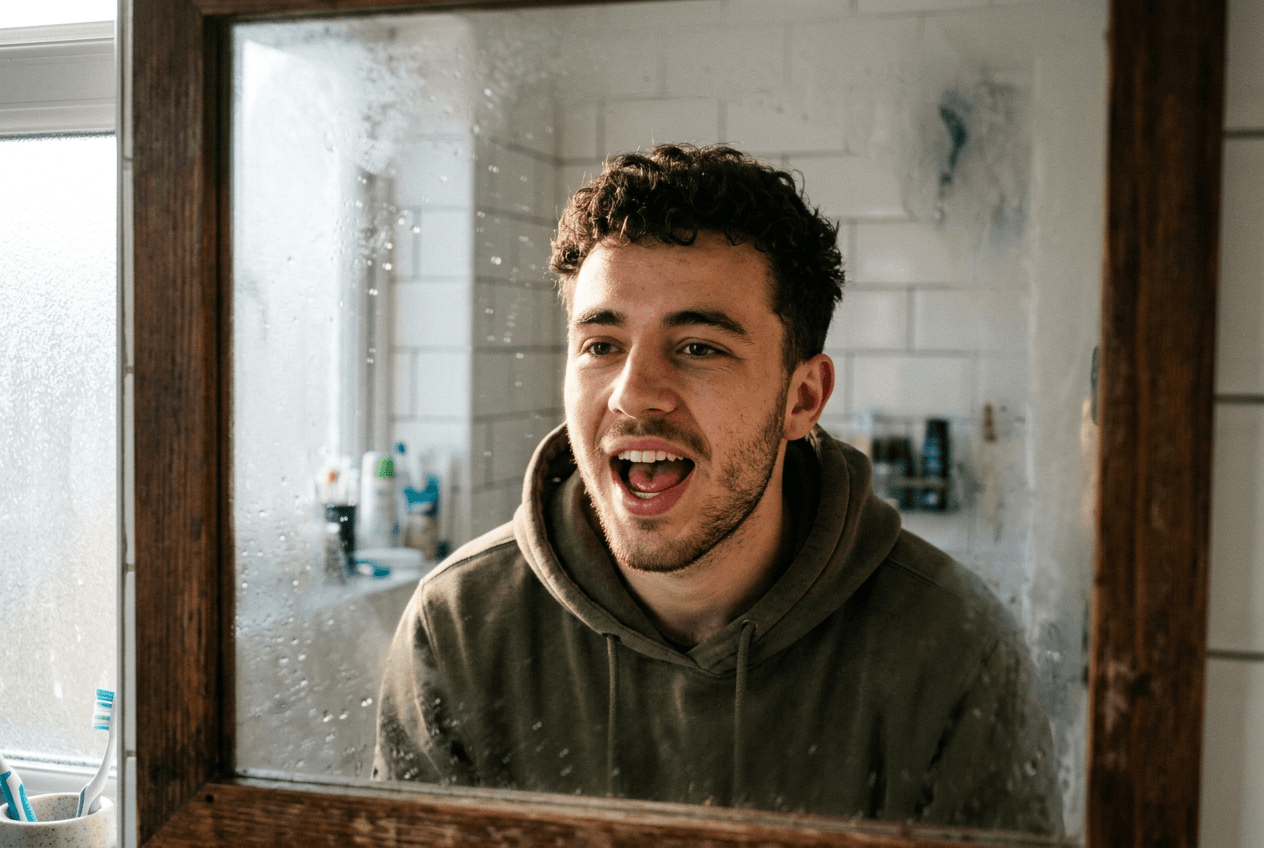
English pronunciation seems chaotic ("though," "through," "thorough" — why?), but it actually follows learnable patterns that help you improve faster.
Three English pronunciation patterns worth learning immediately:
-
Word stress rules. Most two-syllable nouns stress the first syllable (TA-ble, DOC-tor). Most two-syllable verbs stress the second (de-CIDE, re-PEAT). This one rule covers thousands of English words.
-
Vowel reduction. In natural English speech, unstressed syllables get shortened to a quick "uh" sound (called the schwa). "Banana" isn't "ba-NA-na" — it's "buh-NA-nuh." Understanding this makes your spoken English sound more natural immediately.
-
Connected speech. Native speakers blend words together. "What do you want to do?" becomes "Whaddya wanna do?" Learning these patterns helps both your listening and your speaking.
Focus on these patterns rather than perfecting individual words, and your English pronunciation will improve across the board. Our guide on how to speak English fluently and confidently covers more techniques that help.
Duolingo taught you words. No one taught you to speak.
PracticeMe: real voice conversations with an AI tutor, 24/7.
9. Think in English (Stop Translating in Your Head)
Mental translation is the biggest speed limit on fluency. When you think in your native language and translate to English before speaking, every sentence takes twice as long — and usually sounds unnatural.
How to start thinking in English:
- Label things mentally. Walk around your house and silently name everything in English: "door," "window," "coffee mug," "messy desk."
- Narrate your decisions. "I think I'll have pasta tonight. The weather is nice, so maybe I'll walk to the store."
- Rehearse conversations. Before a meeting or social event, mentally practice what you might say — in English.
This feels awkward at first. That's normal. You're building a new mental highway, and it takes time before English thoughts flow naturally without your native language as an intermediary.
The payoff is massive: once you think in English, you speak faster, understand faster, and stop that exhausting mental back-and-forth.
10. Read Graded Material, Then Level Up
Reading is one of the best ways to absorb English vocabulary and grammar passively — if you read at the right level.
Linguist Stephen Krashen's "comprehensible input" theory (i+1) suggests you learn a language fastest when you understand most of what you read, with just a few new words per page. If you're stopping every sentence to look up words, the material is too hard. If you understand everything, it's too easy.
A practical reading progression for English learners:
- Beginner: Graded readers (Oxford, Penguin), children's books, simple news sites
- Intermediate: Young adult novels, Reddit threads, blog posts on topics you know well
- Advanced: Full-length novels, newspaper editorials, professional articles in your field
One rule that saves study time: Only look up an English word if it appears three or more times. If you keep seeing it, it's common enough to be worth learning. If it appears once, context is usually enough.
11. Write Something in English Every Day
Writing is the often-neglected sibling of speaking — but it uses the same "output" brain pathways that help you learn English faster.
You don't need to write essays. Start small:
- 3-sentence journal entry about your day
- A social media comment in English
- A short message to a friend or language exchange partner
- A quick review of a book, show, or product
Writing forces you to recall English vocabulary and construct sentences actively — not just recognize them passively. Research suggests that handwriting specifically helps with memory retention, so grab a notebook for at least some of your English practice.
As you progress, try longer formats: emails, short stories, Reddit posts. Every English sentence you write is a sentence your brain has now practiced building from scratch.
12. Listen with a Purpose (Active Listening)
There's a difference between having English playing in the background and actually listening to it. Both help your language learning, but active listening accelerates progress far faster.
The 3-pass listening technique:
- First listen: Get the general idea. What's the topic? What's the main point?
- Second listen: Focus on details. What specific English words and phrases did the speaker use?
- Third listen: Shadow or transcribe. Try to catch every single word.
Apply this to a 2-3 minute podcast clip or YouTube video. One short English clip practiced thoroughly beats an hour of background listening.
Speed tip: If native English speakers talk too fast, use the 0.75x speed option. There's no shame in it — you're training, not performing. As your ear develops, move back to normal speed.
13. Set Specific Goals with Weekly Deadlines
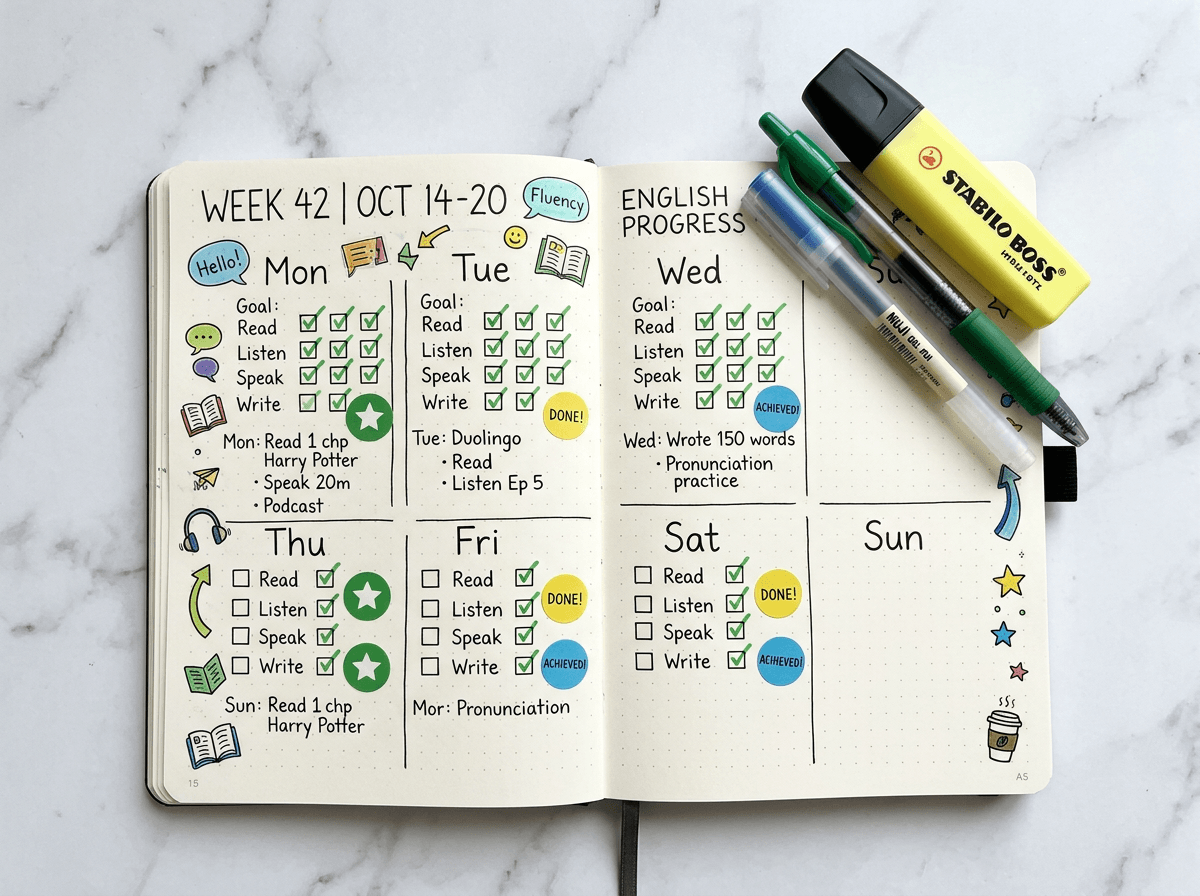
"I want to improve my English" isn't a goal — it's a wish. If you want to learn English fast, you need specific, measurable targets with deadlines.
Examples of effective weekly English learning goals:
- "Learn 20 new English phrases about food and restaurants this week"
- "Have three 10-minute English conversations" (with an AI tutor through Practice Me or a language partner)
- "Watch two TV episodes without subtitles and understand 70%+"
- "Write five journal entries of at least 100 words each"
Notice each goal has a number and a time frame. At the end of the week, you know exactly whether you hit it or not. If you did, raise the bar slightly. If you didn't, ask why and adjust.
This simple feedback loop — set, do, review, adjust — separates people who learn English in months from people who study for years without real progress.
14. Embrace Mistakes (They're Your Best Teacher)
Fear of making mistakes is the single biggest barrier to learning English fast. Research consistently shows that language learners who speak up despite errors progress faster than those who stay silent until they feel "ready."
Here's the reframe: every mistake is free data. When you say something wrong and get corrected (or realize it yourself), that moment of recognition — what linguists call "noticing" — is when real learning happens.
Tips for getting comfortable with English mistakes:
- Practice in low-stakes environments first. AI conversation tools are perfect because there's zero social judgment — you can make the same mistake 50 times and nobody cares.
- Keep an "error journal." Write down English mistakes you catch and the correct version. Review it weekly.
- Celebrate corrections. Someone fixing your English means they care enough to help.
If fear of speaking holds you back, read our guide on how to overcome the fear of speaking English. It's more common than you think — and entirely fixable.
15. Track Your Progress and Adjust Weekly
You can't improve what you don't measure. People who learn English fast track their progress and use the data to make better decisions about where to focus.
What to track for faster English learning:
- Minutes spoken in English per day (this is your #1 metric)
- New English words and phrases learned per week
- Listening comprehension (can you follow an English podcast? What percentage?)
- Confidence level (self-rated 1-10 each week)
A simple spreadsheet or notes app works. Or use a tool with built-in tracking — Practice Me automatically tracks your speaking time, vocabulary growth, and improvement trends, so you can see exactly how you're progressing.
The weekly review: Every Sunday, spend 10 minutes looking at your data. What worked this week? What didn't? Where should you focus next week? This review habit alone puts you ahead of 90% of English learners who study without any feedback loop.

A Realistic Timeline for Learning English Fast
Wondering how to learn English fast — and what "fast" actually looks like? Here's a realistic timeline for someone practicing 1-2 hours daily using the tips and strategies above. Your results will vary based on your native language and consistency.
Month 1 (Foundation):
- Vocabulary: ~500 English words
- Speaking: Basic introductions, simple questions and answers
- Listening: Understanding slow, clear English on familiar topics
- Feeling: Frustrating but exciting. You know words but can't say them yet.
Month 3 (Building Blocks):
- Vocabulary: ~1,500 words
- Speaking: Simple English conversations about daily life and familiar topics
- Listening: Following the gist of English podcasts and shows for learners
- Feeling: First real breakthroughs. Some phrases start coming automatically.
Month 6 (Momentum):
- Vocabulary: ~3,000 words
- Speaking: Discussing most everyday topics, expressing opinions with nuance
- Listening: Understanding most of an English TV show (maybe missing some jokes)
- Feeling: Confident in familiar situations. Starting to think in English.
Month 12 (Comfort):
- Vocabulary: ~5,000+ words
- Speaking: Comfortable in most English situations, handling unexpected topics
- Listening: Following native speakers at normal speed in most contexts
- Feeling: English feels like a tool you use, not a subject you study.
This isn't a guarantee — it's a realistic trajectory if you show up consistently. For a detailed roadmap, read our full guide to becoming fluent in English.
The single most important factor? Showing up every day. Fifteen minutes of daily practice will always beat two hours on Saturday. Consistency compounds — and that's the real secret to learning English fast.
Frequently Asked Questions
How long does it take to learn English fluently?
It depends on your native language and how much time you spend practicing. FSI data suggests 600–2,200 classroom hours to reach professional proficiency. For most learners studying 1-2 hours daily, expect basic conversational ability in 3-6 months and comfortable fluency in 12-18 months. See our realistic fluency roadmap for a detailed breakdown.
Can I learn English fast without a teacher?
Yes — many successful English learners are self-taught, especially with the tools available in 2026. The key is combining input (listening, reading) with output (speaking, writing) daily. AI conversation tools like Practice Me provide the speaking practice that's hardest to get alone, letting you practice English speaking with AI anytime. For a full self-study plan, see our guide on how to improve English speaking by yourself.
What's the fastest way to learn English at home?
Create an English-rich environment: change device languages, stream English media, and practice speaking daily. Follow the 15 tips in this guide, prioritizing speaking practice and immersion. Even without leaving your house, you can practice English speaking alone at home effectively. Beginners should start with our English speaking practice for beginners guide.
How many hours a day should I study English?
For fast progress, aim for 1-2 focused hours daily. But "studying English" doesn't mean sitting at a desk the whole time. Thirty minutes of structured study (vocabulary, grammar patterns) plus 30+ minutes of active practice (speaking, listening to podcasts) plus ambient immersion (English phone settings, English music) is a powerful combination that helps you learn without burnout. Consistency matters more than duration.
Is it possible to learn English in 3 months?
You can reach a basic conversational level in 3 months with intensive daily practice (2+ hours per day). You'll handle introductions, ordering food, giving directions, and discussing simple topics. Full fluency in 3 months is unrealistic — anyone claiming otherwise is selling something. Focus on steady progress using the tips in this guide. For more help, see our expert tips to improve English speaking skills.