Duolingo taught you words. No one taught you to speak.
PracticeMe: real voice conversations with an AI tutor, 24/7.
How to Sound Natural in English: 12 Tips

You've studied English for years. Your grammar is solid. Your vocabulary is wide. You can write a report in English without breaking a sweat. But the second you open your mouth, something feels off — too stiff, too formal, too textbook.
If you've been wondering how to sound natural in English instead of just correct, you're asking the right question. The answer isn't more grammar. It's not more vocabulary. It's not even a better accent. It's breaking a handful of specific habits that textbooks never taught you — the ones that separate "understandable" from "actually natural."
Here are 12 practical tips to sound more natural in English, each with a concrete before/after example showing the shift from textbook speech to natural speech. Pick two or three to start. Layer the rest in over a month.
Quick Summary: To sound natural in English, focus on contractions, connected speech, word stress, phrasal verbs, collocations, and thinking in English rather than translating. Use filler words and idioms strategically — not constantly. The single biggest lever is daily voice practice with something (or someone) that responds in real time.
What It Really Means to Sound Natural in English
Most English courses are designed to help you be understood, not to make you sound native. That's a rational trade-off — being understood is the bigger win — but it leaves most learners stuck in a strange middle zone: fluent enough to communicate, stiff enough to feel self-conscious every time they speak.
Here's the reframe that helps: sounding natural in English has almost nothing to do with your accent. Plenty of globally admired English speakers — diplomats, CEOs, comedians, scientists — have distinct non-native accents and still sound completely natural. What they share isn't pronunciation. It's rhythm, word choice, and flow.
The 12 tips below target exactly those three things. None of them require you to memorize more grammar rules. All of them require you to speak. If your bigger goal is overall fluency, pair this guide with our companion articles on how to speak English fluently and confidently and 15 expert tips to improve English speaking skills.
1. Use Contractions Every Time You Can
Native speakers contract constantly in casual speech — probably in the vast majority of their sentences. If you're saying "I am" instead of "I'm," "do not" instead of "don't," or "we will" instead of "we'll," your English will always sound a beat too formal — sometimes even stiff or angry.
Before (textbook): "I am going to the store because I do not have any milk."
After (natural): "I'm going to the store 'cause I don't have any milk."
The contractions to drill until they're automatic: I'm, you're, we're, they're, he's, she's, it's, don't, doesn't, didn't, can't, won't, wouldn't, shouldn't, I'd, you'd, I've, I'll, we'll. Cambridge Dictionary has a solid reference page on English contractions if you want the full list.
Then there's the casual tier — the contractions nobody teaches you but native speakers use constantly: gonna (going to), wanna (want to), gotta (got to), lemme (let me), kinda (kind of), sorta (sort of), dunno (don't know). You won't find these in a grammar book, but you'll hear them in every sitcom, podcast, and hallway conversation in the English-speaking world.
One caveat: contractions are for speaking, not formal writing. Emails to colleagues, yes. Legal contracts, no.
2. Learn Connected Speech (Words Bleed Into Each Other)
Here's something learners rarely get taught: native speakers don't separate their words. They link them, blur them, and sometimes drop sounds entirely. This is called connected speech, and it's probably the #1 reason fast English sounds like one continuous blur to your ears. BBC Learning English has free audio examples if you want to train your ear.
Before (textbook): "What are you doing tonight?" (four clear words)
After (natural): "Whatcha doin' tonight?" or "What're ya doin' tonight?"
There are four main patterns to listen for:
- Linking: A consonant at the end of one word joins the vowel at the start of the next. "Turn off" → "turnoff." "Pick it up" → "pickidup."
- Intrusion: A tiny /w/ or /j/ sound sneaks in between vowels. "Go out" → "gowout." "I agree" → "Iyagree."
- Elision: Sounds disappear to make speech faster. "Next day" → "nexday." "Friendship" → "frenship."
- Assimilation: Sounds change to match neighboring sounds. "Did you" → "didja." "Don't you" → "doncha."
You don't need to memorize these rules — you just need to hear them enough that your mouth starts doing it automatically. Shadowing is the fastest way there. (We have a full shadowing technique guide if you want to try it.)

3. Use Filler Words — Strategically
Textbooks tell you to avoid filler words. Real speech is full of them. The trick to sounding natural in English is using the right fillers in the right places.
Before (textbook): "The answer is that I think we should leave."
After (natural): "Well, I mean... I think we should just leave, you know?"
There are two kinds of fillers, and they're not equal:
- Purposeful fillers organize your thinking and help you sound native: well, you know, I mean, like, sort of, kind of, actually, basically. These are features of fluent speech, not bugs.
- Accidental fillers leak when you're nervous or searching for words: um, uh, uhh. A few are fine — too many sound hesitant.
The goal isn't to eliminate fillers. It's to upgrade from the accidental kind to the purposeful kind. "Um... the... um... meeting is... um..." becomes "Well, the meeting is, like, kind of a mess." Same pause for thought — completely different impression.
If you want to go deep on this, our English filler words and conversation connectors guide breaks down exactly when to use each one.
4. Master Word Stress and Sentence Rhythm
English is a stress-timed language. That means the rhythm of a sentence comes from stressing certain syllables and squishing the rest. Spanish, French, Japanese, and many other languages are syllable-timed — every syllable gets roughly equal weight. If you carry that habit into English, your speech sounds flat, even, and slightly robotic.
Before (textbook): "pho-to-GRA-phy" with every syllable equal and a random stress guess.
After (natural): "pho-TO-gra-phy" — the second syllable pops; the rest are fast and quiet.
Two rules that do most of the heavy lifting:
-
Content words get stressed. Function words get reduced. Nouns, main verbs, adjectives, adverbs = stressed. Articles, prepositions, auxiliary verbs = reduced. "I'm going to the STORE to buy some MILK." The capitalized words are loud; everything else is fast.
-
Noun/verb pairs often flip stress. REcord (noun) vs. reCORD (verb). OBject (noun) vs. obJECT (verb). PREsent (noun/adj) vs. preSENT (verb). Get these wrong and it sounds like a completely different word.
The fastest way to internalize this rhythm is mimicking recordings out loud — pause, repeat, match the rhythm. If you're brand new to English pronunciation and stress patterns, start with our English pronunciation practice for beginners guide, which walks through the key sounds step by step.

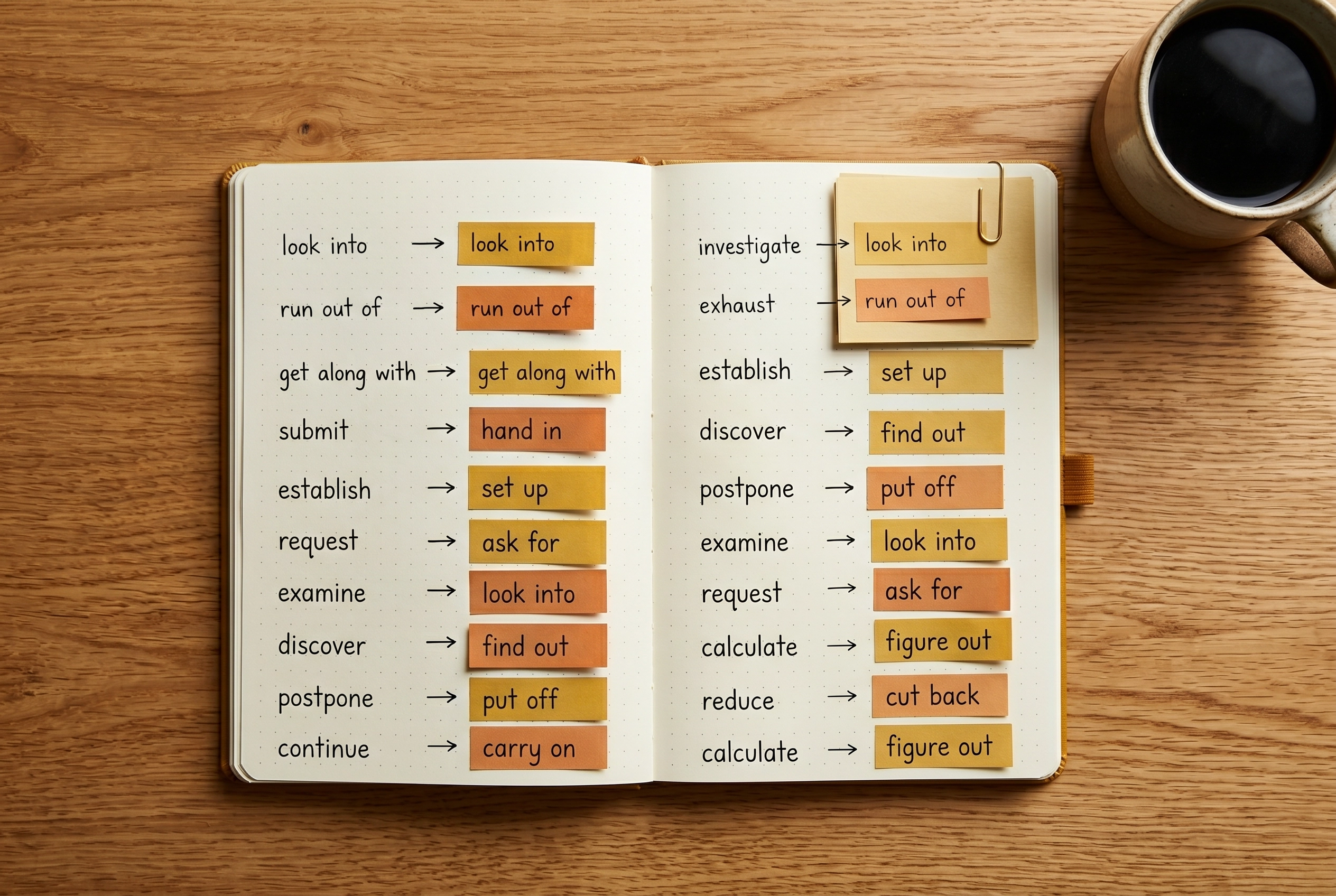
5. Swap Formal Verbs for Phrasal Verbs
This is the biggest instant-upgrade on the list if you want to sound more natural in English. Textbooks love single, Latinate verbs because they're tidy. Native speakers love phrasal verbs because they're how English actually works in the wild.
Before (textbook): "I will commence the project tomorrow and attempt to complete it by Friday."
After (natural): "I'll get started on the project tomorrow and try to wrap it up by Friday."
Here's a starter swap list:
| Formal | Natural (Phrasal Verb) |
|---|---|
| commence | start / kick off |
| attempt | try |
| complete | finish / wrap up |
| investigate | look into |
| tolerate | put up with |
| postpone | put off |
| continue | keep going / carry on |
| discover | find out |
| refuse | turn down |
| encounter | run into |
| discuss | talk about / go over |
| distribute | hand out |
There are thousands of phrasal verbs in English, which is overwhelming. The trick: you don't need all of them. You need the 100 or so that appear in everyday speech. Pick them up in context through conversation rather than memorizing long lists — the list approach almost never sticks because you have nothing to anchor the meaning to. This is why building your English vocabulary through conversations beats flashcards every time.
6. Learn Collocations (Words That Belong Together)
Collocations are word partnerships that don't follow logical rules — they just are. Get them wrong and you sound like you're translating. Get them right and you sound fluent. This is one of the quietest-but-biggest ways your vocabulary becomes natural English vocabulary.
Before (textbook): "I did a big mistake and took a hard decision."
After (natural): "I made a big mistake and made a tough decision."
Some common ones that trip learners up:
- Make vs. do: make a mistake, make a decision, make progress, make an effort. But do your homework, do the dishes, do business.
- Strong vs. heavy: strong coffee, strong opinion, strong accent. But heavy rain, heavy traffic, heavy smoker.
- Fast vs. quick: fast food, fast car. But quick question, quick shower.
- Take vs. have: take a shower (US) / have a shower (UK). Take a break. Have a meeting.
There's no rule that explains why heavy rain sounds right and strong rain sounds translated. You just have to hear the pairing enough times that it feels automatic. Every time you bump into a wrong-sounding phrase, write it down — that's how native speakers store them too. They just do it faster because they've been hearing the pairings their whole lives.
7. Use Idioms Sparingly — But Correctly
Idioms are tempting. They feel like a cheat code to sounding native. They're not.
Before (textbook): "This task is very difficult and annoying."
After (natural): "This task is a real pain in the neck."
But here's the catch: misused idioms sound worse than no idioms at all. A learner who drops "it's raining cats and dogs" into every weather conversation they've ever had sounds like they learned English from a 1995 ESL cassette tape. An idiom used at the wrong register — casual idiom in a formal meeting, formal idiom with friends — sticks out too.
Three rules that keep you safe:
- One or two per conversation is plenty. Stacking idioms back-to-back is a dead giveaway that you're showing off.
- Only use idioms you've heard in real context. If you've never heard a native English speaker say it, don't be the first.
- Match the register. "Let's touch base" in a business meeting = fine. "Let's touch base" to your best friend = weird.
If you want a curated list of idioms that are actually common (not ones that died in 1960), our 50+ common English idioms for everyday conversation is where I'd start.
Duolingo taught you words. No one taught you to speak.
PracticeMe: real voice conversations with an AI tutor, 24/7.
8. Stop Over-Pronouncing Every Word
One of the quietest tells of non-native speech is hyper-articulation — pronouncing every single vowel with full value, like each letter is equally important. Natives don't do that. They mumble half their vowels, and that mumbling is a big part of how to sound natural in English.
Before (textbook): "I WANT TO GO TO THE STORE." — every word fully enunciated.
After (natural): "I wanna go tuh the store." — about half the words reduced.
This pronunciation shift is all about one tiny sound: the schwa (written /ə/). It's the most common vowel in English, and it sounds like a relaxed "uh." When a syllable is unstressed, its vowel almost always reduces to schwa, regardless of how it's spelled.
Listen to how native speakers say these in casual speech:
- to → "tuh" ("I want tuh go")
- for → "fer" ("This is fer you")
- and → "n" ("Fish n chips")
- of → "uv" ("A cup uv coffee")
- a → "uh" ("I need uh pen")
- the → "thuh" (before consonants)
Over-pronouncing these words is fine — people will understand you. It just sounds careful, like you're reading aloud from a book. Letting them reduce is what makes your speaking flow and helps you sound fluent instead of rehearsed.
9. Vary Your Intonation (Don't Speak Flat)
Monotone speech reads three ways to a native listener: robot, bored, or angry. None of those is what you want.
Before (textbook): "I'm going to the meeting." (flat, even pitch)
After (natural): "I'm going to the MEET-ing? Wait, no — I'm going HOME first." (pitch moves with meaning)
The three baseline patterns:
- Statements fall at the end. "I'm having lunch now." ↘
- Yes/no questions rise at the end. "Are you coming?" ↗
- Wh-questions fall at the end. "Where are you going?" ↘
Beyond that, pitch carries emotion. Surprise goes up. Sarcasm slides. Genuine enthusiasm is a wave, not a line. When you ask "really?" with a flat pitch, it sounds uninterested. When it rises, it sounds genuinely curious. When it falls, it sounds skeptical.
A good practice drill: take one sentence — "I didn't say she stole the money" — and say it seven times, each time stressing a different word. Notice how the meaning completely changes with nothing but intonation. That's the tool you're adding to your toolbox.

10. Drop in Discourse Markers
Discourse markers are the small words and phrases that organize speech — signaling transitions, reactions, and attitude. They're the connective tissue between thoughts and one of the most natural things you can add to your English speaking.
Before (textbook): "I think we should leave. Traffic will be bad later."
After (natural): "Actually, I think we should leave — like, right now — because, you know, traffic gets pretty bad later."
The most useful ones, roughly organized by function:
- Starting a thought: so, well, OK, right, now
- Adding information: also, plus, on top of that, and another thing
- Softening a statement: kind of, sort of, I guess, I mean, sort of like
- Shifting topics: anyway, by the way, speaking of which, that reminds me
- Correcting yourself: actually, I mean, or rather, wait
- Reacting: oh, really, no way, for real, huh
These aren't fillers — they carry meaning. "Actually" tells your listener you're about to correct something. "By the way" signals a topic shift. "I mean" usually means a clarification is coming. Once you start noticing them in podcasts and conversations, you'll realize natives rarely speak more than two sentences without one.
11. Practice With Real Conversations, Not Worksheets
This is the one tip that matters more than the other 11 combined. You can know every tip on this list and still sound textbook — because speaking naturally is a muscle, not a checklist. You build it by using your mouth, out loud, in real exchanges where someone responds and you have to respond back.
Before (textbook approach): grammar apps, workbook drills, reading alone in your room, writing journal entries.
After (natural approach): voice conversations where you talk, get a response, and talk again — in real time, without pausing to look up words.

The problem most learners hit: finding someone to practice with. Human tutors are great but expensive and scheduled around their calendar, not yours. Language exchange partners are hit-or-miss and often disappear after two weeks. Classes happen twice a week at best. If finding a partner is your real blocker, our guide on how to practice English speaking alone at home covers the workarounds.
This is also where AI changes the game. Practice Me gives you three AI tutors — Sarah, Oliver, and Marcus — with American and British accents. They respond in natural speech: with contractions, filler words, discourse markers, and genuine conversational rhythm. You can practice before a job interview at 6am. You can try out a new idiom with zero fear of judgment. You can repeat the same conversation five times until it feels automatic. And every new word you use gets saved to your vocabulary list automatically, which helps you build active vocabulary instead of passive vocabulary.
The goal isn't to replace human conversation — it's to give you a safe, unlimited space to fail, experiment, and build the habits from tips 1–10 until they're reflexes. Fifteen minutes a day of real voice practice does more for natural speech and confidence than three hours of passive study. If you want a structured approach, our daily 15-minute English speaking routine lays out exactly what to do.
12. Think in English (Stop Translating in Your Head)
If you're composing sentences in your native language and then translating them into English before speaking, you'll never sound natural. Not because translating is wrong — it's a fine stepping stone — but because it adds a 2-3 second lag that breaks the rhythm of conversation and forces your English into the grammar patterns of your first language.
Before (textbook): "I need to..." [translates "ir" from Spanish] "...I need to go to the..." [translates "tienda"] "...store to buy some..." [translates "leche"] "...milk."
After (natural): "I need to grab some milk from the store."
The shift from translating to thinking in English doesn't happen overnight, but it starts with tiny habits:
- Narrate your day silently in English. "OK, now I'm making coffee. The kettle is almost boiling. I need to text Sarah back."
- Describe your surroundings in English. Riding the bus? Name what you see out the window — in English. No translation, just the English word.
- Journal in English for five minutes a day. Not perfectly. Not beautifully. Just the first English words that come to mind.
- Argue with yourself in English. Debates, internal monologues, "what should I order for lunch" — do them in English.
The full method is worth its own article, and we wrote one: how to think in English and stop translating. For a deeper dive into the mindset shift, our guide on how to stop translating and speak English naturally covers the psychology behind it.

A 30-Day Plan to Sound More Natural in English
Twelve tips is a lot. Don't try to work on all of them at once — you'll get overwhelmed and quit. Instead, stack them in four weekly focus blocks:
Week 1 — Sound & Flow: Contractions (tip 1) + connected speech (tip 2). Record yourself reading a paragraph. Notice every place you're not contracting. Force it.
Week 2 — Rhythm & Music: Word stress and rhythm (tip 4) + vowel reduction (tip 8) + intonation (tip 9). Shadow a podcast or show for 10 minutes a day. Match the music, not just the words.
Week 3 — Word Choice: Phrasal verbs (tip 5) + collocations (tip 6) + idioms (tip 7) + discourse markers (tip 10). Collect one new phrasal verb and one collocation a day from real content. Add them to your active vocabulary by using each in a conversation that same day.
Week 4 — Fluency: Filler words (tip 3) + real conversation practice (tip 11) + thinking in English (tip 12). 15-20 minutes of voice conversation daily, in English only.
By day 30 you won't sound like a native — that takes years. But you'll sound noticeably more natural, speak with more confidence, and, more importantly, have stopped the habits that make textbook English feel textbook. If you want to accelerate further, our guide on how to improve English speaking as a non-native speaker covers the longer game.
Frequently Asked Questions
Here are the questions English learners most often ask about how to sound natural in English when speaking.
How long does it take to sound natural in English?
It depends on your starting level and how much you practice out loud. Most learners at an intermediate level or above notice a real shift after 3-6 months of daily voice conversation — 15-20 minutes a day. It's a gradual change, not a switch. You'll catch yourself naturally saying "gonna" instead of "going to," linking words without thinking, and using filler words automatically. That's when you know it's sticking.
Do I need to get rid of my accent to sound natural?
No, and trying to is usually a waste of effort. Sounding natural and sounding native are different goals. Plenty of globally successful English speakers — Priyanka Chopra, Emmanuel Macron, Trevor Noah, Shakira — have distinct non-native accents and still sound completely natural in English. What makes them sound natural isn't their accent; it's their rhythm, word choice, and flow. Focus on the 12 tips above and let your accent be what it is.
What's the biggest mistake learners make when trying to sound natural in English?
Translating. Most learners compose sentences in their native language, translate them word-by-word into English, and then speak. The result is technically correct English with the grammar patterns and vocabulary choices of another language — which sounds "off" even when every word is right. The second biggest mistake is using formal textbook vocabulary ("I shall commence") in casual situations where no native English speaker would ever talk that way.
Is it okay to sound natural in English at work or in formal situations?
Absolutely. Natural doesn't mean slangy, and register matters. You can use contractions, phrasal verbs, and natural rhythm in a board meeting — native professionals do it constantly. What you'd cut in formal contexts is heavy slang, edgy idioms, and extreme casual contractions like "gonna" or "wanna." "I'll get started on that and wrap it up by Friday" is both natural and professional. "Imma kick it off and see how it shakes out" is natural but probably too casual for the boardroom.
Can I sound natural in English without living in an English-speaking country?
Yes. Many of the most naturally-speaking non-natives never lived abroad. Location matters far less than daily voice practice, good input (podcasts, shows, real conversations), and consistent output. AI conversation tools now make this genuinely achievable without moving anywhere — you can have a 20-minute English conversation at 6am in Tokyo, a 30-minute one at 11pm in São Paulo, and nobody has to fly anywhere. The key is making sure you're actually speaking, not just listening and reading.
How to Start Sounding Natural in English Today
Here's the thing nobody tells you: learning how to sound natural in English isn't about getting better at grammar or memorizing more words. It's about breaking a few textbook habits and building a few new ones — out loud, every day.
Pick two or three tips from this list that felt the most relevant to you. Start there. Record yourself, listen back, and notice what's changing. Then add another two. Then another.
And make sure you're actually talking — not just thinking about talking. The shortest path from "correct English" to "natural English" is conversation: daily, unstructured, responsive, low-stakes conversation. If you've been overcoming the fear of speaking English, an AI tutor that never judges, never gets tired, and never runs out of patience is probably the easiest place to start building both fluency and confidence.
You already know English. You just need to let yourself speak it the way it actually gets spoken.