Duolingo taught you words. No one taught you to speak.
PracticeMe: real voice conversations with an AI tutor, 24/7.
Learn English for Russian Speakers: AI Practice Guide

Trying to learn English for Russian speakers can feel like a strange contradiction. You spent 8, 10, sometimes 12 years studying English at school. You can read Hemingway. You know your tenses. You probably scored well on tests. Yet the moment a real conversation starts, the words freeze somewhere between your brain and your mouth.
That's not a personal failure. It's a side effect of how English is taught in Russia and the post-Soviet world. Grammar drills, reading comprehension, written translation — endless. Real-time speaking with feedback — almost none. The result is a quiet, very common pattern: B2 grammar and A2 speaking. You can write a polite business email but you panic when a tourist asks for directions.
This guide to English for Russian speakers breaks down the specific pronunciation traps Russian phonology creates, the grammar pitfalls Russian doesn't prepare you for, the false-friend vocabulary that will embarrass you, and a 14-day AI voice practice plan you can actually finish — all for a low weekly price. Whether you want structured English lessons or pure speaking practice, the gap you need to close is the same: time spent talking.
Quick Summary: Russian speakers' biggest English problem isn't vocabulary or grammar — it's the lack of speaking practice. Russian phonology creates specific traps (TH sounds, H vs. Х, W/V merge, short /ɪ/ vs long /iː/, final devoicing) that need targeted drills. The fastest fix is judgment-free voice conversation practice with an AI tutor — 24/7, unlimited, and cheaper than a single hour of English lessons with a human teacher.
Why English for Russian Speakers Hits a Wall Around Speaking
Russia ranked 49th out of 116 countries on the 2025 EF English Proficiency Index, in the "Moderate" band. Russians as a group know more English than people in many neighboring countries — yet a 2014 Levada Center poll famously found that only 11% of Russians said they could actually speak it. The numbers have improved since, but the pattern hasn't: passive English is strong, active English is weak.
The reason is structural. Russian schools — and most ESL programs across the post-Soviet space — focus heavily on grammar tables, vocabulary lists, reading exercises, and written translation. Speaking practice, if it happens at all, is usually scripted: memorize this dialogue, recite it in front of the class. The state final exam (ЕГЭ) is heavily weighted toward reading and grammar. The speaking section is short, scripted, and low-stakes.

Layer cultural classroom dynamics on top of that. Mistakes get marked in red. Teachers correct in front of peers. Students learn quickly that silence is safer than risking a wrong answer. By the time you graduate, you've absorbed two beliefs that destroy speaking confidence:
- Speak only when you're sure. Which, in a foreign language, is almost never.
- An accent is a sign of weakness. Which it isn't — but the fear of being judged for it shuts your mouth anyway.
This is xenoglossophobia (literally: fear of speaking foreign languages), and it's hugely common among Russian-speaking learners of English. You're not bad at the language. You just haven't been allowed to fail at it safely, which is the only way speaking actually develops.
There are roughly 258 million Russian speakers worldwide — including large communities in Ukraine, Belarus, Kazakhstan, Uzbekistan, Israel, Germany, and the United States. Most of them carry the same English-Russian gap: solid grammar, frozen speaking. The fix isn't more grammar lessons. It's hours of low-stakes mouth-time.
6 Pronunciation Challenges Every Russian Speaker Faces in English
Russian is one of the most phonetic languages in the world. Each letter maps to a predictable sound. English is the opposite — chaotic spelling, irregular sounds, vowels that shapeshift across words. That mismatch is the root of every pronunciation issue Russian speakers run into. Here are the six biggest ones, with practical fixes for each.
1. The Vowel Squeeze: 5 Sounds Must Stretch to 12+
Standard Russian has 5–6 vowel phonemes. General American English has at least 12 vowels plus 8 diphthongs — more than triple the inventory. That means English makes distinctions Russian doesn't, and your ear genuinely can't hear them at first.
The most painful pair for Russian speakers is short /ɪ/ versus long /iː/:
- ship /ʃɪp/ vs sheep /ʃiːp/
- bit /bɪt/ vs beat /biːt/
- live /lɪv/ vs leave /liːv/
- rich /rɪtʃ/ vs reach /riːtʃ/
In Russian, и is just one sound, somewhere between the two. Most Russian speakers default to the long version, so they say "sheep" when they mean "ship" — and the meaning flips.
The /æ/ in "cat" and "bad" is also missing from Russian. The closest Russian vowel is э, so "cat" comes out as "ket" and "bad" as "bed." Then there's the diphthong /oʊ/ in "go," "phone," "home" — Russian speakers typically flatten it to a single о, losing the glide.
How to practice: Exaggerate the differences. Make "sheep" ridiculously long, "ship" absurdly short. Your ear has to hear the contrast before your mouth can produce it. Minimal-pair drills are the fastest fix — our English minimal pairs practice guide has dozens of read-aloud examples, and the full English vowel sounds guide maps every English vowel against IPA.
2. The TH Sounds That Don't Exist in Russian
Neither the voiceless TH in "think" (/θ/) nor the voiced TH in "this" (/ð/) exists anywhere in Russian phonology. Russian speakers reach for the closest available sound, which is almost always wrong:
- think → "sink" or "tink"
- three → "sree" or "tree"
- this → "dis" or "zis"
- weather → "vezzer"
- thought → "sot"
This is high-frequency damage. TH appears in some of the most common English words on Earth — the, this, that, there, they, with, think, thanks, thing, through. Substituting /s/ or /z/ for TH is the single most recognizable marker of a Russian accent.
How to practice: Place the tip of your tongue between your upper and lower teeth, so it's slightly visible. For "think," blow air out gently — no voice, just air. For "this," add vocal cord vibration so you feel a buzz. It feels strange (no Russian sound requires this tongue position), but it becomes automatic within a few weeks of conscious practice. Our roundup of the hardest English words to pronounce by native language has more targeted drills for Russian speakers.
3. The H Trap: English /h/ Is Not Russian Х
Russian has the letter х (kh), which sounds like the "ch" in Scottish loch or German Bach — a velar fricative articulated with friction at the back of the throat. English /h/ is nothing like that. It's a quiet exhale. Just air.
Russian speakers instinctively substitute their familiar х for English H:
- happy → "khappy"
- how → "khow"
- hello → "khello"
- hospital → "khospital"
- behind → "be-khind"
It's not catastrophic — listeners still understand you — but it's instantly identifiable, and over a long conversation it makes you sound effortful when you don't need to.
How to practice: Try saying "ha-ha-ha" like you're laughing softly. That quiet, throaty-but-not-scraping breath is the English /h/. Then add a vowel: ha, he, hi, ho, hu. No friction. No throat scraping. Just relaxed air becoming voice.
4. W vs V: The Most Visible Russian Accent Marker
Russian has the sound /v/ (written в) but no /w/. So when English demands W, Russian speakers either replace it with V — or, knowing this is a stereotype, they overcorrect and replace their good V with W.
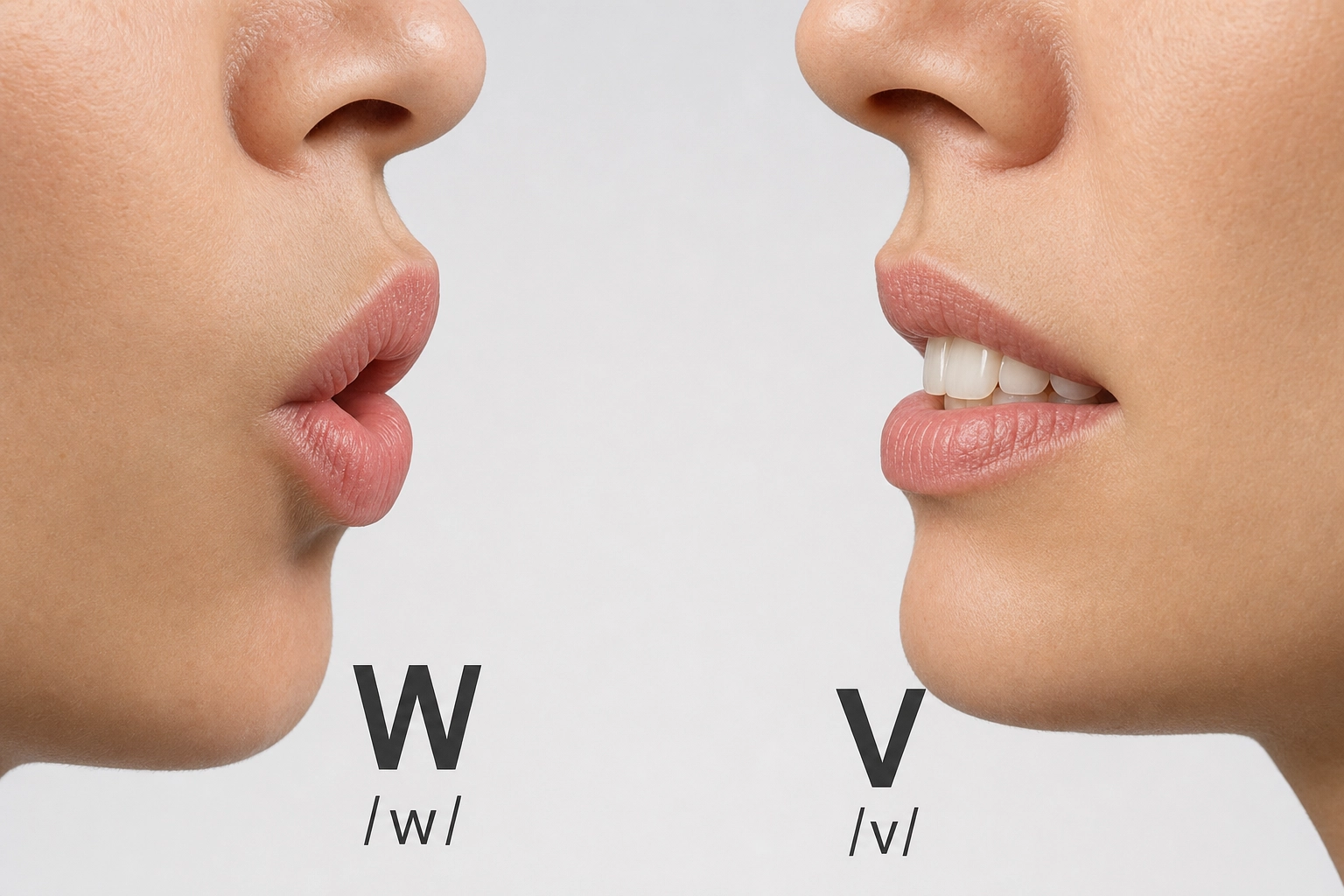
Both failure modes are common among Russian English learners:
- Substitution: water → "vater", west → "vest", work → "vork"
- Overcorrection: very → "wery", vase → "wase", village → "willage"
The English meaning depends on the distinction:
- wine vs vine (drink vs plant)
- west vs vest (direction vs clothing)
- wet vs vet (water vs animal doctor)
- wail vs veil (cry vs face cover)
How to practice: Look in a mirror. For V, your upper teeth touch your lower lip and you feel a buzz when you make the sound. For W, your lips form a tight circle, like you're about to whistle or blow out a candle — no teeth touch. Practice the contrast pairs slowly: "vine, wine, vine, wine." If both feel the same, you're still making V both times.
5. Final Consonant Devoicing: Why "Bad" Sounds Like "Bat"
This is the sneakiest one because it sounds tiny but changes meaning everywhere.
In Russian, voiced consonants at the end of a word automatically become voiceless. The Russian word дуб (oak) is written with a "b" but pronounced "dup." Бог (god) sounds like "bok." This is a rule, not an accent — every Russian speaker does it without thinking.
Carry that rule into English and entire word categories get mangled:
- bad sounds like "bat"
- bag sounds like "bak"
- dog sounds like "dok"
- love sounds like "loff"
- has sounds like "hass"
- knees sounds like "niss"
The past tense suffix -ed gets erased entirely:
- loved sounds like "loff"
- lived sounds like "liff"
So "I loved her" and "I love her" become identical — and you've just removed the difference between a past relationship and a present one.
How to practice: Hold the final consonant slightly longer than feels natural, and keep your vocal cords vibrating until the very end. Place your fingers gently on your throat — for /d/, /b/, /g/, /v/, /z/, you should feel a clear buzz that doesn't cut out. Record yourself saying "bad / bat" and "dog / dock" back to back. If they sound the same, your final consonants are devoicing.
6. The Schwa and Vowel Reduction Pattern
The schwa /ə/ is the most common sound in English. It's the lazy "uh" in unstressed syllables: about, sofa, banana, computer, problem. Russian reduces unstressed vowels too — but to different sounds following different rules, and Russian spelling actually cues those reductions.
Because Russian is so phonetic ("read what's written"), Russian speakers tend to read and pronounce every English vowel as written. So "computer" comes out as "com-PU-tehr" with all three vowels equal in weight. That's not how English actually sounds. Native speakers compress unstressed syllables almost to nothing:
- comfortable is really three syllables: "KUMF-tə-bul" — not four
- vegetable is three: "VEJ-tə-bul" — not four
- chocolate is two: "CHOK-lət" — not three
- interesting is three: "IN-trə-sting" — not four
How to practice: Identify the stressed syllable in any longer word. Then deliberately under-pronounce every other syllable. Make them as quiet and short as you can. This rhythm pattern is what makes English sound natural rather than robotic, and it's exactly what we cover in connected speech in English.
Grammar Pitfalls That Trip Up Russian Speakers Learning English
Russian grammar is brilliant in some areas English isn't — six noun cases, free word order, perfective/imperfective verb pairs. But that strength comes with several blind spots when you switch from Russian into English.
Articles (a/an/the): The Tiny Words With No Russian Equivalent
Russian has no articles. None. Definiteness is communicated through context, word order, or specific demonstratives like этот (this one). When Russian speakers learn English, two failure modes appear immediately:
- Dropping articles: "I went to store." "I am engineer." "Can you pass salt?"
- Sprinkling them at random: "The yesterday I saw the my friend." "I am the engineer."
The basic rule isn't actually complex: use a/an the first time you mention something ("I saw a dog"), and the when both speaker and listener already know which thing you mean ("The dog was big"). The hard part is making it automatic in real speech, which only happens through repetition — and that means hours of actual speaking practice, not flashcards.
The "To Be" Trap: When English Demands a Verb You Don't Use
In Russian present tense, "to be" is omitted. Она милая literally translates as "She nice." Я студент = "I student." Это книга = "This book." There's no Russian present-tense equivalent of is or am or are.
Russian speakers carry this habit into English:
- "She nice" instead of "She is nice"
- "I tired" instead of "I am tired"
- "He from Moscow" instead of "He is from Moscow"
Or they overcompensate and add "to be" where it doesn't belong:
- "I am go to work" instead of "I go to work"
- "She is have a car" instead of "She has a car"
The continuous tenses are where this gets really painful, because you need both the auxiliary verb and the -ing ending simultaneously: "I am working," "She is leaving," "They are eating." Two unfamiliar moves at once.
Tense Overload: From 3 Russian Tenses to 12+ English Tenses
Russian has three tenses (past, present, future) and two aspects (perfective, imperfective). English uses 12+ tense-aspect combinations that include Present Perfect, Past Continuous, Present Perfect Continuous, and others that have no clean Russian equivalent.
The single biggest source of errors is Present Perfect:
- "I have lived in Moscow for ten years" (and I still live there now)
- Russian speakers default to past simple: "I lived in Moscow for ten years" — which sounds like you've moved away
Other common tense traps:
- Using present simple where English needs present continuous: "I study English now" instead of "I am studying English now"
- Using past simple instead of past continuous: "I worked when she called" instead of "I was working when she called"
The fix isn't memorizing rules from a textbook. It's hearing the patterns enough times in real conversation that the right form comes out automatically.
Duolingo taught you words. No one taught you to speak.
PracticeMe: real voice conversations with an AI tutor, 24/7.
Word Order in Questions: When "You Speak English?" Isn't Quite Enough
Russian forms yes/no questions through intonation alone. Ты говоришь по-английски? has the same word order as a statement — only the rising tone makes it a question. The English equivalent requires either inversion ("Are you ready?") or do-support ("Do you speak English?").
This is a high-frequency error because Russians ask questions all the time:
- "You like coffee?" should be "Do you like coffee?"
- "Where you live?" should be "Where do you live?"
- "When she comes?" should be "When does she come?"
The good news: it's a structural habit, not a knowledge gap. Once you've spoken "Do you...?" and "Where do you...?" a few hundred times in real conversation, the auxiliary verb arrives automatically.
False Cognates: Russian-English Words That Will Embarrass You
Russian and English share a surprising amount of vocabulary thanks to mutual borrowings from French, Latin, and Greek. Words like telephone, hospital, radio, computer, restaurant, and taxi are essentially identical (телефон, госпиталь, радио, компьютер, ресторан, такси). That's a real head start for English-Russian learners.
But about 10% of those familiar-looking words are false friends (ложные друзья) — they look or sound like a Russian word but mean something completely different in English. Some lead to merely confusing moments. A few lead to memorably awkward ones.
| Russian Word | What It Looks Like in English | What the English Word Actually Means |
|---|---|---|
| Магазин (magazin) | Magazine | A shop or store (use "shop") |
| Симпатия (simpatiya) | Sympathy | A liking or attraction (use "compassion") |
| Интеллигентный | Intelligent | Cultured, well-educated (English "intelligent" = smart) |
| Актуальный (aktualnyy) | Actual | Current, relevant (English "actual" = real) |
| Артист (artist) | Artist | An actor or performer (English "artist" = painter) |
| Кабинет (kabinet) | Cabinet | An office or study (English "cabinet" = storage furniture) |
| Шеф (shef) | Chef | A boss or manager (English "chef" = head cook) |
| Фамилия (familiya) | Family | A surname (English "family" = your relatives) |
| Лунатик (lunatik) | Lunatic | A sleepwalker (English "lunatic" = crazy person) |
| Презерватив (prezervativ) | Preservative | A condom (English "preservative" = food additive) |
| Декада (dekada) | Decade | A 10-day period (English "decade" = 10 years) |
| Аккуратный (akkuratnyy) | Accurate | Tidy or neat (English "accurate" = precise) |
| Вельвет (velvet) | Velvet | Corduroy (English "velvet" = smooth pile fabric) |
| Инсульт (insult) | Insult | A stroke (medical) (English "insult" = rude remark) |
| Бриллиант (brilliant) | Brilliant | A diamond (English "brilliant" = excellent or smart) |
The "preservative" one is genuinely costly. Telling an English-speaking host that "this jam has no preservatives, very natural" works fine. Telling them "I always read the preservatives on the label" definitely does not. Many Russian speakers confidently use "preservative" thinking it means презерватив — please don't be one of them.

Tip: Keep a personal list of false friends as you find them in real conversation. Write the Russian word, what you thought it meant, and what it actually means. The ones you learn through a real (or near) embarrassment are the ones that stick forever.
25 Hard English Words for Russian Speakers (With IPA + Russian Phonetics)
These are the words that combine multiple Russian-speaker challenges in one place. The Russian-phonetic column shows the closest approximation in Cyrillic — useful as a memory aid, but always check the IPA for the real sound. Read each row carefully before you say the word out loud.
| English Word | IPA | Russian Phonetic | Why It's Hard |
|---|---|---|---|
| think | /θɪŋk/ | синк / тинк | TH + short /ɪ/ + /ŋ/ — three Russian problems in one syllable |
| three | /θriː/ | сри / три | TH + English R + long /iː/ |
| this | /ðɪs/ | зис / дис | Voiced TH at the start of the most common English word |
| weather | /ˈwɛðər/ | у́эзэр | W + voiced TH + schwa |
| world | /wɜːrld/ | уорлд | W + central vowel + R + L cluster |
| wood | /wʊd/ | вуд → уʊд | W (not V) + short /ʊ/ + final voiced D |
| very | /ˈvɛri/ | вэ́ри | Risk of overcorrecting V → W |
| vine / wine | /vaɪn/ vs /waɪn/ | ва́йн / уа́йн | Minimal pair that separates V from W |
| happy | /ˈhæpi/ | хэ́ппи (not кх) | English H, not Russian Х |
| how | /haʊ/ | ха́у | Soft H + diphthong |
| ship | /ʃɪp/ | шип (short) | Short /ɪ/, not long /iː/ |
| sheep | /ʃiːp/ | ши́:п (long) | Long /iː/, not short /ɪ/ |
| live (verb) | /lɪv/ | лив (short) | Short /ɪ/ + final voiced V (not "lif") |
| leave | /liːv/ | ли́:в (long) | Long /iː/ + final voiced V |
| bad | /bæd/ | бэд (final D) | /æ/ vowel + voiced final D (not "bat") |
| bag | /bæɡ/ | бэг (final G) | /æ/ + voiced final G (not "bak") |
| cat | /kæt/ | кэт (not кет) | The /æ/ vowel, wider than Russian э |
| sing | /sɪŋ/ | синь | /ŋ/ at the end — soft nasal, not "sink" |
| rural | /ˈrʊrəl/ | ру́эрл | Two English Rs around a vowel |
| girl | /ɡɜːrl/ | гёрл | Central /ɜː/ + R + L all at once |
| comfortable | /ˈkʌmftəbəl/ | ка́мфтэбл | Three syllables, not four |
| Wednesday | /ˈwɛnzdeɪ/ | у́энздэй | W + silent D + reduced final |
| vegetable | /ˈvɛdʒtəbəl/ | вэ́джтэбл | V (not W) + three syllables, not four |
| engineer | /ˌɛn.dʒɪˈnɪr/ | эндж-и-ни́р | Stress on the LAST syllable, not the first |
| unbelievable | /ˌʌn.bɪˈliːvəbəl/ | анбили́ивэбл | Stress on the third syllable, reduced vowels everywhere else |
How to use this list: Don't try to learn all 25 at once. Pick 3–5 per day. Read the IPA, listen to the word spoken by a native (or by Practice Me's AI tutors), record yourself saying it three times, and compare. Then drop the words into actual sentences during your next voice practice session — that's where real retention happens.
Why AI Voice Practice Solves the Russian Confidence Gap
Here's the core problem with English for Russian speakers in one sentence: Russian English learners have spent thousands of hours absorbing input (grammar tables, vocabulary lists, reading passages) and almost no hours producing output (actually talking). The fix isn't more input or more lessons. It's mouth-time.
The traditional ways to get mouth-time all have problems for Russian speakers:
- Textbooks and workbooks — zero speaking practice.
- Pimsleur-style audio courses — one-way listen-and-repeat, no real conversation, hundreds of dollars.
- Human tutors on platforms like Preply or italki — effective but expensive (a steep per-hour rate for one-on-one lessons), tied to scheduling, and you still feel judged by another human being. For learners with built-in classroom shame, this is a significant barrier.
- Group classes — embarrassment risk is highest of all. Russian speakers who hated being corrected in front of peers at school will hate it at age 35 too.
- Apps like Duolingo — gamified vocabulary, but no real-time conversation. You tap the right answer; you don't speak.

What Russian speakers actually need is the opposite of what their school provided: low-stakes, unlimited, real-time speaking practice with instant feedback and zero social risk. That's what AI voice tutors do well. Practice Me's AI tutors are available 24/7 in both American and British accents, hold real back-and-forth conversations in voice, remember what you talked about last time, and save vocabulary automatically. Most importantly: they don't get tired, frustrated, or judgmental.
The cost difference is dramatic. One hour of English lessons with a private tutor is costly. Practice Me Pro is an affordable monthly subscription, or even less per week on the annual plan — unlimited conversations with every tutor personality, both accents, the full feature set. For the price of one tutor hour, you get a full month of unlimited speaking practice. See the full breakdown on the Practice Me pricing page.
Your 14-Day Practice Me Plan: From Frozen to Fluent
This isn't a "fluent in 14 days" promise. Real fluency takes months of consistent practice. What this plan will do is break the speaking lock — the silent-knowledge problem so common among Russian English learners — so that English starts coming out of your mouth instead of stalling behind it.
Pick one accent (American or British) and stick with it for the full two weeks. Switching mid-plan is fine later, but consistency early on builds muscle memory faster.
Days 1–3: Break the Silence (5-minute sessions)
The only goal here is to talk. Not perfectly. Just out loud.
- Day 1 — Introduce yourself. Tell the AI tutor your name, where you're from, what you do for a living. Don't pre-write anything. Stumble, restart, use filler words. The point is opening your mouth.
- Day 2 — Talk about your day. What time did you wake up? What did you eat? What's on your schedule? Use simple present and past tenses — don't reach for fancy grammar.
- Day 3 — Talk about your hometown. Where exactly is it? What's it known for? What do you love about it? What would you change?
If you get stuck, ask the tutor: "How do you say this in English?" That's perfectly valid practice.
Days 4–7: Hit Your Pronunciation Pain Points (10-minute sessions)
Now layer in targeted pronunciation work alongside conversation.
- Day 4 — TH day. Use a topic starter focused on "thinking" or opinions. Force yourself to say think, thought, three, this, that, the slowly and clearly. Have the AI correct you if you slip into /s/ or /z/.
- Day 5 — W/V day. Pick a topic about weather, weekends, or vacations (lots of W and V words). Notice when you substitute one for the other. Ask the tutor to call it out.
- Day 6 — H day. Talk about happiness, hobbies, or hometowns. Every H word: relax your throat, don't make it a Russian х. Quiet exhale, then vowel.
- Day 7 — Vowel length day. Practice minimal pairs deliberately: ship/sheep, live/leave, bit/beat, rich/reach. Use them in real sentences ("I live in Moscow / I leave Moscow on Friday").
Reference our English minimal pairs practice guide between sessions if you want extra drills.
Days 8–11: Real-Life Scenarios (15-minute sessions)
Now we move from drills to situations. Use Practice Me's Topic Starters or invent your own.
- Day 8 — Ordering food at a restaurant. Roleplay it. Greet the server, ask about the menu, order, deal with a mistake on the bill, ask for the check.
- Day 9 — Job interview. Walk through your career history, why you're interested in the role, your strengths, your weaknesses, salary expectations. Honest answers — not memorized scripts.
- Day 10 — Small talk. Talk to the AI about the weather, weekend plans, a TV show or movie, current news. Practice keeping the conversation going for the full 15 minutes without long pauses. Our how to keep a conversation going in English guide has go-to phrases.
- Day 11 — Disagree politely. Pick an opinion-based topic (best city to live in, remote vs office work, whether AI is good or bad) and disagree with the tutor's first take. Practice softeners: "I see your point, but…", "I'd argue…", "On the other hand…"
Days 12–14: Stretch and Sustain (20-minute sessions)
The final stretch is about endurance and ambition.
- Day 12 — Hypotheticals. "If I won the lottery…", "If I could live anywhere…", "If you were president…" Hypotheticals force you into conditional grammar (would, could, might) — exactly the area where Russian speakers stall.
- Day 13 — Explain something complex. Pick something you know deeply (your job, a hobby, Russian history, a recipe) and explain it to the AI for 10 minutes straight. This builds extended-monologue stamina, which is where Russian school English usually collapses.
- Day 14 — Free conversation. No topic. No plan. Let the AI ask you anything, and follow wherever it goes for 20 minutes. If it feels easier than Day 1 did, the lock is broken.
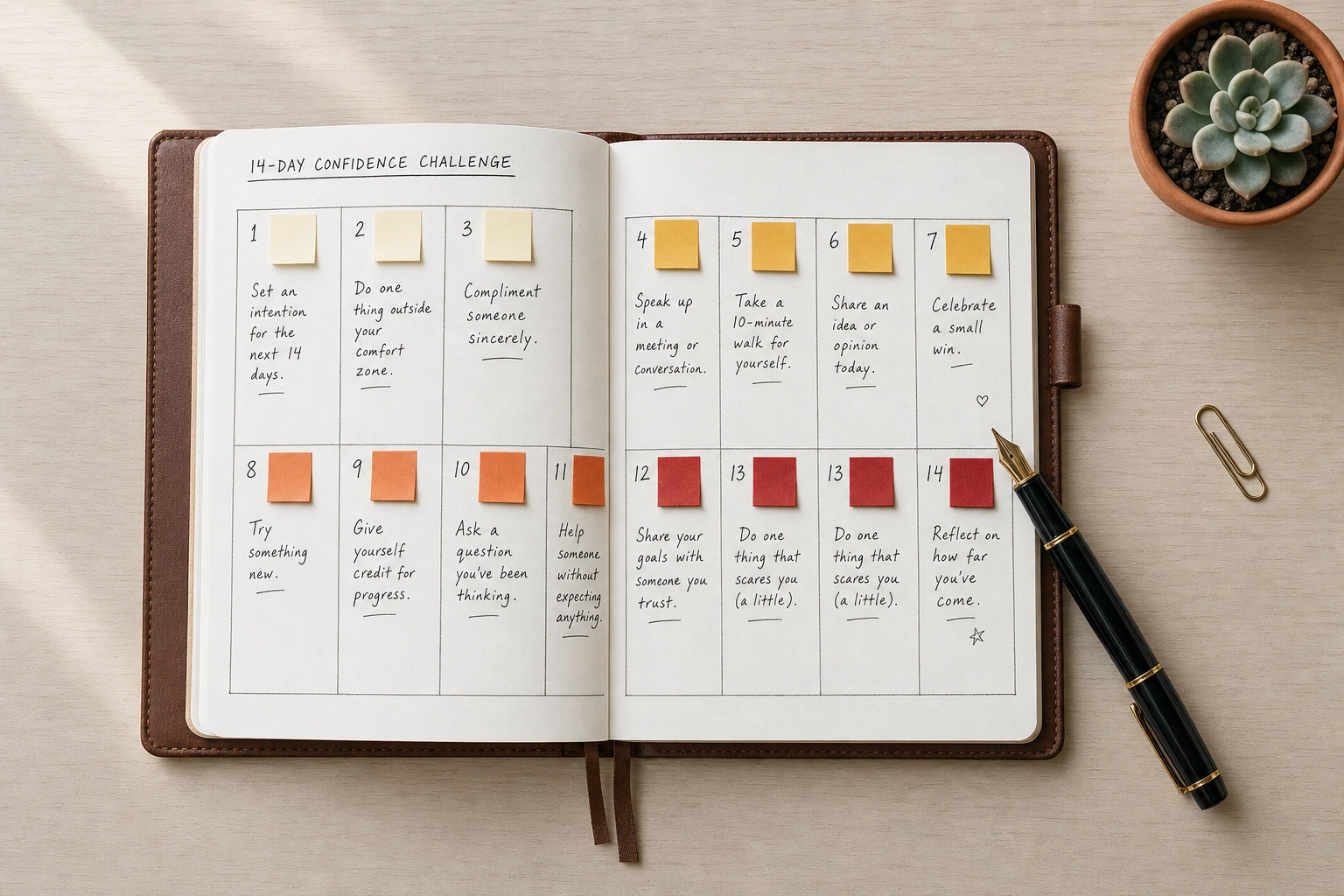
By day 14, you've spoken English in 14 different contexts for a total of around 3 hours of pure mouth-time. That's more spoken English than many Russian learners produce in a year of conventional study or formal lessons. For longer-term momentum, our English speaking confidence checklist covers what comes next, and how to think in English gets you off the translation crutch.
Frequently Asked Questions
What is the best way for Russian speakers to learn English?
The fastest path to learning English for Russian speakers is to flip the input/output ratio. Russian speakers usually have far more passive English (reading, grammar) than active English (speaking). Spend at least 50% of your weekly study time actually speaking — ideally in real-time voice conversation with an AI tutor, language partner, or teacher. Pair that with focused work on Russian-specific pronunciation gaps (TH, W/V, H, final devoicing, short /ɪ/ vs long /iː/).
Why is English pronunciation so hard for Russian speakers?
Two reasons. First, Russian phonology lacks several English sounds entirely — most notably both TH sounds and the W. When the sound doesn't exist in your mouth, you substitute the nearest match. Second, Russian is highly phonetic ("you say what you read"), while English spelling and pronunciation often disagree, which makes guessing new word pronunciations risky. Targeted minimal-pair drills and audio-first English lessons are the fix.
What are the most common English mistakes Russian speakers make?
The top five mistakes for Russian English learners are: (1) dropping or misusing articles (a/an/the), (2) using past simple where Present Perfect is needed, (3) omitting "to be" in present tense ("She nice" for "She is nice"), (4) substituting /s/ or /z/ for TH, and (5) devoicing final consonants so that "bad" sounds like "bat." Most disappear with consistent speaking practice rather than more grammar study.
How long does it take Russian speakers to learn English?
If we're talking from zero to professional working proficiency (B2/C1), the U.S. Foreign Service Institute estimates roughly 1,100 hours of intensive study — that's about 18 months at 2 hours per day. But most Russian-speaking learners aren't starting from zero. They already have years of English lessons from school; they just can't speak the language. For that gap, 3–6 months of consistent voice practice (30 minutes per day) is usually enough to feel comfortable in everyday conversations.
Is it better to learn American or British English as a Russian speaker?
It depends on your goal. American English is more useful for tech, business with US companies, and global pop culture. British English is more common in academic settings (IELTS, UK universities) and traditionally taught more in Russian schools. Neither is "harder" for Russian speakers — both contain the same TH, W/V, and vowel-length challenges. Practice Me lets you switch between American and British tutors freely, so you can sample both before committing.
Can AI really help Russian speakers improve their English speaking?
Yes — and arguably AI helps Russian speakers more than other groups, because the core gap is speaking practice in a low-judgment environment. Russian classroom culture often penalizes mistakes, leaving learners with strong grammar but huge speaking anxiety. An AI tutor doesn't judge, doesn't get tired, doesn't watch the clock, and is available at 3 a.m. when you suddenly feel like trying again. The technical accuracy of AI speech models in 2026 is good enough to give meaningful feedback on pronunciation, grammar, and word choice in real-time.
Do I need to fix my Russian accent to be understood in English?
No. Native English speakers understand a Russian accent perfectly well. You only need to fix the specific sounds that change meaning — so /θ/ vs /s/ ("think" vs "sink"), /w/ vs /v/ ("wine" vs "vine"), short /ɪ/ vs long /iː/ ("ship" vs "sheep"), and final voicing ("bad" vs "bat"). Beyond that, an accent is part of who you are. Many of the world's most respected English speakers — diplomats, scientists, CEOs — have strong Russian, French, Spanish, or Indian accents and zero communication problems.
Start Speaking English Confidently Today

You don't need another grammar book. You don't need more written lessons. You've already done that work. What you need is the speaking practice you should have had ten years ago — judgment-free, unlimited, on your phone whenever you have ten minutes.
Practice Me gives you exactly that: the most practical approach to English for Russian speakers we've seen. Real-time voice conversations with AI tutors in American and British accents. Topic starters when you don't know what to say. Cross-session memory so your tutor remembers what you talked about. Automatic vocabulary saving so the words you learn through conversation stick. All for one affordable monthly subscription, or even less per week on the annual plan.
Three days free, cancel anytime. Pick your accent, start with a five-minute conversation today, and break the silence that's been holding your English back. The Russian-speaker pattern isn't permanent — it just needs the practice you've been missing.