Duolingo taught you words. No one taught you to speak.
PracticeMe: real voice conversations with an AI tutor, 24/7.
English Vowel Sounds: Complete Pronunciation Guide

English has five vowel letters. It has roughly twenty English vowel sounds. That's the entire problem in one sentence.
If you've ever wondered why "ship" and "sheep" sound the same coming out of your mouth, or why your "cat" gets misheard as "cut," you're not making random mistakes. You're running into the gap between English spelling and English speech — a gap that most learners never get properly walked across.
Quick Summary: English vowel sounds total around 20 — 12 monophthongs (single steady vowels) and 8 diphthongs (gliding vowels) — but only 5 vowel letters in the written alphabet. This guide breaks down every vowel sound with IPA symbols, mouth-position cues, minimal pair drills, and L1-specific fixes for Spanish, Chinese, and Japanese speakers.
This is the complete map of English vowel sounds. By the end, you'll know what each sound is, how your mouth makes it, where your native language fights you, and how to practice each one until your speech matches what's in your head.
The 20 English Vowel Sounds at a Glance
English has 5 written vowels: A, E, I, O, U. Spoken English has roughly 20 vowel sounds. The exact count varies by accent — General American typically uses about 15, Received Pronunciation (British) uses about 20 if you count centering diphthongs — but the standard ESL framework teaches 20 vowel phonemes because it covers both major accents.
Those 20 split into two groups:
- 12 monophthongs — single, steady vowel sounds where your mouth holds one position
- 8 diphthongs — gliding sounds that move from one vowel position to another within one syllable
Here's the full reference table. Read it once, then we'll dig into each group. If you want to cross-reference, the official IPA vowel chart on Wikipedia has audio examples of every symbol used below.
The 12 Monophthongs
| IPA | Type | Example | Sounds Like |
|---|---|---|---|
| /iː/ | long | sheep | "ee" |
| /ɪ/ | short | ship | "ih" |
| /e/ or /ɛ/ | short | bed | "eh" |
| /æ/ | short | cat | "ah" (mouth wide) |
| /ʌ/ | short | cup | "uh" (stressed) |
| /ɑː/ | long | car, father | "ah" (mouth open) |
| /ɒ/ | short (British) | hot | "o" (rounded, short) |
| /ɔː/ | long | thought | "aw" |
| /ʊ/ | short | put | "uu" (short) |
| /uː/ | long | boot | "oo" |
| /ɜː/ | long | bird | "er" |
| /ə/ | short | about | "uh" (unstressed) |
The 8 Diphthongs
| IPA | Example | Glide From → To |
|---|---|---|
| /eɪ/ | face | /e/ → /ɪ/ |
| /aɪ/ | price | /a/ → /ɪ/ |
| /ɔɪ/ | boy | /ɔ/ → /ɪ/ |
| /aʊ/ | mouth | /a/ → /ʊ/ |
| /əʊ/ (UK) or /oʊ/ (US) | go | /ə/ or /o/ → /ʊ/ |
| /ɪə/ | near | /ɪ/ → /ə/ |
| /eə/ | square | /e/ → /ə/ |
| /ʊə/ | tour | /ʊ/ → /ə/ |
A few notes that matter:
- Slashes like /iː/ mean we're talking about the sound, not the letter. This is standard IPA notation.
- The colon (ː) after a vowel like /iː/ means the sound is long. Length alone isn't the whole story (we'll get there), but the colon tells dictionaries you're holding it longer than the short version.
- American vs British: /ɒ/ (British "hot") usually merges with /ɑː/ in American English ("hot" rhymes with "cot"). The three centering diphthongs (/ɪə/, /eə/, /ʊə/) are mainly British — Americans usually pronounce these as a vowel plus an R sound.
That's the inventory of English vowel sounds. Now let's understand the physical machine that makes them.
The English Vowel Chart: How Your Mouth Shapes Each Sound
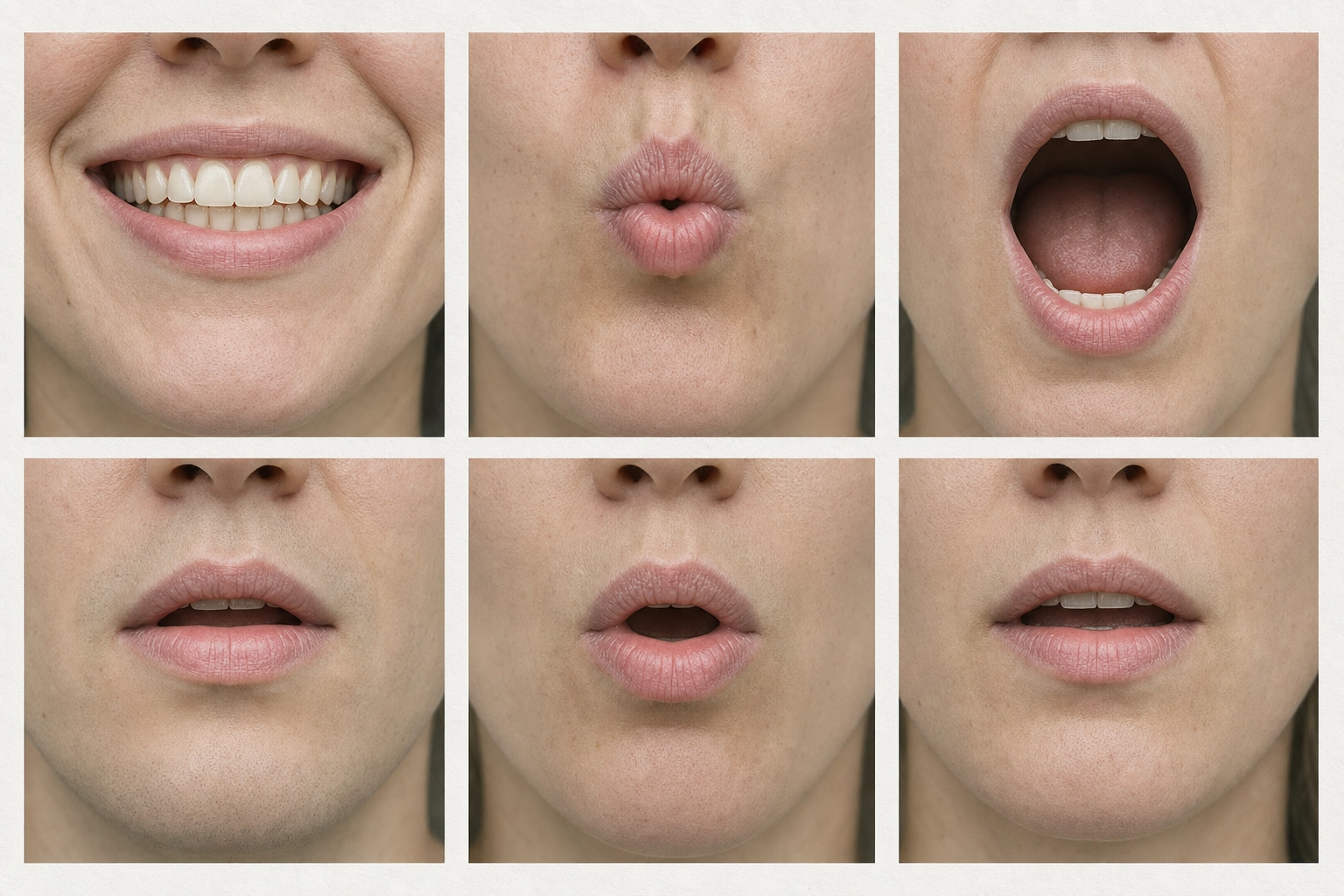
A vowel is just a sound made with an open vocal tract. No teeth clamping, no lips closing, no tongue blocking airflow. Air comes out, your voice box vibrates, and the shape of your mouth filters that sound into a specific vowel.
Three physical variables control which vowel comes out:
1. Tongue height — how high or low your tongue sits in your mouth
- High (close): /iː/ as in "see," /uː/ as in "boot"
- Mid: /e/ as in "bed," /ɜː/ as in "bird"
- Low (open): /æ/ as in "cat," /ɑː/ as in "car"
2. Tongue backness — whether your tongue is bunched at the front, center, or back of your mouth
- Front: /iː/, /ɪ/, /e/, /æ/
- Central: /ʌ/, /ɜː/, /ə/
- Back: /uː/, /ʊ/, /ɔː/, /ɑː/, /ɒ/
3. Lip rounding — are your lips rounded into an "O" shape, or spread/neutral?
- Rounded: /uː/, /ʊ/, /ɔː/, /ɒ/ (basically all back vowels except /ɑː/)
- Unrounded: /iː/, /ɪ/, /e/, /æ/, /ʌ/, /ɜː/, /ə/, /ɑː/
Phoneticians plot all this onto a diagram called the vowel quadrilateral — a trapezoid that maps your mouth from the inside. Front vowels on the left, back on the right. High vowels on top, low on the bottom. If you ever see a vowel chart with /iː/ in the top-left corner and /ɑː/ in the bottom-right, that's why.
Why This Matters for Practice
Mouth position is the most teachable part of pronunciation. You can't see a sound, but you can feel where your tongue is. Try this right now:
- Say "ee" (as in see). Your tongue is high and pushed forward. Lips are spread.
- Slowly slide to "ah" (as in car). Your tongue drops to the bottom and pulls back. Lips relax.
- Then slide to "oo" (as in boot). Tongue goes back up, but stays at the back. Lips pucker into a tight circle.
You just traversed three corners of the vowel quadrilateral. Every other English vowel sits somewhere inside that triangle.
Tense vs Lax: A More Useful Framework Than "Long vs Short"
Linguists today often prefer tense vs lax over "long vs short." Why? Because the real difference between /iː/ (sheep) and /ɪ/ (ship) isn't just that one is longer. It's that:
- Tense vowels (/iː/, /uː/, /eɪ/, /oʊ/, /ɑː/): more muscle tension in the tongue and lips, more peripheral position on the chart, often longer.
- Lax vowels (/ɪ/, /ʊ/, /e/, /æ/, /ʌ/, /ə/): tongue relaxed, more central, shorter.
If you only stretch out a short vowel, it won't sound like the long one. You also have to change where your tongue is. This is why Spanish speakers can say "shiiiip" all day long and it still doesn't sound like "sheep."
Short vs Long Vowels: The Minimal Pairs That Matter
A minimal pair is two words that differ by exactly one sound. They're the sharpest tool for training your ear because they isolate the contrast you need to hear.
Five vowel pairs cause about 80% of real-world misunderstandings for ESL learners. Drill these and your speech becomes dramatically clearer.
1. /ɪ/ vs /iː/ — ship vs sheep
- /ɪ/ (ship): mouth slightly open, tongue mid-high front, lips relaxed and slightly spread. Short and lax.
- /iː/ (sheep): mouth nearly closed, tongue pushed high and forward, lips spread wide (like you're smiling). Long and tense.
Pairs: ship/sheep, bit/beat, fit/feet, slip/sleep, rich/reach, chip/cheap, live/leave, his/he's, filled/field, dim/deem.
2. /ʊ/ vs /uː/ — pull vs pool
- /ʊ/ (pull): tongue high-back, lips slightly rounded but loose. Short and lax.
- /uː/ (pool): tongue high-back, lips tightly rounded into a small circle (like blowing out a candle). Long and tense.
Pairs: pull/pool, full/fool, look/Luke, soot/suit, should/shooed, could/cooed, wood/wooed, foot/food.
3. /e/ vs /æ/ — bed vs bad
- /e/ (bed): tongue mid-front, mouth slightly open.
- /æ/ (bad): drop your jaw further, push your tongue lower and wider. This one needs deliberate jaw movement.
Pairs: bed/bad, men/man, head/had, send/sand, pen/pan, lend/land, bet/bat, dead/dad, said/sad, end/and.
4. /ʌ/ vs /ɑː/ — cup vs cop
- /ʌ/ (cup): tongue central, mouth slightly open, neutral lips. A relaxed "uh."
- /ɑː/ (cop, car): mouth wide open, tongue dropped and pulled back. The "open up wide" the dentist asks for.
Pairs: cup/cop, luck/lock, but/bot, gut/got, shut/shot, putt/pot, rub/rob, hut/hot, duck/dock, fund/fond.
5. /ɑː/ vs /ɜː/ — fast vs first
- /ɑː/ (fast): jaw open, tongue back and low. (British "father" sound.)
- /ɜː/ (first): mouth in a neutral position, tongue central and curled or bunched. (The "er" sound.)
Pairs: fast/first, bard/bird, far/fur, harm/herm, carve/curve, barn/burn, part/pert, palm/perm, starve/serve, dart/dirt.
Drill each pair five times in alternation: "ship — sheep — ship — sheep — ship." Then put them in a sentence: "I'll ship the sheep." Your ear will calibrate within a week. For deeper drills, see our English Minimal Pairs Practice guide.
The Schwa /ə/: English's Most Important Vowel
The schwa is the most common vowel sound in English — it appears in roughly one out of every three syllables you hear. It's also the sound most non-native speakers under-use, which is why they sound "over-articulated."
The schwa is the sound at the start of "about" (/əˈbaʊt/), in the middle of "banana" (/bəˈnænə/), and at the end of "sofa" (/ˈsoʊfə/). It's a short, lazy, neutral "uh" with no muscle tension.
Here's the rule that changes everything: English collapses most unstressed vowels into a schwa, regardless of how they're spelled.
- "computer" isn't kom-PYOO-ter, it's /kəmˈpjuːtər/ — the first "o" becomes schwa
- "photograph" → "phoTOGraphy" — the second "o" turns from /ɒ/ into /ə/ when stress shifts
- "the" in fast speech is /ðə/, not /ðiː/
If you pronounce every vowel as written, you sound robotic. If you reduce unstressed vowels to schwa, you sound natural.
We've got a full breakdown of schwa drills and stress patterns in our dedicated schwa sound guide — including the most common spelling patterns that hide a schwa. For now, just know: the schwa isn't lazy English, it's correct English.
R-Controlled Vowels: Why "Bird," "Her," and "Turn" Sound the Same

When an R follows a vowel in the same syllable, it doesn't behave like a normal consonant — it warps the vowel itself. The result is a category called R-controlled vowels (or "rhotic vowels"), and they confuse almost everyone who learns English as a second language.
Here are the five patterns, with sounds and example words:
AR /ɑːr/ (American) or /ɑː/ (British)
- Examples: car, park, start, farm, heart, garden, hard, arm, sharp, dark
- Mouth open, tongue back and low, then curl R (American) or just lengthen (British)
OR /ɔːr/ (American) or /ɔː/ (British)
- Examples: for, born, short, north, door, four, horse, morning, store, score
- Lips rounded into a small "o," then R glide
ER /ɜːr/ (American) or /ɜː/ (British)
- Examples: her, verb, term, perfect, mercy, person, modern, clerk, fern, herd
IR /ɜːr/ — identical to ER
- Examples: bird, first, girl, shirt, third, firm, dirt, birthday, stir, circle
UR /ɜːr/ — identical to ER and IR
- Examples: turn, burn, curl, hurt, nurse, church, purple, return, purpose, surface
The Critical Insight
ER, IR, and UR all produce the same sound: /ɜːr/. The spellings are historical accidents from Middle English. Your mouth makes the exact same shape for the vowel in "her," "bird," and "turn." If you can pronounce one, you can pronounce all three.
American vs British R-Controlled Vowels
This is where accents diverge dramatically:
- American English is rhotic: the R is fully pronounced in "car" /kɑːr/. Your tongue curls up or bunches back.
- British RP is non-rhotic: the R disappears after a vowel. "Car" becomes /kɑː/ — just a long open vowel, no R sound at all.
If you want to sound American, lock in the R. If you want British RP, drop the R after vowels and lengthen the preceding vowel instead. Both are correct; just pick one and be consistent. For deeper coverage of the R sound itself, see our guide on the R sound in English pronunciation.
Diphthongs: When One Vowel Glides Into Another
A diphthong is a single vowel sound where your tongue starts in one position and slides smoothly into another, all within one syllable. It's one sound, not two — even though it's written with two IPA symbols.
Think of "boy" /bɔɪ/. Your mouth starts in an "aw" shape (/ɔ/) and glides up toward "ih" (/ɪ/). One smooth movement. One syllable. One vowel sound.
The 8 English Diphthongs
1. /eɪ/ as in face
- Words: face, day, eight, weight, break, name, train
- Glide: starts at /e/ (bed), slides to /ɪ/ (ship)
2. /aɪ/ as in price
- Words: price, eye, my, time, light, five, kite
- Glide: starts at /a/ (open), slides to /ɪ/
3. /ɔɪ/ as in boy
- Words: boy, coin, voice, join, oil, employ
- Glide: starts at /ɔ/ (rounded back), slides to /ɪ/
4. /aʊ/ as in mouth
- Words: mouth, now, how, town, sound, brown, cloud
- Glide: starts at /a/, slides to /ʊ/ (rounded)
5. /oʊ/ (American) or /əʊ/ (British) as in go
- Words: go, home, boat, slow, road, show, phone
- Glide: starts at /o/ or /ə/, slides to /ʊ/
6. /ɪə/ as in near (mainly British)
- Words: near, ear, here, year, beer, deer, idea
- In American English, usually pronounced as /ɪr/
7. /eə/ as in square (mainly British)
- Words: square, hair, care, where, air, share
- In American English, usually pronounced as /er/ or /ɛr/
8. /ʊə/ as in tour (mainly British)
- Words: tour, pure, sure, cure, mature
- In American English, usually /ʊr/ or has shifted to /ɔr/
The #1 Diphthong Mistake
ESL learners often produce diphthongs as two separate vowels instead of one smooth glide. "Day" becomes "de-ee" instead of /deɪ/. "Boy" becomes "bo-ee" instead of /bɔɪ/.
The fix: lean heavily on the first vowel (about 80% of the duration), then let your mouth glide quickly into the second. Don't pause between them. It should feel like one continuous motion, not two beats.
Duolingo taught you words. No one taught you to speak.
PracticeMe: real voice conversations with an AI tutor, 24/7.
Common Vowel Mistakes by Native Language

Your native language is the single biggest predictor of which English vowels will trip you up. Every language has a fixed inventory of sounds, and your brain has spent years categorizing speech through that filter. When English uses a sound your L1 doesn't have, your brain tries to map it to the nearest neighbor — even if there's no good match.
Here's what that looks like for three of the most common L1 backgrounds.
Spanish Speakers: 5 Vowels Mapped to 20
Spanish has exactly 5 vowel sounds: /a/, /e/, /i/, /o/, /u/. They're pure (no diphthong-style gliding), consistent across positions, and never reduced to schwa. Beautiful, predictable, simple.
English asks you to expand from 5 categories to 20. Predictable result: collapse.
The classic Spanish-speaker vowel mistakes:
- /ɪ/ ↔ /iː/ collapse: "ship" and "sheep" both become /ʃip/ — close to Spanish /i/. Drill: ship/sheep, bit/beat, sit/seat.
- /æ/ pronounced as /e/: "cat" becomes "ket," "bad" becomes "bed." Spanish has no low front /æ/ — your jaw has to drop further than feels natural.
- /ʌ/ pronounced as /a/ or /o/: "cup" becomes "cop" or "cap." The English central /ʌ/ doesn't exist in Spanish — practice it as a relaxed, neutral mouth shape.
- No schwa: Spanish gives every vowel its full value, so "banana" becomes /baˈnana/ instead of /bəˈnænə/. This is the single biggest fix: learn to reduce unstressed vowels.
- Diphthongs split into two vowels: "day" becomes /ˈde.i/ in two syllables instead of /deɪ/ in one.
Priority drills for Spanish speakers: /ɪ/ vs /iː/, /æ/ vs /e/, /ʌ/ vs /ɑː/, and schwa reduction. See our companion piece on hard English words for Spanish speakers for more.
Chinese (Mandarin) Speakers: Vowel Reduction Is the Real Problem
Mandarin has a smaller vowel inventory than English (around 6-7 monophthongs depending on analysis) and uses tones to distinguish meaning instead of stress. Because Mandarin gives roughly equal weight to each syllable, native speakers often carry that pattern over to English — making every syllable sound equally prominent.
The result is a "staccato" English where every vowel is fully articulated and the natural rhythm of stressed/unstressed alternation is lost.
Common Mandarin-speaker vowel mistakes:
- No schwa: This is the headline issue. "Photograph" /ˈfoʊtəɡræf/ → photoGRAPH with every vowel pronounced fully. Learning schwa reduction is the single biggest pronunciation upgrade.
- /ɪ/ vs /iː/ confusion: Mandarin /i/ falls between them. Practice the lip-spread + tongue-high contrast.
- /æ/ doesn't exist: Often substituted with /ɛ/ ("cat" → "ket") or /a/ ("cat" → "caht"). Deliberate jaw-drop fixes it.
- /ʌ/ approximation: Often comes out closer to /a/. Aim for central, relaxed mouth.
- Diphthong reduction: Mandarin has some diphthongs but they're shorter; English diphthongs need a longer first vowel and a clear glide.
Priority drills for Mandarin speakers: schwa reduction, /ɪ/ vs /iː/, /æ/, and the stressed-unstressed contrast in words like photograph/photography/photographic.
Japanese Speakers: Length, Schwa, and Vowel Insertion
Japanese has 5 vowels: /a/, /i/, /u/, /e/, /o/. And here's the twist — Japanese vowel length is phonemic, meaning short vs long can change a word's meaning (e.g., "kite" /kite/ "come" vs "kiite" /kiːte/ "listening"). So Japanese speakers already understand the concept of vowel length.
But English vowel length is paired with vowel quality (tongue position), and that's where things get harder.
Common Japanese-speaker vowel mistakes:
- Adding vowels after consonants: Japanese syllables almost always end in a vowel, so English consonant clusters and consonant-final words get extra vowels. "Strike" becomes "su-to-rai-ku." Work on word-final consonants without trailing vowels.
- /æ/ doesn't exist: Substituted with /a/. Same fix as other learners — drop the jaw, widen the mouth.
- STIR vowel /ɜːr/ is brutal: Japanese has no R-colored vowels, and the /ɜːr/ in "bird, her, turn, work, world" requires both an unfamiliar tongue position and the rhotic glide.
- Length transfer feels too short: Japanese long vowels are about 1.5× the length of short vowels. English /iː/ vs /ɪ/ has more like a 2× difference plus the quality change. Lengthen further than feels natural.
- No schwa: Like other languages, every vowel gets pronounced. Active reduction practice is essential.
Priority drills for Japanese speakers: /ɜːr/ words (bird, her, turn, learn, work, world), word-final consonants without vowels, /æ/ jaw drop, and length + quality of /iː/ vs /ɪ/. Our deep-dive on the hardest English words to pronounce organized by L1 has more specific word drills.
30 Practice Words: Drill Each Vowel Sound
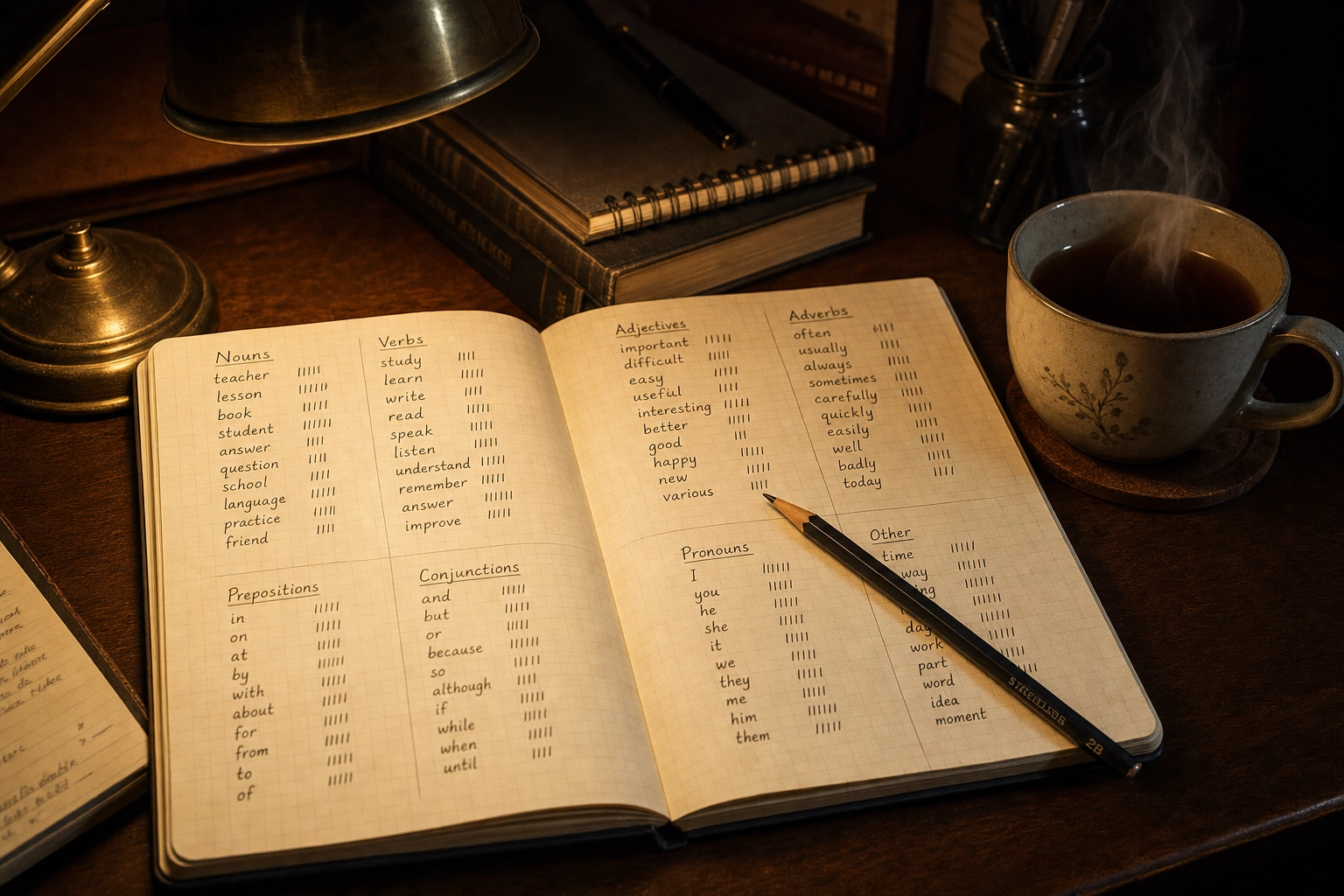
Here are 30 high-frequency English words organized by vowel sound. Pick 5-6 sounds per session and drill them — say each word three times in a row, then put it in a short sentence.
/iː/ as in sheep
- see — "I see it."
- need — "I need help."
- green — "It's green."
- week — "Next week."
- machine — "Use the machine."
/ɪ/ as in ship
- big — "It's big."
- little — "A little bit."
- interesting — "That's interesting."
- finish — "Did you finish?"
- business — "Open for business."
/æ/ as in cat
- happy — "I'm happy."
- family — "My family."
- answer — "The answer is no."
- bank — "Go to the bank."
- bag — "In the bag."
/ʌ/ as in cup
- money — "I have no money."
- love — "I love it."
- enough — "That's enough."
- country — "What country?"
- brother — "My brother."
/ɜːr/ as in bird
- work — "I have to work."
- first — "Me first."
- early — "Wake up early."
- person — "Nice person."
- return — "I'll return tomorrow."
/eɪ/ as in face
- today — "Not today."
- wait — "Please wait."
- make — "Make it."
- email — "Send the email."
- change — "I need change."
For each word, you should: (1) say it three times alone, (2) record yourself, (3) compare to a native audio reference, and (4) put it in a sentence and use it in conversation. The last step is where most learners stop — and it's where actual improvement happens. The BBC Learning English pronunciation library is one good free source for native audio if you need a reference.
How to Practice: The Audio Shadowing Method for Vowels
Reading IPA charts won't fix your accent. Mouth muscles will. The single most effective technique for installing new English vowel sounds is audio shadowing.
Shadowing means speaking on top of a native audio recording, not after it. You start a clip — a short interview, a podcast minute, a movie scene — and you speak the same words at the same time as the speaker, matching their rhythm, pitch, and vowel quality in real time.
Why Shadowing Works for Vowels
When you repeat after audio, your brain has time to fall back on your old vowel categories. When you speak with the audio, you don't have that buffer. Your mouth has to physically imitate what the native is doing right now. After enough repetitions, the new mouth positions become automatic.
Three research-backed reasons shadowing wins:
- Real-time motor imitation trains the same muscle memory native speakers use.
- Forced rhythm matching pulls your stressed/unstressed pattern toward English defaults.
- No time to translate stops you from "reading" English through your L1.
The 15-Minute Vowel Shadowing Routine
Pick one vowel sound to focus on per session.
Minute 0-2: Cold listen. Play your audio clip (30 seconds to 2 minutes). Don't speak. Just listen and note where your target vowel appears.
Minute 2-5: Shadow with text. Read along while the audio plays. Match speed and rhythm. Pay attention to your target vowel.
Minute 5-10: Shadow without text. Just listen and speak. Don't worry about catching every word — match the flow.
Minute 10-13: Record yourself. Shadow one more time while recording. Then listen back. Where does your vowel diverge from the native's?
Minute 13-15: Targeted retry. Replay the specific phrases where you diverged. Loop them until your version matches.
Five days a week, one vowel sound per session, and you cover all 20 English vowel sounds in about a month. For more shadowing routines, see our English shadowing exercises guide.
How Practice Me Helps You Fix Vowel Sounds in Real Conversations

Drills and shadowing build the raw mouth movements. But here's the hard truth most pronunciation courses don't admit: isolated drills don't transfer to real speech.
You can drill "ship" vs "sheep" perfectly in front of a mirror. The moment you're in an actual conversation — thinking about what to say, listening to the other person, managing eye contact — your old vowel habits snap back. Your brain has too many other things to think about, and pronunciation slides to the bottom of the priority queue.
The fix is the same fix athletes use for game-time performance: practice the skill under realistic conditions, repeatedly, until the new habit holds up under cognitive load.
That's exactly what Practice Me is built for.
How Practice Me Trains Vowels in Context
- Real-time voice conversations with AI tutors. Not pre-recorded drills. You actually speak, the AI listens, it responds. Vowels live or die in this kind of unscripted exchange.
- American and British accent options. Tutors Sarah and Marcus speak with native American accents; Oliver speaks with a native British accent. Pick the model that matches your goal — and notice the /ɒ/ vs /ɑː/ difference, the rhotic vs non-rhotic R, the diphthong shapes.
- Cross-session memory. Your AI tutor remembers what you talked about yesterday, what you've practiced before, and where you've improved. You're not starting from zero every conversation.
- Topic starters. If you don't know what to say, pick a scenario — job interview, ordering coffee, debating a topic. You'll naturally use the vowels you've been drilling in realistic sentences.
- 24/7, judgment-free. Vowel mistakes don't get sighs from real humans. You can repeat the same sentence ten times to nail the /ɜːr/ in "world," and the tutor just rolls with it.
What Makes It Different From Shadowing
Shadowing copies what someone else says. Practice Me makes you generate speech in response to unpredictable questions — which is the actual cognitive challenge of real conversation. Your vowels have to hold up while you're thinking about grammar, vocabulary, and meaning all at once.
Practice Me starts with a 3-day free trial (no card-on-file gotchas — cancel anytime). After that, it's an affordable monthly plan, or save more on the annual plan. See pricing details.
You don't need a teacher to learn English vowel sounds. You need consistent, contextual practice with feedback. That's what's been missing — until now.
Your 4-Week Vowel Mastery Plan
Twenty English vowel sounds is a lot. Here's how to space the work so it actually sticks.
Week 1: The 12 Monophthongs
- Days 1-2: /iː/ and /ɪ/ (sheep/ship pair)
- Days 3-4: /e/ and /æ/ (bed/bad pair)
- Days 5-6: /ʌ/, /ɑː/, /ɒ/ (cup/cop/hot triangle)
- Day 7: /ʊ/, /uː/, /ɔː/ (pull/pool/thought)
Daily routine: 10 min minimal pair drills + 15 min Practice Me conversation using the week's target sounds.
Week 2: The 8 Diphthongs
- Days 1-2: /eɪ/ (face) and /aɪ/ (price) — the most common
- Days 3-4: /ɔɪ/ (boy) and /aʊ/ (mouth) — back glides
- Day 5: /oʊ/ (go) — the round one
- Days 6-7: /ɪə/, /eə/, /ʊə/ — centering (skip if focusing on American)
Focus: smooth glides, not two separate vowels.
Week 3: R-Controlled Vowels + Schwa
- Days 1-3: /ɜːr/ (bird/her/turn) — the unified ER/IR/UR sound
- Day 4: /ɑːr/ (car/park)
- Day 5: /ɔːr/ (for/born)
- Days 6-7: Schwa reduction — practice common multi-syllable words
This week handles the sounds most learners ignore but that affect intelligibility the most.
Week 4: Connected Speech & Conversation
By now you've drilled every individual vowel sound. Week 4 is about putting it together.
- Days 1-3: Practice connected speech in English — vowel reductions in fast speech.
- Days 4-5: English word stress rules — where your vowels go big vs small.
- Days 6-7: Open conversation in Practice Me — no drills, just real talk. Notice which vowels still feel awkward; those go on next month's list.
How to Track Progress
Record yourself on Day 1 reading a paragraph aloud. Record the same paragraph on Day 28. The improvement will surprise you. Most learners notice clear progress within 2-3 weeks of consistent daily practice.
Frequently Asked Questions
How many vowel sounds are there in English?
English vowel sounds total approximately 20, though the exact count depends on the accent. General American typically uses around 15 vowel phonemes, while British Received Pronunciation uses about 20 (it adds three centering diphthongs: /ɪə/, /eə/, /ʊə/). The standard ESL teaching framework covers 20 sounds — 12 monophthongs and 8 diphthongs — because it captures both major accents.
What's the difference between short and long vowel sounds in English?
Short vowels (like /ɪ/ in "ship") are lax, with a relaxed tongue and a more central tongue position. Long vowels (like /iː/ in "sheep") are tense, with a more extreme tongue position and longer duration. The key insight is that the difference isn't just length — it's also quality. Stretching a short vowel won't turn it into the long version. You also have to change your mouth shape.
Are American and British English vowel sounds different?
Yes, in three main ways. (1) British English distinguishes /ɒ/ (hot) from /ɑː/ (father); American English merges them. (2) British English is non-rhotic — the R disappears after vowels and the vowel lengthens instead (car → /kɑː/). American English is rhotic — the R is fully pronounced (car → /kɑːr/). (3) The "go" diphthong is /əʊ/ in British and /oʊ/ in American — slightly different starting positions.
Do I need to learn IPA to improve my English vowels?
You don't need to memorize all the symbols, but knowing the IPA for the 20 English vowel sounds gives you a precise vocabulary for what's actually happening in your mouth. Every dictionary uses IPA, and pronunciation guides assume you can read at least the basics. Treat it like a reference, not a test — you'll absorb it through use.
Why do all English vowels sound the same to me?
Because your brain is filtering them through your native language's vowel categories. If your L1 has 5 vowels, your brain initially "rounds" all 20 English vowel sounds into those 5 boxes. The fix is targeted ear training with minimal pairs — pairs of words like ship/sheep that differ by exactly one vowel. After a few weeks of focused listening, your brain starts building new categories. This is well-documented and works at any age.
What's the hardest English vowel sound to learn?
It depends on your L1, but a few sounds are universally challenging: /æ/ (cat) doesn't exist in most languages and requires a deliberate jaw drop. /ɜːr/ (bird, her, turn) combines an unfamiliar vowel with the R glide. The schwa /ə/ is hard not because of the sound itself, but because it requires unlearning the habit of pronouncing every vowel fully. For Spanish speakers, /ɪ/ vs /iː/ is the headline challenge. For Japanese speakers, /ɜːr/ and /æ/ top the list. For Mandarin speakers, schwa reduction is the breakthrough fix.
How long does it take to master English vowel sounds?
Most learners notice meaningful improvement within 2-3 weeks of focused daily practice (15-30 minutes a day). "Mastery" — meaning natural production under conversational pressure — typically takes 3-6 months of consistent work. The variables are how different your L1 vowel inventory is from English, how much daily practice you do, and whether you get feedback on your actual speech. The last variable is the one most learners under-invest in.
Can I learn English vowel sounds without a teacher?
Yes — and most learners do. What you need isn't a human teacher; it's three things: (1) accurate reference audio for each vowel (free online), (2) minimal pairs drills to train your ear (free or in apps), and (3) regular speaking practice with feedback. The third one is the bottleneck. AI conversation apps like Practice Me solve this by letting you speak in unscripted conversations 24/7, with no judgment and unlimited retries — which is closer to what real conversation demands than any drill book can simulate.
Start Speaking English With Clear Vowels
The 20 English vowel sounds aren't a memory test. They're a physical skill. You don't "learn" them — you train your mouth into making them.
Three things to remember:
- Mouth position is teachable. Tongue height, backness, lip rounding. Everything else follows.
- Minimal pairs train your ear. You can't make a sound you can't hear.
- Vowels live or die in real conversation. Drills are warm-ups. Real speech is the game.
Pick one vowel today. Drill it for 15 minutes. Then jump into a conversation in Practice Me and try to use it ten times naturally. Tomorrow, another vowel. Twenty days, twenty sounds, one accent you actually own.
Your 3-day free trial is one tap away — no card, no commitment. Speak English the way you speak in your head: clearly, confidently, and without anyone judging the journey.