Duolingo taught you words. No one taught you to speak.
PracticeMe: real voice conversations with an AI tutor, 24/7.
English Minimal Pairs Practice: Hear the Difference

Say these two English words out loud: ship and sheep. If they sound the same in your mouth, your pronunciation is losing you meaning in real conversations. That tiny vowel sound difference — /ɪ/ versus /iː/ — is what makes native speakers understand you the first time instead of asking "sorry, what?"
English minimal pairs are how you fix that, fast. This guide gives you 50+ English minimal pairs organized by sound contrast, with IPA transcriptions, example sentences that show the meaning change, and a practice tip for each sound. Then we break it down by your native language — Spanish, Chinese, Arabic, and Japanese speakers each struggle with different English sounds for specific, fixable reasons.
Quick Summary: English minimal pairs are two words that differ by exactly one sound (ship/sheep, bat/bet, light/right). Practicing minimal pairs trains your ear to hear sound contrasts your native language ignores, and trains your mouth to produce them. Focus on the pairs your L1 doesn't distinguish — for Spanish speakers that's B/V and short/long vowel sounds; for Japanese speakers it's L/R; for Arabic speakers it's P/B; for Chinese speakers it's TH sounds.
What Are English Minimal Pairs (and Why They Work)
An English minimal pair is two words that are identical except for one sound — and that one sound changes the meaning. Ship /ʃɪp/ and sheep /ʃiːp/ are a minimal pair. Everything is the same except the vowel sound. Pat /pæt/ and bat /bæt/ are another minimal pair: only the first consonant sound is different.
Here's why English minimal pairs matter more than you'd think.
By the time you turned one year old, your brain had already decided which sounds are "real" in your native language and which sounds aren't. Sounds outside that map get filtered out before they reach your conscious hearing. This is called the perceptual magnet effect, documented by Patricia Kuhl and colleagues at the University of Washington. It's why a Japanese adult can hear the English sounds in light and right played 100 times and still not reliably tell them apart — those two English sounds collapse into one category in a Japanese brain.
English minimal pairs force the brain out of this filter. When two words mean different things but differ by only one sound, you can't ignore that sound anymore. You have to notice it. Over time — weeks of deliberate practice, not minutes — the brain builds a new perceptual category for each English sound you're targeting. First you hear the difference. Then you can produce it.
How to Use This Guide to English Minimal Pairs
Every English minimal pair below follows the same format:
- IPA transcription — the exact sounds in the International Phonetic Alphabet
- Example sentence — both words used in context where the wrong sound changes everything
- Practice tip — a physical cue for making the sound, or a common mistake to avoid
You don't need to memorize IPA. The key symbols you'll see repeatedly in English minimal pairs: /ɪ/ (short "i" as in ship), /iː/ (long "ee" as in sheep), /æ/ (short "a" as in cat), /e/ (short "e" as in bed), /ʊ/ (short "oo" as in full), /uː/ (long "oo" as in fool), /θ/ (voiceless TH as in think), /ð/ (voiced TH as in this).
Skip to the language section that matches your L1 if you want a priority shortcut. Otherwise, work through the English sound contrasts in order.
English Minimal Pairs: R vs L

English L and R are physically different sounds in a way most languages don't split. For the L sound, the tip of your tongue touches the ridge just behind your top teeth. For the R sound, the tongue curls back and touches nothing — the sides of your tongue brush your upper molars, but the tip floats in the middle of your mouth. This is the single hardest English consonant pair for Japanese, Korean, and many Chinese speakers.
| Pair | IPA | Example sentence |
|---|---|---|
| light / right | /laɪt/ / /raɪt/ | Turn on the light — it's the right switch. |
| lead / read | /liːd/ / /riːd/ | You lead the meeting; I'll read the notes. |
| glass / grass | /ɡlæs/ / /ɡræs/ | The glass fell on the grass. |
| collect / correct | /kəˈlekt/ / /kəˈrekt/ | Please collect the papers and correct the mistakes. |
| fly / fry | /flaɪ/ / /fraɪ/ | Don't let a fly land on the food I fry. |
| long / wrong | /lɒŋ/ / /rɒŋ/ | That's a long way to be wrong. |
| lice / rice | /laɪs/ / /raɪs/ | We found lice, not rice, in the kitchen. |
| lock / rock | /lɒk/ / /rɒk/ | Use a rock to break the lock. |
| alive / arrive | /əˈlaɪv/ / /əˈraɪv/ | They were alive when help finally arrived. |
| late / rate | /leɪt/ / /reɪt/ | The late fee changes the rate. |
Practice tip: Look in a mirror. For the L sound, you should see the tip of your tongue touch the roof of your mouth. For the R sound, the tongue should disappear behind your bottom teeth or curl up without touching anywhere in front. If your tongue is doing the same thing for both sounds, they'll sound the same.
English Minimal Pairs: B vs V
The B sound uses two lips pressed together (a stop — air builds up, then releases). The V sound uses your top teeth resting lightly on your bottom lip while air streams through (a fricative — continuous, not stopped). Spanish speakers struggle with this English minimal pair because Spanish /b/ and /v/ are allophones of the same phoneme — they're literally the same sound to a Spanish brain.
| Pair | IPA | Example sentence |
|---|---|---|
| berry / very | /ˈberi/ / /ˈveri/ | I like this berry very much. |
| bat / vat | /bæt/ / /væt/ | A bat flew into the vat of wine. |
| boat / vote | /boʊt/ / /voʊt/ | We'll vote on the boat name tomorrow. |
| ban / van | /bæn/ / /væn/ | They want to ban large vans downtown. |
| bet / vet | /bet/ / /vet/ | I'd bet my dog is fine, but let's see the vet. |
| base / vase | /beɪs/ / /veɪs/ | The vase sat on the base of the statue. |
| best / vest | /best/ / /vest/ | His best suit needs a new vest. |
| bow / vow | /baʊ/ / /vaʊ/ | They bow after the vow. |
| marble / marvel | /ˈmɑːrbl/ / /ˈmɑːrvl/ | Tourists marvel at the marble statues. |
| curb / curve | /kɜːrb/ / /kɜːrv/ | Park near the curb on the curve. |
Practice tip: For the V sound, you should be able to hold the sound for 3 seconds straight ("vvvvv"). You cannot hold B — it's one quick sound release. If your "very" and "berry" feel identical, put a finger on your lips: you should feel your lips come together for the B sound but feel your top teeth touch your bottom lip for the V sound.
English Minimal Pairs: TH vs S, T, and F
The two English TH sounds — voiceless /θ/ (think) and voiced /ð/ (this) — appear in only about 8% of the world's languages. If your native language isn't one of them, your tongue instinctively replaces the TH sound with whatever English sound is closest: S, T, F, or D. Each replacement creates a different minimal pair set.
TH vs S minimal pairs (hardest for Chinese, French, German speakers)
| Pair | IPA | Example sentence |
|---|---|---|
| think / sink | /θɪŋk/ / /sɪŋk/ | I think the sink is leaking. |
| thin / sin | /θɪn/ / /sɪn/ | Being thin is not a sin. |
| thigh / sigh | /θaɪ/ / /saɪ/ | She rubbed her thigh with a sigh. |
| path / pass | /pæθ/ / /pæs/ | The path doesn't pass the lake. |
| mouth / mouse | /maʊθ/ / /maʊs/ | A mouse ran into her mouth — kidding. |
| worth / worse | /wɜːrθ/ / /wɜːrs/ | That's worth less, not worse. |
TH vs T minimal pairs (hardest for French, Russian, Thai speakers)
| Pair | IPA | Example sentence |
|---|---|---|
| thin / tin | /θɪn/ / /tɪn/ | This tin is too thin. |
| three / tree | /θriː/ / /triː/ | I see three birds in that tree. |
| thank / tank | /θæŋk/ / /tæŋk/ | I thank the soldiers in the tank. |
| thought / taught | /θɔːt/ / /tɔːt/ | I thought you taught yesterday. |
TH vs F minimal pairs (hardest for some British dialect speakers and Cantonese)
| Pair | IPA | Example sentence |
|---|---|---|
| three / free | /θriː/ / /friː/ | The first three rides are free. |
| thin / fin | /θɪn/ / /fɪn/ | The shark's fin looks thin. |
| thought / fought | /θɔːt/ / /fɔːt/ | I thought they fought last night. |
| deaf / death | /def/ / /deθ/ | He was deaf but not near death. |
Practice tip: For both English TH sounds, the tongue MUST come between your teeth. Not behind them, not touching them — between them, visible. If a friend can't see the tip of your tongue when you say "think," you're making an S or T sound instead. Start by exaggerating: let your tongue stick out a full centimeter. Once the muscle memory is there, you can pull it back.
English Minimal Pairs: P vs B

Both P and B sounds use two lips. The difference is voicing: your vocal cords vibrate for the B sound but stay silent for the P sound. In English, the P sound at the beginning of words also gets a puff of air (aspiration) that B doesn't. Arabic dialects don't have /p/ as a separate phoneme, so this minimal pair is the number-one English challenge for Arabic speakers.
| Pair | IPA | Example sentence |
|---|---|---|
| pat / bat | /pæt/ / /bæt/ | Don't pat the bat — it might bite. |
| pair / bear | /peər/ / /beər/ | A pair of bears crossed the trail. |
| pig / big | /pɪɡ/ / /bɪɡ/ | That pig is very big. |
| cap / cab | /kæp/ / /kæb/ | Put on your cap — the cab is here. |
| lap / lab | /læp/ / /læb/ | The cat sat on my lap in the lab. |
| rope / robe | /roʊp/ / /roʊb/ | She tied the rope around her robe. |
| pea / bee | /piː/ / /biː/ | A bee landed on the pea. |
| pill / bill | /pɪl/ / /bɪl/ | The pill costs more than the doctor's bill. |
Practice tip: Hold a piece of tissue paper or a candle flame 10 cm in front of your mouth. When you say "pat," the paper should visibly flap — or the flame should flicker — from the puff of air. When you say "bat," the paper should barely move and the flame should stay steady. Then put two fingers on your throat — you'll feel vibration on the B sound but not on the P sound.
English Minimal Pairs: Short vs Long Vowel Sounds
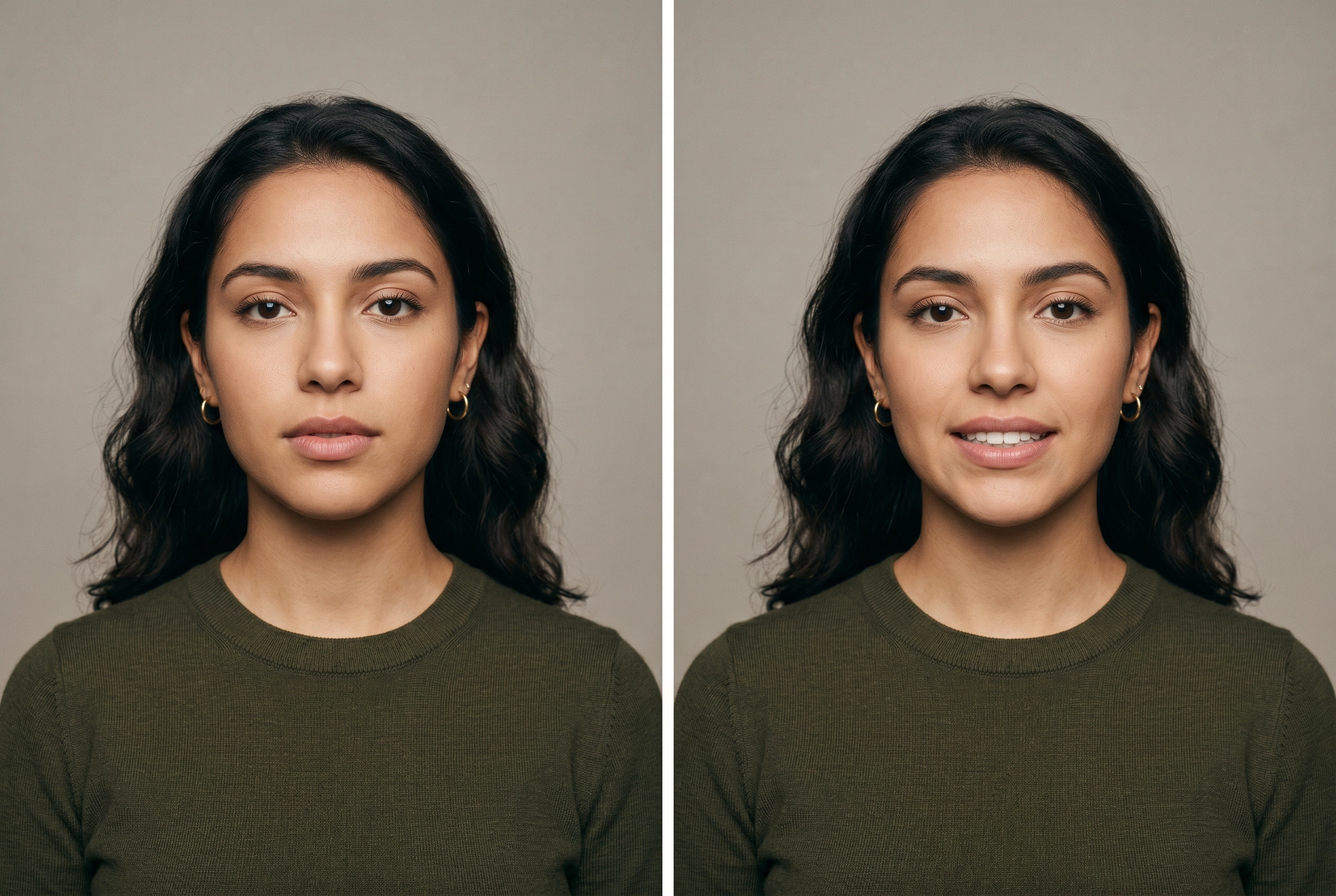
English has roughly 12 vowel sounds. Spanish has 5. Japanese has 5. Arabic has 3 to 6 depending on dialect. This is why vowel sounds are the biggest trap in English minimal pairs for most ESL learners: several English vowel sounds collapse into one vowel in your native language. These English minimal pairs train the ear to split those sounds apart.
/ɪ/ vs /iː/ — the ship/sheep family
Not just length — the tongue position is different for each English vowel sound. /ɪ/ is relaxed and slightly lower; /iː/ is tense with the tongue high and forward, almost smiling.
| Pair | IPA | Example sentence |
|---|---|---|
| ship / sheep | /ʃɪp/ / /ʃiːp/ | The ship carried 500 sheep. |
| bit / beat | /bɪt/ / /biːt/ | One more bit and we beat the record. |
| live / leave | /lɪv/ / /liːv/ | I live here, but I'll leave tomorrow. |
| fit / feet | /fɪt/ / /fiːt/ | These shoes fit my feet perfectly. |
| chip / cheap | /tʃɪp/ / /tʃiːp/ | This chip brand is cheap. |
| sit / seat | /sɪt/ / /siːt/ | You can sit in my seat. |
/ʊ/ vs /uː/ — the full/fool family
| Pair | IPA | Example sentence |
|---|---|---|
| full / fool | /fʊl/ / /fuːl/ | I feel full but not like a fool. |
| pull / pool | /pʊl/ / /puːl/ | Don't pull me into the pool. |
| look / Luke | /lʊk/ / /luːk/ | Hey Luke, look at this. |
| could / cooed | /kʊd/ / /kuːd/ | The baby could have cooed earlier. |
/e/ vs /æ/ — the bed/bad family
This is the English vowel sound contrast most learners miss the longest. /e/ has the mouth slightly open; /æ/ stretches the mouth wide like the beginning of a yawn.
| Pair | IPA | Example sentence |
|---|---|---|
| bed / bad | /bed/ / /bæd/ | A broken bed is bad news. |
| men / man | /men/ / /mæn/ | Those men know that man. |
| pen / pan | /pen/ / /pæn/ | Don't leave the pen in the pan. |
| said / sad | /sed/ / /sæd/ | She said she was sad. |
| head / had | /hed/ / /hæd/ | My head had a headache. |
| dead / dad | /ded/ / /dæd/ | His dad is not dead. |
/ʌ/ vs /ɑː/ — the cut/cart family
| Pair | IPA | Example sentence |
|---|---|---|
| cut / cart | /kʌt/ / /kɑːrt/ | I'll cut the rope on the cart. |
| hut / heart | /hʌt/ / /hɑːrt/ | The old hut had heart. |
| but / Bart | /bʌt/ / /bɑːrt/ | Everyone came, but Bart stayed home. |
Practice tip: Record yourself saying all six words in the /ɪ/-/iː/ group in a row: ship, sheep, bit, beat, live, leave. Play it back. If the short and long vowel sounds sound the same, slow down and exaggerate — hold the long vowel for a full second while stretching your lips into a wide smile, then make the short one feel lazy and quick.
English Minimal Pairs: Final Consonant Voicing
Most languages devoice final consonants — German speakers say "bet" for "bed," Russian speakers say "cap" for "cab." English insists on voicing those final sounds fully. Even trickier: the vowel sound before a voiced final consonant is noticeably longer. Native speakers actually cue off the vowel sound length as much as the consonant sound itself.
Final T vs D minimal pairs
| Pair | IPA | Example sentence |
|---|---|---|
| bet / bed | /bet/ / /bed/ | I bet you're tired — here's a bed. |
| bat / bad | /bæt/ / /bæd/ | That's not a bat; that's bad news. |
| seat / seed | /siːt/ / /siːd/ | Plant the seed near your seat. |
| heart / hard | /hɑːrt/ / /hɑːrd/ | Working from the heart is hard. |
| built / build | /bɪlt/ / /bɪld/ | They built what I asked them to build. |
Final P vs B minimal pairs
| Pair | IPA | Example sentence |
|---|---|---|
| rope / robe | /roʊp/ / /roʊb/ | She tied a rope around her robe. |
| cap / cab | /kæp/ / /kæb/ | I lost my cap in the cab. |
| tap / tab | /tæp/ / /tæb/ | Just tap to open a new tab. |
Final S vs Z minimal pairs
| Pair | IPA | Example sentence |
|---|---|---|
| ice / eyes | /aɪs/ / /aɪz/ | Her eyes went wide at the ice. |
| price / prize | /praɪs/ / /praɪz/ | The price is the prize. |
| advice / advise | /ədˈvaɪs/ / /ədˈvaɪz/ | I advise you to take my advice. |
| bus / buzz | /bʌs/ / /bʌz/ | The bus made a loud buzz. |
Practice tip: To produce a voiced final consonant sound cleanly, stretch the vowel sound slightly and make sure your vocal cords keep vibrating right through the consonant. A useful hack: exaggerate the vowel sound length. "Beeeed" with a long vowel naturally pulls the D into voicing; "bet" with a short vowel naturally produces a clean T sound.
Duolingo taught you words. No one taught you to speak.
PracticeMe: real voice conversations with an AI tutor, 24/7.
Other High-Impact English Minimal Pairs
V vs W minimal pairs (hardest for Hindi, German, Russian speakers)
| Pair | IPA | Example sentence |
|---|---|---|
| wine / vine | /waɪn/ / /vaɪn/ | The wine comes from that vine. |
| west / vest | /west/ / /vest/ | He wore a vest heading west. |
| wet / vet | /wet/ / /vet/ | The dog got wet at the vet. |
| while / vile | /waɪl/ / /vaɪl/ | That smell was vile for a while. |
The W sound rounds the lips into a circle with no teeth contact. The V sound requires your top teeth touching your bottom lip.
SH vs CH minimal pairs (hardest for Arabic, French speakers)
| Pair | IPA | Example sentence |
|---|---|---|
| ship / chip | /ʃɪp/ / /tʃɪp/ | They serve fish and chips on the ship. |
| share / chair | /ʃeər/ / /tʃeər/ | Let's share the chair. |
| wash / watch | /wɒʃ/ / /wɒtʃ/ | Please wash my watch carefully. |
| sheep / cheap | /ʃiːp/ / /tʃiːp/ | Those sheep weren't cheap. |
The SH sound is a continuous hiss. The CH sound starts with a stop (like T) and releases into the SH sound. Practice: CH = T + SH spoken together quickly.
S vs Z minimal pairs
| Pair | IPA | Example sentence |
|---|---|---|
| sip / zip | /sɪp/ / /zɪp/ | Take a sip before you zip the bag. |
| sue / zoo | /suː/ / /zuː/ | They'll sue the zoo. |
| race / raise | /reɪs/ / /reɪz/ | We'll raise money at the race. |
| loose / lose | /luːs/ / /luːz/ | If the belt is loose, you'll lose your pants. |
Y vs J minimal pairs (hardest for Spanish, German speakers)
| Pair | IPA | Example sentence |
|---|---|---|
| yet / jet | /jet/ / /dʒet/ | Has the jet landed yet? |
| yellow / jello | /ˈjeloʊ/ / /ˈdʒeloʊ/ | The jello is yellow. |
| yoke / joke | /joʊk/ / /dʒoʊk/ | That joke was a yoke on us. |
English Minimal Pairs by Native Language
Every English learner has a different priority list of minimal pairs to master. The pairs that matter most are the ones your native language doesn't distinguish — because those are the sounds your brain has never learned to hear. Work on your language-specific English minimal pairs first, then fill in the rest.
English Minimal Pairs for Spanish Speakers
Spanish has five vowel sounds; English has twelve or more. That math alone means English vowel sounds will be your biggest challenge. Consonant-wise, Spanish /b/ and /v/ are the same phoneme, and the /z/ sound doesn't exist as a distinct sound in Spanish.
Top priority English minimal pairs for Spanish speakers:
- bet / vet (/b/ vs /v/) — the classic English sound mix-up
- ship / sheep (/ɪ/ vs /iː/) — "I want to leave" vs "I want to live"
- bed / bad (/e/ vs /æ/) — most Spanish speakers produce both as the Spanish /e/ sound
- sip / zip (S vs Z) — Spanish Z is pronounced as S
- yellow / jello (Y vs J) — Spanish "y" covers both English sounds
For a deeper breakdown including silent letters, schwa, and consonant clusters, see our guide on hard English words for Spanish speakers.
English Minimal Pairs for Chinese (Mandarin) Speakers
Mandarin has no TH sounds, no /v/ sound, and final consonants are limited to /n/ and /ŋ/. Mandarin also contrasts aspiration (puff of air) rather than voicing — so "pat" and "bat" distinguish differently than you'd expect in English minimal pairs.
Top priority English minimal pairs for Chinese speakers:
- think / sink (TH vs S) — Mandarin lacks the /θ/ sound
- vine / wine (V vs W) — no /v/ sound in Mandarin
- bit / beat (/ɪ/ vs /iː/) — English vowel length distinction
- rope / robe (final P vs B) — Mandarin doesn't use voiced stop final sounds
- thought / taught (TH vs T) — the other TH substitution pattern
English Minimal Pairs for Arabic Speakers
Most Arabic dialects lack /p/ as a separate phoneme — which means "park" and "bark" can sound identical in spoken English. The /v/ sound is also absent from most dialects, causing V/F confusion. Short vowel sound distinctions are tricky because Arabic's short vowel sounds don't map cleanly to English.
Top priority English minimal pairs for Arabic speakers:
- pat / bat (P vs B) — the signature Arabic-speaker English challenge
- van / fan (V vs F) — /v/ sound replaced with /f/ sound
- pen / pin (/e/ vs /ɪ/) — short vowel sounds collapse
- ship / chip (SH vs CH) — standard Arabic lacks /tʃ/
- sip / zip (S vs Z) — inconsistent across dialects
English Minimal Pairs for Japanese Speakers
Japanese has one liquid consonant — /ɾ/, a tap made with a quick tongue flick — that falls acoustically between English L and R sounds. Japanese also lacks /v/, /θ/, /ð/, and the /æ/ vowel sound. A classic 1991 study by Logan, Lively, and Pisoni showed that Japanese speakers significantly improved L/R perception after just three weeks of English minimal pair training, especially when the training used multiple speakers' voices.
Top priority English minimal pairs for Japanese speakers:
- light / right (L vs R) — the famous one
- lock / rock (L vs R, different position) — practice both word-initial and word-medial English sounds
- berry / very (B vs V) — /v/ sound not in Japanese
- hat / hut (/æ/ vs /ʌ/) — /æ/ vowel sound not in Japanese
- think / sink (TH vs S) — TH sound replaced with S or T
English Minimal Pairs for Hindi, Korean, and Other Speakers
Hindi speakers typically struggle with V/W (often merged into one sound) and /z/ vs /dʒ/ — try wine/vine and zip/gyp respectively. Korean speakers share Japanese-like challenges with L/R and P/B English sounds, plus /f/ vs /p/. Portuguese, Italian, French, and German speakers each have their own priority lists of English minimal pairs, but the method is identical: identify what's missing in your L1, then drill those pairs first.
For a full language-by-language breakdown, see our guide to the hardest English words to pronounce by native language.
How to Actually Practice English Minimal Pairs (Three-Step Method)
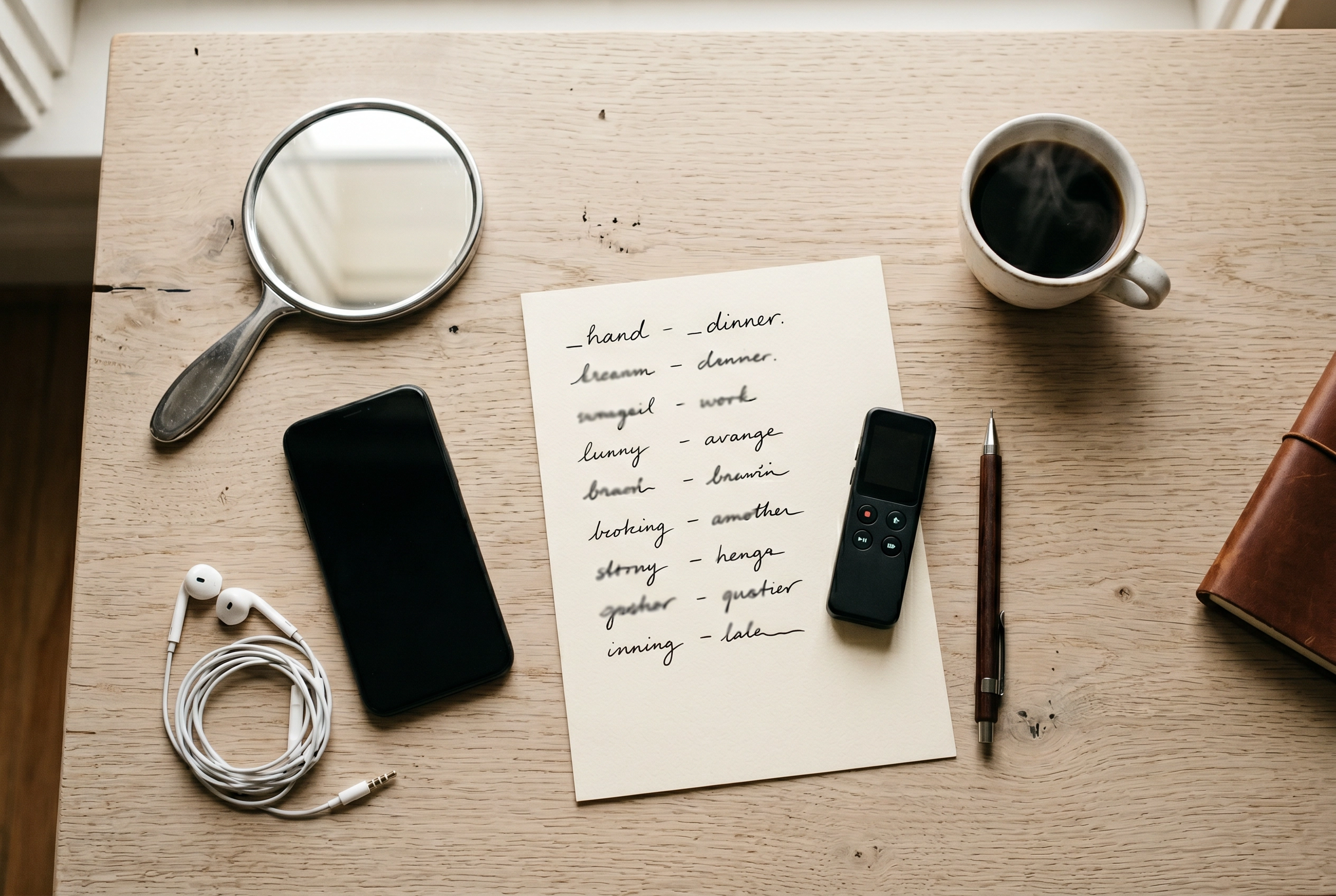
Here's the mistake most English learners make with minimal pairs: they try to produce new sounds before they can perceive them. That's like trying to paint a color you can't see. The effective sequence for English minimal pairs practice is perception first, production second, context third.
Step 1: Perception Drills (Just Listen)
Before your mouth does anything, train your ear. Find a recording or app that plays one word from a pair and asks you to identify it — ship or sheep? light or right? Aim for 90% accuracy over 20 trials before moving on to the next English sound. This is the step most learners skip, and it's the reason their English pronunciation never improves.
Write down the pair on paper. Listen to a native speaker say one word. Point to what you heard. Check the answer. Repeat with 10-15 English minimal pairs per session.
Step 2: Production Drills (Slow, Mirror, Record)
Once you can hear the sound difference reliably, start producing. Three rules:
- Slow first. Say each word with exaggerated articulation. If you can't make the English sound contrast at slow speed, you won't make it at normal speed.
- Watch a mirror. For V vs B, L vs R, TH vs T, your mouth looks visibly different for each sound. If the mirror shows identical lip and tongue positions, you're still making one sound for both words.
- Record yourself. Your internal hearing lies to you — you hear what you intended to say, not what came out. Play back the recording and compare it to a native English model.
The gap between what you think you said and what you actually said is the learning zone. Stay in it.
Step 3: Contextualized Practice (Sentences That Matter)
Isolated English minimal pair drills plateau fast. The next step is using the pair in sentences where only one word makes sense: "The baby tried to walk/work for the first time." Your brain processes the meaning, then has to produce the exact sound to match. This links phoneme to meaning — which is how long-term memory actually forms, not through repetition alone.
Research on English pronunciation training (notably Bradlow and colleagues) consistently shows that high-variability training — practicing English sounds with multiple voices, multiple contexts, not one recording on loop — transfers much better to real-world conversation. This is why real conversation practice, even with an AI, accelerates what isolated English minimal pair drills start.
A 10-minute daily English session beats 70 minutes once a week. For more on structuring daily practice, see our 15-minute daily English speaking routine.
Why AI Conversation Partners Help You Master English Minimal Pairs

Isolated English minimal pair drills teach you the sound. Real conversations teach you to use it. The bridge between them is where most learners get stuck — you can say "ship" and "sheep" perfectly when it's just those two words, but in a real English conversation, you revert to old habits.
Live human tutors are the gold standard here. The problem is practical: scheduling, cost, and the fact that a 30-minute conversation rarely happens to repeat "very" and "berry" twenty times each. You'd need to direct the tutor to focus on English minimal pairs, and most of the session becomes social friction.
AI voice tutors solve three specific problems for English minimal pair learning:
1. Consistent native-model pronunciation. Every time the AI says "sheep," it sounds like every other time. Your brain builds a stable acoustic template for that English sound, which is what perceptual learning actually needs. Human variability is great once the template exists — but not when you're still forming it.
2. Unlimited repetition without judgment. You can ask the AI to say "very" ten times and "berry" ten times, then work both sounds into a sentence about your weekend, then flip to a different context. Zero social cost. No tutor looking at their watch.
3. Contextual use at scale. This is the part drills can't give you. The AI uses target words in real English sentences — "I'd bet a week's pay on that," "Let's take the dog to the vet tomorrow" — so you practice the sound embedded in meaning, which is how you'll actually use it.
With Practice Me, you pick a scenario — everyday conversation, a job interview, travel English, a casual chat — and the AI tutors (Sarah, Oliver, or Marcus) naturally produce dozens of the English sound contrasts you're working on. Shadow them. Ask them to repeat. Try the word yourself and get a response that uses it back in a new sentence.
This doesn't replace targeted minimal pair drills. It's the missing bridge between drill and real English conversation. Pair a 10-minute drill session with 10 minutes of AI conversation focused on the same sound, and you cover both perception training and real-world transfer in the same session. Learn more about this approach in our guide to practicing English speaking with AI.
For more pronunciation-focused practice, combine English minimal pairs with English tongue twisters, which extend single-sound contrasts into connected speech, or use English shadowing exercises to lock in rhythm and intonation around your target English sounds. Beginners should also check our beginner English pronunciation guide for an overview of the sounds this article references.
Frequently Asked Questions
How many English minimal pairs should I practice a day?
Five to ten English minimal pairs in focused 10-minute sessions is more effective than 50 pairs in one marathon session. Your brain consolidates sound categories during sleep, so daily, shorter sessions compound better than weekly long ones. Stick with one English sound contrast (say, R/L) for a full week before moving to the next — switching too fast prevents the perceptual category from stabilizing.
Can adults really learn to hear new English sounds?
Yes, but slower than children. Research from the University of Washington and elsewhere confirms adults retain neuroplasticity for speech perception — the 1991 Logan, Lively and Pisoni study showed Japanese adults improved L/R perception after three weeks of English minimal pair training, and follow-up studies confirm the improvement transfers to new words and new speakers. The adults who succeed use high-variability input (many voices, many contexts) and practice perception of English sounds before production.
Do I need to learn IPA to practice English minimal pairs?
Not formally. You need to recognize maybe 15 symbols that cover the main English sounds — the vowels /ɪ/, /iː/, /e/, /æ/, /ʊ/, /uː/, /ʌ/, /ɑː/, /ɔː/, /ɜː/, /ə/, and the consonants /θ/, /ð/, /ʃ/, /ʒ/, /tʃ/, /dʒ/. Think of IPA as a cheat sheet for pronunciation dictionaries, not a separate alphabet to memorize. Most online dictionaries now include audio, so you can cross-check your guess with the actual English sound.
What's the difference between English minimal pairs and tongue twisters?
English minimal pairs isolate one sound contrast in two words — think/sink, bat/bet. Tongue twisters repeat and alternate multiple sounds rapidly in a phrase — "She sells seashells by the seashore." Minimal pairs train perception and clean production of single English sounds; tongue twisters train speed, flexibility, and coordination under pressure. Use minimal pairs to build the sounds, then use tongue twisters to stress-test them.
How long before I notice improvement with English minimal pairs practice?
For perception, most learners see measurable gains in 2-4 weeks of daily 10-minute English minimal pairs practice. For production, add another 4-8 weeks before the new English sound feels natural in unscripted conversation. The bigger the gap between your native language and English on a specific sound, the longer it takes — Japanese speakers working on L/R typically need longer than French speakers working on TH.
Are British and American English minimal pairs the same?
Most are. The vowel pairs (/ɪ/-/iː/, /e/-/æ/, /ʊ/-/uː/) work identically in both English accents. A few shift: British English has a stronger /ɒ/ vowel sound (as in cot) that American English pronounces closer to /ɑː/, so the cot/caught distinction is clearer in British English. Non-rhotic British English also drops final R in words like hard, so heart/hard still contrast, just slightly differently than in American English.
Start Hearing the Difference
Pick five English minimal pairs from your native-language priority list and practice them today. Not all 50 — five. Spend 10 minutes on perception, 10 minutes on production, 10 minutes using them in sentences. Do that every day for two weeks and then come back to this page. The English sounds you couldn't distinguish when you started will sound obviously different.
The ear leads the mouth. If you can't hear the English sound contrast, you can't reliably produce it — and you'll never know whether what you said was right. English minimal pairs are the training that closes that loop.
Ready to take your minimal pairs into real English conversation? Practice Me gives you unlimited voice practice with AI tutors who naturally produce challenging English sound contrasts in realistic scenarios — the bridge between drill and fluent speech. Start with the sounds that matter most for your native language, and let daily conversation turn them into habits.