Duolingo taught you words. No one taught you to speak.
PracticeMe: real voice conversations with an AI tutor, 24/7.
English Word Stress Rules: A Pronunciation Guide

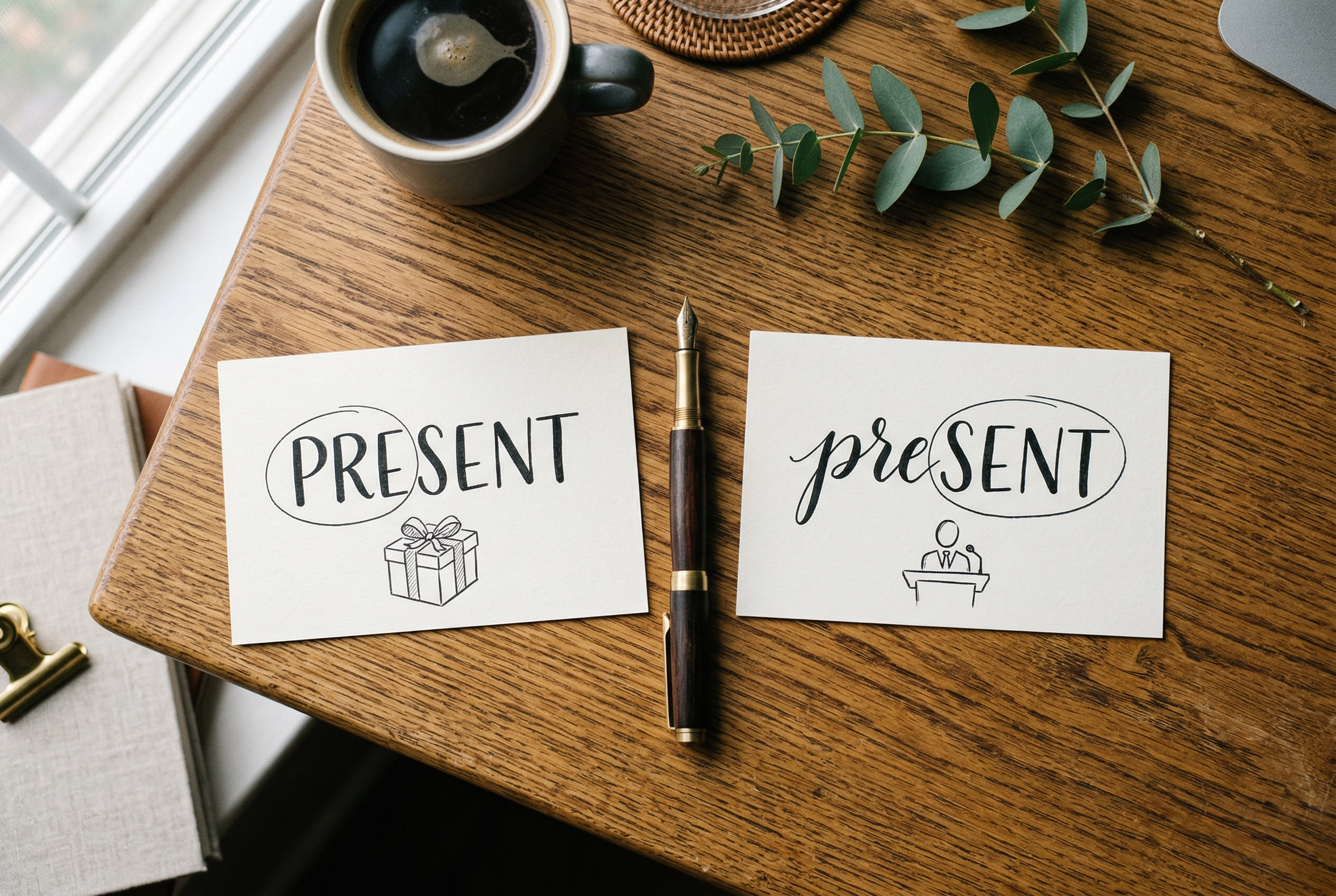
Say the word "present." Now say it again, but this time, make the second syllable louder: "preSENT." You just changed a gift into an action — without changing a single letter.
That's word stress in English, and getting it wrong is one of the fastest ways to confuse a native speaker — even when your grammar and vocabulary are perfect.
Quick Summary: Word stress in English means making one syllable in a word louder, longer, and higher in pitch than the rest. This guide covers 7 learnable English word stress rules with 50+ example words, a full table of words that change meaning with stress, and targeted tips for Spanish, Chinese, and Arabic speakers. You'll also get practice exercises to make correct stress patterns automatic.
What Is Word Stress in English (and Why Does It Matter)?
Every English word with more than one syllable has one syllable that gets more emphasis than the others. That emphasized syllable is louder, longer, and slightly higher in pitch. The remaining syllables are compressed and weakened — often reduced to a quick, neutral vowel sound called the schwa (/ə/), the most common sound in spoken English.
Understanding English word stress patterns matters for three specific reasons:
- Comprehension. Native English speakers rely on stress patterns to identify words. If you say "comPUter" correctly, people hear it instantly. If you say "COMputer" or "compuTER," there's a processing delay — or outright confusion.
- Meaning. Some English words change meaning entirely based on which syllable is stressed (more on this below).
- Natural rhythm. English is a stress-timed language, meaning stressed syllables occur at roughly regular intervals while unstressed syllables get squeezed between them. This creates English's characteristic "bounce" — and without it, your speech sounds flat or robotic to native ears, even when every word is correct.
Here's the good news: about 80% of two-syllable English words stress the first syllable. And the word stress rules below cover the vast majority of multi-syllable words you'll encounter in everyday speech.
The 7 Core English Word Stress Rules
No set of rules covers every English word — this language loves exceptions. But these seven English word stress rules will give you a reliable framework for roughly 90% of the words you use daily.

Rule 1: Two-Syllable Nouns and Adjectives — Stress the First Syllable
Most two-syllable nouns and adjectives put the stress on the first syllable.
| Word | Stress Pattern |
|---|---|
| TAble | TA-ble |
| HAPpy | HAP-py |
| WAter | WA-ter |
| DOCtor | DOC-tor |
| CLEVer | CLEV-er |
| PRETty | PRET-ty |
| CHIna | CHI-na |
| YELlow | YEL-low |
| PURple | PUR-ple |
| CARton | CAR-ton |
This is the default stress pattern for English words. When in doubt about a two-syllable noun, stress the first syllable and you'll be right roughly 80% of the time.
Rule 2: Two-Syllable Verbs and Prepositions — Stress the Second Syllable
Flip the pattern for most two-syllable verbs and prepositions. The stress moves to the second syllable.
| Word | Stress Pattern |
|---|---|
| reLAX | re-LAX |
| deCIDE | de-CIDE |
| beTWEEN | be-TWEEN |
| aSIDE | a-SIDE |
| reCEIVE | re-CEIVE |
| diRECT | di-RECT |
| aMONG | a-MONG |
| beLOW | be-LOW |
| forGET | for-GET |
| beFORE | be-FORE |
Exceptions: Some common English verbs break this rule — LISten, OFfer, ENter, HAPpen. These words are worth memorizing individually.
This noun-first / verb-second split is the foundation of Rule 7 (stress-shift words) below.
Rule 3: Suffixes That Pull Stress — -tion, -sion, -ic, -ical
When a word ends in -tion, -sion, -ic, or -ical, the stressed syllable falls directly before the suffix. Every time.
-tion words:
- inforMAtion, classifiCAtion, reveLAtion, condiTION, eDUcation, pronunCIAtion
-sion words:
- teleVIsion, compreHENsion, occaSION, perMISsion, exPLOsion
-ic words:
- fanTAStic, draMAtic, arCHAic, characteRIStic, scienTIFic, eLECtric
-ical words:
- poLItical, praCTIcal, meCHAnical, hisTORical, geograPHIcal
This is one of the most reliable English word stress patterns you can learn. If you master only one suffix rule, make it this one.

Rule 4: Suffixes That Push Stress to the Third-From-End — -ty, -cy, -phy, -gy, -al
Words ending in these suffixes stress the antepenultimate syllable (the third syllable from the end).
| Suffix | Examples |
|---|---|
| -ty | uniVERsity, eLECtricity, CLArity, quALity |
| -cy | deMOcracy, PRIvacy, ACcuracy, efFIciency |
| -phy | phoTOgraphy, geOGraphy, biOGraphy |
| -gy | bIOlogy, teCHNOlogy, ALlergy, PSYchology |
| -al | CRItical, NAUtical, poLItical, TROPical |
The trick: count three syllables from the end, and that's where you place the stress. uni-VER-si-ty. de-MOC-ra-cy. pho-TOG-ra-phy.
Rule 5: Endings That Take the Stress Themselves — -ee, -eer, -ese, -ette, -ade, -oon
Some word endings are stressed directly on themselves. These suffixes are mostly borrowed from French:
| Suffix | Examples |
|---|---|
| -ee | guaranTEE, emploYEE, refuGEE, trainEE |
| -eer | volunTEER, engiNEER, carEER, pioNEER |
| -ese | JapanESE, PortugESE, ChINESE, VietnamESE |
| -ette | cassETTE, silhouETTE, gaZETTE |
| -ade | lemoNADE, arCADE, cruSADE |
| -oon | afterNOON, baLOON, carTOON, marOON |
If you see these endings on any English word — regardless of word length — the stress is on that last syllable.
Rule 6: Compound Nouns — Stress the First Word
When two words combine to form a single compound noun, the first word gets the primary stress:
| Compound Noun | Stress Pattern |
|---|---|
| SEAfood | SEA-food |
| TOOTHpaste | TOOTH-paste |
| FOOTball | FOOT-ball |
| AIRport | AIR-port |
| NOTEbook | NOTE-book |
| SUNflower | SUN-flower |
| BASketball | BAS-ket-ball |
| BEDroom | BED-room |
Compound adjectives flip this — stress lands on the second word: old-FASHioned, rock-SOLid, sky-BLUE.
Quick test: if you're naming a thing (noun), stress the first part. If you're describing something (adjective), stress the second part.
Rule 7: Prefixes Usually Don't Change the Stressed Syllable in Verbs
Adding a prefix like un-, re-, dis-, or over- to a verb doesn't move the stress. It stays on the root:
- un-DO, re-PLAY, dis-MISS, over-COME, re-WRITE, mis-TAKE
But nouns with prefixes often stress the prefix itself: OUT-line, UP-date (noun), DOWN-load (noun), IN-put.
This ties back to the noun/verb split: the same word "update" is UP-date as a noun ("I have an update") and up-DATE as a verb ("Let me update you").
Duolingo taught you words. No one taught you to speak.
PracticeMe: real voice conversations with an AI tutor, 24/7.
English Stress Words That Change Meaning
This is where word stress in English stops being "nice to know" and becomes essential. Dozens of common English words completely change their meaning — or their grammatical function — based solely on which syllable you stress.
The pattern is consistent: noun/adjective = first syllable stressed, verb = second syllable stressed.
| Word | As a Noun (1st syllable stressed) | As a Verb (2nd syllable stressed) |
|---|---|---|
| record | RECord — "a medical record" | reCORD — "to record a song" |
| present | PRESent — "a birthday present" | preSENT — "to present an idea" |
| object | OBject — "a small object" | obJECT — "I object to this" |
| produce | PRODuce — "fresh produce" | proDUCE — "to produce results" |
| contract | CONtract — "a legal contract" | conTRACT — "muscles contract" |
| permit | PERmit — "a parking permit" | perMIT — "permit me to explain" |
| rebel | REBel — "a rebel fighter" | reBEL — "to rebel against rules" |
| suspect | SUSpect — "the main suspect" | suSPECT — "I suspect foul play" |
| conduct | CONduct — "professional conduct" | conDUCT — "to conduct a meeting" |
| conflict | CONflict — "an armed conflict" | conFLICT — "the stories conflict" |
| desert | DESert — "the Sahara Desert" | deSERT — "to desert your post" |
| insult | INsult — "a terrible insult" | inSULT — "don't insult me" |
| protest | PROtest — "a peaceful protest" | proTEST — "they protest the law" |
| progress | PROGress — "good progress" | proGRESS — "to progress slowly" |
| refund | REfund — "I want a refund" | reFUND — "they'll refund you" |
| export | EXport — "our main export" | exPORT — "we export coffee" |
| import | IMport — "a cheap import" | imPORT — "to import goods" |
| increase | INcrease — "a pay increase" | inCREASE — "prices increased" |
| decrease | DEcrease — "a sharp decrease" | deCREASE — "sales decreased" |
| address | ADdress — "a home address" | adDRESS — "to address the issue" |
| content | CONtent — "the page content" | conTENT — "feeling content" |
| convert | CONvert — "a recent convert" | conVERT — "to convert currency" |
| project | PROJect — "a school project" | proJECT — "to project your voice" |
| refuse | REFuse — "household refuse" | reFUSE — "I refuse to go" |
| perfect | PERfect — "a perfect score" | perFECT — "to perfect your craft" |
| transport | TRANSport — "public transport" | transPORT — "to transport goods" |
| survey | SURvey — "a customer survey" | surVEY — "to survey the land" |
That's 27 pairs where stress on the word determines the part of speech. Try reading each row aloud, shifting the stress between the noun and verb form. If this feels unnatural, that's exactly why you need to practice — these words come up in everyday English constantly.
For even more challenging pronunciation pairs, check our dedicated guide.
Word Stress Tips by Native Language
Your first language creates specific stress patterns that transfer — sometimes helpfully, sometimes not — into English pronunciation. Here's what to watch for based on your language background.

For Spanish Speakers
The core challenge: Spanish is a syllable-timed language where each syllable gets roughly equal time and emphasis. English is stress-timed — stressed syllables get the spotlight, and everything else gets compressed. This rhythmic mismatch is often why Spanish speakers sound "flat" in English even when individual sounds are correct.
What to focus on:
- Learn the schwa (/ə/). This neutral, lazy vowel sound is what English uses for most unstressed syllables. In "banana" (bə-NAN-ə), both the first and last syllable use the schwa. Spanish doesn't reduce vowels this way, so you'll need to actively practice making unstressed syllables shorter and weaker.
- Watch out for cognates. English and Spanish share many words, but the stress often shifts: TEL-e-phone vs. te-LÉ-fo-no, com-FOR-ta-ble vs. con-for-TA-ble. Don't assume the stress on English words matches the Spanish stress pattern.
- Exaggerate at first. When practicing, make the stressed syllable dramatically louder and longer. This feels strange initially, but it trains the English rhythm your ear needs.
For more specific challenges, see our guide to hard English words for Spanish speakers.
For Chinese (Mandarin) Speakers
The core challenge: Mandarin uses tones on individual syllables to change word meaning. English uses stress across multi-syllable words instead. Since most Chinese words are monosyllabic, Mandarin speakers often have no instinct for which syllable in a longer English word should be emphasized.
What to focus on:
- Stress ≠ tone. In English, stress means making a syllable longer and louder — not changing its pitch the way you would in Mandarin. When you stress a syllable in English, think volume and duration rather than tone contour.
- Fight the flatness. Mandarin speakers tend to give every syllable equal weight in English, which sounds monotone to native English speakers. Actively make unstressed syllables shorter and quieter.
- Tap the rhythm first. Before saying a new English word, tap or clap the stress pattern on a table. "pho-TOG-ra-phy" = soft-LOUD-soft-soft. Getting the rhythm physically into your body helps bypass tonal interference from your first language.
For Arabic Speakers
The core challenge: Arabic is stress-timed like English (good news!), but Arabic stress follows more predictable rules based on syllable weight — heavy syllables attract stress. English word stress is more lexical and often unpredictable, so Arabic speakers may apply Arabic stress logic to English words and land on the wrong syllable.
What to focus on:
- Don't insert vowels into consonant clusters. Arabic doesn't allow clusters like "str" or "spl," so you may unconsciously add a vowel ("si-TRESS" instead of "stress"). This changes the syllable count and shifts the stressed syllable entirely.
- Practice vowel reduction. Arabic has about 8 vowel sounds; English has over 20. In unstressed syllables, English reduces most vowels to the schwa. Practice making unstressed vowels shorter and more neutral instead of pronouncing each one fully.
- Record and compare. Record yourself saying a word, then play a native pronunciation via a dictionary app or BBC Learning English. Listen specifically for which syllable sounds longest and loudest.
Practice Exercises for English Word Stress Patterns
Reading word stress rules is one thing. Making correct stress on words in English automatic takes hands-on practice. Here are five exercises you can do anywhere, in under 10 minutes.

Exercise 1: The Clap Test
Pick 10 words from this article. For each one, clap once per syllable — but clap louder on the stressed syllable. Example: for "pronunciation," you'd clap five times: soft-soft-soft-LOUD-soft. This builds physical rhythm awareness that transfers directly to your speech.
Exercise 2: Noun/Verb Pair Drills
Using the stress-shift table above, read each word as a noun, then as a verb: "The RECord was broken. She wants to reCORD a new album." Alternate back and forth until the shift feels natural. Aim for at least 10 pairs per session.
Exercise 3: Shadow a Podcast or Video
Pick any English podcast or YouTube video. Play a sentence, pause, and repeat it — copying not just the words but the rhythm and stress. Pay attention to which syllables the speaker emphasizes hardest. This shadowing technique is one of the fastest ways to internalize natural English word stress patterns. Our shadowing exercises provide structured practice sessions to get you started.
Exercise 4: Record and Compare
Say a word out loud. Then look up the correct pronunciation in an online dictionary (Cambridge Dictionary and Merriam-Webster both offer free audio). Play the recording. Does your stressed syllable match? Is your unstressed syllable reduced enough? This feedback loop is crucial for self-correction.
Exercise 5: Exaggerated Read-Aloud
Read any paragraph of English out loud, but exaggerate every stressed syllable — make it twice as long and loud as you normally would. This feels silly, but it trains your mouth to clearly differentiate stressed and unstressed syllables in English words. You can use tongue twisters for pronunciation practice to make this exercise more engaging.
How AI Conversation Practice Builds Natural Word Stress
Rules and drills give you knowledge of word stress in English. Conversation is what makes it automatic.
The reason native English speakers never consciously think about word stress rules is that they've heard and repeated millions of stressed and unstressed words in context. Your goal is to build a similar volume of practice — and that's where practicing English speaking with AI becomes especially valuable.

With Practice Me, you can have real-time voice conversations with AI tutors like Sarah, Oliver, or Marcus — 24/7, with no scheduling and no judgment. You choose between American and British accents, and the tutors adapt to your current speaking level.
Why this works for developing correct word stress in English:
- Repetition in context. You'll naturally use high-frequency English words (the same ones in this guide) over and over in real conversation — building correct stress patterns through repetition rather than memorization.
- No performance anxiety. Many learners know the stress rules but freeze in real conversations. Practicing with AI removes the embarrassment of making mistakes, so you actually try correct stress on words instead of avoiding the words you're unsure about.
- Automatic vocabulary saving. Words you use in conversation are saved automatically, giving you a personal word list to review — including those tricky stress-shift pairs from the table above.
- Unlimited speaking practice. English word stress patterns take time to become instinct. Unlike a weekly tutor session, you can have conversations whenever you want — whether that's during your daily English speaking practice or a late-night session when the rules feel fresh.
You can also improve your English speaking by yourself using AI conversations alongside the drills above, and build vocabulary through conversations at the same time.
Frequently Asked Questions
How do I know which syllable to stress in a new English word?
Start with the seven rules in this guide — they cover the majority of English words. For unfamiliar words, check a dictionary with audio pronunciation (Cambridge Dictionary and Merriam-Webster are both free online). Over time, you'll develop an instinct for common word stress patterns just from exposure. If you're just starting out with pronunciation practice as a beginner, focus on the suffix rules first — they're the most consistent and predictable.
Does word stress change between American and British English?
Rarely, but it happens with a few specific words. Americans say "ga-RAGE" while many British speakers say "GAR-age." Other examples include "ad-ver-TISE-ment" (American) vs. "ad-VER-tis-ment" (British) and "week-END" vs. "WEEK-end." For 95% or more of English words, stress placement is identical in both varieties.
Can wrong word stress really cause misunderstandings?
Absolutely. According to the British Council, incorrect word stress is one of the most common causes of misunderstanding in English — often more disruptive than individual sound errors. If you say "de-SERT" (to abandon) when you mean "DES-ert" (the Sahara), the listener genuinely hears a different word. Getting stress on words in English right carries real meaning, not just style.
How long does it take to master English word stress?
Most learners notice significant improvement within 4–8 weeks of daily, focused practice — even just 10 minutes per day of speaking exercises. The word stress rules themselves can be learned in an afternoon; making them automatic takes consistent exposure to spoken English through conversation, podcasts, or shadowing practice.
What's the difference between word stress and sentence stress?
Word stress is about which syllable within a single word gets emphasis (com-PU-ter). Sentence stress is about which words in a full sentence get emphasis ("I didn't say he stole the money" vs. "I didn't say he stole the money"). Both affect meaning in English, but word stress rules are more predictable and pattern-based.
Is there an app to practice English word stress?
You can practice English word stress through real voice conversations with AI tutors on Practice Me. Unlike drill-based apps, you'll practice English stress words naturally by speaking in real conversations — which is how native speakers actually develop their pronunciation instincts. It's available on iOS and Android, with both American and British accent options.