Duolingo taught you words. No one taught you to speak.
PracticeMe: real voice conversations with an AI tutor, 24/7.
Aviation English for Pilots & Cabin Crew
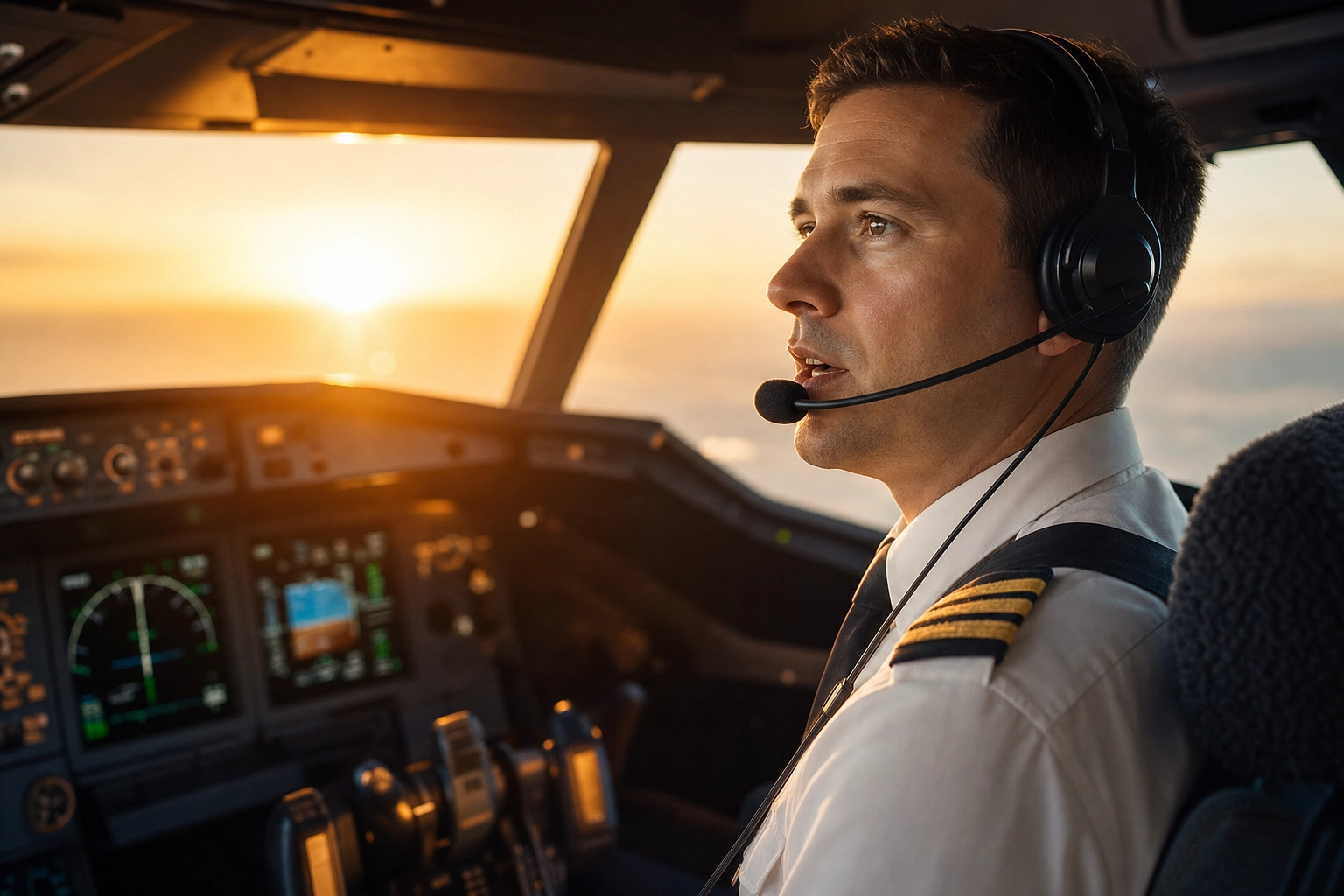
In aviation, the gap between a routine flight and a disaster can be a single misheard word. Aviation English — the precise, internationally agreed language of radiotelephony — is what lets a pilot in São Paulo and a controller in Frankfurt understand each other perfectly over a crackling radio. If you fly internationally or work a control position, you have to prove your command of it at ICAO Level 4 or above.
This page is for the cockpit and the control room — pilots, student pilots, air traffic controllers, and dispatchers who must be understood the first time, every time. Below: the phraseology, alphabet, numbers, and readback discipline the test and the job demand, plus three radio scenarios to rehearse aloud. (Work the cabin instead? Our guide to English for flight attendants and cabin crew covers service and safety language.)
Quick Summary: Aviation English is the standardized radiotelephony English of global aviation, used by pilots and air traffic control worldwide. International pilots and controllers must hold ICAO Level 4 ("Operational") proficiency — scored on your weakest of six skills, not an average. The fastest route is to rehearse phraseology, the phonetic alphabet, numbers, and emergency calls aloud until they're automatic. Practice Me lets you do that with AI tutors, but it does not administer or certify the official ICAO exam.
What Is Aviation English?
Aviation English is the controlled subset of English used between aircraft and the ground. It's not "English with some plane words." It's a tightly defined system of roughly 300 standard words and phrases, fixed sentence patterns, and pronunciation rules, backed by plain English for situations no phrasebook can predict.

It began in 1951, when the International Civil Aviation Organization (ICAO) recommended English as the common language for international radiotelephony. A recommendation wasn't enough: accidents tied to miscommunication pushed ICAO to make language proficiency a hard licensing requirement in 2008. Today, aviation English is the language of the skies, used by everyone from long-haul captains to ground controllers and flight dispatchers.
The skill has two halves: standard phraseology (the scripted calls) and plain English (what you say when a situation goes off-script — a medical diversion, an odd fault, a confusing instruction). Level 4 tests both kinds of language.
ICAO Level 4: The Bar Every International Pilot Must Clear
Every pilot and controller in international operations must hold at least ICAO Level 4, the "Operational" rung of a six-point proficiency scale. You're assessed on six separate skills: pronunciation, structure, vocabulary, fluency, comprehension, and interactions. SKYbrary's summary of the language proficiency requirements lays out the full rating scale, which runs from 1 (pre-elementary) to 6 (expert):
- Level 4 — Operational: the minimum proficiency for international flying; effective in routine and most non-routine situations.
- Level 5 — Extended: consistently accurate, with control of complex language.
- Level 6 — Expert: near-native ease and clarity.
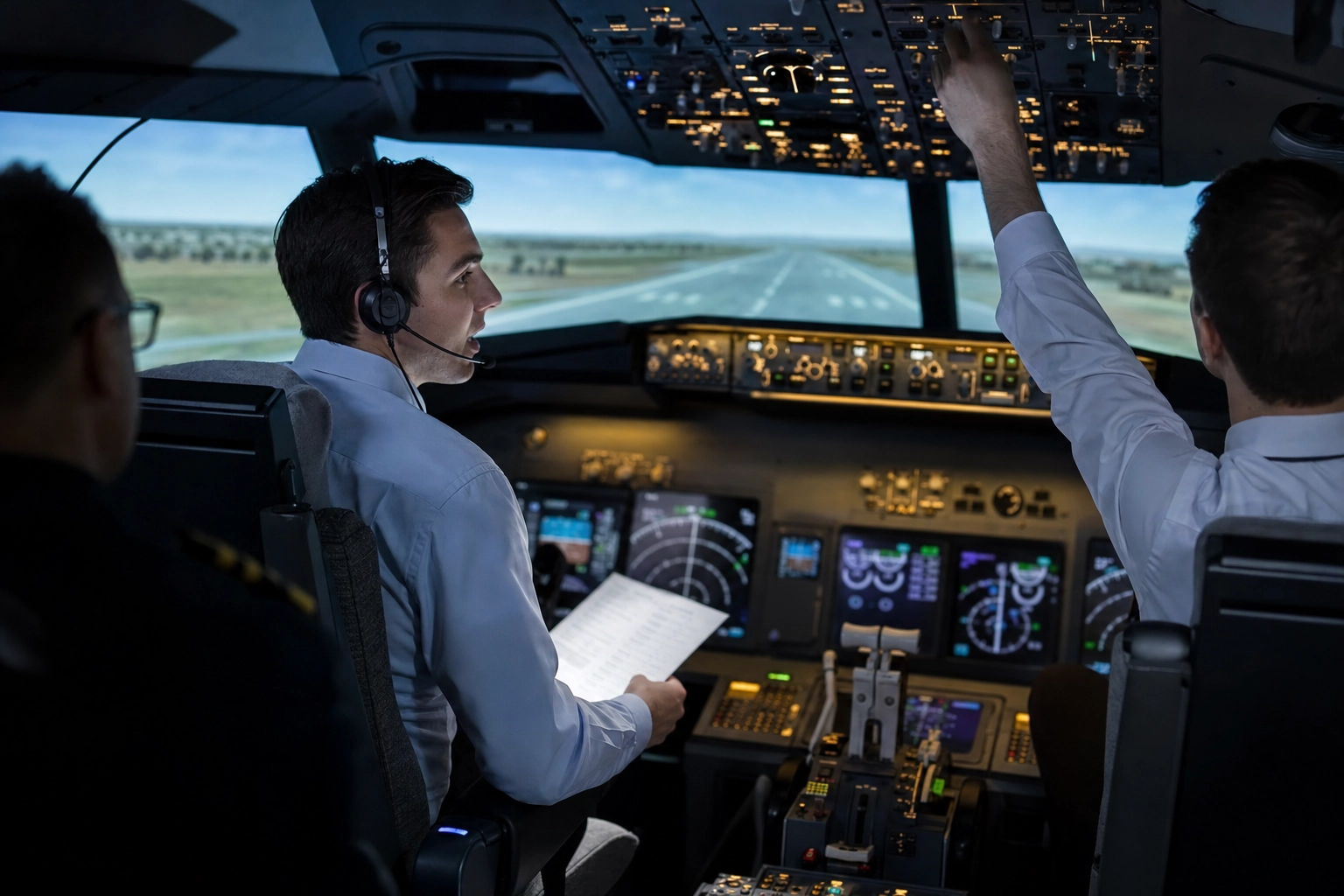
The rule that catches people out: your overall result is the lowest of your six scores, not the average. Score 5 in five skills but a 3 in structure, and your certificate reads Level 3 — below operational. One weak area sinks the whole result, which is why broad, balanced speaking practice beats cramming a single skill.
Two more facts: only speaking and listening are tested — there's no reading or writing — and Level 4 isn't forever. ICAO recommends re-testing about every three years at Level 4 (EASA uses four) and every six at Level 5; only Level 6 is granted for life.
Being a native speaker is no free pass, either. Examiners downgrade natives who rush, mumble idioms, or ramble in run-on sentences. The scale rewards being understood, not sounding local — good news if you've worried about your accent. To benchmark yourself, see how ICAO levels map to the CEFR scale (Level 4 sits broadly around B1–B2) or test your English speaking level first.
Important: Practice Me helps you rehearse for the test — we do not administer the ICAO or EASA exam, score you officially, or issue any certificate. For that, you go to an approved aviation language testing provider.
Standard Phraseology: Why "Roger" Doesn't Mean "Yes"
Standard phraseology is the heart of aviation radiotelephony, built to strip out ambiguity. Each approved word carries exactly one meaning — no room for interpretation at 500 knots. The most common rookie mistake is assuming everyday English applies. It doesn't.
| Term | What it actually means |
|---|---|
| Roger | "I have received your last transmission." Not "yes." |
| Wilco | "Will comply." (Receipt is implied — don't add "Roger.") |
| Affirm | "Yes." |
| Negative | "No," "that is not correct," or "permission not granted." |
| Correction | "I made an error; the correct version is…" |
| Say again | "Repeat all or part of your last transmission." |
| Standby | "Wait, I will call you." |
| Unable | "I cannot comply." |
| Disregard | "Ignore that transmission." |
The FAA's phraseology guidance in the Aeronautical Information Manual and the UK CAA's CAP 413 spell out hundreds more. The discipline is universal: keep transmissions brief, speak at an even rate of about 100 words a minute, and always say whether a number is an altitude, a heading, or a speed.
Why does it matter so much? Non-standard phraseology has killed people. The deadliest accident in history — the 1977 Tenerife runway collision, 583 lives lost — turned partly on one ambiguous call. A departing crew said "we are now at takeoff," meaning they were rolling; the tower read it as a position, not an action. Fog and two radios transmitting at once did the rest.
The NATO Phonetic Alphabet, From Alfa to Zulu
Spell a call sign over a noisy VHF channel and "B," "D," and "P" blur together. The fix is the NATO phonetic alphabet — finalized by ICAO in 1956 and identical to the alphabet NATO later adopted.
| Letter | Word | Letter | Word |
|---|---|---|---|
| A | Alfa | N | November |
| B | Bravo | O | Oscar |
| C | Charlie | P | Papa |
| D | Delta | Q | Quebec |
| E | Echo | R | Romeo |
| F | Foxtrot | S | Sierra |
| G | Golf | T | Tango |
| H | Hotel | U | Uniform |
| I | India | V | Victor |
| J | Juliett | W | Whiskey |
| K | Kilo | X | X-ray |
| L | Lima | Y | Yankee |
| M | Mike | Z | Zulu |
ICAO deliberately writes "Alfa" (not Alpha) and "Juliett" with a double T so speakers of other languages don't drop the sounds. You'll use these constantly — for call signs, runway designators, and waypoints.
Numbers That Can't Be Misheard: Tree, Fife, Niner
Numbers are where comprehension quietly breaks down, so aviation modifies how several digits are spoken.
| Digit | Spoken as | Digit | Spoken as |
|---|---|---|---|
| 0 | ZE-RO | 5 | FIFE |
| 1 | WUN | 6 | SIX |
| 2 | TOO | 7 | SEV-en |
| 3 | TREE | 8 | AIT |
| 4 | FOW-er | 9 | NIN-er |
The changes aren't arbitrary: "tree" stops three collapsing into "free," "fife" keeps five from sounding like "fire," and "niner" stops nine matching the German "nein" (no). Decimals are read as "decimal" (or "point" in US airspace) and thousands as "TOU-SAND."
- Frequency 119.3 → "one one niner decimal tree"
- Flight level 350 → "flight level tree fife zero"
- Altimeter 2992 → "two niner niner two"
- A squawk code is read digit by digit: 4621 → "four six two one"
You can learn the table in an afternoon. Saying it back fast and correctly while you fly the aircraft is a different skill — built only by repetition out loud.
Duolingo taught you words. No one taught you to speak.
PracticeMe: real voice conversations with an AI tutor, 24/7.
Readback and Hearback: Closing the Communication Loop
A clearance isn't truly received until it's confirmed both ways. The readback is the pilot repeating the safety-critical parts of a clearance word for word; the hearback is the controller catching any error. The loop isn't closed until both happen.

Mandatory readback items include route clearances, the runway in use, assigned altitudes and flight levels, headings, speeds, frequencies, transponder (squawk) codes, and hold-short instructions. SKYbrary's briefing on pilot–controller communications shows how this aviation safety net works — and how it fails: expectation bias, fatigue, similar-sounding call signs, and "blocked" transmissions where two stations key up at once. Understanding fast, accented controllers is its own skill; if rapid speech trips you up, see connected speech in English.
Sometimes the missing piece is one word. In 1990, the crew of Avianca Flight 052 told New York controllers they were "running out of fuel," but never declared an emergency or a Mayday. Without that trigger word they weren't given priority — and the aircraft crashed from fuel exhaustion, killing 73. In aviation English, the right word doesn't just describe the situation; it activates the response.
Rehearse the Calls That Matter
You can read these scripts once, or rehearse them until they come out clean under pressure. The point of practicing real role-play scenarios is to move phraseology from "I recognize it" to "I can say it without thinking." Start with these three.
Scenario 1 — Reading Back a Departure Clearance
Controller: "Speedbird 123, cleared to London Heathrow via the Brookmans Park Two Foxtrot departure, climb altitude six thousand feet, squawk four six two one."
You: "Cleared to London Heathrow via the Brookmans Park Two Foxtrot departure, climb six thousand feet, squawk four six two one, Speedbird 123."
You read back every safety-critical item and finish with your call sign — nothing extra, nothing missing.
Scenario 2 — Making a Position Report
On procedural or oceanic routes you report your own position, in a fixed order: call sign, position, time, level, next fix with estimate, then the fix after.
You: "Speedbird 123, position GANSO at four two, flight level three five zero, estimating SOVAR at five eight, next ALESO."
A controller who can't see you on radar now has the full picture — packed into one calm, ordered sentence.
Scenario 3 — Declaring an Emergency: Mayday vs Pan-Pan
Mayday (spoken three times) signals distress — grave, imminent danger needing immediate help. Pan-Pan (three times) signals urgency — serious but not yet life-threatening. Pick the right one, then give a structured message: who you are, what's wrong, your intentions, your position, and the souls and fuel on board.
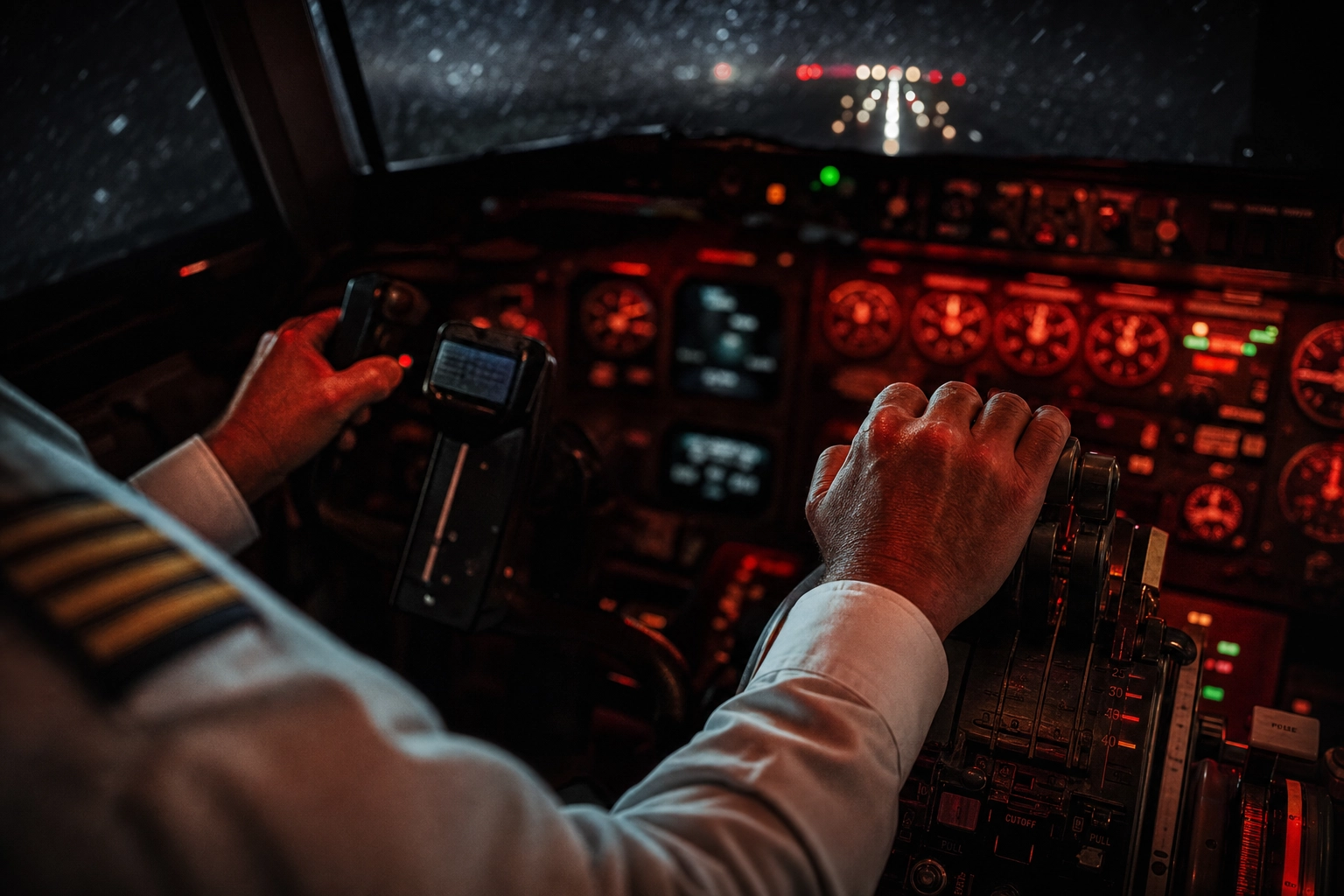
You: "Mayday, mayday, mayday. London Control, Speedbird 123, engine fire number two, shutting it down, request immediate return to Heathrow. Passing flight level three one zero, heading two seven zero, two hundred and ten souls on board, fuel three hours."
Under stress the urge is to speed up. The trainable skill is to slow down and stay intelligible.
How to Practice Aviation English with Practice Me
Here's the catch with everything above: you can study it alone, but you can't rehearse a conversation alone. Most pilots, controllers, and other aviation professionals have no one to run radio calls with between training events, so phraseology stays theoretical — then freezes up on test day, or on a bad-weather night.

That's the gap Practice Me fills. You hold real-time, voice-based conversations with AI tutors that talk back, in American or British accents, available 24/7 and completely judgment-free. You can:
- Run a clearance readback, a position report, or a Mayday call as many times as you need — no instructor's time wasted, no embarrassment.
- Drill the alphabet and numbers aloud until "niner decimal tree" is automatic.
- Practice the plain English Level 4 really tests — explaining a fault, negotiating a diversion, fielding a controller's unexpected question. It's the same audio-only pressure as making high-stakes phone calls in English.
- Steady the nerves that sink tests and interviews: pair daily reps with our speaking-confidence checklist, and if you're job-hunting, airline interview practice too.
The tutor remembers you between sessions and quietly saves the vocabulary you stumble on, so each conversation targets the weak spots that decide your lowest-of-six score.
To be clear: this is rehearsal and confidence-building, not the exam. We don't administer the ICAO or EASA test or issue certificates — we just make sure that when you sit the real thing, the words are already in your mouth.
Ready to hear yourself improve? Start a 3-day free trial and run your first radio scenario today.
Frequently Asked Questions
What is aviation English?
Aviation English is the standardized English used for radio communication between pilots, air traffic control, and ground staff worldwide. It blends about 300 fixed "phraseology" terms with plain English for non-routine situations, removing ambiguity so a message means the same thing to a speaker of any first language.
What is ICAO Level 4 English and who needs it?
ICAO Level 4 ("Operational") is the minimum English proficiency required of pilots and air traffic controllers in international operations. It's measured across six skills — pronunciation, structure, vocabulary, fluency, comprehension, and interactions — and your overall rating equals your lowest score. Most authorities require re-testing every few years until you reach Level 6.
Does Practice Me administer or certify the official ICAO English test?
No. Practice Me is a speaking-practice app that helps you rehearse phraseology, numbers, and real conversations so you arrive prepared and confident. We do not administer the ICAO or EASA exam, give an official score, or issue any certificate — you take the official test through an approved aviation language testing provider.
How is aviation English different from everyday English?
Everyday English tolerates ambiguity; aviation English forbids it. Words have single fixed meanings ("Roger" means message received, never yes), numbers get special pronunciations, letters are spelled with the phonetic alphabet, and safety-critical instructions must be read back and confirmed. It's a smaller, stricter, more disciplined version of the language.
Can a native English speaker fail the ICAO language test?
Yes. Native speakers are still assessed and can be marked down for speaking too fast, slurring words, using local idioms, or rambling. The scale rewards clear, intelligible, structured communication — not a particular accent — so a careful non-native speaker can easily out-score a careless native one.
How long does it take to reach ICAO Level 4?
It depends on your starting point. A strong B1–B2 speaker may need only a few weeks of focused radiotelephony and pronunciation practice; someone rebuilding general English may need months. Because you're scored on your weakest skill, consistent daily speaking practice across all six areas is the fastest route — short, frequent sessions beat occasional long ones.
Is aviation English the same for pilots and cabin crew?
They overlap but differ. Pilots and controllers focus on radiotelephony — phraseology, readbacks, and clearances, as on this page. Cabin crew focus on passenger-facing service and safety language: greetings, the safety demonstration, and managing emergencies in the cabin. If that's your role, see our guide to English for flight attendants and cabin crew.