Duolingo taught you words. No one taught you to speak.
PracticeMe: real voice conversations with an AI tutor, 24/7.
English for Nurses: Patient Care Phrases & Practice

It's 3 a.m. on a busy ward. A doctor calls you back about your patient, and within ten seconds you have to explain a falling blood pressure, a climbing heart rate, and what you think is going wrong — clearly, in English, with no time to rehearse. You know the medicine cold. But under pressure, in your second language, the words stick in your throat.
That moment is what most guides to English for nurses miss. They hand you long vocabulary lists and grammar drills, as if nursing English were a memory test. It isn't. A good medical English course can teach you the words, but it can't give you the nerve to use them when a patient is crying or a monitor is alarming. Nursing English is a speaking problem — the ability to say the right thing, fast, to a frightened patient, a grieving family, or a consultant who's already moving on to the next case. This guide gives you the exact phrases for real bedside situations, the handoff scripts that experienced nurses lean on, and a way to rehearse all of it out loud until it feels automatic.
Quick Summary: Nursing English isn't about memorizing terminology — it's about speaking confidently during pain assessments, medication rounds, SBAR handoffs, family conversations, and emergencies. This guide covers the practical phrases for each, plus how internationally trained nurses can rehearse them with AI roleplay before they ever face a real shift.
Why English for Nurses Is a Speaking Problem, Not a Vocabulary Problem
Here's the uncomfortable truth: you can pass a written exam, score well on the OET, and still freeze the first time a family member asks, "Is she going to be okay?" Knowing the word auscultate doesn't help when a patient mishears you, when a doctor talks over you on the phone, or when a colleague rattles off "he's gone downhill, BP's tanking, can you grab the crash cart?"
Most ranking resources for nursing English are courses and word lists. Useful, but incomplete. The part that actually trips people up — especially internationally trained nurses — is spoken fluency under pressure: speed, accents, idioms, abbreviations fired off mid-task, and the confidence to speak up rather than nod and hope.
So this guide does two things. First, it gives you real patient communication English for the situations that matter most. Second, it shows you how to practice saying these phrases aloud, because reading a phrase and performing it during a code are very different skills. Whether you're a nursing student heading into your first clinical placement or an experienced nurse relocating abroad, the same gap applies. If you want the broader picture across all clinical roles, our guide to English for healthcare workers zooms out; this page stays tightly focused on nurses.
Bedside Phrases Every Nurse Needs
Most of your shift is spent at the bedside, and most patient trust is won or lost in the first 30 seconds of an interaction. Strong therapeutic communication — the kind taught in nursing fundamentals — follows a simple rhythm: introduce yourself, explain what you're about to do, ask permission, then check that the patient understood.
Introducing yourself and asking permission
Patients relax when they know who you are and what's coming next. According to nursing communication guidance published on OpenStax's Clinical Nursing Skills, a clear preview plus a permission check is the foundation of trust.
| Situation | What to say |
|---|---|
| Introducing yourself | "Good morning, I'm Maria. I'll be your nurse until 7 tonight." |
| Confirming identity | "Can you tell me your name and date of birth for me, please?" |
| Previewing a task | "I'm here to do an assessment. It'll take about 15 minutes." |
| Asking permission | "I'd like to listen to your chest, if that's okay?" |
| Warning before touch | "I'm going to put this cuff on your arm — it'll feel tight for a few seconds." |
Assessing pain
Pain assessment is one of the most frequent — and most scripted — conversations you'll have. The numeric scale is the backbone:
"On a scale of 0 to 10, where 0 is no pain and 10 is the worst pain you can imagine, how would you rate your pain right now?"
To go deeper, nurses use a memory framework. In the US, OPQRST is common (Onset, Provocation/Palliation, Quality, Region/Radiation, Severity, Time). In the UK, you'll hear SOCRATES (Site, Onset, Character, Radiation, Associations, Time course, Exacerbating/relieving factors, Severity). The questions sound like this:
- "Where exactly is the pain? Can you point to it?"
- "When did it start, and what were you doing?"
- "Is it sharp, dull, burning, or throbbing?"
- "Does anything make it better or worse?"
- "Does it spread anywhere else?"
For children or patients who can't rate a number, you might say, "Point to the face that shows how much it hurts" (the Wong-Baker FACES scale).

Explaining procedures in plain language
The single biggest fix for patient anxiety is swapping jargon for plain words. Compare:
- ❌ "We need an EKG because you're tachycardic."
- ✅ "I need to do an EKG — that's a quick, painless test with little sticker sensors that checks your heart rhythm."
Comforting without false reassurance
It's tempting to say "You'll be fine, don't worry." Avoid it — nursing texts flag this as a communication blocker because it dismisses the patient's fear. Instead, acknowledge and stay present:
- "This sounds really frightening. Let's go through what we know."
- "I can see you're worried. I'm right here, and I'm not going anywhere."
- "You've told me the pain is getting worse and it's making you anxious. Did I get that right?" (restating to confirm — a core therapeutic technique)
If you're still building the instinct to keep these exchanges flowing, our guide on how to keep a conversation going in English translates directly to the bedside.
Medication Administration English
Medication rounds are where precise language prevents real harm. Nurses verify the "rights" of administration — right patient, right drug, right dose, right route, right time, plus right documentation, reason, and response — and each check has its own phrase. This is core medical English for nurses: precise, checkable, and repeated dozens of times a shift.

| Check | What to say |
|---|---|
| Confirm two identifiers | "Before I give you anything, can you tell me your name and date of birth?" |
| Announce the medication | "I'm going to give you your morning medications now." |
| Screen for allergies | "Are you allergic to any medications that you know of?" |
| Screen for other drugs | "Have you taken any other medications today, including anything you bought yourself?" |
| Explain the drug | "This one is for your blood pressure. It might make you feel a little dizzy when you stand up." |
| Give instructions | "You can take this with a sip of water. Try not to chew it." |
When a patient refuses, you don't argue — you explore, then document. A useful line: "That's completely your choice. Can I ask what's worrying you about it?" If they still decline, you notify the provider and chart the refusal. And remember to re-assess: if someone reported pain at 8 before a PRN painkiller, you circle back later — "Has that taken the edge off? Where's the pain now, 0 to 10?"
SBAR: The Handoff Script That Structures Every Report
If you learn one framework from this guide, make it SBAR — Situation, Background, Assessment, Recommendation. It's a structured way to hand off information so nothing critical gets lost. It was originally developed by the US Navy for nuclear submarines, then adopted across healthcare; the Agency for Healthcare Research and Quality (AHRQ) made it a cornerstone of its TeamSTEPPS program, and The Joint Commission has pushed it as a standard handoff tool since the mid-2000s.
For non-native speakers, SBAR is a gift: it gives you a predictable template, so you're filling in slots instead of inventing sentence structure on the fly. Many hospitals use ISBARR (adding Introduction at the front and Read-back at the end, where you repeat the order back to confirm you heard it correctly).
Here's a full nurse-to-doctor phone escalation:
- Situation: "Hi Dr. Lee, this is Maria, the RN on 4 West. I'm calling about Mr. Patel in room 412. His blood pressure has dropped to 88 over 52 and he's feeling dizzy."
- Background: "He's 68, admitted two days ago with pneumonia, with a history of high blood pressure and diabetes."
- Assessment: "I'm worried he may be becoming septic — his temperature is 38.9, heart rate is 112, and he's pale and clammy."
- Recommendation: "I'd like you to come and assess him. In the meantime, would you like me to start a fluid bolus and draw blood cultures?"
At a shift change, the same structure works at the bedside — you introduce the patient and code status, summarize the diagnosis and hospital course, give your current head-to-toe findings, point out lines and drains (IV, Foley catheter, wound drains), flag recent changes in medications, labs, or tests, and list the tasks waiting for the next shift.

Talking With Patients' Families
Families are anxious, often exhausted, and hanging on your every word. Your job is to be clear, honest, and human — without over-promising. Keep explanations jargon-free and check understanding as you go.
| Goal | What to say |
|---|---|
| Explain a condition | "His lungs have an infection, which is why he's on oxygen and antibiotics." |
| Describe what comes next | "Over the next 24 hours we'll watch his oxygen levels closely and repeat his bloods in the morning." |
| Answer "Is he going to be okay?" | "I can't promise an outcome, but I can tell you exactly what we're doing and what we're watching for." |
| Invite questions | "What questions do you have for me right now?" |
| Check understanding | "Just so I know I explained it clearly — what will you tell your sister when she calls?" |
When the news is serious, experienced nurses lean on the SPIKES approach used across medicine: find a private Setting, ask what the family already Perceives, get an Invitation ("How much would you like to know?"), give a brief warning before the Knowledge ("I'm afraid the scan didn't show what we hoped"), respond with Empathy, then agree a Strategy. Above all, allow silence — resist the urge to fill it. The hardest part for many nurses isn't the vocabulary; it's tolerating that pause without rushing into "You'll be fine."
Duolingo taught you words. No one taught you to speak.
PracticeMe: real voice conversations with an AI tutor, 24/7.
Emergency Room & Rapid-Response English
In the ER and during rapid responses, short and direct beats grammatically perfect every time. Triage runs on a handful of fast questions:
- "What brought you in today?" / "What's the matter?"
- "When did the symptoms start?"
- "On a scale of 0 to 10, how bad is the pain?"
- "Are you having any trouble breathing?"
- "Any chest pain? Any allergies?"
And when seconds count, you need urgent phrases ready without thinking:
- "I need some help in here." / "Can I get a hand in room 3?"
- "Call a rapid response." / "Call a code." (In US hospitals, Code Blue means a cardiac or respiratory arrest.)
- "Stay with me. Can you hear me? Squeeze my hand."
- "We're going to take good care of you."
This is exactly the kind of language that benefits from being rehearsed as a role-play — because you can't look up words mid-emergency. And to understand the rapid, clipped speech flying around you, it helps to train your ear for fast, connected native speech, where words blur together ("whaddya need?" instead of "what do you need?").
Documentation & Charting Vocabulary
Charting has its own compressed dialect. You'll record vitals and fluid balance constantly, so this nursing English vocabulary needs to be second nature:
| Term | Meaning |
|---|---|
| BP, HR, RR, T, SpO2 | Blood pressure, heart rate, respiratory rate, temperature, oxygen saturation |
| V/S | Vital signs |
| I&O | Intake and output (fluid balance) |
| NPO | Nothing by mouth (nil per os) |
| PRN | As needed (pro re nata) |
| STAT | Immediately (from Latin statim) |
| PO / IM / IV / SubQ | By mouth / intramuscular / intravenous / subcutaneous |
| AC / PC / HS | Before meals / after meals / at bedtime |
| Foley | Indwelling urinary catheter |
| NKDA | No known drug allergies |
So an order like "Tylenol 650 mg PO Q6H PRN" reads as paracetamol/acetaminophen, 650 milligrams, by mouth, every 6 hours, as needed.
One safety note that matters in every English-speaking hospital: use only your facility's approved abbreviations. The Institute for Safe Medication Practices keeps a "do not use" list precisely because sloppy shorthand causes medical errors — for example, MSO4 and MgSO4 (morphine sulfate and magnesium sulfate) are dangerously easy to confuse and must be written out in full.
Cultural Sensitivity: End-of-Life, Religion, and Family
Some of the most delicate conversations in nursing have nothing to do with vocabulary and everything to do with cultural awareness. Communication preferences vary enormously: some cultures expect direct, transparent talk about prognosis and dying, while others find that distressing and prefer a gentler, more indirect approach. In some families, the patient is shielded from bad news, or medical decision-making happens collectively through the eldest child or a religious elder rather than the individual.
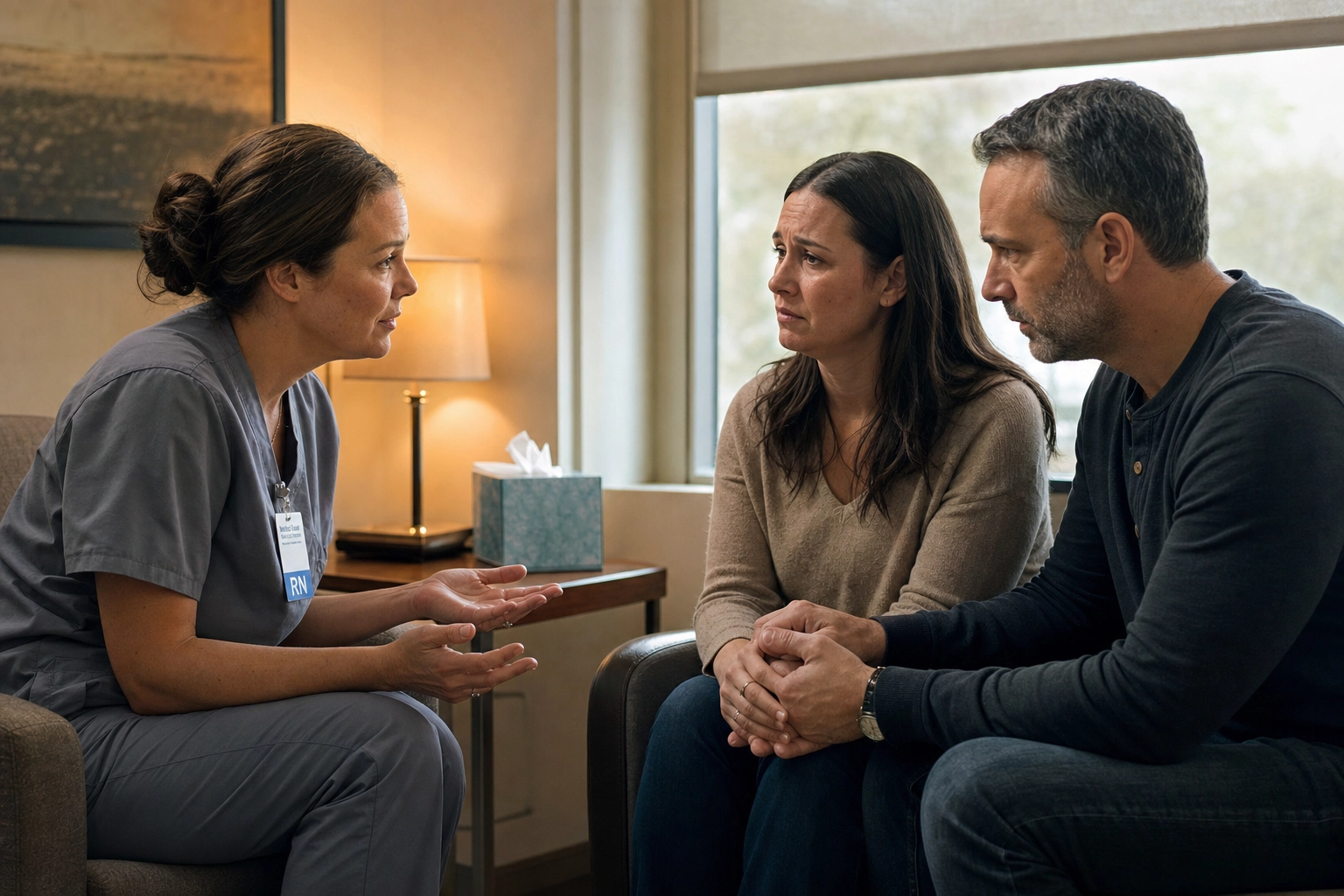
A few principles that travel well across every ward:
- Find out who decides. "Who would you like to be involved in decisions about your care?"
- Ask how much they want to know. "Some people want every detail; others prefer the big picture. What's right for you?"
- Use professional interpreters, not family members — for assessment, consent, and breaking news. A relative may soften or filter what's said.
- Respect beliefs and rituals. "Are there any practices or beliefs that are important to you that we should know about?" and "Would you like me to arrange for a chaplain or someone from your faith community?"
This matters more than many new nurses expect: research reviews note that more than half of palliative care nurses feel under-trained in breaking bad news. Getting comfortable with these phrases — and the silences between them — is a skill you can deliberately build.
Special Challenges for Foreign-Trained Nurses
If you trained abroad, you're in very good company. Internationally educated nurses are now central to staffing in both the US and UK — in 2022–2023, nearly half of all new registrants with the UK's Nursing and Midwifery Council were trained overseas. Filipino and Nigerian nurses are among the largest internationally educated groups in the United States, alongside many Indian-trained nurses, and the licensing road is long: credential evaluation through CGFNS, a VisaScreen certificate, the NCLEX-RN (which moved to the Next Generation format in 2023), state licensure, and usually an EB-3 visa.
Here's what nobody warns you about: the textbook English you mastered is the easy part. This is why English for foreign nurses has to go beyond grammar and word lists. The real hurdles are:
- Speed and accents. Patients and colleagues use regional accents and slang — "he's a bit off," "she's gone downhill," "I'm slammed," "can you cover for me?" No textbook or language course covers it.
- Phone calls. Talking to a doctor by phone strips away lip-reading and body language, so every word has to land by sound alone.
- Confidence and anxiety. Many internationally trained nurses over-apologize or stay quiet rather than ask someone to repeat — but in nursing, not speaking up is a patient-safety risk. You're allowed to say, "Sorry, I didn't catch that — can you say it again?"
- Assertiveness norms. Speaking up to a physician, or pushing back when something seems wrong, is expected on Western wards even though it may feel uncomfortable if your training was more hierarchical.

This is the precise difference between passing a language exam and thriving on shift. The English language tests — OET and IELTS — measure proficiency, and the NCLEX tests clinical knowledge in English, but a five-minute scripted speaking test can't simulate a chaotic handover or a 3 a.m. escalation call. The missing piece is reps: speaking the language of the ward, out loud, until it's automatic. Two habits help enormously here — learning to stop translating in your head so you respond in real time, and keeping a few filler words ready to buy yourself a moment ("let me just check that for you") instead of freezing.
How to Practice Nursing English With AI Roleplay
You can't rehearse a difficult family conversation on a real grieving family, and you can't practice an escalation call by accidentally bungling one at 3 a.m. That's the problem Practice Me solves: it's an AI English speaking app where you have real-time voice conversations with AI tutors, so you can run the exact scenarios you'll face — privately, judgment-free, as many times as you need. Unlike a one-size-fits-all language course, you practise the precise conversations that fill a nursing shift.

A few roleplays worth drilling before your first shift:
- Patient handoff (nurse-to-nurse): give a full SBAR/ISBARR shift report and have the tutor play the oncoming nurse asking follow-up questions.
- Doctor handoff (phone escalation): practice the SBAR phone call above until the structure is muscle memory.
- Family meeting: explain a condition, answer "what comes next," and deliver difficult news gently while the tutor reacts as a worried relative.
- Admission and pain assessment: run the introduce–explain–permission rhythm and a full OPQRST pain history.
- Medication round: rehearse the allergy check, the "I'm going to give you…" announcement, and a patient who refuses.
To set one up, you simply tell the tutor the scene — "Let's role-play a shift handoff; you're the night nurse, I'll give you SBAR" — and start talking. You can choose an American or British accent to match where you're headed, practice at any hour around your shifts, and the tutor remembers your goals across sessions so it can keep nudging the same weak spots. New vocabulary you stumble on gets saved automatically.
One honest caveat: Practice Me is a speaking-confidence tool, not a clinical course, an NCLEX question bank, or an official OET/IELTS scorer. It won't teach you pharmacology or grade your exam. What it does — better than any word list — is give you a safe place to build the speaking confidence and fluency that the ward demands. The same approach works across other high-pressure, customer-facing jobs too, from English for hospitality to English for flight attendants.
If you want to try the scenarios above with your own voice, you can start a free trial and run your first handoff roleplay tonight.
Frequently Asked Questions
What English level do nurses need to work in the US or UK?
Most clinical English sits at a B1–B2 (intermediate) level for vocabulary and grammar, but regulators set specific bars for spoken proficiency through English language tests. The UK's NMC accepts IELTS Academic (7.0 in reading, listening, and speaking; 6.5 in writing) or OET (grade B in reading, listening, and speaking; C+ in writing). In the US, the NCLEX-RN is taken in English and individual state boards or employers may require an additional language proficiency test. In practice, the level that matters most on shift is confident, real-time speaking — which sits above any single test score.
Is OET or IELTS better for nurses?
Both are English language tests accepted by the UK's NMC and many other regulators, so it often comes down to fit. The OET (Occupational English Test) uses healthcare scenarios — reading a referral letter, taking a patient history — so it feels more relevant to clinical work. IELTS Academic is a general academic test that's more widely available and recognized beyond healthcare. Many nurses find the OET's clinical context easier to engage with, but the right choice depends on what your target employer and regulator accept.
How can foreign-trained nurses improve their spoken English for work?
Shift your practice from reading to speaking. No course can replace daily reps, so rehearse the high-frequency scenarios out loud — pain assessments, SBAR handoffs, family updates — until the structure is automatic. Train your ear on fast, accented speech so you can follow rapid handovers, and build the habit of asking people to repeat without apologizing excessively. Even 10–15 minutes of daily voice practice beats occasional cramming. AI roleplay tools let you do this privately, which removes the fear of being judged that keeps so many nurses silent.
What is SBAR in nursing communication?
SBAR stands for Situation, Background, Assessment, and Recommendation. It's a structured framework for handing off patient information clearly and quickly — whether you're calling a doctor, giving a shift report, or transferring a patient. Originally developed by the US Navy and now a Joint Commission–endorsed standard, it reduces the communication errors that cause many adverse events. For non-native English speakers, it's especially valuable because it provides a predictable template to speak into.
Does Practice Me prepare you for the NCLEX or OET?
Not directly — Practice Me is an English speaking-practice app, not an exam-prep course or an official test scorer. It won't deliver NCLEX-style clinical questions or grade your OET speaking. What it does is build the spoken fluency and confidence those exams (and real wards) demand, by letting you rehearse realistic conversations with AI tutors in American or British accents. Think of it as the speaking gym that complements your clinical coursework, not a replacement for it.
What are the most important English phrases for nurses to know?
The highest-value phrases cluster around five moments: introducing yourself and asking permission ("I'd like to do an assessment, if that's okay?"), pain assessment ("On a scale of 0 to 10, how would you rate your pain?"), medication checks ("Are you allergic to any medications?" / "Have you taken any other medications today?"), SBAR handoffs, and family reassurance without false promises ("I can't promise an outcome, but here's exactly what we're doing"). Master those — whether you're one of many nursing students or a seasoned RN — and you've covered the majority of daily nurse-patient communication in English.