Duolingo taught you words. No one taught you to speak.
PracticeMe: real voice conversations with an AI tutor, 24/7.
English for Restaurant & Hospitality Workers
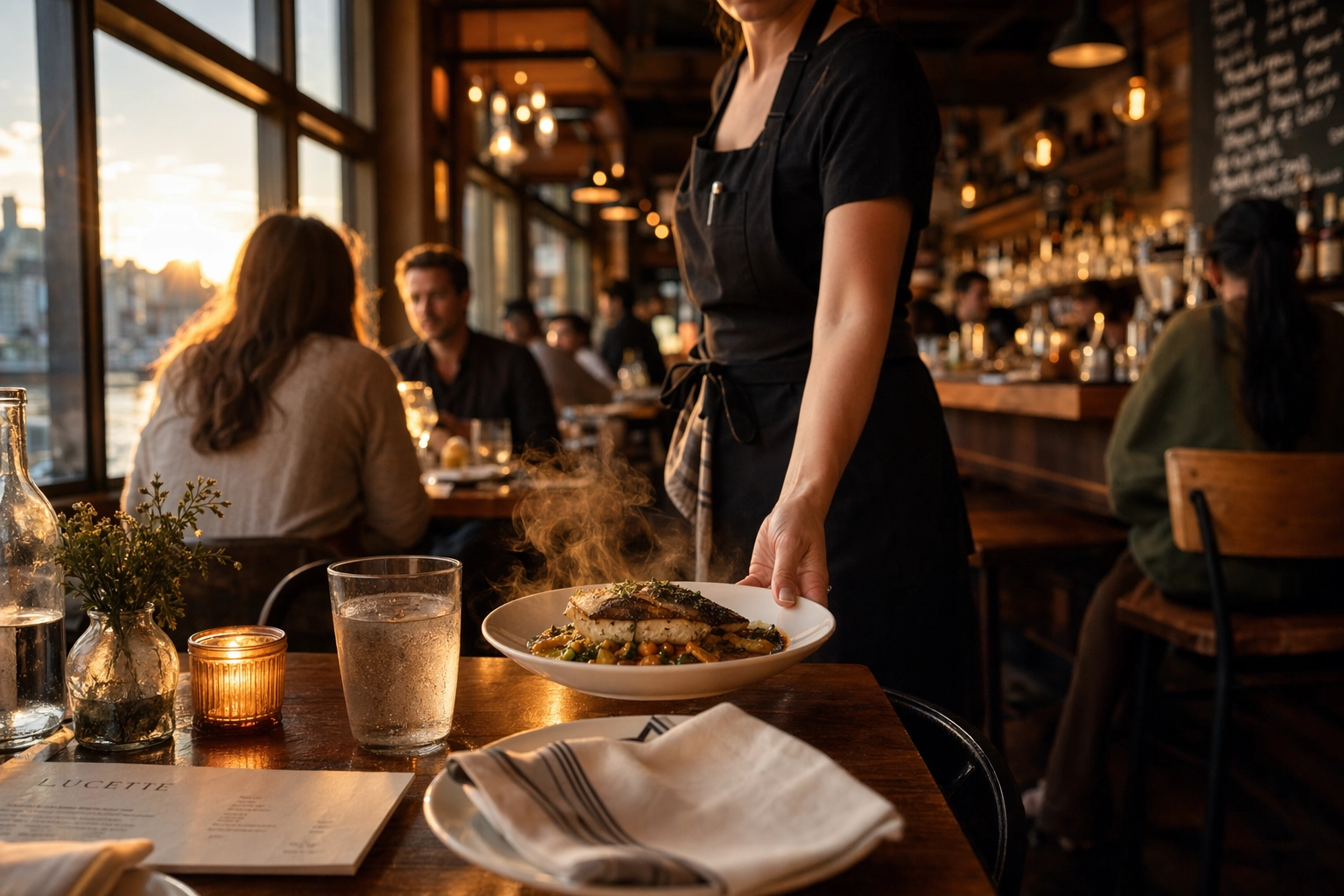
Walk into any busy restaurant in New York, London, Dubai, or Sydney and listen. You'll hear servers taking orders, hosts quoting wait times, bartenders recommending cocktails, and hotel front desk staff checking guests in. A huge number of those voices belong to people working in their second or third language — which is exactly why strong English for restaurant workers has become one of the most valuable job skills in hospitality.
Roughly 22% of U.S. restaurant workers are foreign-born, according to the American Immigration Council and the National Restaurant Association. In hotels it's closer to one in three, and in cities like New York, Miami, and Los Angeles, more than half of hospitality staff speak English as a second language. You are not alone on the line — and the English you need for the job is learnable, specific, and smaller than you think.
Quick Summary: English for restaurant workers is formulaic by design. Learn the vocabulary for your role (server, host, bartender, or hotel front desk), memorize about 30 core phrases, and rehearse 10 common dialogues out loud until they're automatic. This page gives you all three, plus a way to practice each scenario 24/7 with an AI tutor before your next shift.
Why English for restaurant workers matters
Good hospitality English is not about accent or grammar — it's about being understood quickly, sounding polite under pressure, and making the guest feel cared for. Three real benefits show up fast when your English improves:
- Better tips. Servers who communicate clearly earn higher tips than those who don't. A server who can describe a dish well sells more wine and desserts.
- More shifts. Managers assign the busy Friday nights to staff they trust with difficult tables.
- Less stress. The difference between a panic-inducing shift and a smooth one is often just knowing the exact right phrase for the moment.
Hospitality is a huge employer: the U.S. Bureau of Labor Statistics counts nearly 17 million leisure and hospitality jobs in the country. Because hospitality conversations follow predictable patterns, you don't need advanced English — you need the right English for your role.
Essential English for restaurant workers: vocabulary by role
Skip to your role below. Each section gives you the core vocabulary, the phrases you'll use every shift, and the word choices that make you sound fluent instead of formal.
Servers and waitstaff
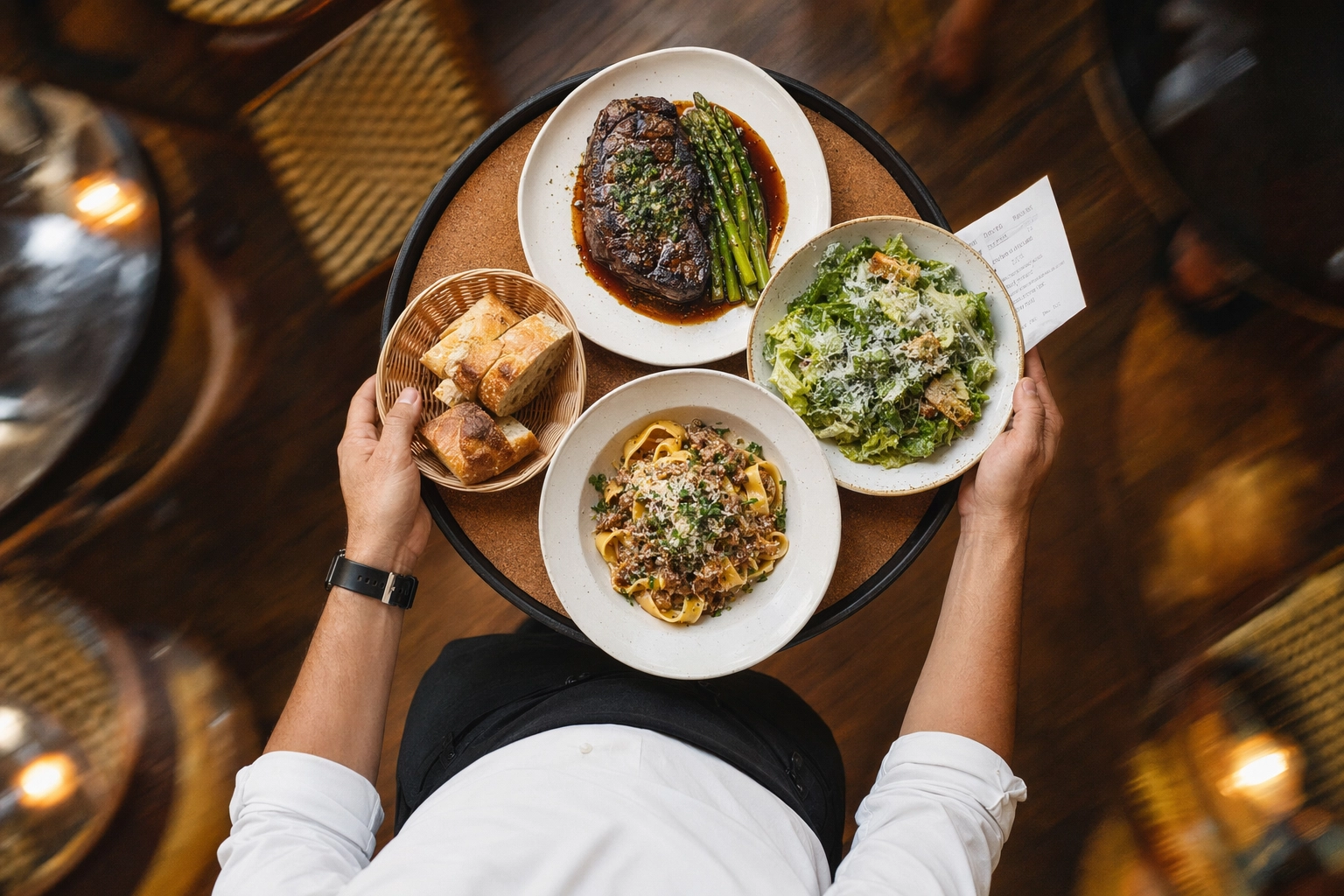
A server's job is a loop: greet, take drink order, take food order, check in, clear, process payment, say goodbye. The same ~40 phrases cover 95% of every shift.
Must-know vocabulary:
- Appetizer (US) / starter (UK) — first course
- Entrée (US) / main or main course (UK) — the main dish
- Side — a small dish served with the main (fries, salad, vegetables)
- Check (US) / bill (UK) — the printed list of what you owe
- Tip / gratuity — money left for the server (18–20% in the US)
- Comp — short for "complimentary"; a free item from the restaurant
- 86 — restaurant slang for "we're out of it" ("86 the salmon")
- On the fly — needed immediately ("I need a Caesar on the fly")
- Running food — delivering plates from kitchen to table
- All day — the total count of an item ("that's three steaks all day")
Phrases you'll use every shift:
- "Hi, my name is [name] and I'll be taking care of you tonight."
- "Can I start you off with something to drink?"
- "Are you ready to order, or do you need another minute?"
- "How would you like that cooked?" (for meat)
- "Any allergies or dietary restrictions I should know about?"
- "How is everything tasting?"
- "Can I get you anything else, or are you ready for the check?"
Hosts and hostesses
The host runs the door. Your job is to make a strong first impression, seat guests efficiently, and manage the wait when the floor is full. You're the calm in the storm.
Must-know vocabulary:
- Party — the group of guests ("a party of four")
- Walk-in — a guest with no reservation
- Wait list — the ordered list of parties waiting for a table
- Covers — the number of guests served in a shift
- Turn a table — to reseat a table with new guests
- Two-top, four-top, six-top — tables for 2, 4, or 6 people
- On the books — a confirmed reservation
Phrases you'll use every shift:
- "Welcome to [restaurant name]! Do you have a reservation with us?"
- "How many in your party tonight?"
- "The current wait is about 20 minutes. Would you like me to put you on the list?"
- "Can I get a name and a phone number so I can text you when your table's ready?"
- "Right this way — your server will be with you shortly."
- "Thank you so much for your patience. Your table's ready."
Bartenders
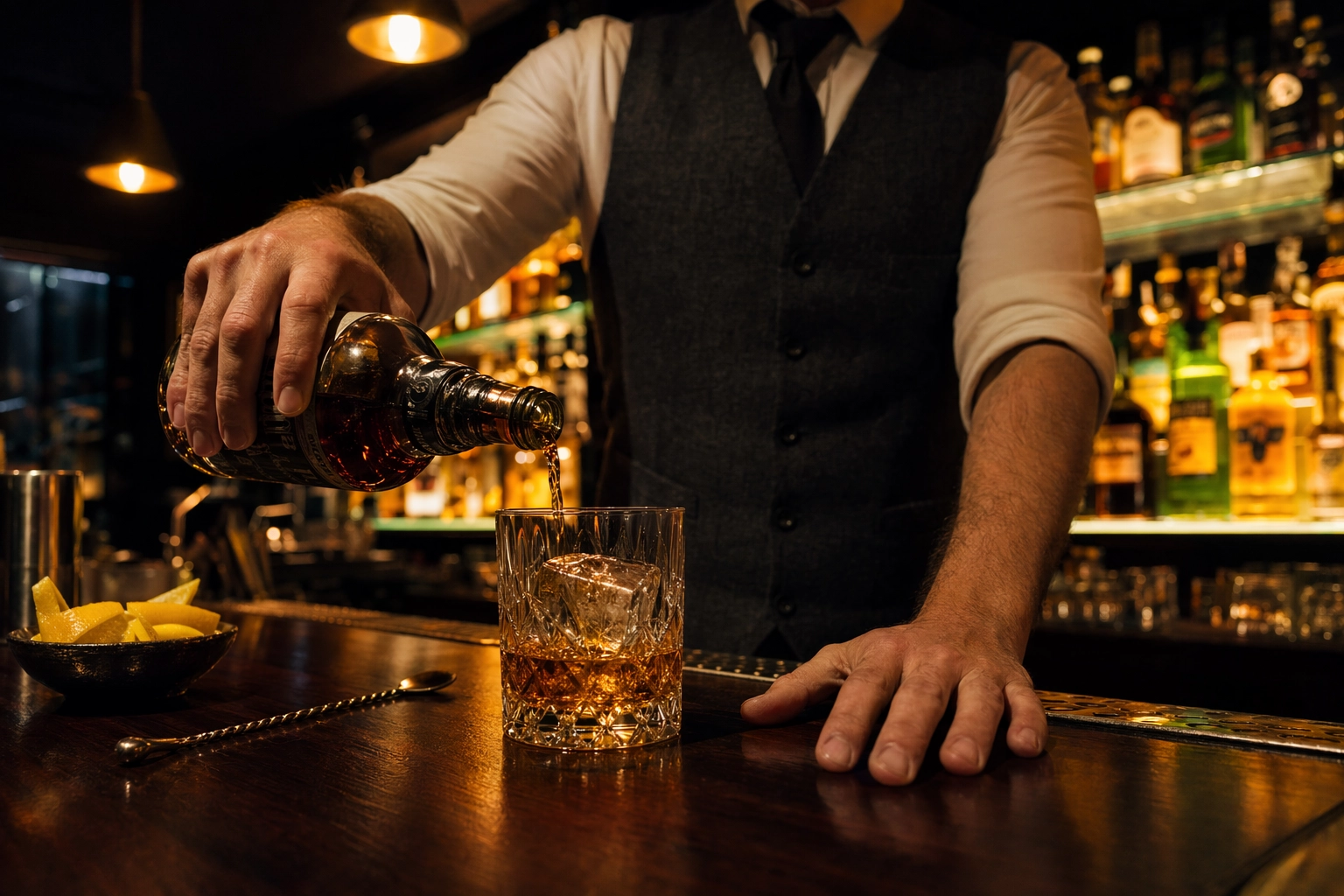
Bartenders do three things at once: mix drinks, check IDs, and have a conversation. Your English has to be quick, friendly, and confident enough to politely cut people off when needed.
Must-know vocabulary:
- Neat — spirit served at room temperature, no ice, no mixer
- Up or straight up — shaken or stirred with ice, then strained into a glass (no ice in the drink)
- On the rocks — served over ice
- Twist — a strip of citrus peel garnish
- Back — a small drink (water, beer) served alongside another drink
- Chaser — a non-alcoholic drink taken after a shot
- Tab — a running bill paid at the end of the night
- Well drink — a cocktail made with the house's basic liquor
- Top shelf or call brand — premium liquor, named by the guest
- Last call — the final chance to order before the bar closes
Phrases you'll use every shift:
- "Hey there, what can I get started for you?"
- "Would you like to open a tab, or is this going to be one drink?"
- "I'll need to see your ID, please."
- "Would you like that neat, on the rocks, or up?"
- "This one's a bit stronger — are you looking for something refreshing or more spirit-forward?"
- "Last call, folks. Anyone want one more?"
Hotel front desk
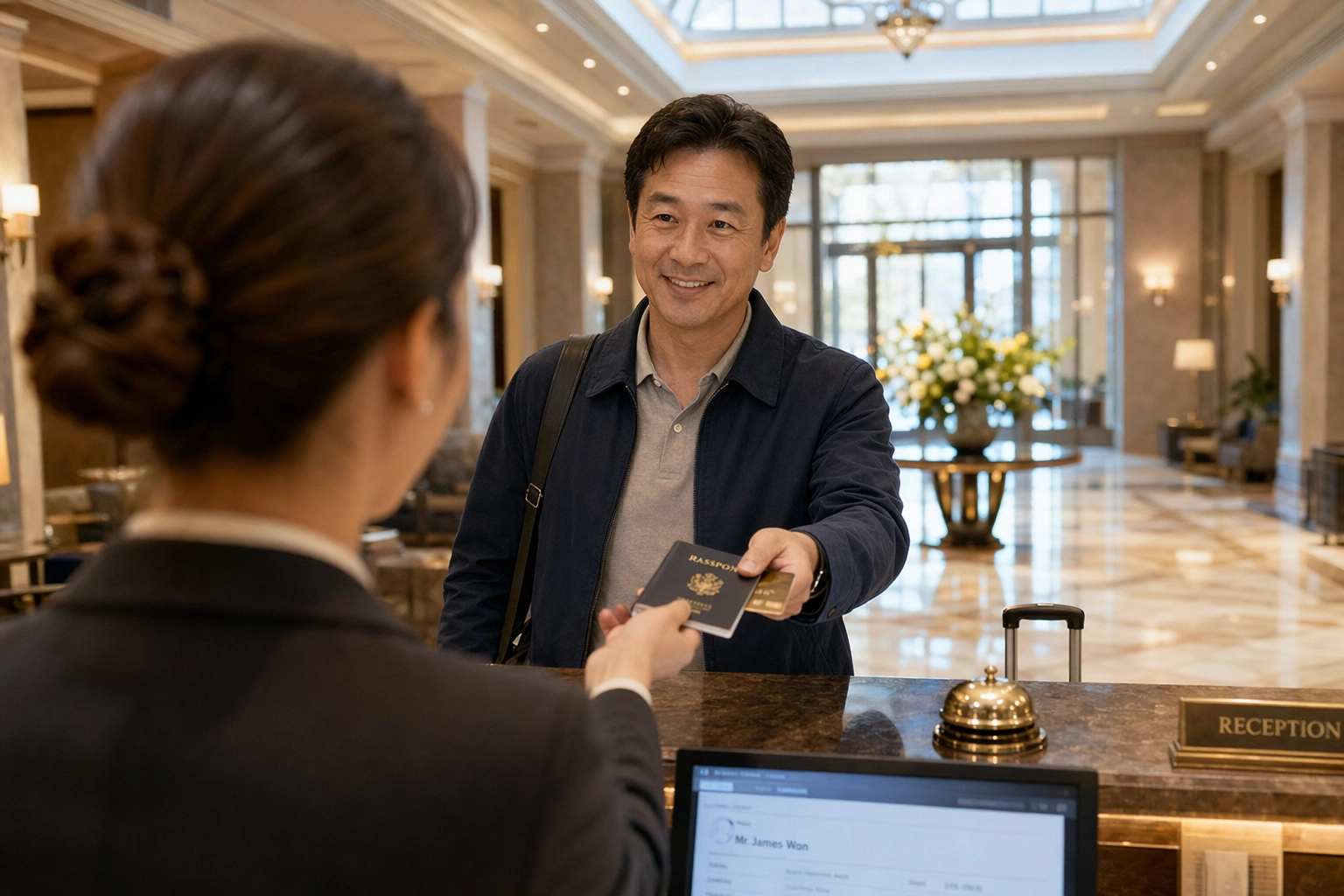
The front desk is the guest's first and last memory of the hotel. Check-in takes about five minutes, but those minutes set the tone for the entire stay.
Must-know vocabulary:
- Reservation / booking — the room held under a guest's name
- Confirmation number — the unique booking reference
- King, queen, double, twin — bed sizes
- Ensuite — the bathroom attached to the room
- Amenities — extras like WiFi, breakfast, gym, pool
- Incidentals — additional charges (minibar, movies, damage)
- Authorization hold — a temporary charge on the guest's card for incidentals
- Late checkout — leaving after the standard checkout time
- Concierge — the staff member who helps with local arrangements
Phrases you'll use every shift:
- "Welcome to [hotel name]. Are you checking in with us today?"
- "May I have the name on the reservation, please?"
- "I'll need a photo ID and a credit card for incidentals."
- "You're in room 412 on the fourth floor. The elevators are right around the corner."
- "Breakfast is served from 6:30 to 10:00 in the dining room on your right."
- "If there's anything you need during your stay, just dial zero from your room."
10 role-play dialogue scripts for real hospitality scenarios
These are the ten conversations that come up most often in hospitality work and trip up non-native speakers the most. Read each one out loud a few times, then rehearse them with a partner — or with an AI tutor — until the words come without thinking. Every one of them is core English for restaurant workers and hotel staff who interact with guests face-to-face.
Dialogue 1 — Greeting and seating guests (host)
Scenario: Two walk-ins arrive during dinner rush.
You: "Good evening, welcome to Vista Grill! How many in your party tonight?" Guest: "Just the two of us." You: "Do you have a reservation, or is this a walk-in?" Guest: "Walk-in." You: "Of course. The wait for a table for two is about 25 minutes. You're welcome to wait at the bar, and I'll come find you when your table's ready. Can I get a name?" Guest: "Patel." You: "Perfect, Mr. Patel. I'll text you at this number when we're ready — could you confirm it?"
Why this works: You gave a realistic wait time (never lie — underpromise and overdeliver), offered a next step, and gathered the info you need to call them back.
Dialogue 2 — Taking a drink order (server)
Scenario: A four-top just sat down.
You: "Hi everyone, I'm Mia and I'll be taking care of you tonight. Can I start you off with something to drink? We've got sparkling and still water, and our cocktail menu is right on the back." Guest A: "I'll have a glass of the house red." Guest B: "Can I see the cocktail list?" You: "Absolutely, here you go. Take your time." Guest C: "Just a Diet Coke for me." Guest D: "I'll have whatever's on tap — what do you have?" You: "Right now we've got a local IPA, a pilsner, and a stout." Guest D: "I'll try the pilsner." You: "So that's one house red, one Diet Coke, one pilsner, and one cocktail still deciding. I'll be right back."
Why this works: You introduced yourself, offered water, gave the undecided guest more time, and repeated the order back — which prevents 90% of mistakes.
Dialogue 3 — Taking a food order with modifications (server)
Scenario: A guest wants a burger with substitutions.
Guest: "I'll have the cheeseburger, but can I swap the fries for a side salad?" You: "Of course. Our side salad comes with mixed greens and a house vinaigrette — does that work?" Guest: "Yes, but can I have the dressing on the side? And no onions on the burger, please — I'm allergic." You: "Got it. One cheeseburger, no onions because of the allergy, side salad instead of fries, dressing on the side. How would you like the burger cooked?" Guest: "Medium, please." You: "Perfect. I'll mark the allergy on the ticket so the kitchen handles it carefully."
Why this works: You confirmed the substitution, flagged the allergy with specific action, and repeated the order back with every modification. Write everything down — even if you think you'll remember.
Dialogue 4 — Describing and recommending a dish (server)
Scenario: A guest asks for your recommendation.
Guest: "I can't decide between the short rib and the salmon. What do you recommend?" You: "Great question. They're both popular, but very different. The short rib is braised for six hours, so it's really tender and rich — it comes with creamy polenta and a red wine reduction. The salmon is lighter, pan-seared with crispy skin, served over wild rice with a lemon-caper sauce." Guest: "Which one would you pick?" You: "Honestly, if you're in the mood for something hearty, the short rib is incredible. If you want something a little brighter, the salmon won't disappoint. Are you having wine with dinner? That might help us decide."
Why this works: You gave real, sensory descriptions, offered a personal take when asked, and moved naturally toward upselling wine. Taste every dish at staff meal if you can — honest recommendations sell.
Dialogue 5 — Handling a complaint about food (server)
Scenario: A guest sends the steak back — overcooked.
Guest: "Excuse me, I asked for medium-rare, but this is well done. I can't eat this." You: "I'm so sorry about that — you're absolutely right, that's not what you ordered. Let me take this back to the kitchen right away. Would you like me to bring out a fresh one cooked medium-rare, or would you rather order something else?" Guest: "A fresh one, medium-rare, please." You: "Of course. I'll put it in as a priority. While you wait, can I bring you another glass of wine, on me?" Guest: "That would be great. Thank you." You: "I'll be back in about 10 minutes with the steak. And again, I'm really sorry about this."
Why this works: You apologized without blaming the kitchen, took action immediately, gave a realistic timeline, and offered a small gesture that turns a bad moment into a memorable one. Never say "sorry, but" — the word but cancels the apology.
Duolingo taught you words. No one taught you to speak.
PracticeMe: real voice conversations with an AI tutor, 24/7.
Dialogue 6 — Processing payment and splitting the check (server)
Scenario: A table of six wants to split the bill.
Guest: "Can we split the check? Three cards." You: "Absolutely. Do you want me to split it evenly across three cards, or by what each person ordered?" Guest: "Evenly, please." You: "Sure. The total is $186, so that's $62 per card. I'll be right back with the readers."
(A few minutes later.)
You: "Thank you. One card didn't go through — would you like to try it again or use a different card?" Guest: "Try a different one. Here." You: "No problem at all. It happens. Let me run this."
Why this works: You asked the right question first, stated the amounts clearly, and handled the decline without embarrassing anyone. Practice numbers out loud — money amounts are one of the hardest things to say fluently in a second language.
Dialogue 7 — Managing a long wait time (host)
Scenario: A family of five arrives, no reservation, 45-minute wait.
You: "Welcome! How many tonight?" Guest: "Five of us, no reservation." You: "Okay, we can definitely seat you — the wait for a table of five is about 45 minutes. I know that's a while, especially with the kids. Would you like to put your name down? You're welcome to wait here, or there's a playground two doors down if that helps." Guest: "45 minutes is long. Is there anywhere closer we could eat sooner?" You: "If you're open to it, our bar area has high-top tables available right now with the full menu. The wait would be just a few minutes." Guest: "That works. Let's do the bar." You: "Perfect. Right this way."
Why this works: You acknowledged the inconvenience, gave realistic options (including leaving), and offered a creative alternative. Underpromise on wait times — a guest quoted 45 minutes who's seated in 30 is a happy guest.
Dialogue 8 — Checking a guest into a hotel (front desk)
Scenario: A guest arrives with a reservation.
Guest: "Hi, checking in. The reservation is under Torres." You: "Good afternoon, Mr. Torres — welcome to the Harbor Inn. I have you here for three nights in a king room with a city view, checking out Friday. Does that sound right?" Guest: "Yes, that's correct." You: "Perfect. May I have a photo ID and a credit card for incidentals? There's a $50-per-night authorization hold that's released at checkout if nothing is charged to the room." Guest: "Sure, here you go." You: "Thank you. You're in room 608 on the sixth floor — here are your two key cards. The elevators are just around the corner to your left. Breakfast is included and served from 6:30 to 10:00. Our WiFi network is HarborGuest, and the password is on the back of your key card holder. Would you like help with your bags?" Guest: "No, I've got them. Thanks." You: "My pleasure. If there's anything you need, just dial zero from your room. Enjoy your stay!"
Why this works: You confirmed the booking first (catches errors before they happen), explained the hold clearly, and gave the guest everything they need for the next 12 hours without making them ask.
Dialogue 9 — Giving directions to a local attraction (front desk)
Scenario: A guest asks how to get to a nearby museum.
Guest: "How do I get to the Museum of Modern Art from here?" You: "It's a great walk, about 15 minutes, or you can take the subway two stops. Which would you prefer?" Guest: "Walking sounds nice." You: "Perfect. When you leave the hotel, turn right on Main Street. Walk four blocks — you'll pass a big fountain on your left and a bookstore on the corner. At the fifth block, you'll see the library, which is a big brick building. Turn left there onto 5th Avenue, and the museum is two blocks down on the right. It's a tall glass building — you can't miss it." Guest: "Got it." You: "Here's a map — I'll mark the route for you. The museum closes at 6, so you have plenty of time."
Why this works: You gave the guest a choice, used landmarks instead of street names alone (landmarks are easier to remember and spot), and added helpful context like closing time.
Dialogue 10 — Handling a room issue (front desk)
Scenario: A guest calls down at 11 p.m. — the AC isn't working.
You: "Front desk, this is Alex. How can I help?" Guest: "I'm in 312. My air conditioning isn't working. It's really hot in here." You: "Oh no — I'm so sorry about that, especially this late. Let me send maintenance up right now. They should be at your door within 10 minutes. While you're waiting, would you like me to send up some ice water, and would you prefer to move to another room if we can't fix it quickly?" Guest: "Let's see if they can fix it first. And yes, ice water would be great." You: "Of course. I'll have water up in five minutes and maintenance right behind. I'll also call back in 20 minutes to make sure everything's working. If it's not, we'll get you into a different room tonight and I'll take care of any inconvenience." Guest: "Thank you, I appreciate that."
Why this works: You apologized fully, took immediate and specific action, offered a small comfort, proposed a backup plan, and committed to follow up. When a guest is upset, your calm, specific tone is contagious.
Power phrases for polite customer service English
Polite English is built from patterns. Learn these seven sentence frames and you'll have a polite response ready for almost any situation — the backbone of English for restaurant workers in every role.

Warm greetings that set the tone
- "Welcome to [name of place]!"
- "Good morning / afternoon / evening."
- "Hi there, how are you doing today?"
- "How can I help you today?"
- "Great to see you again." (for a returning regular)
Use the time of day — it sounds more natural than just "hello."
Softer requests using Could / Would / May
Direct requests sound rude in English service situations. Soften them with these three words:
- "Could I see your ID, please?" (instead of "Give me your ID")
- "Would you mind waiting a few minutes?" (instead of "Wait a few minutes")
- "May I take your coat?" (more formal — great for upscale places)
The rule: a request in the form of a question is almost always more polite than a statement.
Apologies that take responsibility
- "I'm so sorry about that."
- "My apologies for the wait."
- "That's on us — let me make it right."
- "I completely understand how frustrating that must be."
- "You're absolutely right — let me fix this."
Never say "Sorry, but..." — the word but undoes the apology.
Confirming you heard correctly
- "So that's [repeat the order] — correct?"
- "Let me make sure I have this right..."
- "Just to confirm, you said medium-rare?"
- "One more thing — did you want the dressing on the side?"
Repeating orders back is the single best habit you can build.
Saying no politely when you have to
- "Unfortunately, we're out of that tonight."
- "I'm afraid we're fully booked this evening."
- "I'm not able to do that, but I can offer [alternative]."
- "Let me see what else I can do for you."
Always pair a "no" with a "here's what I can do."
Reassuring an anxious or upset guest
- "I'll take care of this right away."
- "You're in good hands."
- "Let me make this right for you."
- "Please don't worry about it."
Memorable closings
- "Thank you so much for dining with us tonight."
- "We hope you come back soon."
- "Have a wonderful evening."
- "Safe travels home."
How you end the interaction is what the guest remembers longest. Make it warm.
How to rehearse English for restaurant workers before your next shift
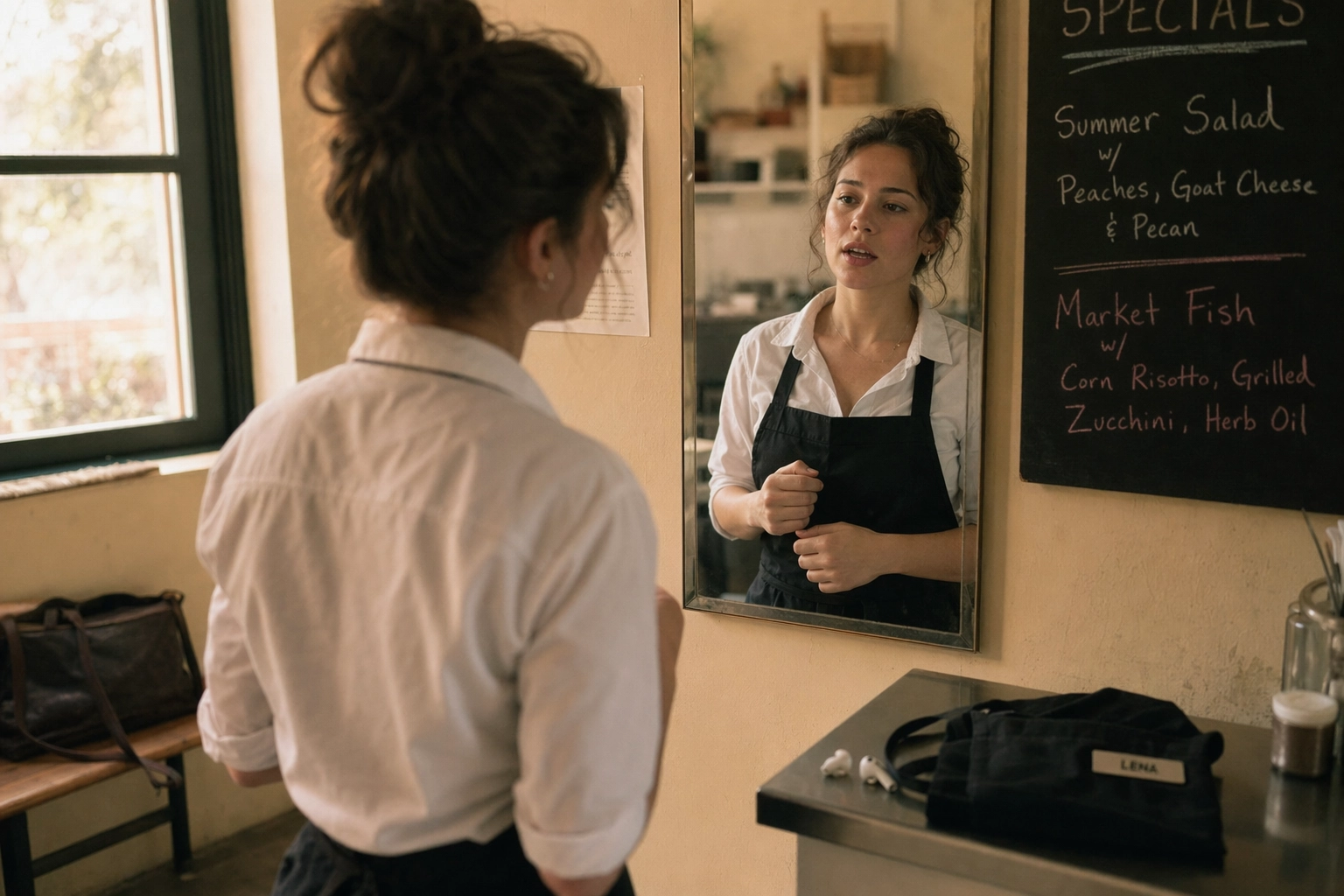
Reading phrases on a page is not the same as saying them fluently to a real customer. The gap between knowing the words and saying them automatically is the rehearsal gap — and it's why so many non-native speakers freeze up in the moment, even when they know exactly what to say.
Practice Me is built to close that gap. It's an AI-powered English speaking app that lets you have real voice conversations with AI tutors who can play any role — a demanding dinner guest, an angry hotel guest, a confused tourist asking for directions. You talk out loud, they respond in natural English, and the whole conversation feels like the real thing — without a real customer watching.
How hospitality workers use it:
- Before a shift: Run through 2–3 of the dialogues above with an AI tutor playing the customer. Ten minutes of practice = much more confidence walking in.
- After a bad interaction: Replay the moment with the AI. Try different phrasings. Find one that feels natural.
- Learning a new menu: Describe each dish out loud to the tutor until the words come automatically.
- Accent preparation: Practice with the American or British accent your guests are most likely to have.
- Overcoming anxiety: For those of us dealing with the fear of speaking English at work, private practice with zero judgment is the fastest way through it.
The Pro plan gives you unlimited conversations, which means you can rehearse each scenario 10 times until it's muscle memory. Targeted practice with English for restaurant workers beats generic English study every time — you need the exact phrases of your role, not a broad grammar course.
Pair this page with our English for healthcare workers guide and business English speaking practice to cover every workplace English situation you're likely to face.
Frequently Asked Questions
What level of English do I need to work in a restaurant?
It depends on the role. Back-of-house positions like busser, dishwasher, and prep cook only need basic English (A1–A2) for safety instructions and kitchen communication. Customer-facing roles like server, host, and bartender benefit from B1–B2 intermediate English, mostly because you need to handle surprises gracefully. Fine dining, luxury hotels, and concierge roles typically expect B2–C1. More important than your overall level is the specific vocabulary for your role — a server with an A2 general level but strong English for restaurant workers will outperform a B2 speaker who's never worked in food service.
How do I handle a customer I can't understand?
Four moves that always work. First, ask them to repeat: "I'm sorry, could you say that again, a little slower?" Most guests will happily repeat. Second, repeat back what you did catch: "So you wanted the salmon, and..." — they'll fill in the rest. Third, ask them to point on the menu if it's a food item. Fourth, get a coworker to help without feeling embarrassed. Everyone in hospitality — native speakers included — does this.
What's the difference between American and British restaurant English?
A few key swaps. "Check" (US) is "bill" (UK). "Entrée" in the US means the main course, but in France and some UK menus it means a starter — so ask. "Server" is the neutral US term; "waiter" and "waitress" are used more in the UK. "To go" (US) is "takeaway" (UK). Tipping expectations are very different: US guests typically tip 18–20% on top of the bill, while many UK restaurants add a 12.5% service charge automatically. Our American English conversation practice guide covers the specific U.S. service-industry expressions.
How can I describe dishes I've never eaten?
Taste every dish you can at staff meal — most restaurants let servers sample new items. If that's not possible, ask the chef for 2–3 flavor words per dish (smoky, tangy, buttery, bright) and a cooking method (pan-seared, braised, grilled). Read the menu description carefully and memorize one specific detail you can say in your own words: "The short rib is braised for six hours — it falls apart with a fork." One honest detail sells a dish better than three generic adjectives. Learn sensory words: rich, creamy, crisp, tender, juicy, zesty, fresh, earthy.
What should I do when an angry customer yells at me?
Stay calm — your tone is contagious, and matching their energy makes it worse. Let them finish their full complaint without interrupting; people calm down 50% just by being heard. Apologize sincerely without blaming the kitchen or your coworkers ("I'm so sorry this happened" — never "the kitchen is really behind tonight"). Offer a specific next step: "Let me bring out a fresh one right now, and I'll take the wine off your check." If the situation escalates or the guest is abusive, get a manager — that's literally what managers are there for.
How long does it take to get comfortable speaking English on the job?
For the core phrases of your role, expect 2–4 weeks of on-the-job work to feel automatic. For complex situations — complaints, descriptions, phone reservations — plan on 2–3 months. To feel truly fluent and comfortable handling anything a shift throws at you, most people need 6–12 months. You can cut that timeline in half with daily out-loud practice of English for restaurant workers — even just 15 minutes. The bottleneck isn't usually vocabulary — it's the nervous silence before you speak. Private rehearsal removes that silence. Learn how to introduce yourself in English, build your vocabulary through real conversations, and practice pronunciation fundamentals alongside your role-specific work, and you'll get there faster than you think.