Duolingo taught you words. No one taught you to speak.
PracticeMe: real voice conversations with an AI tutor, 24/7.
Learn English for Arabic Speakers: Practice Guide

Learning English for Arabic speakers isn't like learning English for Spanish or Italian speakers. The two languages disagree about almost everything: the sounds your mouth makes, the order of words in a sentence, the way questions work — even the direction your eyes move across the page when you read.
That's not a bug in your brain. It's geography and history. Arabic is a Semitic language; English is Germanic. They've been evolving in opposite directions for thousands of years. The U.S. State Department's Foreign Service Institute classifies the English-Arabic pair as one of the most distant for adult learners — but distance doesn't mean impossible. It just means your English lessons need a different practice strategy than someone whose first language is closer to English.
The good news: once you understand exactly where the two languages disagree, you can practice the right things and stop guessing. This guide on English for Arabic speakers walks through every major pronunciation hurdle, the grammar patterns that trip up Arabic-speaking learners of English, the cultural side of speaking anxiety in Arab learners, and a 14-day plan you can actually finish. No fluffy English courses, no expensive textbooks — just the patterns that matter and a way to practice them out loud.
Quick Summary: English for Arabic speakers comes with predictable challenges: P/B confusion, vowel distinctions, consonant clusters, TH sounds (depending on dialect), the article system, and adjective order. Daily voice practice with judgment-free AI tutors fixes these patterns faster than reading textbooks, books, or taking traditional English lessons — especially for learners who feel social pressure when speaking.
Why English Feels Different When Arabic Is Your First Language
English and Arabic don't share much. Arabic has 28 consonants, three vowel qualities, and a writing system that flows right-to-left. English has roughly 24 consonants, 12+ vowel sounds, eight diphthongs, and Latin letters that flow left-to-right. Arabic prefers verb-first sentences (VSO); English locks into subject-first (SVO). Arabic builds words from three-letter roots; English builds them from prefixes, roots, and suffixes glued together.
Before you read further, one important note: "Arabic" isn't one language for the purpose of pronunciation. Modern Standard Arabic (the formal version used in news, books, and writing) behaves differently from Egyptian Arabic, Levantine Arabic (Syrian, Lebanese, Jordanian, Palestinian), Gulf Arabic, Iraqi Arabic, and Maghrebi (Moroccan, Algerian, Tunisian) dialects. Some sounds — like the TH in "think" — exist in some dialects and not others. Throughout this guide on English for Arabic speakers, we'll flag when dialect matters.
The patterns below show up in research from English teachers and language schools across Saudi Arabia, the UAE, Egypt, Jordan, and beyond. They're shared by enough Arabic speakers learning English to be worth practicing. If you've ever read books on ESL or sat through English lessons in school and still struggled to actually speak, you're not alone — most traditional English language courses focus on reading and writing rather than the spoken patterns we'll cover here.
The 8 Pronunciation Challenges Arabic Speakers Face in English
Most pronunciation mistakes aren't about effort. They happen because your mouth has spent decades making sounds one way, and English asks for a slightly different shape. Once you know what to change, the fix is mechanical.
1. The /p/ vs /b/ Confusion (No P in Arabic)
Modern Standard Arabic doesn't have the /p/ sound. Arabic only has ب (ba), so English words that should start with P often come out as B for Arabic speakers:
- Pizza sounds like bizza
- People sounds like beople
- Pepsi sounds like bebsi
- Passport sounds like bassbort
- Pay sounds like bay
Here's the trick: /p/ and /b/ are made exactly the same way — lips together, then a small puff of air. The only difference is whether your vocal cords vibrate. /b/ is voiced (vibration); /p/ is voiceless (no vibration).

Fix it in 60 seconds. Whisper the word "bay." That whispered version is "pay." Hold a piece of paper one inch from your lips and say "pizza." If the paper jumps, your /p/ is working. If it doesn't move, you're still saying "bizza."
Read these English pairs out loud: pat/bat, pen/Ben, pull/bull, cup/cub, rope/robe.
2. The /v/ vs /f/ Mix-Up
Arabic has /f/ (ف) but no /v/. So:
- Very sounds like ferry
- Van sounds like fan
- Voice sounds like foice
- Save sounds like safe
Like P and B, the only difference is voicing. Bite your bottom lip lightly, blow air through — that's /f/. Now turn on your voice and hum at the same time — that's /v/. Touch your throat: you should feel the vibration.
Practice these English words in pairs: fan/van, ferry/very, fast/vast, safe/save, leaf/leave.
3. The Vowel Gap: 3 Sounds vs 12+
This is the single biggest mountain for Arabic speakers learning English. According to the Wikipedia overview of Arabic phonology, Modern Standard Arabic has three vowel qualities — /a/, /i/, /u/ — each with a short and long version, for six total. English has 12+ distinct vowel sounds plus eight diphthongs (like "boy," "now," "say").
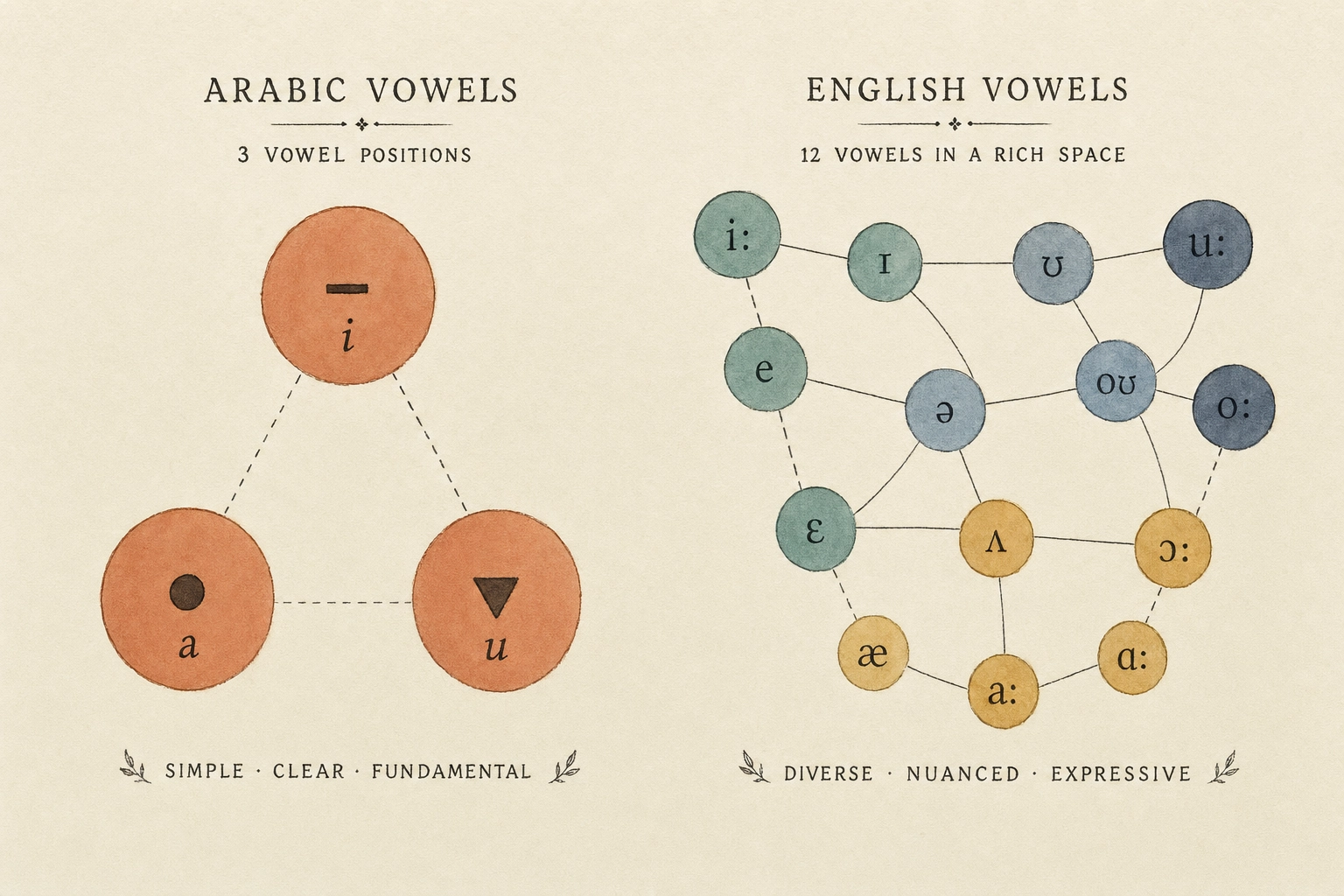
Your ear is trained to hear three vowels. English asks you to distinguish twelve. The most painful confusions for Arabic speakers in English:
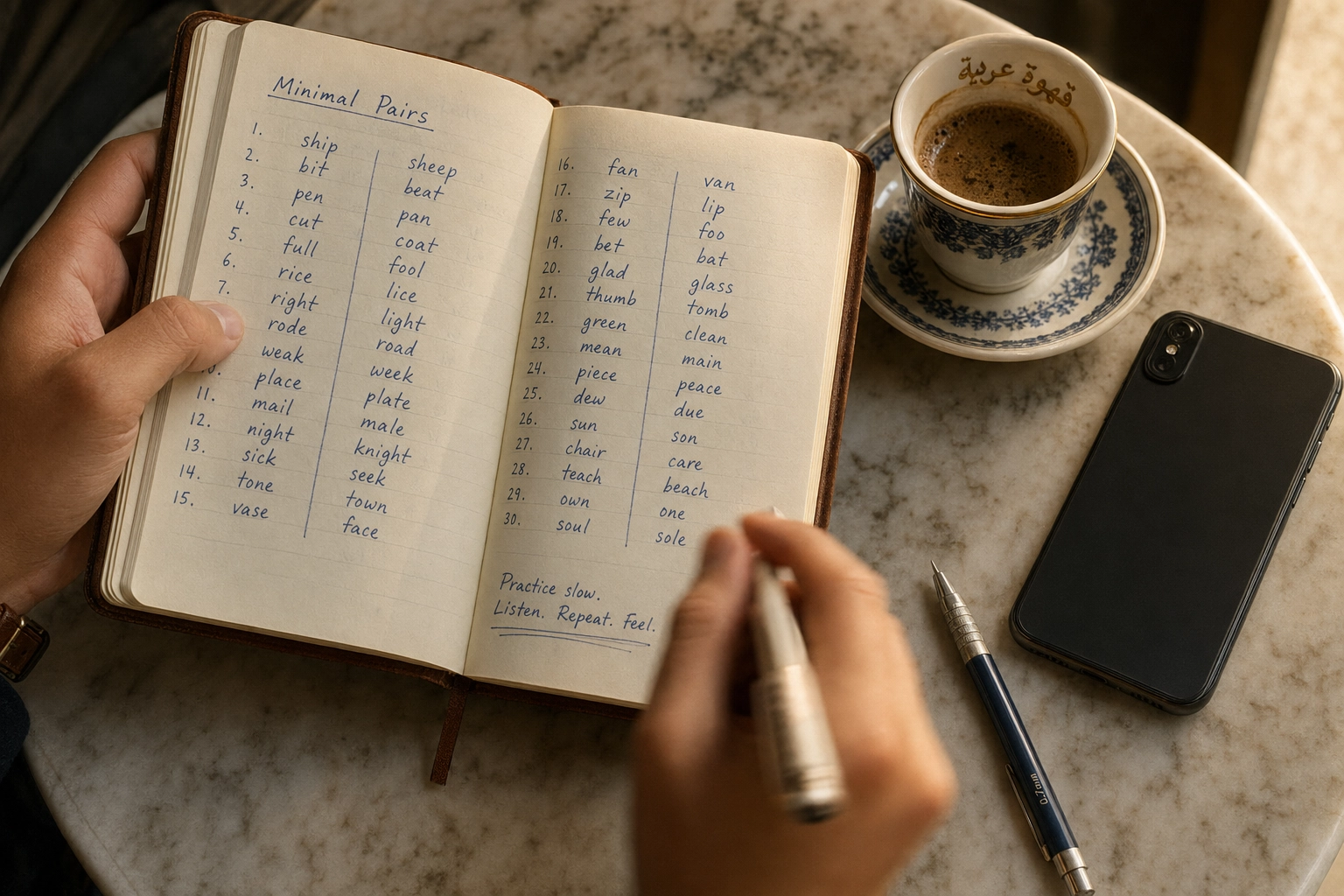
- /ɪ/ vs /iː/: ship/sheep, bit/beat, fit/feet, sit/seat
- /ɪ/ vs /ɛ/: bit/bet, sit/set, lid/led
- /ʊ/ vs /uː/: full/fool, pull/pool, look/Luke
- /æ/ vs /ʌ/: cat/cut, ran/run, bat/but
Diphthongs (boy, town, day, no) often collapse into a single vowel — "boy" becomes something closer to "boo" or "bah."
Fix: Train your ear before your mouth. Listen to minimal pairs (ship/sheep) ten times each before trying to say them. Voice-only AI practice helps here because you hear the contrast in real time and can repeat without anyone watching.
4. Consonant Clusters and the Hidden Vowel Trap
Arabic syllables follow tight rules: most allow CV (consonant-vowel) or CVC (consonant-vowel-consonant) patterns. Arabic doesn't allow two consonants at the start of a word.
English does this constantly: spring, street, scratch, splash, screen, three.
When Arabic speakers hit an English cluster, the brain quietly inserts a vowel to "repair" the syllable. Linguists call this epenthesis. Here's what comes out:
- Spring → isbring or sibring
- Street → estreet or istreet
- Split → siplit
- Scratch → iscratch
- Stress → istress
Three-consonant clusters (str-, spr-, scr-, spl-) are the hardest. Even at the end of words, English clusters like strength (8 sounds, 4 consonants in a row) or months (/nθs/) trip up advanced Arabic speakers.
Fix: Practice the cluster in isolation — "spr, spr, spr" — before you say the full word. Don't add a vowel. Don't take a breath between consonants. Then drill these English words slowly, then at normal speed: street, strength, scratch, spring, split, splash, screen, scream, strange.
5. The TH Sounds (It Depends on Your Dialect)
Here's where Arabic dialect matters a lot. English has two TH sounds: voiceless /θ/ (think, three, thumb) and voiced /ð/ (this, that, mother).
Modern Standard Arabic actually has both sounds: ث = /θ/ and ذ = /ð/. If you grew up speaking Gulf Arabic (Saudi, Kuwaiti, Emirati), Iraqi Arabic, Tunisian Arabic, or you're well-trained in MSA, you already pronounce these correctly.
But many regional Arabic dialects have dropped them:
- Egyptian and Levantine Arabic: /θ/ → /t/ or /s/, /ð/ → /d/ or /z/
- That's why "three" comes out as "tree" and "this" comes out as "dis" or "zis"
Fix: Stick the tip of your tongue gently between your teeth. Blow air for /θ/ (think). Add voice for /ð/ (this). It feels weird because your tongue is exposed — that's correct. The mistake most Arabic learners make is keeping the tongue behind the teeth.
Read these English words out loud: think, three, thumb, thirty, thirsty, thing / this, that, them, mother, brother, weather.
6. CH vs SH Confusion
Standard Arabic has /ʃ/ (sh, as in ش) but no /tʃ/ (ch). So:
- Cheap sounds like sheep
- Chair sounds like share
- Watch sounds like wash
- Catch sounds like cash
Fix: /ch/ is just /t/ and /sh/ glued together. Say "t-sh" slowly, then faster, then as one sound. That's /ch/.
Practice English pairs: ship/chip, share/chair, wash/watch, cash/catch, sheep/cheap.
7. The English R (Stop Rolling It)
The Arabic R (ر) is a trill — your tongue tip taps the roof of your mouth, sometimes more than once. The English R is completely different: it's an approximant. The tongue curls back and doesn't touch anything.
A trilled R in English makes you sound like you're imitating a pirate. It also makes some words harder to understand — Americans and Brits aren't used to hearing it.
Fix: Relax your tongue. Pull it slightly back into your mouth. Don't let the tip touch the top of your mouth. Round your lips a little. The sound should feel almost lazy.
Read these English words aloud: red, run, river, around, very, four, car, work.
8. The STIR Vowel /ɜː/ Doesn't Exist in Arabic
The English vowel in bird, work, learn, hurt, third, turn has no Arabic equivalent. Arabic speakers usually substitute whatever the spelling suggests:
- Bird → beerd (using long ee)
- Work → wark (using short a)
- Learn → lern (with a short e)
- Hurt → hart or hurrt (with rolled R)
Fix: Relax your mouth in a neutral position — not too open, not too closed. Keep your tongue flat in the middle of your mouth. The sound is somewhere between "uh" and "er." Hold it long.
Read these English words: bird, word, work, learn, third, turn, girl, heard, world, first.
20+ Hard English Words for Arabic Speakers (With Specific Fixes)
These are the English words that keep tripping up Arabic-speaking learners across every level. Read them out loud — silent reading won't fix pronunciation. For a broader list across multiple language backgrounds, our guide to the hardest English words to pronounce breaks the patterns down by native language.
P-words (don't say B):
- Pizza /ˈpiːtsə/ — Not "bizza." Whisper "bizza" first to feel the /p/.
- People /ˈpiːpəl/ — Two P's. Both need the puff of air.
- Problem /ˈprɒbləm/ — Cluster + P. Don't say "broblem."
- Pepper /ˈpɛpər/ — Two P's, short e, no rolled R.
- Passport /ˈpæspɔːrt/ — Three P/B-ish sounds. Stay voiceless on both P's.
V-words (don't say F):
- Very /ˈvɛri/ — Bite your lip, hum, then release. Not "ferry."
- Village /ˈvɪlɪdʒ/ — V at the start, soft G at the end (/dʒ/).
- Vegetable /ˈvɛdʒtəbl/ — V at the start, then a tricky three-syllable rhythm.
- Voice /vɔɪs/ — V + diphthong. Don't say "foice" or collapse the diphthong.
- Available /əˈveɪləbl/ — Two V/B traps. Both Vs need vibration.
Vowel pair traps:
- Sheep / Ship — Long /iː/ vs short /ɪ/. The mouth shape changes.
- Beat / Bit — Same vowel contrast. Say them back-to-back.
- Full / Fool — Short /ʊ/ vs long /uː/. Don't merge them.
- Cat / Cut — /æ/ vs /ʌ/. Cat has a wider mouth; cut is more relaxed.
- Bird /bɜːrd/ — STIR vowel. Don't say "beerd."
Consonant cluster traps:
- Street /striːt/ — Three consonants up front. Don't insert a vowel.
- Strength /strɛŋθ/ — Cluster + final TH. Six sounds, one syllable.
- Spring /sprɪŋ/ — /spr/ cluster + final NG (no hard G).
- Scripts /skrɪpts/ — Five consonants in a row. Practice slowly.
- Crisps /krɪsps/ — British favorite. Brutal cluster work.
TH traps:
- Three /θriː/ — Tongue between teeth, then /r/, then long ee. Not "tree."
- Throw /θroʊ/ — TH + R + diphthong. Three challenges in one word.
- Months /mʌnθs/ — /nθs/ at the end. Brutal final cluster.
- Clothes /kloʊz/ or /kloʊðz/ — Most natives say it as "close" /kloʊz/.
Mixed traps:
- Wednesday /ˈwɛnzdeɪ/ — Silent D. Don't say "Wed-nes-day."
- Comfortable /ˈkʌmftərbl/ — Drops to three syllables in fast speech.
- Squirrel /ˈskwɜːrəl/ — /skw/ cluster + STIR vowel + L.
- Rural /ˈrʊərəl/ — Two R's, English style, with the STIR-ish vowel.
If you can say these 28 English words clearly, you've solved most of the pronunciation problems unique to Arabic speakers. The next leap is grammar.
Grammar Differences That Trip Up Arabic Speakers
Pronunciation gets the attention, but grammar interference is what makes English sentences sound off even when individual words are clear. The five patterns below cause most of the recurring errors for Arabic speakers learning English.
Duolingo taught you words. No one taught you to speak.
PracticeMe: real voice conversations with an AI tutor, 24/7.
Articles: When to Use a, an, the, or Nothing
Arabic has one definite article — al- (الـ) — and no real indefinite article. A noun is either definite (with al-) or indefinite (without it). That's a two-way system.
English has a four-way system: a, an, the, and zero (no article).
This English-Arabic mismatch creates two opposite errors:
Error 1: Dropping articles.
- Wrong: I bought car yesterday.
- Right: I bought a car yesterday.
Error 2: Overusing "the" for general concepts.
- Wrong: The life is hard.
- Wrong: I love the music.
- Wrong: The men are stronger than the women.
- Right: Life is hard. I love music. Men are stronger than women.
Arabic uses al- for general categories ("life," "music," "men in general"). English uses no article for those.
Quick rule:
- The = specific, identifiable thing both speakers know about ("the book on the table")
- A/an = one of many, mentioned for the first time ("I saw a dog")
- No article = general concepts, uncountable nouns ("water," "love," "music")
This pattern takes time. Even advanced Arabic speakers learning English make article errors. The fix is exposure — hearing thousands of correct examples in conversation, not memorizing rules from books.
The Missing "To Be" Verb
Arabic doesn't use a copula (linking verb "to be") in the present tense. Huwa sa3eed literally means "he happy." The "is" is implied.
This shows up in English as:
- Wrong: He happy. / She teacher. / They tired. / We at home.
- Right: He is happy. She is a teacher. They are tired. We are at home.
Drill: spend 10 minutes describing your family, your job, and your day in English using am, is, are. Force the verb in. After enough repetition, it stops feeling extra.
Adjective Order: Big House, Not House Big
Arabic puts adjectives after the noun:
- al-bayt al-kabeer = "the-house the-big" = "the big house"
- al-sayyara al-hamra = "the-car the-red" = "the red car"
English puts adjectives before the noun. When Arabic speakers translate directly, you get:
- Wrong: I want house big. / She has car red. / He wears shirt blue.
- Right: I want a big house. She has a red car. He wears a blue shirt.
When you have multiple adjectives, English follows a strict order: opinion → size → age → shape → color → origin → material → noun.
So it's a beautiful small old round red Italian wooden table — not a wooden Italian red round old small beautiful table. Native English speakers don't think about this rule; they just feel it. You'll feel it after enough listening too.
Forming Questions with Do, Does, Did
Arabic forms yes/no questions with the particle hal or with rising intonation. There's no auxiliary verb the way English uses do/does/did.
This produces direct-translation questions in English:
- Wrong: You speak English?
- Wrong: Where you live?
- Wrong: Why she came late?
- Right: Do you speak English? Where do you live? Why did she come late?
The English pattern: Do/Does/Did + subject + base verb. The main verb stays in its base form (no -s, no past tense) because the auxiliary carries the tense and agreement.
Practice flipping English statements into questions:
- You like coffee. → Do you like coffee?
- She works in Dubai. → Does she work in Dubai?
- They went home. → Did they go home?
Verb-Subject Agreement (The Sneaky -s)
In Arabic VSO order, the verb agrees with the subject in gender only, not number. In SVO, it agrees fully. English uses one rule: third-person singular adds -s in the simple present (he writes, she goes, it works).
Arabic speakers commonly drop the -s:
- Wrong: He write every day. / She go to work. / My brother live in Cairo.
- Right: He writes every day. She goes to work. My brother lives in Cairo.
This single -s is one of the most useful English fixes you can make — it instantly signals "fluent speaker."
The Right-to-Left Factor: How Reading Direction Shapes Speaking
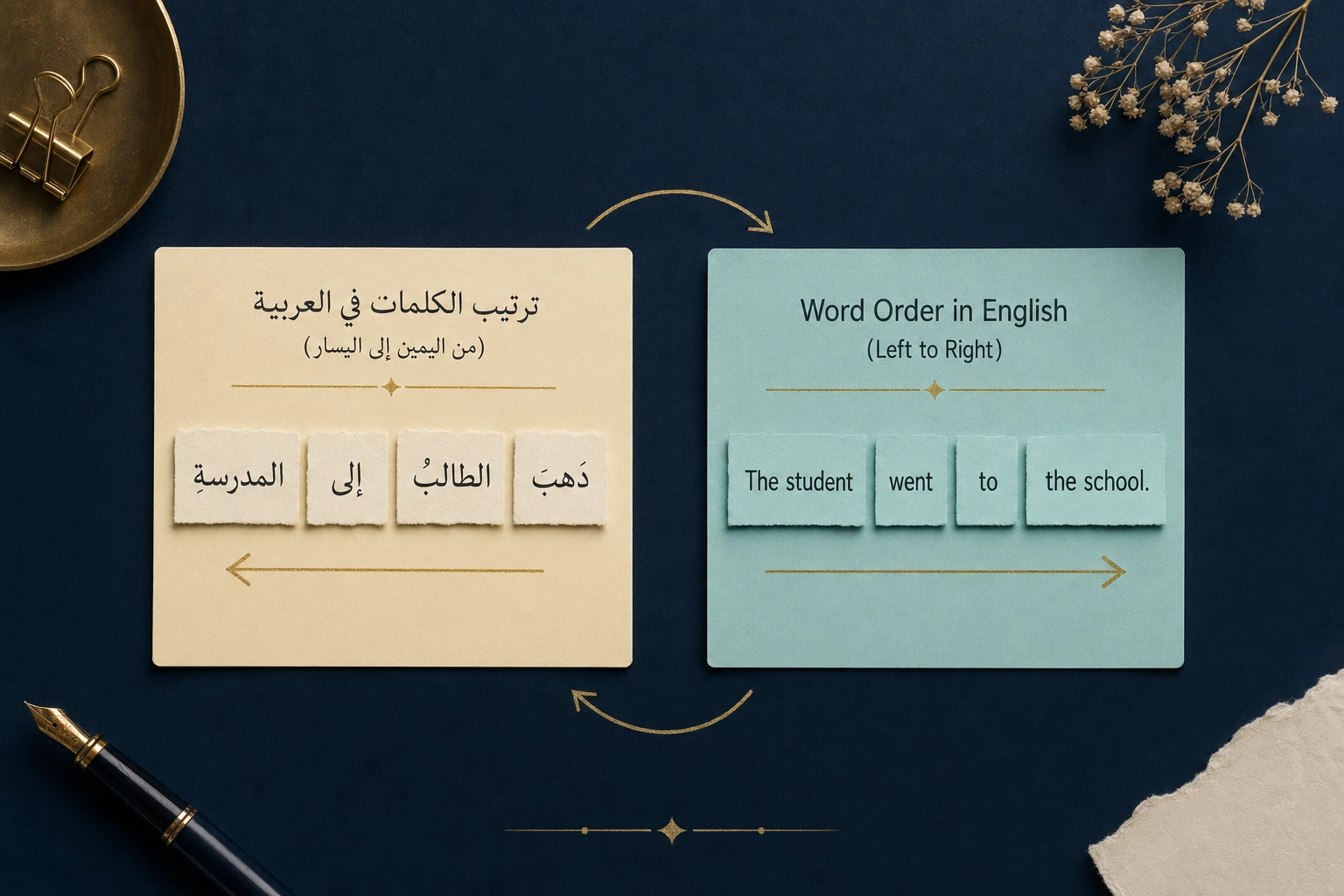
Arabic reads right-to-left. English reads left-to-right. Eye-tracking research shows that Arabic-L1 readers learning English initially scan English text in the wrong direction before consciously correcting. This costs milliseconds per word — enough to slow comprehension and disrupt the flow of speaking.
This affects more than reading. Your brain has been trained for decades to expect sentence structure to unfold from right to left. When you listen to English, your brain has to actively flip the expected order. When you speak English, you have to flip it again before words leave your mouth.
There's a real benefit hiding here: voice-first practice (no reading, no text on screen) lets you build English instincts without fighting the visual interference. Many Arabic speakers report that pure conversation practice — eyes closed, just speaking — feels easier than reading-based exercises or grammar books. Use this. Practice with your eyes off the screen when you can. Our deeper guide on thinking in English instead of translating covers techniques that work especially well for Arabic L1 speakers.
The Cultural Side: Speaking Anxiety in Arab Learners
Pronunciation books rarely discuss this part, but it might be the single biggest barrier for Arab learners.

Concepts of honor (sharaf) and face (karama, wajh) make public mistakes feel especially heavy in Arab culture. Speaking English incorrectly in front of peers, family elders, or colleagues isn't just embarrassing — it's a small loss of social standing.
Researchers have noticed this. Saudi-based studies developed an Arab Foreign Language Anxiety Questionnaire (AFLAQ) precisely because the standard Western anxiety scales didn't capture self-presentation concerns the way Arab learners experience them. Findings consistently show Arabic-speaking learners go silent rather than risk visible error in front of others. That's not weakness. It's a rational response to a culture that values dignified speech.
The practical problem: speaking is a skill that requires output. You can't get better at English without making the mistakes the culture punishes. Many Arab learners get stuck in a loop — they understand English well, can read it fluently, can write it for work, but freeze the moment they need to speak.
This is exactly the gap that private AI voice practice fills. There's no audience. No peers comparing your accent to theirs. No teacher waiting to correct you in front of the class. You make mistakes alone, fix them alone, and walk into your real conversations already warmed up.
If anxiety is your main barrier — not vocabulary, not grammar, but the social cost of stumbling — the fastest path forward is to build your reps somewhere safe first. We've written more about this in our guide on how to overcome the fear of speaking English.
A 14-Day English Practice Plan for Arabic Speakers
Two weeks. 15-30 minutes a day. Voice-first. Each day has one specific English goal you can hit in a single Practice Me conversation. Think of it as 14 short, focused English lessons that build on each other — no scheduling, no books to buy, no waiting list.
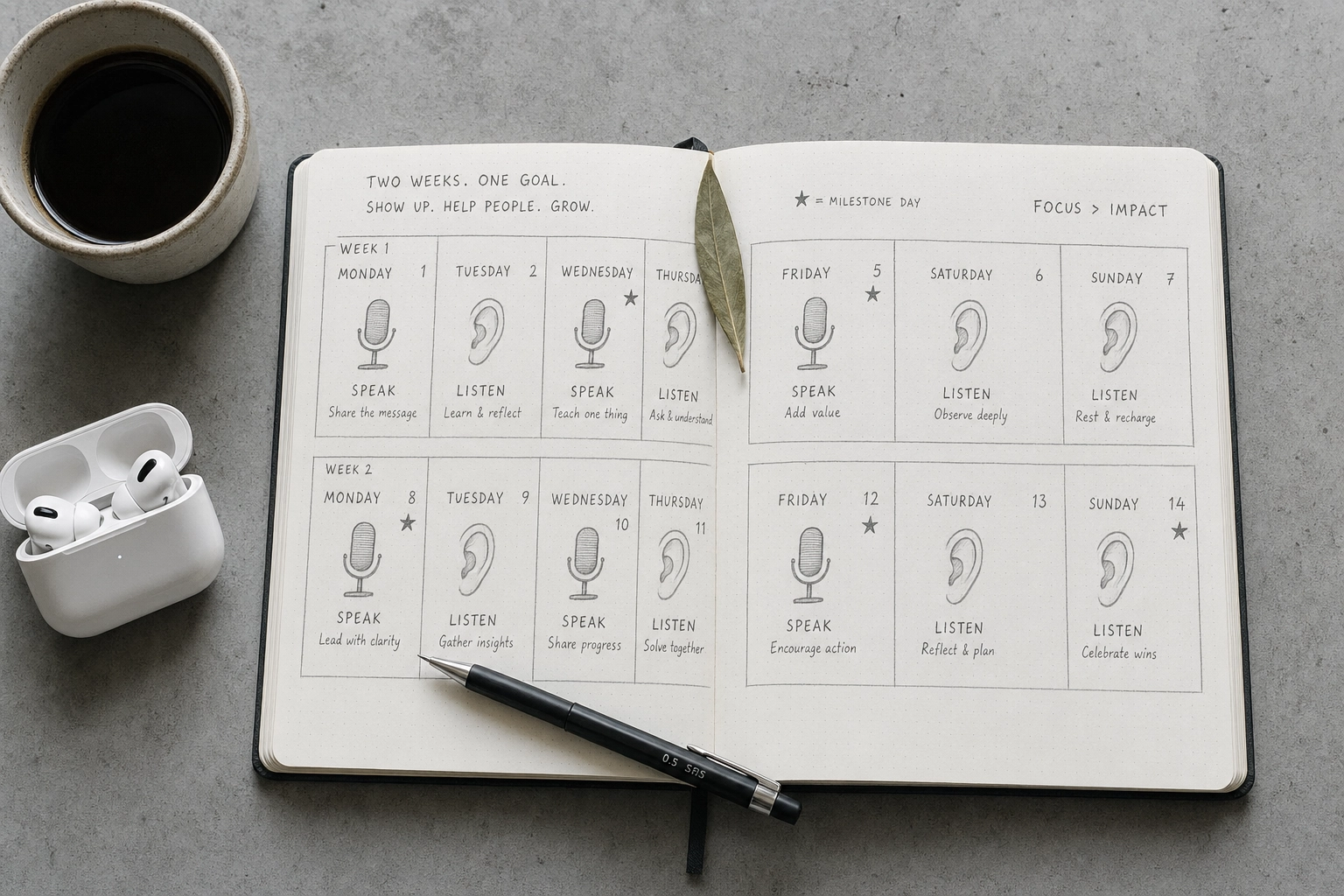
Week 1: Pronunciation Foundation (Days 1-7)
Day 1 — P/B mastery. Spend 20 minutes with the AI tutor saying minimal pairs out loud: pat/bat, pen/Ben, pull/bull. Use the paper test. Have the tutor correct you when /b/ slips through.
Day 2 — V/F mastery. Bite-and-hum drills. Say: very, voice, van, vacation, available. Then sentences: "Very few villages have voice mail."
Day 3 — Short vowels. Drill ship/sheep, bit/bet, pull/pool, cat/cut. Talk to the AI about your day, but consciously slow down on every short-vowel English word.
Day 4 — Consonant clusters. Practice: street, spring, split, scratch, screen, strength. No hidden vowels. Then have a conversation about your morning routine.
Day 5 — TH sounds. Tongue between the teeth. Drill: think, three, thirsty, this, that, mother. Use a sentence loop: "I think this is the third thing my mother brought."
Day 6 — English R. Relax the tongue. No trill. Drill: red, run, river, around, very, four, car. Tell the tutor a story about a trip you took.
Day 7 — Free conversation. No script. Talk to the AI in English for 15 minutes about anything. Try to use everything from days 1-6. Don't stop to fix mistakes — speak through them.
Week 2: Grammar and Real Conversation (Days 8-14)
Day 8 — Articles. Have the tutor describe pictures or scenarios with you. Practice "a/an/the/no article" out loud. Force yourself to use the only when something is specific.
Day 9 — "To be" drill. Describe yourself, your family, your job, your city, the weather in English. Force am/is/are into every sentence. "I am from Jordan. My brother is an engineer. We are happy."
Day 10 — Adjective order. Describe ten objects in your room with two adjectives each ("a small black laptop, a beautiful old book"). Then have a conversation about your favorite restaurant.
Day 11 — Question formation. Interview the AI. Ask it twenty English questions using do/does/did. "Do you like coffee? Where do you live? Why did you come?"
Day 12 — Third-person -s. Tell a story in English about a friend or family member. Force the -s every time. "My brother lives in Riyadh. He works as a doctor. He goes to the gym every morning."
Day 13 — Role-play. Pick a real scenario you'll face: job interview, doctor's appointment, ordering at a café in London, asking for directions. Run it for 20 minutes.
Day 14 — Reflection. Tell the AI what's improved. Talk about which English sounds still feel hard. Make a plan for the next two weeks.
By day 14, the patterns won't be fixed forever — but they'll be fixable in real conversations. You'll have shifted from "I freeze when I have to speak English" to "I make mistakes and keep going." That's the breakthrough most Arabic speakers are looking for. For more daily-routine ideas, see our daily English speaking practice routine, or build pronunciation reps with our English tongue twisters collection.
How Practice Me Helps Arabic Speakers Specifically
Most English-learning apps focus on writing, reading, or grammar drills. Practice Me is different — it's voice-first, judgment-free, and designed for the moment when you actually have to open your mouth and speak English.

For Arabic speakers, that focus matters because:
- Cultural anxiety is solved by privacy. No peers, no audience, no social cost when you mispronounce a word. The AI doesn't roll its eyes when you say "bizza."
- 24/7 availability fits any schedule. Practice between prayers, after work, before bed. No scheduling, no waiting list, no fixed lesson times.
- Tutors adapt to your level. Sarah, Oliver, and Marcus each speak English naturally and adjust to how you speak. Ask them to repeat. Ask them to slow down. Ask them to explain a word again. They don't lose patience.
- American or British English. Many Arab schools teach British English (especially in Egypt, Sudan, and Gulf states). Many Arab learners later move toward American English for work. Practice both.
- Vocabulary auto-saves. Every English word you stumble on gets saved automatically. Read and review the list whenever you're ready, or build your vocabulary through conversation to make new words stick.
- Real conversations, not drills. You build English fluency the way native speakers do — by using the language in context, not by filling worksheets or memorizing lessons from books.
If you want to compare your situation to other language backgrounds, our guides for English for Chinese speakers and English for Hindi speakers cover the same patterns from different starting points. You can also read our broader guide on improving English speaking as a non-native speaker, which covers strategies that work across L1s, learn the English pronunciation basics every learner needs, or jump straight into practicing English speaking with AI for the daily method.
Frequently Asked Questions
How long does it take an Arabic speaker to become fluent in English?
The U.S. State Department's Foreign Service Institute classifies Arabic and English as a "Category IV/V" pair — meaning the linguistic distance between them is significant. Expect roughly 1,000 to 2,000 hours of focused practice for working English fluency. In daily-practice terms: 30 minutes a day produces noticeable improvement in 6 months, and confident conversational fluency in 18-24 months. Speaking practice is the rate-limiting factor — most Arabic speakers spend too much time reading English books and not enough time talking out loud.
Should I learn American or British English?
It depends on your goal. If you'll work or study in the US or Canada, learn American English. If your target is the UK, parts of the Gulf region, or international business heavily influenced by British schools, go British. Most Arabic-speaking countries' school systems historically taught British English in their lessons, so that's where most Arab learners start. Both varieties are equally valid. Pick the one your future audience will be speaking and stick with it. Practice Me supports both English accents.
Will I lose my Arabic accent in English?
You don't have to — and probably shouldn't want to. The realistic goal is clarity, not accent erasure. Plenty of fluent English speakers retain a recognizable Arabic accent and communicate flawlessly. Focus on the English sounds that change meaning (P/B, ship/sheep, three/tree) before worrying about polishing the rest. Your accent is part of who you are.
What's the hardest part of English for Arabic speakers?
Two things tie for first place: short vowel distinctions (ship/sheep, bit/bet) and the article system (a/an/the/zero). Pronunciation of P/B can be fixed in days. The English vowel system takes months of consistent ear training. Articles cause errors throughout your career because there's no clean rule that covers every case. Steady exposure to natural English in conversation is the only real fix — more useful than any grammar book or course.
Can I practice English without speaking to a human?
Yes — and for Arabic speakers struggling with cultural anxiety, this is often the fastest path. AI voice tutors give you unlimited reps without any social risk. The most effective approach combines AI practice for daily English fluency-building with occasional human conversation for real-world calibration. You don't need a human to fix pronunciation. You do need a human (eventually) to test that what you've practiced works in the wild.
Is Practice Me available in Arabic-speaking countries?
Yes. Practice Me works on iOS (iPhone and iPad) and Android wherever you have an internet connection — including Saudi Arabia, the UAE, Egypt, Jordan, Morocco, and the rest of the Arab world. Subscriptions are processed through the App Store or Google Play, and one account syncs across both.
Are there good English books for Arabic speakers?
Books are useful for reading and grammar reference, but they can't teach you to speak. The best approach pairs a solid grammar book — any standard ESL/EFL textbook your school recommends — with daily voice practice. Books for grammar; conversation for fluency. Reading alone won't fix the patterns covered in this guide.
Start Speaking English with Confidence
The three pillars for Arabic speakers learning English are pronunciation accuracy, grammar adjustment, and the confidence to actually open your mouth. Most learners drill the first two and skip the third — then wonder why they freeze in real conversations. Our guide on speaking English fluently and confidently covers the mindset side in more depth.
Practice Me gives you all three in private, judgment-free voice conversations. Pick an AI tutor, choose American or British English, and start practicing the patterns from this guide on English for Arabic speakers. No scheduling. No audience. No social cost when you mess up.
Practice Me Pro unlocks unlimited conversations, all tutors, both English accents, and progress tracking. The iOS app comes with a free trial — download it, talk to Sarah for ten minutes, and see how it feels.
Your accent isn't the problem. Your silence is. Open the app and start speaking English today.