Duolingo taught you words. No one taught you to speak.
PracticeMe: real voice conversations with an AI tutor, 24/7.
Learn English for Chinese Speakers: AI Practice Guide

Finding good english lessons for chinese speakers isn't easy. Most English courses, apps, and online programs treat all learners the same, whether you speak Spanish, Arabic, or Mandarin. That's a problem, because the obstacles a Chinese speaker faces when learning English are fundamentally different from those of any European language speaker.
The U.S. Foreign Service Institute classifies Mandarin Chinese and English as a Category IV language pair — the maximum difficulty rating. The FSI estimates 2,200 class hours to reach professional proficiency between these two languages. Compare that to just 600 hours for Spanish-English.
The reason? Almost nothing transfers. No shared alphabet. No shared vocabulary. No shared grammar structures. And perhaps most challenging: Mandarin is a tonal language where pitch changes word meaning at the syllable level, while English is stress-timed and uses pitch for emphasis and emotion, not vocabulary.
But here's what nobody tells you: that extreme distance also means that once you do start speaking English confidently, you've accomplished something genuinely remarkable. And with the right tips and approach — targeting the specific areas where Chinese and English clash — progress happens faster than you'd expect.
This guide is the english lesson for chinese speakers that actually addresses your challenges. It breaks down exactly where you'll struggle with english pronunciation for chinese speakers, gives you 25 difficult english words for chinese speakers with IPA transcriptions and practice tips, and includes a free 14-day speaking practice plan you can start today.
Quick Summary: Chinese speakers face 5 core pronunciation challenges when learning English: R/L distinction, TH sounds, final consonant clusters, vowel length, and word stress patterns. Grammar interference from Mandarin (no articles, no verb conjugation, no plural markers) adds another layer. The fastest path to fluency is consistent speaking practice — and AI conversation tools let you practice English 24/7 without the fear of being judged, for a fraction of the cost of human tutoring.
Why Learning English Is Uniquely Hard for Chinese Speakers
China has the world's largest population of English learners — over 400 million people study the language, and English is a required subject from primary school through the college entrance exam (高考/Gaokao). Despite this massive investment in English education, the EF English Proficiency Index consistently ranks China in the "moderate" proficiency band.
Why? Because most English learning in China focuses heavily on reading, writing, grammar rules, vocabulary lists, and test preparation — not speaking or listening skills. Students can often read and write English reasonably well and score high on exams, but freeze when they need to actually communicate with native speakers.
This creates a specific pattern that experienced ESL teachers and online tutors recognize immediately: Chinese learners who know English grammar rules intellectually but can't execute them in real-time speech. The gap between knowledge and speaking performance is where consistent practice makes all the difference.
Here's what makes English especially difficult compared to what Mandarin speakers are used to:
- No tones, but stress matters. In Mandarin, saying "mā" (妈, mother) vs "mǎ" (马, horse) is a pitch difference that changes meaning. English doesn't work that way — but it uses stress patterns that are equally important and equally confusing for Chinese learners.
- Spelling is unreliable. Mandarin pinyin is almost perfectly phonetic. English spelling is notoriously inconsistent — "through," "though," "thought," and "tough" all use "-ough" but sound completely different.
- Sounds that don't exist. English has several consonants and vowels with no equivalent in any Chinese dialect — particularly TH sounds, the dark L, and about half the vowel inventory.
- Grammar is inflectional. Chinese grammar communicates through word order and context. English changes the words themselves — verb endings, plural markers, article usage — all in real-time while speaking.
If you're a Chinese speaker who reads English fairly well but struggles with speaking, you're not alone. And the solution isn't more grammar study or writing exercises — it's targeted speaking practice on the specific sounds and patterns that trip you up. (For tips and resources for learners from other language backgrounds, we've also published a guide for English for Spanish speakers.)
English Pronunciation for Chinese Speakers: 5 Key Challenges
Let's break down the five areas where Chinese phonology clashes most directly with English pronunciation. Understanding why these sounds are hard makes them easier to fix — and is the foundation of effective english lessons for chinese speakers.
1. The R/L Distinction
This is the challenge most people associate with Chinese English learners — and the reality is more nuanced than the stereotype suggests.
Mandarin speakers actually have a retroflex consonant (the "r" in pinyin, as in 人/rén) that shares some characteristics with the English R. If you're a Mandarin speaker, you're starting with a partial advantage here.
Cantonese and Shanghainese speakers face a bigger challenge. These dialects lack the retroflex entirely, leading to consistent /r/ → /l/ substitution: "right" sounds like "light," "row" sounds like "low."
But there's a second R/L problem that affects all Chinese speakers learning English: the dark L — the thick L sound at the end of words like "will," "full," and "people." This sound doesn't exist in Mandarin or Cantonese. ESL teachers report that "will" is one of the first words they test because it reliably reveals this gap in communication skills.
How to practice: For the English R, curl your tongue slightly back without touching the roof of your mouth. For L, press the tip of your tongue firmly against the ridge right behind your upper teeth. Practice these minimal pairs slowly: right/light, read/lead, wrong/long, raw/law, row/low.
2. TH Sounds (/θ/ and /ð/)

Neither the voiceless TH in "think" (/θ/) nor the voiced TH in "this" (/ð/) exists in any Chinese dialect — Mandarin, Cantonese, Hokkien, or otherwise. This makes TH one of the most universal english pronunciation challenges for chinese speakers.
Common substitutions:
- "think" → "sink" or "tink"
- "this" → "dis" or "zis"
- "three" → "tree" or "sree"
- "clothes" → "close"
- "breathe" → "breeze"
How to practice: Place the very tip of your tongue between your upper and lower teeth — you should be able to feel the edge of your tongue if you look in a mirror. For voiceless TH (think, three, through), blow air gently over your tongue without engaging your vocal cords. For voiced TH (this, that, the), add vocal vibration. No Chinese sound requires this tongue-between-teeth position, so it feels physically strange at first. That's normal. Within 2-3 weeks of daily practice, it becomes automatic.
For more detailed pronunciation drills on TH and other fundamental sounds, see our pronunciation practice for beginners guide.
3. Final Consonant Clusters

This might be the single most impactful challenge for Chinese English learners to address, because it affects both pronunciation and grammar simultaneously.
Mandarin syllable structure is extremely strict: almost every syllable ends in a vowel, /n/, or /ŋ/. English, on the other hand, can pile up consonants at the end of words without limit: strengths (/streŋθs/) has four consonants in a row at the end.
Chinese speakers handle this in two ways:
- Dropping the final consonants: "most" → "mos," "text" → "tex," "hand" → "han"
- Adding extra vowels: "cat" → "cat-uh," "please" → "puh-lease," "worked" → "work-ed" (two syllables)
Here's why this is critical for anyone learning English: when you drop final consonants, you also erase English grammar markers. Drop the "-ed" from "worked" and it becomes "work" — you've lost the past tense. Drop the "-s" from "books" and you've lost the plural. These aren't just pronunciation issues; they're communication breakdowns.
How to practice: Start by exaggerating the endings. Over-pronounce them. Say "bookSSS," "workTTT," "handZZZ." Then gradually reduce to a natural level. Recording yourself and playing it back is incredibly effective — you'll catch dropped endings you didn't even notice making. This is one of the most important tips for building English fluency.
4. Vowel Length and Quality
English has at least 12 distinct vowel sounds plus 8 diphthongs (vowels that glide from one position to another). Mandarin has significantly fewer vowel distinctions, and crucially, vowel length doesn't change word meaning in Chinese the way it does in English.
These minimal pairs all depend on vowel differences that Chinese learners need to master:
- ship /ʃɪp/ vs sheep /ʃiːp/ — short vs long
- full /fʊl/ vs fool /fuːl/ — short vs long
- bed /bed/ vs bad /bæd/ — different vowel entirely
- hat /hæt/ vs hut /hʌt/ vs hot /hɒt/ — three "a"-like sounds
Then there's the schwa (/ə/) — the most common sound in the entire English language, appearing in the unstressed syllables of words like about, sofa, banana, and comfortable. It's a lazy, reduced "uh" sound that Mandarin speakers tend to pronounce as a full vowel, making their English sound overly precise and robotic.
How to practice: Exaggerate the difference between long and short vowels at first. Make "sheep" absurdly long and "ship" absurdly short. Your ear needs to register the contrast before your mouth can produce it reliably. For the schwa, practice saying multi-syllable words quickly and letting the unstressed syllables collapse naturally. Online resources like the BBC Learning English pronunciation guide offer free audio examples.
5. Word Stress and Intonation (vs Tones)

This is arguably the most misunderstood challenge for chinese speakers learning english. Mandarin uses four tones (plus a neutral tone) to distinguish word meaning at the individual syllable level. English doesn't use tones this way — but it has its own pitch system that's equally important and works very differently.
In English, word stress determines which syllable gets emphasized:
- REcord (noun: a vinyl record) vs reCORD (verb: to record something)
- PREsent (noun: a gift) vs preSENT (verb: to present)
- CONtract (noun: a legal contract) vs conTRACT (verb: to contract)
And sentence intonation communicates emotion, emphasis, and meaning:
- "I didn't say he stole the money" (someone else said it)
- "I didn't say he stole the money" (he borrowed it)
Chinese speakers often apply tonal thinking to English, producing stress patterns that don't match native English expectations — or flattening everything into a monotone. Both make speech harder for English listeners to follow.
How to practice: Shadow native English speakers. Listen to a sentence, then repeat it with the exact same rhythm and stress pattern. Shadowing exercises are one of the most effective techniques for developing natural English intonation and fluency. Focus on copying the music of the sentence, not just the individual words.
25 Difficult English Words for Chinese Speakers (With IPA)
Below are 25 difficult english words for chinese speakers, organized by the specific pronunciation challenge they represent. Each includes IPA transcription and a targeted practice tip — essential vocabulary for any English course for Chinese speakers. For a broader list across multiple native languages, see our guide to the hardest English words to pronounce.
TH Sound Words
| Word | IPA | Common Error | Tip |
|---|---|---|---|
| through | /θruː/ | "sru" or "tru" | Tongue between teeth + R |
| three | /θriː/ | "tree" or "sree" | Start with tongue out, slide into R |
| thought | /θɔːt/ | "taught" or "sought" | Voiceless TH + open "aw" vowel |
| breathe | /briːð/ | "breeze" | Voiced TH at end — feel the vibration |
| clothes | /kloʊðz/ | "close" | Voiced TH + Z ending — don't simplify |
| months | /mʌnθs/ | "mons" | The n-θ-s cluster is brutal — slow down |
R/L Words
| Word | IPA | Common Error | Tip |
|---|---|---|---|
| rural | /ˈrʊr.əl/ | "lural" | Two R sounds — tongue curled, not touching |
| world | /wɜːrld/ | "word" or "wold" | R + L + D cluster — say each consonant |
| really | /ˈriː.ə.li/ | "lili" or "rearry" | Start with clear R, end with clear L |
| library | /ˈlaɪ.brer.i/ | "lie-berry" | BR cluster in the middle |
| will | /wɪl/ | "wiu" | Dark L — tongue tip stays on ridge |
Consonant Cluster Words
| Word | IPA | Common Error | Tip |
|---|---|---|---|
| strengths | /streŋθs/ | "strens" | STR- opening + -ŋθs ending — hardest word |
| texts | /teksts/ | "tex" | Say "tekst" then add the S |
| sixths | /sɪksθs/ | "six" | Practice ks-th-s one sound at a time |
| asks | /æsks/ | "ax" | The /æ/ vowel + sks cluster |
| worked | /wɜːrkt/ | "work" or "work-ed" | -ed sounds like "t" here, not a syllable |
| breadth | /bredθ/ | "bread" | Don't drop the final TH |
Duolingo taught you words. No one taught you to speak.
PracticeMe: real voice conversations with an AI tutor, 24/7.
Vowel Challenge Words
| Word | IPA | Common Error | Tip |
|---|---|---|---|
| comfortable | /ˈkʌmf.tər.bəl/ | "com-for-ta-ble" | Only 3 syllables in natural speech |
| vegetable | /ˈvedʒ.tə.bəl/ | "vege-table" | Reduce to 3 syllables: "vej-tuh-bull" |
| colonel | /ˈkɜːr.nəl/ | "ko-lo-nel" | Sounds like "kernel" — ignore the spelling |
| queue | /kjuː/ | "kway" | Just say "kyoo" |
Stress and Tricky Words
| Word | IPA | Common Error | Tip |
|---|---|---|---|
| entrepreneur | /ˌɒn.trə.prəˈnɜːr/ | "en-tre-pre-noor" | Stress the last syllable: -NOOR |
| squirrel | /ˈskwɜːr.əl/ | "swi-rel" | SKW cluster + ER sound |
| photograph | /ˈfoʊ.tə.ɡræf/ | "fo-to-graf" | Stress shifts: PHO-tograph, pho-TOG-raphy |
| determine | /dɪˈtɜːr.mɪn/ | "de-TER-mine" | Second syllable stress |
Practice these words with English tongue twisters to build vocabulary and muscle memory faster.
English Grammar Patterns That Trip Up Chinese Speakers

Pronunciation gets the most attention in english lessons for chinese speakers, but grammar interference from the Chinese language causes equally frustrating communication breakdowns. These are the four patterns where Mandarin structure clashes most directly with English grammar — and where learners need the most practice and learning resources.
Articles (a, an, the)
Mandarin has no articles. None. The concept of marking nouns as definite or indefinite simply doesn't exist in the Chinese language. This makes articles one of the hardest grammar patterns for Chinese speakers to internalize when learning English, even at advanced levels.
Common errors:
- ❌ "I go to school" → ✅ "I go to the school" (specific school)
- ❌ "She is teacher" → ✅ "She is a teacher"
- ❌ "I saw cat on street" → ✅ "I saw a cat on the street"
There's no free shortcut for this — articles must be learned through massive exposure to natural English conversation. The good news: when you practice speaking with an AI tutor, you get real-time conversational feedback on article usage in context, which is far more effective than memorizing grammar rules from a textbook or writing worksheets.
Verb Tenses and Conjugation
In Mandarin, verbs never change form. Ever. The word 跑 (pǎo, "run") stays the same whether you ran yesterday, are running now, or will run tomorrow. Context and time markers do all the work in Chinese — English requires you to change the verb itself.
English has 12 tenses, and each requires different verb forms:
- ❌ "She run yesterday" → ✅ "She ran yesterday"
- ❌ "I eat already" → ✅ "I have eaten already"
- ❌ "He work here since 2020" → ✅ "He has worked here since 2020"
This intersects with pronunciation: the -ed ending that marks past tense is also a consonant cluster that Chinese speakers tend to drop when speaking. So the grammar error and the pronunciation error compound each other — making speaking practice doubly important for language learning.
Plural Markers and Subject-Verb Agreement
Mandarin nouns don't change for plural. 一本书 (one book) and 五本书 (five books) use the same 书. This leads to systematic errors when speaking or writing English:
- ❌ "I have two book" → ✅ "I have two books"
- ❌ "He like swimming" → ✅ "He likes swimming"
- ❌ "There are many student in the class" → ✅ "There are many students"
The -s ending is both a grammar marker and a pronunciation challenge — making it doubly hard for Chinese English learners to produce consistently in conversation.
Pronoun Gender (He/She Mix-Ups)
In written Mandarin, "he" (他), "she" (她), and "it" (它) look different. But in spoken Mandarin, they're all pronounced identically: tā. This means Chinese speakers frequently swap "he" and "she" in English conversation — not out of confusion about the person's gender, but because their spoken language has never required them to make this distinction in real-time speech.
This is a deeply ingrained habit that even advanced Chinese English speakers slip on. The only fix is practice — lots of it, in real conversations where you're actually choosing pronouns on the fly. For tips and strategies on building this kind of automatic English fluency, see our guide on how to stop translating and speak English naturally.
Your Free 14-Day English Speaking Practice Plan
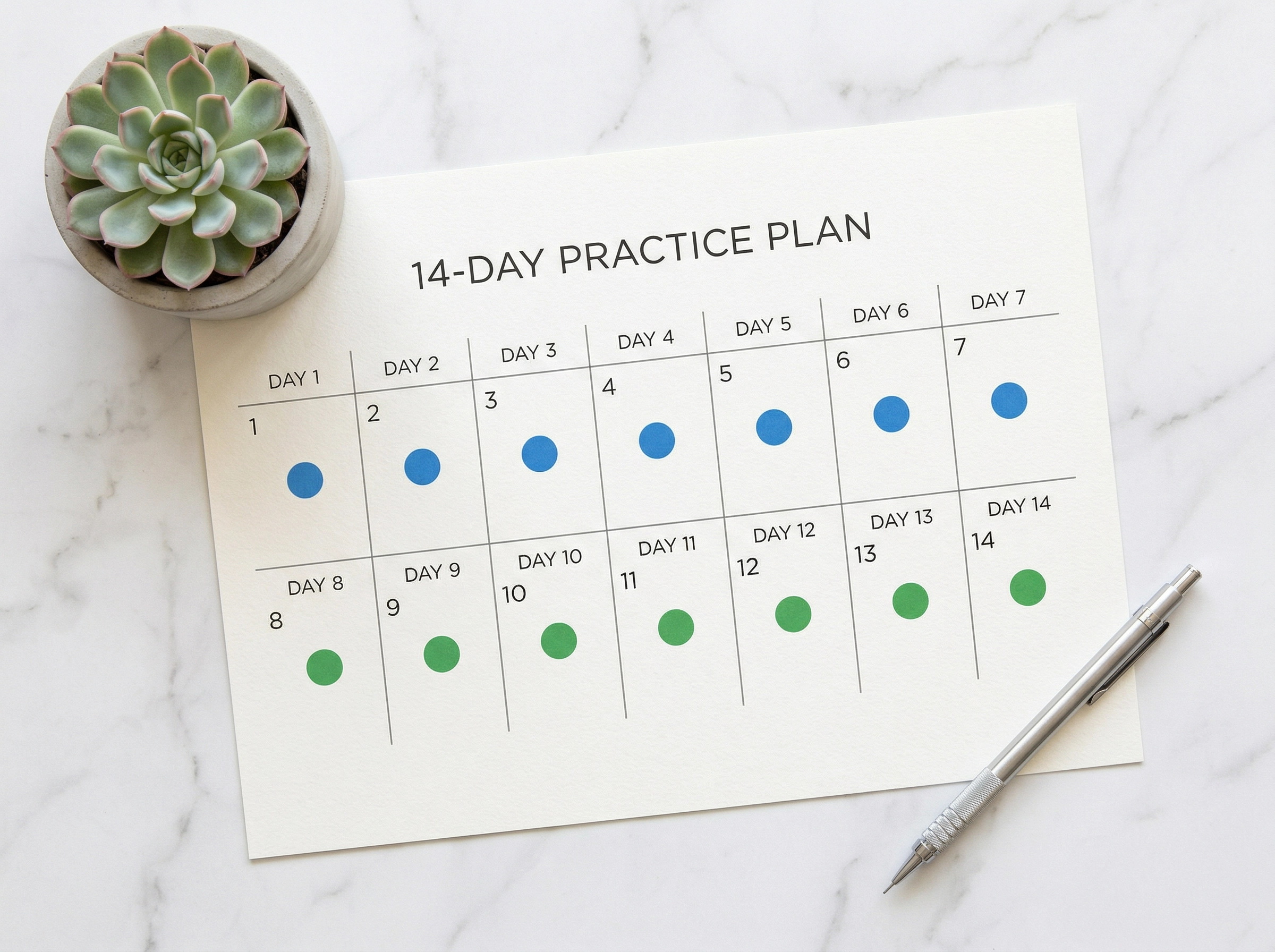
This free practice plan uses AI voice conversations to systematically target every challenge covered above. Each day takes just 15-20 minutes — ideal for busy professionals and students who can't commit to scheduled language classes or expensive online tutoring sessions. All you need is the Practice Me app and a quiet place to talk.
The key principle: Focus on one challenge per day, then build up to natural English conversation. Don't try to fix everything at once.
Week 1: Pronunciation Foundations
| Day | Focus | What to Practice |
|---|---|---|
| 1 | R/L sounds | Ask your AI tutor to have a conversation about travel. Focus on words with R and L: "really," "recently," "actually," "explore," "relax." If you catch yourself swapping R→L, pause and self-correct. |
| 2 | TH sounds | Talk about your thoughts on something — a movie, a book, anything. The topic doesn't matter; what matters is using "think," "thought," "the," "this," "that," "there," and "through" repeatedly in your speaking. |
| 3 | Final consonants | Discuss what you did last week. Focus on past tense: "worked," "talked," "watched," "finished," "asked." Exaggerate the -ed endings. |
| 4 | Vowel length | Practice minimal pairs with your AI tutor. Ask them to quiz you: "Did I say ship or sheep?" "Was that full or fool?" Listen to how the tutor pronounces them and match the vowel length. |
| 5 | Word stress | Talk about your job or studies. Focus on multi-syllable vocabulary: "department," "important," "development," "professional," "communication." Tap your desk on the stressed syllable as you speak. |
| 6 | Mixed review | Free conversation — but record it (most phones can do this). Play it back and note which of the 5 challenges you still hear in your speaking. |
| 7 | Weak area repeat | Go back to whichever day (1-5) was hardest for you. Repeat that focused practice session. |
Week 2: Grammar + Real English Conversation
| Day | Focus | What to Practice |
|---|---|---|
| 8 | Articles | Describe your home, room by room. "There is a window in the kitchen. The living room has a big couch." Force yourself to include articles with every noun. |
| 9 | Past tense | Tell your AI tutor about your weekend using only past tense. "I went to the store. I bought groceries. I cooked dinner." Focus on both pronunciation of -ed and correct verb forms. |
| 10 | Plurals | Describe what you see around you. "There are three books on the desk. I have two monitors. My room has four walls." Emphasize the final -s when speaking. |
| 11 | He/She practice | Tell a story about two friends — one male, one female. Use "he" and "she" deliberately and carefully. If you mix them up, stop, correct yourself, and continue. This skill takes consistent practice. |
| 12 | Business English | Practice a job interview scenario. Introduce yourself, describe your professional experience, answer "What are your strengths?" This combines grammar, pronunciation, vocabulary, and real-world communication skills. |
| 13 | Full conversation | Have a 15-minute unstructured conversation with your AI tutor on any topic from our list of conversation practice topics. Don't focus on any single issue — just talk naturally and enjoy the process of learning English. |
| 14 | Record & compare | Record a 2-minute self-introduction in English. Compare it to your Day 1 recording (if you made one). Note specific improvements in your speaking, pronunciation, and fluency. Celebrate the progress. |
After completing this 14-day plan, you'll have a strong foundation for continued English learning. For ongoing improvement, see our guide to building a daily English speaking practice routine, try English shadowing exercises for advanced fluency work, or explore strategies to build English vocabulary through conversations.
Why AI English Lessons for Chinese Speakers Work

There's a specific cultural factor that makes AI practice especially valuable for Chinese English learners: 面子 (miànzi) — the concept of "face."
Many Chinese speakers describe intense anxiety about making mistakes in front of others, particularly when speaking English. The fear of losing face in front of a teacher, classmates, or colleagues is a significant barrier that keeps learners silent even when they know what to say. If this resonates with you, you're not alone — we've written extensively about how to overcome the fear of speaking English.
AI conversation practice removes this barrier entirely. There's no judgment, no embarrassment, no social cost for making mistakes. You can pronounce "three" as "tree" fifty times while you work on your TH placement, and nobody will ever know.
Beyond the psychological benefits, AI english lessons for chinese speakers offer practical advantages that traditional language courses, classes, and online tutoring simply can't match:
- 24/7 availability. Whether you're in Beijing, Shanghai, or Vancouver, you can practice at any time — early morning, late night, or during a lunch break. No scheduling, no time zone math, no cancellation fees. This flexibility is free from the constraints of traditional classes.
- Unlimited repetition. Human tutors may lose patience when you practice the same sounds. AI never does. Repeat the same word, the same sentence as many times as you need.
- Accent options. Practice Me offers both American and British English accents, so you can learn and train for whichever you'll use most in your career, studies, or travel.
- Fraction of the cost. Human English tutors and language schools are expensive per session. Practice Me Pro gives you unlimited conversations for less than a single tutoring session.
- Adapts to your level. The AI tutors adjust to how you actually speak, not where a textbook says you should be. This personalized approach helps every learner improve their skills faster.
For a deeper look at how AI tools fit into a complete English learning strategy, read our guide to practice English speaking with AI. And for more self-study resources and tips on improving your English, see how to improve English speaking as a non-native speaker.
Frequently Asked Questions
How long does it take for Chinese speakers to become fluent in English?
The FSI estimates 2,200 classroom hours for the Chinese-English language pair — the maximum for any major language combination. In practical terms, a Chinese speaker practicing 30-60 minutes of speaking daily can expect conversational fluency in 2-4 years, though basic communication skills come much sooner (6-12 months). The timeline depends heavily on how much speaking practice you do versus passive study like reading and writing exercises. Learners who prioritize conversation and use online resources for practice consistently develop fluency faster.
Is learning English harder for Chinese speakers than for other learners?
Objectively, yes — Chinese and English have maximum linguistic distance. Spanish speakers share 30-40% of English vocabulary and similar grammar structures. Chinese speakers share essentially nothing. However, Chinese learners have a significant advantage in discipline and study habits, and the specific challenges are well-documented and addressable with targeted practice, the right tips, and good learning resources.
What is the most effective way to practice TH sounds at home?
Place your tongue tip between your teeth (you should see it slightly) and blow air for voiceless TH (/θ/ — think, three, through) or add vocal vibration for voiced TH (/ð/ — this, that, the). Practice daily with individual words, then phrases, then full sentences. A mirror helps you check tongue placement. English tongue twisters like "the thirty-three thieves thought that they thrilled the throne throughout Thursday" build muscle memory quickly. Many students find that practicing these sounds during a free AI conversation feels more natural than doing isolated drills.
Can I improve my English pronunciation without a human teacher?
Absolutely. Research shows that consistent practice with immediate feedback matters more than the source of that feedback. AI voice practice tools and apps provide real-time English conversation where you can hear your pronunciation in context and self-correct. For Chinese speakers specifically, the judgment-free environment can actually accelerate learning by removing the anxiety that keeps many learners silent. See our full guide on how to practice English speaking alone for more free techniques and resources.
Should Chinese speakers learn American or British English first?
Pick whichever you'll use most — or whichever sounds more natural to you. If you work with American companies or plan to live in North America, learning American English makes sense. If you're targeting the UK, Australia, or many international professional contexts, British English is equally valid. The core pronunciation challenges for Chinese speakers (TH sounds, R/L, consonant clusters) exist in both varieties of the language. Practice Me offers both American and British accent options, so you can switch between them as your learning needs evolve.
Start Learning English Today
The gap between knowing English and speaking English only closes with practice. Not reading practice. Not grammar drills. Not writing exercises. Speaking practice — out loud, in real conversations, making mistakes and learning from them.
Every pronunciation challenge and grammar pattern in this guide is fixable. Chinese speakers around the world learn and master English every day, and the ones who improve fastest are the ones who practice speaking consistently — even when it feels uncomfortable.
Try Practice Me free on iOS and start your first AI English conversation today. No scheduling, no judgment, no excuses.