Duolingo taught you words. No one taught you to speak.
PracticeMe: real voice conversations with an AI tutor, 24/7.
Learn English for Japanese Speakers: Practice Guide
English for Japanese speakers is hard — but not for the reasons most people think. If you've ever known exactly what to say in English but felt your mouth lock up before the words came out, you're in good company. Japan ranks 92nd of 116 countries on the 2024 English Proficiency Index — its lowest position ever — and a 2024 survey found only 11.2% of Japanese people feel confident speaking English at all.
That gap isn't about intelligence or effort. Most Japanese students learn English for six to ten years in school, can read intermediate news articles, and score well on grammar tests. Put them in a real conversation, though, and the words won't come.
This guide to English for Japanese speakers will help you find the six pronunciation challenges your native language creates, learn twenty hard English words with katakana comparisons, fix the grammar patterns that trip up almost every Japanese learner, and understand the cultural forces that make speaking English feel harder than it is.
Quick Summary: English for Japanese speakers is hard because of three structural gaps: phonology (Japanese has ~5 vowels, English has 12+), prosody (mora-timed pitch-accent vs. stress-timed), and syntax (no articles or plurals, opposite word order). Pair these with cultural pressure to speak perfectly or stay silent, and you get the classic "output gap" — strong reading, frozen speaking. The fix: low-pressure, daily speaking practice where mistakes don't cost you face.
Why English for Japanese Speakers Is So Hard
Japanese and English are about as structurally different as two human languages get. They evolved on opposite sides of the world with no shared ancestor, and they organize sound, rhythm, and meaning in fundamentally incompatible ways.
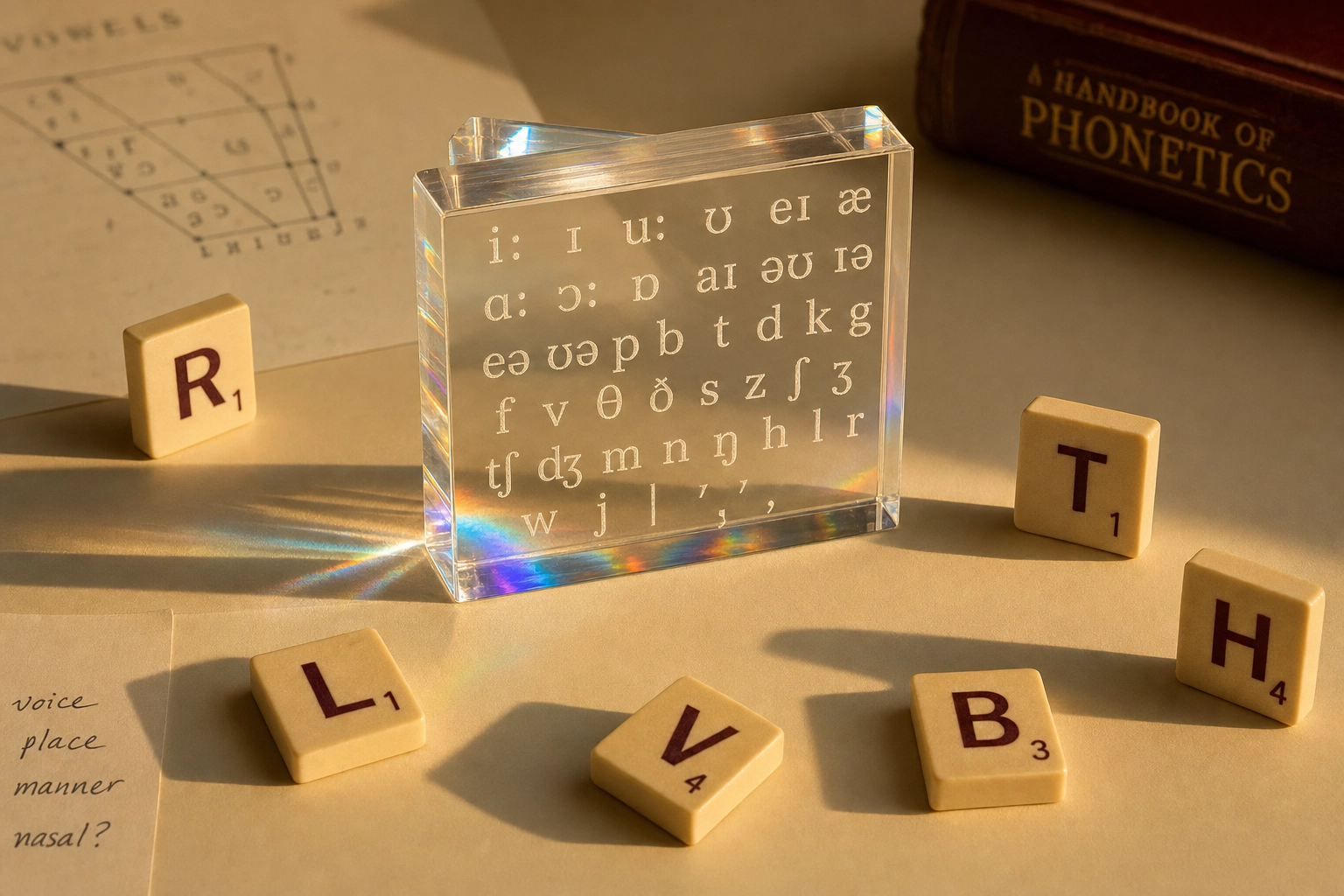
Three core gaps every Japanese English learner has to bridge:
- Phonology — the sounds. The Japanese language uses ~5 vowels and a strict CV (consonant-vowel) syllable structure. English uses 12+ pure vowels, 8 diphthongs, and complex consonant clusters. Roughly 20 English sounds simply don't exist in Japanese.
- Prosody — the rhythm. Japanese is mora-timed and pitch-accented. English is stress-timed: stressed syllables get longer, louder, higher; unstressed ones reduce to a near-silent schwa.
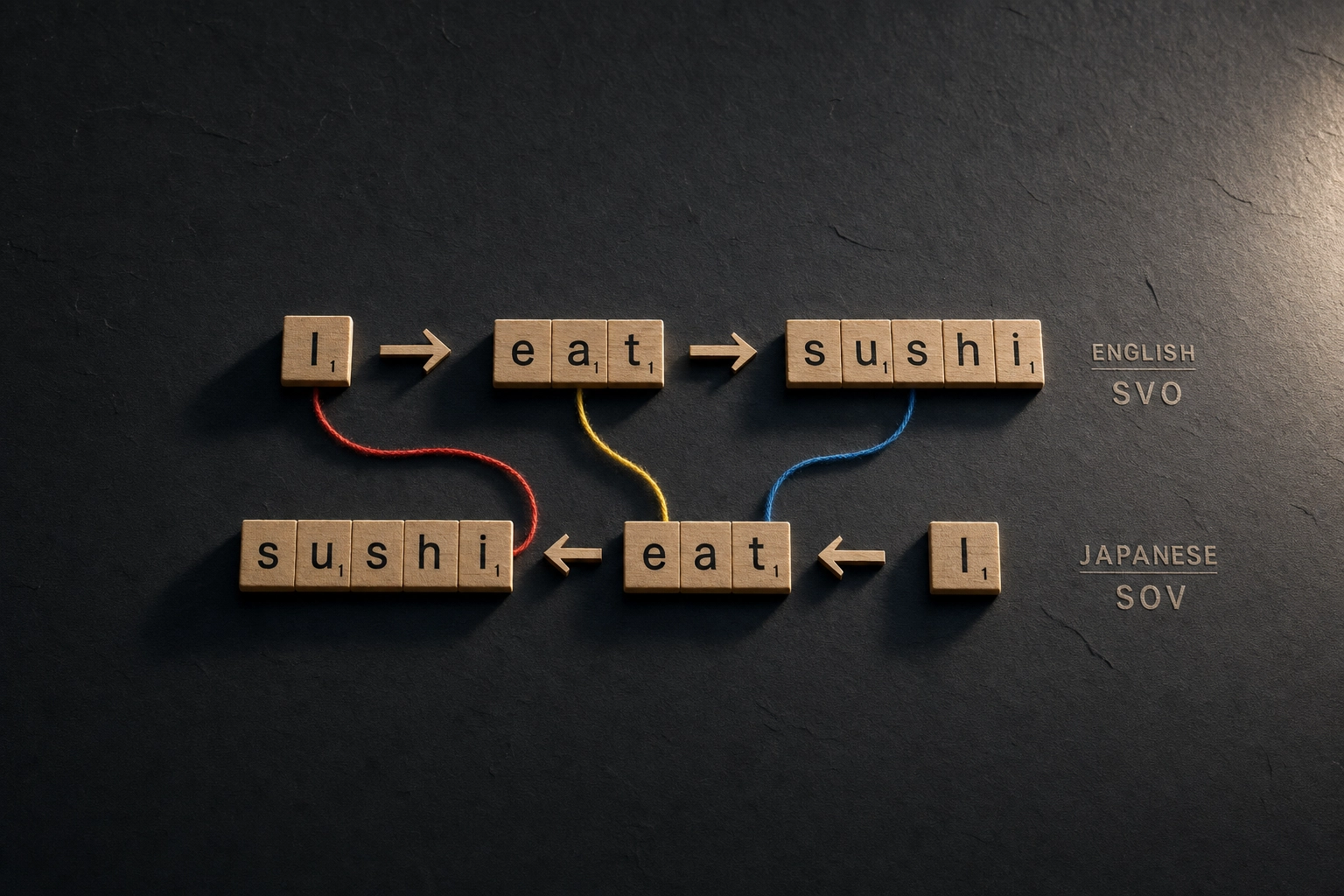
- Syntax — the grammar. Japanese is subject-object-verb, topic-prominent, head-final, and pro-drop. English is subject-verb-object, head-initial, and demands explicit subjects, articles, and plurals.
Layer those gaps on top of a Japanese education system that emphasizes reading and grammar over free speaking, and you get the "output gap": learners who comprehend but can't produce. Over half of Japanese students score zero percent on the speaking section of nationwide tests.
The good news: every gap is mappable. To start with broader foundations, our non-native speaker guide helps build the basics. The rest of this page is specific to English for Japanese speakers.
The 6 Pronunciation Challenges in English for Japanese Speakers
Each challenge below exists because of something the Japanese language doesn't do. Once you can name the gap, you can train it.

1. R vs L — Japanese Has One Liquid Sound, English Has Two
Japanese doesn't have an "R" halfway between English R and L. It has one liquid phoneme — an alveolar tap [ɾ] — acoustically closer to a soft tapped D than to either English sound. English has two completely separate phonemes: lateral /l/ and rhotic /ɹ/.
Research by Goto (1971) and later studies show Japanese adults often can't reliably hear the difference between English R and L, even after years in English-speaking countries. The brain learned at age zero that those frequencies were the same sound.
The fix is mechanical, not auditory:
- /l/ as in "light": Tongue tip presses against the alveolar ridge — just behind your upper front teeth — and stays there. Air flows around the sides.
- /r/ as in "right": Tongue curls back and bunches in the middle of your mouth. Tip touches nothing. Lips round slightly.
Practice these minimal pairs: light/right, play/pray, long/wrong, glass/grass, fly/fry, lock/rock. Say them slowly while watching your mouth in a mirror. Our pronunciation practice for beginners and English tongue twisters help you build muscle memory.
2. The TH Sounds — No Dental Fricatives in Japanese
Japanese has no /θ/ (TH in "think") and no /ð/ (TH in "this"). These dental fricatives don't exist in the Japanese language at all.
Japanese speakers usually replace /θ/ with /s/ ("sink" for "think") and /ð/ with /z/ ("zat" for "that"). "Thank you" sometimes comes out "sank you," which can land awkwardly.
The fix: Stick the tip of your tongue lightly between your upper and lower front teeth. Push air through the gap. For voiceless /θ/, vocal cords stay quiet. For voiced /ð/, you turn on your voice. Practice words: think, three, thirty, Thursday, this, that, weather, father, brother, with.
3. V vs B — The Phantom V Problem
Japanese has /b/ but no /v/. The katakana ヴ (vu) was created to represent foreign V sounds, but it's rarely used — most English V words got assimilated with B. Television became テレビ (terebi). Violin became バイオリン (baiorin). Video became ビデオ (bideo). Decades of katakana habit have wired V→B into the average Japanese speaker's mouth.
The fix is about your lower lip:
- B is a plosive: both lips press together, then pop apart.
- V is a fricative: lower lip touches upper teeth (gently), and air vibrates while vocal cords hum.
Test pairs: very/berry, vote/boat, vase/base. A practice sentence that forces switching: "I have a very big vocabulary." Three V/B switches in five words.
4. Vowel Insertion After Consonants — The Katakana Trap
Japanese is a strictly CV language. Every consonant must be followed by a vowel; only /n/ can end a syllable. This is why English loanwords get extra vowels:
- desk → desuku (デスク)
- milk → miruku (ミルク)
- world → waarudo (ワールド)
- McDonald's → makudonarudo (マクドナルド)
The pattern gets baked into your mouth through years of katakana exposure. When you reach for "milk," "miruku" comes out — your motor memory has practiced it thousands of times.
Fix: Practice closing your lips on /p/ and /b/ without releasing them. Practice clusters as one motion — "asked" is /æskt/ snapped together, not "asu-ku-do." Record yourself; the /u/ insertion is sneaky. Target words: cat (not kyatto), help (not herupu), bus (not basu), street (not sutoriito).
5. Word Stress — Pitch-Accent Meets Stress-Timing
Japanese is mora-timed: each mora gets roughly equal duration, and stress comes from pitch. English is stress-timed: stressed syllables are longer, louder, and higher; unstressed ones compress to a fast schwa /ə/. Apply Japanese rhythm to English and the music goes flat.
Stress placement also carries meaning:
- REcord (a recording) vs. reCORD (to capture)
- PREsent (a gift) vs. preSENT (to give)
- CONtract (an agreement) vs. conTRACT (to shrink)
Fix: Identify the stressed syllable. Exaggerate it. Compress the rest. Try clapping the rhythm: clap loud on the stressed syllable, soft on the rest.
6. Sentence Intonation — The Melody of English
Japanese intonation is relatively flat — pitch changes are local to each word. English uses sweeping curves: rising on yes/no questions, falling on statements, with emphatic peaks on the most important content words.
- "Are you ready?" ↗ (yes/no question)
- "I'm ready." ↘ (statement)
- "WHAT did you say?" (peak on "what")
- "What did you say?" (peak on "you")
Same words, different melody, different meaning. The shortcut to find better English intonation isn't memorizing rules — it's shadowing. Pick a 30-second clip of a native speaker and repeat it imitating not just the words but the rise and fall. Our shadowing practice guide walks through the technique.
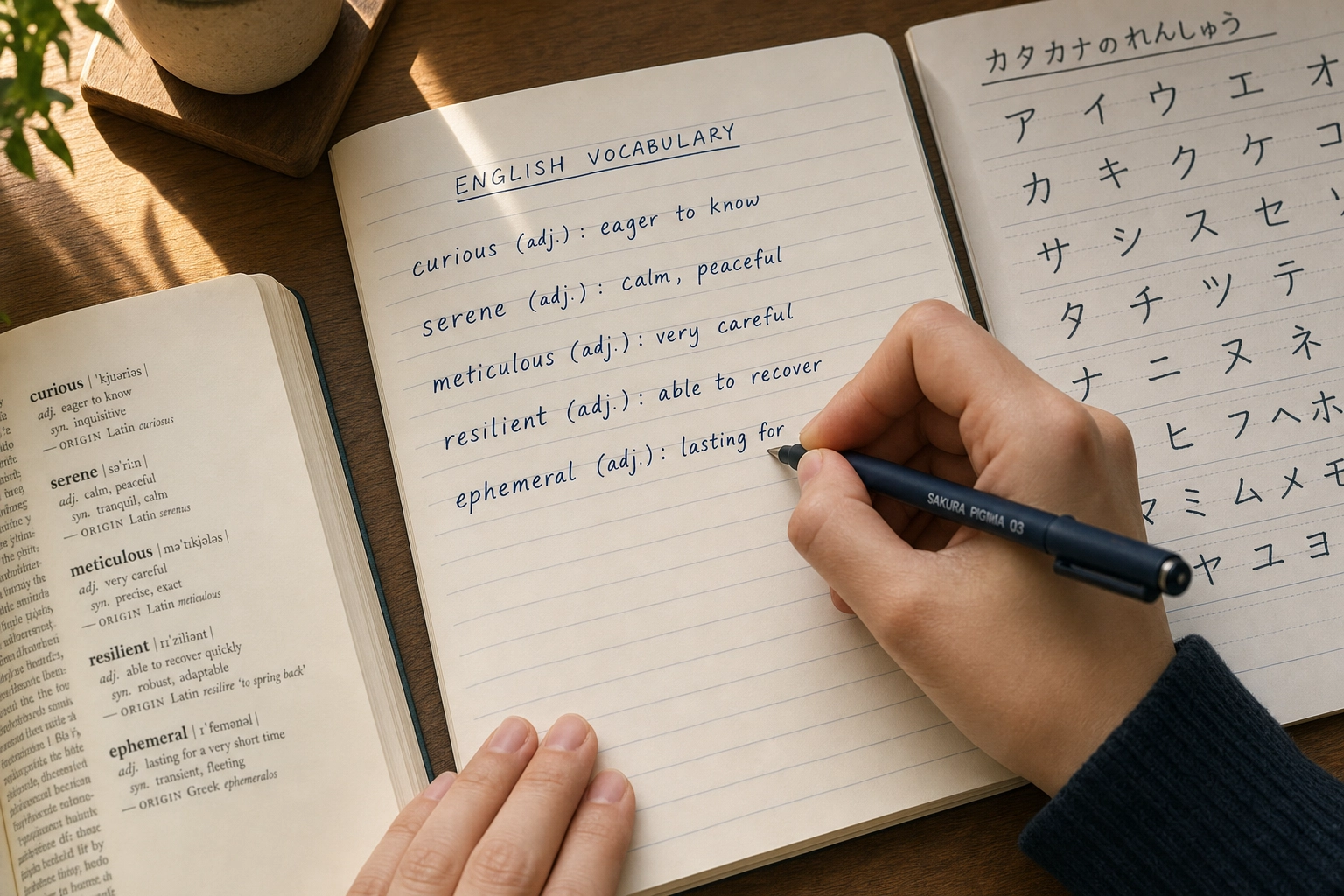
20 Hard English Words for Japanese Speakers (With Katakana Comparison)
Each word includes IPA, the katakana approximation Japanese speakers default to, the challenge, and the fix.
R/L Words That Trip Up Japanese Speakers
1. really /ˈriː.li/ — katakana: リアリー Two /l/ sounds in a row. Japanese instinct adds a vowel between them. Tongue tip on the alveolar ridge, stays there. Two syllables: REE-lee.
2. world /wɜːrld/ — katakana: ワールド (wa-a-ru-do) Four sounds at the end (/r/-/l/-/d/) with no vowels between. Glide from R-curl to L-touch to D-tap without releasing into a vowel.
3. girl /ɡɜːrl/ — katakana: ガール Both liquids in a row. Start the R curl mid-vowel, then flick the tip to the alveolar ridge for the L. One snapping motion.
4. rural /ˈrʊr.əl/ — katakana: ルーラル Three R/L sounds in five letters. Notoriously hard. Both R's are full English /r/. Final "al" is /əl/.
5. literally /ˈlɪt.ər.ə.li/ Triple liquid (l-r-l). Surprise: in casual American English, the middle "t" becomes a flap [ɾ] — the same sound as Japanese ら. Use that to your advantage.
6. parallel /ˈpær.ə.lel/ R, then two L's. Stress on PAR. The two L's are sustained, not separated.
TH Words That Need Tongue-Between-Teeth
7. thirty /ˈθɜːr.ti/ — katakana: サーティー Initial TH, then R-vowel, then a flap T. Tongue between teeth, curl back for the R, flap the T.
8. Thursday /ˈθɜːrz.deɪ/ TH + R + Z cluster + diphthong. Think "th-erz-day" — only two syllables.
9. throughout /θruːˈaʊt/ TH + R cluster + diphthong. Drop your tongue between your teeth, immediately glide into "roo," then "out."
10. months /mʌnθs/ Three sounds tightly clustered: /n-θ-s/. Practice "month" first, then add a fast /s/.
V/B and Consonant Cluster Words
11. vegetable /ˈvedʒ.tə.bəl/ V at start, J-sound in the middle, only 3 syllables: VEJ-tuh-bull. The "e" between veg- and -table is silent.
12. vocabulary /voʊˈkæb.jə.ler.i/ — katakana: ボキャブラリー V, then B, in the same word. Stress on the second syllable: vo-CAB-yu-leh-ree.
13. available /əˈveɪ.lə.bəl/ — katakana: アベイラブル V is a fricative, not a stop. Don't say "abeilable." Stress on -VAIL-.
14. asked /æskt/ Three consonants, no vowel: /skt/. Hiss "ssss," add /k/, then /t/, all snapped together.
15. specifically /spəˈsɪf.ɪ.kli/ Initial /sp/ cluster — don't add /u/ between s and p. Fix: spuh-SIF-ik-lee.
Duolingo taught you words. No one taught you to speak.
PracticeMe: real voice conversations with an AI tutor, 24/7.
Stress and Multi-Challenge Words
16. comfortable /ˈkʌmf.tər.bəl/ — katakana: カンファタブル Looks like 4 syllables but is 3: KUMF-ter-bull. The "or" disappears. One of the most commonly mispronounced English words by Japanese speakers.
17. refrigerator /rɪˈfrɪdʒ.ə.reɪ.tər/ — katakana: レフリジレイター Two /r/ sounds plus the /dʒ/ J-sound. Stress on second syllable: re-FRIDGE-er-ay-ter.
18. February /ˈfeb.ru.er.i/ Most American speakers drop the first R: FEB-yoo-er-ee. The /br/ cluster is the trap.
19. Wednesday /ˈwenz.deɪ/ Silent D in the middle. Only 2 syllables: WENZ-day.
20. lawyer /ˈlɔɪ.jər/ "Aw" looks like it should rhyme with "law," but the diphthong shifts to /ɔɪ/. LOY-er — like "boy" plus "er."
Bonus — drawer /drɔːr/ — one syllable despite six letters. Just "drawr." Bonus — twelfths /twelfθs/ — five consonants in a row. Even natives struggle.
For more by language, our hardest English words by native language post covers Spanish, Chinese, Arabic, Hindi, and Japanese speakers.
Grammar Patterns That Trip Up Japanese Speakers
Pronunciation gets most of the attention, but grammar interference is just as common — and because it's invisible to the speaker, it often goes uncorrected for years.
Articles (a, an, the) — Japanese Has None
Research from the University of Fukui found article errors are the single most frequent error Japanese learners of English make — and omission is the most common type.
The Japanese language expresses definiteness through context, particles (は wa, が ga), and demonstratives (この kono "this"). It doesn't need a or the.
Common errors:
- ❌ "I want to be doctor." → ✅ "I want to be a doctor."
- ❌ "Please pass salt." → ✅ "Please pass the salt."
- ❌ "Sun is bright today." → ✅ "The sun is bright today."
Two-question shortcut: Is the listener supposed to know which one? If yes → "the." Is it singular and countable, and new information? → "a" or "an." Native speakers track articles unconsciously and notice immediately when one is missing.
Subject Dropping (Pro-Drop Transfer)
Japanese is topic-prominent and pro-drop. Subjects (and often objects) get omitted when context makes them obvious. Tabemashita (食べました) literally just means "ate" — the subject is inferred.
This habit transfers to English:
- ❌ "Went to the store yesterday." → ✅ "I went to the store yesterday."
- ❌ "Is raining." → ✅ "It is raining."
- ❌ "Was a great movie." → ✅ "It was a great movie."
English requires an explicit subject in almost every sentence, even when grammatically empty. "It is raining" — the "it" doesn't refer to anything; English just demands a subject slot.
Plural Markers — The Hidden /s/
Japanese rarely marks plural. Ringo (りんご) can mean "apple" or "apples." The suffix -tachi (達) exists but is mostly for people.
English count nouns require explicit plural marking:
- ❌ "I bought three book." → ✅ "I bought three books."
- ❌ "Many student come to class." → ✅ "Many students come to class."
Watch for irregular plurals (children, people, mice — no /s/) and uncountable nouns (information, advice, news — never take /s/). "Many informations" is wrong; say "much information."
Relative Clause Position — Backwards from Japanese
Japanese is head-final: descriptive clauses come before the noun. Kakuta hito (書いた人) reads "wrote person" — the person who wrote.
English is head-initial: descriptive clauses come after the noun. The person who wrote.
When Japanese speakers transfer their native pattern to English:
- ❌ "The yesterday I bought book is good."
- ✅ "The book I bought yesterday is good."
Japanese also has no relative pronouns (who, which, that), so they often get forgotten in English. Practice pattern: noun first → THAT/WHO/WHICH → description. Our guide on how to think in English instead of translating tackles this directly.
The Real Reason Japanese Speakers Struggle: It's Not Just the Language
Pronunciation and grammar gaps are real. But they don't fully explain why Japan ranks 92nd while South Korea ranks 50th and the Philippines ranks 22nd. Korean is structurally similar to Japanese — pro-drop, head-final, SOV — yet Korean learners outperform Japanese learners.
The bigger barrier is psychological and cultural. A 2025 study in TPM by Muthumaniraja and colleagues identified perfectionism as a primary precursor to foreign language anxiety in Japanese EFL learners — and that anxiety predicts how willing learners are to actually speak.
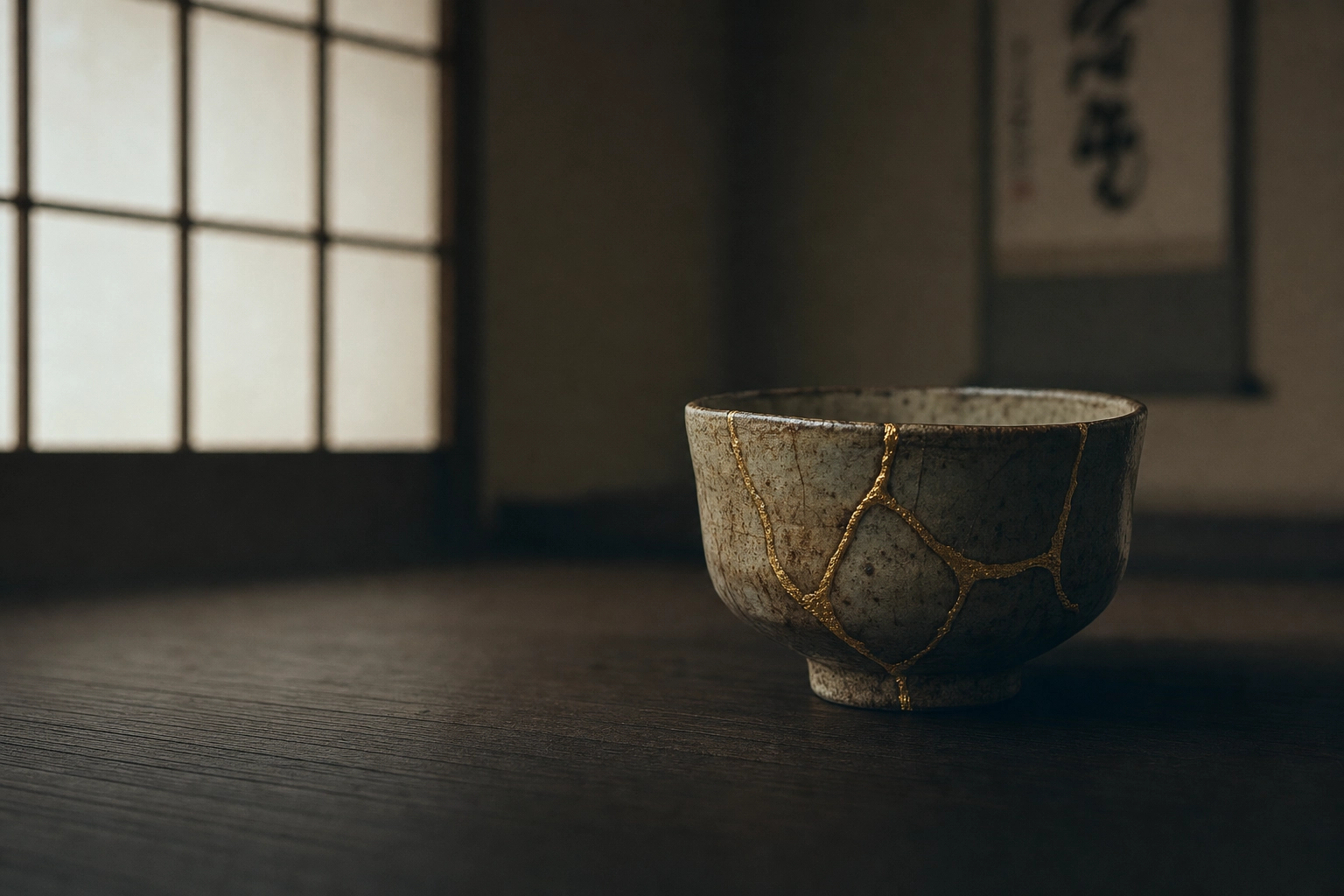
Perfectionism (Kanpekishugi 完璧主義)
The cultural value that produces flawless sushi, kintsugi pottery, and bullet trains accurate to the second becomes a barrier when applied to spoken English. A perfect noun phrase is achievable. A perfect spontaneous conversation is not.
Writer Miki Toyota captured the irony in her 2024 essay: "Perfectionism makes sushi an art — but conversations are meant to be messy, not masterpieces." Many Japanese learners understand this intellectually and still cannot bring themselves to speak imperfectly. The wabi-sabi (侘寂) tradition — finding beauty in imperfection — could be a powerful frame for language learning.
Kenkyo (謙虚 — Modesty) and the "My English Is Poor" Reflex
Kenkyo — modesty — is a core social virtue. The phrase "Sumimasen, eigo ga heta de" (sorry, my English is poor) is so reflexive that fully fluent Japanese speakers often say it before any English conversation begins.
The result is double damage. You broadcast a low expectation that your conversation partner will accept and adjust to — even if your English is good. And you wire that low self-image deeper into your own confidence.
In English-speaking cultures, calling yourself "poor at English" reads as either fishing for compliments or warning the listener. Neither lands the way kenkyo does in Japanese. A simple "I'm still practicing" communicates the same humility without sandbagging yourself.
Wa (和 — Group Harmony) and Fear of Standing Out
There's a famous Japanese proverb: Deru kui wa utareru (出る杭は打たれる) — the nail that sticks out gets hammered down. Speaking confidently in English in front of Japanese peers can feel like sticking up — showing off, breaking harmony.
Multiple classroom studies have documented Japanese students deliberately downplaying their English ability to avoid appearing different from classmates. The social cost of being seen as eigo ga umai (good at English) by your peers can outweigh the benefit of practicing.
The implication: practice environments where Japanese speakers do best are ones with no Japanese peers watching — and ideally, no human watching at all. If speaking anxiety is your wall, our deeper guide on how to overcome the fear of speaking English breaks it down further.
How to Practice English Speaking Without the Anxiety
Here's a practice approach that works with Japanese cultural values instead of against them. The traditional "just go to a language exchange" advice is exactly wrong for many Japanese learners — it activates every cultural alarm bell at once.

A better sequence to start:
1. Practice alone, before anyone else hears you. Private practice is not procrastination — it's the confidence layer that makes public practice possible. Twenty minutes of solo speaking removes more anxiety than ten conversations with strangers. Our guide on practicing English alone has a step-by-step routine.
2. Aim for understandable, not perfect. Apply wabi-sabi to your own speech. A perfectly imperfect sentence that lands is worth ten beautiful sentences that never leave your mouth.
3. Get unlimited repetitions. Pronunciation is muscle memory. Your tongue, lips, and breath need thousands of correct reps to overwrite katakana habits and help your mouth learn new patterns. A weekly tutor session gives you a few dozen reps. You need thousands.
4. Get feedback in a low-pressure way. Human teachers, even kind ones, watch your face when you make a mistake. That micro-judgment activates kenkyo and makes you self-edit. Practice that's both private and feedback-rich is the unlock.
5. Practice topics you'll actually use. Generic textbook scenarios feel artificial. Practice ordering coffee, doing a job interview, or explaining your work. Specificity sticks. Our daily English speaking routine gives a 15-minute structure to start with today.

This is exactly why we built Practice Me. You pick a tutor — Sarah (American, friendly), Oliver (British, professional), or Marcus (American, easygoing) — and have a real voice conversation. They adapt to your level and help you with whatever topics matter. They don't sigh, frown, or switch to Japanese to be polite. You can fail a hundred times and nobody knows.
The Pro plan unlocks unlimited conversations, all tutors, and both American and British accents. The iOS and Android apps start with a free trial; the Pro plan is available on both. For TOEFL prep, our TOEFL speaking topics guide pairs naturally with daily Practice Me sessions.
The biggest unlock for many Japanese users isn't a new technique. It's that, for the first time, they find a place to practice English without anyone — Japanese or foreign — watching.
Frequently Asked Questions About English for Japanese Speakers
Why is English harder for Japanese speakers than for Korean or Chinese speakers?
Korean and Chinese both have larger vowel inventories than Japanese (Korean ~10 monophthongs, Mandarin ~6 plus tones, Japanese 5), so the vowel gap is smaller. They also have more permissive syllable structures, so consonant clusters are less foreign. Daily exposure differs too: South Korea has decades of close contact with American English, and major Chinese cities have larger English-speaking populations than most Japanese cities.
How long does it take a Japanese speaker to become fluent in English?
The U.S. Foreign Service Institute classifies Japanese as a Category IV language — about 2,200 class hours for working proficiency. Plan on 1,500–2,200 hours of focused study to reach upper-intermediate fluency. At one hour per day, that's 4–6 years. Conversational confidence — the gap most Japanese learners face — comes much faster, often after just 30–60 days of daily speaking practice.
Should I learn American English or British English?
For most Japanese learners, American English is more practically useful. It dominates business, technology, popular media, and Japan's own English education curriculum. American pronunciation is also slightly more forgiving of Japanese-accented speech. Choose British English if you're studying or working in the UK or EU. Whichever you pick, commit. Mixing accents sounds confused.
Do I need to lose my Japanese accent to speak English well?
No. The goal is intelligibility, not native-like sound. Many highly successful international Japanese speakers — Haruki Murakami, Marie Kondo, Hideki Matsui — have audible Japanese accents and communicate clearly. Focus your effort on the sounds that affect meaning: R/L, TH, V/B, and word stress. An accent is a record of where you came from; aim to be clear, not American.
Why can I read English well but freeze when speaking?
This is the "output gap" — the defining feature of Japanese English education. Reading and listening are input skills. Speaking and writing are output skills. Japanese curriculum has historically emphasized input — grammar, reading, listening — with very limited free speaking practice. The fix is uncomfortable but simple: the only way to get better at speaking is to speak. Even 15 minutes of daily practice closes the gap faster than years of additional reading.
Start Speaking English Confidently — No Audience, No Judgment

Pronunciation gaps in English for Japanese speakers are real but mappable: R/L, TH, V/B, vowel insertion, stress, and intonation. Grammar interference is predictable: articles, subject dropping, plurals, relative clause position. The biggest barrier, though, is the psychological one — perfectionism, modesty, and group harmony combining into a quiet voice that says "don't speak until it's perfect."
That voice will never let you speak, because no language is ever perfect. The Japanese cultural strengths of preparing thoroughly before performing publicly work against you in language learning, where messy practice is the path. The first time you speak English without an audience is the moment your real fluency starts.
Practice Me is built for exactly that moment — AI English tutors available 24/7, real voice conversations, American and British accents, three tutor personalities, and zero humans watching. The Pro plan gives you unlimited practice, and the iOS app starts with a free trial — find a quiet moment tonight and start speaking.
You already know more English than you think. Now you just need somewhere to use it where the stakes are zero.