Duolingo taught you words. No one taught you to speak.
PracticeMe: real voice conversations with an AI tutor, 24/7.
Babbel Speak Review: New Speaking App [2026]
![Babbel Speak Review: New Speaking App [2026]](https://cdn.babyseo.ai/images/practiceme.app/babbel-speak/babbel-speak-review-language-speaking-practice-hero.webp)
For the better part of two decades, Babbel taught you words. In late 2025, it finally asked you to say them.
Babbel Speak is the company's first feature built entirely around the moment most language learners dread: opening your mouth. Launched in open beta on September 16, 2025, it bolts a voice-led conversation partner onto an app long known for tidy grammar lessons and vocabulary drills. The promise is bold — take nervous beginners "from silence to speech" — and as Babbel's first dedicated speaking product, it deserves a careful, honest look.
In this Babbel Speak review, I'll cover exactly what Babbel Speak is, how it works, where it genuinely helps, and where it quietly falls short — plus who should use it and who should look elsewhere in the wider world of AI language learning apps. I'll also put Babbel Speak head to head with Practice Me, a conversation-first alternative built around open-ended voice calls, so you can pick the right tool for your level and goals.
Quick Summary: Babbel Speak is an AI-powered speaking feature inside the Babbel mobile app that guides you through scripted, real-life conversation scenarios with pronunciation feedback. It's a well-designed confidence on-ramp for complete beginners, but it stays guided and repetitive rather than offering true open-ended AI conversation — so intermediate and advanced learners chasing real fluency will outgrow it fast.
What Is Babbel Speak?
Babbel Speak is an AI-powered, voice-led speaking trainer built into the main Babbel app. Instead of tapping answers or matching words to pictures, you talk out loud to an AI conversation partner that walks you through everyday situations — ordering a coffee, greeting a neighbor, chatting about your interests.
It launched as an open beta on September 16, 2025, accessible through a new "Speak" tab on the app's home screen. Crucially, it is not a separate download — there's no standalone Babbel Speak app. It's a feature layered on top of the lessons, courses, and curriculum Babbel has refined since 2007.
At launch, Babbel Speak supports five languages: English, Spanish (both European and Mexican), French, Italian, and German. That English support matters — it means ESL learners can use it too, not just English speakers learning Spanish or another foreign language.
Babbel frames it as the missing bridge in its method, saying it "completes Babbel's progressive speaking practice from structured to natural conversation." In plain terms, it's the first time the app has built Babbel speaking practice around an actual back-and-forth, rather than asking you to repeat a phrase after a recording. Like Rosetta Stone and Pimsleur, Babbel has always lived in the structured-course camp — and Babbel Speak extends that same method into spoken practice.
How Babbel Speak Differs From Classic Babbel Lessons
If you've used Babbel before, you know the classic format: short, expert-built lessons and courses that introduce vocabulary, explain grammar, and test you with fill-in-the-blank exercises and spaced-repetition review. It's structured, methodical, and built around recognition and recall — and unlike Duolingo's gamified, streak-chasing style, it has always been aimed at adult learners who want the reasoning behind each rule.
Babbel Speak is different from those lessons in one key way — production. You're not selecting the right answer; you're generating speech in real time and responding to an AI that talks back. Think of the classic lessons as learning the ingredients and Babbel Speak as your first attempt at cooking the meal.
One important limitation up front: Babbel Speak is mobile-only. Babbel's help center confirms it's available solely on the mobile app, not the desktop or web version. If you study your lessons on a laptop, you simply can't reach it.
How Does Babbel Speak Work?
Each Babbel Speak session is built around a single, expert-curated scenario — a slice of real life like ordering food, introducing yourself, or asking for directions. Before you start, the app shows you a clear objective so you know exactly what you're working toward.
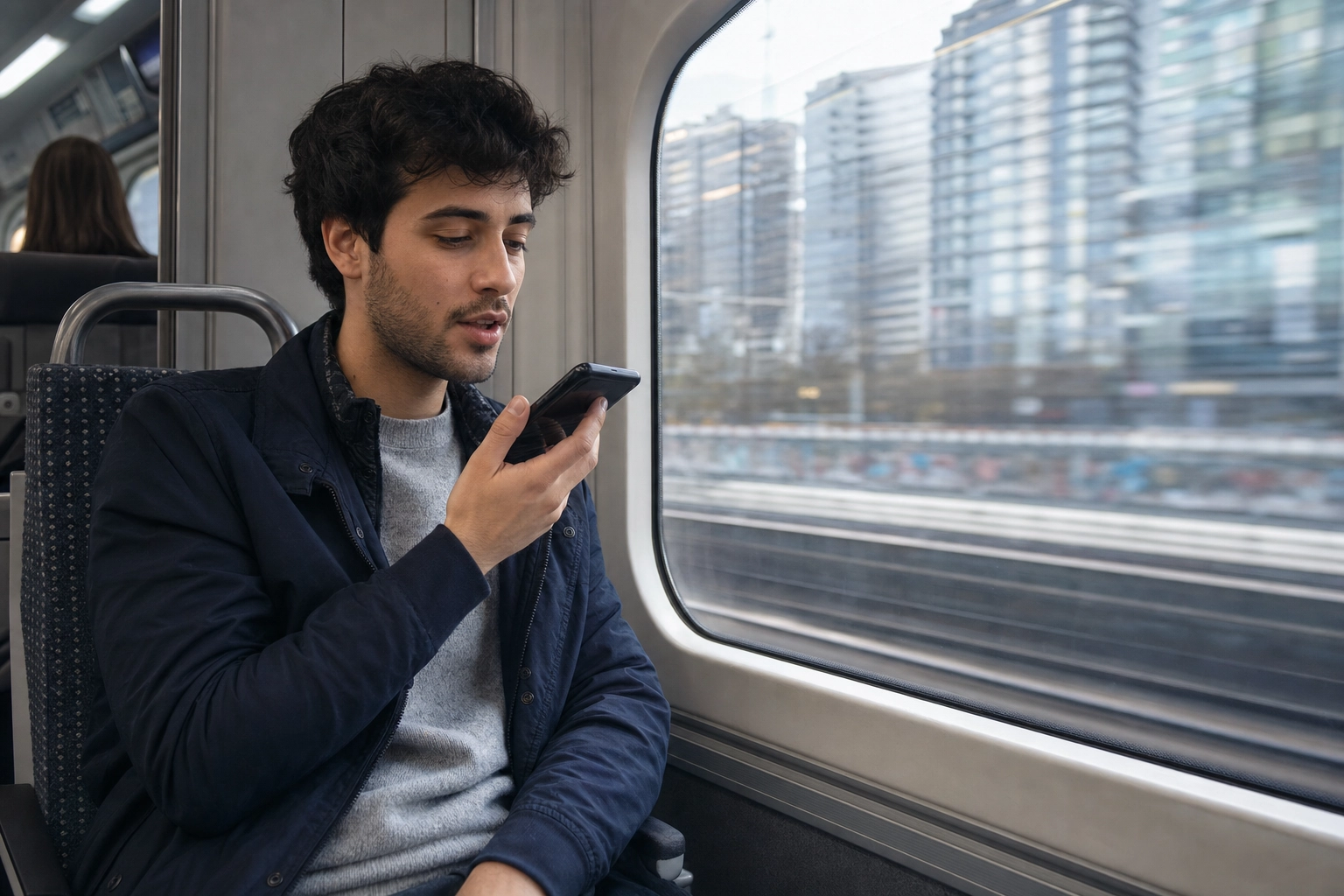
When the conversation begins, an AI-generated voice speaks first. Reviewers note the voice sounds surprisingly realistic and adopts a clear accent, which helps with pronunciation modeling. Your job is simple: speak back.
The core Babbel Speak features are easy to summarize: expert-curated scenarios, an AI-generated dialogue partner, in-conversation hints, and pronunciation feedback — all wrapped in a calm, beginner-friendly interface. If you get stuck — and beginners will — you have a safety net. According to a two-week hands-on test for Tom's Guide, you can ask the AI to slow down, repeat itself, translate into your own language, or hand you a hint when you don't know what to say. That scaffolding is the whole point: it keeps you talking instead of freezing.
Under the hood, speech recognition listens to your pronunciation and offers feedback — though pronunciation-focused tools like ELSA Speak take a far more granular, drill-based approach, as covered in our ELSA Speak comparison. The design leans hard into comfort, too: Babbel describes gentle animations, visual cues for conversation timing, and a deliberately calming interface meant to reduce cognitive load and speaking anxiety.
Babbel describes the system as a two-layer design. Its language experts define the pedagogy — how you progress through scenarios and what you practice — while the AI manages the conversational flow and personalized responses. As Babbel's principal product manager Franz Ardito told EdTech Innovation Hub, the team had to "strike the balance between overwhelming learners with complete conversational freedom and intimidating them with challenging tasks." That balance is the feature's central design choice — and, as we'll see, its central limitation.
A Typical Babbel Speak Session, Step by Step
Here's what using Babbel Speak actually looks like:
- Open the Speak tab and choose a scenario matched to your level.
- Read the objective and any key phrases the app surfaces beforehand.
- The AI greets you and prompts you to respond out loud.
- You speak back, leaning on hints, slow-down, or translation whenever you're stuck.
- You finish with feedback and a set of useful phrases to carry into your next conversation.
The loop is designed to be short, low-stakes, and repeatable — closer to a guided rehearsal than a real, unpredictable chat.

Babbel Speak Strengths: What It Gets Right
Babbel Speak isn't hype. For the right learner, it does several things genuinely well.
It's backed by a proven curriculum. Babbel Speak inherits the structured, expert-designed pedagogy that independent studies from Yale University, Michigan State University, and the City University of New York have linked to real gains in oral proficiency. The scenarios aren't random — they're sequenced by the same linguists who build Babbel's lessons and courses, the grammar-aware Babbel Method that draws learners who find Duolingo's streaks too shallow.
The scaffolding works for true beginners. The single biggest barrier in language learning isn't vocabulary — it's the fear of opening your mouth. Research on foreign language anxiety consistently finds that more than half of learners report high anxiety, and speaking is the skill that triggers it most. Babbel Speak's hints, clear objectives, and "you can't really fail" framing are well-aimed at helping nervous learners overcome the fear of speaking English. It helps people who would never start a conversation take a first step.

The audio is high quality. Babbel has always leaned on native-speaker recordings, and the AI voice in Babbel Speak continues that tradition with clear, realistic pronunciation — a crisp Spanish, German, or English accent you can imitate. For learners building an ear for the language, that matters.
It's a judgment-free space. No human is listening, no one sighs when you stumble, and you can repeat a scenario as many times as you like. For anxious or shy learners, removing the social stakes is liberating — the same principle behind why so many people now practice English speaking with AI before trying it on a real person.
It's effectively free if you already pay for Babbel. There's no separate Babbel Speak subscription. If you're a current subscriber in a supported language, it's simply there in your app at no extra cost, right beside your normal lessons, podcasts, and review tools.
It covers multiple languages. Unlike English-only speaking tools, Babbel Speak works across five languages, so a household learning Spanish, German, and English can get value from one ecosystem.
Babbel Speak Weaknesses: Where It Falls Short
Here's where an honest review has to push back. Babbel Speak's strengths come from its structure — and that same structure is its ceiling.
It's still scripted, not real conversation. This is the big one. Despite the "AI conversation partner" label, Babbel Speak guides you along expert-defined rails. You're rehearsing scenarios, not having spontaneous dialogue. In a detailed October 2025 review, one experienced Babbel user concluded the platform "doesn't have AI conversational practice or adaptive learning systems," and that its "templated tourist scenarios" don't scale: try to discuss politics, philosophy, or current events — anything beyond the script — and Babbel "doesn't scale with you."
It gets repetitive fast. In the hands-on Tom's Guide test, the reviewer liked the feature but noticed he "seemed to just be having similar conversations but with different scenarios" — a sameness he warned "could impact how engaged a user would stay with the app over a longer period of time."
There's no memory and no real adaptation. Babbel Speak doesn't remember you between sessions or adjust to your interests, your weak spots, or your pace. Every conversation starts from the same blank slate. That's a meaningful gap for anyone who wants steady, personalized progress rather than isolated rehearsals.

The feedback can be too forgiving. Some users in Babbel's own community have complained that the speaking review is overly lenient — that you "can say anything you want and the AI will register it as correct." For a tool whose whole job is building accurate speech, soft feedback undercuts the value.
It's an open beta with limited advanced content. Babbel itself frames Babbel Speak as a beta "giving room for further iteration." That honesty is welcome, but it means rough edges, a shallow library of scenarios, and very little for upper-intermediate or advanced learners right now.
It's mobile-only, with a familiar interface. No desktop or web version exists, and some learners find Babbel's overall UI dated. The same Medium reviewer noted that recent years have brought "no fundamental innovation" — mostly curriculum refinements and minor UI tweaks rather than a leap forward.
Each language usually means a separate subscription. A standard Babbel plan covers one language. If you want to practice speaking in two, you'll generally pay for two subscriptions — a cost that adds up for multilingual households.
If your goal is to genuinely speak under pressure, those limitations matter. Scripted practice builds familiarity, but real fluency comes from handling the unexpected — exactly what open English role-play scenarios train and a fixed script can't. Even using ChatGPT for English practice lets you go off-script in ways Babbel Speak won't.
How Much Does Babbel Speak Cost?
There's no standalone Babbel Speak price — it's bundled into a regular Babbel subscription. If you already subscribe in a supported language, you get it for free.
Babbel's pricing shifts constantly with promotions, but the pattern is consistent: the longer you commit, the cheaper the monthly rate. Across plan lengths, the monthly rate stays relatively affordable, with month-to-month plans costing more and annual or multi-year plans bringing the per-month price down. You can try some sample lessons for free, but full access requires a paid plan.

Two cost details are easy to miss:
- One subscription usually covers one language. Babbel's standard plans are language-specific, so practicing speaking in a second language generally means a second subscription.
- Human classes are gone. Babbel discontinued its live, human-led Babbel Live group classes for individual consumers on July 1, 2025. If you specifically want real teachers, our italki vs AI English practice and Cambly alternatives breakdowns weigh the tradeoffs — but that option no longer exists inside Babbel itself for individuals.
For comparison, Practice Me takes a single-purpose approach: unlimited open-ended conversation in English for a flat monthly rate with a short free trial — you can see the full breakdown on the Practice Me pricing page. Babbel is the cheaper, broader curriculum; Practice Me is the dedicated conversation engine. And if budget is your only concern, it's worth scanning the best free English speaking apps before you commit to anything.
Duolingo taught you words. No one taught you to speak.
PracticeMe: real voice conversations with an AI tutor, 24/7.
Who Should Use Babbel Speak?
The honest answer depends entirely on your level and what you're trying to achieve.
Best For: Complete Beginners Who Want Structure
Babbel Speak is genuinely good for:
- Absolute beginners (A0–A1) taking their very first steps into speaking a new language.
- Nervous learners who freeze up and need hints, clear objectives, and a guaranteed-safe space to start.
- Existing Babbel subscribers who want to add speaking reps without leaving the app and lessons they already pay for.
- Travelers rehearsing predictable, high-frequency situations — ordering, greeting, asking for directions — before a trip.
If that's you, Babbel Speak is one of the gentlest on-ramps available, and it pairs naturally with the broader work of building English speaking confidence.

Not For: Learners Who Need Real Fluency
Babbel Speak will frustrate you if you're:
- An intermediate or advanced learner who wants open-ended, go-anywhere conversation.
- Someone who needs to speak under pressure — interviews, meetings, exams, real-world small talk — where nothing follows a script.
- A learner who wants an AI tutor that remembers you and adapts to your goals over time.
- A web or desktop user, since Babbel Speak is mobile-only.
For those learners, a scripted trainer isn't enough. You need to practice the messy, unpredictable reality of conversation — which is exactly where a conversation-first tool comes in.

Babbel Speak vs Practice Me: Scripted Scenarios vs Real Conversation
Babbel Speak and Practice Me both want to get you talking, but they take opposite philosophies. In the Babbel vs Practice Me decision, the dividing line is simple: Babbel Speak guides you through a script, while Practice Me hands you the microphone and lets you actually talk.
Practice Me is an AI English speaking app built around open-ended, real-time voice calls with AI tutors — Sarah, Oliver, and Marcus — each with their own personality and a choice of American or British native accents. There's no fixed script. You can talk about your day, rehearse a job interview, debate football, or work through a travel scenario, and the tutor responds naturally. Most importantly, the tutors remember you across sessions, so your practice builds on itself instead of resetting every time.

Here's how the two compare:
| Babbel Speak | Practice Me | |
|---|---|---|
| Conversation style | Guided, scripted scenarios | Open-ended, free-form voice calls |
| AI memory | None — resets every session | Remembers you across sessions |
| Adapts to you | Fixed pedagogical path | Follows your interests and level |
| AI tutors | Single generic voice | Named personalities (Sarah, Oliver, Marcus) |
| English accents | Not learner-selectable | American & British, your choice |
| Languages | English, Spanish, French, Italian, German | English only (speaking-focused) |
| Platform | Mobile app only (beta) | iOS, iPad, and Web |
| Best for | First words, structured intro | Building real, flexible fluency |
| Status | Open beta | Live product |
| Pricing | Included in a paid Babbel subscription (per language) | Paid subscription, 3-day free trial |
When to Choose Babbel Speak
Stick with Babbel Speak if you're a true beginner who wants maximum structure and hand-holding, you already subscribe to Babbel, or you simply want to dip a toe into speaking with predictable, low-stakes scenarios. As a first step, it does its job.
When to Choose Practice Me
Choose Practice Me if you can already form basic sentences and want to actually build fluency through real conversation. It's the better fit when you want an AI tutor that remembers you and follows your interests, when you need to practice on both web and iOS, when you want to pick an American or British accent, or when you're preparing for the unscripted pressure of job interviews and exams. It's also worth weighing against other conversation tools — see how it stacks up in Practice Me vs Speak and Practice Me vs Loora, or browse the wider field of the best AI English tutor apps and a roundup of SmallTalk2Me alternatives to find your fit.

The two aren't really enemies. Babbel Speak is a fine place to find your voice; Practice Me is where you learn to use it. Many learners graduate from one to the other.
Babbel Speak Review Verdict: Is It Worth It in 2026?
Babbel Speak is a thoughtful, well-designed first step — and a genuine milestone for a brand that spent the better part of two decades teaching everything except spontaneous speaking. The scaffolding is smart, the audio is excellent, and the anxiety-reducing design solves a real problem for beginners who can't get themselves to start.
But be clear-eyed about what it is: a guided trainer, not a fluency engine. It rehearses you through scripts rather than throwing you into real conversation, it doesn't remember you, and it doesn't yet scale beyond beginner-friendly scenarios. Reviewers who tested it hands-on landed in the same place — useful and promising, but repetitive and limited.

So the bottom line of this Babbel Speak review: if you're an absolute beginner who already uses Babbel and wants a low-pressure way to start speaking, yes — it's one of the kindest on-ramps out there. If you're past the basics and chasing real, flexible fluency, you'll outgrow it within weeks and need genuine open conversation practice to keep moving.
The smartest approach for many learners is to use both in sequence — a sensible move in any plan to learn English fast: let Babbel Speak help you find your first words, then graduate to free, open-ended practice the moment you're ready to actually talk. If that's where you are, you can start unscripted English conversations with AI tutors who remember you and practice English with AI on your own schedule, 24/7.
Frequently Asked Questions
Is Babbel Speak worth it?
For absolute beginners who want structure and a judgment-free way to start speaking, Babbel Speak is worth trying — especially if you already pay for Babbel, since it's included at no extra cost. For intermediate and advanced learners who want open-ended conversation and real fluency, it's too scripted and limited to rely on alone.
Is Babbel Speak free?
There's no separate charge for Babbel Speak — it's included for paying Babbel subscribers in supported languages, and some sample lessons are available without paying. To unlock full access, though, you'll need an active Babbel subscription, priced on the usual monthly-to-yearly sliding scale (longer plans cost less per month). There's no permanent free tier.
What languages does Babbel Speak support?
At its open-beta launch, Babbel Speak supports five languages: English, Spanish (European and Mexican), French, Italian, and German. Babbel has signaled it plans to expand and refine the feature over time.
Can you learn English with Babbel Speak?
Yes — English is one of the five launch languages, so ESL learners can use Babbel Speak to practice English speaking. It works well for beginner-level pronunciation and confidence, but it's limited for advanced fluency because the conversations stay scripted. For open-ended English practice with American or British accents, a dedicated tool like Practice Me is a better fit.
What's the difference between Babbel Speak and classic Babbel lessons?
Classic Babbel lessons teach vocabulary, grammar, and comprehension through short interactive exercises and spaced-repetition review. Babbel Speak is the speaking layer on top: instead of tapping answers, you talk out loud to an AI partner through guided scenarios. You still need the underlying Babbel subscription either way.
Does Babbel Speak offer real AI conversation?
Not in the open-ended sense. Babbel Speak uses AI to manage the flow of expert-written scenarios, so it feels conversational, but you're following a guided script rather than talking freely. As this Babbel Speak review found, that makes it great for first words yet limited for spontaneous, real-world dialogue — where a free-conversation tool like Practice Me has the edge.
Is Babbel Speak available on desktop or web?
No. Babbel's help center confirms Babbel Speak is a beta feature available only on the Babbel mobile app, not on the desktop or web version. If you prefer to practice on a laptop, you'll need a web-based option instead — Practice Me, for example, works on iOS, iPad, and the web.
Babbel Speak vs Practice Me: which is better for speaking fluency?
For your very first words and maximum structure, Babbel Speak is a gentle starting point. For actually building fluency, Practice Me is the stronger choice: it offers open-ended voice conversations, AI tutors who remember you across sessions, a choice of American or British accents, and web plus iOS access. Many learners start with guided practice and move to open conversation as their confidence grows.