Duolingo taught you words. No one taught you to speak.
PracticeMe: real voice conversations with an AI tutor, 24/7.
Learn English for German Speakers: Practice Guide

If you want a guide to English for German speakers that finally tackles speaking — or, as you might search it, Englisch lernen für Deutsche — instead of another grammar refresher, you're in the right place. Here's a fact that should make you proud and a little frustrated at the same time. In the 2025 EF English Proficiency Index, Austria ranked 3rd in the world and Germany 4th — out of 123 countries — both in the "very high proficiency" band, with Germany posting one of the biggest year-on-year gains in Europe. German-speaking Switzerland scores high too. Across Germany, Austria, and Switzerland, that's 95 million+ native German speakers who, on paper, are among the best English speakers on the planet.
And yet. You can read a contract in English without blinking, you ace the grammar, you understand every word of a Netflix series — but the moment a client asks an unscripted question on a call, your mouth locks up. You translate in your head. You hear your own accent and cringe. You retreat to the three sentences you know are correct.
That gap — between knowing English and speaking it freely — is the entire subject of this guide. We're not going to drill more rules into you; you already have them. We're going to fix the specific things that keep German speakers sounding stiff or stuck, and hand you a speaking-first plan to close the distance to real fluency.
Quick Summary: German speakers already have an excellent English foundation — the missing piece is unscripted speaking time. This guide breaks down the four things that hold you back (a handful of pronunciation habits, "over-precise" rhythm, German grammar interference, and directness vs. English politeness), then gives you a 25-word pronunciation cheat sheet and a 14-day AI voice-practice plan to reach fluency.
English for German Speakers: Why a Strong Foundation Still Gets Stuck
Most German speakers don't have an English knowledge problem. Years of formal language learning gave you grammar, vocabulary lists, and reading comprehension, and you probably scored well. So why the plateau?

Because none of that was speaking. You can know the present perfect exists and still freeze when you have to produce a sentence in real time, in front of a real person, with no time to plan it. Speaking is a physical, fast, error-prone skill — and it only improves with reps, not with more theory.
There's a cultural layer on top. German learners are often perfectionists: precise, thorough, allergic to mistakes. That instinct makes you brilliant at written English and uncomfortable with spontaneous English, because spontaneous speech means being okay sounding imperfect. The learners who break through are the ones who get comfortable being wrong out loud — a lot — until the right version becomes automatic.
So the smartest way to learn English for German speakers isn't "study harder." It's "talk more, with feedback, somewhere mistakes cost nothing." The rest of this guide shows you exactly what to work on. If you want to measure where you stand first, test your English speaking level and note the gap between your reading and your speaking — for most German speakers, it's wide.
English Pronunciation for German Speakers: The Accent, Decoded
When people look for help with English for German speakers, the accent is usually the first worry — so let's start there. Good news: the "German accent" isn't a vague cloud of foreignness. It's a small, predictable set of sound swaps carried over from German. Fix four or five of them and most listeners stop noticing an accent at all. These pronunciation fixes are the highest-leverage place to begin.
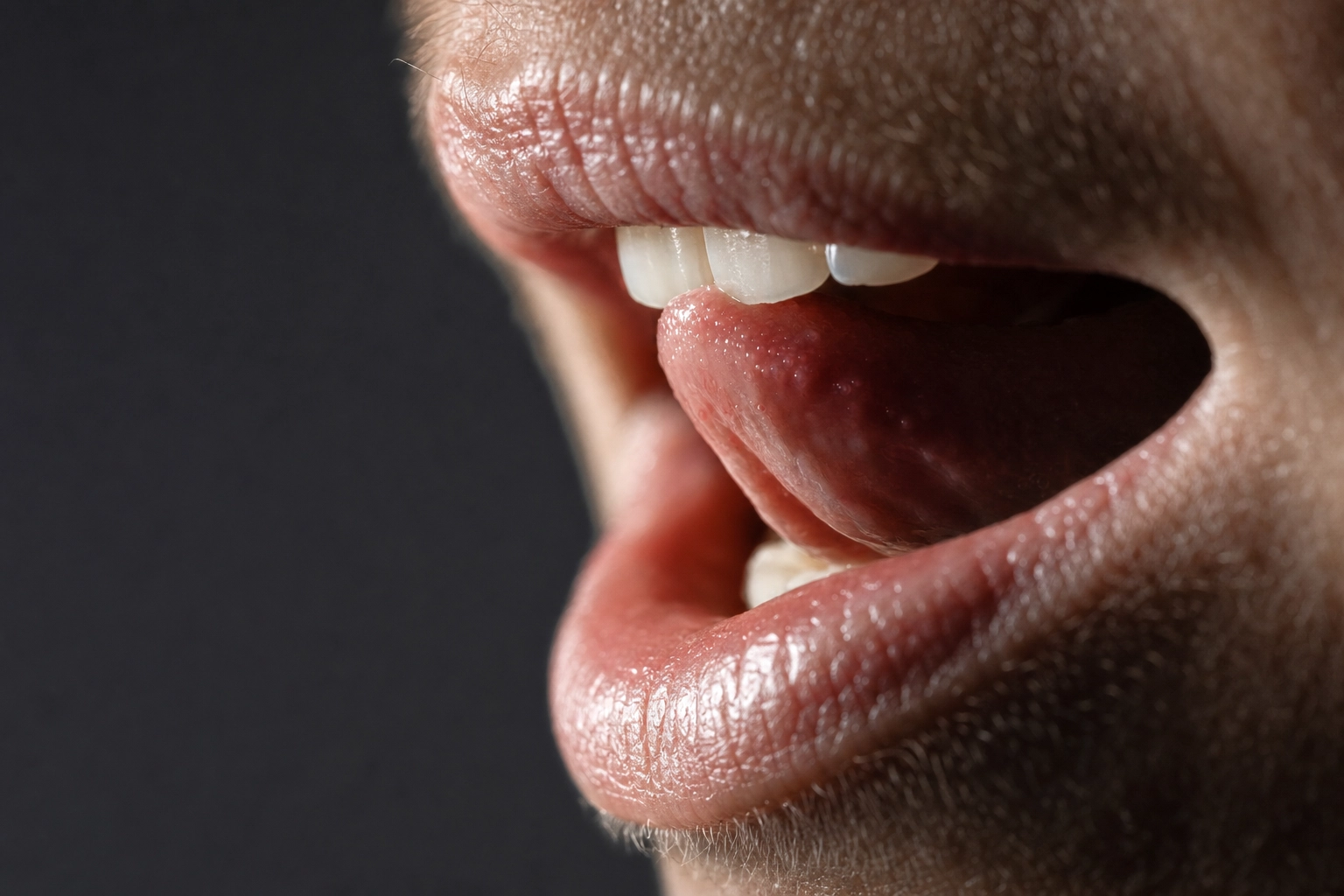
TH Sounds: "Three" Should Not Be "Sree"
English has two TH sounds that simply don't exist in German: the voiceless /θ/ in think and three, and the voiced /ð/ in this and they. With no German equivalent, your brain reaches for the nearest sound — so three becomes "sree" or "tree," this becomes "zis" or "dis," and think becomes "sink."
The fix is pure mechanics: put the tip of your tongue lightly between your teeth and push air through. For think and three, no voice. For this and they, add your voice so the throat buzzes. It feels ridiculous at first — Germans aren't used to a tongue sticking out — but that slightly silly tongue position is exactly right. Drill it with pairs that force the contrast: think / sink, three / free, they / day. A few minutes of tongue twisters like "the thirty-three thieves thought they thrilled the throne" will do more than an hour of reading about it.
V vs W: Why "We" Comes Out as "Ve"
This one is baked into German spelling. In German, the letter W is pronounced /v/ (Wasser sounds like "Vasser"), and the letter V is pronounced /f/ (Vater sounds like "Fater"). The English /w/ sound — lips rounded, no teeth involved — doesn't exist in German at all.
The result: we becomes "ve," wine and vine merge, west sounds like vest. Some German speakers genuinely can't hear the difference at first, which is why it survives all the way to advanced level. Here's the muscle memory you need. For W, round your lips into a tight little circle, as if you're about to blow out a candle — your teeth never touch your lip. For V, press your top teeth gently onto your bottom lip and buzz. Run minimal pair practice on wine/vine, west/vest, worse/verse, wet/vet until the W stops collapsing into V.
Final Consonant Devoicing: When "Bad" Becomes "Bat"
German has a rule called Auslautverhärtung — final-obstruent devoicing. At the end of a syllable, voiced consonants turn voiceless: Rad (wheel) sounds exactly like Rat (advice). You apply this rule to English without realizing it, so:
- bad → "bat"
- dog → "dock"
- give → "giff"
- prize → "price"
- bag → "back"
Unlike the accent quirks, this one causes real misunderstandings. "I need a new bag" and "I need a new back" are different requests. Two fixes work together: keep your vocal cords buzzing all the way through that final consonant, and — the secret weapon — lengthen the vowel before it. In English, the vowel in bad is noticeably longer than in bat. Stretch the vowel and the voiced ending tends to follow on its own.
The English R: Drop the Throat, Relax the Tongue
Standard German uses a uvular R, made at the back of the throat — a little scrape or trill. English R is the opposite: a smooth sound where the tongue pulls back in the middle of the mouth and touches nothing.
You also get to make a choice here. British (RP) English is non-rhotic: the R is only pronounced before a vowel, so car has no R sound but carry does. American English is rhotic: you pronounce every R. Pick one target accent and stay consistent — mixing them is part of what sounds "off." (Practice Me lets you choose American or British tutors precisely so you can lock onto one.) The hardest words pile R's together — rural, world, February (where the first R quietly disappears), and the legendary squirrel, reportedly used as a shibboleth in WWII to spot German speakers. The trick for squirrel: stop trying to say two syllables. Say "girl," then "whirl," then add "sk" to the front — "skwirl," one smooth syllable.

The Vowel Traps: pet/pat, short/shot, coat/caught
A few English vowels live in gaps where German has only one sound:
- /e/ vs /æ/ — bed/bad, men/man, pet/pat. For the /æ/, drop your jaw lower and open wider than feels natural.
- /ɔː/ vs /ɒ/ — short/shot, nought/not. The short, open /ɒ/ doesn't exist in German, so it drifts toward a longer "or" sound.
- /əʊ/ — coat, bone, so. English glides this vowel (o‑u); German says a flat, single "oh," which makes coat sound like caught.
- /ɜː/ — first, word, bird. Germans tend to round the lips here; keep them relaxed and neutral.
You don't need to master all of these at once. Nail TH, V/W, final voicing, and the R first — those carry most of the "heavy accent" impression — then come back for the vowels. Practising in front of a mirror, watching your own mouth, makes the difference visible.
The "Over-Precise" Trap: Why Textbook-Perfect English Still Sounds Foreign
Here's the subtle one. Even German speakers with flawless grammar and clean sounds often sound foreign for a completely different reason: they're too precise.
German is a syllable-clear language — you pronounce every consonant, every ending, each word as its own neat package. Carry that into English and you get a clipped, staccato, almost robotic rhythm where every word lands with equal weight. Natives don't talk like that.

English is stress-timed. A few important words get the stress; everything else gets squashed. Function words — to, for, and, of, a, the, are, you — collapse into a tiny "schwa" (uh) sound, and words melt into each other:
- "Are you planning to buy me some flowers?" — a native stresses only planning, buy, and flowers. The rest blurs: "Are-ya plannin't' buy me s'm flowers?"
- "What do you want?" becomes "Wadaya want?"
- "I would have gone" becomes "I'd've gone."
This is called connected speech, and it's the single biggest reason "perfect" textbook English still sounds non-native. It cuts both ways, too: because you pronounce everything fully, you also expect to hear everything fully — so when a fast native links and reduces, you can't catch it. Fixing your own rhythm fixes your listening at the same time.
Three things to practice: learn the weak forms (how to, and, of reduce), practice linking so linking sounds flow word-to-word, and use contractions out loud (I'm, you're, don't, it's, I'd've) instead of the full forms you were taught to write. The fastest way to internalize all three is shadowing — playing a short clip of natural speech and speaking along in real time, copying the music, not just the words. Get the English word stress rules under your belt and your whole rhythm shifts. One more giveaway: German speakers tend to use rising intonation where English statements fall. "It's really rather interesting" should drop in pitch at the end, not rise — a rise makes you sound unsure.
Grammar Pitfalls That Survive Into Advanced English
These aren't beginner mistakes. They're the errors that stick around at B2 and C1 because they feel correct in German. Your brain isn't guessing — it's confidently applying a German rule. This is classic first-language interference, and it hides in your speech long after the textbook is closed.
Present perfect overuse. In spoken German, the Perfekt ("Ich habe ihn gesehen") covers most completed past actions, so German speakers reach for the present perfect in English too: "I have seen him yesterday." But English has a hard rule — once there's a finished time marker (yesterday, last week, in 2019, this morning), you must use the simple past: "I saw him yesterday." Finished time, simple past. Full stop.
And the exact reverse. Because German uses seit with the present tense ("Ich wohne seit zehn Jahren hier" — literally "I live since ten years here"), German speakers say "I live here since ten years" or "I am working here since 2019." English needs the present perfect for something that started in the past and continues: "I have lived here for ten years," "I've been working here since 2019." The present perfect trips Germans up in both directions — overused for finished events, underused for ongoing ones.
Word order (the V2 carryover). German is a verb-second language: when something other than the subject starts the sentence, the verb still comes second and the subject jumps behind it ("Gestern ging ich..."). Slip that into English and you get "Yesterday went I to the office." English keeps subject–verb–object even after a fronted word: "Yesterday I went to the office."

Capitalization and commas (in writing and email). Two habits leak from German into your written English, which matters enormously at work. German capitalizes every noun, so emails come out as "I sent the Document to the Manager about the Project." In English, only proper nouns are capitalized. And German puts a comma before subordinate clauses ("Ich denke, dass..."), so Germans write "I think, that we should wait" — English uses no comma before that. Small things, but they quietly signal "non-native" on every message you send.
False Friends: The "Falsche Freunde" That Betray You
Because English and German are closely related languages, thousands of words look identical — and a cruel handful mean something completely different. These falsche Freunde are dangerous precisely because you say them with total confidence. The classic: a German ordering food says "I become a steak," because bekommen means "to get." Here are the false-friend vocabulary traps most likely to embarrass you, especially at work:

| You say (German word) | You mean it as | It actually means in English | What you wanted |
|---|---|---|---|
| eventuell | "eventually" | (no real overlap) | possibly / maybe |
| aktuell | "actual / actually" | — | current / currently |
| bekommen → "become" | to get / receive | to turn into | to get, to receive |
| Chef → "chef" | boss | a cook | boss / manager |
| Gift → "gift" | a present | poison | present |
| sensibel → "sensible" | sensitive | reasonable, practical | sensitive |
| spenden → "spend" | to donate | to use up money | to donate |
| Promotion | a job promotion | a marketing campaign | a doctorate / PhD |
| Milliarde / Billion | billion / trillion | see below | mind the gap |

That last row can cost real money. German uses the long scale: eine Milliarde is a thousand million (10⁹), which is the English billion — but eine Billion is a million million (10¹²), which is the English trillion. Say "billion" when you mean Billion in a financial meeting and you're off by a factor of 1,000. (If you want the full rabbit hole, Wikipedia's long and short scales page lays it out.) When numbers matter, slow down and confirm the figures out loud.
Duolingo taught you words. No one taught you to speak.
PracticeMe: real voice conversations with an AI tutor, 24/7.
German Directness vs English Politeness: The Register Gap
This is the most overlooked fluency skill — and for German professionals working internationally, often the most important. This register gap is where English for German speakers most often gets misread at work.
In German culture, politeness lives in precision. Saying exactly what you mean, clearly and without padding, is respectful: it doesn't waste anyone's time. "Das funktioniert nicht" — "That doesn't work" — is normal, helpful, and completely neutral.
English-speaking cultures, especially British, encode politeness differently — through softening, hedging, and indirectness. The same idea becomes "I'm not sure that'll quite work — maybe we could look at another option?" To an English ear, the blunt German version can sound abrupt or even hostile. And in the other direction, Germans often read all that English hedging as evasive or wishy-washy — just tell me what you think. Neither side is wrong; they're running different software.

You don't need to abandon your clarity — that's a strength. You just need a layer of cushioning on top. The toolkit:
- Softeners: just, a bit, kind of, a little, perhaps. → "This is a bit of a problem" instead of "This is a problem."
- Hedges: I think, it seems, I'd say, maybe. → "I think we might be missing something."
- Indirect requests: instead of "Send me the report," try "Could you send me the report?" or "Would it be possible to get the report by Friday?"
- Cushioning bad news: open with "I'm afraid..." or "Unfortunately..." → "I'm afraid that won't work for us" lands far softer than "That won't work."
Watch the difference:
Too direct (German register): "No. That is wrong. We must change it." Native-polite (English register): "Hmm, I'm not totally sure about that one — I think we might want to change it. What do you reckon?"
Same message. Completely different reception.

Then there's small talk, which many Germans find pointless or even fake. In English-speaking work culture it isn't fake — it's the social glue that opens meetings and builds trust. "How was your weekend?" isn't a request for a detailed report; it's a friendly handshake in words. A 30-second exchange about the weather or your weekend before getting down to business is expected, and skipping it can read as cold. Our full guide to small talk in English gives you ready-made openers, and learning to sound more natural in English ties the whole register shift together. (For a neutral primer on the cultural side, SBS's Cultural Atlas profile on German communication is a fair, well-sourced read.)
Business English for German Professionals in International Companies
If you work at a DAX corporation, an Austrian or Swiss multinational, or a Mittelstand company that runs in English, your spoken English is no longer a hobby — it's career infrastructure. Promotions, client trust, and how competent you seem all ride on it, often unfairly relative to how competent you actually are.

The pressure points are predictable, and every one of them is rehearsable:
- Daily stand-ups and status updates — a crisp, confident summary without over-explaining
- Disagreeing in a meeting — softening "that won't work" into something collaborative
- Giving and receiving feedback — the English feedback sandwich vs. German bluntness
- Pre-meeting small talk and conference networking — the part that has nothing to do with the agenda
- Presenting results to international stakeholders — pacing, signposting, handling questions on the fly
- 1:1s and performance reviews — talking about your work without sounding arrogant or apologetic
- Negotiating deadlines and handling client calls — staying polite under pressure

Here's the thing about all of these: you can't improve them by reading. You improve them by doing them — ideally several times, badly, before the real meeting where it counts. That's what AI voice roleplay is built for. You can run the exact same difficult conversation ten times — disagree with your "manager," push back on a "client," present your quarterly numbers and the technical vocabulary that goes with them — and fail completely safely, with nobody judging. Stack that with our guides to business English idioms, role-play scenarios, and presentation tips for non-native speakers, and you walk into the real room already warmed up.
25 Hard English Words for German Speakers (With Pronunciation Notes)
These are the words that catch German speakers out — some famous, some everyday, some you'll need in the boardroom. Say each one out loud, record yourself, and compare. Most of the difficulty traces back to the same culprits: TH, the soft R, the W/V swap, and final voicing.

| Word | The German trap | Say it like |
|---|---|---|
| squirrel | the skw + soft r; comes out "skwiggle" | "SKWIRL" — one syllable (girl → whirl → add sk) |
| rural | two soft R's in a row | "ROOR-uhl" — relax the tongue, don't trill |
| thorough | TH + the silent -ough | "THUH-ruh" — not "thoroughf" |
| three | TH slides to "sree" | tongue between teeth: "THREE" |
| months | the -nths cluster | "MUNTHS" — don't drop the TH |
| clothes | the TH+Z blend | most natives just say "KLOHZ" (like close) |
| world | W + R + L + final D | "WURLD" — keep the D voiced, not "vorlt" |
| word | W not V; voiced ending | "WURD" — not "vort" |
| wine / vine | W and V collapse together | round lips for wine; teeth-on-lip for vine |
| bad / bat | final devoicing merges them | buzz the D and lengthen the vowel in bad |
| Wednesday | the silent middle D | "WENZ-day" |
| February | the first R disappears for many | "FEB-yoo-ree" |
| comfortable | it's three syllables, not four | "KUMF-tuh-bul" |
| vegetable | also collapses to three | "VEJ-tuh-bul" |
| recipe | it's not "re-SIPE" | "RES-uh-pee" (and ≠ Rezept) |
| suite | looks like suit | sounds exactly like "sweet" |
| queue | four silent vowels | just say the letter "Q" |
| colonel | spelled nothing like it sounds | "KER-nul" (like kernel) |
| mischievous | tempting to add a syllable | "MIS-chiv-us" — three syllables |
| although | voiced TH + silent gh | "awl-THOH" |
| beach | the short-i version is... unfortunate | stretch it long: "BEEACH" /iː/ |
| focus | mind the first vowel | "FOH-kus" — keep it clean |
| idea | don't stop at "I-dee" | "eye-DEE-uh" — ends in a schwa |
| jewellery | starts with a J sound, not "ye" | "JOO-uhl-ree" |
| entrepreneur | the French business word everyone dreads | "on-truh-pruh-NUR" |
Want more of these sorted by difficulty? Our roundup of the hardest English words to pronounce groups them by native language, including a full German section.
Your 14-Day English Speaking Practice Plan (AI Voice)
Knowing all of this changes nothing until you speak. Here's a two-week plan of English speaking practice built specifically around the German-speaker challenges above. Budget 15–20 minutes a day, always out loud, always speaking more than you read. It's designed for AI voice practice — a tutor that talks back in real time, in your chosen American or British accent, and remembers what you worked on yesterday.

| Day | Focus | What to do (out loud) |
|---|---|---|
| 1 | TH sounds | Minimal pairs (think/sink, they/day), then a 5-min chat where you deliberately overuse TH words |
| 2 | V vs W | Drill wine/vine, west/vest; then describe your weekend, hunting every W |
| 3 | Final voicing | bad/bat, bag/back; tell a story about your day, lengthening vowels before voiced endings |
| 4 | Weak forms | Practice reduced to/and/of; have a casual conversation and let function words shrink |
| 5 | Linking & contractions | Replace full forms with I'm/you're/don't; shadow a short clip, then chat |
| 6 | Intonation | Practice falling statements; record yourself, check for the "uncertain" rise |
| 7 | Past simple vs present perfect | Tell yesterday's events (simple past) and your life-so-far (present perfect) in one session |
| 8 | Word order | Narrate with fronted time words ("Yesterday I...", "Last year we...") — keep SVO |
| 9 | False friends | Use eventually, currently, get, donate, sensitive correctly in real sentences |
| 10 | Softening & hedging | Roleplay: disagree with the tutor politely using I'm afraid / a bit / perhaps |
| 11 | Requests & feedback | Roleplay asking a colleague for help indirectly; give gentle feedback |
| 12 | Small talk | 10 minutes of pure small talk — weekend, weather, hobbies, no agenda |
| 13 | Business roleplay | Run a real scenario: status update, client call, or pushing back a deadline |
| 14 | Review & assess | Re-record Day 1's TH drill; have a free conversation; check your progress trends |

By Day 14, two things happen. The mechanical stuff (TH, W, voicing) starts running on autopilot, and — more importantly — you've spent two weeks being imperfect on purpose, which quietly dismantles the perfectionism that was freezing you. If you tend to translate every sentence in your head first, pair this with our guide on how to stop translating in your head, and keep a speaking confidence checklist nearby to track the mindset side.
This is the same approach we recommend for other strong-on-paper learners — see our companion guides for English for Turkish speakers and English for Brazilian Portuguese speakers, each tuned to that language's specific traps.
Babbel Gave You the Grammar. Practice Me Gives You the Reps.
If you grew up in Germany, Austria, or Switzerland, there's a good chance you've used Babbel — it was founded in Berlin in 2007 and built its name on structured, well-designed grammar and vocabulary lessons. That kind of tool is genuinely good at what it does: teaching rules, drilling vocabulary, and walking you through scripted dialogues with neat right-or-wrong answers.

But here's the honest gap. After all the lessons, the thing still missing is unscripted speaking time — the messy, real-time, anything-could-happen conversation where fluency actually lives. You can't get that from filling in blanks or repeating a fixed phrase. You get it by talking.
That's the whole point of Practice Me. Instead of structured grammar exercises, you have open-ended, real-time voice conversations with AI tutors — Sarah, Oliver, or Marcus — in American or British accents. They respond to whatever you actually say, ask follow-up questions, let you go off-script, and remember you across sessions, so the work you did on TH sounds yesterday carries into today. There's no human on the other end watching you fumble, which is exactly why it suits the perfectionist German learner: you can be wrong a hundred times, judgment-free, until right becomes automatic.
Think of it as two halves of one coin. Lessons build the foundation; conversation turns it into fluency. The best path to learn English for German speakers who are already strong on paper is simply more speaking reps — that's the reality of English for Germans, Austrians, and Swiss professionals alike. If your reading is at C1 but your speaking feels stuck at B1, you don't need more rules — you need conversation. Practice Me Pro gives you unlimited conversations with every tutor, with a 3-day free trial to start. Talk for fifteen minutes a day for two weeks and you'll feel the plateau crack.
Frequently Asked Questions
Is English hard for German speakers?
Not particularly — German and English are closely related languages, which is a big head start, and Germany and Austria rank among the most English-proficient countries in the world. The hard part for German speakers isn't understanding English; it's speaking it spontaneously. A handful of sounds (TH, W vs V, the soft R), English's connected rhythm, and the shift from German directness to English softening are the main hurdles — and all of them respond quickly to speaking practice.
How do I sound less German when I speak English?
Focus on four things in this order: the TH sound (tongue between teeth, not "s"), the W sound (round your lips, don't say "v"), final voicing (keep bad from sounding like bat), and the soft English R (tongue touches nothing). Then work on rhythm — let small words like to and and shrink instead of pronouncing every word with equal weight. Fixing the over-precise, every-consonant-equal habit does more for sounding natural than any single sound.
Why do German speakers confuse V and W in English?
Because German spelling assigns those letters different sounds than English does. In German, W is pronounced /v/ and V is pronounced /f/, and the English /w/ sound (rounded lips, no teeth) doesn't exist in German at all. So we naturally comes out as "ve." The fix is physical: round your lips into a tight circle for W, and only touch your teeth to your lip for V. Minimal-pair drills like wine/vine and west/vest retrain the habit fast.
How long does it take a German speaker to go from B2 to fluent?
If your reading and grammar are already B2–C1 and the gap is purely speaking, most German learners feel a real difference within a few weeks of daily spoken practice — and reach comfortable, confident fluency in three to six months. The variable isn't intelligence or talent; it's speaking volume. Fifteen to twenty minutes of real conversation every day moves you far faster than hours of passive study, because you're training the exact skill you're missing.
Is Practice Me better than Babbel for German speakers?
They're built for different jobs. Babbel is excellent for structured grammar and vocabulary — the foundation. Practice Me is built for the next step: open-ended, real-time voice conversations that turn that foundation into spoken fluency. Since most German speakers are already strong on grammar and stuck on speaking, Practice Me targets the actual bottleneck. Many learners use both — lessons to learn the rules, conversation to make them automatic.
Which is harder for Germans: TH sounds or the English R?
Both are absent from German, but they fail differently. TH is easier to fix because the tongue position is simple once you commit to it — tongue between the teeth. The soft English R is often harder to make consistent, because it has to replace the deeply ingrained throat-R and changes depending on whether you're aiming for British (non-rhotic) or American (rhotic) English. Pick one target accent and the R gets much more manageable.