Duolingo taught you words. No one taught you to speak.
PracticeMe: real voice conversations with an AI tutor, 24/7.
Duolingo English Test Speaking Topics & Sample Answers [2026]
![Duolingo English Test Speaking Topics & Sample Answers [2026]](https://cdn.babyseo.ai/images/practiceme.app/duolingo-english-test-speaking-topics/duolingo-english-test-speaking-topics-2026.webp)
The Duolingo English Test speaking section can feel like the hardest part of the exam — not because the topics are difficult, but because speaking under pressure makes even simple ideas hard to express.
Good news: Duolingo English Test speaking topics are predictable. The test draws from the same pool of everyday themes, and knowing what to expect cuts your anxiety in half.
Quick Summary: The 2026 Duolingo English Test has 4 scored speaking question types plus 1 unscored Speaking Sample that universities review. This guide covers the current format, all 8 scoring criteria, 35 practice topics organized by category with model answers, and a practical preparation plan to help you score 125+.
The 2026 DET Speaking Format: What Actually Changed
The Duolingo English Test is a 60-minute, computer-adaptive English proficiency test accepted by over 5,700 universities worldwide. It costs a fraction of the TOEFL or IELTS, and you can take it from home.
The test has three parts:
- Introduction & Onboarding (5 minutes) — ID verification and setup
- Adaptive Test (45 minutes) — Reading, writing, listening, and speaking tasks that adjust to your level
- Writing & Speaking Sample (10 minutes) — Unscored open-ended responses sent to universities
Your overall score ranges from 10 to 160. Most universities require 110+, competitive programs want 125+, and top schools expect 130+.
The DET also gives four subscores:
- Conversation (Speaking + Listening)
- Production (Speaking + Writing)
- Literacy (Reading + Writing)
- Comprehension (Reading + Listening)
Since speaking contributes to both the Conversation and Production subscores, mastering Duolingo English Test speaking topics lifts nearly half your score profile.
The 4 Scored Speaking Question Types
The 2026 format includes four scored speaking tasks. (Note: the "Listen, Then Speak" task was removed in the 2026 update — if you see it in older study guides, ignore it.)
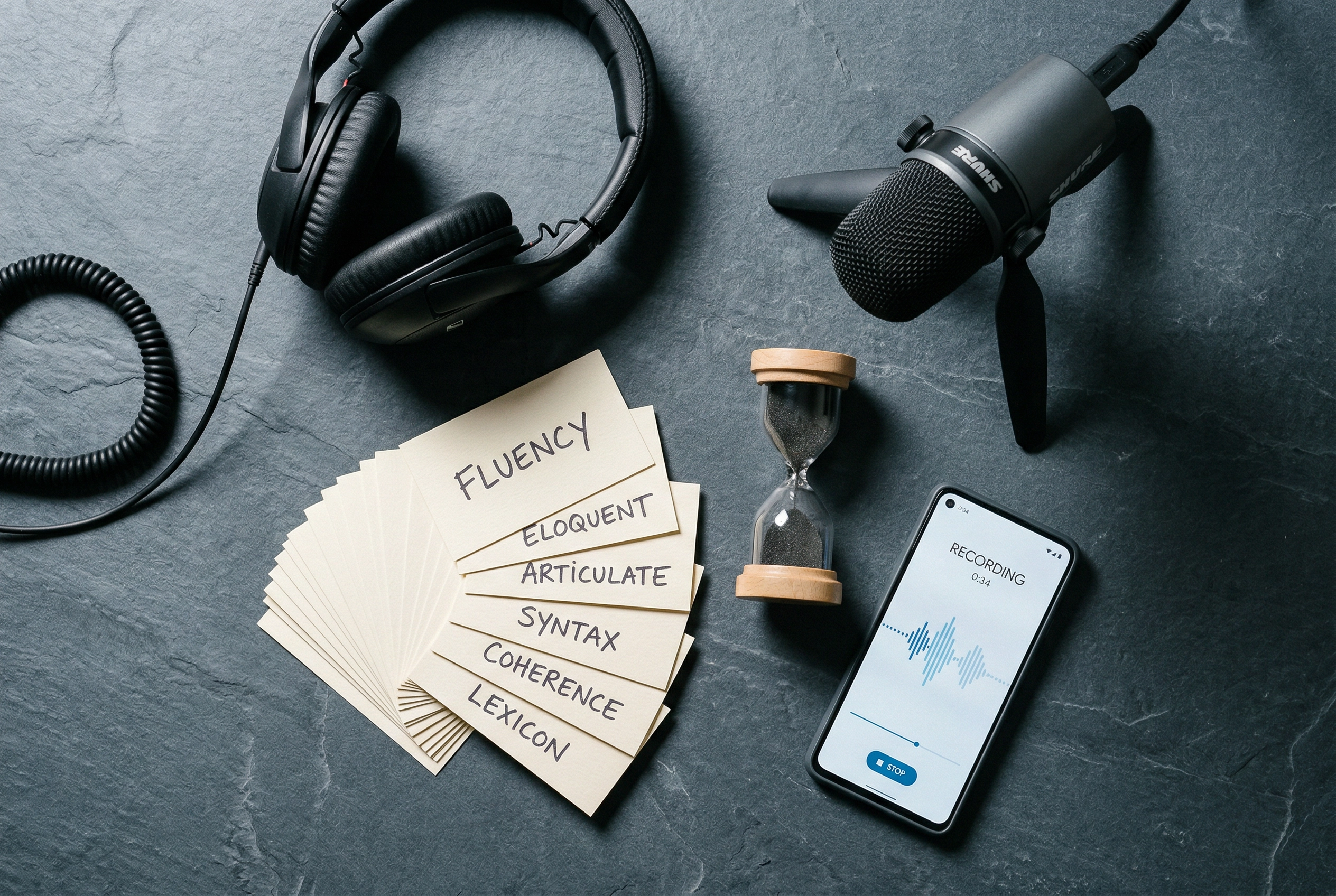
| Question Type | What You Do | Time | What It Tests |
|---|---|---|---|
| Interactive Speaking | Answer 6–8 rapid questions from an animated character | 35 sec per answer | Spontaneous speech, fluency |
| Read, Then Speak | Read a prompt with sub-questions, then respond | 20 sec prep, 30–90 sec speak | Organized extended response |
| Speak About the Photo | Describe an image in detail | 20 sec observe, 30–90 sec speak | Descriptive vocabulary, coherence |
| Read Aloud | Read a sentence out loud | ~10 sec | Pronunciation, stress, intonation |
Interactive Speaking is the newest addition and arguably the trickiest. It simulates a real conversation — topics change midway, and you can't replay the audio prompt. Think of it as a mini-interview where you need to think on your feet. If you want to learn how to introduce yourself in English smoothly, that skill transfers directly to the first few Interactive Speaking prompts.
Speaking Sample (Unscored but Universities See It)
The Speaking Sample appears in the final 10 minutes of the Duolingo English Test. You get a written prompt, 30 seconds to prepare, and 1 to 3 minutes to respond.
Here's the key: while the AI doesn't score this section, universities receive your recording and may use it to evaluate your readiness for classroom participation. Treat it like a short admissions interview — it matters even if it doesn't affect your number.
How the DET Scores Your Speaking
The Duolingo English Test uses AI scoring validated against thousands of human-rated samples. According to Times Higher Education, the DET employs "sophisticated AI models rigorously trained on thousands of expert-rated samples" to evaluate spoken and written responses. Here's what the AI looks for across eight criteria:

1. Fluency — Do you speak at a steady, natural pace? Minimal pauses, few filler words like "um" and "uh," and smooth transitions between ideas.
2. Pronunciation — Can the listener understand you clearly? This means correct sounds, appropriate word stress, natural intonation, and proper rhythm. You don't need a perfect American or British accent — intelligibility is what matters. For pronunciation basics, see our pronunciation practice guide for beginners.

3. Grammatical Accuracy — Are your sentences correct? Subject-verb agreement, proper tense usage, correct articles and prepositions.
4. Grammatical Complexity — Do you use a range of structures? Mixing simple, compound, and complex sentences (with clauses like "although," "because," "which") scores higher than speaking only in simple present tense.
5. Vocabulary Sophistication — Do you use precise, topic-appropriate words? Saying "I find gardening tranquil and rewarding" scores higher than "I think gardening is nice." Our guide on building English vocabulary through conversations shows how to expand your active word bank naturally.
6. Vocabulary Diversity — Do you avoid repeating the same words? Using synonyms and varied phrasing shows a stronger command of English. This is especially important for improving your English speaking skills overall.
7. Content Relevance — Did you actually answer the question? Staying on topic and addressing every sub-prompt is critical. Off-topic responses tank your score.
8. Discourse Coherence — Is your response organized logically? Clear introduction, structured body, and a brief conclusion show you can communicate like a proficient speaker.
What separates a 130+ response from a 100-level one? At the 130+ level, you speak English fluently and confidently with varied sentence structures, use precise vocabulary, address every part of the prompt, and maintain a clear organizational thread. At 100, you answer the question but with frequent pauses, repeated vocabulary, and limited sentence variety.
35 Duolingo English Test Speaking Topics by Category
Duolingo speaking topics consistently draw from the same topic clusters. Below are 35 topics organized into six categories — the most comprehensive list of Duolingo English Test speaking topics you'll find online. For each, there's a sample prompt (in the style of a Read, Then Speak or Speaking Sample question), key vocabulary to practice, and a quick scoring tip.
Use these topics to prepare your ideas ahead of test day. You don't need to memorize answers — but having thought through these themes before means you won't freeze when a prompt appears.

Personal Life & Relationships
Topic 1: A Person Who Influenced You Prompt: "Talk about someone who has had a significant influence on your life. Who is this person? How did you meet them? In what ways have they influenced you?"
Key vocabulary: influential, role model, motivated, determination, shaped my perspective, unconditionally
Tip: Use specific anecdotes rather than vague praise. "She taught me to wake up at 5 a.m. and study before school" is more compelling than "She was very inspiring."
Topic 2: A Childhood Memory Prompt: "Describe a memory from your childhood that you still think about. What happened? Where were you? Why is this memory important to you?"
Key vocabulary: vivid, nostalgic, formative, carefree, reminisce, cherish
Tip: Engage the senses — describe what you saw, heard, or smelled to make your response feel authentic.
Topic 3: Your Best Friend Prompt: "Talk about your best friend. How did you become friends? What qualities do you admire in them? Describe a memorable experience you shared."
Key vocabulary: bond, loyalty, supportive, complementary, trust, spontaneous
Topic 4: A Difficult Decision Prompt: "Describe a difficult decision you had to make. What were the options? How did you decide? What did you learn from the experience?"
Key vocabulary: dilemma, weigh the options, consequence, hesitate, ultimately, in hindsight
Topic 5: Your Daily Routine Prompt: "Describe your typical daily routine. What does your morning look like? How do you spend your evenings? Is there anything you would change?"
Key vocabulary: productive, hectic, unwind, habit, efficient, prioritize
Tip: This Duolingo speaking topic seems easy, but many test-takers give flat descriptions. Add opinions and comparisons: "I wish I could wake up earlier, but honestly, I'm a night owl."
Education & Learning
Topic 6: Your Favorite Subject Prompt: "Talk about a subject you enjoyed studying in school. What was it? Why did you like it? How has it influenced your life or career?"
Key vocabulary: fascinated, analytical, hands-on, curriculum, sparked my interest, practical application
Topic 7: Online vs. In-Person Learning Prompt: "Compare studying online and studying in person. What are the advantages and disadvantages of each? Which do you prefer and why?"
Key vocabulary: flexibility, self-discipline, interaction, engagement, accessible, isolation
Tip: Comparison prompts are among the most common Duolingo English Test speaking topics. Structure your response clearly: advantages of A, advantages of B, then your personal preference with reasons.
Topic 8: A Teacher Who Inspired You Prompt: "Describe a teacher who inspired you. What subject did they teach? What made them special? How did they affect your attitude toward learning?"
Key vocabulary: encouraging, patient, passionate, mentor, approach, go beyond
Topic 9: The Role of Education in Your Country Prompt: "What role does education play in a person's life? Do you think formal education is essential for success? Why or why not?"
Key vocabulary: critical thinking, opportunity, foundation, empowerment, self-taught, well-rounded
Topic 10: A Skill You Want to Learn Prompt: "Talk about a skill you would like to learn in the future. Why do you want to learn it? How would you go about learning it?"
Key vocabulary: aspire, proficiency, dedication, rewarding, step by step, hands-on experience
Tip: Show awareness of the learning process. Saying "I'd start by watching tutorials, then practice 20 minutes daily" is more detailed than "I would just practice." For related ideas, explore how to improve English speaking as a non-native speaker.

Technology & Communication
Topic 11: How Technology Changed Communication Prompt: "How has technology changed the way people communicate? Give examples. Do you think this change has been mostly positive or negative?"
Key vocabulary: revolutionized, instant messaging, social media, face-to-face, disconnected, convenient
Topic 12: Your Favorite Device Prompt: "Describe a piece of technology you use every day. What is it? How do you use it? Why is it important to you?"
Key vocabulary: indispensable, streamline, multitask, user-friendly, reliant, functionality
Topic 13: Social Media's Impact Prompt: "What is the impact of social media on young people? How has it changed social interactions? Do you think it does more harm or good?"
Key vocabulary: curated, mental health, comparison, authentic, influence, platform
Topic 14: Modern vs. Traditional Communication Prompt: "Compare modern communication methods (texting, video calls) with traditional ones (letters, face-to-face meetings). Which do you think is more meaningful?"
Key vocabulary: personal touch, efficiency, nuance, tone of voice, body language, impersonal
Topic 15: Children and Smartphones Prompt: "Should young children be allowed to use smartphones? What are the potential benefits and risks? At what age should children get their first phone?"
Key vocabulary: screen time, cognitive development, parental controls, digital literacy, boundaries, moderation
Tip: Opinion prompts test your ability to argue a position. Pick a side, support it with 2–3 reasons, and briefly acknowledge the opposite view.
Culture & Traditions
Topic 16: A Festival or Tradition in Your Country Prompt: "Talk about a tradition or festival celebrated in your country. When does it take place? What do people do? Why is it important to you?"
Key vocabulary: cultural heritage, customary, ceremonial, symbolize, commemorate, communal
Model Answer (Speaking Sample, ~90 seconds):
"One of the most important festivals in my country, Mexico, is Día de los Muertos — the Day of the Dead. It takes place on November 1st and 2nd every year. During this time, families build altars called 'ofrendas' decorated with marigold flowers, candles, photos, and the favorite foods of deceased loved ones. People visit cemeteries to clean and decorate graves, and there are parades with colorful skull face paint and traditional music.
What makes this festival meaningful to me is that it reframes how we think about death. Instead of mourning, it's a celebration of the lives people lived. I remember as a child, my grandmother would spend days preparing tamales and arranging the ofrenda. Those moments taught me about family history and the importance of remembering where you come from. I think this tradition is unique because it turns grief into something beautiful and communal."
Key vocabulary used: cultural heritage, commemorate, communal, reframes, deceased
Topic 17: A Custom Unique to Your Country Prompt: "Describe a custom or social practice that is unique to your culture. What is it? When is it practiced? How do outsiders usually react to it?"
Key vocabulary: distinctive, ritual, etiquette, hospitality, ingrained, cultural significance
Topic 18: Traditional Food from Your Country Prompt: "Describe a traditional dish from your country. What are the ingredients? How is it prepared? What makes it special to you?"
Key vocabulary: staple, recipe, seasoning, passed down, aromatic, delicacy
Topic 19: Globalization and Local Cultures Prompt: "How has globalization affected local cultures in your country? What has been gained? What has been lost?"
Key vocabulary: homogenization, preserve, identity, influence, adapt, endangered
Topic 20: A Cultural Event You Attended Prompt: "Describe a cultural event you attended, such as a concert, exhibition, or ceremony. What happened? How did it affect you?"
Key vocabulary: immersive, atmosphere, captivating, moved, perspective, unforgettable
Duolingo taught you words. No one taught you to speak.
PracticeMe: real voice conversations with an AI tutor, 24/7.
Travel & Places
Topic 21: A Place You Want to Visit Prompt: "Describe a place you have always wanted to visit. Where is it? Why do you want to go there? What would you do there?"
Key vocabulary: fascinated, bucket list, breathtaking, diverse, explore, wander
Model Answer (Interactive Speaking, ~35 seconds):
"I've always wanted to visit New Zealand. I'm fascinated by the dramatic landscapes — the mountains, fjords, and green valleys. I'd love to hike the Milford Track and see the glow-worm caves. Beyond the scenery, I've heard the local Maori culture is deeply connected to the land, and I'd want to learn about that firsthand."
Topic 22: Your Favorite City Prompt: "Talk about your favorite city. What makes it special? What can visitors see and do there? Would you recommend it to a friend?"
Key vocabulary: vibrant, infrastructure, culinary scene, walkable, nightlife, cosmopolitan
Topic 23: A Memorable Trip Prompt: "Describe a trip you took that was memorable. Where did you go? Who were you with? What made it unforgettable?"
Key vocabulary: spontaneous, adventure, eye-opening, itinerary, off the beaten path, bonding
Topic 24: Traveling Alone vs. With Friends Prompt: "Compare traveling alone and traveling with a group of friends. What are the benefits and drawbacks of each?"
Key vocabulary: independence, compromise, flexibility, companionship, logistical, self-discovery
Topic 25: How Travel Changes Your Perspective Prompt: "Do you think traveling can change a person's perspective on life? How? Give examples from your own experience or what you've heard."
Key vocabulary: broaden horizons, open-minded, exposure, empathy, cultural immersion, transformative
Environment & Society
Topic 26: An Environmental Issue in Your Country Prompt: "Talk about an environmental issue that concerns you. What is the problem? What causes it? What can individuals do about it?"
Key vocabulary: pollution, sustainable, carbon footprint, conservation, renewable, ecosystem
Topic 27: Government and the Environment Prompt: "Should governments do more to protect the environment? What specific actions should they take? Who should bear the cost?"
Key vocabulary: legislation, subsidize, regulate, incentivize, accountability, climate policy
Topic 28: Urban vs. Rural Living Prompt: "Compare living in a city with living in a rural area. What are the advantages and disadvantages of each? Where would you prefer to live?"
Key vocabulary: pace of life, congestion, community, amenities, tranquil, commute
Topic 29: The Importance of Volunteering Prompt: "Do you think volunteering is important? What kind of volunteer work have you done or would like to do? How does it benefit society?"
Key vocabulary: give back, altruism, community engagement, fulfilling, grassroots, social responsibility
Topic 30: Public Transportation in Your City Prompt: "Describe the public transportation system in your city. Is it efficient? How could it be improved? Do you prefer public transport or driving?"
Key vocabulary: infrastructure, reliable, congested, eco-friendly, commute, accessibility
Bonus Topics: Work, Health & Hobbies
Here are five more Duolingo English Test speaking topics that appear frequently. Use these to round out your DET speaking practice:
Topic 31: Your Dream Job — "Describe your dream job. What would you do? Why does this career appeal to you?" Key vocabulary: fulfilling, ambitious, passionate, work-life balance, contribute, aspiration
Topic 32: A Hobby You Enjoy — "Talk about a hobby that you enjoy. How did you get into it? What do you like about it?" Key vocabulary: therapeutic, creative outlet, dedication, immersive, relaxing, skill-building
Topic 33: Staying Healthy — "What do you do to stay healthy? Talk about your habits related to diet, exercise, or mental health." Key vocabulary: well-being, balanced diet, stamina, mindfulness, consistent, holistic
Topic 34: A Book or Movie That Impacted You — "Describe a book or movie that made a strong impression on you. What was it about? How did it change your thinking?" Key vocabulary: thought-provoking, narrative, resonated, compelling, protagonist, perspective shift
Topic 35: The Importance of Sports — "Why is sports participation important? How does it benefit individuals and communities?" Key vocabulary: teamwork, discipline, perseverance, camaraderie, physical fitness, sportsmanship

Model Answers for Each DET Speaking Question Type
Each Duolingo English Test speaking task requires a slightly different approach. Here's a model answer for each scored type so you can see the difference in length, structure, and style. Study these DET speaking practice examples carefully.
Interactive Speaking: Hobbies → Transportation Pivot
Question 1: "Hi! I'm researching hobbies for a project. Can you tell me about a hobby you enjoy?"
"Sure — I really enjoy cooking. I find it both creative and relaxing. I started experimenting with recipes during the pandemic, and now I try to cook a new dish every weekend. Last month I made homemade pasta from scratch, which was surprisingly satisfying." (~30 seconds)
Question 2 (topic pivot): "Now let's talk about something different. What's public transportation like where you live?"
"In my city, public transport is decent but unreliable during rush hours. The bus system covers most areas, but the trains are often delayed. I usually ride a bike when the weather allows, which is honestly faster and more pleasant." (~25 seconds)
Key strategy: Don't panic when the topic shifts. Take one second to mentally reset, then lead with your direct answer. The AI rewards natural transitions over polished ones.
Read, Then Speak: Education Topic
Prompt: "Talk about the role of education in today's world. What makes education important? How has it changed? What improvements would you suggest?"
"Education is arguably the most important tool for social mobility. It gives people access to opportunities that wouldn't exist otherwise — better jobs, broader perspectives, and the ability to think critically about the world around them.
What's changed dramatically in recent years is accessibility. Online platforms have made it possible for someone in a small village to take courses from major universities. That said, the digital divide means not everyone benefits equally. In many developing countries, students still lack reliable internet access.
If I could improve one thing, it would be making education more practical. Traditional curricula focus heavily on memorization, but the modern job market demands problem-solving, creativity, and communication skills. Schools should integrate real-world projects and collaborative learning much earlier." (~85 seconds)
Why this scores well: It addresses all three sub-prompts, uses varied sentence structures (simple, compound, complex), includes specific examples, and finishes with a clear opinion.

Speak About the Photo
Imagine a photo showing a crowded outdoor market with fresh produce, vendors, and shoppers.
"This image shows a busy outdoor market, probably on a weekend morning. In the foreground, I can see a stall with colorful fruits and vegetables — there are oranges, green apples, and what looks like fresh herbs. The vendor appears to be a middle-aged man wearing an apron, and he's handing a bag to a customer.
In the background, there are more stalls and a crowd of people browsing. The atmosphere looks lively and communal. I imagine this is a farmers' market where people come to buy fresh, locally grown produce. Markets like this are important because they support local farmers and create a sense of community." (~60 seconds)
Key strategy: Describe what you see (foreground → background), then add interpretation or opinion. Don't just list objects — connect them into a narrative.
How to Practice Duolingo English Test Speaking Effectively
Knowing the DET speaking topics is only half the battle. Here's how to build real speaking skills before test day. If you want a proven approach to how to get fluency in English, these practice methods work for both test prep and general improvement.

Record Yourself and Self-Evaluate
Record your response to any Duolingo speaking topic above, then listen back with this checklist:
- ✅ Did I speak for at least 60 seconds (90 for Speaking Sample)?
- ✅ Did I address every part of the prompt?
- ✅ Did I use fewer than 5 filler words ("um," "uh," "like")?
- ✅ Did I use at least 2 advanced vocabulary words naturally?
- ✅ Did my response have a clear beginning, middle, and end?
- ✅ Did I speak at a steady pace without rushing or long pauses?
This is the single most effective free practice method. Most people hate hearing their own voice — get over it. It's how you improve. For additional ESL speaking practice activities, we've compiled 15 exercises you can do alone.
Practice Speaking Out Loud With AI
Reading Duolingo English Test speaking topics silently won't prepare you for the pressure of speaking on a timer. You need to practice talking out loud, getting real-time feedback, and building the muscle memory of spontaneous English speech.
Practice Me is built exactly for this. You have voice conversations with AI tutors who adapt to your level, ask follow-up questions (similar to Interactive Speaking), and help you work through topics naturally — without the judgment of a human listener. It's available 24/7, so you can squeeze in a 15-minute session before bed or during your lunch break. If test anxiety is part of your challenge, practicing with an AI first builds the confidence you need for the real thing.

You can also practice with other methods: talk to yourself in the mirror, narrate your day in English, or describe photos you see on social media out loud. The point is this — your mouth needs to practice forming English words and sentences under time pressure. Reading articles about speaking won't do it. For more approaches, check out our guides on how to practice English speaking alone and practicing English speaking with AI.
Build Topic-Specific Vocabulary Banks
For each of the six topic categories above, create a vocabulary list of 15–20 words. Write the word, its meaning, and an example sentence you create yourself. This is more effective than memorizing dictionary definitions because you're building vocabulary through real context.
If you struggle with particular sounds, try working through English tongue twisters — they're surprisingly effective for pronunciation drills and can help your Read Aloud scores.
Time Every Practice Response
Use a timer for every practice session:
- 35 seconds for Interactive Speaking practice
- 90 seconds for Read, Then Speak and Speak About the Photo
- 2 minutes for Speaking Sample practice
Speaking without time constraints builds fluency but doesn't prepare you for the DET's pacing. Train under test conditions from week one. If you need to stop translating and speak English naturally, timed practice forces your brain out of translation mode.
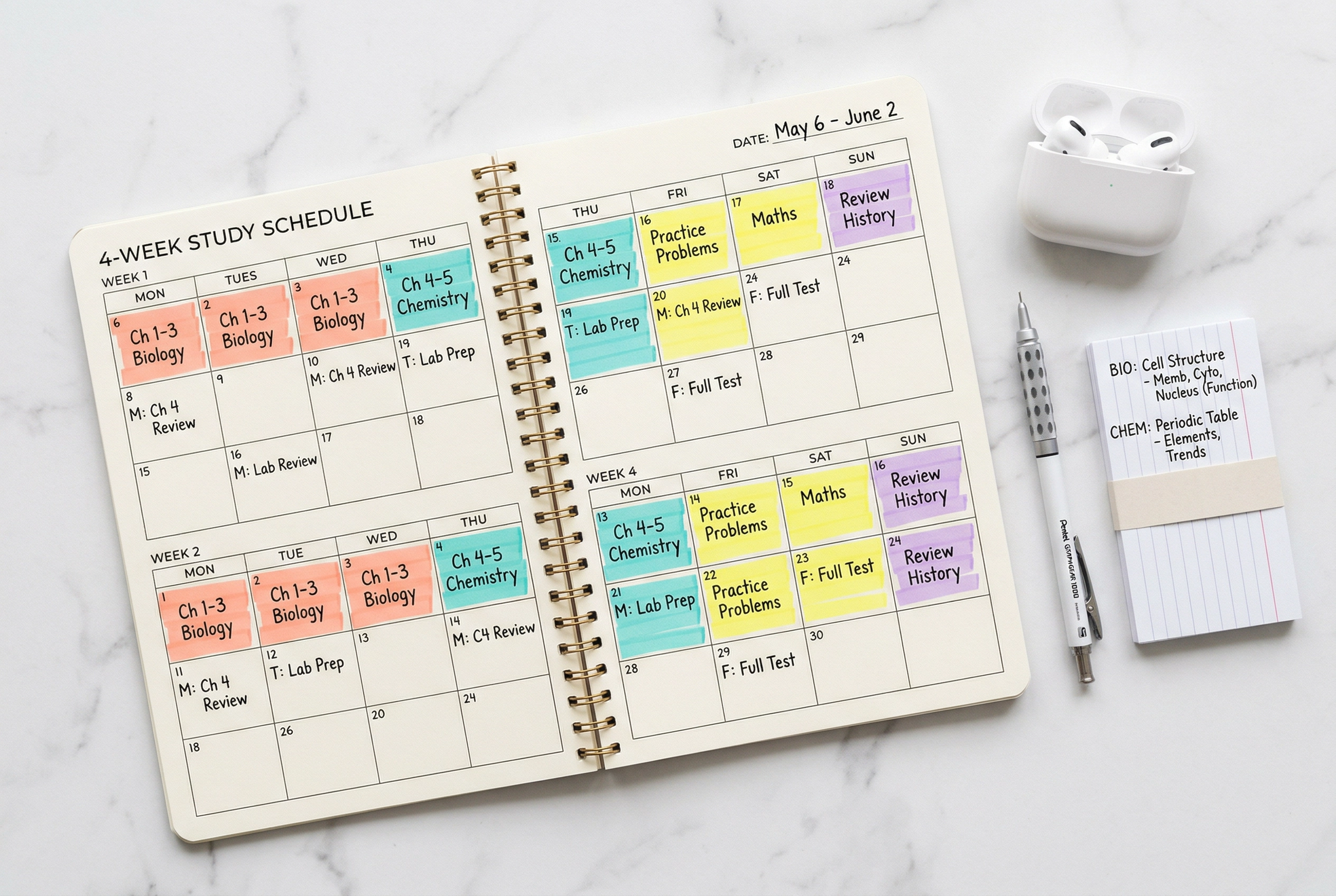
A 4-Week DET Speaking Preparation Plan
| Week | Focus | Daily Practice (15–20 min) |
|---|---|---|
| 1 | Read Aloud + Pronunciation | Read 5 sentences aloud daily. Focus on stress and intonation. See our guide on English pronunciation practice for beginners. |
| 2 | Read, Then Speak + Photo Description | Practice 2 timed prompts per day using the Duolingo speaking topics from this guide. |
| 3 | Interactive Speaking Simulation | Have AI voice conversations on different topics. Practice the topic pivot. |
| 4 | Full Mock Tests + Speaking Sample | Do 2 full practice sessions with all question types. Record and review. |
A daily English speaking practice routine — even just 15 minutes — does more for your DET score than cramming for hours the night before. For general fluency strategies, our guide on how to learn English fast covers 15 proven methods.
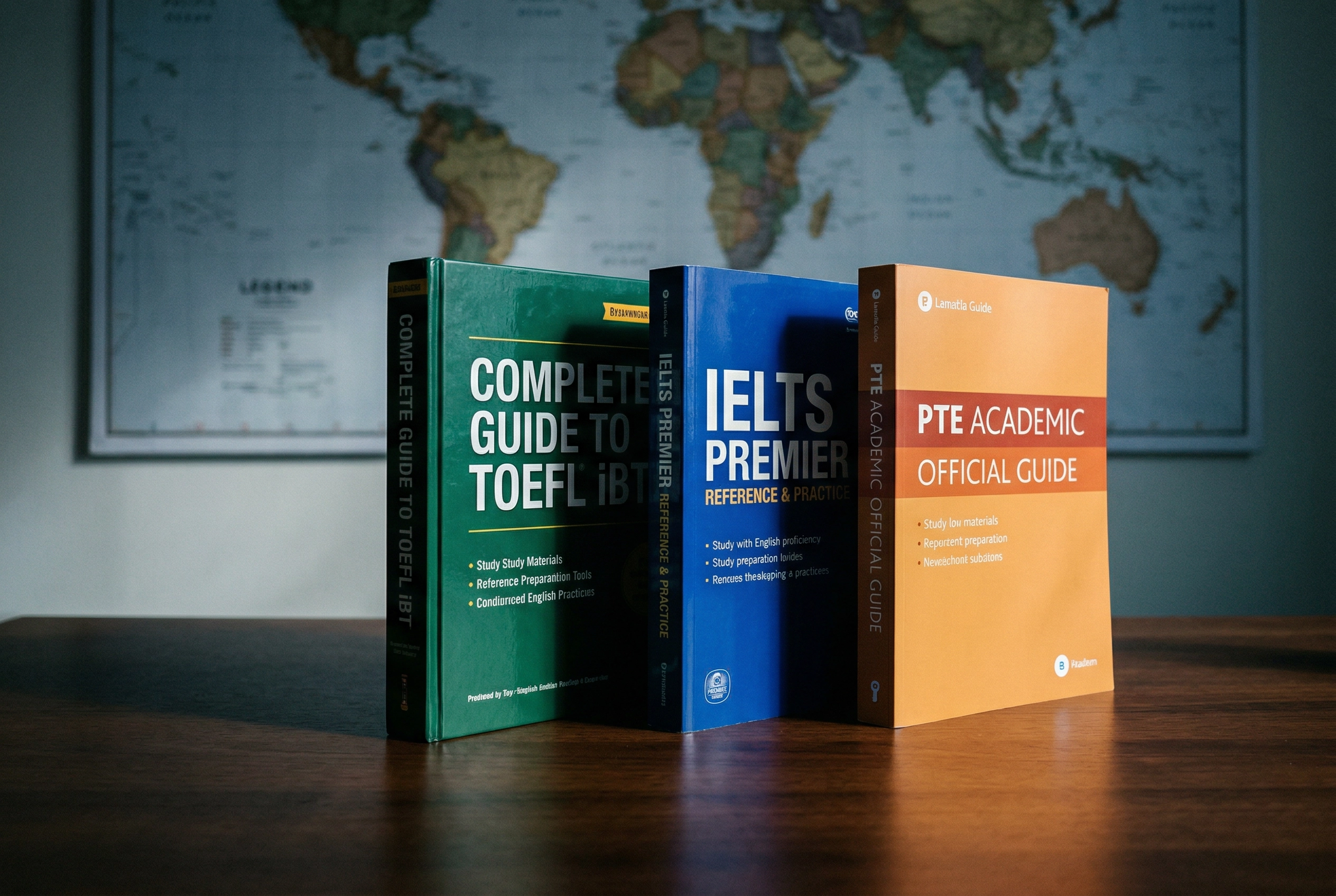
DET vs. TOEFL vs. IELTS Speaking: Quick Comparison
If you're deciding between tests or preparing for multiple ones, here's how the speaking sections compare:
| Feature | DET | TOEFL iBT | IELTS |
|---|---|---|---|
| Format | Computer at home | Computer at test center | Face-to-face with examiner |
| Duration | ~10 min of speaking tasks | ~16 min | 11–14 min |
| Question types | 5 types (4 scored) | 2 types (Listen & Repeat, Interview) | 3 parts (intro, topic card, discussion) |
| Preparation time | 20–30 sec per task | 15–30 sec | None for Parts 1 & 3 |
| Scoring | AI-scored (10–160 scale) | AI-scored (0–30 scale) | Human-scored (0–9 bands) |
| Test cost | Lowest of the three | Higher | Highest |
| Availability | Anytime, from home | Scheduled, test centers | Scheduled, test centers |
Already preparing for TOEFL? Many of the speaking topics overlap. Check out our TOEFL speaking practice topics guide, which covers the 2026 format with sample questions and the IRT response framework.
For broader conversation practice beyond test prep, our list of 50+ English conversation practice topics covers every level from A1 to C2. You can also explore how to improve English speaking by yourself with proven self-study methods.
Frequently Asked Questions
How many speaking questions are on the Duolingo English Test?
The 2026 DET includes approximately 10–15 speaking tasks across four scored types (Interactive Speaking, Read Then Speak, Speak About the Photo, and Read Aloud) plus one unscored Speaking Sample. The exact number varies because the test is adaptive.
Is the DET Speaking Sample scored?
No. The Speaking Sample is unscored — it doesn't affect your 10–160 score. However, universities receive the recording and may review it during the admissions process. Treat it as a mini admissions interview.
How long should my Speaking Sample response be?
You must speak for at least 60 seconds, but aim for 90 seconds or more. The AI values endurance and developed responses. The maximum is 3 minutes, but 90–120 seconds of well-organized, fluent speech is the sweet spot for most test-takers.
What Duolingo English Test speaking topics appear most often?
The most common DET speaking topics fall into six clusters: personal life and relationships, education and learning, technology and communication, culture and traditions, travel and places, and environment and society. Preparing 5–6 topics per category covers the vast majority of what you'll encounter on test day.
How do DET speaking scores compare to IELTS?
A DET score of 110–115 roughly equals IELTS 6.5, while a DET 125–130 corresponds to about IELTS 7.0–7.5. According to Times Higher Education, the DET uses AI models trained on thousands of expert-rated samples to ensure scoring accuracy comparable to legacy tests.
Can I retake the DET if I score low on speaking?
Yes. You can take the Duolingo English Test every 48 hours, and there's no limit on total attempts. This is a major advantage over TOEFL and IELTS, which have longer wait times and higher costs per retake.
How can I reduce filler words during the DET?
The best technique is deliberate pause training. Instead of saying "um" or "uh," practice pausing silently for one second. This actually sounds more confident than filling gaps with noise. Recording yourself and counting your fillers is the fastest way to become aware of them. See our full guide on English filler words and conversation connectors for replacement strategies.
Is the Duolingo English Test accepted for university admissions?
Yes. Over 5,700 institutions worldwide accept the DET, including universities in the US, UK, Canada, Australia, and Europe. Always verify with your specific university, as requirements and minimum scores vary by program. The list of accepting institutions is available on the official Duolingo English Test website.
Preparing for English proficiency tests takes consistent practice. Whether you're targeting the DET, TOEFL, or IELTS, the foundation is the same: speak English fluently and confidently by practicing out loud every day. Start with the Duolingo English Test speaking topics above, record yourself, and build from there.